

The Science of Human Development
GA 183
24 August 1918, Dornach
Translated by Steiner Online Library
Fourth Lecture
[ 1 ] If one wishes to understand the era in which one lives, one must understand it within the broader context of world history. This is precisely what is so petty about the present age: people are unwilling to grasp the impulses and forces at work in the present by placing them within a broader context. And in particular, it will be necessary time and again to understand one or another of the forces at work today by looking back to the conditions through which human development passed at the time of the Mystery of Golgotha. This Mystery of Golgotha—we have, after all, described it from a wide variety of perspectives and have seen how deeply and significantly it intervenes in the entire course of evolution, the entire development of humanity. We know that before the Mystery of Golgotha, people perceived the world differently and viewed it differently than they did after the Mystery of Golgotha. Of course, this transition from one state to another does not happen all at once. But a retrospective examination does reveal what we have set forth from a wide variety of perspectives. In particular, I would like to point out one thing today in order to lay a certain foundation for our next reflections.
[ 2 ] When we consider the mood and state of human souls before the Mystery of Golgotha, we can generally say that within civilized humanity—that is, the humanity from which today’s civilized humanity emerged—there existed, prior to the Mystery of Golgotha, a certain capacity in the souls to glimpse into the mysteries of the cosmic, spiritual world. For people before the Mystery of Golgotha, it was, so to speak, a matter of course not to look up at the starry sky the way people look up at it today. We know, of course, that today people look up at the starry sky, saying to themselves: Our Earth is connected to several other planets that orbit the Sun together with it; and then there are countless other fixed stars, which in turn have their own planets.” — And when people then consider what kind of thought they are actually forming by pondering such things, they must admit to themselves that they are conceiving of a vast cosmic machinery. That there are other forces at work besides those of this vast cosmic machinery is something that people today realize only very, very rarely. This was more or less self-evident to human beings before the Mystery of Golgotha. In particular, it was self-evident to them not to view the sun, for example, merely as what today’s physicist views it—to put it bluntly, a kind of glowing sphere out there in outer space—but rather, human beings before the Mystery of Golgotha knew quite precisely: This sun of which physics speaks is only one element within the whole sun. Underlying this sun is something soulful and something spiritual. And the spiritual element underlying this sun was, after all, still referred to by the Greek sage as the universal good of the world, as the good of the world, as the unified good that surges through the world. That was, for him, the spirit of the sun. To him—to this Greek sage—it would have seemed the strongest form of superstition to think, as today’s physicist does, that out there in the cosmos there simply floats a glowing sphere; rather, to him this glowing, floating sphere was the revelation of the unified Good that acts centrally in the world. And connected to this central Good, which is of a spiritual nature, is in turn a soul element: Helios, as the Greeks called it. And only the third—the physical expression of the Good and of Helios—was the physical sun. Thus, people in those days saw a threefold reality in place of the sun. And with this threefold nature, which was seen in the sun in ancient times, those people who thought during the time of the Mystery of Golgotha—equipped with the knowledge of this Mystery of Golgotha, equipped with the knowledge of the ancient mysteries—these sages brought together the Christ Mystery with this threefold solar mystery, the Mystery of Golgotha itself. For those who knew, the worship of the Sun was linked to the worship of Christ. And for those who knew, the wisdom of the Sun was in turn linked to the wisdom of Christ.
[ 3 ] But in order to naturally feel what I have just explained—to perceive it as something self-evident—the constitution of the soul that existed at that time was precisely what was necessary. And this constitution of the soul simply disappeared. It had already been disappearing since the 8th century B.C., beginning in the year 747—this is the true founding date of Rome—before the Mystery of Golgotha. With the founding of Rome, the ancient ability to perceive the spiritual in the outer cosmos actually began to fade. With Rome’s entry into history, what might be called the prosaic element entered human evolution. The Greeks, for example, still preserved in their entire worldview the ability to see, behind the sun, the other two suns—the soul sun and the spiritual sun. And it was precisely because the Mystery of Golgotha was not immersed purely in Greek wisdom and Greek sensibility, but rather in Roman wisdom and Roman sensibility, that a break occurred with the knowledge of the connection between Christ and the spiritual sun. It was precisely this—veiling the mystery of the sun, causing humanity to forget this mystery of the sun, and preventing it from coming to light—that the Christian Church Fathers and Christian theologians had to deal with. In a sense, a veil was to be spread—through the ongoing development of Christianity, as it is called—over the profound, significant, and all-encompassing wisdom concerning the connection between Christ and the mystery of the sun.
[ 4 ] If one were to define the mission of the Church—that Church which came into being when Christianity was absorbed into Roman culture—one would have to do so by saying: The Roman-influenced Christian Church made it its specific mission to conceal the mystery of Christ as much as possible, to ensure that as little as possible of it became known. — The structure that the Church acquired through Romanism was particularly suited to ensuring that people knew as little as possible about the mystery of Christ. As a result, the Church had become an institution dedicated to concealing the mystery of Christ, an institution designed to allow as little of the mystery of Christ as possible to reach the world. This is something that must become increasingly clear to humanity in the present age, for the time is beginning that is capable of working once again with concepts other than Roman ones. Roman concepts are precisely characterized by their sharpness, their sharply defined contours, their cadaverous quality. The concepts that are being developed—for example, to understand the human being in his truth, as I sketched him here on the board eight days ago in his “normal aura,” so to speak— —the concepts necessary to grasp the true reality of the human being once again and thereby to comprehend the true reality of the world to some extent—these concepts must be fluid; they must not be sharply contoured, for reality is not something rigid, but something in the process of becoming. And if we wish to grasp reality with our concepts and ideas, we must use our concepts to follow the flow, the becoming of reality.
[ 5 ] If we disregard this blurring of concepts, we end up with what can be observed today in many places, to the detriment of humanity. Take a phenomenon that today virtually imposes itself on more thorough, alert observers of the world. It is the following phenomenon. Isn’t it true that we have scholars among us in the world—scholars in the most diverse fields? These scholars represent and preserve, as one says, science; and modern humanity, which is certainly not prone to blind faith in authority, nevertheless believes—despite having cast aside such faith—everything that is put forward by scholars in various fields. And among themselves, scholars always believe what others say—provided it is not strictly within their own field. People today do not like to look into these circumstances, because the entire fragmented and chaotic nature of our culture would become apparent to them if they were to examine these circumstances. But we have, for example, experienced the following. Let’s suppose that a scholar—we could always single out one for each field—specializes in, say—for the sake of argument, I’ll choose something unusual—Egyptology. His profession then consists of instructing the rest of humanity—who cannot concern themselves with what are called the sources—about the distinctive characteristics of the Egyptian people, and also about the relationships between the Egyptian people and other peoples of antiquity. It is people’s duty to take this at face value, for the man is, after all, an authority on Egyptology. But now a calamity has befallen our time: a large number of these scholars, who represent such specialized fields, have not remained silent, but have spoken on topics that do not belong to their field of expertise. It would indeed have been better if they had remained silent, but they did not; for example, under the influence of these events, they have applied their thinking and their patterns of thought to their own people and to their relationships with other peoples. And now we have ample opportunity to see what kind of nonsense people are actually spouting. We must now draw conclusions—conclusions that can be thought through very realistically. Quite a few people who are considered authorities—let’s say, in the field of Egyptology—and whose views on the characteristics of the Egyptian people and their relationship to other peoples are generally regarded as indisputable, are now suddenly spouting utter nonsense about their own people and about their own people’s relationship to other peoples. Indeed, do you believe he will now speak—or has spoken—more sensibly about the Egyptians and their relations with other peoples? When Balfour speaks today about his people’s relationship with the rest of the world, or when F. S. Chamberlain constantly spouts nonsense about the relationship of human beings to one another, even without giving it much thought, some might somehow realize that these people are talking nonsense—utter nonsense! But now Chamberlain has written *The Foundations of the Nineteenth Century* and a large number of other books in which one does not have the opportunity to verify the history. Of course, he was spouting exactly the same nonsense back then.
[ 6 ] The time of testing has already arrived—and specifically, the time to finally realize that what matters is not merely to make judgments that have a certain limited value in that they are correct within a specific field—which is true of almost every judgment; even the most false judgment is correct within a specific field—but rather that what matters is to actively seek that fluidity of judgment that can only be found through spiritual science, which penetrates reality.
[ 7 ] It is indeed strange to see what conflicts between sound thinking and contemporary thinking are coming to the surface right now. In recent days, we’ve heard about a religious discussion that took place in Petersburg—Petrograd, as it was called for a while; I don’t know if they’re calling it Petersburg again now—anyway, a religious discussion that took place in what used to be St. Petersburg. Right in the midst of Bolshevism, we’ve heard about a religious discussion. Socialists, priests, and, of course, all sorts of bourgeois people spoke there about religion and its development. Naturally, they didn’t say the wisest things. Yet one could learn quite a bit from the discussion that took place there—a discussion that was, of course, colored by the present but, it seems, operated entirely within the rigid confines of old concepts. For example, one priest brought up something highly interesting. The priest feels compelled to speak to his flock in the way he has always been accustomed to. Until now, of course, he has spoken as though everything in the world—tsarism and everything else—naturally comes from God. What can the good priest do today? He must, of course, at least somehow maintain what he used to say to his flock—though they are no longer a flock—because he does not want to switch to newer concepts. So he says: The world is from God, everything is from God; since we now have a Soviet government, it, too, is from God. Bolshevism, after all, has been sent to humanity by God. Since everything comes from God, Bolshevism, too, comes from God.—What else is he supposed to say? I am fully convinced that this conclusion can be extended even further. Why shouldn’t one be able to make it sound quite plausible that the devil comes from God? The devil has been appointed by God, according to exactly the same line of reasoning! — That is precisely the point: to truly delve deeper into what is necessary. Of course, this meets with the strongest opposition in all areas. But one cannot rest when one has resolved to participate in this transformation of people’s imagination.
[ 8 ] Concepts that materialism has developed and that are considered virtually indisputable are, in a sense, among those that must be most thoroughly overcome. After all, nothing is encountered more frequently today, in the name of the so-called authority of science, than what is called the law of conservation of energy and matter—the conservation of force and matter. This is something that has become particularly dear to humanity. The worldview that has become entirely mechanistic and physical seeks to numb itself to the existence of the spirit. Since it refuses to acknowledge the spirit, it cannot attribute permanence or eternity to the spirit; instead, it attributes eternity to its little idol, the atom, or to matter or force in general. But the truth is that of all that you can perceive with your senses—all that surrounds you in the world as matter and forces—nothing, absolutely nothing, will exist beyond the stage of the Venus Age according to the laws of the universe. We know that the Earth’s evolution is followed by the Jupiter evolution, and the Jupiter evolution by the Venus evolution, then the Vulcan evolution. Just as human beings find themselves in various incarnations, so does the Earth find itself as Jupiter, after the Jupiter evolution as Venus, and after the Venus evolution as Vulcan. Whatever can be found today as matter and material structure through any physical experiment does not endure beyond the Venusian existence. There is no conservation of matter and force—the kind of matter and force that physicists speak of—beyond the Venusian existence. The entire law of the conservation of matter and force is merely a superstition; it is the very thing that dominates all physical concepts. But something is obscured by the very notion that the world consists of indestructible matter that constantly reassembles itself in different configurations. What is concealed is the answer that must come when one raises the question: Yes, what will remain then, when everything that surrounds our senses in a wider sphere will no longer be there, when the Venusian era has arrived or reached its midpoint? What will remain then? Where is there anything at all that remains?
[ 9 ] Now, turn your gaze out into the vast expanse that you can see. Look at everything, absolutely everything; look at the entirety of the mineral, plant, animal, and human kingdoms; look at everything you can see—the stars, light phenomena, all atmospheric phenomena, all water phenomena; look wherever you wish to look, take in everything you can somehow grasp through your external sensory perceptions, and ask yourself: Where is there anything that remains of our present existence? — In no animal, in no plant, in no mineral, in no air, in no water—nowhere but in the human being! In everything you can see today, there is nothing contained that truly transcends the Venusian existence, except for the human being alone. In nothing else can you seek anything enduring, anything that can be described in terms of eternity—in nothing else but the human being. That is to say: If we seek the seeds of the true future of the world, where must we look for them? — We must look for them in the human being! We cannot seek them in any other creature, in any realm of nature. But through the realms of nature, the ancient people—before the Mystery of Golgotha—beheld the cosmic whole, spiritually and naturally. Take the sun, for example: they saw a glowing ball, but through that glowing ball they saw Helios and the Good. Yet this glowing ball of the sun will not exist any longer than the Venusian existence; then it will be gone. And everything through which, like the ancients, one has seen the constitution of some spiritual existence as if through a veil—all of that will be gone. And of all that which is present now, only that which is latent as a seed within human beings will remain for the future.
[ 10 ] So what actually happened? Before the Mystery of Golgotha, people looked out into the vast universe; they saw star after star, they saw the sun and the moon, they saw air and water, the various kingdoms. But they did not view them as people do today; rather, they beheld the spiritual-divine existence behind all of this, and they beheld Christ—who had not yet descended to Earth—behind all of this. In those ancient times, Christ was seen as connected to the cosmos; He was perceived as otherworldly. In all that in which Christ was seen, there is nothing that endures beyond the Venusic existence. Everything through which the spiritual revealed itself to humanity in the times before the Mystery of Golgotha—including Christ in the cosmos—lasts only as far as the Venusic stage. Before the Mystery of Golgotha, people lived in harmony with the heavens, but these heavens are so sensory that they, too, disappear with the Venusic stage. What remains beyond the Venusic stage has its seeds only within the human being. Christ had to come to humanity from the universe if He was to embark with humanity on the path into eternity. Because all this is as I have now described it to you, Christ descended from the cosmos to be henceforth with that which, as a seed within humanity, endures into eternity.
[ 11 ] This is the great cosmic event that must be understood. Before the Mystery of Golgotha, people were able to worship God—Christ—in the universe. The people who had to come to this realization—and since the Mystery of Golgotha, it has become increasingly clear that the seed for the eternal future of the world lies only within the human being—these people had to have a Christ not in the outer cosmos, which is decaying, but united with the human being, with the human organism, with the human realm. It is literally true: That which exists within the vast sphere of the senses as stars and celestial bodies will pass away. But the Word, the Logos, who appeared in Christ and who unites with the eternal core of the human being, will remain. And this is a literal truth, just as the things in the genuine occult and religious texts are literal truths.
[ 12 ] But that is also the reason why we must, in a sense, have a dualism in the naming—as I have already indicated—in the naming of Christ Jesus. On the one hand, we must recognize the Christ who belongs to the extraterrestrial cosmos—this spiritual being who, prior to the Mystery of Golgotha, was not connected to the people of Earth; this must not be forgotten, for He descended and united Himself with human nature, with Jesus. The dualism of Christ Jesus contains what is essential to understand. In the Christ, one must see the cosmic-spiritual; in the Jesus, one must see that through which this cosmic-spiritual entered into historical development and thus united itself with humanity in such a way that it can now live on into eternity with the human seed.
[ 13 ] To conceal and distort this mystery of Christ, which is connected to the ancient mysteries—that was, in a sense, the task of the Church in past centuries. And try, if you will, to truly study the course of human history over these past centuries; try to understand what it was like for those individual people who truly wanted to seek Christ Jesus, who truly wanted to find the path to Christ Jesus: it was always a path of martyrdom. Christ Jesus always had to be sought in defiance of conventions—just as, of course, he must be sought today in defiance of what remains of those conventions. But one cannot draw near to the mystery of Christ unless one connects it with the mystery of nature.
[ 14 ] You see, the necessity we have set before our souls—the descent of Christ from cosmic heights to the human seed, the mystery of Christ becoming Jesus—can only be understood when the study of nature, the study of the world, cosmology, and the science of the becoming of the human being and the divine in humanity are united. There is a certain tendency to avoid precisely this: that natural science should at the same time become spiritual science, and spiritual science at the same time become natural science. This is, after all, the aim of most theologians, and, on the other hand, the aim of most contemporary natural scientists: to erect a barrier between natural science on the one hand and spiritual science on the other. But under no circumstances should anything be said about Christ Jesus that is at the same time connected with the evolution of the Earth, and under no circumstances should anything be said about the evolution of the Earth—that is, about its individual parts—that is connected with the great spiritual mystery.
[ 15 ] By addressing these matters, one is addressing what is “in fact the most important, the very most important thing in human life today.” For that confused babble about all sorts of spiritual matters—to which even our friends so often draw our attention, and which they point out to us to our disgust—that confused babble about the spirit is of no use whatsoever. I mean, every few moments someone comes along and says: ‘Just look, he’s been talking in a thoroughly theosophical or anthroposophical way again; he said this and that!’ — This convenient search for support amid the current confusion is not what we should be striving for; rather, we must stand firm on the foundation that spiritual science will provide us. And the times are too serious to allow for further compromises, especially in this area.
[ 16 ] To build a bridge between the natural sciences—indeed, between knowledge of the perceived world and knowledge of that to which sin, redemption, and, in short, religious truths belong—to build a bridge between these two realms can only happen if one has the courage to truly penetrate the spiritual realm. But one will not be able to know anything meaningful about the truths of life either unless one has the courage to truly and genuinely penetrate the spiritual realm. To penetrate the spiritual reality, one must above all be able to look back once more at the threefold mystery of the sun in ancient times—but in a new sense, appropriate to present-day humanity. Just as the sun is a triad, so too is the human being a triad. But the point is that we must truly study this threefold human being. This is the most important thing for the present: to study the threefold human being. Today, by way of preparation—tomorrow and the day after tomorrow we will bring this important matter to a conclusion—I would like to outline schematically something that can guide you along the path that must actually be sought in order to understand the threefold human being.
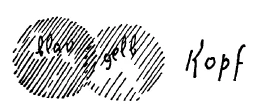
[ 17 ] Imagine the following—what I’m about to sketch is meant to be a diagram—imagine you have a form that is nothing but an image, a mere representation, which essentially has no meaning in and of itself; in other words, it is a representation. I’ll sketch this out as follows: I’ll simply draw a circle (see drawing on page 71, blue), a circular area. This is a form that is a representation of something else, but precisely because it is a representation, it has completely consumed the other thing it represents. It may sound strange when I say the following, but just imagine: In our dome—the small dome—four women are working; let’s assume that these four women, two on each side, were painting portraits of themselves, but this act of self-portraiture would have a particular consequence. So imagine this: these four women are painting self-portraits in the small dome, depicting themselves there, but this act of painting themselves would have a very specific consequence: namely, they would disappear as a result; they would merge into their own images; they would cease to exist. Once they are finished, they are no longer there. Because the images have come into being, they themselves are no longer there. — Imagine such a formation based on what I have sketched out here: a formation that came into being because it was created from something of which it is an image; but because the image exists, the other has been consumed.
[ 18 ] But this “consumed” state is not alone in the world. Just imagine, in fact, if the story weren’t over yet for these four ladies. Well, these four ladies would have vanished; they would have appeared in the paintings and then vanished; but the paintings remain. They are not alone in the universe; the universe, with all its forces, is still there as well. The ladies have vanished; they have, so to speak, been absorbed by the images; but because the images are there, something substantial coalesces once more from the cosmos and reforms the ladies—though now as children: they slowly emerge again, coming into being right there beside them. Thus, alongside this formation, its archetype emerges once more (see drawing, yellow). I should actually draw it a little way inside, but I’ll draw it here beside it instead: that is the archetype. That is the archetype, but there is a very loose connection between this image and the archetype—a very loose connection. The two have almost nothing to do with one another. This image is truly solidified and has almost nothing to do with its archetype.
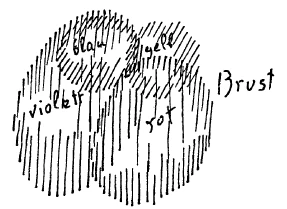
[ 19 ] Now imagine a second figure. I’ll sketch the second figure in such a way that I also make it a representation (see drawing on page 72, purple); only this time, the first one is inside the second. The first one exists on its own, but it is also inside the second. So I’ll boldly draw the second one over the first. This, in turn, is another such image, and again a similar image of yet another one, which I now want to draw on top of it (see drawing, red); but now I have to connect it more intimately with the first one. So the situation is this: I couldn’t use the comparison I chose earlier with the four ladies; rather, if I were to choose a comparison now with regard to this image and its reflection, I would have to say: So there are the four ladies; they are painting in the small dome, and while they paint, something of themselves is already being absorbed. But they are only half absorbed; in the end, they are such that—well, to avoid making an unaesthetic comparison: the left half of one’s body is absorbed, while the right half still protrudes from the picture; the right half of the other’s body is absorbed, while the left half still protrudes. So they are partially absorbed; partially, they still protrude. That is the second point.
[ 20 ] Then imagine a third one, which in turn encompasses both the first and the second (see diagram on page 73, green). But this is largely connected to its image; it is not yet separated from its image. So, if I wanted to capture the comparison, I would have to say: The ladies are painting, but they also remain as ladies, and the whole thing I have before me consists of the ladies and their images. That is present (see drawing, orange); for the most part, it is also present in the original image.
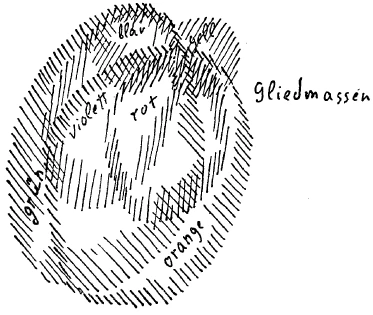
[ 21 ] So here (drawing on page 71) you have sketched something schematically: first, at the top, an image—hardened, crystallized—that has as little to do with its archetype as possible; the archetype is beside it, emerging anew. That, in fact, is your head; it is the most material, most hardened part of human nature. Its archetype has virtually nothing to do with it—it is emerging anew; and by the time you have reached the age of twenty-eight, your head is such that it no longer yields anything from within itself—it has fully matured. The greatest materialist in human nature is the head. A second formation consists of the chest, breathing, and everything associated with them. It is roughly such that I could use the second as a diagram (drawing on page 72). This is already more interconnected; spirit and matter are already more closely linked here; it is already more spiritualized. Everything pertaining to the lungs and the respiratory process is already more spiritualized for the Earth. And what remains—the limbs, and in connection with them, everything that encompasses sexuality—there the spiritual and the physical are one; there they are still united. This belongs to the third diagram (drawing above).
[ 22 ] This is the threefold human being. Today I was only able to sketch it out for you schematically on the blackboard. This mystery of the threefold human being—which is at once wondrous and fruitful, magnificent and profoundly penetrating—is in turn connected to the threefold mystery of the sun. And that, in turn, is connected to all the truths we need—like the bread of life—for everything that must take the place of what has descended into chaos, what has reached a dead end, and what has led to the current catastrophes facing humanity. We will speak further about this tomorrow.