

The Science of Human Development
GA 183
25 August 1918, Dornach
Translated by Steiner Online Library
Fifth Lecture
[ 1 ] Yesterday I briefly touched on the threefold nature of the human being. It is certainly true that our current spiritual life offers few insights into the nature of the human being as it must be understood from the perspective of spiritual science. Nevertheless, we must strive to approach this human being. The most important concepts—which we must also gain regarding the entirety of human life and the development of the human being between death and a new birth—can only be grasped if we proceed from an understanding that is rooted in this threefold human being. Let us now consider this threefold human being in detail.
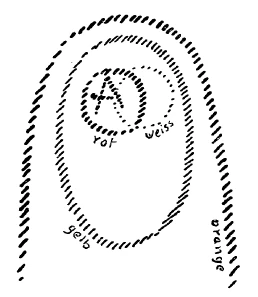
[ 2 ] As was already pointed out yesterday, we can begin by focusing on the human head. In a certain sense, this human head is truly a kind of independent, form-bearing entity. You can stand in front of a human skeleton yourself and easily detach the head. You can detach it just like a sphere. In reality, however, the separation between the three members of human nature is not so simple that one could say: “That which can be so easily detached from the rest of the skeleton like a sphere is the head.” — Things are not so strictly separated. But one must gradually work one’s way out of mere schematism—including that which nature itself suggests—toward a living perception. And as you saw yesterday, I did not simply have to draw three circles side by side, but rather one circle for the head, a second circle that encompassed this head, and a third circle that in turn encompassed both. So that if one were to draw the three-part human being schematically according to its physical nature, one would have to draw it in such a way that one says: the head section (see drawing, red circle A), the torso section (oval, yellow), and then the limb section (orange)—actually three spheres, even if these spheres must be elongated. The spiritual aspect—which, as you saw yesterday, is a young formation—is connected to the head region, that is, to what has been designated here as the red circle A (small, lightly hatched white circle). This spiritual aspect of the head is a young spiritual formation, whereas the head itself is an old physical formation, a physical form-being. Therefore, what is generally stated about human beings in general applies above all to the head—even though, when stated in such general terms, it is not entirely correct; for the head, however, it is correct. What I have described here as the white, spiritual aspect in relation to the head is, when you are asleep, outside the head. When you are awake, it is united with the head and is, for the most part, inside the physical head. It can therefore most easily separate itself from the physical head; it goes out and then returns, going back inside.
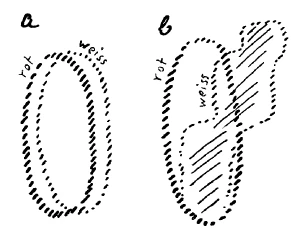
[ 3 ] This is certainly not the case for the middle human being—let’s call him, for my sake, the “chest human.” Everything enclosed by the thorax, the ribcage, the ribs, and the spine is connected to the spiritual, but the spiritual is not so pronounced on the outside when you sleep. Even during sleep, the spiritual remains strongly connected to the physical for this “chest human.” And for the third human—the “limb human,” which also includes the “sexual human”—there is in reality practically no separation between sleeping and waking. One cannot say that the spiritual-soul aspect truly separates during sleep; they remain more or less united even during sleep. So that, according to a different schema, one could well depict the waking human being in such a way that one would say: If this is the physical human being, awake (see drawing a, darkly hatched, red), then this would be the spiritual human being (lightly hatched, white). That would be the sleeping human being (see drawing b, red and white); this aspect would thus remain more or less united with the physical body, and only that actually withdraws (see drawing b). From a certain point of view, that would be the actual illustration of the contrast between the waking and sleeping human beings.
[ 4 ] You will only understand the important points we need to discuss if you cross-reference this threefold division of the human being—which we have just discussed—with another division of the human being that builds on what I explained here last week.
[ 5 ] If we go through the head, the torso-human, and the limb-human once more in this way, we can indeed say: In the truest sense, only the torso-human is truly human. He is therefore also the one into whom the Elohim have breathed the living breath. He is the breathing human. Here, the division is not quite as straightforward as with the skeleton; the process of breathing through the nose and mouth already belongs to the torso-human. So, isn’t it true that, in reality, the division cannot be made as schematically convenient as one might like to depict it, but these are, of course, the difficulties of understanding such a matter.
[ 6 ] So the actual human being, the earthly human being, is the torso-human. And the head-human, as a physical form, is not really something thoroughly human. One cannot say that the human head is something thoroughly human. The human head contains a great deal of Ahrimanic elements. It is essentially structured the way it is because certain formative principles within it—namely those that have been left over from the ancient Sun, that is, from this second stage of Earth’s evolution—Saturn, Sun—are at work. Our head, with its entire complex structure, would not be as it is if it had not received its initial formation during those ancient times of the old Sun. And so it is actually ancient, very ancient formative principles that extend into the Earth sphere today, and which we must therefore describe as Ahrimanic. We must always regard residual principles as Luciferic or Ahrimanic, depending on the perspective. That which constitutes the human being as an earthly human, where the principles of becoming earthly play the principal role, is the chest-human, the torso-human.
[ 7 ] The human being of the limbs is not purely human either, but has a great deal of Luciferic within him, and his formative principles are not yet fully developed; rather, they are principles that will only reach their full development once the Earth has entered the Venus stage—that is, once the Jupiter stage has preceded it and is in transition to the Venus stage. Then the formative principles—which today, I might say, still form only a shadow of a being, namely the human being of the limbs, this third human being—will work in their full intensity and in their true form: when the Venus era arrives. Thus, human beings anticipate what will only be present in the Venus era and form it today in an imperfect, embryonic state, not allowing it to develop beyond the embryonic stage.
[ 8 ] This is how things appear from a cosmic perspective. From a cosmic perspective, then, we are constituted in such a way that, in our heads, we repeat—in a sense, according to our capacities—the ancient solar era, and in our chests we carry the process of becoming Earth; and because we are beings of the extremities, we carry within us the seeds of becoming Venus. This is the cosmic perspective.
[ 9 ] From a humanistic perspective, it is something else. Here we must look at human individuality and how this human individuality progresses from incarnation to incarnation. We must say: What we carry within us today as the head in this incarnation has proven to be related to our previous incarnation; what we now carry within us as the chest is actually purely related to our present incarnation; and what we carry within us as the limbs will, after all, become the head in the next incarnation—it is already related to the next incarnation. I told you last week: The head has something treacherous about it, especially in its negative aspect. If you were to take a negative impression of the head’s physiognomy and look at it, you would recognize in this negative physiognomy of your head much of what you did in a previous incarnation.
[ 10 ] The situation is different with the “limb-oriented person.” In that case, you can’t take a cast; instead, you have to proceed differently. Imagine removing the head and the torso from the human being, but imagine everything that your hands and legs do—form a picture in your mind of what your hands and legs do. You have to create a kind of map for yourself. After all, every time you do this or that with your hands, it happens in a different place. Besides, you walk around; you interact with other beings. If you were to draw everything your hands and legs do, and create a picture over the course of your life—it would be a very dynamic picture—of what your hands and feet, arms and legs do, then you would see in this drawing a complex map; from it, you would learn much about what is karmically reserved for you in your next incarnation. In it, you would be able to discern much about the karma of your next incarnation. It is quite significant: Just as the negative imprint of one’s physiognomy, in its stillness and in its firm, contoured lines, reveals what has already happened in the previous incarnation, so too would what one could discern from the way the arms, hands, legs, and feet behave be extraordinarily instructive regarding what a person will do in the next incarnation. In particular, it is also instructive regarding what a person will do in their next incarnation—where they will go, where their legs will carry them. If you were to trace all the places—if you were simply to follow the path where your legs carry you—it would form a map. You would end up with curious patterns. People’s inclinations are not without influence on these patterns. These patterns reveal a great deal about a person’s secret inclinations. These traces that remain are very revealing of what the next incarnation will bring to the person. So that would be from a humanistic perspective. The other was from a cosmic perspective.
[ 11 ] This structure of the human being, which, I would say, is directed toward the present, nevertheless implies a connection to the mysteries of antiquity, in which people understood the matter in a more atavistic way, yet were already familiar with such mysteries as those just mentioned. There is a beautiful legend, connected to King Solomon, about the certainty with which a person sets foot where he is to meet his death. The meaning of this legend, so to speak, is that there is a specific place on Earth where a person is destined to die—you will find a related lecture in which I spoke specifically about this legend of Solomon—and that is where the person then sets their feet. This is connected to the ancient mystery knowledge of these matters.
[ 12 ] Well, when a person lives in the ordinary sense, he actually has only his ordinary consciousness; but, as you can see, a human being is a rather complex creature. When they are awake, when their youngest mental limb—the head—is inside their physical head, they know nothing of their head. You will rightly say: Thank God we know nothing of the head; for if we knew of the head, it would only be a headache. — There is no other way for a human being to become aware of his head than when he gets a headache; then he knows that he has a head. Otherwise, it remains unconscious—unconscious in the most profound sense, far more unconscious than any other part of the human physical body. A human being can count himself quite fortunate if, in his normal state of consciousness, he knows nothing of his head. But beneath this consciousness of the head—which usually takes note only of the external world, which is directed solely toward knowing what is in the surroundings—beneath this knowledge lies another, a kind of dream consciousness, a dream-knowledge. Your head is constantly dreaming. And while you are aware of the outside world in the way that is familiar to you, you are actually dreaming continuously beneath the threshold of consciousness, in the subconscious. And what you dream there—this dreaming within your mind—if you could fully grasp it, if you could bring it entirely into consciousness, it would give you a picture, a true, comprehensive picture of your previous incarnation. For you are subconsciously dreaming of your previous incarnation within your mind. That is indeed the case. There is always a faint awareness present, one that is merely drowned out by the brighter light of ordinary consciousness—a dreaming awareness of your previous incarnation.
[ 13 ] By the year 747 before the Mystery of Golgotha, outer consciousness had become so strong that, little by little, this subconsciousness of the previous incarnation had been completely erased. But before that year 747, people knew a great deal about this dream-consciousness of the head. That is why you will find repeated earthly lives cited as a fact throughout the foundations of ancient cultures. This simply stems from the fact that, at that time, this subconsciousness of the head had not yet receded so completely into the background as it has now, as has occurred during the fourth and, in particular, the fifth post-Atlantean epoch.
[ 14 ] Even in ordinary consciousness, you know very little about what is psychically and spiritually connected to the human chest and torso. That in itself is something dreamlike. Only occasionally—and then in a very chaotic, irregular way—does this awareness of the torso and chest surface into a person’s consciousness in a “dream.” When a person can breathe regularly, when their heartbeat is regular—that is, when all the functions of their chest and torso are regular—then the consciousness of the torso is not as vivid as the consciousness of the head, but rather remains dreamlike even in ordinary life. One dreams, in a sense—as I explained here last year—of this middle human being. But this which lies within the feelings—which a person experiences only in their feelings—when it is brought to the surface by a consciousness that is becoming increasingly clairvoyant; in other words, when a person learns to survey what is taking place in their chest just as consciously as they otherwise survey, in the waking state, only what is in their head consciousness—indeed, then this torso and chest consciousness clearly divides into two parts. One part dreams back over the entire period between the previous death and the present birth or conception. So while you have, in a dreamlike state—in very deep dreams—the events of your previous incarnation subconsciously present in your head consciousness, you experience in the dreams of the chest what has elapsed in the interim from the previous incarnation up to your present birth. And in the dreams located more toward the lower parts of the chest, you have a strong awareness of what lies between your coming death and your next earthly life. So the consciousness that is concentrated in the chest—but which remains more or less subconscious to the present-day human being—is actually a dreamlike consciousness, both for the time before this birth and for the time after this death. What lies between our last earthly death and our next earthly conception—with the exception of, or even including, what we now experience between birth and death—unfolds before this subconsciousness of the average human being.
[ 15 ] And in that which remains largely subconscious throughout one’s entire life—which can only be brought to the surface if a person is able to do so through constant engagement with spiritual scientific studies and exercises— so that certain moments of the sleep life—which otherwise simply pass by in a sleeping, unconscious state—are brought to the surface, and the person becomes conscious in the midst of sleep—it is there that the tableau of the next earthly incarnation of this third human being can unfold from the subconscious of the “human being of the extremities.” What a person experiences as their ordinary, waking consciousness today is actually a kind of secondary impulse; it radiates into the head from the outside. But behind this consciousness lies another consciousness that extends across the previous incarnation, across the life from the previous incarnation to this one, across the life from this incarnation to the next, and then again across the next incarnation. It is only that the human being sleeps through this consciousness.
[ 16 ] It is primarily the consciousness of the previous incarnation. In all the organs that primarily serve exhalation, a strong consciousness of the life between the previous incarnation and this one is at work. In all the functions that primarily serve inhalation, a consciousness is at work from the present incarnation to the next earthly incarnation. And in the human being as a physical entity—in all the mysterious processes of the human being as a physical entity—a consciousness of the next human incarnation remains very, very subconscious.
[ 17 ] These states of consciousness have been more or less obscured since the beginning of the fourth post-Atlantean epoch, since 747 before the Mystery of Golgotha. And the task of our time is, once again, to extract from the general chaotic human consciousness the specific awareness of these concrete processes of cosmic and human evolution.
[ 18 ] Everything I have just elaborated upon must, I would say, intersect with a different understanding of human existence. Yes, it is indeed necessary that we engage in such difficult discussions; otherwise, we will not arrive at a more precise understanding. I would so much like it if these difficult discussions were not merely marked by a certain resignation, but if—precisely for these difficult matters, because this is so necessary for present-day humanity—we could muster a little enthusiasm, a little spirited engagement, which is, of course, so infinitely difficult in a society of our time.
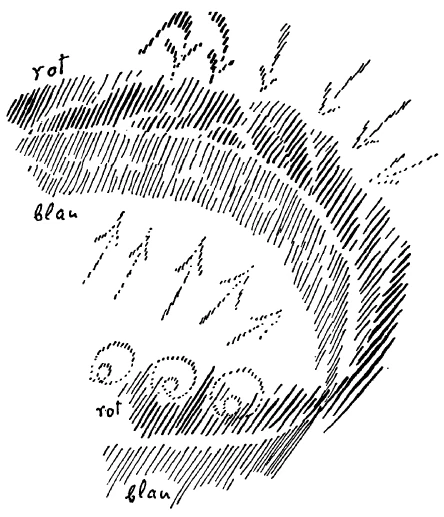
[ 19 ] You see, you direct your senses outward. Through your senses, you find the external world spread out before you as something perceptible. I’ll sketch a diagram of what lies around us, spread out outward as something perceptible. Please, let this (see drawing, blue) represent what lies out there around us. When you direct your eyes, your ears, your sense of smell—whatever you choose—toward the external world, what turns toward you, so to speak, what turns toward these senses, is the inner side of this external world—that is, the inner side of this external world (left). Suppose you turn your senses toward what I have drawn there (see drawing, arrows); then these senses are directed toward this external world, and you see what leans inward here. Now comes the difficult concept, but I must address it. Everything you are looking at there reveals itself to you from within. Imagine that this must also have an outer side. Well, I want to bring this to your mind schematically by saying: When you look out like this, you see the firmament as the boundary of your vision—this here is almost the same, except that I’ve drawn it small. But now imagine that you could fly out there in an instant, pass right through it, and look from the other side—viewing your sensory impressions from the other side. So you could look like this (see drawing, arrows at the top). Of course, you cannot actually see this; but if you could look that way, that would be the other aspect. You would have to step outside yourself and view your entire sensory world from the other side. So you would view what presents itself to you as color from the back, what presents itself to you as sound from the back, and so on; what presents itself to you as smell, you would view from the back—you would take in the smell through your nose from the back. So imagine viewing the world from the other side: the sensory objects spread out like a carpet, and now you’re looking at the carpet from the other side. You see only a small piece—a very, very small piece—of this reverse side. I can illustrate this very small piece here only by doing the following: Now imagine that I’m drawing what you would see from the other side in red; so that I can say, schematically, this is how the sensory world appears: As one usually sees it, it looks blue; if one sees it from the other side, it looks red—but of course, one doesn’t actually see that. Within this part—which you would see as red—is contained, first of all, everything that can be experienced between death and a new birth; and second, everything described in *An Outline of Esoteric Science* as the Saturn, Sun, Moon, and Earth stages of development, and so on. What is hidden from sensory perception is stored there. That is on the other side of the sphere. But you can see a small part of it; I can only draw it by saying: Take this small part of the red—it would go over there (see drawing, below) and intersect with the blue, so that the blue, instead of being in front, is now behind. I would actually have to draw this in four dimensions if I were to draw it realistically; therefore, I can only draw it very schematically. So here (on the left), the senses are now directed toward the blue; there, they are not directed toward the blue, but toward the red, which you otherwise cannot see. But behind the red, what is otherwise seen has now crossed over, and that is now underneath. And this small section that intersects with the other—you see it constantly in ordinary consciousness. For these are, in fact, your stored memories. Everything that arises as a memory does not arise according to the laws of this outer world of perception, but rather according to the laws that correspond to this inner world over there. This inner world that you experience as your memories truly corresponds to what is on the other side (to the right). By looking within yourself, into all that constitutes your memories, you actually see a fragment of the world from the other side; there, the other side protrudes a little, and there you see the world from the other side. And if you could now slip through your memories as they are written down—I spoke of this eight days ago—if you could go down there, look beneath your memories, and view them from the other side, from over there (see drawing, left), you would see the memories as your aura. There you would see the human being as a spiritual-soul-auric being, just as you otherwise see the outer world sensually in your perceptions. Only it would be just as unpleasant—as I described here eight days ago—because the human being is not yet beautiful from this other side.
[ 20 ] So this is the interesting point—what one must combine with the other understanding of the threefold human being. This combination here is found in the middle human being, the breast-human. You may recall the drawing I made eight days ago, where I depicted the lemniscates coiled inward with their loops turned backward: I would have to draw that here. Here I would have to draw this breast-human with the lemniscates turned backward (see drawing on page 85, bottom left): that would correspond to the sphere of memory. So that this threefold human being has, here in its middle part, this reversal, where the inner becomes outer and the outer becomes inner, where you now see as your own small microcosmic memory what you would otherwise regard as the world tableau, as the great world memory. In your ordinary consciousness, you see what has taken place from your third year until now: this is an inner record, a small fragment corresponding to what is otherwise the record of the entire evolution of the world, which lies on the other side.
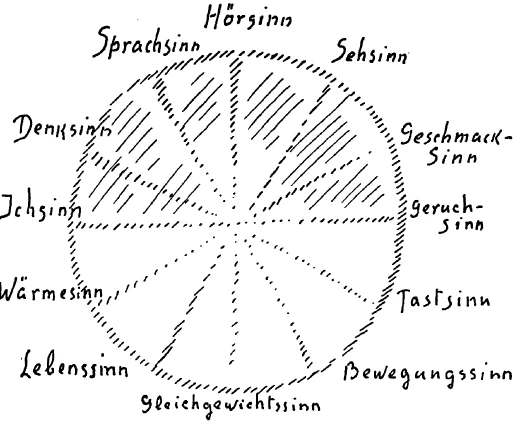
[ 21 ] It was not without reason that I spoke of this at the time—as most of you are probably aware—and I elaborated on it again in the note at the end of my latest book, *On the Riddles of the Soul*—it was not without reason that I spoke of the fact that human beings actually have twelve senses. We must conceive of these senses in such a way that some of these twelve senses are directed toward the sensory world, while others are directed inward. They are also directed down there (see illustration on page 85) toward what has already been turned toward us. Specifically, the following are directed toward the external sensory realm: the sense of “I,” the sense of thought, the sense of speech, the sense of hearing, the sense of sight, the sense of taste, and the sense of smell. These senses are directed toward the sensory realm. The other senses, in fact, do not come to a person’s consciousness precisely because they are directed first toward their own inner being and then toward the inverted world. These are primarily: the sense of warmth, the sense of life, the sense of balance, the sense of movement, and the sense of touch. Thus we can say: For ordinary consciousness, seven senses lie in the light (above) and five senses lie in the darkness (below). And these five senses, which lie in the darkness, are turned toward the other side of the world, and in the human being, toward the other side as well (see drawing on page 85).
[ 22 ] You can therefore have a complete parallelism between the senses and between something else, which we will discuss shortly (see diagram, circle). So let’s assume we have the following senses: the sense of hearing, the sense of language, the sense of thought, the sense of the self, the sense of warmth, the sense of life, the sense of balance, the sense of movement, the sense of touch, the sense of smell, the sense of taste, and the sense of sight. Essentially, you have everything from the sense of the self down to the sense of smell, lying in the light, in that which is accessible to ordinary consciousness (see diagram, hatched area). And everything that is turned away from ordinary consciousness, just as night is turned away from day, belongs to the other senses.
[ 23 ] Of course, this distinction is, again, only a simplification; the categories overlap somewhat; reality is not so straightforward. But this division of the human being according to the senses is such that, even in the schematic, you need only substitute the zodiac signs for the senses, and you have: Aries, Taurus, Gemini, Cancer, Leo, Virgo, Libra—seven zodiac signs for the light side; five for the dark side: Scorpio, Sagittarius, Capricorn, Aquarius, Pisces: day, night; night, day. And you have a complete parallelism between the microcosmic human being—that which is turned toward the senses, and that which is turned away, yet is actually turned toward the lower senses—and between that which in the outer cosmos signifies the alternation of day and night. In a sense, the same process takes place within the human being as occurs in the structure of the world. In the structure of the world, day and night alternate; in the human being, day and night also alternate—namely, waking and sleeping—even though both have become emancipated from one another in the current cycle of human consciousness. During the day, the human being is attuned to the daytime senses; we might just as well say: Aries, Taurus, Gemini, Cancer, Leo, Virgo, Libra, as we might say: the sense of “I,” the sense of thought, the sense of speech, and so on. You can perceive every other person’s “I”; you can understand another person’s thoughts; you can hear, see, taste, and smell: these are the daytime senses. At night, human beings are, just as the Earth is otherwise turned toward the other side, turned toward the other senses—only these are not yet fully developed. Only after the Venusian era will they be fully developed enough to perceive what lies on the other side. They are not yet fully developed enough to perceive what lies on the other side. They are shrouded in night, just as the Earth is at night when passing through the other regions of the heavens, through the other signs of the zodiac. The human being’s journey through his senses can be likened entirely to the orbit—whether you speak of the Sun orbiting the Earth or the Earth orbiting the Sun, it is ultimately irrelevant for this purpose; but these things are interconnected. And the sages of the ancient mysteries knew these connections very well.
[ 24 ] This gradually faded from consciousness during the fourth post-Atlantean epoch, but it must be brought back—and must be brought back once again for the sake of human culture, even in the face of the resistance that arises against it. For it is in the concepts one acquires there that lies what enables one to understand what is now taking place in social and historical life. As long as you separate natural life and spiritual life in the way that modern humanity prefers today, you will not arrive at concepts that could play a role in historical development; instead, you will be overwhelmed by the concepts that play a role in historical life. You will be overwhelmed. There are, after all, many examples of this.
[ 25 ] Isn’t it true that, for, say, two hundred years, people have, as they believe, thought an awful lot? One can compile what people have thought over the past two hundred years, what ideals they have developed, and what they have spoken of—and continue to speak of—as the great ideals: from the ideal of the Enlightenment up to the present day, to the ideal of the great Caesar substitute, Woodrow Wilson. Everything that has been said about these various ideals—that is what people have been thinking about over the centuries, over the course of two centuries; that shaped people’s thoughts. But world history has been scarcely moved by these thoughts. World history has been driven by something entirely different: by those thoughts that have worked and woven their way into things. And never, in fact, have the thoughts swarming in people’s minds been further removed from the great cosmic thoughts that live in things than in our time. What has, one might say, driven people for the past one hundred and fifty years to bring about a certain shaping of the world are not the ideas of liberty, equality, fraternity, justice, and so on, but rather the ideas that were interwoven, for example, with the advent of the mechanical loom. The fact that the mechanical loom entered modern development in the second half of the 18th century, that this significant invention—the mechanical loom—took the place of traditional hand weaving in human development, and that the entire machine culture of modern times has sprung from this mechanical loom—in all of this are woven the objective ideas, the real ideas that have given the world the form it has to this day, and from which the current catastrophic chaos has arisen. If one wishes to write a history of the present catastrophic chaos, one need not turn to the thoughts that have swirled in human consciousness, but rather to these objective ideas—from the inception and invention of the mechanical loom to the rise of large-scale industry and its shadow, socialism. For even if large-scale industry and socialism are apparent opposites, they are polar opposites that belong together; they cannot be separated from one another. It is these objective ideas that one must examine and consider in the context of historical development.
[ 26 ] There one finds that people have succumbed to many illusions during the 18th century, throughout the 19th century, and especially in the part of the 20th century in which we now live. They have succumbed to many illusions in their thinking; but they have been overwhelmed by objective, historical-cosmic ideas. These are woven into the fabric of things. And an interest in these objectively woven ideas—albeit a terribly one-sided interest—has in fact been gradually developed only by those people who have formed socialism as a worldview. And that is something tremendously characteristic. If you trace the 19th century: the bourgeoisie is losing more and more interest in major worldview questions. Major worldview questions even become highly unpleasant for the bourgeoisie; they are possibly relegated to the realm of aesthetics. Whether spiritual beings exist or not—if you are a typical average bourgeois, you may hear all sorts of things about this from the stage, where you don’t need to believe in them, where it doesn’t matter whether these things are true or not: there, you let Björnson and people like him lead you to believe all manner of things. Thus, into the realm of aesthetics, into the play with all manner of so-called “artistic” things—that is where matters of worldview have been relegated for the bourgeoisie in recent times. To truly bash each other’s heads in over questions of worldview—by which I do not mean to regard this as an ideal in the physical sense, but in the spiritual sense it is, in a certain sense, an ideal: You know, I have pointed out with great aplomb that I would like to have some temperament even when defending anthroposophical truths—and in recent decades, people have been butting heads in the socialist sphere. And that is why the others did not concern themselves with it. They have, I would say, left alone those people who actually viewed the world from a very narrow perspective—who saw the world only from the perspective of the factory, from within the factory, from within the printing workshop, and so on. And it is, of course, extremely interesting what kind of so-called worldview has emerged from the perspective of the factory: for that is socialism! It stems from the perspective of the interior of the factory; it stems from the perspective of people who know nothing else but the interior of the factory. And as for what was developing down there—the bourgeoisie, which is preoccupied with all sorts of abstract ideas, but also with aestheticizing in the abstract, so that one didn’t really have to rack one’s brains—the bourgeoisie actually took little interest in what was developing down there. And so, curiously enough, the bourgeoisie has found itself in the middle between the dying—the completely dying—old worldview, which has lost all that is spiritual and seeks to push all the great questions into aestheticism, and what is emerging anew—socialism, which has no concepts at all yet, which is still merely devising all sorts of systems with words, because it cannot yet see the world at all, but can only see the factory, can only see the most extreme mechanical aspects. Just imagine what it actually means when a person knows nothing inwardly about the mineral, plant, and animal kingdoms, but knows only the way in which, mechanically, this or that pin moves up and down in a machine, this or that is filed or planed, and the like! Socialism is a worldview based on the conception of a world that is purely mechanical. For the socialist, the part of the world that is mechanical has been carved out; he forms his concepts accordingly.
[ 27 ] This was allowed to develop because the guiding principle was to concern oneself with things solely from an aesthetic standpoint. When the Theosophical Society was first founded, its main principle was, after all, seen as love among all people. How much has been declaimed about this! Well, I have already expressed myself sufficiently on this point. It is as convenient as it is fruitless. But it also stems from a desire to push whatever has truly concrete content as far as possible into the realm of the meaningless. And so it was impossible to take a genuine interest in the actual course of events. Some individuals noticed the peculiar nature of conventional—let’s say—historical analysis. Let’s take one example.
[ 28 ] Take a popular account of the Roman Imperial period; try to learn about it from school textbooks or from books written by the great, authoritative historians. I believe you will learn remarkably little from these accounts about a certain figure who already played a significant political role under Nero—his political aspirations were already evident under Nero—and who then caused quite a stir and gained significant influence over Roman politics under Vespasian and Titus, so that one can say this figure was the soul of the government of Vespasian and Titus. Then, under the reign of Domitian, whom he regarded as a scourge of Roman civilization, this figure turned to the other side. He turned to the other side. He was put on trial—a highly sensational trial in Rome that unfolded in a very interesting manner, during which Domitian underwent a complete reversal, transforming from a tyrant into someone who was at a loss as to how to handle this trial and was therefore unable to convict the man. Then again, when Nerva succeeded Domitian, we see this figure once more energetically aligned with the emperor, Caesar. There, however, we see this figure engaging in high politics based on the entire worldview of that time, and at the same time we see this figure attempting—for the last time during the Roman Empire—to instill truly far-reaching concepts drawn from the cosmos into political events. And curiously enough, you won’t find an accurate description of this figure in any standard history book—not even in SzeZon or Tacitus—but only in Philostratus. And Philostratus describes him in such a way that one cannot tell whether he is recounting a novel or reality. He describes the life of Apollonius of Tyana. For Apollonius of Tyana is the one I told you about—the man who exerted such a great influence on politics from the time of Nero through Nerva, and especially under Vespasian and Titus—and whom Philostratus described. And the Tübingen theologian Baur—the historian Baur—was utterly astonished that one could find absolutely nothing about a figure like Apollonius, who ought to have played a leading role in historical accounts. Of course, Baur failed to see what really matters. What matters is that Apollonius represents a historical figure who not only exerted this great influence but also derived his principles from the transcendent cosmic order. This was utterly disastrous for Christianity as it was becoming integrated into Roman culture. And now I ask you to bear in mind that everything that exists historically is there by the grace of the Church. After all, there is nothing else there but what the Church has graciously left to humanity. It was not without reason that an old man—by no means a foolish one—claimed that there had never actually been a Plato or a Sophocles at all, but that monks of the 14th and 15th centuries had written Sophocles’ plays; for there is no conclusive proof that Sophocles ever lived. Even if this claim is untenable—and is, of course, nonsense—we have often emphasized just how uncertain everything is that is considered established historical fact. And we must be clear about this. We must, after all, connect the present with the past, for we are now approaching a great and significant question.
[ 29 ] We have once again—from a modern perspective—pointed out the threefold nature of the human being, this connection to cosmic truths, and the necessity of revealing this once more. Indeed, what exactly was the main activity of the Church, particularly since the Eighth Ecumenical Council in Constantinople, which took place in 869? It consisted in erasing, in wiping out of human consciousness that which, in those ancient times, Christianity itself had understood regarding the connection between the human being and the cosmos, and with the great spiritual world. With genuine anxiety, everything that revealed this connection was eliminated. And only because not everything can be eliminated—because karma already counteracts this—have works such as that of Philostratus survived. And so, if you now bring the past into relation with the present, you can understand why certain people on the side of the Church are seized by a desperate fear whenever, in the present, an attempt is made to reestablish the connection between what makes a human being a part of the cosmos, and that human being himself and his mission.
[ 30 ] It is simply not acceptable to pursue what the anthroposophical movement intends to achieve in a half-asleep manner. One must pursue it with a lively, vigorous awareness. That is absolutely necessary. With this, I have pointed out what we now wish to elaborate on further. Tomorrow I will give a lecture here in which I will continue these reflections.