

The Science of Human Development
GA 183
26 August 1918, Dornach
Translated by Steiner Online Library
Sixth Lecture
[ 1 ] Certain questions will inevitably arise again and again for the thinking person, even in times when materialistic culture predominates and one might wish to avoid these questions to a greater or lesser extent. There are many such questions. Today I would like to highlight a few from the vast array of questions that arise from the fact that human beings—even when they are reluctant to acknowledge a spiritual world—still sense the presence of that spiritual world. Among such questions is, for example, one that—one might say—arises in everyday life: Some people die young, others die very old, and still others die somewhere in between. Faced with this fact—that on the one hand very young children die, while on the other hand people live to a very old age and then die—questions arise for human beings that can never be answered by the means we today call scientific—and anyone, upon clear reflection, will have to admit this. And yet these are burning questions for human life, and everyone can actually sense that an infinite amount about life would be clarified if we could come closer to answering these questions: Why do some people die early—in childhood, in youth, or in the middle of their normal lifespan? Why do others die of old age? What significance does this have in the entire universe?
[ 2 ] Up until the point in time I have already indicated to you in these reflections—that is, up until the beginning of the fourth post-Atlantean epoch, roughly around the middle of the 8th century B.C.—people still had ideas and concepts that enabled them to answer such questions. They had inherited these concepts from ancient wisdom. Even in those ancient times preceding the 8th century B.C., there were widespread ideas about the Earth’s culture of that era, which, in the spirit of the time, provided people with insights into questions such as those just mentioned. What we call science today cannot even attach any real meaning to such questions; it does not even occur to it that there is anything inherent in these questions for which one should seek an answer. All of this stems from the fact that, in the time that has elapsed since the period just mentioned, virtually all ideas relating to the spiritual—and thus to the eternal—human being have been lost. Only those concepts have remained that relate to the transitory human being and the human being confined between birth and death.
[ 3 ] I have pointed out that all ancient worldviews spoke of a threefold sun—the sun that is perceived by the physical senses as a luminous sphere in outer space. Behind this sun, however, the ancient sages saw the soul sun—in the Greek sense, Helios—and only behind this soul sun did they see the spiritual sun, which Plato, for example, identified with the Good. For people today, it actually makes little sense to speak of Helios, the soul sun, or even of the spiritual sun, the Good. But just as the physical sun shines upon us here between birth and death, so too, if I may say so, the spiritual sun—which Plato identified with the Good—shines into our “I” during the time we spend between death and a new birth. To speak of this luminous sphere—as our modern materialistic worldview does—in reference to the time between death and a new birth makes no sense; between death and a new birth, it only makes sense to speak of the spiritual sun, of what Plato still refers to as the Good. But precisely such a concept should point us toward something. It should prompt us to reflect on what the actual nature is of the physical image of the world that we form in our minds. The fact that what we form as physical conceptions of the world—what is spread out before us in a way perceptible to the senses—is a kind of illusion, a kind of Maya, is not taken seriously in the full sense of the word, at least not seriously enough for our view of life to be truly permeated by these things.
[ 4 ] This is essentially the kind of idea of the Sun held by anyone who takes modern physics—or astrophysics, for that matter—as authoritative: If he could travel up to where physicists place the Sun, then as he approached it—well, let’s set aside human living conditions for now and assume that living conditions could be absolute—he would feel immense heat, or so he imagines, and upon entering the space that physicists conceive of as being filled by the Sun, he would find incandescent gas or something similar within that space. That is, in fact, how the physicist actually imagines it: a ball of incandescent gas or something of the sort. But that is not the case; it is a true maya, a true illusion. And this conception does not hold up against the true physical insights that can be gained, let alone against true supersensible perception. For if one could truly approach the Sun and reach the place where the Sun is—indeed, as one approaches, one already encounters something akin to passing through flooding light (it is depicted as a yellow circle with a blue core inside); but when one enters the place where physicists suppose the physical sun to be, one first finds what one might describe as empty space. There is absolutely nothing there; there is nothing at all where one supposes the physical sun to be. I’ll sketch it schematically (in blue), because there is actually nothing there. There is nothing there; there is empty space. But what a strange kind of empty space it is! When I say, “There is nothing there”—I am not actually speaking quite correctly; there is less than nothing there. It is not merely empty space that is there, but there is less than nothing there. And that is what is extraordinarily difficult for Westerners today to conceive of. People from the East still grasp this concept easily even today; for them, it is nothing at all strange or difficult to understand when one tells them that there is less than nothing there. People from the West imagine—and they imagine this especially if they are true Kantians, for far more people than one thinks today are Kantians, are unconscious Kantians—that if there is nothing in space, then it is simply empty space! — But that is not the case; it can also be filled space. For if you were to look through this solar corona, you would find this empty space you were entering to be extremely uncomfortable: it would tear you apart. And in this it reveals its essence, that it is more—or less, as I might better put it—than empty space. You need only draw on the simplest mathematical concepts, and it will not remain entirely unclear to you what I mean here: empty space is even less than merely empty. Let’s assume you possess some wealth. But it can also happen that you have spent everything you own, that you have nothing. Yet one can have less than nothing: one can be in debt, and then one truly has less than nothing. If one moves from a space filled with matter to an ever-thinner and thinner filling of space, one can arrive at empty space; but one can then go even beyond mere emptiness, just as one can go from nothing to debt.
[ 5 ] This is the greatest flaw in today’s worldview: that it is unaware of this peculiar kind of negative materiality—if I may put it that way—that it knows only emptiness and fulfillment, and not that which is less than emptiness. For because today’s knowledge, today’s worldview, does not recognize that which is less than emptiness, this worldview is more or less held captive by materialism—indeed, held captive by materialism; I would say: bound to materialism. For there is also within the human being—if I may put it that way—a place that is emptier than empty; not in its entirety, but one that contains parts that are emptier than empty. On the whole, the human being—I mean the physical human being—is a being that materially fills a space; but a certain aspect of human nature, of the three I have mentioned, actually has something within it that is sun-like, emptier than empty. That is—yes, you’ll just have to accept it—the head. And precisely because human beings are organized in such a way that their head can always empty itself and, in certain aspects, be emptier than empty, this head has the capacity to contain the spiritual. Just imagine the matter as it actually is. Of course, one must visualize things schematically; but imagine that everything that physically fills your head, I would schematically depict as follows. That would be your head schematically (see drawing, red). But now, if I want to draw it completely, I must leave empty spaces within this head. Of course, it isn’t that large now, but there are empty spaces inside. Into these empty spaces can enter what I have called the “young spirit” in recent days. The young spirit must be drawn into these empty spaces, so to speak, in its rays (yellow).
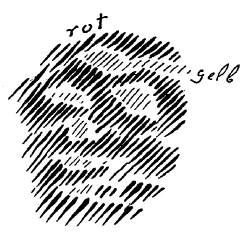
[ 6 ] Yes, the materialists say: The brain is the instrument of spiritual life, of thought. — The opposite is true: The holes in the brain—indeed, even that which is more than holes, or I might also say, less than holes, that which is emptier than empty—that is the instrument of spiritual life. And where there is no spiritual life, where spiritual life is constantly blocked, where the space of our skull is filled with brain matter—there, nothing is thought; there, nothing is experienced spiritually. We do not need our physical brain for the life of the soul; rather, we need it only so that we can capture the life of the soul—capture it physically. If the life of the soul—which actually lives in the holes of the brain—were not constantly breaking through everywhere, then
[ 7 ] It would simply vanish; we wouldn't even be aware of it. But it lives in the holes of the brain, which are emptier than empty.
[ 8 ] So we must gradually correct our concepts. When we stand in front of a mirror, we do not perceive ourselves, but rather our reflection. We can forget about ourselves. We see ourselves inside the mirror. Similarly, a person does not experience themselves by using their brain to hold together what lies within the brain’s cavities; rather, they experience how their inner life is reflected everywhere as it comes into contact with the brain matter. It is reflected everywhere; that is what a person experiences. In fact, they experience their own reflection. But what has slipped into those cavities is what, when a person passes through the gate of death, becomes conscious of itself without the brain’s counterforce, because it is then permeated by consciousness in the opposite way.
[ 9 ] Now I want to draw another diagram. Take a look at the following. Please, I want to draw the brain quite dramatically here, showing the holes (blue). There is the brain matter; it leaves these holes, and into these holes flows the life of the soul (yellow). This life of the soul, however, continues beyond the holes. There we enter the human aura—which, of course, is visible only in the vicinity of a human being but extends into the indefinite.
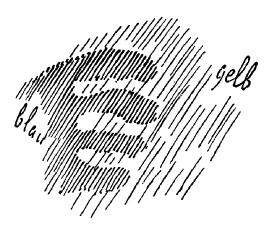
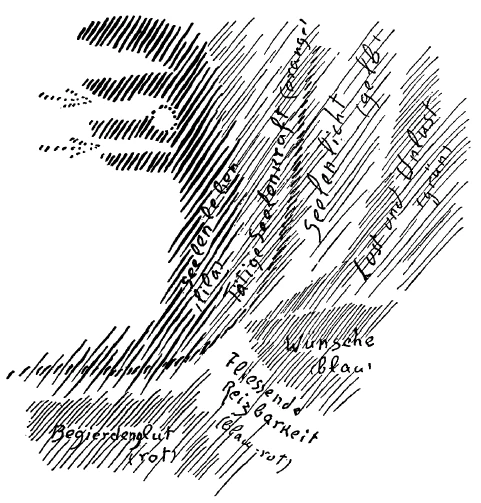
[ 10 ] If we now set aside the brain and imagine that we are observing the inner life of the ordinary human being between birth and death, then we would have to say: The true human being, viewed in this way, is in such a state between birth and death that—though I must now sketch this schematically in a different way—he actually turns his face toward his body (see drawing on page 105, purple); he turns his inner life toward the physical. And when we look at the brain, this soul life extends sensory antennae here that enter the cavities of the brain. What I have drawn there (see drawing on page 102) in yellow, I draw here in purple, because that better corresponds to what is seen in a living human being. That would be what extends into the brain in a living human being.
[ 11 ] If I were to draw the physical human being based on that, the best way I could indicate it would be by drawing in the boundary here—the boundary set by the capacity for memory. It would extend outward from there, and that would be the outer boundary—the boundary of cognition—which I have already spoken to you about. You need only recall the drawing I made recently and yesterday.
[ 12 ] But the fact is that when one looks at a person spiritually from the outside, the life of the soul extends into the person in this way. So I want to sketch this individual extension only in relation to the brain. But this soul life is also differentiated in itself: if I were to trace this soul life further, I would have to draw another region here (red beneath the purple), another region here (blue); all of this would thus belong to the aura that constitutes the human being. Then another region (green): As you can see, this part, which I am now sketching schematically, lies beyond the limits of human cognition. Then this region (yellow)—essentially, all of this belongs to the human being—and this region (orange).
[ 13 ] When a person falls asleep, it moves more or less out of the body, as was illustrated yesterday (drawing on page 77); when a person is awake, it moves more or less into the body, so that the aura can actually only be perceived spiritually in the body’s immediate vicinity. When describing the physical human being, one does so by saying: This physical human being consists of lungs, heart, liver, gallbladder, and so on. This is what the physical anatomist, the physiologist, and so on say. But you can describe the spiritual-soul human in exactly the same way—as one that actually extends into the “holes” of the human being, into that which is more than emptiness, extending into the human being. You can describe it just as well. You simply have to specify what this spiritual-soul human consists of. And just as one distinguishes organs in the physical human being, so here one can distinguish currents. One can say: Here, where I have drawn the red, the physical human being would stand in profile, facing this way, with the eyes roughly here (see drawing); here would be the region of the fire of desire (red). This would be a component of the soul-spiritual human being, drawn in substance from the region you know from *Theosophy* as the region of the fire of desire. So the fire of desire—in a sense, something drawn from it and transposed into the human being—constitutes this part of the human being. What I have drawn here in purple—if I were to describe the details—I would have to call “soul life.” As you know, a certain part of the realm of the soul, the “land of the soul,” is designated as “soul life.” The substance derived from this would be this violet, this purple, which forms a part of the spiritual-soul aspect within the human being.
[ 14 ] What I have referred to here as “orange,” if we were to retain this terminology, we would have to call “active soul force.” So you would have to imagine it this way: that which enters you most intensely through your senses during life between birth and death—that is the life of the soul; and behind that, also pushing its way in but unable to penetrate fully, held back by the life of the soul: active soul force. And even further behind that is what one might call “soul light.” I have marked it here in yellow. Quite close to this soul light, pushing its way through, would then be what is drawn from the realm of pleasure and displeasure. I would assign that roughly to the green area here (see drawing). Then, to the area already turning bluish, would be assigned: desires. And now, adjoining the blue here, already shifting more toward blue-red, that would be the region of flowing excitability. What I call here the “fervor of desire,” “fluid excitability,” and “desires”—these are auric currents. These auric currents, as you know, constitute the soul world; but they also constitute the soul-spiritual human being, who is, so to speak, composed of the ingredients of this soul world.
[ 15 ] When death occurs, the physical body falls away, and the human being takes with them whatever has penetrated into them through their orifices. They now take it with them. By taking it away—we can imagine this physical human being as no longer existing—the human being now enters into a certain kinship with the world of the soul, and then also with the spirit realm, as you will find described in *Theosophy*. He has a certain kinship through the fact that he possesses these elements within himself. But during physical life, they are bound to the physical body; then they become free. But as they become free, the whole gradually transforms. Whereas it used to be the case that—if I now leave out the distinctions and depict soul life in this way—during physical life the feelers (darkly hatched) reach into our cavities, after death these feelers withdraw. But as the feelers withdraw, the soul life itself hollows out, and within the soul life, the spiritual life blossoms; from the other side, the spiritual life blossoms (light hatching).
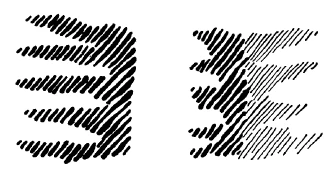
[ 16 ] To the same extent that a person ceases to be submerged in the physical body, their spiritual-soul aspect becomes brighter, illuminating their aura from the other side. And just as a human being can gain consciousness through the fact that, as the spiritual-soul aspect enters the physical body, it constantly strikes against it and is thereby constantly reflected, so too does the human being now gain consciousness through the fact that he withdraws toward the light. But this is the light of the sun, which is the first light: the Good. Thus, while during his physical life the human being, as a spiritual-soul being, collides with that which is akin to the sun—namely, the empty cavities in the brain—he, withdrawing after death, collides with the other sun, the good sun, the first sun.
[ 17 ] You can see how closely the possibility of gaining an understanding of life between death and a new birth is connected to the fundamental concepts of the ancient mysteries. For we are immersed in this entire cosmic life, just as I have described it to you these past few days. But of course, in order to gain a proper understanding of these things, one must delve deeper into the actual structure of human evolution throughout the Earth era. Wouldn’t it be possible, after all, for someone—through a stroke of luck, as one might call it—to see with clairvoyance the whole picture I have just described? But that stroke of luck could go no further than allowing them to see changing forms. Something like this: Let’s suppose a person, through some miracle—though it doesn’t actually happen through a miracle—were to gain clairvoyant, supersensory vision; then they would see the spiritual-soul life of the human being in a manner similar to what I have attempted to describe here. You will understand that this looks somewhat different from what I described some time ago as the “normal aura” once you realize that a few days ago I described (see page 31) what appears as the aura when one sees the whole human being—that is, the physical human being and the aura surrounding them; but now I have isolated the spiritual-soul being, so that the spiritual-soul being is abstracted from the physical human being.
[ 18 ] This shows you that sometimes you have to apply the colors one way and other times another; it also shows you that things look very different to the supersensible consciousness. Resolve to see a person’s aura simply as it is while the person has a physical body, and then you will see this aura—that is, if you resolve to see the person now, setting aside the spiritual-soul aspect, as the being whose organs extend into the physical body. But if you now look at the human being in the time between death and a new birth, you will see once again how the whole thing transforms. First and foremost, the region I have marked in red here moves away from here and rises upward; the yellow part descends here; the whole thing gradually becomes jumbled. One can observe such things, but there is something bewildering about this observation. And therefore, even for the modern person, it will not be easy to find ways to bring meaning and significance into this bewildering state unless he resorts to other aids.
[ 19 ] We have pointed out that the human head points to the past, while the “human of the extremities” points to the future. It is a complete contrast, polar; both the human head and the “limb-human”—just recall what I explained yesterday—are actually one and the same; it’s just that the head is a very old formation, a superformation. That is why it has these holes. The “limb-human” does not yet have these holes; it is still entirely filled with matter. Developing holes is a sign of overdevelopment. Being able to see this regression in the head is of great importance. And it is very important to understand that the “limb-human” is a young metamorphosis, while the head is an old metamorphosis. And because the “limb-human” is a young metamorphosis, he cannot yet think here in physical life; rather, his consciousness remains unconscious. He does not open up such “holes” to the spiritual-soul human as the brain does.
[ 20 ] This is of infinite importance and will become increasingly important for spiritual culture in the future: to recognize that two things which are outwardly and physically quite different from one another—such as the “head-oriented person” and the “limb-oriented person”—are, spiritually and psychologically, one and the same, merely at different stages of development in terms of time. Many mysteries lie precisely in this fact: that two physically different things, by virtue of being at different stages of development over time, can actually be one and the same. Outwardly, they are physically quite different, but they are states of transformation—that is, metamorphoses—of one and the same entity.
[ 21 ] Goethe was, in a fundamental way, the first to introduce concepts through which such things can be grasped, namely with his theory of metamorphosis. While the development of concepts had essentially been at a standstill since ancient times, Goethe revived the ability to form concepts. And these concepts are the living concepts of metamorphosis. Goethe, however, began with the simplest example. He said: When we look at a plant, we see the green leaf, but this then transforms into the colorful petal. Both are one and the same; they are merely metamorphoses of one another. — Just as the green plant leaf and the red rose petal are different metamorphoses—one and the same thing at different stages—so too are the human head and the organism of the extremities simply metamorphoses of one another. If we take Goethe’s concept of metamorphosis as applied to the plant, we have something primitive and simple; but this idea can be made fruitful for a higher purpose: for describing the transition of the human being from one incarnation to the next. We see a plant with green leaves and a flower and say: The flower—the red rose—is transformed from the green plant leaf. We see a human being standing before us and say: The head you bear—that is your transformed arms, hands, legs, and feet from your previous incarnation; and what you now bear as arms, hands, legs, and feet will be transformed into your head for the next incarnation.
[ 22 ] But now comes an objection that clearly weighs heavily on your soul. Now you will say: Yes, for heaven’s sake, but I’m leaving my legs and feet behind, and my arms and hands too; I’m certainly not taking them with me into my next incarnation! How on earth is my head supposed to turn out then? — Isn’t that a valid objection? Once again, you are standing right here before a Maya. For it is not true that you are actually leaving your legs and feet, your hands and arms behind. That is not true; you say that because you are caught up in the Maya, in the great illusion. For what you call your arms and hands, your legs and feet with your ordinary consciousness—these are not your arms and hands, nor your legs and feet—but rather they are the very things that fill your arms and hands, your legs and feet as blood and other bodily fluids. This is another difficult concept to grasp, but it is so. — Suppose you have arms and hands, legs and feet here; but what is here is spiritual—these are spiritual forces. Please imagine:
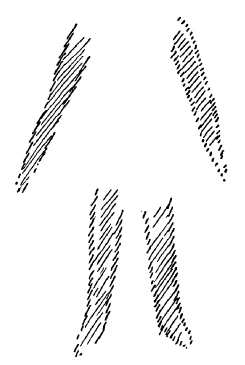
[ 23 ] Your arms and hands, your legs and feet are forces—supernatural forces. If you had only them, you would not see them with your eyes. They are filled—these forces are filled with the vital fluids, with the blood, and with that which, as a mineral substance—liquid or partly solid, with only the smallest part being solid—fills the invisible; that is what you see (hatched). What you leave in the grave, what is cremated, is merely—I would say—the mineral inclusions. Your arms and hands, your legs and feet are not visible limbs and so on; they are forces, and you take these with you. You take the forms with you. You say: I have hands and feet. — The one who looks into the spiritual worlds does not say, “I have hands and feet”—but rather says: There are spirits of form, Elohim, who think cosmically, and whose thoughts are my arms and hands and legs and feet; and whose thoughts are filled with blood and other fluids. — But blood and other fluids, in turn, are not what they appear to be in the physical realm; these substances are, in turn, the ideas of the Spirits of Wisdom, and what the physicist calls “matter” is merely the outward appearance. Where the physicist locates matter, he ought to say: “Here I encounter a thought of the Spirits of Wisdom, the Kyriotetes.” And where you see arms and hands, legs and feet, you cannot even encounter them there; you must say: “Here the cosmic thoughts of the Spirits of Form are shaping my forms.” — In short, as strange as it sounds: your body does not actually exist at all; rather, where your body is in space, the cosmic thoughts of the higher hierarchies live intertwined. And if you were to see not according to Maya but correctly, you would say: Here the cosmic thoughts of the Exusiai, the Spirits of Form, the Elohim, extend inward. These cosmic thoughts make themselves visible to me by being filled with the cosmic thoughts of the Spirits of Wisdom. This gives rise to arms and hands, legs and feet. What appears in Maya does not stand there at all before the spiritual gaze; rather, the cosmic thoughts stand there, and these cosmic thoughts clump together, condense, and interlock, and thus they appear to us as this shadow figure—the one we walk around as, the one we believe to be real. So the physical human being—he does not exist at all.
[ 24 ] We can say with some justification: At the hour of death, the Spirits of Form separate their cosmic thoughts from the cosmic thoughts of the Spirits of Wisdom. The spirits of form carry their thoughts up into the air, while the spirits of wisdom sink their material thoughts into the earth. As a result, a lingering shadow of the thoughts of the spirits of wisdom remains in the corpse even after the spirits of form have withdrawn their thoughts back into the air. This is physical death; this is what it truly is.
[ 25 ] In short, when we begin to think about realities, we arrive at a dissolution of what is commonly called the physical world. For this physical world exists because the spirits of the higher hierarchies interweave their thoughts, and therefore—please imagine: finely dispersed droplets of water flow into something and form a dense mist—your body, too, appears as a shadow-like form, because the thoughts of the spirits of form penetrate the thoughts of the spirits of wisdom, and the thoughts of form enter into the thoughts of matter. From this perspective, the entire world dissolves into the spiritual. But one must be able to truly envision the world spiritually, to know: This is merely an illusion—that my arms and hands, my feet and legs, are being surrendered to the earth. In reality, the metamorphosis of my arms and legs, hands and feet begins there and is completed in the life between death and a new birth, and my arms and legs, hands and feet will become my head in the next incarnation.
[ 26 ] I have spoken to you about various things just now that may have struck you as somewhat strange, at least in their form. But what, after all, is what we have been discussing other than our ascent from the apparent human being to the true human being, from that which lives outwardly in Maya to the successive levels of the hierarchies? Only by doing this can one speak today, in a mature way, of the fact that the human being may know within themselves a so-called higher self. If one merely declaims about the higher self, if one merely says, “I feel a higher self within me”—then this higher self is a pure, empty abstraction; it has no content; for the ordinary self belongs to Maya and is therefore Maya itself. The higher self has meaning only when one speaks of it in relation to the world of the higher hierarchies. To speak of the higher self without taking into account the world that consists of the spirits of form and the angels, archangels, and so on—to speak of the higher self without taking this world into account—means speaking of empty abstractions; it also means not speaking of that which lives within the human being between death and a new birth. For just as we live here with animals, plants, and minerals, so do we live between death and a new birth with the realms of the higher hierarchies, of which we have often spoken. Only by gradually approaching these ideas and concepts—we may speak of this in about eight days—can one come close to something that can answer the question: Why do some people die as young children, why do some die at a very advanced age, and why do others die in between?
[ 27 ] What I have just outlined for you are concrete concepts of the realities of the world. These are truly not abstract concepts that I have presented to you; they are concrete concepts of the realities of the world. These concrete concepts did exist—albeit within a more atavistic mode of perception—in the ancient mysteries. They were lost to human perception beginning in the 8th century B.C.; they must be regained through a deepening of our understanding of the Christ Being. This can only be achieved through the path of spiritual science.
[ 28 ] Let us once again try to form a kind of picture of human evolution from a certain perspective. We now want to focus on some very, very important concepts. One could say: If we look back at human development, we come to the conclusion—as I have often described—that in ancient times, people had more group souls, and only later did individual souls integrate into the group soul structure. You can read about this in various cycles. Then one could schematically depict the development of humanity as follows: In ancient times there were group souls; each of these group souls in turn split off—this would be a purely psychological view; from a spiritual perspective, it would be somewhat different—but each such soul clothe itself in a body, which I indicate here with a red line (see drawing on page 114).
[ 29 ] This drawing—or something similar to it—continued to be made right up into the Pythagorean school, with the explanation that: Look at the bodies; in terms of their bodies, human beings are separate—each one a body in and of itself—which is why the red lines here are isolated—but in terms of their souls, one finds a unity of humanity by ascending to the group soul, which, however, lies far in the past. — There is a unity. If you imagine the red lines removed, the lighter hatched area forms a single, unified figure.
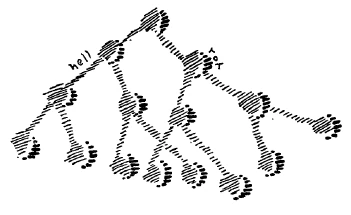
[ 30 ] But it only makes sense to speak of this figure if one has first spoken of the spiritual in the way we have done today; for then one knows what is at work within these souls, how the higher hierarchies are at work in this soul life. It makes no sense to speak of this figure unless one speaks in relation to the hierarchies. This was also the way of speaking right up to the Pythagorean School, and it was from the Pythagorean Schools that Apollonius, in turn, learned what I spoke of yesterday—and about which I will speak further next week. But then, since the 8th century B.C.—even the Pythagorean schools were latecomers—the ability to speak in this way was lost. And gradually, the concepts that are concrete, that are real when they refer to the higher hierarchies, have become confused and blurred for people. And so, instead of the world of angels, archangels, primal forces, forms, movements, wisdoms, and thrones—instead of all this concrete weaving of the spirit—a concept has emerged for them that already plays a certain role in the Greek worldview: the concept of the pneuma, in which everything floats in a jumble. Pneuma, the universal spirit—this vague concept that pantheists still love today: spirit, spirit, spirit, spirit! I have often spoken of how pantheists place the spirit everywhere. But this trend is already evident in Greek life. There, this figure has been drawn once again; but you see: what was once concrete—the multitude of deities—has become an abstract concept, has become the Pneuma. The white represents the Pneuma, the red represents physical matter (see drawing on page 114), when one considers human evolution. But the Greeks at least still had a conception of this Pneuma, for they still perceived something auric; so that what they imagined in those white branches was, for them, still something auric—that is, something truly perceptible. This is the great significance of the transition from Greek to Roman culture: that the Greeks, in their conception, still experienced the Pneuma as something truly spiritual, whereas the Romans no longer did. For the Romans, it had already become entirely abstract—complete abstraction, mere concepts. The Romans are the people of abstract concepts.
[ 31 ] My dear friends, in modern times you will find the very same pattern in the natural sciences! You can look it up today in materialistic science textbooks: there you will find exactly this same pattern that you found recorded in the ancient mysteries, in the Pythagorean schools, where everything was still related to the hierarchies. You find it among the Greeks, where it was related to the pneuma; you find it depicted again today. We will see what it is today. Today, the natural scientist says, as he draws this same diagram on the blackboard for his students: As the human race reproduces, the germ substance of the parents is passed on to the children; but a part of the germ substance is preserved in such a way that it can be passed on to the children in the next generation, and of that, another part is preserved in such a way that it can be passed on to the children again, while another part of the germ substance forms the cells of the physical body. — They follow exactly the same pattern; it is just that today’s naturalist sees the continuity of the germ substance in the white area (see diagram). He says: If we go back to our ancient human ancestors and take their germ plasm—the male and female germ plasm—and then go down to present-day humans and take their current germ plasm, this forms a single stream; the germ plasm is continuous. There is always something eternal in the germ substance—so the natural scientist imagines it—and only, so to speak, half of the germ plasma passes over into the other physical form. — The natural scientist has the same concept again, only now he no longer has the pneuma, but the white substance; that is now, for him, the material germ substance. It is no longer anything soul-spiritual; for him, it is the material germ substance. You can read about this in the works of today’s natural scientists; it is regarded today as a great, significant discovery. This is the materialization of a highly spiritual concept through the process of abstraction; the abstract concept lies at the very heart of it. And it is amusing that a modern natural scientist has written a book—for anyone capable of thinking clearly, it is amusing—in which he states outright: What the Greeks still conceived of as “pneuma” is today the continuously persisting germ substance. — Yes, it is foolish, but today it is regarded as profound wisdom.
[ 32 ] But you can see one thing from this: the drawing isn’t the point! And you will understand from this why I have always, in a certain way, opposed the drawing of diagrams as long as we were still trying to carry out our anthroposophy through the Theosophical Society. All one had to do was walk into any theosophical branch: the walls were usually covered with all sorts of such diagrams. All manner of things were depicted there, with words accompanying them, and there were entire family trees and all sorts of other things drawn. But these drawings are not what matters; what matters is that one can truly arrive at a living conception; for the drawing can be exactly the same, whether you imagine it as an outflow of the hierarchies—spiritual-soul elements—or whether you imagine it as the continuous germ plasma, a pure matter. These distinctions are blurred for people today. That is why it is so important to be clear about how the Greeks still knew something of the real self within the human being, of the real spiritual, and how this, in the case of the Romans, gave way to abstract concepts. You can see this in outward expressions. When the Greeks speak of their gods, they do so in a way that makes it perfectly clear: the Greeks still conceive of concrete figures behind the gods. For the Romans, the gods are essentially nothing more than names, mere designations; they are abstractions and are becoming increasingly abstract. The Greeks still held a certain conception that the hierarchies live within the human being standing here, and that these hierarchies live differently within each person. The Greeks perceived human beings in their reality, and when they said: “That is Alcibiades, that is Socrates, that is Plato”—they still held the concept that within Alcibiades, within Socrates, within Plato, the cosmic ideas of the hierarchies extend in various ways, and because these cosmic ideas extend in various ways, different figures emerge.
[ 33 ] This was lost on the Romans. Consequently, a system of concepts developed among the Romans that reached its extreme in the fact that, from the time of Augustus onward—and in fact even earlier—the Roman Caesar himself was regarded as a god. Divinity had gradually become increasingly abstract, and the Roman Caesar was himself a god because the concept had become entirely abstract. But the other concepts also became just as abstract. In particular, the concepts that permeated Roman society as legal and moral concepts became highly abstract, and thus a sum of abstractions took the place of the old, living realities. And this sum of abstractions—which remained as a legacy throughout the entire Middle Ages, carried over into modern times, and persisted as a legacy well into the 19th century—consists of abstract concepts that permeate every sphere.
[ 34 ] Then something surprising happened in the 19th century. Amid all the abstract concepts, the concept of the human being had been completely lost. The Greeks still had a sense of the true human being, who is formed from within the cosmos; but throughout the Roman era, the human being was lost. The 19th century was compelled to rediscover the human being through all the circumstances to which I have already referred, and to which I will refer in greater detail. And this rediscovery of the human being now took place from the opposite pole. The Greeks sought to see the human being who comes from the hierarchy—the divine human being; the Romans replaced this with a series of abstract concepts; the nineteenth century—and indeed the eighteenth century, but especially the nineteenth century—was compelled to rediscover humanity from the other side, from its animal nature. And now it could no longer be grasped through these abstract concepts. That was the great shock. And that is the great shock, that is the deep chasm that arises: What, after all, is this thing standing before us on two legs, waving its hands, and eating and drinking all sorts of things—what is it? The Greeks still knew; then it was transformed into abstract concepts. Now it takes people in the 19th century by surprise; there it stands, but they have no concepts with which to grasp it. It is understood as merely a higher animal: on the one hand, there is Darwinism, from a natural scientific perspective; on the other hand, in the spiritual realm, there is socialism, which seeks to place human beings in society merely as animals. It is human beings who stand there, surprised by themselves: What is that, actually? — and who are powerless to answer this question.
[ 35 ] This is the situation today; it is a situation that will not only give rise to correct or incorrect concepts, depending on what people want, but is destined to bring about either catastrophic or salutary events. But this is the situation: the shock that human beings experience when faced with themselves. Once again, the elements necessary for understanding the spiritual human being must be found. They cannot be found except by delving into the doctrine of metamorphosis. Therein lies the essential point. The concepts of metamorphosis in Goetheanism alone are capable of grasping the fluctuating phenomena that present themselves to the observation of reality.
[ 36 ] Well, I would say that spiritual development has always been moving in this direction. Even back then—I alluded to this in *Reich* in a series of essays on “ The Chemical Wedding of Christian Rosenkreutz”—when *The Chemical Wedding* and other writings were published in such a wondrous way in the 17th century, there was already the aspiration to ensure that a social structure corresponding to the true nature of the human being would come into being among people. This is, in fact, how *The Chemical Wedding of Christian Rosenkreutz* came into being through the so-called Valentin Andreae. But on the other hand, there is also the book he called *General Reformation of the Whole Wide World*, in which he provides a broad political overview of how social conditions should be shaped. The Thirty Years’ War swept all of that away.
[ 37 ] There, it was the Thirty Years’ War that swept everything away. Today, it is possible that the world order will either sweep things away once again, or incorporate them into the development of humanity. This brings us to the great fundamental question of our time, which people should be addressing instead of all the secondary issues that occupy them today. If people were to engage with this fundamental question, they would find the means and ways to bring fruitful concepts into today’s reality; then they would avoid abstract concepts.
[ 38 ] It is not so easy to distinguish reality from illusion. To do so, one must truly want to engage with life in earnest and with all good will, without getting bogged down in agendas and prejudices. I could tell many stories along these lines. I’ll just cite one fact: In the early 1890s, a number of people came together in various cities across Europe and once again imitated something American: namely, the “Movement for Ethical Culture.” At that time, certain intellectuals were all set on founding “Societies for Ethical Culture.” People put forward some very beautiful ideas, and if you read today the essays written back then by these representatives of the “Societies for Ethical Culture”—if you have a taste for, well, saccharine stuff—you’ll probably still be enchanted by all the beautiful, wonderful ideals in which people revelled back then. And it was truly no pleasant task to turn against this revelling in those saccharine ideals. But back then, in one of the first issues of the magazine *Die Zukunft*, I wrote an article against all this saccharine “ethical culture” nonsense, railing furiously against this “ethical culture.” It was, of course, a shameful act, for how could it not be shameful to turn against something so good, when people are setting out to “ethicize” the whole world, to impose morality on everything! I was living in Weimar at the time, but I went to Berlin once and spoke with Herman Grimm; he said: “What exactly do you want with this ‘ethical culture’? Go and talk to these people—you’ll see: the ones who gather here in Berlin, these ethicists, are all quite nice, lovely people. You can’t possibly have anything against them. They’re people you can find quite likable, who you can really warm to.” — That was undeniable, and at that moment, of course, Herman Grimm was just as right as I was. Outwardly speaking, one was just as right for the moment as the other; one position could be proven just as well as the other, and I don’t mean to claim that, purely logically, my arguments against the ethical culturalists were better than the arguments they put forward. But it is precisely from all this “butter idealism” that the current catastrophe has arisen, and the only people who were right—and have been vindicated by the facts—are those who said back then: With all your reveling and talk of such “butter ideals,” through which you seek to bring about universal peace and the like, as well as universal morality among people, you produce nothing other than what I then called the “social carcinoma,” which was bound to lead, ultimately, to this catastrophic present. Time has shown who worked with real concepts and who worked with mere abstractions. One cannot decide at all, based on mere abstract character, whether anyone is right or wrong; that is determined solely by whether a concept fits correctly into the course of events or not. If a professor teaches natural science at his university today, then he can, of course, prove beautifully—logically prove—that everything he says is correct. All of that goes right into people’s heads; of course, I can say that today in the very best sense of the word. And lo and behold, that is not the point at all—whether seemingly sound logical reasons can be cited for it—but rather: when those same thoughts are implanted into a Leninist mind, they become Bolshevism. What a thought becomes in reality—that is what matters. What matters is not what one might think about it or feel about it in the abstract, but rather what power actually shapes a thought in reality. And when one examines the worldview that has been discussed most in recent times—because the others were aestheticized, as I explained yesterday—when one examines socialism, the point today is not to sit down and “plow through” Karl Marx, Lassalle, or Bernstein, that is, to study their books and these authors, but rather to have a sense, a living experience of what will come to pass in the course of human history when a number of people—those who work at machines—hold this idea. That is what matters, and not speculating about the social structure of the near future as is commonly taught in today’s diplomatic training. Rather, now is the time when it is crucial to be able to weigh ideas in order to answer the question: What does the future hold in the coming decades? The time has already come when it is no longer permissible to sit comfortably in all sorts of armchairs and complacently carry on with the old ways; rather, the time has come when humanity must feel the shock of facing itself, and when the thought must arise in those who are responsible for something somewhere: How can this question be resolved from within spiritual life? We will continue discussing this next time.