

The Science of Human Development
GA 183
24 August 1918, Dornach
Translate the original German text into any language:
Versions Available:
The Science of Human Development, tr. SOL
Vierter Vortrag
Fourth Lecture
[ 1 ] Wenn man eine Zeit, in der man selbst lebt, verstehen will, so muß man sie aus größeren Weltenzusammenhängen heraus verstehen. Das ist gerade das Kleinliche der gegenwärtigen Zeit, daß man nicht will die Impulse, die Kräfte, die wirksam sind in der Gegenwart, aus größerem Zusammenhang heraus sich klarmachen. Und insbesondere wird es immer wieder und wiederum notwendig sein, um das eine oder das andere gegenwärtig Wirksame zu verstehen, zurückzugreifen zu den Verhältnissen, durch welche die Menschheitsentwickelung gegangen ist zur Zeit des Mysteriums von Golgatha. Dieses Mysterium von Golgatha, wir haben es ja von den verschiedensten Gesichtspunkten aus dargestellt und haben gesehen, wie tief, wie bedeutsam es eingreift in den ganzen Evolutionsgang, die ganze Entwickelung der Menschheit. Wir wissen, daß die Menschen vor dem Mysterium von Golgatha anders die Welt empfanden, anders anschauten als nach dem Mysterium von Golgatha. Natürlich geht das nicht so auf einmal aus dem einen Zustand in den andern Zustand über. Aber der rückschauenden Betrachtung ergibt sich schon dasjenige, was wir von den verschiedensten Gesichtspunkten aus dargelegt haben. Insbesondere möchte ich heute, um eine gewisse Grundlage für die nächsten Betrachtungen zu finden, auf eines hinweisen.
[ 1 ] If one wishes to understand the era in which one lives, one must understand it within the broader context of world history. This is precisely what is so petty about the present age: people are unwilling to grasp the impulses and forces at work in the present by placing them within a broader context. And in particular, it will be necessary time and again to understand one or another of the forces at work today by looking back to the conditions through which human development passed at the time of the Mystery of Golgotha. This Mystery of Golgotha—we have, after all, described it from a wide variety of perspectives and have seen how deeply and significantly it intervenes in the entire course of evolution, the entire development of humanity. We know that before the Mystery of Golgotha, people perceived the world differently and viewed it differently than they did after the Mystery of Golgotha. Of course, this transition from one state to another does not happen all at once. But a retrospective examination does reveal what we have set forth from a wide variety of perspectives. In particular, I would like to point out one thing today in order to lay a certain foundation for our next reflections.
[ 2 ] Wenn wir die Stimmung, die Verfassung der Menschenseelen vor dem Mysterium von Golgatha betrachten, so können wir im allgemeinen sagen, daß innerhalb der Kulturmenschheit, also derjenigen Menschheit, aus der die heutige Kulturmenschheit hervorgegangen ist, vor dem Mysterium von Golgatha eine gewisse Fähigkeit in den Seelen vorhanden war, in die Geheimnisse der kosmischen, geistigen Welt hineinzuschauen. Es war für die Menschen vor dem Mysterium von Golgatha gewissermaßen selbstverständlich, nicht so zum Sternenhimmel hinaufzuschauen, wie heute der Mensch zum Sternenhimmel hinaufschaut. Wir wissen ja, heute schaut der Mensch zum Sternenhimmel: hinauf, indem er sich sagt: Mit unserer Erde sind einige andere Planeten verbunden, die mit ihr zusammen um die Sonne kreisen; dann sind unzählige andere Fixsterne da, die wiederum ihre Planeten haben. — Und wenn dann der Mensch darauf achtet, was er eigentlich, indem er sich so etwas überlegt, für einen Gedanken hat, so muß er sich doch sagen, er hat den Gedanken einer großen Weltmaschinerie. Daß da noch anderes waltet und wirkt als die Kräfte dieser großen Weltmaschinerie, das macht sich der Mensch der Gegenwart nur sehr, sehr wenig klar. Das war mehr oder weniger für den Menschen vor dem Mysterium von Golgatha selbstverständlich. Insbesondere war für ihn selbstverständlich, die Sonne zum Beispiel nicht bloß als dasjenige anzuschauen, als was sie der heutige Physiker anschaut, roh gesprochen, eine Art glühender Kugel im Weltenraume draußen, sondern der Mensch vor dem Mysterium von Golgatha wußte ganz genau: Diese Sonne, von der die Physik spricht, diese Sonne ist nur ein Element in der ganzen Sonne. Dieser Sonne liegt zugrunde ein Seelisches und ein Geistiges. Und das Geistige, das dieser Sonne zugrunde liegt, sprach ja noch der griechische Weise als das allgemeine Weltgute an, als das Gute der Welt, als das einheitliche, die Welt durchwallende Gute. Das war ihm der Geist der Sonne. Ihm wäre es, diesem griechischen Weisen, als stärkster Aberglaube vorgekommen, so zu denken, wie der heutige Physiker denkt, daß da draußen im Weltenraume einfach eine glühende Kugel schwebe; sondern ihm war diese glühende, schwebende Kugel die Offenbarung des einheitlich Guten, das in der Welt zentral wirksam ist. Und mit diesem zentralen Guten, das geistiger Art ist, ist wiederum verbunden ein Seelisches: der Helios, wie es die Griechen nannten. Und erst das dritte, der physische Ausdruck des Guten und des Helios, war dann die physische Sonne. Es sah also der Mensch damals an Stelle der Sonne ein Dreifaches. Und mit diesem Dreifachen, das in der Sonne in alten Zeiten gesehen worden ist, brachten diejenigen Menschen, welche in der Zeit des Mysteriums von Golgatha dachten — ausgerüstet mit dem Wissen dieses Mysteriums von Golgatha, ausgerüstet mit dem Wissen der alten Mysterien —, mit diesem dreifachen Sonnenmysterium brachten diese Weisen das Christus-Mysterium zusammen, das Mysterium von Golgatha selber. Mit der Sonnenverehrung war verbunden für diejenigen, die etwas wußten, die Christus-Verehrung. Mit der Sonnenweisheit war wiederum für diejenigen, die etwas wußten, verbunden die Christus-Weisheit.
[ 2 ] When we consider the mood and state of human souls before the Mystery of Golgotha, we can generally say that within civilized humanity—that is, the humanity from which today’s civilized humanity emerged—there existed, prior to the Mystery of Golgotha, a certain capacity in the souls to glimpse into the mysteries of the cosmic, spiritual world. For people before the Mystery of Golgotha, it was, so to speak, a matter of course not to look up at the starry sky the way people look up at it today. We know, of course, that today people look up at the starry sky, saying to themselves: Our Earth is connected to several other planets that orbit the Sun together with it; and then there are countless other fixed stars, which in turn have their own planets.” — And when people then consider what kind of thought they are actually forming by pondering such things, they must admit to themselves that they are conceiving of a vast cosmic machinery. That there are other forces at work besides those of this vast cosmic machinery is something that people today realize only very, very rarely. This was more or less self-evident to human beings before the Mystery of Golgotha. In particular, it was self-evident to them not to view the sun, for example, merely as what today’s physicist views it—to put it bluntly, a kind of glowing sphere out there in outer space—but rather, human beings before the Mystery of Golgotha knew quite precisely: This sun of which physics speaks is only one element within the whole sun. Underlying this sun is something soulful and something spiritual. And the spiritual element underlying this sun was, after all, still referred to by the Greek sage as the universal good of the world, as the good of the world, as the unified good that surges through the world. That was, for him, the spirit of the sun. To him—to this Greek sage—it would have seemed the strongest form of superstition to think, as today’s physicist does, that out there in the cosmos there simply floats a glowing sphere; rather, to him this glowing, floating sphere was the revelation of the unified Good that acts centrally in the world. And connected to this central Good, which is of a spiritual nature, is in turn a soul element: Helios, as the Greeks called it. And only the third—the physical expression of the Good and of Helios—was the physical sun. Thus, people in those days saw a threefold reality in place of the sun. And with this threefold nature, which was seen in the sun in ancient times, those people who thought during the time of the Mystery of Golgotha—equipped with the knowledge of this Mystery of Golgotha, equipped with the knowledge of the ancient mysteries—these sages brought together the Christ Mystery with this threefold solar mystery, the Mystery of Golgotha itself. For those who knew, the worship of the Sun was linked to the worship of Christ. And for those who knew, the wisdom of the Sun was in turn linked to the wisdom of Christ.
[ 3 ] Um aber das, was ich jetzt auseinandergesetzt habe, naturgemäß zu fühlen, als etwas Selbstverständliches zu empfinden, dazu war eben die Konstitution der Seele notwendig, die damals da war. Und diese Konstitution der Seele verschwand eben. Sie verschwand schon seit dem 8. vorchristlichen Jahrhundert, mit dem Jahre 747 — dies ist die wirkliche Gründungszahl von Rom — vor dem Mysterium von Golgatha. Mit der Gründung Roms schwindet eigentlich die alte Möglichkeit, in dem Kosmos draußen das Geistige zu sehen. Mit dem Eintritt Roms in die Geschichte tritt das in die Menschheitsevolution ein, was man das prosaische Element nennen kann. Die Griechen zum Beispiel bewahrten in ihrer ganzen Weltanschauung noch die Möglichkeit, hinter der Sonne eben die zwei andern Sonnen, die seelische und die geistige Sonne zu sehen. Und nur dadurch, daß nun nicht rein in griechische Weisheit und in griechisches Empfinden das Mysterium von Golgatha getaucht worden ist, sondern in römische Weisheit und in römisches Empfinden, dadurch ist es gekommen, daß man gebrochen hat mit dem Wissen von dem Zusammenhang des Christus mit der geistigen Sonne. Damit haben sich ja namentlich die christlichen Kirchenväter und die christlichen Kirchenlehrer zu befassen gehabt, dieses Mysterium von der Sonne zu verhüllen, dieses Mysterium von der Sonne für die Menschheit vergessen zu machen, es nicht herauskommen zu lassen. Es sollte gewissermaßen ein Schleier gebreitet werden durch die fortgehende Entwickelung des Christentums, wie man das nennt, über die tiefe, die bedeutsame, die umfassende Weisheit von dem Zusammenhange des Christus mit dem Sonnenmysterium.
[ 3 ] But in order to naturally feel what I have just explained—to perceive it as something self-evident—the constitution of the soul that existed at that time was precisely what was necessary. And this constitution of the soul simply disappeared. It had already been disappearing since the 8th century B.C., beginning in the year 747—this is the true founding date of Rome—before the Mystery of Golgotha. With the founding of Rome, the ancient ability to perceive the spiritual in the outer cosmos actually began to fade. With Rome’s entry into history, what might be called the prosaic element entered human evolution. The Greeks, for example, still preserved in their entire worldview the ability to see, behind the sun, the other two suns—the soul sun and the spiritual sun. And it was precisely because the Mystery of Golgotha was not immersed purely in Greek wisdom and Greek sensibility, but rather in Roman wisdom and Roman sensibility, that a break occurred with the knowledge of the connection between Christ and the spiritual sun. It was precisely this—veiling the mystery of the sun, causing humanity to forget this mystery of the sun, and preventing it from coming to light—that the Christian Church Fathers and Christian theologians had to deal with. In a sense, a veil was to be spread—through the ongoing development of Christianity, as it is called—over the profound, significant, and all-encompassing wisdom concerning the connection between Christ and the mystery of the sun.
[ 4 ] Wenn man definieren sollte die Aufgabe der Kirche, jener Kirche, die entstanden ist dadurch, daß das Christentum in das Römertum eingesenkt worden ist, dann müßte man dies so tun, daß man sagte: Die römisch gefärbte christliche Kirche hatte sich namentlich zur Aufgabe zu machen, das Christus-Mysterium möglichst zu verhüllen, es möglichst wenig bekanntwerden zu lassen. — Die Einrichtung, welche die Kirche durch den Romanismus erfahren hat, die ist insbesondere geeignet gewesen, die Menschen so wenig wie möglich von dem Christus-Geheimnis wissen zu lassen. Die Kirche war dadurch eine Institution zur Geheimhaltung des Christus-Mysteriums geworden, eine Institution geworden, möglichst wenig in die Welt kommen zu lassen von dem Christus-Mysterium. Dies ist etwas, was immer mehr und mehr in der jetzigen Zeit der Menschheit klarwerden muß, weil beginnen muß diejenige Zeit, welche in der Lage ist, wiederum mit andern Begriffen zu arbeiten als mit den römischen Begriffen. Römische Begriffe haben gerade das Scharfumrissene, das Scharf konturierte, das Kadaverhafte. Diejenigen Begriffe, welche entwickelt werden, um zum Beispiel den Menschen in seiner Wahrheit zu begreifen, wie ich ihn in seiner Normalaura, möchte ich sagen, Ihnen vor acht Tagen hier auf die Tafel gezeichnet, skizziert habe, die Begriffe, die notwendig sind, um die wahre Wirklichkeit des Menschen wieder zu erfassen und damit die wahre Wirklichkeit der Welt einigermaßen zu begreifen, diese Begriffe müssen flüssig sein, diese Begriffe dürfen nicht scharf konturiert sein, denn die Wirklichkeit ist nichts Starres, sondern etwas Werdendes. Und wollen wir mit unseren Begriffen und Ideen die Wirklichkeit erfassen, so müssen wir mit unseren Begriffen dem Fluß, dem Werden der Wirklichkeit nachschreiten.
[ 4 ] If one were to define the mission of the Church—that Church which came into being when Christianity was absorbed into Roman culture—one would have to do so by saying: The Roman-influenced Christian Church made it its specific mission to conceal the mystery of Christ as much as possible, to ensure that as little as possible of it became known. — The structure that the Church acquired through Romanism was particularly suited to ensuring that people knew as little as possible about the mystery of Christ. As a result, the Church had become an institution dedicated to concealing the mystery of Christ, an institution designed to allow as little of the mystery of Christ as possible to reach the world. This is something that must become increasingly clear to humanity in the present age, for the time is beginning that is capable of working once again with concepts other than Roman ones. Roman concepts are precisely characterized by their sharpness, their sharply defined contours, their cadaverous quality. The concepts that are being developed—for example, to understand the human being in his truth, as I sketched him here on the board eight days ago in his “normal aura,” so to speak— —the concepts necessary to grasp the true reality of the human being once again and thereby to comprehend the true reality of the world to some extent—these concepts must be fluid; they must not be sharply contoured, for reality is not something rigid, but something in the process of becoming. And if we wish to grasp reality with our concepts and ideas, we must use our concepts to follow the flow, the becoming of reality.
[ 5 ] Wenn außer acht gelassen wird dieses Flüssigwerden der Begriffe, dann kommt das zustande, was heute zum Unheil der Menschheit an zahlreichen Orten beobachtet werden kann. Nehmen Sie eine Erscheinung, die heute für etwas gründlichere, nicht schlafende Weltenbeobachter sich geradezu aufdrängt. Es ist die folgende Erscheinung. Nicht wahr, wir haben in der Welt unter uns Gelehrte, Gelehrte auf den mannigfaltigsten Gebieten. Diese Gelehrten vertreten, bewahren, wie man sagt, die Wissenschaft, und die heutige Menschheit, die ja nicht autoritätsgläubig ist, glaubt aber trotz ihres aus der Welt geschafften Autoritätsglaubens aufs Wort alles dasjenige, was von den Gelehrten der verschiedenen Gebiete vertreten wird. Und die Gelehrten untereinander glauben den andern immer dasjenige, was nicht gerade in ihrem Gebiete ist. In diese Verhältnisse sehen die Menschen heute nicht gern hinein, weil das ganze Zerfaserte und Chaotische unserer Kultur den Menschen auffallen müßte, wenn sie in diese Verhältnisse hineinsehen würden. Aber wir haben ja zum Beispiel das Folgende erlebt. Nehmen wir an, so ein Gelehrter — wir könnten immer für die verschiedenen Gebiete einen herausheben — hat zu seinem speziellen Gebiete, nun, meinetwillen — ich will etwas Ausgefallenes nehmen —, die Ägyptologie. Da besteht dann sein Beruf darinnen, daß er über die Eigentümlichkeit des ägyptischen Volkes die übrigen Menschen, die sich nicht beschäftigen können mit dem, was man die Quellen nennt, unterrichtet, daß er auch über die Beziehungen des ägyptischen Volkes zu andern Völkern des Altertums die Menschen unterrichtet. Der Menschen Aufgabe ist es, das aufs Wort zu glauben, denn der Mann ist ja in der Ägyptologie eine Autorität. Nun ist aber in unserer Zeit ein Unheil gekommen: Eine große Anzahl von diesen Gelehrten, die solche Spezialgebiete vertreten, haben nicht geschwiegen, sondern über Themen gesprochen, die nicht zu ihrem Fachgebiet gehören. Es wäre ja besser gewesen, wenn sie geschwiegen hätten, aber sie haben nicht geschwiegen; sie haben zum Beispiel ihr Denken, ihre Gedankenformen heute unter dem Eindruck dieser Ereignisse angewendet auf ihr eigenes Volk und auf seine Beziehungen zu den andern Völkern. Und da hat man nun genügend Gelegenheit zu sehen, was für Unsinn eigentlich die Leute reden. Nun müßte man Schlüsse ziehen, Schlüsse, die sehr real gedacht werden können. Gar mancher, der etwas gilt, sagen wir, auf dem Gebiete der Ägyptologie, und von dem man die Meinung hat, daß seine Begriffe mit Bezug auf die Eigentümlichkeiten des ägyptischen Volkes und seines Verhältnisses zu andern Völkern unanfechtbar seien, der redet nun plötzlich in der Gegenwart lauter Unsinn über sein eigenes Volk und über das Verhältnis seines eigenen Volkes zu den andern Völkern. Ja, glauben Sie, er wird nun über die Ägypter und über ihre Beziehungen zu andern Völkern gescheiter reden und geredet haben? Wenn Balfour heute über das Verhältnis seines Volkes zu der übrigen Welt spricht, oder wenn Fousten Stewart Chamberlain fortwährend Unsinn redet über das Verhältnis der Menschen zu den andern Menschen, da könnten einige auch ohne Nachdenken irgendwie herauskriegen, daß die Leute Unsinn reden, völligen Unsinn reden! Aber nun hat der Chamberlain geschrieben «Die Grundlagen des 19. Jahrhunderts» und eine große Anzahl anderer Bücher, bei denen man nicht die Gelegenheit hat, die Geschichte zu prüfen. Er hat natürlich ganz genau denselben Unsinn geredet dazumal.
[ 5 ] If we disregard this blurring of concepts, we end up with what can be observed today in many places, to the detriment of humanity. Take a phenomenon that today virtually imposes itself on more thorough, alert observers of the world. It is the following phenomenon. Isn’t it true that we have scholars among us in the world—scholars in the most diverse fields? These scholars represent and preserve, as one says, science; and modern humanity, which is certainly not prone to blind faith in authority, nevertheless believes—despite having cast aside such faith—everything that is put forward by scholars in various fields. And among themselves, scholars always believe what others say—provided it is not strictly within their own field. People today do not like to look into these circumstances, because the entire fragmented and chaotic nature of our culture would become apparent to them if they were to examine these circumstances. But we have, for example, experienced the following. Let’s suppose that a scholar—we could always single out one for each field—specializes in, say—for the sake of argument, I’ll choose something unusual—Egyptology. His profession then consists of instructing the rest of humanity—who cannot concern themselves with what are called the sources—about the distinctive characteristics of the Egyptian people, and also about the relationships between the Egyptian people and other peoples of antiquity. It is people’s duty to take this at face value, for the man is, after all, an authority on Egyptology. But now a calamity has befallen our time: a large number of these scholars, who represent such specialized fields, have not remained silent, but have spoken on topics that do not belong to their field of expertise. It would indeed have been better if they had remained silent, but they did not; for example, under the influence of these events, they have applied their thinking and their patterns of thought to their own people and to their relationships with other peoples. And now we have ample opportunity to see what kind of nonsense people are actually spouting. We must now draw conclusions—conclusions that can be thought through very realistically. Quite a few people who are considered authorities—let’s say, in the field of Egyptology—and whose views on the characteristics of the Egyptian people and their relationship to other peoples are generally regarded as indisputable, are now suddenly spouting utter nonsense about their own people and about their own people’s relationship to other peoples. Indeed, do you believe he will now speak—or has spoken—more sensibly about the Egyptians and their relations with other peoples? When Balfour speaks today about his people’s relationship with the rest of the world, or when F. S. Chamberlain constantly spouts nonsense about the relationship of human beings to one another, even without giving it much thought, some might somehow realize that these people are talking nonsense—utter nonsense! But now Chamberlain has written *The Foundations of the Nineteenth Century* and a large number of other books in which one does not have the opportunity to verify the history. Of course, he was spouting exactly the same nonsense back then.
[ 6 ] Es ist schon einmal gegenwärtig die Zeit der Prüfung, und namentlich die Zeit der Prüfung dafür, nun endlich einmal einzusehen, daß es nicht bloß darauf ankommt, Urteile abzugeben, die einen gewissen eingeschränkten Wert haben, indem sie richtig sind auf einem bestimmten Gebiete — das ist fast jedes Urteil, das Falscheste ist auf einem bestimmten Gebiete richtig —, sondern daß es darauf ankommt, geradezu zu suchen jene Flüssigkeit der Urteile, die nur durch die Geisteswissenschaft gefunden werden kann, die in die Realität eindringt.
[ 6 ] The time of testing has already arrived—and specifically, the time to finally realize that what matters is not merely to make judgments that have a certain limited value in that they are correct within a specific field—which is true of almost every judgment; even the most false judgment is correct within a specific field—but rather that what matters is to actively seek that fluidity of judgment that can only be found through spiritual science, which penetrates reality.
[ 7 ] Es ist ja merkwürdig, welche Kollisionen zwischen gesundem Denken und zeitgemäßem Denken gerade heute an die Oberfläche treten. Man hat in den letzten Tagen von einer religiösen Diskussion gehört, die stattgefunden hat in Petersburg — Petrograd, so hat man eine Zeitlang gesagt, ich weiß nicht, ob man jetzt schon wieder Petersburg sagt —, also von einer religiösen Diskussion, die in dem ehemaligen St. Petersburg stattgefunden hat. Mitten drinnen im Bolschewismus hat man von einer religiösen Diskussion gehört. Da haben über die Religion und ihre Entwickelung gesprochen Sozialisten, Popen, selbstverständlich auch allerlei Bourgeoisleute. Die haben natürlich nicht das Gescheiteste geredet. Nun könnte man aus der Diskussion, die da gepflogen worden ist, die natürlich in der Wolle gefärbt war von der Gegenwart, aber durchaus mit den starrsten alten Begriffen arbeitete, wie es scheint, doch manches lernen. Zum Beispiel hat da ein Pope etwas höchst Interessantes vorgebracht. Der Pope fühlt sich genötigt, zu seinen Lämmern so zu sprechen, wie er es bisher gewohnt war. Nun hat er natürlich bisher so geredet, daß alles dasjenige, was auf der Welt ist, der Zarismus und alles, alles selbstverständlich von Gott kommt. Was kann er heute machen, der gute Pope? Er muß natürlich das, was er gewohnt war, früher seinen Lämmern zu sagen — jetzt sind es keine Lämmer mehr —, heute wenigstens irgendwie beibehalten, denn er will ja nicht zu neueren Begriffen übergehen. Da sagt er denn: Die Welt ist von Gott, alles ist von Gott; da wir jetzt eine Sowjetregierung haben, ist sie auch von Gott. Bolschewismus ist eben von Gott der Menschheit geschickt. Da alles von Gott ist, ist auch der Bolschewismus von Gott. — Was soll er anderes sagen? Ich bin ganz überzeugt davon, die Schlußfolgerung kann auch noch weiter ausgedehnt werden. Warum sollte man nicht sehr schön plausibel machen können, daß der Teufel von Gott ist? Der Teufel ist eingesetzt von Gott, nach ganz derselben Schlußfolgerung! — Das ist es ja, daß man wirklich einmal tiefer hineinleuchtet in dasjenige, was notwendig ist. Das findet natürlich auf allen Gebieten stärkste Gegnerschaft.Schlafen aber kann man nicht, wenn man sich vorgenommen hat, teilzunehmen an dieser Umarbeitung des Vorstellungsvermögens der Menschen.
[ 7 ] It is indeed strange to see what conflicts between sound thinking and contemporary thinking are coming to the surface right now. In recent days, we’ve heard about a religious discussion that took place in Petersburg—Petrograd, as it was called for a while; I don’t know if they’re calling it Petersburg again now—anyway, a religious discussion that took place in what used to be St. Petersburg. Right in the midst of Bolshevism, we’ve heard about a religious discussion. Socialists, priests, and, of course, all sorts of bourgeois people spoke there about religion and its development. Naturally, they didn’t say the wisest things. Yet one could learn quite a bit from the discussion that took place there—a discussion that was, of course, colored by the present but, it seems, operated entirely within the rigid confines of old concepts. For example, one priest brought up something highly interesting. The priest feels compelled to speak to his flock in the way he has always been accustomed to. Until now, of course, he has spoken as though everything in the world—tsarism and everything else—naturally comes from God. What can the good priest do today? He must, of course, at least somehow maintain what he used to say to his flock—though they are no longer a flock—because he does not want to switch to newer concepts. So he says: The world is from God, everything is from God; since we now have a Soviet government, it, too, is from God. Bolshevism, after all, has been sent to humanity by God. Since everything comes from God, Bolshevism, too, comes from God.—What else is he supposed to say? I am fully convinced that this conclusion can be extended even further. Why shouldn’t one be able to make it sound quite plausible that the devil comes from God? The devil has been appointed by God, according to exactly the same line of reasoning! — That is precisely the point: to truly delve deeper into what is necessary. Of course, this meets with the strongest opposition in all areas. But one cannot rest when one has resolved to participate in this transformation of people’s imagination.
[ 8 ] Begriffe, die der Materialismus herausgearbeitet hat und die geradezu als unanfechtbar gelten, sie gehören zu demjenigen, was gewissermaßen am gründlichsten überwunden werden müßte. Nichts begegnet einem ja heute häufiger aus der sogenannten Autorität der Wissenschaft heraus als dasjenige, was genannt wird das Gesetz von der Erhaltung der Energie und des Stoffes, Erhaltung von Kraft und Stofl. Das ist dasjenige, was ganz besonders der Menschheit ans Herz gewachsen ist. Die ganz und gar mechanistisch, physikalisch gewordene Weltanschauung will sich betäuben gegenüber dem Vorhandensein des Geistes. Da sie den Geist nicht anerkennen will, kann sie dem Geist auch nicht Dauer, nicht Ewigkeit zuschreiben; sie schreibt die Ewigkeit ihrem kleinen Götzen, dem Atom, oder überhaupt dem Stoff oder der Kraft zu. Aber, die Wahrheit ist, daß von alldem, was Sie sinnlich anschauen können, was Sie da stofflich und als Kräfte in der Welt umgibt, nach den Gesetzen des Weltenalls nichts, aber auch gar nichts über die Stufe des Venuszeitalters hinaus existieren wird. Wir wissen, daß auf die Evolution der Erde die Jupiterevolution folgt, und auf die Jupiterevolution die Venusevolution, dann die Vulkanevolution. So wie sich der Mensch in verschiedenen Verkörperungen wiederfindet, so findet sich die Erde wieder als Jupiter, nach der Jupiterevolution als Venus, nach der Venusevolution als Vulkan. Dasjenige, was heute von irgendeinem physikalischen Experiment als Stoff und Stoffgefüge gefunden werden kann, es hat nicht Bestand über das Venusdasein hinaus. Es gibt keine Erhaltung des Stoffes und der Kraft — solchen Stoffes, solcher Kraft, von der die Physiker sprechen können — über das Venusdasein hinaus. Das ganze Gesetz von der Erhaltung des Stoffes und der Kraft ist lediglich ein Aberglaube, ist dasjenige, wovon alle physikalischen Begriffe beherrscht werden. Aber etwas wird zugedeckt, indem man geradezu davon spricht, die Welt bestehe aus unzerstörbarem Stoff, der sich immer in andern Gruppierungen ergibt. Zugedeckt wird das, was als Antwort kommen muß, wenn man die Frage aufwirft: Ja, was bleibt denn dann, wenn alles das, was unsere Sinne in weiterem Umkreise umgibt, schon nicht mehr da sein wird, wenn die Venuszeit gekommen oder in ihrer Mitte angelangt sein wird? Was bleibt dann? Wo ist denn irgend etwas, was bleibt?
[ 8 ] Concepts that materialism has developed and that are considered virtually indisputable are, in a sense, among those that must be most thoroughly overcome. After all, nothing is encountered more frequently today, in the name of the so-called authority of science, than what is called the law of conservation of energy and matter—the conservation of force and matter. This is something that has become particularly dear to humanity. The worldview that has become entirely mechanistic and physical seeks to numb itself to the existence of the spirit. Since it refuses to acknowledge the spirit, it cannot attribute permanence or eternity to the spirit; instead, it attributes eternity to its little idol, the atom, or to matter or force in general. But the truth is that of all that you can perceive with your senses—all that surrounds you in the world as matter and forces—nothing, absolutely nothing, will exist beyond the stage of the Venus Age according to the laws of the universe. We know that the Earth’s evolution is followed by the Jupiter evolution, and the Jupiter evolution by the Venus evolution, then the Vulcan evolution. Just as human beings find themselves in various incarnations, so does the Earth find itself as Jupiter, after the Jupiter evolution as Venus, and after the Venus evolution as Vulcan. Whatever can be found today as matter and material structure through any physical experiment does not endure beyond the Venusian existence. There is no conservation of matter and force—the kind of matter and force that physicists speak of—beyond the Venusian existence. The entire law of the conservation of matter and force is merely a superstition; it is the very thing that dominates all physical concepts. But something is obscured by the very notion that the world consists of indestructible matter that constantly reassembles itself in different configurations. What is concealed is the answer that must come when one raises the question: Yes, what will remain then, when everything that surrounds our senses in a wider sphere will no longer be there, when the Venusian era has arrived or reached its midpoint? What will remain then? Where is there anything at all that remains?
[ 9 ] Nun, richten Sie Ihre Augen hinaus in den weiten Umkreis, den Sie überschauen können. Schauen Sie sich alles, alles an, schauen Sie sich die Gesamtheit des mineralischen, des pflanzlichen, des tierischen, des menschlichen Reiches an; schauen Sie sich an alles dasjenige, was Sie sehen können als Sterne, Lichterscheinungen, alle Lufterscheinungen, alle Wassererscheinungen, sehen Sie hin, wo Sie hinschen wollen, fassen Sie alles zusammen, was Sie irgendwie in Ihren äußeren Sinneswahrnehmungen zusammenfassen können und stellen Sie sich die Frage: Wo ist etwas, was von unserem jetzigen Dasein bleibt? — In keinem Tier, in keiner Pflanze, in keinem Mineral, in keiner Luft, in keinem Wasser, nirgends als nur im Menschen! In allem, was Sie heute sehen können, ist nichts enthalten, was regelrecht über das Venusdasein hinausgeht, als einzig und allein der Mensch selber. In nichts anderem können Sie etwas Bleibendes, etwas, was mit dem Begriffe der Ewigkeit angesprochen werden kann, suchen, in nichts anderem als in dem Menschen. Das heißt: Suchen wir die Keime für die wahre Weltenzukunft, wo müssen wir sie suchen? — Wir müssen sie im Menschen suchen! Wir können sie bei keinem andern Geschöpf, in keinem Naturreiche suchen. Aber durch die Naturreiche haben die alten Menschen vor dem Mysterium von Golgatha das kosmische All, geistig natürlich, gesehen. Wenn wir die Sonne nehmen: Sie haben einen glühenden Ball gesehen, aber sie haben durch den glühenden Ball den Helios und das Gute gesehen. Doch dieser glühende Sonnenball wird nicht länger vorhanden sein als das Venusdasein; dann ist er weg. Und alles dasjenige, wodurch man wie die Alten als durch einen Schleier die Konstituion irgendeines geistigen Daseins gesehen hat, es wird weg sein. Und von alledem, was jetzt da ist, bleibt für die Zukunft nur das, was in den Menschen keimhaft veranlagt ist.
[ 9 ] Now, turn your gaze out into the vast expanse that you can see. Look at everything, absolutely everything; look at the entirety of the mineral, plant, animal, and human kingdoms; look at everything you can see—the stars, light phenomena, all atmospheric phenomena, all water phenomena; look wherever you wish to look, take in everything you can somehow grasp through your external sensory perceptions, and ask yourself: Where is there anything that remains of our present existence? — In no animal, in no plant, in no mineral, in no air, in no water—nowhere but in the human being! In everything you can see today, there is nothing contained that truly transcends the Venusian existence, except for the human being alone. In nothing else can you seek anything enduring, anything that can be described in terms of eternity—in nothing else but the human being. That is to say: If we seek the seeds of the true future of the world, where must we look for them? — We must look for them in the human being! We cannot seek them in any other creature, in any realm of nature. But through the realms of nature, the ancient people—before the Mystery of Golgotha—beheld the cosmic whole, spiritually and naturally. Take the sun, for example: they saw a glowing ball, but through that glowing ball they saw Helios and the Good. Yet this glowing ball of the sun will not exist any longer than the Venusian existence; then it will be gone. And everything through which, like the ancients, one has seen the constitution of some spiritual existence as if through a veil—all of that will be gone. And of all that which is present now, only that which is latent as a seed within human beings will remain for the future.
[ 10 ] Was ist denn also eigentlich geschehen? Die Menschen haben vor dem Mysterium von Golgatha hinausgesehen in das weite Weltenall; sie haben gesehen Sterne über Sterne, sie haben gesehen die Sonne und den Mond, sie haben gesehen Luft und Wasser, die verschiedenen Reiche. Aber sie haben sie nicht so angeschaut wie der heutige Mensch, sondern sie haben hinter alldem das geistig-göttliche Dasein geschaut, und sie haben hinter alldem den Christus, der noch nicht zur Erde niedergestiegen war, geschaut. In diesen alten Zeiten hat man den Christus verbunden mit dem Kosmos, außerirdisch hat man ihn gesehen. In all dem, worinnen man den Christus gesehen hat, ist nichts, was über das Venusdasein hinaus dauert. Alles, wodurch sich in den Zeiten vor dem Mysterium von Golgatha dem Menschen das Geistige enthüllt hat und auch der Christus im Kosmos, hat nur einen Bestand bis zum Venusdasein. Die Menschen lebten vor dem Mysterium von Golgatha mit dem Himmel, aber dieser Himmel ist so sinnlich, daß er auch mit dem Venusdasein verschwindet. Was über das Venusdasein hinaus bleibt, das hat seine Keime nur im Menschen. Der Christus mußte aus dem Weltenall zu dem Menschen kommen, wenn er mit dem Menschen den Gang in die Ewigkeit antreten wollte. Weil das alles so ist, wie ich es Ihnen jetzt geschildert habe, deshalb stieg der Christus aus dem Kosmos herab, um fortan mit dem zu sein, was als Keim im Menschen in die Ewigkeit hinaus dauert.
[ 10 ] So what actually happened? Before the Mystery of Golgotha, people looked out into the vast universe; they saw star after star, they saw the sun and the moon, they saw air and water, the various kingdoms. But they did not view them as people do today; rather, they beheld the spiritual-divine existence behind all of this, and they beheld Christ—who had not yet descended to Earth—behind all of this. In those ancient times, Christ was seen as connected to the cosmos; He was perceived as otherworldly. In all that in which Christ was seen, there is nothing that endures beyond the Venusic existence. Everything through which the spiritual revealed itself to humanity in the times before the Mystery of Golgotha—including Christ in the cosmos—lasts only as far as the Venusic stage. Before the Mystery of Golgotha, people lived in harmony with the heavens, but these heavens are so sensory that they, too, disappear with the Venusic stage. What remains beyond the Venusic stage has its seeds only within the human being. Christ had to come to humanity from the universe if He was to embark with humanity on the path into eternity. Because all this is as I have now described it to you, Christ descended from the cosmos to be henceforth with that which, as a seed within humanity, endures into eternity.
[ 11 ] Das ist das große kosmische Ereignis, das man verstehen muß. Die Menschen vor dem Mysterium von Golgatha konnten den Gott, den Christus im Weltenall verehren. Die Menschen, die darauf kommen mußten — und es ist die Zeit seit dem Mysterium von Golgatha immer mehr und mehr darauf gekommen, daß nur im Menschen der Keim ist für die ewige Weltenzukunft —, diese Menschen mußten einen Christus haben nicht im Weltenall draußen, das zerfällt, sondern vereint mit dem Menschen, mit der menschlichen Organisation, mit dem menschlichen Reiche. Wörtlich wahr ist es: Dasjenige, was da ist im weiten Umkreis der Sinne als Sterne, als Himmelskörper, es wird vergehen. Aber das Wort, der Logos, der erschienen ist in dem Christus, und der sich vereinigt mit dem ewigen Wesenskern des Menschen, der wird bleiben. Und das ist eine wörtliche Wahrheit, wie die Dinge in den wirklichen okkulten, religiösen Urkunden wörtliche Wahrheiten sind.
[ 11 ] This is the great cosmic event that must be understood. Before the Mystery of Golgotha, people were able to worship God—Christ—in the universe. The people who had to come to this realization—and since the Mystery of Golgotha, it has become increasingly clear that the seed for the eternal future of the world lies only within the human being—these people had to have a Christ not in the outer cosmos, which is decaying, but united with the human being, with the human organism, with the human realm. It is literally true: That which exists within the vast sphere of the senses as stars and celestial bodies will pass away. But the Word, the Logos, who appeared in Christ and who unites with the eternal core of the human being, will remain. And this is a literal truth, just as the things in the genuine occult and religious texts are literal truths.
[ 12 ] Das aber ist auch der Grund, warum wir gewissermaßen einen Dualismus in der Namengebung haben müssen — ich habe darauf schon hingedeutet —, in der Namengebung Christus Jesus. Den Christus, der dem außerirdischen Weltenall angehört, dieses geistige Wesen, das vor dem Mysterium von Golgatha nicht mit den Menschen der Erde verbunden war, muß man auf der einen Seite erkennen; das darf nicht vergessen werden, denn das ist heruntergestiegen und hat sich mit der Menschennatur, mit dem Jesus verbunden. In dem Dualismus Christus Jesus liegt dasjenige, was notwendig ist, zu verstehen. In dem Christus muß man das Kosmisch-Geistige sehen; in dem Jesus muß man dasjenige sehen, durch welches dieses Kosmisch-Geistige in die historische Entwickelung eingetreten ist und sich so mit der Menschheit verbunden hat, daß es mit dem Menschenkeim nun weiter in die Ewigkeiten leben kann.
[ 12 ] But that is also the reason why we must, in a sense, have a dualism in the naming—as I have already indicated—in the naming of Christ Jesus. On the one hand, we must recognize the Christ who belongs to the extraterrestrial cosmos—this spiritual being who, prior to the Mystery of Golgotha, was not connected to the people of Earth; this must not be forgotten, for He descended and united Himself with human nature, with Jesus. The dualism of Christ Jesus contains what is essential to understand. In the Christ, one must see the cosmic-spiritual; in the Jesus, one must see that through which this cosmic-spiritual entered into historical development and thus united itself with humanity in such a way that it can now live on into eternity with the human seed.
[ 13 ] Dieses mit den alten Mysterien zusammenhängende Christusgeheimnis zu verhüllen, zu entstellen, das war gewissermaßen die Aufgabe der Kirche in den verflossenen Jahrhunderten. Und versuchen Sie einmal, den Werdegang der Menschheit in diesen verflossenen Jahrhunderten wirklich zu studieren, versuchen Sie sich klarzumachen, wie es denjenigen einzelnen Menschen gegangen ist, welche den Christus Jesus wirklich suchen wollten, die wirklich den Weg finden wollten zu dem Christus Jesus: es war immer ein Märtyrerweg. Er mußte immer gesucht werden, der Christus Jesus, gegen die Konventionen, wie er ja auch heute selbstverständlich gegen dasjenige, was von den Konventionen geblieben ist, gesucht werden muß. Aber man kann dem Christus-Geheimnis nicht nahekommen, wenn man es nicht verbindet mit dem Naturgeheimnis.
[ 13 ] To conceal and distort this mystery of Christ, which is connected to the ancient mysteries—that was, in a sense, the task of the Church in past centuries. And try, if you will, to truly study the course of human history over these past centuries; try to understand what it was like for those individual people who truly wanted to seek Christ Jesus, who truly wanted to find the path to Christ Jesus: it was always a path of martyrdom. Christ Jesus always had to be sought in defiance of conventions—just as, of course, he must be sought today in defiance of what remains of those conventions. But one cannot draw near to the mystery of Christ unless one connects it with the mystery of nature.
[ 14 ] Sie sehen, die Notwendigkeit, die wir vor unsere Seele hingestellt haben, von dem Herunterkommen des Christus aus kosmischen Höhen zu dem Menschenkeim, das Geheimnis von dem Jesus-Werden des Christus, man kann es nur verstehen, wenn eine Einheit wird Naturbetrachtung, Weltbetrachtung, Kosmologie und die Wissenschaft von dem Werden des Menschen und des Göttlichen in der Menschheit. Das möchte man gerade von einer gewissen Seite her vermeiden, daß Naturwissenschaft zu gleicher Zeit Geisteswissenschaft und Geisteswissenschaft zu gleicher Zeit Naturwissenschaft werde. Das ist ja das Bestreben der meisten Theologen, und auf der andern Seite wiederum das Bestreben der meisten Naturgelehrten der Gegenwart, daß eine Schranke aufgerichtet werde zwischen der Naturwissenschaft auf der einen Seite und der Geisteswissenschaft auf der andern Seite. Nur ja soll nicht über den Christus Jesus etwas gesagt werden, was zu gleicher Zeit zusammenhängt mit der Erdenevolution, und nur ja soll nicht über die Erdenevolution, das heißt über ihre einzelnen Teile etwas gesagt werden, was zusammenhängt mit dem großen geistigen Mysterium.
[ 14 ] You see, the necessity we have set before our souls—the descent of Christ from cosmic heights to the human seed, the mystery of Christ becoming Jesus—can only be understood when the study of nature, the study of the world, cosmology, and the science of the becoming of the human being and the divine in humanity are united. There is a certain tendency to avoid precisely this: that natural science should at the same time become spiritual science, and spiritual science at the same time become natural science. This is, after all, the aim of most theologians, and, on the other hand, the aim of most contemporary natural scientists: to erect a barrier between natural science on the one hand and spiritual science on the other. But under no circumstances should anything be said about Christ Jesus that is at the same time connected with the evolution of the Earth, and under no circumstances should anything be said about the evolution of the Earth—that is, about its individual parts—that is connected with the great spiritual mystery.
[ 15 ] Indem man diese Dinge berührt, berührt man in der "Tat Wichtigstes, Allerwichtigstes im Menschenleben der Gegenwart. Denn jenes konfuse Geschwätz von allerlei Geistigem, auf das auch unsere Freunde einen so oftmals aufmerksam machen, und zum Ekel einen aufmerksam machen, dieses konfuse Geschwätz vom Geiste nützt gar nichts. Ich meine, es kommt alle Augenblicke einer und sagt: Nun sehen Sie einmal, der hat wiederum ganz theosophisch oder anthroposophisch geredet, er hat das und das gesagt! — Dieses bequeme Suchen nach Stützen in der gegenwärtigen Konfusion, das ist nicht dasjenige, was wir anstreben sollen, sondern wir sollen schon auf dem Fundament feststehen, das uns die Geisteswissenschaft sein wird. Und die Zeit ist zu ernst, um weitere Kompromisse, besonders auf diesem Gebiete zu pflegen.
[ 15 ] By addressing these matters, one is addressing what is “in fact the most important, the very most important thing in human life today.” For that confused babble about all sorts of spiritual matters—to which even our friends so often draw our attention, and which they point out to us to our disgust—that confused babble about the spirit is of no use whatsoever. I mean, every few moments someone comes along and says: ‘Just look, he’s been talking in a thoroughly theosophical or anthroposophical way again; he said this and that!’ — This convenient search for support amid the current confusion is not what we should be striving for; rather, we must stand firm on the foundation that spiritual science will provide us. And the times are too serious to allow for further compromises, especially in this area.
[ 16 ] Die Brücke zu schaffen zwischen dem Naturwissen, überhaupt zwischen dem Wissen des Wahrgenommenen und dem Wissen desjenigen, zu dem die Sünde, zu dem die Erlösung, kurz, zu dem die religiösen Wahrheiten gehören, die Brücke zu schaffen zwischen diesen zwei Gebieten, das kann nur geschehen, wenn man den Mut haben wird, in das Geistige wirklich real einzudringen. Aber auch über die Lebenswahrheiten wird man nichts Vernünftiges wissen können, wenn man nicht den Mut hat, in das Geistige real, wirklich einzudringen. Zum Eindringen in das geistig Reale gehört vor allen Dingen diese Möglichkeit: wiederum etwas zurückzublicken zu dem dreifachen Sonnenmysterium der alten Zeit, aber in dem neuen Sinne, wie es der gegenwärtigen Menschheit angemessen ist. Geradeso wie die Sonne eine Dreiheit ist, so ist ja der Mensch auch eine Dreiheit. Aber es handelt sich darum, daß wir diesen dreifachen Menschen wirklich studieren. Das ist Wichtigstes für die Gegenwart: den dreifachen Menschen zu studieren. Ich möchte Ihnen heute einmal vorbereitend — morgen und übermorgen werden wir diese wichtige Sache zu Ende führen — schematisch etwas angeben, was Sie führen kann auf dem Wege, der eigentlich gesucht werden müßte, um den dreifachen Menschen zu begreifen.
[ 16 ] To build a bridge between the natural sciences—indeed, between knowledge of the perceived world and knowledge of that to which sin, redemption, and, in short, religious truths belong—to build a bridge between these two realms can only happen if one has the courage to truly penetrate the spiritual realm. But one will not be able to know anything meaningful about the truths of life either unless one has the courage to truly and genuinely penetrate the spiritual realm. To penetrate the spiritual reality, one must above all be able to look back once more at the threefold mystery of the sun in ancient times—but in a new sense, appropriate to present-day humanity. Just as the sun is a triad, so too is the human being a triad. But the point is that we must truly study this threefold human being. This is the most important thing for the present: to study the threefold human being. Today, by way of preparation—tomorrow and the day after tomorrow we will bring this important matter to a conclusion—I would like to outline schematically something that can guide you along the path that must actually be sought in order to understand the threefold human being.
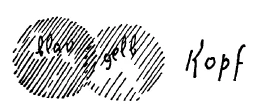
[ 17 ] Denken Sie sich einmal das Folgende — also das, was ich jetzt skizziere, soll ein Schema sein —, denken Sie sich, Sie hätten ein Gebilde, das ganz und gar nur Bild, nur Abbild sei, das im Grunde gar keine Bedeutung in sich selber hat, also Abbild ist. Das will ich so skizzieren: ich zeichne einfach einen Kreis (siehe Zeichnung Seite 71, blau), eine Kreisfläche. Das ist ein Gebilde, das Abbild ist von etwas anderem, aber dadurch, daß es Abbild ist, hat es das andere, wovon es Abbild ist, vollständig aufgezehrt. Es ist ja sonderbar, wenn ich folgendes sage, aber denken Sie sich einmal: In unserer Kuppel, in der kleinen Kuppel arbeiten vier Damen; nehmen wir einmal an, diese vier Damen würden, auf jeder Seite zwei, malen, sich selber porträtieren, aber dieses Porträtieren hätte eine besondere Folge. Also denken Sie sich, diese vier Damen, die porträtieren sich in der kleinen Kuppel, malen sich selber da ab, aber dieses Sich-selber-Porträtieren, das hätte eine ganz bestimmte Folge: sie verschwänden nämlich dadurch, sie gingen über in ihr Abbild, sie hörten auf zu sein. Wenn sie fertig sind, sind sie nicht mehr da. Dadurch, daß die Abbilder entstanden sind, sind sie selbst nicht mehr da. — Solch ein Gebilde stellen Sie sich unter dem, was ich hier skizzenhaft aufgezeichnet habe, einmal vor: ein Gebilde, das dadurch entstanden ist, daß es gemacht worden ist von etwas, wovon es Abbild ist; aber dadurch, daß das Abbild da ist, ist das andere aufgezehrt.
[ 17 ] Imagine the following—what I’m about to sketch is meant to be a diagram—imagine you have a form that is nothing but an image, a mere representation, which essentially has no meaning in and of itself; in other words, it is a representation. I’ll sketch this out as follows: I’ll simply draw a circle (see drawing on page 71, blue), a circular area. This is a form that is a representation of something else, but precisely because it is a representation, it has completely consumed the other thing it represents. It may sound strange when I say the following, but just imagine: In our dome—the small dome—four women are working; let’s assume that these four women, two on each side, were painting portraits of themselves, but this act of self-portraiture would have a particular consequence. So imagine this: these four women are painting self-portraits in the small dome, depicting themselves there, but this act of painting themselves would have a very specific consequence: namely, they would disappear as a result; they would merge into their own images; they would cease to exist. Once they are finished, they are no longer there. Because the images have come into being, they themselves are no longer there. — Imagine such a formation based on what I have sketched out here: a formation that came into being because it was created from something of which it is an image; but because the image exists, the other has been consumed.
[ 18 ] Nun ist aber dieses Aufgezehrte nicht allein in der Welt. Stellen Sie sich nämlich vor, es wäre die Geschichte noch nicht aus mit diesen vier Damen. Gut, diese vier Damen wären verschwunden, sie hätten sich da aufgemalt und wären verschwunden; aber die Bilder sind da. Sie sind nicht allein da im Weltenall, das Weltenall ist mit seinen Kräften außerdem noch da. Die Damen sind verschwunden, sind von den Bildern gewissermaßen aufgesogen worden; aber dadurch, daß die Bilder da sind, zieht sich aus dem Weltenall wiederum Substantielles zusammen und bildet die Damen neu, allerdings jetzt als Kinder: sie entstehen langsam wieder, entstehen da daneben. So entsteht neben diesem Gebilde wiederum sein Urbild (siehe Zeichnung, gelb). Ich müßte es eigentlich ein Stückchen hinein zeichnen, ich zeichne es nun daneben auf: das ist das Urbild. Das ist das Urbild, aber es ist ein sehr loser Zusammenhang zwischen diesem Abbild und dem Urbild, ein sehr loser Zusammenhang. Beide haben fast gar nichts miteinander zu tun. Dieses Abbild ist richtig verhärtet und hat fast gar nichts mit seinem Urbilde zu tun.
[ 18 ] But this “consumed” state is not alone in the world. Just imagine, in fact, if the story weren’t over yet for these four ladies. Well, these four ladies would have vanished; they would have appeared in the paintings and then vanished; but the paintings remain. They are not alone in the universe; the universe, with all its forces, is still there as well. The ladies have vanished; they have, so to speak, been absorbed by the images; but because the images are there, something substantial coalesces once more from the cosmos and reforms the ladies—though now as children: they slowly emerge again, coming into being right there beside them. Thus, alongside this formation, its archetype emerges once more (see drawing, yellow). I should actually draw it a little way inside, but I’ll draw it here beside it instead: that is the archetype. That is the archetype, but there is a very loose connection between this image and the archetype—a very loose connection. The two have almost nothing to do with one another. This image is truly solidified and has almost nothing to do with its archetype.
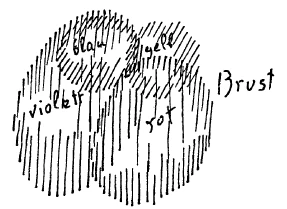
[ 19 ] Dann denken Sie sich ein zweites Gebilde. Ich will das zweite Gebilde so skizzieren, daß ich es nun auch als Abbild mache (siehe Zeichnung Seite 72, violett); nur ist das erste drinnen in dem zweiten. Das erste ist etwas für sich, aber es ist auch drinnen in dem zweiten. Also ich zeichne da kühn über das erste das zweite drüber. Das ist wiederum solch ein Abbild, und wiederum so ähnlich ein Abbild von einem andern, das ich auch nun da drauf zeichnen will (siehe Zeichnung, rot); das muss ich aber nun schon inniger mit dem verbinden. Da ist die Sache also so, daß ich nicht den Vergleich wählen könnte, den ich früher mit den vier Damen gewählt habe, sondern wenn ich bezüglich dieses Bildes und Abbildes jetzt einen Vergleich wählen würde, müßte ich so sagen: Es sind also die vier Damen da, sie malen in der kleinen Kuppel, und während sie malen, geht schon auch etwas von ihnen selber auf, wird aufgesogen. Aber nur zur Hälfte werden sie aufgesogen; zuletzt sind sie so, daß sie — nun, ich will also sagen, um nicht einen unästhetischen Vergleich hervorzurufen: Es wird von der einen die linke Körperhälfte aufgesogen, die rechte ragt noch heraus aus dem Bilde; von der anderen die rechte Körperhälfte aufgesogen, die linke ragt noch heraus. Also sie sind teilweise aufgesogen; teilweise ragen sie noch heraus. Das ist das zweite.
[ 19 ] Now imagine a second figure. I’ll sketch the second figure in such a way that I also make it a representation (see drawing on page 72, purple); only this time, the first one is inside the second. The first one exists on its own, but it is also inside the second. So I’ll boldly draw the second one over the first. This, in turn, is another such image, and again a similar image of yet another one, which I now want to draw on top of it (see drawing, red); but now I have to connect it more intimately with the first one. So the situation is this: I couldn’t use the comparison I chose earlier with the four ladies; rather, if I were to choose a comparison now with regard to this image and its reflection, I would have to say: So there are the four ladies; they are painting in the small dome, and while they paint, something of themselves is already being absorbed. But they are only half absorbed; in the end, they are such that—well, to avoid making an unaesthetic comparison: the left half of one’s body is absorbed, while the right half still protrudes from the picture; the right half of the other’s body is absorbed, while the left half still protrudes. So they are partially absorbed; partially, they still protrude. That is the second point.
[ 20 ] Dann stellen Sie sich ein drittes vor, das also wiederum das erste mitumfaßt und das zweite auch mitumfaßt (siehe Zeichnung Seite 73, grün). Das aber ist zum großen Teil mit seinem Abbilde verbunden, das ist noch nicht getrennt von seinem Abbilde. Da müßte ich also, wenn ich den Vergleich festhalten wollte, sagen: Die Damen malen, aber sie bleiben auch als Damen vorhanden, und das Ganze, was ich vor mir habe, sind die Damen und ihre Abbilder. Das ist vorhanden (siehe Zeichnung, orange), das ist zum größten Teile auch im Urbilde vorhanden.
[ 20 ] Then imagine a third one, which in turn encompasses both the first and the second (see diagram on page 73, green). But this is largely connected to its image; it is not yet separated from its image. So, if I wanted to capture the comparison, I would have to say: The ladies are painting, but they also remain as ladies, and the whole thing I have before me consists of the ladies and their images. That is present (see drawing, orange); for the most part, it is also present in the original image.
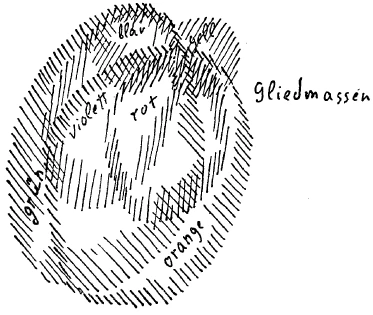
[ 21 ] So haben Sie also hier (Zeichnung Seite 71) etwas schematisch gezeichnet: zuerst oben ein Abbild, verhärtet, kristallisiert, es hat möglichst wenig mit seinem Urbilde zu tun; das Urbild ist daneben, neu entstehend. Das ist nämlich Ihr Kopf; der ist der materiellste, verhärtetste Teil der Menschennatur. Sein Urbild hat geradezu nichts mit ihm zu tun, entsteht neu; und wenn Sie achtundzwanzig Jahre alt geworden sind, ist Ihr Kopf so, daß er aus sich selber gar nicht einmal mehr etwas hergibt, ausgewachsen ist. Der größte Materialist in der Menschennatur ist das Haupt. Ein zweites Gebilde ist Brust und Atmung und alles, was dazugehört. Das ist ungefähr so, daß ich das zweite als Schema gebrauchen könnte (Zeichnung Seite 72). Das ist schon mehr verbunden, da hängen Geist und Materie schon mehr zusammen, das ist schon durchgeistigter. Alles das, was Lunge und Atmungsprozeß ist, ist schon für die Erde vergeistigter. Und was übrigbleibt, Gliedmaßen, im Zusammenhange damit alles das, was die Sexualität umfaßt, da ist Geistiges mit Physischem eins, da sind sie noch zusammen. Das gehört zum dritten Schema (Zeichnung oben).
[ 21 ] So here (drawing on page 71) you have sketched something schematically: first, at the top, an image—hardened, crystallized—that has as little to do with its archetype as possible; the archetype is beside it, emerging anew. That, in fact, is your head; it is the most material, most hardened part of human nature. Its archetype has virtually nothing to do with it—it is emerging anew; and by the time you have reached the age of twenty-eight, your head is such that it no longer yields anything from within itself—it has fully matured. The greatest materialist in human nature is the head. A second formation consists of the chest, breathing, and everything associated with them. It is roughly such that I could use the second as a diagram (drawing on page 72). This is already more interconnected; spirit and matter are already more closely linked here; it is already more spiritualized. Everything pertaining to the lungs and the respiratory process is already more spiritualized for the Earth. And what remains—the limbs, and in connection with them, everything that encompasses sexuality—there the spiritual and the physical are one; there they are still united. This belongs to the third diagram (drawing above).
[ 22 ] Das ist der dreifache Mensch. Ich habe es Ihnen heute nur schematisch auf die Tafel zeichnen können. Dieses zu gleicher Zeit wunderbare und fruchtbare, dieses großartige und tiefeindringende Mysterium vom dreifachen Menschen hängt wiederum mit dem dreifachen Sonnenmysterium zusammen. Das aber hängt wiederum zusammen mit all den Wahrheiten, die wir brauchen wie das Brot des Lebens für alles dasjenige, was sich setzen muß an die Stelle dessen, was in das Chaos, was in die Sackgasse hineingekommen ist und zu den gegenwärtigen Menschheitskatastrophen geführt hat. Davon werden wir morgen weiter sprechen.
[ 22 ] This is the threefold human being. Today I was only able to sketch it out for you schematically on the blackboard. This mystery of the threefold human being—which is at once wondrous and fruitful, magnificent and profoundly penetrating—is in turn connected to the threefold mystery of the sun. And that, in turn, is connected to all the truths we need—like the bread of life—for everything that must take the place of what has descended into chaos, what has reached a dead end, and what has led to the current catastrophes facing humanity. We will speak further about this tomorrow.