

The Polarity of Duration and Development in Human Life
GA 184
4 October 1918, Dornach
Translated by Steiner Online Library
Tenth Lecture
[ 1 ] Today and over the next few days, I would like to draw some conclusions for human life itself from the reflections that have been shared here recently. I would like to note in advance—particularly with regard to certain ideas that the outside world holds against anthroposophy as such—how certain perspectives regarding these ideas should actually be gained and emphasized by us. In the life of nature, in the order of nature, every person today recognizes exactly the same thing—albeit adapted to the order of nature—that we seek to assert through anthroposophical spiritual science for spiritual life and the spiritual order. However, the anthroposophical view is bound to be misunderstood if it in any way attempts to blend modern spiritual science with any kind of traditional error bordering on superstition or mysticism. We must accustom ourselves to using terms such as “Ahrimanic” and “Luciferic”—which have become familiar to us in connection with the spiritual order—in this way, albeit on a higher plane of existence, just as the natural scientist, in his own field, uses terms such as positive and negative electricity, positive and negative magnetism, or similar concepts. We must simply be clear—in contrast to conventional and prejudiced natural science—that, naturally, the moment one ascends to the contemplation of the spiritual order of the world, such concepts—which for natural science have a certain, specific, one might even say highly abstract content—must be conceived in more concrete, indeed spiritual, terms.
[ 2 ] Now we know that the human being, as it first appears to us in life between birth and death, presents us with what we have come to call the physical body, and beyond that, what we call the etheric body—or what I will attempt to call, in order to find a more suitable term, so to speak, the “body of formative forces”; then that which already possesses a character of consciousness—what we have come to call the astral body—but which does not yet possess the character of consciousness that pervades our present-day consciousness as it first presents itself to us. That which we today call the “subconscious,” following the custom of many people, would belong to the astral body. Then there is what we call our ordinary consciousness, which alternates between states of sleep and wakefulness, which sends only chaotic dreams into the states of sleep, and which, in the states of wakefulness, is not content with mere perceptions but resorts to abstract judgments and concepts; —we designate all of this as that aspect of the human being which we call the “I.” It is only in this last aspect of the human being—in the “I” proper, one might say—that the modern human being is familiar with himself. This “I” is reflected to him by his consciousness. This “I” is the very place where all the soul’s thinking, feeling, and willing actually take place. Everything else—the astral body, the etheric body, and the physical body in its true form—lies below consciousness and also below the “I.” For what conventional science—anatomy, physiology, and so on—can ascertain about the physical body is, after all, only its outer aspect; which, when it comes down to it, is nothing other than the content of our consciousness regarding the human physical body—a content we perceive in exactly the same way as we perceive any other sensory content. This is the external image of the physical body as it appears to our consciousness, but it is not the physical body itself.
[ 3 ] So, the three members of the human being that we, based on their development, refer to as pre-earthly—you are familiar with this development from my Outline of Esoteric Science—these three members are initially located outside the realm of human consciousness. Now you know that, with regard to the spiritual order, we refer to beings who, ascending upward, are connected to human beings as hierarchies and as members of hierarchies, just as the three natural kingdoms—the animal, plant, and mineral kingdoms—are connected to them descending downward. The moment we now consider the human being spiritually, we can no longer speak solely of those aspects of the astral, etheric, and physical bodies that ordinary science—or even anthroposophy—discusses when it takes into account only that aspect of human life which manifests itself in the sensory world. And that is why I have already mentioned in earlier reflections this fall that these—let us call them the lower members of human nature—that these lower members of human nature, when we consider them in their true nature, are essentially connected to the spirits of the individual hierarchies.
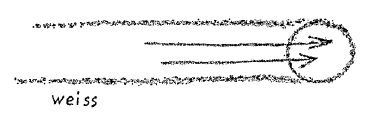
[ 4 ] Now, in line with what I recently explained to you in connection with Goethe’s worldview, we can say: To the extent that human beings develop over time through these three aspects of their being—to the extent that they undergo the development that can be traced from birth to death—to that extent are they connected to certain spiritual forces that underlie their development. I have tried to make this clear to you by saying: If we regard this (see drawing) as the essence of modern human beings, then we must conceive of the spiritual forces—which we have recognized as the members of the higher hierarchies—as being connected to this essence of theirs in the course of their evolutionary development. As you know, these spiritual forces do not, in the case of the normal human being, act directly upon his “I,” except for the spirits of form, those called the Exusiai. Thus, apart from these spirits of form—those forces that give the human being his very own form—the other spiritual forces do not act upon the human being’s present consciousness. We gain a concept of the spirits of form—admittedly a sparse one, but nevertheless somewhat feasible—when we turn our gaze to that aspect of the human being’s formation—it is only a part, a link in his general formation—which he still assumes during the course of his physical life. We are all born as more or less crawling beings. We do not have control over the vertical axis. Now, an immense amount in the total being of the human being is connected to the human being’s ability to stand upright—not exactly in the mathematical sense, but with the power to maintain an upright posture as their natural state. And when one considers the difference between human beings and animals in terms of purely external characteristics, one should not focus on the things that are usually emphasized—such as the number of bones and muscles and so on, which human beings essentially share with animals—but rather one should pay attention precisely to this power of uprightness, which gives the developing human being its form. It is only one part of what comes into consideration, but it is an essential part. The same force that intervenes in our physical development as this “uprighting force” is of the same nature as all the forces that give us our form as human beings, as earthly human beings. And only these forces, which are of this nature, intervene in our “I.”
[ 5 ] In contrast, other forces come into play; which we call the forces of cosmic movement, cosmic wisdom, and cosmic will; we refer to them as Dynamis, Kyriotetes, and Thrones—using ancient names for these concepts as understood in the modern spirit—that which does not enter human consciousness, and thus belongs to the human astral body, the body of formative forces (or etheric body), and the physical body. Thus, if one considers these aspects of human nature without the spiritual content I have just mentioned, one is actually speaking of a mere illusion, a mere semblance. In truth, we do not dwell in what presents itself as outward appearance, but in the spiritual forces indicated within it.
[ 6 ] Now, however, as I recently said in connection with Goethe’s worldview—in a sense, these two types of forces, which we describe as Luciferic or Ahrimanic, begin to influence human beings over time, without being directly linked to their development. We can say: the Luciferic forces (see diagram, red) are more spiritual in nature, while the Ahrimanic forces (purple) stem more from the subconscious. Hence, we have a threefold structure in humanity’s cosmic placement within existence. Thus we say: There are certain spiritual forces in human nature that are directly connected to the current of human development. There are two other currents of force—the Luciferic and the Ahrimanic—which are not connected to the human being’s immediate stream of development but act upon him over time; they thus come in addition to what actually belongs to the human being.
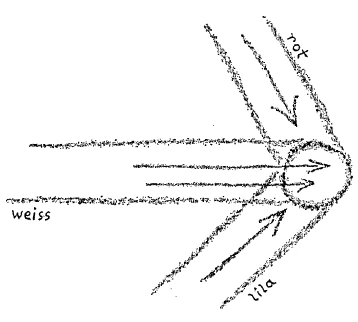
[ 7 ] Let us now consider life. When we look at life, do you not think that we see not only the stream of forces that actually belongs to us, but that we always see something that has flowed together from the three streams of forces? Whatever we survey—be it the external sensory world, or human historical life as it unfolds between pleasure and suffering, joy and pain, action and inaction—we see it as the result of these three currents merging into one another. In ordinary life, we do not undertake what, for example, a chemist does when he does not simply accept water as the liquid it appears to be on the surface, but breaks it down into hydrogen and oxygen. Spiritual science must undertake this breakdown. Spiritual science must engage in this spiritual chemistry; otherwise, human life will never be fully understood.
[ 8 ] We have now pointed out, from a wide variety of perspectives, the distinctive nature of that entity we call “Luciferic” and the distinctive nature of that entity we call “Ahrimanic.” The task now is to examine these matters from yet another perspective—that of immediate human life. We can then ask: Where, exactly, in human life is the point at which the Luciferic forces gain particular influence, and where, in turn, is the point at which the Ahrimanic forces gain particular influence?
[ 9 ] Yes, if human beings could be left to their own peaceful development, rooted in their very essence—but they cannot, as you know from earlier discussions; they would only be able to attain some self-knowledge in the second half of life—then they would not be exposed to the temporal intervention of the Luciferic and Ahrimanic forces. But in real life, as we have to live it, human beings are precisely exposed to this temporal intervention of the Luciferic and Ahrimanic forces; indeed, they must even reckon with the Luciferic and Ahrimanic forces. In all that which, in human beings, belongs more to the realm of the conscious, but in such a way that human beings do not merely strive for this consciousness through nature alone, but go beyond nature—we go beyond nature when, for example, we already have self-knowledge in the first half of life—in all that which human beings strive for through their consciousness, there lies something we can call nothing other than the superconscious. Our consciousness would look quite different if the superconscious were not present within it. It is the superconscious that prompts human beings to contribute more to historical life than they would if they were to rely solely on their mere physical development. At this point in human evolution on Earth, we would be living in a culture of a completely different nature if the superconscious had not flowed into that which has developed as consciousness solely through humanity. But with this superconscious comes the very possibility of intervention by Luciferic forces. One need only recognize in the right way how Luciferic forces work their way into consciousness. Human beings would never be led to develop a way of thinking other than the one I recently characterized for you as the ideal of Goethe’s worldview, were it not for the influence of Luciferic forces. Through the Luciferic forces, human beings form hypotheses; through the Luciferic forces, human beings form fantasies about reality. They do not merely grasp reality; they unite the superconscious with the conscious. They form all manner of ideas about reality—ideas that in turn enable them to grow together with this reality more deeply than they otherwise would. And when we consider the entire realm of art, we must emphasize that within art—where the superconscious plays such a major role—the Luciferic element must be active to the highest degree if art is not to degenerate into pure naturalism. It is not acceptable—as I have emphasized time and again—to simply say that human beings should keep the Luciferic element at a distance in their lives. If human beings were to keep their distance from the Luciferic, they would not be able to lead a true life, but would have to become primeval philistines. That which time and again acts like leaven and saves humanity, spurring it on to strive out of philistinism—that is precisely the Luciferic vitality.
[ 10 ] But all this Luciferic restlessness also causes human beings, in a certain sense, to be inclined—one might say—to view the world from a bird’s-eye perspective. Everything that arises over time in the form of programs or so-called beautiful ideas—with which people always believe they can bring about a golden age in one way or another—all of this stems from the Luciferic inclinations flowing into human beings. Everything that causes human beings to strive away from their interconnectedness with reality—through which they would, as it were, raise their wings higher than the context into which they are placed as human beings—all of this points to the Luciferic. The Luciferic element in human nature is the impulse that constantly causes us to diminish our interest in our fellow human beings. If we were to follow our very own human nature—that is, the forces of development inherent in the human being’s own current—we would have a far greater interest in our fellow human beings than we actually do. The Luciferic element in human nature is what causes a certain lack of interest toward other people. And when studying human nature, one should place great emphasis on precisely this point. Much in the world would be different if we were to acknowledge, in all its reality, this urge of ours to take far too much interest in what we ourselves concoct, and far too little interest in what other people think, feel, and want. One can only attain true insight into human nature if one illuminates one’s view of humanity with the question: What is driving me away from the interest I can develop in other people? And it must be a task of human culture in the future to develop precisely this insight into human nature. Today, “knowledge of human nature” is still often used to refer to what someone says about people, depending on how they imagine them to be or how they think they ought to be. Accepting people as they are, and being clear that everyone—just as they are, even the criminal—and this, too, must be said—still tells us something more important about the world than the illusions we create about human nature, no matter how beautiful the thoughts we concoct: to acknowledge this means to grant the Luciferic principle its proper place of equality within us. Such a quest for knowledge of human nature would reveal an infinite amount. And in the history of human development on Earth, no era has actually been further removed from a genuine, authentic interest in immediate human nature than the present day. Let us not confuse what is meant here with an uncritical attitude toward humanity. Of course, anyone who starts from the idea that “you must regard all people as good and love all people equally” is, in fact, taking a rather Luciferic shortcut, for they are basing their views all the more on their own fantasies. To regard all human beings as equal is, in fact, a Luciferic fantasy. It is not a matter of cultivating a general idea, but rather of engaging with the concrete reality of each individual human being and developing a loving—or perhaps, better said, interested—understanding of them.
[ 11 ] Now you might ask: What, then, is the purpose of all this Luciferic power within us, if it prevents us from being tolerant of human nature in the wise sense and from developing an interest in it? It has its rightful place in the economy of the spirit, if I may use that philistine expression. This Luciferic force must indeed be present, because if we were merely carried along by the continuous current and developed the natural and spiritual inclination toward knowledge inherent in every human being, we would—forgive me for the harsh expression—drown in our knowledge of human nature. We would drown; we would not be able to find our bearings. This is precisely what is connected to many of the mysteries of existence: that in this existence there is actually nothing which, if pursued to its logical conclusion—pursued to its extremes—does not become evil, does not become misfortune. That which truly brings us together with other people—that which allows us to find the other person within ourselves—would cause us to drown in our knowledge of human nature if it were not for the constant presence of the Luciferic sting, which time and again lifts us out of the water, brings us back to the surface, and subsequently awakens our interest in ourselves. It is precisely in our relationships with others that we live in a constant interplay between our very own power and the Luciferic power. And anyone who says it would be wiser if people simply followed their own innate power and were not touched by the Luciferic at all—let them also claim, if they have a scale with a balance beam and two pans, that they would rather remove one of the pans and weigh only with the other, that is, with just one pan. Life, after all, unfolds in states of equilibrium, not in absolute, objective relationships. This is what can initially be said about the Luciferic influence in relation to human life: it seizes consciousness, but in such a way that the superconscious intermingles with consciousness.
[ 12 ] The Ahrimanic influence initially takes hold mainly of the subconscious in human life. The Ahrimanic forces intermingle with all those subconscious, often so subtle, drives of human nature. In everything that plays out in human life from the subconscious, the Ahrimanic forces intermingle. If one wishes—I would say—to characterize Ahriman and Lucifer personally, one can say: Lucifer is a haughty spirit who loves to soar up to a bird’s-eye view and survey the whole picture; Ahriman is a morally solitary spirit who does not easily reveal himself, who operates within the human subconscious, influences the human subconscious, and conjures up judgments from this subconscious. People then believe that they are judging from their consciousness, whereas they are often conjuring up judgments—or allowing them to be conjured up—from their subconscious drives and their subtle, subconscious impulses, precisely through the forces of Ahriman.
[ 13 ] As we know, religious depictions often stem from old, now outdated views in the humanities. And Peter is not wrong to call Ahriman the prowling lion who seeks to devour anyone he can catch. This is why Peter calls Ahriman by this name: because Ahriman does indeed prowl in secret—that is, in the subconscious of human nature—and thereby strives to achieve his cosmic goal by drawing the subconscious power of human beings toward himself, in order to use it to attain, in the course of cosmic evolution, spiritual goals other than those inherent in the straightforward course of human development.
[ 14 ] When it comes to historical life, it is always Luciferic forces that lead us to concoct grand visions of the world that take no account of human nature. How many such ideas for bringing happiness to the world have been concocted in the course of human thought! And according to the conviction of those who devise such ideas for the world’s happiness, the world can only become happy through these very ideas. This stems from the fact that such Luciferic thinking is of a perspectival nature; it rises to a bird’s-eye view and disregards everything that teems down below, believing that the world can be organized according to the lines of thought conceived from that bird’s-eye perspective. Such ideas for bringing happiness to the world, which are always based on a lack of knowledge of human nature, are of a Luciferic nature. Dreams of world domination that arise from specific human spheres are of an Ahrimanic nature. For these dreams of world domination develop from the subconscious. It is Ahrimanic to focus on a specific sphere of human existence and, within that single sphere, to actually seek to encompass and dominate the entire world. Everything connected with human desires for domination over other people, everything that runs counter to a healthy social will, is of an Ahrimanic nature. The person of whom one might say—not in a superstitious sense, but in our sense—that he is possessed by Lucifer loses interest in his fellow human beings. The person who is possessed by Ahriman wants to dominate as many people as possible; if he is clever, he will then seek to exploit human weakness in order to dominate people precisely through that weakness. For this is Ahrimanic: to seek out human weaknesses in the subterranean, in the subconscious, in order to dominate people.
[ 15 ] Now we must ask: Where does all this come from? That is, after all, the question that should interest us most: Where does all this come from? What kind of essential forces are the Ahrimanic and Luciferic ones? We know, don’t we, that our Earth is the metamorphosis—to use Goethe’s term—of previous cosmic world bodies, the fourth metamorphosis. And to put it in terms we can understand, we have said: The Earth was first embodied as Saturn, then as the Sun, then as the Moon, and is now embodied as the Earth. So we know that this Earth is the fourth embodiment of its cosmic essence, the fourth metamorphosis. It will undergo further metamorphoses. We must take all of this into consideration if we now wish to ask further: What significance do the Ahrimanic and Luciferic forces have within the entire cosmic context in which human beings are situated? — We know that the spirits of form are connected with the form assumed by the part of the cosmos that most directly concerns us: our Earth. And if we consider the most distinctive feature of the Earth’s formation, it is identical to the essential nature of what—as I said earlier—lies, albeit only to a very small extent, in the way we overcome gravity through our own power of uprightness. These spirits of form are, so to speak, the governing forces of earthly existence, of the present metamorphosis of our planet. These spirits of form, however, act—as we know—through other spirits, whom we call Archai, Archangeloi, and Angeloi, using the ancient terms in our modern way.
[ 16 ] Of these entities, we are initially interested in the Archai, or primal forces, the primordial beginnings. We know that, in the hierarchy of spiritual entities, the spirits of form stand, so to speak, immediately above the primal forces. Consequently, in the course of development that is most inherent to human beings—which I have schematized here with simple chalk lines (see Figures 198 and 200)—the situation is such that the forces of the Archai are, so to speak, serving forces of the spirits of form. Within our human being, Archai and Exusiai are at work: spirits we call primal forces, and spirits we call spirits of form. But in addition to this, the following is also present: there are certain spiritual forces of form—spirits of form—that masquerade as primal forces, as Archai. These could therefore be Exusiai, but they do not assert themselves as Exusiai; rather, they assert themselves as Archai—they disguise themselves. This is the essential point: that we come to understand how, within the structure of the world, spiritual beings who actually stand at a different stage of development disguise themselves.
[ 17 ] But this has a very specific consequence. These primal forces—which are not actually primal forces, but spirits of form—can now influence that which lives within the outer earthly form just as much as it is influenced by the actual spirits of form. But the significant point is that in our earthly existence, everything connected with space—insofar as it takes shape within space—arises from the spaceless. We can only fully comprehend the spatial when we trace its imagery back to archetypes that are spaceless. This, of course, is the difficulty for Western thought: it finds it so hard to conceive of the spaceless. And yet it is true that everything connected with our very essence as human beings—that which emerges from the spirits of form by taking shape in space—is the effect of the non-spatial. To put it concretely: as individual human beings, who first crawl on all fours, then stand upright, and overcome gravity in our upright posture, we place ourselves within space; but the force underlying this strives from the non-spatial into space. So if we as human beings were subject only to the spirits of form that belong to us, we would, in every way we place ourselves within space, realize the non-spatial within space; for the spirits of form do not live in space. Whoever seeks the divine in space will not find it; of course, they will not find it. That which appears in space as a form is a realization of the spaceless.
[ 18 ] Those beings who are actually spirits of form but masquerade as Archai, as primal forces, would therefore, by their very nature, be destined for the non-spatial realm. Yet they enter into space; they act within space. And this is the true Ahrimanic character: that spiritual beings, who by their very nature are destined to be non-spatial, have chosen instead to act within space. This creates the possibility within space to shape things in such a way that the form does not radiate directly from the non-spatial realm, but rather that the spatial is reflected within the spatial—one thing through another within space.
[ 19 ] If I may cite a specific example: We humans are all different from one another because we are all brought into life from the spaceless. Our archetypes exist in the formless. Everything is fundamentally different. You know the famous story of how, under Leibniz’s guidance—princesses sometimes have nothing else to do—princesses searched the garden for two tree leaves that were completely identical and found none, because there really aren’t even two identical leaves. So in a certain sense, we are all forms emerging from the non-spatial, insofar as we are not alike. Yet we are alike; especially when we are blood relatives, we are alike. We are alike because there are also spiritual beings who shape the spatial according to the spatial—who do not merely shape the spatial according to the non-spatial, but shape the spatial according to the spatial. We resemble one another because Ahrimanic forces permeate us. Human beings must admit this to themselves; otherwise, they will always merely rail against Ahrimanic and Luciferic forces, but refuse to understand them.
[ 20 ] This example most clearly illustrates how Ahriman intervenes in life. To the extent that you dare to say to yourself: “I am a human being in my own right, and I am unlike any other”—to that extent, you are on the straight path of development. And if only that were true in the world—if the Ahrimanic side current did not come into play—then no mother could rejoice that her little daughter looks so terribly like her, for she would notice how every single human being is a spatial image of a non-spatial being, and no spatial being resembles another spatial being. The entry of certain spirits of form into space gives rise to the Ahrimanic. Of course, this Ahrimanic is not limited merely to the similarity among human beings, but extends to many things; but we were able to illustrate this with an example.
[ 21 ] Now I ask you to recall the line of thought I introduced—not to comfort you, but for the sake of the argument itself—after I explained that a person does not truly become capable of self-knowledge until the second half of their life. I said: Insofar as our life follows such a temporal course—and if it had only this temporal course and nothing else were acting upon us—we could indeed only attain self-knowledge in the second half of our lives. But now, as I said at the time, Luciferic forces are at work in the first half of life and produce a self-knowledge that does not stem from our very own human nature. But I have contrasted what human life would be if it followed only its very own nature with what I have called the realm of duration. With regard to everything that belongs to our very own human nature, we are a different person at fifty than we are at twenty; we develop. With regard to everything in which we do not develop, we belong not to our physicality but to the spiritual-soul aspect and are connected to the realm of duration—that realm in which time plays no role. Just as everything spatial is grounded in something non-spatial, so everything temporal is grounded in something enduring. We would be entirely different people if we were not connected to the realm of duration. We would, so to speak, only wake up from a certain dreamlike state of life at the age of twenty-eight or twenty-nine, as I said some time ago. But we live in the realm of eternity, and thus the drowsiness of the first half of life and the terrible state of being “awake” in the second half are balanced by the realm of eternity.
[ 22 ] All the spiritual forces of the higher hierarchies that we know belong to this realm of duration, with the sole exception of the spirits of form. They play a role in the realm of temporal development. But by living in a way that is both spaceless and spatial—by, so to speak, spending their lives between spacelessness and spatiality—they create forms that emerge from the spaceless into the spatial. This is subject to a temporal process; their life unfolds within time. But the other beings, who are higher up in the hierarchical order than the Spirits of Form, are beings that belong purely to duration. To speak of them as temporal beings can only be done in a comparative sense; if one means it in reality, it is nonsense. It is indeed difficult to speak about these things, for the simple reason that, in the current course of human development, very few people have a keen sense for concepts and ideas that are developed by stepping beyond space and time. Most people today would dismiss the non-spatial as mere fantasy, just as they would the timeless, the enduring, the imperishable—and, by extension, the unchanging.
[ 23 ] Above the beings of the Exusia order, there are only beings that belong to the realm of duration. But there are some among them who disguise themselves as beings of time, who enter into time. Just as the other beings—the Ahrimanic ones I have described—enter into space, so there are beings who enter into time. These are Luciferic beings—beings who, in the hierarchical order, actually belong to the Spirits of Wisdom, but who act as Spirits of Form because they operate within time. And that which would otherwise act timelessly within the human soul is drawn into time by these spirits. This is why, for example, certain things that could always be there for us—if only we were allowed to follow the realm of eternity—are also subject to time; for example, they can be forgotten by us, or remembered more or less clearly, and the like—which, of course, is connected only with our physical-soul nature, not with our spiritual-soul nature; that is, remembering, memory.
[ 24 ] Thus, the spirits of duration that masquerade as spirits of time are the Luciferic forces; in reality, they are beings—essential forces within the cosmic order—of a very high nature, forces higher than those of which some pastors speak when they speak of the divine, no matter how theologically sophisticated they may believe themselves to be. Well, what the pastors speak of are in reality much lesser forces, as we have just mentioned here in this very place.
[ 25 ] These Luciferic forces possess the ability to, as it were, translate into time that which would otherwise appear to our human perception as purely spiritual and enduring, giving it the appearance of temporal progression. And it is solely through this appearance of temporal progression in certain phenomena within ourselves that human beings come to assert that their spiritual activity is connected to material processes. If we were not, in a sense, permeated by Luciferic beings in our souls, our spiritual activity would appear to us directly as something spiritual. It would never even occur to us that what constitutes spiritual activity could be dependent on matter. We would realize that the only image I often use is also the only correct one: that the person who believes his mental activity arises from matter is like a person who stands in front of a mirror and believes that the reflection originates from a being behind the mirror. Certainly, the image depends on the shape of the mirror; in the same way, our thinking depends on our physicality. But the body functions no differently than a mirror. This would reveal itself immediately to the individual in their own perception, were it not for the Luciferic illusion that spiritual activity is shaped out of the material. Just as much as Lucifer interferes with the superconscious, he also evokes the illusion that misleads us in a similar way to when we walk toward a mirror and shatter it to see what lies behind it.
[ 26 ] This illusion that the spiritual could originate from the material is, in essence, a Luciferic illusion. And one can say: Anyone who claims that the spiritual is a product of the material is declaring—even if they do not say so explicitly—that Lucifer is their god. — The assertion that the spiritual arises from the material—which is entirely identical to the assertion that a mirror produces mirror images as if the beings were behind the mirror—this assertion that matter produces the spiritual, the human spiritual, is entirely identical to the declaration, even if it is not explicitly stated: Lucifer is God.
[ 27 ] We can also ask about the opposite pole. One Luciferic illusion is the notion that the mirror—the material world—allows something spiritual to flow out of itself. The opposite pole is that this deception is also present in human beings, as if what exists in the sensory world could ever truly affect the human inner being. Were it not for the Ahrimanic illusion—arising from forces that enter the spatial realm from the non-spatial—human beings would see through the notion that forces anchored in the material world could ever exert an influence on their very being. The assertion that forces and energies are anchored in the material world and can continue to affect human beings is a purely Ahrimanic one, and whoever makes it declares Ahriman to be his god, even if he does not say so explicitly.
[ 28 ] Nevertheless, human beings hover between these two illusions; they hover between the one illusion that repeatedly leads them to believe that the mirror allows images to flow forth from within itself as entities, as if matter were capable of producing spiritual activities. The other illusion is that the external, sensory existence contains energies that, when transformed in some way, can lead to human activity. The former is the Luciferic illusion; the latter is the Ahrimanic illusion.
[ 29 ] What so characterizes our present age is that it has no inclination to engage with the spiritual in the same way that it engages with the natural order. It is, of course, easier to speak of the spirit from the standpoint of a nebulous mysticism or from the standpoint of abstract concepts of nature than to engage concretely with spiritual processes and spiritual impulses in a truly scientific manner, just as one does with nature itself. We are, after all, living in an age in which human beings must begin to consciously educate themselves about what is at work in their souls. We know the reasons why the time has passed when human beings could find in the unconscious the impulses that guided them further; today, human beings must begin to consciously enter the realm in which their soul life is active, and it is this soul life that gives rise to consciousness.
[ 30 ] We can therefore say that human beings would actually be quite different beings in their development if they were to follow only their own primordial nature and the good spiritual forces in the world, than they are now, since they are in reality following this primeval development in interaction with the Luciferic and Ahrimanic forces acting upon them in this age. The question now is this: How is a state of equilibrium established between these three forces? To establish this state of equilibrium—or at least to recognize how it can be established—one must consider the following.
[ 31 ] External natural science takes the easy way out by applying the following principle to certain areas: A knife is used for eating, so when one reaches for the shaving kit, one takes out a razor and uses it to cut whatever is served at the table. This is how a great many of today’s scientific judgments are formed—for example, the one concerning death. Modern natural science uses no more than the most obvious concept for the phenomenon of death: the cessation of an organism. This is convenient, because it allows one—as some who call themselves researchers do today in a grotesque manner—to speak of the death of plants, the death of animals, and human death in the same sense. But this is really no different from speaking of a “knife” and meaning both a table knife and a razor in the same category. In truth, what can be called “death” is something different in plants, something different in animals, and something different in humans. It is only because the cessation of organic functions is observed in all three that one generalizes.
[ 32 ] When one studies death in human nature—and we have, after all, often spoken of the phenomenon of human death—this death reveals such a nature within human nature that it can, in a certain sense, be regarded as the counterbalancing force to the Luciferic forces. Isn’t that so? After all, death is not merely a one-time event, for the human being actually begins to die the moment he is born; since the impulses of dying are already present within him, death takes place at a certain point in time. All the forces that lead to death are at the same time the forces that establish a balance with the Luciferic forces. For through death, the human being is led out of the temporal realm into the realm of eternity.
[ 33 ] Now we know that the Luciferic forces derive their very nature from the fact that they actually belong to the realm of eternity and carry into the realm of temporality what they were meant to do in the realm of eternity. This would have no balance if Death were not introduced into the realm of temporality, which in turn leads human beings out of the realm of temporality and back into the realm of eternity. Death is the balancing force against the Luciferic. The Luciferic brings permanence into time; death carries time out into permanence. This is expressed in abstract terms, yet within this abstraction lies a vast amount of the concrete.
[ 34 ] What have we had to say about Ahriman? He makes the similar into the similar. I have cited for you the specific case of the “similar” in human nature that is connected with the Ahrimanic. This similarity—a counterbalance must be created for it, or must already exist—though of course one cannot speak teleologically, so “must already exist”—this counterbalance must be present, one that actually counteracts the similarity. Yet, strangely enough, the similarity is often traced back to this very counterbalance through one of the confused concepts that arise when one does not engage with deeper connections. The counterbalance to this similarity is the power of heredity: we are not only similar in the form that gives rise to our physical appearance, but we also carry within us inner hereditary forces. Through these hereditary forces that we carry within us, we actually counteract the similarity of form. Only a confused science conflates similarity and heredity. We resemble our parents, but at the same time we inherit certain forces from them into our inner being that strive to lead us back to the archetype of the human being. In fact, what we inherit is in conflict with this resemblance. A more nuanced observation of human life can reveal this, even without supernatural insight, simply through external observation. Try once to examine life in the right way; try once to observe people who bear a particular resemblance to their parents, grandparents, and so on in this or that physical characteristic, and then look at the inherited moral impulses: you will see that the inherited moral impulses generally work in opposition to these same physical characteristics.
[ 35 ] If you look at the portraits of the more distinguished figures recorded by history—whose physical features appear similar to those of their ancestors—you will see everywhere that, at the same time, their biographies record spiritual qualities—which are precisely the inherited qualities—that stand in contrast to those from which these physical similarities originated. This is essentially one of the mysteries of life. And ancestors would understand their descendants, and parents would understand their children, much, much better if they could consider such a fact with complete impartiality. If, for example—forgive me for saying such things, but we are not in a philistine society—a mother has a little son who resembles her very closely, she can rejoice that her little son resembles her; but for the sake of his upbringing, it could be very helpful if she were to ask herself: What traits are likely to develop in this little boy that are similar to those that so often cause me to quarrel with my husband? — One should focus on such concrete impulses, which have immense significance in life. Recognition of such impulses will be particularly necessary for the task of education in the future, for future human development. For in the future, one will not be able to educate based on abstract principles, but will have to educate based on evidence—on empirical, concrete evidence. And this concrete, empirical evidence does not reveal itself if one cannot read life. One must be able to read it; but to do so, one must know the letters. In concrete terms, as you know, there are many more, but for the most essential spelling in the near future, it is sufficient to know the three letters: normal development, the Ahrimanic, and the Luciferic. But whoever does not know them cannot read, just as someone who does not know the ABCs cannot read a book. These are simply the letters through which one learns to know life, to read life. And the spirit of utopianism, which is so widespread among humanity, can only be overcome by learning to read life. But then one must commit oneself to studying the forces at work in life.
[ 36 ] Now, of course, someone might say: You’re describing something here as the very essence of human existence, but it can’t be found anywhere. — That goes without saying; but this is no different from the objection raised by someone who says: “You’re telling me that the flowing river water contains hydrogen and oxygen; I can’t find any of that.” — It is precisely necessary to address these matters, and above all to form a correct understanding of what form is. I once used the following analogy, which I would like to repeat.
[ 37 ] One can arrive in Koblenz or anywhere else—even in Basel—and admire the Rhine, and one might be moved to say: “This Rhine—it has been flowing for who knows how long, certainly for centuries, but perhaps since time immemorial.” How old is this Rhine! — But what exactly is old here? The water you’re looking at will be somewhere else entirely in a few days; it will be gone: that certainly isn’t old, because a few days ago it wasn’t even there at all—it was somewhere else entirely. What you see there is certainly not old; you mustn’t think of it as centuries-old. And when you speak of the Rhine, you’re probably not speaking of the channel in the earth where the water flows; you’re really speaking of something that isn’t actually right in front of you. For when you speak of reality, you cannot speak of what is right in front of you, because what is right in front of you is a confluence of currents acting throughout the world, and is merely a state of equilibrium. And wherever you look, you see only states of equilibrium. You must first penetrate these realities. But only by penetrating these realities is it possible to spell out life.
[ 38 ] Tomorrow I will speak about the relationship between the Luciferic and Ahrimanic impulses and the Christ-Yahweh impulse, so that you may see how this Christ-Yahweh impulse actually positions itself within these currents.