

The Polarity of Duration and Development in Human Life
GA 184
5 October 1918, Dornach
Translated by Steiner Online Library
Eleventh Lecture
[ 1 ] From the wide variety of hints and explanations I have offered regarding the Mystery of Christ, you will have gathered that a distinction must be made between what was inherent in the general course of human evolution at the time of the Mystery of Golgotha, and what was introduced into this human evolution through the Mystery of Golgotha. Based on what we have now learned about human evolution, you know that we are dealing with a continuous flow of forces that originate from the beings of the higher hierarchies and are part of humanity’s very nature, as well as with two lateral currents: the Luciferic and the Ahrimanic currents.
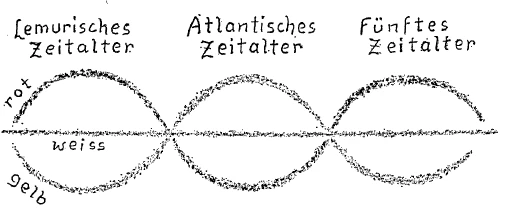
[ 2 ] The point is that the Luciferic and Ahrimanic forces, so to speak, reached their peak—the peak of their beneficial influence within human evolution—precisely at the time of the Mystery of Golgotha, and in a certain sense—if one may use the expression—humanity faced the danger that this peak might be exceeded, and that as a result, the necessary balance between the Ahrimanic and Luciferic forces for the entire development of humanity might be lost. In the course of this human development, the following became apparent. If we regard the progressive development of humanity as a straight line (see diagram $.220), we can say that this progressive development of humanity includes—let us begin with the Lemurian period—the Lemurian Age, the Atlantean Age, and our own age, the fifth, however we may designate it, the post-Atlantean Age. If I draw the intensity of the Luciferic influence as a red line, it can be depicted roughly as follows. One can say that in the Lemurian Age there is a certain intensity that grows, then diminishes again, and this Luciferic intensity becomes very weak and then disappears entirely in the Atlantean Age, only to rise again in the post-Atlantean Age. So that in the Atlantean era, essentially—I am not speaking here of the individual human being, but of the development of humanity—there is little of the direct influence of the Luciferic in the historical development of humanity (see diagram, red).
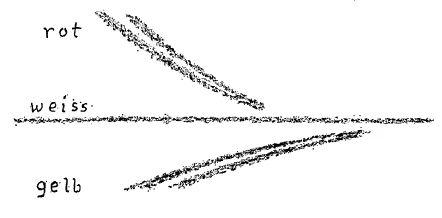
[ 3 ] In contrast, however, this era was marked by Ahrimanic development, which I have indicated with a yellow line, and I would have to draw it such that it is particularly strong in the Atlantean epoch and here, in the post-Atlantean era, becomes weaker again—I am now speaking of historical development—and we must be clear that when we characterize something like this, we must always take into account what I said the other day: When Lucifer is particularly active, he evokes Ahriman in the subconscious. So if the Luciferic curve is particularly pronounced in our fifth epoch, this does not mean that, because Lucifer is particularly active, Ahriman lies outside our sphere; on the contrary, it is precisely the case that, because Lucifer is strongly active among the historical forces, Ahriman is particularly at work in the subconscious regions of the human being.
[ 4 ] So you see, there is a kind of undulating pattern in the course of human evolution on Earth, both for Ahrimanic and Luciferic forces. A state of balance must be established between the two forces of Ahriman and Lucifer. This state of balance has never been perfect in the course of historical development. There were times when the Luciferic influences were very strong, and times when the Ahrimanic influences were very strong.
[ 5 ] When we consider the era of human development in which humanity was approaching the Mystery of Golgotha, we find that the balance between the Luciferic and Ahrimanic forces is an extraordinarily unstable one—a fluctuating one—and that there is, in fact, no true equilibrium. On the one hand, we have that current of humanity moving toward the Mystery of Golgotha, which appears to us historically in the development of the Semitic peoples. This current of humanity is particularly susceptible to the Luciferic being, whereby Ahrimanic influences are strongly generated in the subconscious.
[ 6 ] In contrast, the Greek nature is highly susceptible to the historical Ahrimanic forces, which generate strong Luciferic effects in the subconscious. One can only fully understand Semitic and Greek culture—which are, after all, polar opposites—if one properly takes into account this oscillation in human evolution between the Ahrimanic and the Luciferic. But for the Western population, at the time when the Mystery thus entered Earth’s evolution from outside, the influence of Greek culture was of immense significance. This influence of Greek culture, however, was already on the wane; or rather, it had passed its zenith. Greek culture was threatened by a downward trajectory. And this downward trajectory threatening Greek culture can be expressed as follows: It was precisely through the Ahrimanic influence they had—which manifested in their art as a Luciferic element—that the Greeks developed a high wisdom. And this wisdom, as we have often described, took on a very individual, humanly individual character. But it was, in essence, greatest where that which spiritual beings themselves had taught human beings still shone into Greek wisdom from time immemorial.
[ 7 ] We know, of course, that in ancient times the teachers of humanity were Initiates who drew their inspiration directly from the spiritual world. Through them, however, the spiritual beings of the world spoke directly, and when we look back to the ancient times of human development—still at the beginning of the fifth epoch—we can behold a wondrous primordial wisdom. In a sense, this wisdom had been so refined in terms of concepts and ideas that it had adapted itself to human beings through these very concepts and ideas. Whereas in earlier times it had been proclaimed by the great initiates in a more pictorial, imaginative form, it had been expressed by the Greeks in ideas and concepts, thereby adapting itself to human beings. But what is truly admirable about the Greeks—what still resonates even in Plato’s philosophy—is an echo of that primordial wisdom which humanity, I might say, received from the mouths of the gods themselves. Yet this wisdom was in danger of being lost to humanity.
[ 8 ] When one looks back on that era of Greek intellectual development which Nietzsche called the “tragic age,” one looks back on the great figures of Greek philosophy—Anaxagoras, Heraclitus—and one sees in them, I might say, the last bearers of the wisdom of the gods, which has, however, already been transformed into ideas and concepts. Thales is, in a sense, the first to base his thought purely on natural concepts; he is already detached from the immediate, living impression of humanity’s primordial wisdom, which can still be perceived in Anaxagoras. Humanity was gradually in danger of losing this primordial wisdom. Yet it was from this primordial wisdom that flowed what, in ancient times, enabled people to know anything at all about human beings. Knowledge of the human being—this was, after all, something that was to permeate Greek wisdom and all primordial wisdom. The mysteries were meant to impart knowledge of the human being. “Know thyself” was one of the sayings of wisdom. But this ancient knowledge of humanity was conveyed indirectly through Lucifer, and human beings developed it through Ahrimanic forces. It was entirely bound up with the state of equilibrium between Ahrimanic and Luciferic forces.
[ 9 ] Now, at the time when the old world was coming to an end, as the Mystery of Golgotha was emerging from the other side, a slight excess of Ahrimanic forces set in for humanity. The Ahrimanic forces were particularly strong at that time. Now, since the 16th century, something similar has been happening again—a kind of renaissance of the Ahrimanic forces. But it was precisely during that time—when the Mystery of Golgotha entered the world—that the Ahrimanic forces were particularly strong. And the strength of these Ahrimanic forces brought about, in particular, that human soul life was driven toward abstractness, to the very degree of abstractness that we then encounter in the Roman character, which is abstract through and through. One must ask: What would have become of humanity if the course of development had continued solely within this current of development just described, had the Mystery of Golgotha not come? What would have happened is that human beings would no longer have been able to grasp a concept, an idea, or a feeling of the human personality itself.
[ 10 ] This is an extraordinarily significant statement. This was the threat facing humanity: because nothing could any longer be communicated to them from the gods, because even the traditions had been lost—those traditions of divine wisdom regarding the individual—they were destined to become more and more of a mystery to themselves. One must feel the full force of this truth: Without the Mystery of Golgotha, humanity would have faced the threat of becoming more and more of a mystery to itself. People could have attained wisdom, but only about nature, not about themselves. And they would have gradually forgotten that they were born of the Spirit. They would have had to unlearn this completely.
[ 11 ] Then came the Mystery of Golgotha. And among the various perspectives from which the Mystery of Golgotha can be characterized, one perspective that must be considered is that, through the impact of the Mystery of Golgotha, human beings were once again given the ability to establish themselves as personalities from spiritual heights that they had lost from the earthly realm. The Christ impulse gave human beings the opportunity to once again establish themselves as personalities—but now to do so through inner forces.
[ 12 ] It is extremely difficult for people today to imagine how ancient humans came to develop a sense of their own personality, because people today refuse to believe just how different the external worldview was for them. One cannot understand a figure such as Julian the Apostate in all his world-historical significance unless one knows that he was one of the last of those who still viewed the sun differently than people do today. People today view the sun as a physical body. The influence of the moon has lingered longer for them as a natural phenomenon. Even today, lovers still take walks under the moon, swooning and dreaming; under the moon, the imagination grows and blossoms; under the moon, twilight falls, and moonlight poetry—both true and false—is still widespread among people today. Just as some people still feel this way about the moon today—but much more intensely—so did the ancient people feel when they awoke and beheld the sun. When the people of old awoke and saw the sun, they did not merely speak of the sunlight; they sensed: From this celestial being, along with its rays, flows into us that which permeates us, warming and illuminating us, that which makes us who we are.
[ 13 ] Julian the Apostate still sensed this, and he believed that it could be preserved for humanity. And that was his error; that was also his great tragedy. The personality no longer came to meet evolving humanity through the physical ray of sunlight. This realization of the personality was brought to humanity through a spiritual path. What the sun out in space could no longer provide, what could no longer reach humanity from the outside, had to rise from the deepest inner being of the human being. Christ Himself had to link His cosmic destiny with that of humanity, so that in the constant wavering of the scales between Ahriman and Lucifer, humanity would not fall from its path of progress. And one must take it with full and profound seriousness that Christ descended from spiritual heights to humanity and linked his destiny with that of humanity. How is this so? This is what is peculiar about it: When people looked into the sensory world before the Mystery of Golgotha, they simultaneously perceived something spiritual. I have just made this clear to you in connection with the contemplation of the sun. That was lost to humanity. In its place, humanity had to receive something else; it had to receive a spiritual reality from which, at the same time, it gained an impression of sensory reality. That is what is remarkable about the Mystery of Golgotha and its relationship to human knowledge.
[ 14 ] And this Mystery of Golgotha, which gave the actual meaning to the development of the Earth, actually took place—unnoticed by the Romans—in a small corner of the world, and Tacitus actually knows nothing concrete about the Mystery of Golgotha, even though he composed his excellent account of Roman history a hundred years after the Mystery of Golgotha. History actually says nothing about the Mystery of Golgotha, for the Gospels are not history; they are written as I describe in my book Christianity as a Mystical Fact: they are, in fact, books of mysteries applied to life. And no matter how much effort theologians may expend, there will never be a history—in the sense that history exists for other events—of the Mystery of Golgotha. For that is precisely what is characteristic of the Mystery of Golgotha: that one is not supposed to know anything about it historically, through the medium of external, factual history. Anyone who wants to know anything about the Mystery of Golgotha must believe in the supersensible. The Mystery of Golgotha cannot be proven historically or through the senses.
[ 15 ] Just as the people of old looked into the sensory world and perceived the supersensible, so too must modern people—if they do not wish to lose their understanding of the personality—look upon the Mystery of Golgotha as something supersensible and, through this gaze upon the supersensible, gain the conviction that: This, too, has happened historically, though no history records it. — Whoever fails to grasp that, in the course of humanity’s historical development, there is no history of the most important historical event—that outwardly, nothing has been recorded about it in what is called history—whoever fails to grasp this does not understand the entire relationship of the Mystery of Golgotha to modern humanity. For modern humanity is meant to learn from the Mystery of Golgotha to turn toward the reality of something for which it has no historical record. And this reality is meant to be effective. For what did we actually mention yesterday as coming from Ahriman and Lucifer? We mentioned that Lucifer diverts human minds from interest in our fellow human beings. If only Luciferic forces were at work in humanity, we would lose more and more interest in our fellow human beings. We would be little moved by what one person or another thinks. One can even get a fairly good measure of how much Luciferic influence is present in a person by asking: Does this person take an objective, tolerant interest in others, or is he or she actually interested only in himself or herself? — Luciferic natures have little interest in their fellow human beings; they are rigid and obstinate within themselves; they consider only what they themselves conceive and feel to be right; they are impervious to the judgments of others. If the Luciferic principle had continued to influence human development in the same way it had up to the Mystery of Golgotha, then humanity would gradually have entered a course characterized by people becoming stubborn and closed-off in their souls, each person concerned only with their own affairs, each person regarding only their own ideas as true, and having no inclination to look into the hearts of others. But this is nothing other than the flip side of the loss of personality. For in losing the very ability to recognize a human being as a personality, we also lose our understanding of the personality of our fellow human beings. There were a great many people—far more than one might think, especially in the age when the Mystery of Golgotha was approaching—in the Greek and Roman worlds, in Africa, and in Western Asia; many people who, in a certain sense, were haughty in spirit, people who went through the world, as, one cannot say “eccentrics,” but like haughty, solitary people who wanted to be alone. There were many such people; there were also those who made a philosophy out of not caring about other people, but only following what they carried within themselves. This was brought about by the fall of the Luciferic forces from their state of equilibrium.
[ 16 ] And even the Ahrimanic principle was present in a superhuman force. This is most clearly evident in the example of the first Roman emperors, the Julii, of whom only the very first, Augustus, was initiated—albeit in a somewhat questionable manner—while among the others there were at most those who forced their way into initiation, yet all of whom considered themselves sons of the gods—that is, initiates—and believed themselves to be descended from the gods. For the Ahrimanic reveals itself particularly in that a person does not wish to live among people as a personality among personalities, but rather wishes to develop power—as I explained yesterday—wishes to rule, to rule by exploiting the weaknesses of others. These were the two great and looming dangers at the time of the Mystery of Golgotha, to which humanity would have succumbed had the Mystery of Golgotha not come to pass: indifference toward fellow human beings, and the desire for domination on the part of each individual. By linking his destiny to that of humanity, Christ has implanted something extraordinarily profound within humanity. Perhaps you will understand me best if I speak to you schematically about what Christ actually implanted within humanity. We human beings, as I have shown you, possess forces that we develop through our very own nature. As you know, in a certain sense, it is only in the second half of life that we truly become wise through our very own nature. I have explained this to you at great length and repeatedly. But that is not all. What I have explained to you regarding the development of human intelligence between birth and death applies, in essence, only to Earth’s evolution; and we are to become even more intelligent through the Jupiter, Venus, and Vulcan phases of evolution. These forces, which we are to develop in the course of the Jupiter and Venus phases of evolution, are already present within us.
[ 17 ] Now, the following has happened: You know that whatever a human being can attain in terms of self-knowledge during the first half of life, he cannot attain through his own inherent human nature. He must attain it through Lucifer. His own inherent human nature continues. The Luciferic principle imparts self-knowledge to the human being by exerting an influence on them during the first half of life; this resplendent self-knowledge is then tempered by Ahriman in the second half of life. With the Christ impulse, a different current enters human evolution: the impulse that enters with the Mystery of Golgotha speaks to the deepest inner being of the human being. And if human beings were to develop, through their own innermost powers, what would lead them of their own accord to those cosmic insights that have entered Earth’s evolution through the Christ, then they would not acquire the capacity to do so until the Venusic stage of evolution. So no matter how intelligent a human being may become before his death, he would not be able to achieve on his own, during his time on Earth, what he attains through the fact that the Christ impulse has linked his destiny to the development of the Earth.
[ 18 ] We thus live out our earthly lives without being able—through our own inner development—to reach the point of comprehending the Christ impulse by the time of our death. From this, the following should be clear to you: There were contemporaries of Christ, his disciples; they associated with him, and through the tradition of primordial wisdom they were able to gain enough insight into him to later write the Gospels; but they could not truly understand him. For they certainly could not have attained an understanding of the Christ impulse by the time of their deaths. When, then, were they able to do so? After their deaths, in the afterlife. If we assume that, say, Peter or James were contemporaries of Christ, when were Peter or James ready to understand Christ? Only in the 3rd century after the Mystery of Golgotha. In the 3rd century after the Mystery of Golgotha, for they did not become ready until their deaths; rather, it was only in the 3rd century that they became ready.
[ 19 ] We are thus touching upon a very significant mystery; let us bring it very clearly before our souls. Christ’s contemporaries first had to pass through death; they had to live on in the spiritual world into the 2nd and 3rd centuries; only then could the knowledge of Christ dawn upon them in the life after death, and only then could they inspire those who wrote about the Christ impulse toward the end of the 2nd century or from the 3rd century onward. Consequently, writings on the Christ impulse—because they were channeled through the more or less clear, or indeed more or less clouded, inspiration of the Church Fathers—take on a very special character, but only from the third century onward. This is why Augustine, who ultimately became the defining figure for the Middle Ages, belongs to this era. And from this you can see what was essential for understanding the Christ Impulse: the Venus wisdom—if I may put it that way—which human beings cannot yet experience in this life until after their death, but only after their death—and in subsequent centuries, indeed, only then—this Venus wisdom being inspired onto the Earth. And it was—one might say, if the expression were not quite so foolish, but there is really no other—a stroke of luck that inspiration could take hold in the 2nd and 3rd centuries; for had one waited longer, beyond the year 333, then humanity would have become increasingly hardened against the spiritual world and would not have accepted any inspiration at all.
[ 20 ] As you can see, the effectiveness of the Christ impulse within humanity has been bound up with various mysteries over the course of centuries of Christian development. And anyone who wishes to seek them out again today will find the most important elements of the knowledge of the Christ impulse only by embracing supersensible knowledge. For the first true teachers of humanity regarding the Christ impulse were, in essence, the dead—as you have seen from my remarks just now—people who were contemporaries of Christ and who were not ready to attain a complete understanding until the 3rd century. In the 4th century, this understanding was then able to grow; but the difficulty of inspiring people also grew. And in the 6th century, the difficulty grew even more, until finally the time came when order was established from Rome regarding this infusion of spiritual secrets about the Christ Mystery into humanity and the resistance of obstinate humanity to it. It was then that Rome finally established order in the 9th century, in 869, at the Council of Constantinople, where the Spirit was finally abolished. Rome had finally had enough of this “inspiration business,” and the dogma was established that human beings possess something spiritual in their souls, but that it is heretical to believe in the Spirit. People were to be weaned off the Spirit. That is essentially what is connected with the Eighth Ecumenical Council in Constantinople in 869, which I have mentioned several times. It is merely a consequence of this abolition of the Spirit that Jesuits today—as I recently pointed out to you—tell people: “Well, in the past, there were inspirations, but today inspiration is diabolical; one must not strive for supernatural insights, because that is where the devil comes in.”
[ 21 ] Yet these matters are connected to the very depths that must interest one if one truly wishes to delve into spiritual science. For they are connected to a certain recognition of a character of wisdom that many so-called spiritual scientists—namely those who are often united in so-called secret societies—do not acknowledge. There is, I would say, a certain deception that is repeatedly instilled into humanity by those who know spiritual mysteries. And this deception cloaks itself in a false opposition, in a false polarity. Have you not heard people say that there is Lucifer, and his opponent is Christ—that people set up the polarity: Christ and Lucifer as adversaries? I have explained to you that even Goethe’s Faust concept suffers from the confusion between Ahriman and Lucifer, that Goethe was unable to distinguish precisely between the Ahrimanic and the Luciferic. The second essay in my little book on “Goethe’s Spiritual Nature” also deals with this.
[ 22 ] But this refers to something extraordinarily significant. The true opposition—which those who wish to speak the truth from the spiritual world have communicated to humanity—is that between Ahriman and Lucifer; the Christ impulse, however, brings something else entirely and has nothing to do with the Ahriman-Lucifer polarity, but rather moves along the line of balance. And something of immense significance rests upon the recognition of this fact. We will continue to speak about this tomorrow.