

The Polarity of Duration and Development in Human Life
GA 184
11 October 1918, Dornach
Translated by Steiner Online Library
Thirteenth Lecture
[ 1 ] You already know from a wide variety of sources that the development of modern humanity reached a decisive turning point in the 15th century, the beginning of the fifth post-Atlantean cultural epoch. As we know, this era is characterized by the fact that, at this point in time, humanity began its development through the soul of consciousness, whereas in the preceding Greco-Roman period, human development took place primarily in the realm of the soul of understanding or the soul of feeling. The point is that we must not regard a truth such as this—that we entered the age of the conscious soul in the 15th century—merely theoretically or abstractly, but with the full seriousness of life, so that we have, as it were, the will to constantly reflect on the following: What must the state of our soul be, and what must we do regarding this state of the soul, so that we may do justice to the fact that we are indeed in the age of the development of the soul of consciousness?
[ 2 ] Well, first and foremost, the point is that, precisely because of this age of the conscious soul, humanity is impelled to consciously strive toward certain perspectives that were not consciously sought in earlier ages. We know, of course, that among the many things—some more important than others—affected by what has just been mentioned, the most important event that has ever taken place in earthly life is also included: the event at Golgotha. For we have often emphasized: the event of Golgotha entered human evolution in such a way that, at first, human souls could not fully grasp its significance, but that this full comprehension can only come about gradually. And we have also often emphasized that the forces known to us always give rise to a tendency in humanity to lag behind in its development on the one hand, and to overshoot the mark on the other. Thus, in human spiritual culture, we find numerous efforts to maintain an unconscious way of understanding the event of Golgotha and to apply as little as possible the conscious development that humanity is undergoing to this event of Golgotha. We have, in fact, recently witnessed within a religious community the struggle between the effort to uphold, as far as possible, only the traditional, unconscious aspects regarding the Mystery of Golgotha, while—albeit with admittedly inadequate means, but nonetheless—the striving to advance more consciously than has been the case so far toward an understanding of the Mystery of Golgotha has asserted itself in what were called modernist Catholic efforts. The resistance to spiritual science’s advance toward the Mystery of Golgotha is, after all, nothing other than the striving of those who wish to keep this Mystery of Golgotha, as far as possible, in the unconscious sphere with regard to human souls.
[ 3 ] If one wishes to make fruitful progress toward the understanding that is particularly necessary for the development of the conscious soul, one must, above all, strive to gain insight into one’s own human nature from a wide variety of perspectives—not through empty talk, but by focusing on the facts. Let us therefore view our age as objectively as possible; let us first draw attention to facts that are particularly significant for development within the age of the conscious soul.
[ 4 ] In recent times, in this age of the conscious soul, people speak with great pride—indeed, with true arrogance—of the age of natural science. In a certain sense, this talk is correct, for it is not only those who are educated in the natural sciences today who live in this age of natural science, but by far the majority of educated people live within the scientific current of the age; for living in the age of natural science does not depend on whether one thinks the way botanists think about plants, zoologists about animals, or anthropologists about human beings today; it does not matter whether one knows more or less about anthropology, botany, or zoology; rather, what matters is that one shapes one’s thoughts about the world in such a way that they align with the direction of scientific thinking. And this direction of scientific thinking is actually taken by most people who today have even the slightest connection to formal education—that is, who are not illiterate or nearly illiterate. So the people who are even considered today adopt a scientific way of thinking; they are not prevented from doing so by the fact that they sometimes attend church diligently, listen to sermons, or are, as one says, religious and devout. For just ask yourself once: how much does this religious piety still influence everyday life today, even if one believes oneself to be—or to ought to be—as devout as possible? The religious sentiments cultivated within this or that religious denomination have extraordinarily little power to influence people’s thoughts about the world. Everywhere in outward life, among the broadest segments of today’s population, people simply think in a scientifically oriented way. For most people today, religion is, to a greater or lesser extent, merely an afterthought. One can therefore say that the modern age of the conscious soul is proud—even haughty—of its scientific achievements and the corresponding scientific orientation of its thinking, and that this age looks upon earlier ages with a certain arrogance.
[ 5 ] Just think of the feelings—those petty, smug, self-satisfied feelings—with which the “proper” person of today looks back on the ancestors whom he claims believed in ghosts. There is no need to object too strongly to the claim that our ancestors believed in ghosts. They did. Today, let us focus less on the conceptual content of the statement—“Our ancestors believed in ghosts, and we are so intelligent that we no longer believe in ghosts”—and instead focus more on the emotional content one feels when we look at the present and see how it judges those foolish ancestors who believed in ghosts, and how we have now finally moved beyond that in the age of science and no longer believe in ghosts. This judgment—that our ancestors believed in ghosts—is in itself a half-truth and therefore an extraordinarily dangerous one; for half-truths are often worse than complete errors, because complete errors are easily recognized, whereas half-truths haunt the world like ghosts.
[ 6 ] It is indeed true: If one goes back to earlier ages, to the time before and after the Mystery of Golgotha, and even further back to the third post-Atlantean cultural epoch, one finds, for the most part, that people believed in ghosts and demons, as I myself recently demonstrated to you in the case of the great Tertullian. That is true. But this age is preceded by another, in which people also spoke of ghosts, though not in the same sense as they believed in these ghosts during the ages just described. They spoke of ghosts in the second and first post-Atlantean cultural epochs, being fully aware that what they were imagining was a product of their own imagination. They could only imagine ghosts according to their own imagination. But in imagining ghosts, these ghosts were images of the spiritual world lying behind them. — So there was a long era in which people did indeed form ideas of ghosts, but knew that behind the ghosts—which they regarded as images—lay the spiritual world. In a sense, they depicted the spiritual world—which they imagined in ghostly terms—within their own imaginative realm. But then the spiritual world was more or less forgotten, or rather, lost from view; what remained were mere images, which were then regarded as realities, and from this arose the superstition about ghosts—which is thus a decay of that from which it originated.
[ 7 ] So one can say: The ancients developed their consciousness in such a way that they cultivated precisely those powers that were inherent in consciousness, and they instinctively limited themselves to having nothing but ghosts in their imaginations. In ancient times, they imagined the gods through ghosts, and later they came to regard ghosts as realities. Not that the ghosts were false, but people’s view of ghosts has become false.
[ 8 ] Well, modern man admits—in his judgment of the ancients—that their ancestors imagined ghosts and that believing in ghosts is a superstition; he licks his fingers in self-satisfaction and considers himself clever. But he refuses to acknowledge that in even earlier times, people conceived of the spiritual world through ghosts, for the spiritual world does not particularly interest him today—only the natural world. And so he feels infinitely superior to his ancestors by forming concepts of nature from within his own consciousness. The age of the conscious soul, however, demands something different from us than what our ancestors were capable of. We must gain insight into what we actually possess when we hold a view of nature.
[ 9 ] Well, we do form ideas based on our consciousness, especially if we are truly modern, self-satisfied, enlightened, intelligent people; we form ideas about nature. But if you take this entire world of ideas about nature and examine it—examine it without prejudice—then you find that, while we do have these ideas, we cannot capture nature within them. There remain, as people say, limits to our understanding of nature. I have often cited a contemporary philosopher who, as a philosophical writer, has become little known, but who has spoken openly about many things that others did not, because they had not examined them so deeply: Richard Wahle, who has written two major books and all sorts of smaller ones, including a major book as early as the 1890s, titled: The Whole of Philosophy and Its End; and a few years ago he wrote the book On the Mechanism of Spiritual Life. This Richard Wahle is a person whom one might call an exponent of contemporary humanity; one could say that the way Richard Wahle thinks is actually the way all people think who are oriented toward the natural sciences. They think just as he does; only he draws the ultimate conclusions, and so the strange, striking situation arises that he became a professor of philosophy and immediately wrote a thick book on the end of philosophy—a book in which he sought to prove, based on the scientific way of thinking, that philosophy should not exist. In this volume of his, On the Mechanism of Mental Life, this professor of philosophy and philosophical writer expresses himself in a very peculiar way about his colleagues, the philosophers. He says, more or less, that philosophers are like a restaurant; in the past, cooks and waiters used to stand around preparing inedible dishes and serving them to the guests; now they stand around with absolutely nothing to do. So this particular cook or waiter or philosopher claims that philosophy can be compared to a restaurant where, in the past, nothing but unhealthy food was churned out by cooks and waiters—this philosopher’s colleagues—and now things have gone so far that not even unhealthy food is being cooked by today’s philosopher-cooks anymore; instead, the cooks and waiters are just standing around. Of course, since he is such a chef or waiter or philosopher, he must feel that he is actually standing around completely unnecessarily. So in his two books, he has set himself what he believes to be a final task; afterward, there will be no more philosophers—he is to be the last one. That, roughly speaking, is the deeper meaning of his books. He is to be the last, for he has now set himself the task—yes, how should I characterize this?—Richard Wahle, as one of the waiters or cooks among the other cooks or waiters who used to concoct the unhealthy fare of philosophy and now have absolutely nothing to do, is busy among these cooks and waiters concocting a poison that will kill them all! This is an extraordinarily interesting spectacle! And if one is accustomed to viewing history symptomatically as it unfolds, it is a serious and very remarkable symptom of the present. For this philosopher is astute and has penetrated deeply into the problems of scientific thought.
[ 10 ] Now, I am convinced that the vast majority of you, when you pick up one of these books, will put it down again very soon, because these books are also written in the language of modern philosophical scholarship, and this language, as you know, is equipped with terminology that anyone not well-versed in it cannot understand—terminology that must first be learned. Nevertheless, anyone who can handle this language will know that these books contain a vast amount of insight—the kind that can be produced in the present day—and that within the lamentable circumlocutions found precisely in these books lies an intuitive insight that must, however, be articulated quite differently than Richard Wahle articulates it. But one might say: This peculiar passion, this peculiar fervor he possesses—to set about concocting this poison I have spoken of for the other cooks and waiters—testifies that this insight pulses within him; otherwise he would not have said, as a well-established professor of philosophy, that man possesses no more wisdom than an animal, and differs from the animal only in that the animal is at least not rational enough to strive for wisdom, whereas man does strive for wisdom—and is thus rational—because he intuits that which cannot possibly exist for him.
[ 11 ] There lies an important insight, even if this insight is more or less negative in nature: within it lies the insight into contemporary scientific knowledge of nature. This scientific knowledge is supposed to deal with nature; it is supposed, as it were, to bring nature to life in the imagination of modern consciousness. But if one really takes a close look at the ideas people form today about nature—especially in the most scholarly contexts—one finds that, curiously enough, human consciousness today actually does nothing other than conjure up ghosts; the only difference is that the ancients conjured up ghosts in the form of gods, while modern people conjure up ghosts based on the facts of nature. For what modern people imagine to be natural science is not nature itself, but rather stands in relation to nature as a ghost stands in relation to reality. Indeed, a person like Richard Wahle senses that the age of the conscious soul must be coming: We are not all that much more exalted than our ancestors; they used the powers of consciousness to form ideas of ghosts, and we, too, form ideas of ghosts. The only difference is that our ancestors had more beautiful ghosts than the ghosts concocted by today’s scientific thinkers, which are, in essence, terrifying phantoms of abstract concepts. But they are ghosts, just as the ghosts of our ancestors were ghosts. And these ghosts of natural science, this ghostly natural science itself, relate to reality no differently than the old ghosts related to divine reality.
[ 12 ] It is now fitting for the Age of the Consciousness Soul to come to the realization that this is indeed the case—that one truly lives among ghosts when one lives in ideas. It is of the utmost importance that, in the Age of the Consciousness Soul, one arrive at this significant fact. The ancients did not live in the Age of the Consciousness Soul; therefore, they were able to remain unaware of the fact that they were imagining ghosts. Our natural scientists also imagine ghosts; but in the Age of the Consciousness Soul, we have the task of knowing that we, too, are imagining ghosts—that we are not imagining nature itself, but only ghosts of nature. And just as our ancestors evolved from their more distant ancestors—who did not take these phantoms for reality, but rather for images of divine forces, for images of supersensible intelligences—so must we, precisely through the age of the soul of consciousness, ascend to the true recognition: Our scientific phantoms are not realities, as today’s natural scientists believe, but are pointers to the realities that one is actually supposed to seek through them. If one is mistaken about the phantom-like nature of natural science, one cannot arrive at an understanding of the human being either. For we can observe nature with our phantom-like conceptions; it nevertheless appears before our eyes in its true form; but we must consciously experience human beings themselves, beginning with the age of the consciousness soul. It is not possible to merely apply phantom-like conceptions here; otherwise, we turn ourselves into phantoms. This has already happened all too often.
[ 13 ] The theory of evolution—Goethe’s theory of development—is not wrong, but rather tends toward the truth because it seeks to grasp human beings as reality. The materialistic, Darwinian-tinged theory of evolution speaks of the descent of humans from animals. But the fact is that something within us does indeed descend from animals, or at least shares a common ancestry with them; yet that is not who we are as human beings—rather, it is the specter that natural science knows of us. First, natural science turns human beings into spectres by knowing only their spectral appearance, and then it asks: Where does this specter come from? Only when we come to realize that it is not the human being, but his specter, that can be treated as modern natural science does, will we arrive at the correct understanding in this field. But one must live, and you will readily admit to me: Just as you walked here, came here—you would not have come here if you had merely sent the homunculus, the specter, as you must imagine yourself to be according to scientific concepts. And if only the homunculi were sitting here—those who, in your consciousness, live through you—then I would not be able to speak to these homunculi either! You are already bringing your real human being here, but not into consciousness. Yet the age of the conscious soul must bring the real human being into consciousness. There must be an ascent from the homunculus to the Homo. For if this were not to happen, human beings would come to experience the polar opposite of their ghostly existence. If one does not regard oneself as a ghost, but in one’s reality, as the ancients did—who, though they imagined themselves as ghosts, but because they possessed atavistic forces within themselves, reality could still enter them, whereas in modern human beings only that which can come through their consciousness soul enters—but if one has only the ghost of the human being in the consciousness soul, then moral-spiritual impulses do not enter through this consciousness soul. And if you look at the accompanying phenomena of ghostly natural science, indeed, you will find that this newer age, which has a ghostly natural science, never really wants to accept that impulses for moral action come from the spiritual world itself. The moral impulses with which humanity today works are ancient, dating back to atavistic ages; for modern humanity does not wish to consult the spirit when impulses for action arise, but rather wishes to consult nature. It asks: What is human nature? What kinds of instincts are there in human nature?
[ 14 ] It is terrible how modern humanity really wants only to question nature, yet knows of nature only a phantom. Therefore, reality weighs heavily and struggles unconsciously within modern human beings, demanding entry through consciousness, because we live in the age of the conscious soul.
[ 15 ] I have thus clarified for you some of the important aspects of the current situation. I have led you to see that in this present situation, the state of affairs is such that, on the one hand, people form ghostly notions about nature and become experimental natural scientists in all fields; then human beings themselves approach them in their reality, and these people then observe these human beings in their reality. But the ghostly concepts of natural science are inadequate tools. Therefore, these people do not become observers of human beings, but only observers of the human ghost: psychoanalysts. Psychoanalysis is truly the child of ghostly natural science; that is why I always refer to psychoanalysis as something that works with inadequate tools.
[ 16 ] Now we may ask: What has brought about this situation? This situation has arisen because, as a result of the constellation brought about in the Earth’s evolution, there is a very specific relationship between human evolution itself and the two side currents—the Ahrimanic and the Luciferic. I have, in various ways, pointed out, so to speak, the normal course of development, and then also the two side currents: the Luciferic current, which flowed into earthly life during the Lemurian epoch, and the Ahrimanic current, which flowed in during the Atlantean epoch. Thus these three currents are present within human evolution, and whatever occurs in human evolution is under the influence of these three currents.
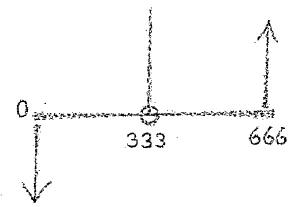
[ 17 ] Everything contained within these currents led to the emergence of a significant turning point in the entire course of human development around a specific year. In that year, where the three currents converge, there was a turning point in human development that is obscured only by the chaotic external circumstances, so that one cannot see exactly what is happening, but only the chaos itself. This important turning point occurred around the year 666 after the Mystery of Golgotha. At that time, 666 years after the birth of Christ, something should have happened—and could have happened—but did not. You will soon hear the reason why it did not happen.
[ 18 ] In the year 666, a significant being could have appeared—visible to outer humanity, particularly to Western humanity—a being that would not have appeared on the physical plane but would have made itself known to humanity very clearly, even outwardly, so that people would have fallen under its spell. If this being had appeared in the form it had itself planned, then we would not be writing the year 1918 today, but—minus 666—only 1252; for this being would have inspired people to such an extent that they would have based their calendar on it. If this being had been able to appear as it had planned, it would have brought about something very peculiar. The fact is this: 333 years earlier—that is, precisely in the year 333 A.D.—marked the midpoint of the fourth post-Atlantean epoch, the very midpoint of the Greco-Latin epoch. Now you can work it out for yourself: it begins in 747 and ends in 1413—that is 2,160 years, just as it should be. If you take half of 2,160 years, you get 1,080 years, meaning that 1,080 years had elapsed since 747 by the midpoint of the post-Atlantean era. So if we subtract 747, we are left with 333: thus, the year 333 A.D. marked the midpoint of the Greco-Roman era. This midpoint did not occur before the Mystery of Golgotha, but actually only after the Mystery of Golgotha; it signifies the highest possible reality, though not an external one, because in external reality other currents also come into play. But if development had proceeded in a straight line and the lateral currents had not intervened, then that would have been the true midpoint, and it would have been the culmination of the age of the intellectual or emotional soul. There, the intellectual or emotional soul would have had to reach its utmost, highest unfolding. It did not turn out that way, because, so to speak, the worm was already gnawing away—the one who planned, 333 years later, in 666, to carry out a very specific procedure regarding human development. The procedure that was to be carried out regarding human development by this being, the Sorat, the animal, was to consist in this: that this being, who had already fully developed the consciousness soul, while humanity had only reached the stage of the intellectual or emotional soul, would bestow upon humanity all the spiritual and soul-related achievements that humanity did not yet possess at that time by virtue of its intellectual or emotional soul, but which it can only attain through the consciousness soul—achievements that would therefore only become available to humanity in a later age. The culture of the consciousness soul was to come to humankind prematurely. And according to the conditions of the world, 666 was the most favorable time; then this being could exert such an influence on the Earth that it could have said: “I will now teach humankind everything they can ever discover through their consciousness soul.” I am already bestowing upon human beings, even now in the age of the intellectual or emotional soul, what the other gods—whom I oppose—intend to give them only in the next cultural epoch. — The unjustified mingling of the intellectual or emotional soul with the soul of consciousness—that was the intention.
[ 19 ] It would hardly have been possible to induce all of humanity—which, of course, exists at various stages of development—to incorporate the content of the soul of consciousness into the intellectual or emotional soul, but it might have been possible for a large number of people. It could have succeeded in such a way that, if this being had truly achieved its purpose, a number of geniuses would have emerged among humanity, particularly in the educated world of the West. For they would indeed have been geniuses. What people who could not quite keep up—those who still lag behind in their development—will normally not know until the year 2493—consider: in the middle of the age that began in 1413; for if you add half a cultural age to 1413, that is, 1080, you arrive at 2493— that could have bubbled over at that time—though not in the same way as it would for those people then, but through the genius of an intuitive imagination—and revealed itself to the unsuspecting Western humanity.
[ 20 ] Strange phenomena had been planned. When you think about the scientific ideals of the present day, when you hear people describe how wonderfully far we’ve come in recent decades—just imagine what kind of ideas those same people might have about what humanity on Earth will be like in the year 2493, if they’re already so clever in 1918! So people would not have built machines and so on, would not have experimented, would not have gone through the trial-and-error process—but with ingenious powers they would have foreseen everything and accomplished much as well. This year 666 was destined to literally flood humanity with a level of knowledge and a culture that the gods inherent to humanity had intended only for the third millennium of human history. It is unimaginable—and need not be imagined—what situation the so-called educated world would have found itself in had it been flooded in such a way with this knowledge of the year 666. People would have degenerated due to their lack of self-discipline. For if you open the stories—which, after all, always tell only one-sided accounts of the state of mind that people had in the year 666—you will already come to realize how people would have behaved had they possessed such geniuses among them. They had already come so wonderfully far with what they had developed up to the year 1914; where would humanity have ended up if they had been flooded with all this wisdom of the beast! But it was planned by certain higher spirits, namely by a being of Ahrimanic nature who was to be the leader of these spirits—a being who would have appeared, if not on the physical plane, then in a very real sense.
[ 21 ] This had to be prevented. And even if many believe that nothing should be withheld from humanity if such a thing can be given to it: since it was not in keeping with the spiritual sense of human development, it had to be prevented. And it could be prevented by maintaining the balance. Consider that 333 marked the midpoint of the fourth post-Atlantean epoch; 333 years later came 666; by then, the Ahrimanic forces would have powerfully elevated all forms of materialistic arrogance—albeit with genius-like powers. The balance could only be maintained because, 333 years earlier—that is, at the beginning of the Christian era—the being had appeared who introduced his own substance into human development to restore balance, thereby preventing the being I have spoken of from appearing 333 years after 333.
[ 22 ] There you have one side of the scale: from 333 to 666 is 333 years. There you have the other beam of the scales, which brings about the balance: from 333 back to the Mystery of Golgotha. This has created a state of equilibrium. As a result, something has happened that, so to speak, took place behind the scenes of outer, profane history. Something that could have happened was prevented by something else that actually did happen—but, as I explained recently, this can only be grasped through supersensible forces, because the entire process unfolded with supersensible significance for the development of the Earth.
[ 23 ] So what actually would have happened starting in 666, if the Beast had been able to intervene in human evolution at that time without the Mystery of Golgotha having taken place beforehand? What could have happened? You will be able to form a picture of what might have happened if you consider what I have just described. Humanity was rushing toward the fifteenth century; if the beast had been wreaking havoc among humanity from 666 onward all the way into the fifteenth century, it would have completely taken control of what was unfolding. The ghostly, scientific understanding of the world was on the horizon, and with it, the emancipation of human instincts. Because the consciousness soul was meant to grasp only the ghost of the human being, the real human being was left behind; he did not grasp himself. Now, in the age of the soul of consciousness, human beings can become truly human only by becoming conscious of this fact; otherwise, they remain animals, lagging behind their own human development.
[ 24 ] But that was what the being who sought to intervene in 666 wanted: to make itself a god. It said: People will come; they will no longer turn their gaze toward the Spirit; the Spirit will not interest them. I will see to it—and this being has indeed succeeded in this—that a council will be held in Constantinople in the year 869, where the Spirit will be abolished. People will continue to have no interest in the Spirit; they will turn their interest to nature and develop ghostly notions about nature. And then—which people will not notice, because they will not recognize themselves as real human beings but as ghosts—I will gain complete control over the conscious soul. I will mislead people about themselves; I will allow them to perceive themselves only as ghosts, and I will then pour all the wisdom of the conscious soul into their intellectual or emotional soul. Then I will have them; then I will have seized them.
[ 25 ] For what would have been achieved then? If a human being develops in a reasonably normal way—if he were to develop in such a way that that being would have no further role to play—he must progress toward the spiritual self, the life spirit, and the spiritual human; that would be thoroughly taken away from him. He should remain at the level of the consciousness soul; he should receive what the Earth can give him, but no more—he should not proceed to the stages of development associated with Jupiter, Venus, and Vulcan. If it were to happen that, at the right stage of development, he were to acquire the content of the consciousness soul through his own innate powers, then the predisposition to ascend to the spiritual self and so on would already be present within him as a result of the development he has undergone in the normal sense. But this was to be prevented. That is why human beings were to have the soul of consciousness, along with its contents, instilled and implanted into their intellectual or emotional soul at an earlier stage. Then human development would have come to a halt at the stage of the soul of consciousness; then he would be a monstrosity of knowledge, left to his own devices from the sixth epoch onward! But then it would be all over for them; they would not develop further, but would incorporate the contents of their consciousness soul, placing everything within their utmost egoism, in the service of the consciousness soul.
[ 26 ] That was the intention of this being who sought to appear as 666: to cut off, to ensure that the future development of the Earth would be cut off; that, once the Saturn, Sun, Moon, and Earth phases of evolution have run their course, this evolution would be brought to a close, and that humanity would then no longer follow the path that the beings of the higher hierarchies—who have guided its normal evolution from the very beginning—wish to walk with it.
[ 27 ] This could only be prevented by ensuring that this balance, this state of equilibrium, became an integral part of humanity’s evolution—that is, by placing Christ’s intervention, the Mystery of Golgotha, exactly as far back from the midpoint of the fourth post-Atlantean epoch as the point in time lay ahead at which the animal sought to intervene.
[ 28 ] You can see the connections hidden within the facts that external Maya actually contains. In the Age of the Conscious Soul, it cannot be any other way than that people enlighten themselves about such things. For that means, after all, becoming aware that one no longer lives unconsciously. Consider that we are all immersed in what has been brought about solely by the fact that—as a certain “Catholic Epistle” in the Gospels puts it—the beast has been bound by Christ Jesus. It is a most remarkable fact that in this Epistle of James—which is regarded as authentic in some of the original Gospels but has been classified as apocryphal by the Western Church—precisely the most important fact concerning the “balancing” of the beast by Christ Jesus is articulated. It was known in certain circles what should not be allowed to reach the people of the West if one wished to prevent knowledge of the mysteries of Christ from passing more and more into the conscious soul.
[ 29 ] If you take what I have said today, then you will not be surprised that the author of the Book of Revelation speaks about it with a certain passion. You will easily be able to reconcile what I am saying today about the temporal realm with what I have said from other perspectives about the beast of 666. Things are, after all, always viewed from different angles; as you know, we must do this. The author of the Book of Revelation expresses himself with a certain passion at the point where he speaks of the appearance of the beast, saying something like: “The number of this beast is 666, and it is the number of a man.” — Or rather, it is the number of the man who refuses to say, “Not I, but the Christ within me.” These things must become ever more conscious to human beings, since they have already entered the age of the conscious soul.
[ 30 ] But just take the facts as they stand today! Don’t turn them into some old-fashioned criticism, but rather into a call to real action—just take the matter as it is. If one were to speak today to the truly intelligent people of our time about the kinds of things we have just discussed—imagine sitting down with one of the leading figures of our time, someone who is truly intelligent in a particular field, and telling them such a thing—just imagine what judgment that person would form today! But if you take what you have to imagine there in all seriousness, then you will have to say to yourself: We have indeed entered the era of human development in which one is least understood when speaking of spiritual science, which is most appropriate for this very era.
[ 31 ] I would like to say that never before have two groups in the world understood each other as little as the spiritual and the non-spiritual do today. That is to say, the spiritual can certainly understand the non-spiritual—it is not particularly difficult, after all—but the non-spiritual resist with all their might, and especially with their words, any kind of understanding of the spiritual.
[ 32 ] Well, this fact should come as no surprise, for other aspects of the present day are also at odds with one another, and our age is, after all, an age of great discrepancies and great disharmonies, where opposites clash head-on. If today a person who is considered “intelligent” comes across an essay on such matters as they are presented here, he will say: It is strange how this fits into our age—it doesn’t fit in at all! — For they believe that only what they themselves think fits into this age; they find the other ideas completely out of step. That it is in harmony—if not in a sensory sense, then at least in a supersensory one—is what we will discuss tomorrow and the day after.
[ 33 ] But other things don’t add up in our present age either. Just take a close look—with the seriousness one would apply to a reflection on life—at such descriptions, these reflective accounts of how humanity had made such magnificent progress in humaneness and mutual understanding among peoples right up into the 20th century! You can find magnificently written essays and entire books from the early 20th century on this subject—written in a smooth, sweet style! A truly progressive person of that time perceived the description of his own era as something he could savor like honey. Such descriptions do exist: there are countless accounts of just how wonderfully far humanity has come! Well, then compare that with the present situation over the past four years, and see if it really adds up.
[ 34 ] But all of this is based on the fear people have of entering the Age of the Conscious Soul. For as we truly enter the Age of the Conscious Soul, certain truths about human evolution must come to light. And that is why so much nonsense arises today regarding the most important matters—because people are afraid, because everyone should speak consciously but does not want to. We will continue this discussion tomorrow.
[ 35 ] [These words were followed by a brief description of an example illustrating the shrewdness of the authorities at the time, which the editors had not originally included, as the stenographer apparently had difficulty following the account and transcribing it accurately. The preserved text follows:
[ 36 ] “For, my dear friends, some of what is considered quite clever today reminds me of a notice I read recently, in which an authority announces that it will soon be issuing ration cards for 500 grams—I don’t know for what foodstuff. So an authority announces and makes it known that it will soon—who knows—issue butter ration cards or something of that sort in 500-gram denominations. It’s actually stated in the decree issued by the authority in question. Well, you’ll have a hard time slipping those cards into your pocket—each one weighing half a kilo! Well, when something is that clumsy, you notice it right away. But those who wrote it down don’t have to notice that. Yet, lo and behold, many such judgments are passed, and many such speeches are made. And if one were to examine more closely—where it isn’t so obvious—some of what is said and written today, it would look exactly like this 500-gram bread, fat, or cheese ration card.
[ 37 ] Let's talk more about this tomorrow. We'll meet here tomorrow evening at seven o'clock, and then again on Sunday at half past three»]