

The Polarity of Duration and Development in Human Life
GA 184
12 October 1918, Dornach
Translated by Steiner Online Library
Fourteenth Lecture
[ 1 ] Yesterday we attempted to characterize an extraordinarily important fact in the development of humanity in terms of its inner essence—once again from a different perspective than we have often taken before, but from an exceptionally significant one. Let us briefly recall this once more. Yesterday, I attempted to show that, in a sense, a kind of equilibrium has been achieved in the development of European humanity because the event that, according to our calendar, should have occurred in the year 666 was countered by another event, which we refer to as the event of Golgotha. I said: Humanity is subject to a development that is, in a sense, predetermined by the world-formation from which humanity originated in the first place. If one traces this human development in detail, one comes to understand how the soul, in particular, can position itself within whatever age into which it is born. We live in the so-called fifth post-Atlantean epoch, which began in the 15th century and will extend until the beginning of the 4th millennium, until the end of the 3rd millennium. In this epoch, humanity is to attain the development of what is called the consciousness soul. Thus, all the events of this age will ultimately point toward the goal that can be described as the development of the consciousness soul. Painful and joyful events, trials for humanity, and events that we can also describe as divine gifts for the spiritual enrichment of human beings—everything, both light and shadow—is meant to serve in this age to enlighten human beings more and more about themselves and their connection to the world. To consciously place oneself within the world and thereby attain what people have fantasized about so much in earlier ages and even today, but have never truly recognized—to attain, through self-discipline, what can be called the free human personality, the genuine exercise of the will grounded in self-education: this will, as time goes on, be the task of humanity in this age. To put it in layman’s terms, one could say that the fact that this is taking place is the decision of those divine beings with whom human beings have been connected from the very beginning, who lead them forward from stage to stage, but who are opposed on two sides by those forces we are accustomed to calling the Ahrimanic and Luciferic forces.
[ 2 ] Now I have said: Let us suppose, hypothetically, that the event at Golgotha had not taken place, that Christ had not decided to link his divine destiny with that of humanity—what would have happened then? One cannot truly understand history by merely noting what is apparent, for one will never arrive at a genuine, accurate assessment of events if one considers only what is visible. For example, suppose we are struck today by some event that prevents us from doing something we would have done had that event not occurred—suppose, for instance, we are prevented from going somewhere tomorrow where we might have met our death in a train accident: then one cannot say that one is correctly evaluating the event today if one merely takes note of it. For this event may very well—if we consider it in and of itself—be a highly insignificant event, merely preventing us from being where death would have struck us tomorrow; and if we consider only the event that has befallen us today, we cannot understand it. Precisely because people engage only in sensory and intellectual science, never asking what might have happened, they cannot assess events in terms of their true reality; therefore, they fail to gain insight into the true reality of events.
[ 3 ] So we ask the question: If we hypothetically assume that Christ had not linked his divine destiny to the human destiny through the event at Golgotha, what would have happened? Well, I told you yesterday: What would have happened is that in the year 666, through certain measures that would have become possible, humanity would have reached an entirely different stage in its development; that through certain geniuses who would have emerged, humanity would have attained an immense amount of great wisdom—somewhat fantastical wisdom, but an immense amount of wisdom nonetheless. This wisdom would have been of such immense significance for humanity because, in the natural course of development—as people slowly evolve toward this wisdom, as predestined by the divine spirits connected to their origin—they would still have to wait millennia, as I have indicated. They will also receive it in another way, because they will attain it through their own efforts.
[ 4 ] In other words, something should have been brought forward, so to speak, that humanity could only have attained through its own efforts over the course of a very, very long time. Humanity would have attained it in an immature state. It is hard to imagine today how the history of so-called civilized humanity would have unfolded if this event had occurred. As if by instinct—but by a genius instinct—humanity would have acquired an immature form of knowledge. Enormous confusion would have ensued. But there is something else: People would have been, as it were, suddenly overwhelmed by this knowledge, rendered as if paralyzed, and their future development would have been cut short. They would have merely been imbued with the consciousness soul—not in the natural way, as was meant to happen from the 15th century onward, but artificially as early as the 7th century—yet the entire development toward the spiritual self, the life spirit, and the spiritual human being would then have been cut short. Humanity would have become an extraordinarily perfect earthly human being, but its development toward higher stages would have been precluded. This is what is indicated in such a—I would say—vigorous manner—and I mean this vigorous manner in all seriousness, not as the word is usually used—in the Apocalypse, in the Revelation of John, as the appearance of the beast. There, reference is made to the number 666, which has caused so many scholars so much trouble in trying to elucidate it. They have all, to a greater or lesser extent, missed the mark.
[ 5 ] In the past, however—in order to prevent this from occurring within humanity and to ensure that humanity had a counterforce—the event at Golgotha had to take place in the course of human evolution, once humanity was ready to receive what was then infused into human evolution through the appearance of Christ Jesus.
[ 6 ] This, in turn, is a perspective that allows us to properly assess the significance of the event at Golgotha in the evolution of humanity. It is what gives meaning to the entire evolution of the Earth. That is why I have always said—just to give an idea of what the event at Golgotha means for the evolution of the Earth—: If a being from another planet in our solar system—one equivalent to an Earth human but not native to this planet—were to come down to Earth one day, everything on Earth would naturally be unknown to it; such a being, if it were suddenly to appear as if out of nowhere into earthly existence, might not understand many things, but there is one thing that being would understand. If you were to lead such a being—no matter where it came from—before Leonardo’s The Last Supper and show it Christ in the act of breaking bread, then this being would gain an inkling, in its own way, of the meaning of the Earth. You could otherwise show it all the natural products that exist on Earth, all the works of art that exist on Earth: it would understand only that into which the destiny of Christ Jesus is in some way woven. What I explained yesterday was derived—as I already said eight days ago on another occasion regarding something else—purely from spiritual insight. This spiritual insight alone can serve as a guide for people today to facts of vital importance. Through the perception of what unfolds over the course of time with the supersensible senses, this contrast emerges for the year of the birth of Christ Jesus and for the year 666. But let us now examine external history in this regard. Let us ask external history: Does it provide us with any confirmation anywhere that something like this actually took place?
[ 7 ] Well, since outward scholarship knows little about these things, it has never recorded these events in great detail. But when one knows the truth, it is indeed the case that even in outward history one is guided to those events that can then shed light on what is most important. You see, certain things happen here in life. Behind these things lies the spiritual world. Those who understand the connections then know how to relate this or that event to its spiritual background. Anyone who considers the emergence of modern humanity from the ancient Greco-Latin era—the Greco-Roman cultural development—will find much, much that remains a mystery if they look only at the outward aspects of history. But the inner connections shed light on these matters.
[ 8 ] Consider, for instance, an event that, while of little interest to the general public, is nonetheless extraordinarily significant: the fact that in 529 Emperor Justinian issued a ban preventing the Greek philosophical schools from continuing to operate, thereby prohibiting these schools—the glory of antiquity—from functioning. Thus, the body of learning from ancient times that had found its way into the Greek philosophical schools—the very learning that had produced an Anaxagoras, a Heraclitus, and later a Socrates, a Plato, and an Aristotle—was wiped out by this decree of Emperor Justinian in 529. Certainly, based on what history records, one can now form ideas about why Emperor Justinian, so to speak, swept away the ancient science in Europe; but if one reflects honestly on these matters, one remains unsatisfied by all the explanations offered. One senses that unknown forces are at work here. And it is strange that this event coincides—not entirely, but historical facts that are sometimes separated by a few decades nonetheless appear, to later observers, to belong together—with the expulsion of the philosophers from Edessa by the Isaurian, Zeno Isauricus, so that, so to speak, the most learned people were driven out of the most important centers of the world at that time. And these learned people, who had preserved the ancient science insofar as it had not yet been influenced by Christianity—that is, in the 5th and 6th centuries of our Christian era—were forced to emigrate. They emigrated to Persia and founded the Academy of Gundishapur.
[ 9 ] Even among philosophers, little is actually said about this academy of scholars in Gondishapur. But without understanding the nature of the Gondishapur Academy—founded by the remnants of the ancient scholars—one cannot comprehend the entire development of modern humanity. For what the sages—who had been expelled by Justinian and Isauricus—had brought with them to Gondishapur from ancient scholarship formed the foundation for an immensely significant body of teaching, which was then imparted to students in Gondishapur in the 7th century. And it was in Gondishapur that Aristotle, the ancient Greek sage, was translated. And the remarkable thing that happened was this: Aristotle—who would otherwise probably have been lost entirely—had first been translated into Syriac in Edessa by the scholars who were later expelled by Isauricus. The Syriac translation was brought to Gondishapur, and there the Syriac Aristotle was translated into Arabic. And this transmission of Aristotle from Greek into Arabic via the detour of Syriac contained something very remarkable. Anyone who gains insight into the changes that occur with ideas when one truly translates them—or attempts to translate them—from one language into another will be able to understand that, in a sense, there could have been something—well, let me put it hypothetically—like an intention behind it: not to take the Greek Aristotle, but rather the Aristotle who had made his way from Syriac into Arabic. And so, through the translation of Aristotle, a foundation was established in which Aristotelian concepts appeared in the light of the Arab soul as it was at that time—this remarkable soul of the Arabs, as it was then, where the sharpest thinking was combined with a certain element of fantasy, which, however, followed logical paths and rose to the level of intuition. And now, in the light of this unique teaching, this unique perspective, a powerful worldview developed at Gondishapur. It was at Gondishapur that, in the 7th century, what I have alluded to took place.
[ 10 ] What I have alluded to is not a fantastical event; it is not even something that took place entirely outside of Earth. Rather, what I spoke of yesterday was already being taught in Gondishapur: that which—understood in its essence—is the greatest antithesis, the greatest conceivable antithesis to what developed out of the event at Golgotha. And there was a certain endeavor among the sages of Gondishapur. This striving was—and it was precisely what I described yesterday and hinted at earlier—a comprehensive science that was intended to replace the efforts of the conscious soul, but which would have reduced human beings to mere earthly beings, cutting them off from their true future: their development into the spiritual world. Wise people would have emerged, but they would have been materialistically minded, purely earthly human beings. They would have been able to see deeply into the spiritual-earthly realm, into the supersensible-earthly realm; but they would have been cut off precisely from the very development intended for humanity by its creators through the spiritual self, the life spirit, and the spiritual human being. And anyone who has even a faint inkling of the wisdom of Gondishapur will certainly regard it as dangerous to humanity in the highest sense, yet at the same time will consider it a tremendous phenomenon. And the intention was to flood not only the surrounding region but the entire civilized world known at that time—everywhere, from Asia to Europe—with this scholarship.
[ 11 ] The groundwork had been laid for this as well. But what was to emanate from Gondishapur was blunted, held back, as it were, by retarding spiritual forces that were nevertheless connected—even though they also formed a kind of contrast—to that which was influenced by the Christ impulse. What was to emanate from Gondishapur was blunted, initially by the appearance of Muhammad. By spreading a fantastical religious doctrine—especially in those regions where the Gnostic wisdom of Gondishapur was intended to be disseminated—Muhammad, so to speak, cut off the ground beneath this Gnostic wisdom of Gondishapur. He skimmed off the cream, so to speak, and then what came from Gondishapur followed in its wake, but could no longer make headway because of what Muhammad had done. This is, in a sense, the wisdom of world history; one can only truly understand Islam when one also knows, in addition to other factors, that Islam was destined to blunt the Gnostic wisdom of Gondishapur, to deprive it of the very, strongly Ahrimanic, tempting power that it would otherwise have exerted upon humanity.
[ 12 ] Well, this wisdom of Gondishapur has not disappeared entirely. However, one must carefully trace the development of humanity from the 7th century down to the present day if one wishes to understand what happened in connection with the Gnostic movement of Gondishapur. What the great teacher—whose name has remained unknown, but who was the greatest opponent of Christ Jesus—taught his students in Gondishapur has not been achieved; yet something else has indeed been achieved. One must, however, conduct careful studies to recognize it. One might ask: How, in fact, did modern natural science come about—this peculiar scientific way of thinking? What I am about to say is not unknown even to careful historians. This modern scientific way of thinking, as I characterized it for you again yesterday, did not come about through a direct development from Christianity; no, the modern scientific way of thinking actually has nothing to do with Christianity as such, so to speak. Step by step, decade by decade, one can trace how—albeit in a diluted form—the Gnostic wisdom of Ctesiphon spread across Southern Europe and Africa to Spain, France, and England, and then across the continent, especially through the detour via the monasteries, one can trace how the supersensible was driven out and only the sensible was retained—so to speak, the tendency, the intention, was retained; and from the dulling of the Gnostic wisdom of Gondishapur, Western scientific thinking arose.
[ 13 ] It is particularly interesting to study Roger Bacon from this perspective—not Bacon of Verulam, but Roger Bacon, who demonstrates, despite being a monk—albeit one not highly regarded by his colleagues—how the Gnostic wisdom of Gondishapur has influenced him. People today know so little about the sources of what is at work in their souls that they believe they possess unbiased scientific thinking, whereas this unbiased scientific thinking actually originated in the Academy of Gondishapur.
[ 14 ] It is not, then, the case that what is derived from spiritual vision cannot be proven; one must simply follow the right paths to demonstrate, even within the realm of external experience, how what is derived from the spiritual realm actually came to pass. It is precisely such reflections that will be of immense importance for humanity’s immediate future. For if humanity wishes to find a way out of today’s confusion—the confusion of recent years—it will have to orient itself through its past. The fact that people today have a tendency to view everything, so to speak, from a scientific perspective has nothing to do directly with Christianity as such; rather, it is the result of the conditions I have described. Thus, in the development of Western culture, we truly have these two forces, these two currents: on the one hand, the Christian current; on the other, that which has so profoundly influenced Western thought—and which can be studied precisely when one studies medieval intellectual life.
[ 15 ] This medieval intellectual life is studied in a rather one-sided way. But go and take a look at the paintings that depict how medieval scholastics behaved toward the Arab philosophers. See how, in the spirit of the Western Christian tradition, the scholastic is depicted standing there with his Christian doctrine, using this Christian doctrine to stage the event that enables him to trample these Arab scholars underfoot—time and again, this passionate motif: to trample the Arab scholars underfoot with the power of Christ! See it in the images that emerged from the Christian tradition of the West, and then understand that these images embody all the passion of the Middle Ages to set Christianity against that which originally arose from opposition to Christ—from the Academy of Gundishapur, through Arab scholarship, and on to Europe. And to those who understand the context, even in Maimonides (Rambam) and Avicenna, the echoes of what I have described to you are evident everywhere. Just consider: human beings were destined for this, and the Mystery of Golgotha was meant to help them find the soul of consciousness within their own personality, so that they might then ascend further to the spiritual self, the spirit of life, and the spiritual human being. But there, drawing on brilliant Gnostic scholarship, he was to receive something directly through revelation, without his soul of consciousness having to develop on its own from the 15th century onward; like a revelation born of genius, he was to receive everything there that he would otherwise have had to find through his own personal efforts in connection with the divine-spiritual beings destined for him and determining him—among whom Christ Jesus also belongs.
[ 16 ] Even those who, already quite jaded, had embraced the Gnostic wisdom of Gondishapur—such as Averroes—still based their thinking on this. Who, when reading those foolish, disjointed notes about Averroes found in today’s textbooks, can actually understand why Averroes, the Spanish-Arab scholar, said: When a person dies, only the substance of his soul flows into the universal spirit; that human beings have no personal individuality, but rather that everything that constitutes the soul in the individual human being is merely a reflection of the one Universal Soul?” — Why did Averroes say this? Because this is a branch of the wisdom of Gondishapur, which made it clear to people not that each individual should develop the consciousness-soul, but that the wisdom of the consciousness-soul should descend upon them as a revelation from above. Then it would have been an Ahrimanic revelation; but it would indeed have turned out for humanity that the content of the soul of consciousness would have become monistic, and the individual consciousnesses would, in essence, have become mere illusions. All things that exist within the development of Western culture become clearer when viewed from a spiritual perspective. Now we must ask ourselves again and again, first: How can this development toward the soul of consciousness take place? It must, after all, take place. Second: What prevents people today from turning to spiritual science, which alone can show them the way to the soul of consciousness?
[ 17 ] Well, I explained to you yesterday: The knowledge of nature of which humanity today is particularly proud—this knowledge of nature actually leads to ideas that do not reflect nature, but rather contain a phantom. What people know about nature is not the truth of nature; it is a phantom, and it relates to true nature just as a phantom relates to true reality. Natural scientists simply do not realize that their knowledge is phantom-like, that what they know about human beings is not about Homo sapiens, but about the homunculus. Now, the course of human development—which, in its present form, began in the 15th century and will continue until the end of the third millennium—will be such that human beings will increasingly have to realize what they achieve through, for example, knowledge of nature, and how they approach reality through this knowledge of nature. Humanity will have to strive for knowledge, and it will have to avoid the obstacles that stand in its way as it develops this quest for knowledge. The most significant obstacles—we have already characterized them from a certain perspective, and we wish to bring them to mind once more—arise from the fact that in the age of natural science, which is a child of the Academy of Gondishapur, human beings acquire only a ghostly form of knowledge, because they form concepts of nature from which the spiritual has been stripped away. And we may ask: Why does the human being of our age do this? For then we will gain an understanding of what the human being must overcome. Why does the human being unconsciously seek a ghostly knowledge of nature and remain so proud and arrogant in this ghostly knowledge of nature? Why?
[ 18 ] Well, the moment one recognizes—fully recognizes—that this scientific knowledge of nature is merely a phantom of nature, one also feels compelled to penetrate to the true reality that lies behind the phantom. One then seeks the reality of nature. One could, in fact, also characterize our scientific worldview from the following perspective. One could say: This scientific worldview arrives at phantom-like conceptions, finds comfort in them because it succumbs to the belief that it thereby possesses conceptions of real nature, and then invents all sorts of concepts—atoms, molecules, and so on—which, as you know, do not actually exist at all but are merely invented—and invents all sorts of laws, such as the conservation of energy and the conservation of matter, which do not exist in reality. It seeks all manner of hypothetical explanations behind what does not exist, behind what it conceives of as phantom-like according to the laws of nature. Why does it do this? Well, because the secret fear I mentioned earlier, lurking in the depths of the soul, immediately asserts itself; only, people know nothing of this fear, because it is an unconscious fear. I could also call it cowardice. For what would happen if a person were to courageously admit to themselves: “You want a concept of nature, not a specter of nature; therefore, you must penetrate to reality”? — Then one would not find atoms, nor molecules, nor the concepts of Ostwald or Haeckel; instead, one would find Ahriman and his hosts! Then the matter becomes spiritual. The one who truly penetrates to reality through genuine natural science finds Ahriman. But people fear this, for they believe they will plunge into the abyss if, where they seek only matter—which in truth is not there—they find the spirit. For at first, the spirit reveals itself—a spirit one cannot worship, but from which one must protect oneself, and through which one must attain full clarity.
[ 19 ] It is certainly not by some arbitrary act that Christ has been placed alongside Ahriman and Lucifer in our group over there; rather, he has been placed there because this is connected to the deepest questions of life in our age, and because the matters at stake here must be made known to humanity. Our knowledge of nature is a ghostly one—it must be a ghostly one—as long as we lack the courage to seek the spiritual; but there we find Ahriman. And our knowledge of the soul does not provide us with the true soul, but only an image of the soul. Essentially, what is taught today as psychology in colleges and universities is precisely that which provides only an image of the soul. And this image obscures reality, for if one were to continue researching along the same path by which this image comes into being, then Lucifer would reveal himself. That is the next spiritual reality one would then encounter.
[ 20 ] Yes, anyone who can truly penetrate even the historically dulled remnants that still exist today of what was to be established in Gondishapur will find that this method leads to very precise knowledge about Lucifer and Ahriman. But it was meant to lead only to Lucifer and Ahriman, not to the guidance of humanity through Christ Jesus.
[ 21 ] This is something that was sensed by the medieval scholastics, who sought to trample the Arab scholars underfoot and always saw themselves in this situation—a feeling that arose because it is connected to the deepest evolutionary impulses of humanity. That which, so to speak, instead of being attained by human beings themselves over the course of centuries, was to have been revealed to them through Ahrimanic mediation—that would have been an exceedingly dangerous form of wisdom. Humanity is on the path to attaining this wisdom—which relates to three things—through the consciousness soul; but back then, in the 7th century, it was to come to humanity in the way I have indicated. This wisdom relates to three things; it is not a wisdom that humanity is not meant to attain, but one that it is meant to attain under the guidance of the Christ impulse. The three things to which this wisdom relates are: First, the nature of birth and death. We have spoken at length about these matters, and you know from the way we have spoken about birth and death that birth and death in human beings can only be mastered through supersensible knowledge. When a human being is born and when a human being dies, the supersensible seems to enter into the sensible. Birth and death remain mysteries to those who would seek to understand them solely through external, sensory means, for they are not sensory phenomena. The sensory appearance of birth and death is a false one; in truth, they are supersensible events. But when one attempts to explore the mysteries of birth and death through genuine supersensible observation, certain accompanying phenomena arise in the process of understanding. Above all, one comes to realize that, just as one lives here in the sensory world, one has only an apparent spiritual life. For centuries, the West has resisted this truth. You can trace this resistance in my book The Riddle of Man; I speak of it right at the beginning. I simply had to express myself more cautiously, because these things cannot yet be revealed to the outer world; it still finds them paradoxical. But as you know, the entire Western world is permeated by what Descartes formulated—though it is traced back to Augustine—the statement: Cogito ergo sum—“I think, therefore I am.” People believed they could grasp the reality of the soul through thinking. The statement would have to be phrased differently if one were to present the truth about human beings living in the sensory world. One would have to say: I think, therefore I am not! — For at the very moment we begin to think alone, when we develop only inner thought, we no longer exist. What is there within us? There is, indeed, a very complex phenomenon, but that will become clear to us today and tomorrow.
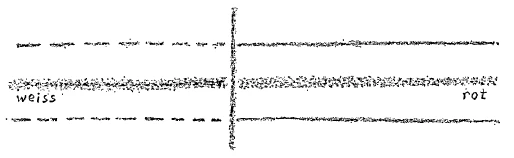
[ 22 ] Let us assume that this is human life and that this is what the human being, as an imaginative, thinking being, experiences within themselves throughout life: then this is merely an illusion; it actually runs like a hollow tube from birth to death (see drawing, red), for the truth lies before that. Before birth—or let us say before conception—that is where the truth lies; there we are truly in the spiritual world, in the supersensible realm; there we are truly present, and at the threshold where we enter the sensory world, only an image is allowed to pass through. We are merely an image of our life before birth or before conception. The truth is not at all that the being who is now alive is speaking to you; when I speak to you, these are merely the images that have been allowed to pass through. In truth, the being who was in the spiritual world is still speaking today. We are not eternal because we endure, but because we are still today what we truly were before birth or conception—that which speaks into the present. By entering into our physical bodies, we have in fact become a mere reflection of our true being for the duration of our earthly life. “I think, therefore I am not”—philosophy, from Augustine to Descartes, sought to cast darkness over this profound truth. In this darkness, one will never fathom the mysteries of birth and death. For one asks: When did the soul begin? At birth. When does it end? At death. If one knows the transcendent truth, one should speak differently: When did the soul cease to unfold its life as a soul? When we were born—or rather, when we were conceived. When will it begin again to unfold its life as a supersensible being? When we die. — Here on earth, we interrupt this process so that what is supersensible does not act alone in our lives, but so that we can absorb the achievements of the sensible world and carry them forward into our entire life. We are not speaking of some fanciful asceticism, but rather, of course, of the fact that earthly life is absolutely necessary for the entirety of human existence. But this earthly life is precisely so significant—and appears to be material—because our actual human life as a supersensible being ceases when we enter earthly life, and begins again when we live on through death.
[ 23 ] The mysteries of birth and death begin to reveal themselves only when we recognize ourselves as supersensible beings and realize that we are merely an image of what we were before birth and what we are after death as spiritual beings. But then we must have the courage to look into what lies within us. If there is (see drawing) only a hollow tube, only an image, then we must have the courage to say to ourselves: Let us not be blinded by the image, but let us face Lucifer in our knowledge. Gaining knowledge that is truly fruitful for life requires courage—inner courage. This must be emphasized again and again. — That is one thing: a knowledge that relates to birth and death.
[ 24 ] The second is a form of knowledge that relates to the course of our own lives. Because we view our relationship as a soul to the body incorrectly—and I say “incorrectly” for the reasons you can find in my Outline of Esoteric Science—human beings also have a false view of the course of their own lives. He also imagines it in the same way as the image I cited here a few days ago—that of “Father Rhine.” You recall how I used the image of Father Rhine. Someone stands there, looks down from the bridge in Basel, and says: “There I see the old Rhine.” The old Rhine—yes, I then ask him: “What exactly is the old Rhine?” The water you see flowing down there is certainly not old, for within the next hour it will already be far downstream, and in a few days it will be somewhere in the vast ocean; but it is certainly not old. And what you are speaking of does not seem to me to be merely the excavation and widening of the earth between the Swiss mountains and the North Sea. So, what is Father Rhine, the Old Rhine, of which people often speak? In substance, he is nothing at all; nothing substantial remains when you take the concept of Father Rhine. Nor, in truth, does anything substantial remain when you take your own physicality. This physicality of your own is a continuous stream: destruction, renewal of the vital fluids, destruction, renewal of the vital fluids. Nothing remains but the form, which is a product of the mind. Into this form, that which appears as substance constantly pours itself anew, pours itself in, is destroyed—just like the water in Father Rhine.
[ 25 ] Through that which arises in reality within the outer Maya—within the illusion—we do not behold this flow of constant dissolution and renewal, which is the truth regarding outer sensory life; rather, we behold something that is to be born, a lump of flesh filled with bones and blood, which is then to grow larger, grows until it is fully grown, and then remains that way until death. This is roughly how we imagine it: as if we were to picture the Father Rhine as a body of water—which, of course, does not exist—but as if we were to imagine a body of water, right, stretching from the Swiss mountains to the North Sea, and to imagine it specifically as remaining a calm body of water lying still within its riverbed; that is how we imagine this human physicality. While it is in a state of constant flux, we believe it to be something rigid—one cannot even capture it in a proper word—between birth and death. If we were to see ourselves correctly, we would see ourselves in a state of constant flux and would not be able to conceive of the idea that what is in this constant flux has anything to do with our true being. But if one were to see that which continually underlies the process of dissolution and renewal as forces, then this would give rise to a medical science—that spiritual medical science—which would, of course, take a different form than the medical science we have today. You cannot judge that medical science by saying, “Well, with this medical science, diseases are cured!” — Diseases are not cured, because it cannot be a matter of curing diseases in the way that people today want them to be cured. With true spiritual medical science, one can only preserve the healing forces in their entirety. True medicine would consist in organizing life in such a way that the human being masters the forces that bring about his or her continuous excretion, dissolution, and renewal. Then there would be no need for pharmaceutical products—provided not only that a single individual knows how to apply this to his or her own human personality, but also that he or she lives in such a way with others that it might take root among the entire human race. I have mentioned this often. — That is the second point.
[ 26 ] The third thing associated with this insight is true natural science. Yes, what, then, is true natural science? I have often emphasized that spiritual science does not oppose natural science as it exists today, but it knows that this natural science does not present natural reality, but rather a phantom. And the point is not to fight this phantom. Given our human nature, we must simply put up with this phantom. What matters is not—as I described yesterday in the case of the philosopher Richard Wahle—devising a poison—even if only a poison against a philosophy, a philosophical poison rather than an external one—to eliminate all those who think in terms of natural science, but rather finding out exactly in what sense they are right. One should say to the natural scientists: If you were to claim that your research is correct, we would agree with you completely, but you must at the same time admit: With this research—which is correct in the sense of natural science—you arrive only at conceptions of a “ghost of nature,” not at the reality of nature. — But one must see through this. That is precisely the task of the Age of Consciousness: to see through things to their reality.
[ 27 ] Now the natural scientist will say: Yes, I have these and those reasons for not letting my knowledge of nature become a phantom! The spiritual researcher must object: But you are quite right to have a ghostly knowledge of nature. For if you seek any natural substance outside the ghost, then you are indeed in the wrong. You are only right if you seek all manner of Ahrimanic elements behind the ghost, if you seek the spiritual behind it. So you are right if you seek a ghostly knowledge. — Well, what I have just told you about the physicality of the human being already takes on a strongly ghostly character. And the one who now penetrates into nature from a higher point of view regards as a genuine natural phenomenon—one about which he is under no illusion—something quite different from those usually cited as robust natural phenomena. It is, after all, the peculiar thing—and I will speak about this phenomenon again tomorrow—that the world nevertheless points us everywhere, at certain points, I might say, with its fingers toward what is right. Somewhere there is always a clue as to what is correct, if one wants to know how to think about the reality of natural phenomena that surround our senses. What, then, should one actually observe? Is there something in nature itself that enlightens us?
[ 28 ] Yes, there is something: for example, the rainbow; the rainbow is truly an image of a natural phenomenon. Think about it—you know this yourself—if you could go up to where the rainbow is, you could walk right through it; it is caused solely by the interplay of certain processes. As spectral as the rainbow, as ghostly as the rainbow—only that we don’t notice it—are all natural processes; they are not what they appear to be to the eye, the ear, or the other senses, but rather they are the convergence of other processes, which are then spiritual. We step onto the ground, believing there is matter beneath it; in reality, it is only that which we perceive as force, just like the rainbow, and as we believe we are stepping onto something solid, it is Ahriman who sends the force up from below.
[ 29 ] As soon as we move beyond the merely spectral, the merely ghostly aspects of natural phenomena, we encounter the spiritual. This means that all research into so-called gross matter is, in general, quite nonsensical. Once we give up—and humanity will do so before the 4th millennium—the search for the grossly sensory as the foundation of nature, then we will arrive at something entirely different; then we will find rhythms everywhere in nature, rhythmic orders. These rhythmic orders exist; it is just that today’s materialistic science generally makes fun of them. We have expressed this rhythmic order visually in our seven columns, in the entire configuration of our building here. But this rhythmic order is present throughout nature. Leaves grow rhythmically on a plant, one after another; the petals are arranged rhythmically; everything is arranged rhythmically. Fever sets in rhythmically during an illness and then subsides again; the whole of life is rhythmic. To penetrate the rhythms of nature—that is what true natural science will be.
[ 30 ] But by delving into the rhythms of nature, one also arrives at a certain application of rhythm in technology. That, then, is the goal of future technology: to accomplish immense work through harmonized vibrations—vibrations that are generated on a small scale and then transmitted to a larger scale—simply by bringing them into harmony.
[ 31 ] Tomorrow I will explain to you in greater detail why it is truly wise for the Christian world order—which, in this sense, is the wise divine world order—to allow humanity to mature over the course of centuries for the insights I have just spoken of, whereas the Academy of Gondishapur simply wanted to throw these insights at people. For humanity must strive for something else if these insights are to come to it. These insights may only enter into humanity if, first, simultaneously with the development toward these insights, a completely selfless social order for the third point is established to the broadest extent within humanity. One cannot establish a rhythmic technology without bringing further harm to humanity unless, at the same time, a selfless social order is strived for. A selfish humanity would acquire rhythmic technology only to its own detriment. And one cannot simply hand over to humanity that force—which I mentioned second—that is identical to the healing power of the human being, where one observes processes of dissolution and renewal, processes of elimination and absorption under the influence of this force. One cannot simply hand this power over to humanity—as I have already said from other perspectives—unless, at the same time, one cultivates within humanity an absolute conscientiousness that relates not only to human behavior with regard to what is outwardly observable, but also to what is outwardly unobservable; unless human beings refrain not only from what is outwardly visible, but also, in accordance with a certain moral principle, from what is not outwardly visible: thinking and feeling. For with the recognition of this power—which is concealed by our viewing the flow of our lives between birth and death as a rigid body—and with the mastery of this power, one could once again wreak immense harm, were it not to develop in the light of absolute conscientiousness even toward the imperceptible.
[ 32 ] And the third would be that which corresponds to my first point, which corresponds to the knowledge of the mysteries of birth and death. Yes, these mysteries of birth and death similarly presuppose that humanity must first pass through a certain stage of maturity; for they presuppose that human beings can truly and consciously confront Ahriman and Lucifer. And whoever can fully consider what is meant by this first point knows the following, which I now wish to present to you in conclusion; tomorrow it will be elaborated further. They know the following: One can pursue knowledge of nature as merely phantom knowledge, without realizing that it is merely phantom knowledge; one can be content with what is false knowledge. This helps one—it truly does help—because one then avoids the danger of coming into contact with Ahriman. You can make Ahriman invisible to yourselves; but you must then limit your study of nature solely to the modern sense of the term—which, however, contains no truth. It is a good barrier against Ahriman to stop at the level of natural knowledge—that is, at the level of untruth. You have only one choice: either to seek truth—in which case you must also become acquainted with what works in the world as the Ahrimanic supersensible—or to embrace untruth. If you cultivate untruth, saying, “This ghostly knowledge of nature reveals the true nature of things”—well, then you are siding with what pleases Ahriman; for he wants the lie, and he thrives on the lie. And he can thrive all the more on this secret lie; and nothing is dearer to him than when this lie prevails, which consists in the view that ghostly natural science is true natural science.
[ 33 ] And again, I have spoken of what is merely a reflection of what exists in the supersensible realm; I have described it as a filtered image. Here, too, one has a choice: Either one advances into the supersensible realm—well, but then one must also face Lucifer eye to eye, spiritually of course—or one remains with untruth and regards the appearance of the soul as reality. But then one can never gain insight into birth and death and into immortality, for one is not looking at the soul, which is immortal, but merely at an image. That is what I would like to set before your soul for now. Tomorrow we will pick up where we left off with these thoughts.
[ 34 ] This is an important thought: In the present age of the conscious soul, the human being on Earth has the choice to strive for the truth; in that case, he must courageously face the spiritual realm. Or he may choose to avoid the spiritual realm, in which case he can remain in illusion, remain in untruth. The Academy of Gondishapur sought to spare humanity the quest for truth, to spare humanity the effort of further development; it thus sought to reveal to humanity that which it itself had received through Ahrimanic means. The Academy of Gondishapur—whose final shadow, its specter, is found in the scientific illusion of the present—this Academy of Gondishapur sought to turn human beings into purely earthly beings. It has been overcome in its endeavors by that which was already placed within humanity before its very inception: by the Mystery of Golgotha. More on this tomorrow.