

The Polarity of Duration and Development in Human Life
GA 184
13 October 1918, Dornach
Translated by Steiner Online Library
Fifteenth Lecture
[ 1 ] Yesterday we saw how the state of the soul toward which we must strive in the Age of the Consciousness Soul has, in a sense, been historically prepared. Let us now clearly hold before our souls what the external world situation is with regard to these matters. We can say, in a sense, that the year 333 A.D. represents a kind of state of equilibrium (see diagram on p. 300), which is clearly discernible in the course of historical development but which appears only rarely in external history, for the simple reason that things revolve around it—I might say— and the pivot point itself—even in mechanical movements—does not, as such, belong to the system that is moving. Take a scale: you see the movement of the pans and the balance beam; but the pivot point itself is something ideal—it is something you cannot see. But it is the most important thing, of course; it must be supported above all else. Above all, we must grasp what happened in this year 333—which is so important—yet went so unnoticed by the outer world, just like the pivot point of a balance. Now, the year 333 is precisely the midpoint of the fourth post-Atlantean period, the midpoint of that important period that spanned from 747 before the Mystery of Golgotha—when Rome was founded—until approximately 1413, when the Greco-Latin era came to an end and that age began which will then last on through to the end of the fourth millennium, and which is our era of the consciousness soul. This midpoint in the year 333—when viewed in terms of external events—is just as inconspicuous as the midpoint of Libra. However, we could already point to something more 333 years later, in 666. This is the year about which we could say: What later developed as humanity’s scientific way of thinking manifests itself as the endeavors of the Academy of Gondishapur, which had been dulled by Islam. We tried to trace this yesterday—how a certain kind of spiritual or psychological disposition among people spread across Southern Europe and then became that peculiar scientific atmosphere that we actually still have in modern natural science, and which we have also spread very, very widely in modern thinking. That is, 333 years from that era when, so to speak, one really only looked back to the ancient times—if one was like Julian the Apostate. There are 333 years until 666; if we then go back, take the other side of the scale—that is, go back 333 years—we find the Mystery preparing itself through the birth of Christ Jesus.
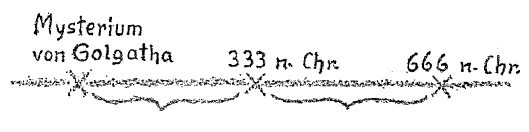
[ 2 ] Now, we have all essentially viewed these events in such a way that we asked: What would have happened in the development of humanity if the Mystery of Golgotha had not taken place? For the entire foundation of the Academy of Gondishapur and everything it brought about took place independently of the Mystery of Golgotha. The philosophical schools in Athens had, in a certain sense, already come into contact with Christianity. However, Justinian had closed them in 529. Pure Greek wisdom made its way through Syria to Gondishapur in the Neo-Persian Empire. And everything else that followed—if it is not mere apathy, but rather what was actually intended from Gondishapur onward—was conceived with the exclusion of Christianity and the exclusion of the Mystery of Golgotha. In reality, nothing has happened without the impulse of the Mystery of Golgotha having been at work since the year zero of our era; but, of course, much was intended.
[ 3 ] Now we can say that even what lies at the turning point—that which was active in the 4th century in souls that were not inclined toward Christianity—can only be viewed objectively if one first asks: How would the development of Western humanity have unfolded if the Mystery of Golgotha had not taken place? One can certainly study this—even historically—to see how the development of Western humanity would have unfolded; for example, in the case of Augustine, who presents both sides to the later observer. He begins entirely independent of Christianity, attempts to resolve his profound philosophical puzzles among the Manichaeans, and is only later converted to Christianity.
[ 4 ] Now, however, we can go back even further, and this raises an important question: What would be the case if, specifically regarding the time of the Mystery of Golgotha, we were to consider the course of development and ask ourselves: What was the situation at that time, when the Mystery of Golgotha took place over in Palestine, in all the regions untouched by this event? After all, apart from the immediate sphere of influence of Christ himself, this essentially encompassed all regions of the globe. What was the situation like in all these regions of the globe? What was it like, in particular, in Rome, where the impulse of the Mystery of Golgotha later spread with particular effectiveness?
[ 5 ] This question is of particular importance for our time; indeed, in our day it is by no means merely theoretical: What was the situation in Rome when the Mystery of Golgotha was unfolding over in Palestine? For we shall see later how similar—albeit in a somewhat different sphere—our immediate present is to the time that can be regarded as the time of the Mystery of Golgotha. One must never forget what is easily forgotten when, looking back from the present, one turns one’s gaze to the time of the Mystery of Golgotha; one must again and again—and this must happen out of a need of the soul—place oneself, purely through feeling, into the culture of the ancient Roman Empire, where it was completely unknown that over there a solitary human being, with a few followers, had appeared, who had lived a certain life, suffered death on the cross, and to whom were then linked the insights—the vital insights of later generations—regarding birth and death. One must again and again imagine: Although this event—which today shines like a full sun upon human history—took place at the beginning of our era, all spiritual and external life across the entire globe in those times unfolded in such a way that nothing was known of this Palestinian mystery of Golgotha. Therefore, one must ask the question: What was the situation like, particularly in Rome?
[ 6 ] Now we will understand each other more easily if we start directly from what was later intended—in 666—in the minds that the Academy of Gondishapur had primarily brought forth. As I said yesterday: What the conscious soul could only attain later through human effort, they wanted to give to humanity through a revelation they themselves had received through Ahrimanic means. In the year 666, after all, it was still the age of the intellectual and emotional soul; at that time, people were not yet capable of thinking in such a way that they would be conscious of everything. But that is what they wanted to give them: they wanted to give humanity something earlier—something that was not to come until millennia later. The situation was the exact opposite in the year zero, in the age in which the Mystery of Golgotha itself took place. 333 years after 333, they wanted to give humanity something belonging to the future, something that is destined for it only in the future. 333 years earlier—that is, precisely around the time of the Mystery of Golgotha—they wanted to push humanity back to that which, according to the normal course of human development, had entered human evolution millennia earlier.
[ 7 ] It is very difficult to speak about these things, for the reason that history—which itself has a history—has unfolded in such a way that, throughout history, people have actually always been led into error regarding these matters. What actually took place in the southern regions of Europe has been concealed; it has not been brought to the attention of humanity. History, for example, also describes the figure of the first Roman emperor, Augustus. But the fact that he was such a significant, such a profoundly influential figure—this is something that, intentionally on the part of certain quarters and unintentionally on the part of most others, is not really brought to people’s understanding. For Emperor Augustus stood at the center of Roman endeavors that quite deliberately sought to bring about a state of world culture intended to obscure from humanity everything that the intellectual or emotional soul had brought forth—to obscure what people had been able to achieve in terms of culture through their own labor since the year 747. Above all, humanity was to be restricted to what it had attained up to that age—the age of the intellectual or emotional soul—and specifically during the age of the sentient soul, the Egyptian-Chaldean period.
[ 8 ] While later, in 666, the sages of the Academy of Gondishapur sought to bring the future into the past, what humanity can achieve in the present was to be eradicated during the reign of Emperor Augustus. Instead, however, humanity was to possess—in its former glory and significance—that which had been characteristic of an earlier era: the time of ancient Persia, the time of the ancient Egyptian-Chaldean culture. And when one looks back at reality through all the undergrowth that has accumulated as “history” and then asks oneself: What is it, actually, that people in Rome at that time consciously sought to preserve, and what was subsequently prevented from being preserved by the spread of the impulses of the Mystery of Golgotha—what was it that Christianity prevented from being preserved? —one arrives at the following:
[ 9 ] Well, it was, above all, twofold. First, the aim was to preserve the sense—the intuitive sense—of the ancient cults, those cults that had already been common practice for millennia among the Egyptians and in the Near East, but also further into Asia. They wanted, so to speak, to shut down people’s reason, to render their intelligence ineffective, and to develop solely the feeling soul by presenting people with all the significant, magnificent, and powerful cults that were meant to be effective in ancient times—cults that were effective in the era when people had not yet attained intelligence, cults that were effective in the era when the worship of the gods was to arise from the feeling soul, so that people would not be left without gods. There were great, significant cults that were meant to replace reflection, which, in a sort of semi-hypnotic state and according to ancient atavistic customs, were intended to stimulate the revival of divine consciousness and piety in the souls. In Rome, on the other hand, the aim was to revive the emotional soul. One can only come to understand the specific nature of the difference between Roman and Greek culture—the latter of which was at that time facing its external destruction—by paying attention to these finer distinctions. This sensibility, which Emperor Augustus in particular sought to introduce in Rome with his powerful, backward-looking initiatory impulse, these impulses—they were unknown over in Greece. The Greeks did not wish to look back to ancient times. The Greeks wanted to have before them that which they themselves could understand, with which they could unite. And had the Christian impulse not come later—come very soon—had the Christian impulse not very rapidly counteracted the intentions of Augustus and his successors, an even greater splendor of ritual practices would have sprung from Rome than actually did.
[ 10 ] So let us first note the following: According to the intentions of Augustus and his followers, just as a later prophetic wisdom was to emanate from the Academy of Gondishapur, so too was a powerful cult to emanate from Rome that would cloud the entire world by depriving it of both the possibility of the intellectual soul and that of the later soul of consciousness. Just as the Academy of Gondishapur was meant to bestow the soul of consciousness upon humanity in order to cut off what was to come—and thereby, by the soul of consciousness arriving too early, to cut off the spiritual self, the life spirit, and the spiritual human— what was to happen in Rome, on the other hand, sought to prevent the soul of consciousness from emerging at all; it also sought—as early as 333 before the turning point—to eliminate the soul of understanding or the soul of feeling, and to present to humanity, through powerful soul-cult rituals, that which is to lead to the consciousness of God. That was one aspect of what they sought to introduce in Rome following the initiated Augustus.
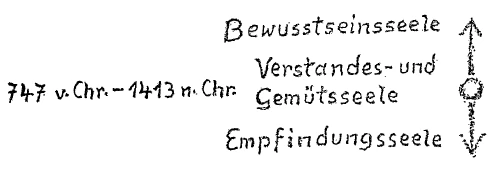
[ 11 ] Now, what is known as the intellectual or emotional soul always has two aspects. One aspect is essentially that part of the intellectual or emotional soul that tends toward the sensory soul. As you know, when we classify the soul, we have the sensory soul, the intellectual or emotional soul, and the conscious soul. The first to develop was the sensory soul, whose development was completed in 747 B.C. The intellectual soul is the one that developed from 747 to approximately 1413 A.D.—these are approximate figures—and since then we have been in the age of the conscious soul. Now, the middle soul—the intellectual or emotional soul—tends, on the one hand, toward the sensory soul (arrow) when it seeks to interpenetrate with the ancient, as has just been shown. Augustus sought to enliven the meaning to be derived from the sensory soul. What, then, happens when one, so to speak, “screws back” the intellectual or emotional soul to the level of the sensory soul? What becomes of that part—which is, of course, not yet developed but is already there—that tends toward the conscious soul, toward the more intelligent sense? One must raise the question—and in the age of Augustus it certainly had to be raised as a major cultural issue: What happens to that which seeks to develop toward the soul of consciousness if one cuts off this development, if one does not allow the soul of understanding or the soul of feeling to develop further? What then becomes of that part of the human soul that strives toward the consciousness soul? That which strives toward the feeling soul is satisfied—more than the measure of normal human development permits—through the cult that is being revived. But what does one give to that part which strives toward the consciousness soul? One need only mention the word that has always been avoided in this context—so that the true light might not be shed on a certain fact of human development since that time—one need only mention that word in this context, and one will already be able to grasp the meaning. On the other hand, one gives to the soul one wishes to dismiss—in accordance with its sensibility—a form of worship that is mere rhetoric; a rhetoric that, instead of imbuing the soul with substance and inner content, offers only a shell, striving for the configuration of words and sentence structure where living concepts should prevail.
[ 12 ] Yes, under Augustus’s influence, something quite different from what had previously existed in Greece came into being in Rome. No matter how similar the Roman garment may be to the Greek one, the Roman toga no longer gives the impression, through its drapery, that one feels like the Greek who felt at home within it; rather, viewed from the outside, it appears as a garment intended to be decorative. A reflection of religious veneration is still preserved even in the drapery of the Roman toga, in contrast to the Greek garment. And a striking difference would be perceived—if one were only willing to perceive it—between Demosthenes, who stuttered and yet was meant to express the Greek spirit through his stuttering demeanor—not through rhetoric! — and the Roman rhetoricians, for whom it was essential that there be no stutterer among them, but rather someone who knew how to formulate word order and sentence structure well.
[ 13 ] During the Augustan Age, the intention was, on the one hand, to present humanity with the ancient cults in a form that could not be understood. The aim was, in fact, to ensure that humanity did not attempt to understand the cults, and certainly did not ask: What is the meaning of what occurs in the cult? This attitude has persisted into our own time in the most diverse fields. There are even Freemasons today who tell you something quite curious. For example, one might say to these Freemasons: “Yes, you have an extensive symbolism. There is a great deal of meaning contained within this extensive symbolism; but modern Freemasonry does not concern itself at all with what these symbols actually mean.” — When you tell people this, they reply: “That’s precisely what I find so beautiful about modern Freemasonry—that everyone can interpret the symbols however they wish.” — Most often, such a person imagines whatever their simple mind can conceive, which is very, very far removed from the deep meaning of the symbols—the deep meaning that leads into the minds and souls of human beings.
[ 14 ] That is precisely what people in Rome deliberately sought to create back then: a cult, without asking what significance the cult held, without approaching it with intelligence and will. The other pole, which is necessarily linked to this, is empty rhetoric—the kind of rhetoric that is effective not only when speeches are given, but which, for example, has been fully incorporated as rhetoric into Justinian’s Corpus iuris and has subsequently flooded the Western world with so-called Roman law. This Roman law relates to what was meant to be effective in the souls that were moving away from the development of the conscious soul in the same way that rhetoric relates to soul-warming content. This is what that chilling coldness inherent in Roman law has brought upon the world: that Roman law relates to the warmth of the soul just as rhetoric relates to that which, even if spoken haltingly, is uttered from the warmth and light of the soul.
[ 15 ] The fact that what Augustus had intended did not reach its fullest potential ensured that the spirit of the mystery of Golgotha blew in from the East. Nevertheless, just as the legacy of the Academy of Gondishapur has been preserved in our modern natural sciences, so too has the aftereffect of what Augustus intended been preserved; but it has achieved no more of what he intended in the form he envisioned than the Academy of Gondishapur achieved what it intended. The supernatural was simply driven out of the impulse of the Academy of Gundishapur: this has remained the scientific mindset to this day. But this supernatural—at least the great supernatural, which Augustus desired as a true renewal of the ancient religiosity of the feeling soul—was also driven out. This supernatural element was also expelled, and what remained of the other—which had been established primarily in Rome at the time of the Mystery of Golgotha—was Catholicism, the Catholic Church; for the Catholic Church is the true continuation of the Augustan age. The fact that the Catholic Church has taken on the form it has is due to the fact that it is not founded on the Mystery of Palestine, that it is not founded on the Mystery of Golgotha. That has merely breathed its spirit into it. What lives on in the Catholic Church is, at most, its cult. But this cult, which lives on in the Catholic Church, is a cult into which only that which has come over from the Mystery of Golgotha is woven; yet in its forms and ceremonies, it has come over from the age of humanity’s feeling soul.
[ 16 ] Today, one can only properly relate to this Catholic worship—which is truly something sacred, something great, because it embodies the sacred that has woven its way through the ages of humanity—everything has its great, its mighty aspects; it just must not be developed one-sidedly— one can only adopt the right attitude, for example, toward its center, the Mass, which is a reflection of the highest mysteries of all time, by breathing life into that which has become dead and which is intended merely for the sentient soul, through what anthroposophically oriented spiritual science has to say once again in modern times about the Mystery of Golgotha. One can bring into what has been preserved by Catholicism from the Augustinian era that which is rediscovered in the normal course of human development through spiritual scientific research; just as one must bring into what remains—dulled to the sensory realm—of the will of the Academy of Gondishapur, that which spiritual science can draw from the spiritual worlds. The spirit must enter into the natural sciences; the spirit must enter into the sacramental acts that human beings must rediscover. Only those who feel—and anyone who has engaged with spiritual science for some time can feel this—will grasp the full, profound, and significant meaning of what I have just said: how similar our time is, in what lives largely unconsciously in people’s souls, to the time when the Mystery of Golgotha drew near to humanity. I have mentioned this often, and you will find it described in the first of my mysteries, The Gate of Initiation, that just as there was a point back then that led to a turning point—just as at that time, at the time of the Mystery of Golgotha, before this turning point of the fourth post-Atlantean epoch, 333, we too stand today before an important turning point. The time span is somewhat shorter because the movement of the higher spirits changes in speed; one cannot simply calculate that we should stand before it 333 years earlier today as well. Such things change over time; the speed at which the various spirits of the higher hierarchies move changes. Thus, today, in the first third of the 20th century, we are facing the approach of a significant event for humanity. And all the upheavals, all the catastrophes, are nothing other than the earthquake-like processes that precede a great spiritual event of the 20th century. This is not an event in the physical world, but rather an event that people will experience as a kind of enlightenment, one that will have come to pass before the first third of the 20th century has come to an end. One might call it—if one does not misunderstand the term—the reappearance of Christ Jesus. But Christ Jesus will not appear in an outer body as He did at the time of the Mystery of Golgotha, but will be active within human beings, and people will perceive Him supernaturally: He is present in the etheric body. Those who prepare themselves for this can continually perceive him in visions, continually receive counsel from him, and, in a sense, enter into a direct, personal relationship with him. All that lies before us is comparable to what the Romans, before the Augustan age, perceived as the physically real Mystery of Golgotha drawing near.
[ 17 ] But for such matters, one simply must have the intuition. One must sense, through the various external events that have unfolded and ultimately led to this terrible global catastrophe, how the urge toward the ritualistic is once again present in human beings. Deep down, it has been creeping up on us slowly. Just consider this, study it—but I ask you to do so with alert senses—how, for more than a century, it has been precisely the more sensitive minds who have once again felt this urge and, emerging from the sober, rational Protestantism of the intellect, have once again sought to return to ritual. See how it was precisely those minds—who were able to sense something of the full significance that the cult holds in the soul—who, among the Romantics, strove toward Catholicism. Because they were not yet capable of illuminating, through spiritual science, that which strives sacramentally into the world, they therefore strove toward Catholicism. Minds such as Novalis’s—and he is a particularly characteristic personality precisely because of his exceptionally deep spirituality, which developed in him at a relatively early age—are not satisfied with sober Protestantism; they yearn for the forms of Catholicism, but they are, of course, healthy enough to be spared from converting to Catholicism. They express precisely what the age must express if it is to remain healthy: the striving to feel once again something sacramental, something cult-like in the world, but not something that merely seeks to carry over old cults, as indeed many do today where invalid minds appear, where the invalids of spiritual life appear—among whom I certainly count Hermann Bahr, whom I have known for years and with whom I was once very close friends. We see it in these invalids of the soul, how they tend toward a misunderstood Catholicism even in our time—in Hermann Bahr, in Scheler, in Börries von Münchhausen, in all these people—there are a great many of them, and I know many of them—they strive toward Catholicism in the invalidity of their soul life. This state of mind is very well known; it arises from the fact that people cannot bring themselves to engage in an active inner spiritual life, to a genuine, courageous activity of the soul, since, as I said, they have become invalids of the spiritual life, and therefore strive for something that is already presented to them in a finished form. This permeates all of Scheler’s books on mythology—which are very insightful—as well as all the recent mythological treatises by Hermann Bahr and others. This is a form of spiritual disability, in a certain sense. It is that complacent attitude that does not wish to draw forth from the depths of the soul what the times demand, in order to find, in the age of the conscious soul, that which works toward a natural science that sees the sacramental in all of nature itself—a science in which all of nature becomes an expression of the divine-spiritual world order.
[ 18 ] Yes, in the age of the conscious soul, one must very soon become a person who has the ability not merely to engage in that abstract, dry natural science that petrifies the whole human being—which is today heralded as the salvation of the world—but also that natural science which can deepen into a prayerful contemplation of what the Deity, through sacred symbols, spreads throughout the entire world in all the deeds that satisfy human beings, but also in all that through which the Deity tests human beings. If we are once again able, in a sacramental way and on a higher level, to view the laboratory and transform the clinic into an altar—rather than a mere slaughterhouse or a carpenter’s workshop in the crude sense—then the time has come that is demanded by divine evolution for our present-day soul. It is therefore no wonder that in such a time much can be misunderstood; misunderstandings arise above all from what still persists as the legacy of the Academy of Gondishapur—that is, the approach that embraces natural science without seeking to establish a relationship with the Mystery of Golgotha. As a result, natural science becomes a purely Ahrimanic science, corresponding to all of humanity’s Ahrimanic needs and to the mindset that seeks to order the world solely according to outward appearances. One can say: The impulse of the Mystery of Golgotha must be taken up anew again and again; one must take seriously the words: “I am with you always, even unto the end of the age,” until the cycles of the Earth are fulfilled. One must take these words seriously. If one wishes to connect with the Mystery of Golgotha, one must keep one’s soul fresh in order to continually receive new and fresh impulses that flow from the spiritual world in cycles—not constantly, but from time to time, seeking to reach humanity.
[ 19 ] In contrast, however, there is a natural science that wants nothing to do with such influences, that simply wants to confine researchers to the laboratory or the clinic and so on, where everything continues in a monotonous, repetitive cycle. There, they investigate how invisible rays work, without paying any attention to what is revealed to the world through them. They test aspirin, acetin, phenacetin, and so on, and administer them to patients: when administering them one after another in this way, one need only observe with the external senses and record what one has observed; there is no need to stir the soul into activity. This is the mindset that essentially emerged from the impulse of the Academy of Gondishapur. For if it were thoroughly permeated by those impulses, people today could simply lie back and do nothing at all; after all, everything they might have wished to work out for their conscious soul would have been placed into their hands by grace back then. This mindset, translated solely into the sensory realm, is present in the external natural sciences.
[ 20 ] The other mindset is the one that was spread throughout the world from Rome, which lives on in the most diverse forms of that which did not originate in Palestine, nor from the Mystery of Golgotha, but rather originated in Rome and developed in two directions: the burning of incense to foster a form of worship that does not call upon the intellect but only upon the emotional soul, and rhetoric that strives solely for the formulation of words, or for a stylization of human actions that, in its legislation, is itself essentially a form of rhetoric. Both sides have persisted. Both sides can only be helped if one realizes that, on the other hand, a spiritless natural science must not be allowed to exist in the future. Without opposing natural science, one will have to recognize its limits. There is no need to oppose it; if viewed purely in a positive light, it delivers something magnificent and powerful, and no one has the right to speak against natural science unless they are thoroughly familiar with its findings. Anyone who is unfamiliar with natural science and speaks critically of it is in the wrong; only those who believe in natural science, know it, have mastered it, and have made its methods their own—only they have thereby earned the right to speak about it, namely to define its limits and to show how natural science itself must lead to a spiritual understanding of the world.
[ 21 ] Among other things, those with hostile attitudes have also found in my writings that I have spoken appreciatively of Haeckel and modern natural science. From the standpoint of spiritual science, which I hold, I would never dare to say a single disparaging word about natural science unless I had first done everything possible to acknowledge its merits. For, on the ground of positive spiritual life, one has a right to negative criticism only if one is also able to demonstrate that one fully acknowledges that which one opposes, within the limits in which it is to be acknowledged. I believe I have fully earned the right to proclaim a spiritual development of humanity—a spiritual evolution—in which I have described what the senses do not teach, because I have also shown the significance of Darwinism and Haeckelianism in scientific life.
[ 22 ] If one stands on the ground of spiritual science, one must insist that the words one speaks be understood somewhat differently than they are usually understood. Therefore, I do not wish for what I am about to say—from the perspective I have taken today regarding Catholicism or other contemporary movements—to be interpreted from the standpoint of the ordinary philistine and confused with what any liberalizing society might critically advance regarding Catholicism or similar movements. Nothing is meant other than what is presented here, and nothing else is meant other than what can truly be justified from the standpoint of spiritual scientific research. Research in the natural sciences demands deeper exploration, so that it gradually leads into spiritual life. That which has been preserved since ancient times—and which has, in part, become quite worn out in the course of human life—is now reemerging for the reasons I have just cited: humanity’s need for sacramentalism, humanity’s need for formation. To see, in the forms, the life of the Divine in the world, but to understand the forms; not to speak of Lucifer, Ahriman, and Christ as in dogmas, but to have this Trinity before us artistically in forms: that is what we need.
[ 23 ] Based on this idea, the central triad of Christ-Lucifer-Ahriman will emerge in our building through the wooden statue; from this idea: to create, in forms that express a whole, that which is a challenge in the development of humanity—but in such a way that, by looking at the forms, one penetrates to the spirit. Creating such forms had to be the foundation of our building. Nor does one have the right to view this building in a trivial sense, but rather in accordance with the fundamental direction of what is intended in light of the great demands of our time—as is necessary in an era that must once again, and now in a new way, draw closer to the Mystery of Golgotha.
[ 24 ] Just as in our time—I would say—the necessary moment has come to rediscover Christ, to find Christ from a higher vantage point, so too are the forces of resistance against Christ present. After all, the forces opposing Christ were present in the past as well. We know that Christianity was determined not to allow what the Academy of Gondishapur sought to impart to take root at all. What was founded in Rome by Augustus actually sought to establish something that had nothing to do with the Christ impulse. It later became Catholicism because the Christian impulse penetrated Romanism. The persecutions of Christians—the Neronian era, the Diocletian persecutions, everything that preceded them, including the rejection of Apollonius of Tyana—all of this happened because Rome resisted accepting Christianity as much as possible. It was meant to be eliminated entirely, but it could not be eliminated. Consequently, Romanism—by absorbing as much of Christianity as it could—became the Catholic Church, and the Catholic Church has continued to develop in this spirit: the moment a new revelation enters humanity, one that leads further into the knowledge of the Mystery of Golgotha, the Catholic Church turns away from it—not toward it, but away.
[ 25 ] Just think about it—this fact must be emphasized again and again: When Copernicus, who was himself a canon—that is, a true Catholic—put forward the Copernican theory, the Catholic Church condemned it as heretical. Until the year 1827, it was forbidden for an orthodox Catholic to believe in the Copernican doctrine; since that time, it has been permitted to believe in it. And then it became possible for a professor of Catholic philosophy at the university to say: Certainly, the Catholic Church banished the Copernican doctrine and treated Galileo the way it did. But it is no longer proper to think that way today; today it is proper—as Professor Müllner, who was a Catholic philosopher at the time, said when he delivered his inaugural address as rector at the University of Vienna—to say that it was precisely through the discoveries of Copernicus and Galileo regarding the outer mysteries of the universe that the wonders of divine omnipotence became all the more vivid. That was, of course, expressed in Christian terms, but if it were censored according to the usual practices, it would certainly not be expressed in Roman Catholic terms. So it did, after all, take some time before the Catholic Church, under external pressure, acknowledged that the understanding of the universe does not suppress Christianity but rather promotes it. As for how long it will take the Catholic Church to acknowledge the findings of spiritual science and anthroposophy—well, we’ll have to wait and see; but while we wait, we must probably accept that we will not reach a conclusion as long as we are incarnated in this earthly body. That is one side of the matter.
[ 26 ] But confusion and misunderstandings can easily arise. The confusion and misunderstandings that can arise stem from the fact that there is truly an urge in people’s souls, in their subconscious, to experience the sacraments today. Indeed, all of humanity today is striving for a higher level of sacramental experience. Therefore, the Catholic Church naturally makes use of this human striving to further its own agenda. And the desire to achieve this is so strong that, within humanity’s current—alas, alas—state of such deep slumber, people might at least awaken to the most important events taking place, even if, as individuals, they cannot change them in many areas. Certainly, one need not ask oneself: “How can I, as an individual, change this?” With some things, it is necessary to let time take its course; with others, it is necessary to act within the proper context. One need not immediately demand a formula for everything, but one does need a clear awareness to be able to observe events, so that when something is required of a person in their own situation, they truly know what they must do. Above all, it is necessary to see that wherever it is at all possible, humanity—which believes itself to be thinking so much—is in fact asleep today; humanity is simply asleep, and one would like to win it over to a true recognition of the impulses that lie at the heart of human development. Yet that is difficult. But others are awake: Jesuitism is awake, Rome is awake. And these forces are now using every opportunity, every channel, to prevent what lives within humanity from developing in a way that accords with the soul of consciousness, but rather to shape it in a way that suits Rome. And if only people would awaken to what Rome wants, if only they would recognize the things that are sometimes obvious—things that are judged from entirely different perspectives—if only they would recognize the hand of Rome and Jesuitism, then that would be of immense significance for resolving the issues that must be resolved in the near future out of the chaotic confusion of the present.
[ 27 ] That is why acknowledging a fact such as the one we discussed yesterday and today is of immense importance even for the immediate present. One should not seek to judge the world today according to abstract principles: that is merely to lull oneself into complacency; one should seek to judge it according to genuine insights. For what must happen in the coming years will only be possible on the part of those people who draw their principles—the impulses for their actions and will—from a spiritual understanding of the evolution of the world. And I must say: One must not, on the one hand, allow the healthy, genuine, and delightfully refreshing tendency of human souls toward sacramentalism to be exploited for the revival of ancient cults. It is not used to bring about an understanding of the Mystery of Golgotha, but rather to perpetuate the spiritless symbolism of Rome, as it was inaugurated in the Augustan age and as it is currently being sought once again from Rome to serve its own purposes. This is one way in which human souls can be exposed to misunderstandings—misunderstandings regarding sacramentalism, misunderstandings regarding cults, and misunderstandings regarding rhetoric as well, regarding life expressed in concepts and words that are formulated but which truly did not spring from the efforts that Demosthenes made in Greece, who placed stones on his tongue because he was a stutterer, yet still wanted to convey the warm and loving content of his soul to the Greeks—but rather stem from flowery rhetoric that carries people away and which they accept when they cannot fully awaken to the impulses of human development.
[ 28 ] This, too, is well known to those who wish to settle their accounts. You can see how that which humanity has already been striving toward—out of a healthy impulse in recent times—has been renewed! Read the writings and treatises appearing today on the Catholic Church’s efforts to renew the Corpus iuris canonici, which is to rise again from its grave: the Corpus iuris canonici is to become law once more for Catholic Christians. The system has been put together. Then you will sense through which channels that which flows from Rome—from that Rome which is so wise, so magnificently wise, and so magnificently initiated into the mysteries of human development—is to flow; and you will realize that it can never be successfully combated with external means of state power, but only through the means of spiritual struggle. Let the Jesuits be admitted everywhere, but give people everywhere the opportunity to educate themselves spiritually just as deeply as the Jesuits are educated; then the Jesuits will pose no danger. Only if one protects oneself and does not protect the other—but rather combats it—will Jesuitism be dangerous. Jesuitism can be allowed in everywhere if the struggle that must be waged against it is allowed to unfold with the same freedom and in the same unbiased spirit as that which comes from the other side. Given the habits of our present-day lives, we are far, far removed from this.
[ 29 ] But what is supposed to spread does not spread only from this side. What lives on in Roman sacramentalism, in Roman rhetoric, and what is particularly triumphant today in pulpit rhetoric—that is only one side of the story.
[ 30 ] The other side is that which swears by crude, literal-minded natural science alone—a science that refuses to become spiritual, that accepts natural science only insofar as it becomes technology, and that rejects everything that can be discovered about the spiritual content of the world through the mighty, grand phenomena of nature. I once said—truly not out of rhetoric, but out of what springs from a deeper understanding of the soul—that until our physics, our mechanics, and our entire external science are permeated by Christ, they have not reached their goal. — Not only should history speak of the Mystery of Golgotha, but one must also know that, since the Mystery of Golgotha, natural phenomena must be viewed in such a way that one knows: Christ is on earth, whereas before He was not on earth. A true Christian science will not seek atoms and their laws, nor the conservation of matter and energy, but rather the revelation of Christ in all natural phenomena, which thereby themselves become a form of sacramentality for human beings.
[ 31 ] When we view nature in this way, this contemplation of nature also gives rise to a contemplation of the moral, social, political, and religious principles of human life that are truly commensurate with that life. If we draw the divine from nature, if we draw the power of Christ from our knowledge of nature, then we infuse Christology into everything we prescribe to humanity as laws, into everything we seek to offer humanity—whether in caring for the poor or in any other field—as an external social service; we infuse Christology into all our actions. But if we cannot perceive the nature around us as permeated by Christ, if we cannot discover Christ at work in what lives in human deeds—even when these are deeds that put humanity to the test—then we are also incapable of immersing ourselves in our social, moral, and political life with what is truly demanded of our time. Then we would remain, on the one hand, stuck with crude, clumsy natural science, which is nothing other than a misunderstanding of the supernatural, or we would remain stuck with mere rhetoric, which is a legacy of Romanism—the specter of Romanism. And if, on the one hand, when speaking of misunderstood sacramentalism and worship, one must refer to Rome—specifically to today’s Rome, to that Rome which has grown great particularly through Leo XII, the wise Pope, then one must also find the name that indicates that very emptiness of rhetoric—that empty phrase-mongering—which anyone who has truly imbued themselves with an anthroposophical understanding of spiritual life must recognize in rhetoric today. We have often pointed out this rhetoric here. I must now turn to current events; I usually do so only when the other topic has run its course.
[ 32 ] Where do we find the kind of rhetoric that, like Roman pulpit rhetoric in Jesuitism, stands in opposition to a cult that has become obsolete? Where do we find the rhetoric that stands in opposition to today’s natural science—which demands spirituality—and that threatens our humanity, because our humanity passively accepts what may indeed be necessary for it for external reasons, but which, where it is supposed to recognize, should remain entirely foreign to it? That is Wilsonism! Woodrow Wilson’s name is the one that must be associated with a life of mere rhetoric, of a mere insubstantial jumble of words, whether they be called the League of Nations or something else; that is precisely revelling in mere rhetoric. This is something humanity should not overlook. Humanity today needs to recognize what has been emphasized here: that true Wilsonism is the very opposite of humanity’s true progress, and must be recognized as rhetoric built on feet of clay. Just as the now-crippled spiritual constitution of humanity today strives toward Rome on the one hand, so too does the self-misunderstanding soul of the present—corroded by a crude, scientific worldview—tend toward what today blows through the world as mere rhetoric, and which is hostile to everything connected with the true, beneficial progress of humanity.
[ 33 ] This cannot be expressed with a few bourgeois, a few philistine thoughts. What threatens our time from this direction—what one must soberly recognize when considering current events—must, on the other hand, be understood in all its significance. We must not allow a state of slumber to descend upon all people, causing the world to become “Wilsonized.” Whether the Wilsonians are in America, in Europe, or living here or there, there must still be people who know that there is a deep kinship between Jesuitism on the one hand and Wilsonism on the other. Such people must exist. These people must, however, rise above the philistinism of the present; they must not form their judgment based on what the day or even the years bring, but must be able to form their judgment based on what the centuries hold and what the centuries reveal to us when we truly and sincerely, with the innermost, active power of the soul toward that hill upon which stood the Cross of Golgotha—which is the symbol of all that has flowed into humanity as the revelation of the ancient mysteries, yet which is and always will be young, and will bring ever new revelations to humankind, provided that people do not close themselves off from these revelations, whether they allow themselves to be lulled by Rome or by the dazzling rhetoric to which they are so prone today.