

Historical Symptomatology
GA 185
18 October 1918, Berlin
Translated by Steiner Online Library
First Lecture
[ 1 ] Today, tomorrow, and the day after tomorrow, I will try to build upon the reflections I shared with you here last week. What I wish to build upon—these matters that have led us to a certain depth into the impulses governing recent human development—will emerge from various turning points in recent historical life. Let us try to consider this recent historical life up to the point where we can see how the human soul stands within the context of the world today—both in relation to its development within the cosmos and to its soul development in relation to the Divine, as well as its “I” development in relation to the Spiritual. But I would like to relate these matters to more or less everyday experiences that are familiar to you. That is why today I am first taking as my starting point—you will see tomorrow and the day after why—that historical overview of recent human development, which also formed part of the basis for yesterday’s reflection on recent history, which I attempted to present in my public lecture in Zurich.
[ 2 ] We know from earlier lectures I have given on similar topics that, from the perspective of spiritual science, what is commonly called history must be viewed as a symptomatology. That is to say, from the perspective I have in mind here: what is usually perceived as history—what is recorded in what is conventionally called history—should not be regarded as what is truly significant in the course of human development, but should instead be viewed merely as symptoms that, so to speak, unfold on the surface and through which one must look to perceive the deeper layers of events, through which what is actually the reality of humanity’s becoming is then revealed. While history usually considers so-called historical events in their absoluteness, here what is called historical events should be regarded only as something that, in a sense, first betrays a deeper, underlying, true reality and, when viewed correctly, reveals it.
[ 3 ] One doesn’t have to think very deeply to realize very quickly just how nonsensical, for example, a very common remark is: that modern man is a product of humanity’s past, and that this remark ties into the interpretation of what history tells us about that past. Let’s review these historical events that you were taught as history in school, and then ask yourself how much of them could have influenced—as history claims to portray—your own mind, your own psychological structure! — But to consider the psychological structure as it is situated in the present within the development of humanity—that is, after all, part of a person’s true self-knowledge. This self-knowledge is not fostered by conventional history. Sometimes, however, a measure of self-knowledge is fostered or brought about, but in a roundabout way—for example, as a gentleman told me yesterday, that he once didn’t know in school when the Battle of Marathon took place and was therefore given three hours of detention. That is certainly something that affects the human soul and that, indirectly, could contribute to impulses leading to self-knowledge! But the way history speaks of the Battle of Marathon contributes little to a person’s true self-knowledge. Nevertheless, even a symptomatological account must take external facts into account, simply because it is precisely through the observation and evaluation of external facts that insight can be gained into what is actually happening.
[ 4 ] Now, to begin with, I would like to sketch out, so to speak, a picture of the more recent development of human history—the one that is usually covered in school by starting with the discovery of America and the invention of gunpowder—well, you know all that, don’t you—and saying: “Now the Middle Ages were over; now the modern era begins.” — But if one wishes to make such an examination fruitful for humanity, it is essential, above all, to turn one’s gaze toward the actual upheavals in human development itself—toward those great turning points at which the inner life of human beings has transitioned from one mode to another. These transitions usually go unnoticed. We fail to notice them precisely because they are obscured by the thicket of facts. We know, of course, from a purely spiritual-scientific perspective, that the last great turning point in the development of human culture occurred at the beginning of the 15th century, when the fifth post-Atlantean epoch began. We know that the Greco-Latin period began in 747 B.C. (before the Mystery of Golgotha) and lasted until the start of the more recent, fifth post-Atlantean period, which began at the start of the 15th century. It is only because people view things superficially that the ordinary observer fails to realize that the entire soul life of humanity truly changed at that particular point in time. And it is utter nonsense, for example, to conceive of the 16th century in history as if it had simply emerged successively from the 11th or 12th century, while omitting that significant turning point that took place around the 15th century and then gradually came to an end. Of course, such a point in time is approximate; but what in real life isn’t approximate? Whenever a developmental process—which is in itself coherent in a certain way—spills over into another era, we must always speak of it as “approximate.” When a person reaches sexual maturity, one cannot pinpoint the exact day in their life either; rather, it builds up and then comes to pass. And so it is, of course, with this year 1413 as well. Things develop slowly, and everything does not immediately manifest in its full strength everywhere. But one gains no insight into these matters at all unless one properly takes the turning point into account.
[ 5 ] Now, one cannot help but—when looking back beyond the 15th century, reflecting on the most significant state of mind of humanity, and then seeking to compare it with what, after the beginning of the 15th century, increasingly permeated this state of mind — one cannot help but turn one’s gaze to that all-encompassing reality which spread throughout the entire so-called Middle Ages across civilized European humanity, and which was still intimately connected with the entire spiritual constitution of the Greco-Latin era: It is the form that gradually took shape over the course of the centuries, emerging from the Roman Empire within Catholicism as it was bound to the Roman Papacy. Indeed, up to the great turning point of modern times, Catholicism cannot be viewed in any other way than by recognizing how it was a universal impulse and how it spread as such. You see, people in the Middle Ages were organized into groups; they were organized by social classes, by family ties, by guilds, and so on. But running through all these divisions was what Catholicism instilled in people’s souls, and it ran through them in the form that Christianity had taken on under various impulses—which we will come to know in the coming days—and under those impulses that I have described to you in previous lectures. Catholicism spread as that form of Christianity which received essential influences in Rome from the sources I have just described.
[ 6 ] What, then, did Catholicism—which originated in Rome and evolved over the centuries—expect? It was truly a universal impulse, the deepest force pulsing through European civilization. It counted on a certain unconsciousness of the human soul, on a certain power of suggestion that can be exerted upon the human soul. It counted on those forces that had shaped the human soul’s constitution for centuries, during which the human soul—which only awoke in our own era—had not yet fully awakened. It counted on those who were still in the stage of the emotional and intellectual soul. He counted on instilling into their minds, through suggestive influence, whatever he deemed useful; and in the case of the educated—who were, for the most part, the clergy—he counted on their keen intellect, which, however, had not yet given birth to the conscious soul within itself. The development of theology up through the 13th, 14th, and 15th centuries was such that it relied everywhere on the sharpest possible intellect. But if you base your understanding of what the human intellect is on the intellect of today, you can never gain a true conception of what the intellect was like in human beings up until the 15th century. The intellect up through the 15th century had something instinctive about it; it was not yet permeated by the soul of consciousness. It was not independent thinking among humanity—which can come only from the soul of consciousness—but rather, here and there, an immense sharpness of mind, as you will certainly find in many debates up through the 15th century, for many of these debates are more astute than those of later theology. But it was not that intellect which worked from the soul of consciousness; rather, it was that intellect which—to put it in layman’s terms—worked from the Divine, or, to speak esoterically, worked from the angel, from the Angelos; in other words, something that humanity did not yet possess. Independent thinking only became possible when human beings were left to their own devices through the conscious soul. When one spreads a universal impulse in this way with suggestive power—as happened through the Roman Papacy and everything associated with it in the church structure—one appeals much more to what is common to humanity, to the group-soul aspect of human beings. And Catholicism did just that. And—as we will discuss later from a different perspective—certain impulses of recent history led to a situation where this universal impulse of expanding Catholicism, so to speak, found its battering ram in the Roman-Germanic Empire, and we see how the spread of universal Roman Catholicism actually took place amid constant clashes and confrontations with the Roman-German Empire. You need only study the Carolingian and Hohenstaufen periods in standard history books, and you will see everywhere that the essential point is that the Catholic universal impulse, as conceived from Rome, is making its way into European culture.
[ 7 ] If we wish to view the matter correctly from the perspective of the beginning of the culture of the consciousness soul, we must look to a major turning point, which outwardly and symptomatically reveals how that which truly prevailed throughout the Middle Ages—in the sense just characterized—ceases to be as dominant as it once was. And this turning point in recent historical development is the fact that in 1309, the Pope was simply transferred from Rome to Avignon by the French. This marked the occurrence of something that, of course, could not have happened in the past, and it signaled that a new era was beginning in which humanity was becoming different from what it had been before, since it had previously been governed by a universal impulse. It is impossible to imagine that it could ever have occurred to a king or an emperor in the past to simply relocate the Pope from Rome to some other place. In 1309, the matter was settled quickly: the Pope was relocated to Avignon, and thus began the period of strife between popes and antipopes, which was directly linked to the relocation of the papacy. And in connection with this, we then see how something—which, admittedly, was related to Christianity in an entirely different context but had come to have a certain external connection with the papacy—was also affected. While the pope was transferred to Avignon in 1309, we see that shortly thereafter, in 1312, the Order of the Knights Templar was dissolved. This is such a turning point in modern history. One should not view such a turning point merely in terms of its actual content, but as a symptom, in order to gradually discover the reality that lies behind it.
[ 8 ] Now let us allow other such symptoms to pass before the eye of our soul. We perceive them once we have allowed the period in which this turning point occurred to unfold before our soul. Looking out over Europe, we are struck by the fact that European life, even as it extends further eastward, is radically influenced by those events that, in the course of history—I might say—take effect like natural phenomena. These are the ongoing migrations—which began in more recent times with the Mongol invasions—that take place from Asia into Europe and that brought an Asian element into Europe. You need only consider that, when you link this fact to an event such as that of Avignon, you gain very significant clues for a historical symptomatology. For consider the following. If you wish to know what the external—not the inner spiritual, but the external human dispositions and effects—were that were linked to the event of Avignon and led to it, then you will be able to arrive at a coherent complex of human decisions and facts. You cannot do this if you view such events—such as the Mongol invasions, and later the Turks—in isolation. Rather, when you consider such a historical event, such a complex of facts, you must make the following considerations if you truly wish to arrive at a historical symptomatology.
[ 9 ] Let’s suppose: There is Europe, there is Asia (see Zeiehng, p. 16), and trains run between them. Now let’s suppose that such a train has advanced as far as this border; beyond it—for the sake of argument—are the Mongols, later the Turks, whoever they may be; and in front of it are the Europeans. If you consider the events in Avignon, you’ll find a complex of facts consisting of human decisions and human actions. You don’t have that there. There, you must consider two sides: one that lies here, and the other that lies here (pointing to the drawing). For the Europeans, this onslaught coming over there is simply like a natural phenomenon: they see only the outer surface. They come over and simply cause disruption; they intrude. Behind that, however, lies all that culture—all that culture of the soul—which they themselves carry within. Their own spiritual life lies behind it. One may judge this as one will, but this spiritual life is there. It does not extend across the border at all. The border becomes, as it were, a sieve through which only something like elemental forces pass. Such two sides—an inner life that remains with the people standing behind such a boundary, and that which is directed solely toward the other—you will of course not find in the event of Avignon; there, everything is contained within a single complex. Events such as these migrations from Asia bear a great resemblance to the very view of nature itself. Imagine you are looking at nature; you see the colors, you hear the sounds: all of that is merely a tapestry, merely a covering. Behind it lies the spirit; behind it lie the elemental beings, right up to this point. There, too, you have the boundary. You see with your eyes, you hear with your ears, you feel with your hands. Behind that lies the spirit, which cannot penetrate here. That is how it is in nature. It is not quite the same there, but something similar. What lies behind it as the soul does not penetrate there; it merely turns the outer surface toward the other realm.
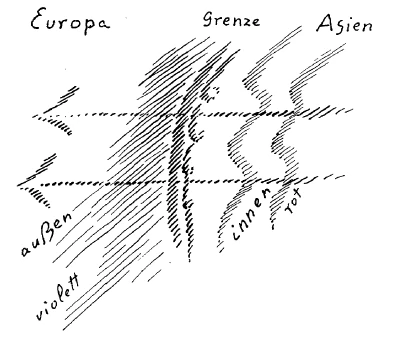
[ 10 ] It is of extraordinary significance to consider this peculiar intermediate structure—where peoples or races clash, each, as it were, facing only their outward appearance toward the other—this peculiar intermediate structure —which also appears among the symptoms—between the actual universal experience of the human soul, as it must be viewed when one observes something like the Avignon event, and genuine impressions of nature. All the historical discourse that has emerged in recent times, which has no inkling of the intervention of such an intermediate phenomenon, all of that fails to lead to a true cultural history. Neither Buckle nor Ratzel could therefore arrive at a true cultural history. I mention these two cultural-historical observers, whose views are worlds apart, because they proceeded from the same prejudices: Well, one must simply view two successive events in such a way that the later one is the effect and the earlier one the cause, and that people were situated within this framework.
[ 11 ] So this, too, is one such event. If we view it as a symptom of humanity’s recent development, then—as we will see in the coming days—it becomes a bridge from the symptoms to reality.
[ 12 ] Now we see something emerging from the complex of facts, which we in turn wish to view more from a symptomatic perspective. In Western Europe—initially still appearing as a more or less unified entity—we see the emergence of what would later become France and England. For at first—as we see what will later become these two entities emerging over time, if we do not focus on external distinctions such as the English Channel, which is, after all, merely a geographical feature—we cannot actually distinguish between them. Over in England, at the time when modern historical development begins, French culture is essentially prevalent everywhere. English rule extended into France; members of one dynasty laid claim to the throne in the other country, and so on. But we see one thing emerging there—something that, throughout the entire Middle Ages, had likewise been part of what was, so to speak, driven into subordination by the Roman Catholic universal impulse. As I said, people had communities; they had blood ties within families to which they clung tenaciously; they had guild communities—all sorts of things. But running through all of this is something that was more powerful, more dominant—something that drove the other into subordination, something that imposed its stamp on the other: That was precisely the Roman-shaped, Catholic universal impulse. And just as this Roman-Catholic universal impulse made the guilds or other communities into something subordinate, so too did it make national solidarity into something subordinate. At the time when Roman universal Catholicism truly developed its greatest impetus, national solidarity was not regarded as the most important element in the spiritual structure of human beings. But it has now become clear that the national is to be regarded as something essential for human beings—infinitely more essential than it could have been in the past, when the Catholic universal impulse was all-dominant. And we see this occurring precisely in the area I have just described to you. But at the same time, while the general idea of feeling oneself to be a nation is emerging there—we will have to discuss this matter further—we see how efforts are being made to bring about a very important and significant differentiation. While we see how, over the centuries, a certain unifying impulse spread across France and England, we also see how, in the 15th century, differentiations began to emerge, with the most important turning point being the appearance of the Maid of Orleans in 1429, which provided the impetus—and if you look into history, you will see that this impetus was a significant and powerful one that continued to have an effect—the differentiation between the French on the one hand and the English on the other.
[ 13 ] Thus we see the emergence of the national as a unifying force, and at the same time this differentiation—which is symptomatically significant for the development of modern humanity—that reached its turning point in 1429 with the appearance of the Maid of Orleans. I would like to say: At the very moment when the impulse of the papacy is forced to release the Western European population from its clutches, the power of the national emerges precisely in the West and is formative there. — You must not allow yourselves to be deceived in such a matter. Just as history is presented to you today, you can of course look back at any people and say: “Well, yes, the national element was already there!” — In doing so, you are not taking into account how things actually work. You can look at the Slavic peoples, for example; under the influence of today’s ideas and impulses, they will naturally trace their national feelings and forces back as far as possible. But national impulses were, for example, particularly active precisely during the period we are discussing today, so that you have witnessed an epoch of profoundly transformative impulses in the regions we have just discussed. That is what matters. One must force oneself to be objective in order to grasp reality. And just as the fact mentioned earlier outwardly reveals the emergence of the conscious soul, so too does this peculiar process of an Italian national consciousness organizing itself out of the leveling, papal element—which had been poured over Italy up to that point and sought to subordinate the national—serve as a symptomatic fact. In Italy, it is precisely during this period that the national impulse essentially becomes the force that emancipates the people of the Italian peninsula from the papacy. All of these are symptoms present at a time when, within Europe, the culture of the soul of consciousness is seeking to develop out of the culture of the soul of intellect and the soul of feeling.
[ 14 ] During the same period—of course, we’re looking at centuries here—we then see the conflict that begins between Central and Eastern Europe. What developed out of what I have called the “battering ram” for the papacy—the Roman-Germanic Empire—came into conflict with the advancing Slavs. And we see how, through the most diverse historical manifestations, this interplay between Central and Eastern Europe takes place. One need not open the door to princely rule in history as wide as history teachers do today. After all, one must be a complete fool to present to people as major historical events the hocus-pocus that took place between Louis the Pious and his sons and so on in a certain region of Europe; one must be a Wildenbruch to list as historically significant those events that he himself portrays as such in his plays, which deal precisely with these events. These historical family events are no more significant than any other family gossip; these family events have nothing to do with the development of humanity. One only gains a sense of this by engaging in symptomatology within history. For then one develops a sense of what truly stands out and of what is quite insignificant for the course of human development. What is significant in modern times is the general conflict between Central Europe and Eastern Europe. But fundamentally, what took place with Ottokar and so on is merely a gesture. It actually only points to what is really happening. On the other hand, it is of great importance not to view this event one-sidedly, but rather to see how, while that conflict was continuously taking place, a wave of colonization from Central to Eastern Europe brought about peasant movements that later carried people from the Rhine all the way down to Transylvania, where—and through a blending of Central and Eastern Europe—the — influenced the entire way of life that later developed in these regions in the deepest sense. So that, on the one hand, we see the advancing Slavs becoming entangled in their actions with what had emerged in Central Europe from the Roman-Germanic Empire, a region continually traversed by Central European colonizers who were moving eastward. And out of this remarkable development arises what would later become, in history, the Habsburg Empire. But another phenomenon, emerging from this interplay throughout Europe—as I have described it to you—is the formation of certain centers with a distinct, central mindset that develops within small urban communities. The 13th through the 15th centuries mark the peak period when cities across Europe emerged with their own urban spirit. The phenomenon I described earlier plays out throughout these cities. But individualities also take shape within them.
[ 15 ] It is, after all, remarkable and significant for that period how, following the differentiation between France and England—and initially in England—the foundations of what would later become parliamentary government in Europe were slowly but thoroughly laid. Out of protracted civil wars—you can read about this in history books—that lasted from 1452 to 1485, the historical phenomenon of burgeoning parliamentarism emerged amid a variety of external signs. As the age of the conscious soul began in the 15th century, people wanted to take matters into their own hands. They wanted a say; they wanted to establish a parliamentary system; they wanted to discuss what should happen; and they wanted to shape external events based on what they discussed—or at least sometimes imagine that they were shaping external events. And this developed, out of their severe civil wars in the 15th century, within England from a configuration that was distinctly different from what had formed in France, even under the influence of the national impulse. This parliamentary system in England emerged from the national impulse. So we must be clear about this: Through a phenomenon such as the emergence of parliamentarism from the English Civil War in the 15th century, we see interplaying—or, if you will, intermingling—on the one hand the rising national idea, and on the other an impulse that leads us very clearly toward what the soul of consciousness, stirring within the human being, desires. And for reasons that will become apparent, the impulse of the consciousness soul breaks through precisely through these events in England, but takes on the character of that national impulse which it could have acquired only there; hence it takes on this coloring, this nuance. With this, we have considered much of what shaped Europe at the very beginning of the Age of Consciousness Culture.
[ 16 ] Behind all this, standing in the background, as it were, like a half-riddle for Europe, what would later become the Russian entity develops, rightly regarded as something unknown. We know why: because it carries within itself the seeds of the future. But it is initially born out of the purely old, or at least out of that which does not actually spring from the conscious soul—not at all from the human soul. Of course, it did spring from the human soul at one time, but here it did not spring from the human soul. None of the three elements that shaped the Russian entity sprang from the Russian soul. One of the elements was that which came from Byzantium, from Byzantine Catholicism; the second was that which had flowed in through the Norman-Slavic intermingling of blood; the third was that which came over from Asia. None of these three elements were produced from within the Russian soul, yet they shaped what emerged there as an enigmatic entity behind European events in the East.
[ 17 ] And now let us look for a common characteristic among all the things that have presented themselves to us as symptoms. Such a common characteristic does exist, and it is very striking. We need only compare what are, in fact, the driving forces today with what were once the driving forces in human development, and we will find a significant difference that will point us characteristically to what is essential in the culture of the conscious soul, and to what is essential in the culture of the intellectual and emotional soul.
[ 18 ] To make the point quite clear, we can initially compare it to an impulse such as Christianity: something that must be generated within every human being from the very depths of their innermost being—an impulse that truly becomes part of historical events, yet is generated from within the human being. Now, Christianity is the greatest impulse of this kind in the development of the Earth. But we can, of course, consider smaller impulses. We need only take what entered Roman culture through the Augustan Age; we need only look at the numerous impulses springing forth from the human soul in Greek life. There we see how, everywhere, something new—truly produced from within the human soul—enters into human development. This era of the culture of the conscious soul does not bring about a “naissance” in this regard, but at most a “Renaissance,” a rebirth. With regard to what emerges from the human soul, there is at most a renaissance, a resurrection of the old. For all that intervenes as impulses is not something that pulsates forth from the human soul. The first thing that strikes us is, as it is often called, the national idea—though one should say the national impulse. This is not productively born from the human soul, but lies in what we have inherited, in what we find already present. It is something entirely different from what, let us say, arises through the numerous spiritual impulses in Greek culture. This national impulse is an insistence on something that is there like a product of nature. Here, the human being produces nothing from within when he regards himself as a member of a nation; rather, he merely points out that he has grown in a certain way, just as a plant grows, just as a natural being grows. And I have deliberately pointed out to you that what comes over from Asia—by focusing solely on one aspect of European culture—has something natural about it. Conversely, nothing happens in Europe that is produced from within the human soul as a result of the Mongols—and later the Ottomans—breaking into European events, even though much occurs under this impulse. Nor does anything happen in Russia that arises from the human soul and is particularly characteristic of it; this has merely spread Byzantinism and Asianism—this Norman-Slavic mixture of blood. These are given facts, natural facts, that enter human life, but nothing is truly produced from within the human soul. Let us note this as a starting point for later. The character of what people insist upon will be quite different from the 15th century onward.
[ 19 ] Let us consider more internal events. We have so far focused more on external historical facts; let us now consider more inner events that are more closely connected with the impulse of the soul of consciousness breaking through the shell of the human soul. There, for example, when we turn our attention to the Council of Constance in 1415, we see the execution of Aus. In Hus we see a personality who, I would say, bursts forth like a human volcano, in this particular way. In 1414, the Council of Constance, which passes judgment on him, begins at the start of the 15th century—precisely at the dawn of the culture of the consciousness soul. How does this Hus fit into modern life? As a powerful protest against the entire suggestive culture of the Catholic universal impulse. In Hus, the consciousness soul itself rebels against what the intellectual or emotional soul has adopted through the Roman universal impulse. But in connection with this, we see—we could also point out how this was already foreshadowed in the Albigensian Crusades and so on—that, fundamentally speaking, this is not an isolated phenomenon. We see, after all, how Savonarola emerges in Italy; we see how others emerge: it is the rebellion of the human personality standing on its own, which, by standing on its own, also seeks to arrive at its own religious confession. It turns against the suggestive universal impulse of papal Catholicism. And this finds its continuation in Luther; it finds its continuation in the emancipation of the Church of England from Rome, which is so extraordinarily interesting and significant; it finds its continuation in the Calvinist influence in certain regions of Europe. This is something that runs like a current through the entire civilized European world, something that is more internal than other influences, something that is more closely connected to the human soul.
[ 20 ] But how? In a way different from how it used to be. After all, what do we admire about Calvin and Luther if we view them merely as historical figures? What do we admire about those who freed the English Church from Rome? Not new, productive ideas, not something new produced from the depths of the soul, but the power with which they sought to cast the old into a new form, so that, whereas it was previously accepted by the more unconsciously instinctive intellectual or emotional soul, it is now to be accepted by the human being’s self-conscious soul. But no new creed is produced; no new ideas are produced. Old ideas are debated; no new symbol is found. Just consider how rich humanity was in the production of symbols the further back we go. Truly, a symbol such as the sacrament of the altar had to be produced once from the human soul. In the age of Luther and Calvin, people could only argue about whether it should be this way or that. But such an impulse—one that arises from within, that is individual in itself, that must be produced from within the human soul—was not there; across the entire broad spectrum, it was not there. A new relationship to these things signifies the emergence of the culture of the conscious soul, but not new impulses.
[ 21 ] So that we can say: As this new era dawns, the emerging soul of consciousness is at work within it. It manifests itself in historical symptoms. And we see how, on the one hand, national impulses are at work, and how, on the other hand, even down into the depths of religious belief, the rebellion of the personality is at work—a personality that wants to stand on its own, precisely because the soul of consciousness wants to break free from its shells. And these forces—these two forces I have just characterized—must be studied in their effects if we are now to consider the further development of the representative nation-states, France and England. They are growing stronger, but in such a way that they reveal, through clear differentiation, how the two impulses—the national impulse and the impulse of the individual—interact in different ways in France and England, and reveal not something new produced by human hands, but rather something time-honored in transformation as the foundation for the historical structure of Europe. One might say: This strengthening of the national element manifests itself in a particular way in England, where the personal—which, for example, in Hus was effective only as religious pathos—unites with the national and with the impulse of the individual within the conscious soul, increasingly taking the form of parliamentarism and shaping it more and more, so that everything there leans toward the political side. — We see how in France—despite the national element, which exerts a strong influence through temperament and other factors—the self-centeredness of the personality predominates, imparting a different nuance. Whereas in England the national nuance provides the stronger coloring, in France it is the personal element that provides the outwardly visible and effective nuance. One really must study these things in depth.
[ 22 ] That these things have an effect—an objective effect, not arising from human caprice—you can see this where a particular impulse takes effect but fails to bear fruit, remaining sterile because it finds no external support and because the counter-impulse is still strong enough to stifle it. In France, the national impulse is so strong that it emancipates the French people from the papacy. That is why it was France that forced the Pope to Avignon. That is why the ground is being prepared there for the emancipation of the individual. In England, the national impulse is strong, but at the same time—as if innate—the impulse of the individual is also strong: culture is emancipated from Rome to a high degree throughout the entire nation, which also establishes its own structure of belief. In Spain, we see how the impulse does indeed take effect, but can neither permeate the national character nor allow the individual to emerge against the suggestive influence. Everything remains, I might say, inside the eggshells and slips into decadence before it can develop.
[ 23 ] External events are really only symptoms of what we seek to discern through these external symptoms. And I would like to say: It is obvious, if one is only willing to look, that what are commonly called historical facts are merely symptoms. In 1476, a significant battle took place on what is now Swiss soil. What lived in people’s souls at the time when Charles the Bold was defeated at Murten is most significantly reflected in this battle of Murten in 1476: the beginning of the decline of chivalry, the knightly way of life, which was intimately connected with the Roman Papacy. But this is yet another trend running through the entire civilized world of that time, one that, in a sense, comes to the surface there only in a highly representative manifestation.
[ 24 ] Of course, when something like this seeks to come to the surface, the counterforce of the old is present. Alongside the normal course of development, as you know, there are always all sorts of Luciferic and Ahrimanic forces at work, stemming from lagging impulses. These seek to assert themselves. That which enters humanity as a normal impulse must struggle against that which enters in the Luciferic-Ahrimanic manner. And so we see that it is precisely the impulse that emerges so vividly in Wycliffe, Hus, Luther, and Calvin that must struggle. We see a symptom of this struggle in the revolt of the United Netherlands against the Luciferic-Ahrimanic Spanish figure of Philip. And we see one of the most significant turning points of modern times—though we can only regard it as a symptom—in 1588, when the Spanish Armada was defeated, thereby repelling everything that had developed from Spain as the strongest resistance to the emergence of the emancipated personality. The Dutch struggles for freedom and the defeat of the Armada are external symptoms. They are merely external symptoms, for we can only reach the reality if we are willing to slowly make our way inward. But as these waves are stirred up, the inner reality becomes increasingly apparent. This wave of 1588, when the Armada was defeated, demonstrates precisely how the emancipating personality—which the consciousness soul seeks to develop within itself—rebelled against that which had remained in its most rigid form from the intellectual or emotional soul.
[ 25 ] It is nonsense to view the historical development of humanity in this way: that what comes later is a consequence of what came before; cause and effect, cause and effect, and so on. That is, of course, incredibly convenient. It is particularly convenient when engaging in professorial historical analysis. It is, after all, incredibly convenient to—well, to plod along like this, step by step, from one historical fact to the next. But if one is not blind and is not asleep, but rather looks at things with open eyes, then the historical symptoms themselves reveal just how nonsensical such an analysis is.
[ 26 ] Take a historical phenomenon that is truly extraordinarily illuminating from a certain point of view. Everything that has emerged since the 15th century—and the impulses I have already alluded to: the national impulse, the impulse of the individual, and so on—all of this gave rise to contradictions that ultimately led to the Thirty Years’ War. The way the Thirty Years’ War is typically portrayed in history is, after all, particularly inadequate from the standpoint of symptomatology. One cannot really examine it using the “coffee-table chat” method, for after all, it was of little significance for the fate of Europe whether it was precisely Martinitz, Slawata, and Fabricius who were thrown out of the historic window in Prague—and if there hadn’t happened to be a manure heap below, they would have been dead; but since they fell onto a manure heap—which is said to have consisted only of scraps of paper that the servants at Hradčany had thrown away and not cleared away, until they finally became a pile of paper scraps—they survived. That’s certainly a rather charming anecdote for a coffee-table chat, but one certainly cannot claim that it has any intrinsic connection to the development of humanity.
[ 27 ] In any case, it is important to note that when one begins to study the Thirty Years’ War—I need not tell you that it began in 1618—it stems from pure doctrinal conflicts, from what developed in opposition to old Catholicism, to the old Catholic impulse. Everywhere we see how the fierce struggles arose from these conflicts between the newer personality and the old, evocative Catholicism. But when we then study the conflict through to its end and reach the year 1648, when, as is well known, the Peace of Westphalia put an end to the turmoil, we can ask ourselves the following question: What actually happened? — For if we ask ourselves: What was the state of Protestant and Catholic antagonisms in 1648? What had become of them over the course of those thirty years? How did this develop? — Well, nothing could be more striking than the fact that, with regard to the conflicts between Protestantism and Catholicism and everything associated with them, the situation in 1648 was exactly the same as it had been in 1618—and I mean exactly the same. Even if, in the meantime, one thing or another had slightly altered the very issue that had originally sparked the disputes, at least throughout Central Europe, the situation was still exactly the same as it had been at the outbreak. But what got mixed in—things that had nothing to do with the causes of 1618, all the factors that, once a certain space had been created, became entangled in the conflict—that is what ultimately gave the political forces in Europe an entirely different structure. The political horizon of those who intervened has become entirely different. But what emerged from the Peace of Westphalia—what has truly changed compared to the past—has not the slightest connection to the causes of 1618.
[ 28 ] This fact is of extraordinary importance, particularly in the context of the Thirty Years’ War, and demonstrates just how absurd it is to view history from the perspective of cause and effect, as is commonly done. In any case, what emerged from the events that unfolded was precisely that the leading position of England and France—as they had attained it in Europe—arose more or less from this war and is linked to the course of the war. But it is truly in no way connected to the causes that led to it. And this is precisely the most important aspect of the course of modern history: that following the Thirty Years’ War, national impulses, in conjunction with the other impulses I have characterized, developed in such a way that France and England became the representative nation-states. When there is so much talk today about the national principle in the East, one must not forget that the national principle has spread from the West to the East. It is like the trade winds on Earth: the current of the national impulse has flowed from the West to the East. One must simply keep this fully in mind.
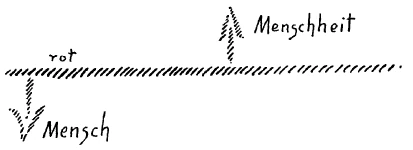
[ 29 ] It is interesting to note how this same national impulse, combined with the emancipation of the individual, takes on very different forms in the two distinct entities where, as we have seen, they began to diverge clearly in 1429. In France, the nuance of the emancipation of the individual within the national context manifests itself in such a way that it is directed primarily inward. I would say: If the national (see diagram, red) is this line, and on one side of the national lies the individual, and on the other side of the national lies humanity, the world, then in France the development of the national takes the direction toward the individual, while in England it takes the direction toward humanity. France transforms the national within the nation-state in such a way that it tends toward a transformation of the individual from within, that it tends to turn the individual into something else. In England, the personal aspect emerging from the national takes on the character of wanting to extend itself into the whole world, of wanting to shape the entire world so that personality flourishes everywhere. The Frenchman seeks more to become the educator of the personal within the soul, while the Englishman seeks to become the colonizer of all humanity with regard to the implantation of personality. Two entirely different directions; the national is the fertile soil. In one case, it reaches toward the soul, inward; in the other, it reaches outward, toward the soul of humanity. Thus we have two parallel currents in France and England, each with very distinct nuances. That is why it was only in France—where the inner core of the personality was grasped—that the structure which developed there, as I have characterized it, could lead, via Louis XIV and so on, ultimately to the Revolution. In England, it led to quiet liberalism because it discharged itself outward; in France, inward, toward the innermost being of the human person.
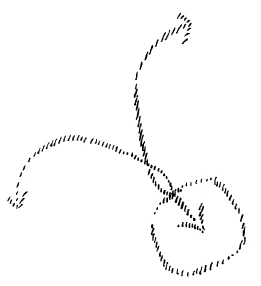
[ 30 ] Curiously, this also becomes apparent geographically, and it is particularly evident when we again consider a turning point in modern history as a symptom—namely, the turning point at which Napoleon, born out of the Revolution, lost the Battle of Trafalgar to the English in 1805. For what is revealed there? Napoleon—admittedly a peculiar figure, but nonetheless a representative of the French spirit—signifies a turn inward, even geographically, toward the European continent. If you imagine Europe as this structure (see diagram), Napoleon is pushed into Europe precisely by the Battle of Trafalgar (arrow), while England is pushed out toward the whole world, in the opposite direction. In doing so, we must not forget that this differentiation naturally requires its own conflict. It needs this conflict; in a sense, one must rub against the other. This takes place in the struggle for dominance in America; it is already somewhat evident from this turning point of 1805. But when we look back a few decades, we see how the very nuance that shaped French culture—Romanism—is being pushed back by Anglo-Saxon culture in North America.
[ 31 ] In this way, if you are willing, you can sense what is at work there. In this way, you can see how this impulse of consciousness, through its power—much like the Sorcerer’s Apprentice—evokes national impulses that take root in humanity and infuse it with nuance in the most diverse ways. One can only approach these things by studying the impulse of consciousness in everything, while avoiding pedantry and keeping one’s gaze open to the significant and the insignificant, the characteristic and the uncharacteristic—and even the more or less characteristic—so that one can thereby penetrate from the outer symptoms to the inner course of reality. For the outward appearance often even completely contradicts what actually lies within the personality as an impulse. And especially in a time when the personality is left to its own devices, the outward appearance contradicts very strongly what actually lies within the personality as an impulse.
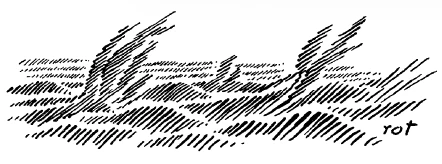
[ 32 ] This also becomes evident when one traces this development in the recent history of humanity in a symptomatic way. It is the same everywhere: there is the current (shaded in red), there is the surface—and schoolteachers teach this unreality as history. But there are points where, just like waves washing ashore—sometimes quite explosively—what lies beneath breaks through into historical events. At other points, again, it peeks out, I might say, and individual historical events reveal what lies beneath. These are then particularly characteristic as symptoms. But sometimes it is precisely the symptoms where, by looking at the symptomatic fact, one must look past the outward appearance very strongly.
[ 33 ] Now, a figure is particularly characteristic of the emergence of the impulse of the consciousness soul in Western Europe, both through her personal development and through her complete immersion in recent historical life. At the beginning of the 17th century, this individual placed himself right in the midst of this differentiation between the French and English impulses, with all the effects that these had already begun to exert on the rest of Europe at that time. By the 17th century, this impulse had already been at work for some time and had already spread. It was this individual who placed herself within that context—a remarkable individual who can be described as follows. One might say: This personality was extraordinarily generous, filled with a genuine, deep sense of gratitude for all that she had received, grateful to the highest degree and in an exemplary manner for all the kindness she encountered from humanity; a personality who was highly learned, almost embodying the scholarship of the entire era; a personality who was who was extraordinarily peace-loving, averse to worldly affairs as a ruler, filled solely with the ideal that there should be peace in the world, downright wise with regard to decisions and impulses of the will, and filled with an extraordinarily deep inclination toward friendly behavior toward people. — That is how one might describe this figure. One need only be a little one-sided to describe him this way, if one looks at him from the outside, as he appears in history.
[ 34 ] One can also describe him in the following way, even if it means being a bit one-sided again. One could say: He was a terrible spendthrift who had absolutely no idea what he could and could not afford to spend; he was a pedant, a true academic type who injected his erudition into everything in an abstract and pedantic way. One could describe him as: He was a timid person, a timid character, who, whenever it came to defending something valiantly or bravely, would timidly withdraw and prefer peace out of timidity. One could say: He was a cunning person who wound his way through life by wisely choosing whatever would get him through every situation, and so on. One could say: He was a man who sought relationships with others the way children seek relationships with others. There was an element in his friendships that was downright childish, and that veered into the fantastical and romantic in his adoration of others and his desire to be adored by them. — One need only be a little one-sided to say one thing or the other. And indeed, there were people who said one thing, who said the other; some said both. And with all that, one had considered the outward historical personality of James I as it presented itself while he reigned from 1603 to 1625. One could speak as I did at first, one could speak as I did later, and both would apply equally well to James I. When one describes one thing or the other, one has no real knowledge of what actually lived within him, nor of what lived in him as a member of modern human development. And yet, precisely during the period when James I reigned in England, something began to emerge from below, and the symptoms of that time became highly characteristic of what was actually taking place.
[ 35 ] Well, let's continue talking about these things tomorrow.