

Historical Symptomatology
GA 185
19 October 1918, Berlin
Translated by Steiner Online Library
Second Lecture
[ 1 ] Yesterday I attempted to give you a broad overview of the symptoms of humanity’s recent historical development, and finally, as if immersed in this complex of symptoms — which we did not initially examine in such detail that we would have looked everywhere for what it reveals (we will do that later), but which we have rather characterized in general terms — the remarkable figure of James I of England. He stands there at the beginning of the 17th century as a so-called ruler in England, actually as a sort of enigmatic figure, roughly in the middle of the period that has elapsed from the beginning of the fifth post-Atlantean epoch to the important, decisive 19th century. It is not yet my task here—though that may come later—to speak of the many mysteries associated with the personality of James I. That cannot be my task today, but I must point out even now how remarkable—and, again, symptomatically remarkable—this James I stands within the course of modern history. One might say: a man who could truly be characterized in such contradictory ways from all sides, as I attempted to do yesterday from two perspectives. Depending on how one frames it, one can say the very best or the very worst about him.
[ 2 ] Above all, however, one can say of this James I that, on the ground on which he stands—which has evolved from all the circumstances I have described to you and on which, in particular, a concept of the state has developed that has grown out of the national impulse, and on which that which we have characterized as a liberalizing, or at least one inclined toward and striving for liberalization—that on this ground James I appears like an uprooted plant, like a being that is not quite connected to this ground. But if we look a little more deeply at what characterizes this entire fifth post-Atlantean epoch from one perspective—namely, the birth of the consciousness soul—then the picture surrounding James I becomes somewhat clearer in a certain respect. Then we see that he is the personality who embodies that radical contradiction so easily associated with personalities from the Age of Consciousness. Isn’t it true that in this Age of Consciousness, the personality loses the very value it once possessed by virtue of instincts, precisely because it was not actually developed as a self-conscious personality? In earlier ages, the personality expressed itself—one might say—with elemental force, with a humanized, animated—and please do not misunderstand me when I say this—animal force. The personality expressed itself instinctively, not yet fully born out of the group soul, not yet fully emerged. And now it was to emancipate itself, to stand on its own two feet. This gives rise to a very peculiar contradiction, particularly for the personality. On the one hand, everything that previously existed for individual-personal expression is shed; the instincts are subdued; and within the soul, the center of the personal is to gradually take shape. The soul is to gain full, substantive strength.
[ 3 ] You can see that a contradiction exists, above all, in what I said yesterday. Whereas in earlier times—in the ages when the personality had not yet emerged as a self-aware entity—cultural development incorporated highly productive forces, this is now coming to an end. The soul becomes sterile. And yet it places itself at the center of the human being, for this is the essence of the personal: that the soul places itself at the center of the human being’s personality. As a result, such towering personalities as were characteristic of antiquity—Augustus, Julius Caesar, Pericles—we could name many others—are no longer possible. It is precisely the elemental aspect of personality that loses its value, and what emerges is what would later be called a democratic mindset—one that levels the personality, that makes everything the same. But it is precisely in this leveling that the personality seeks to emerge. A radical contradiction!
[ 4 ] Everyone holds a certain position because of their karma. Now, James I happened to hold the position of ruler. Certainly, in the time of the Persian kings, in the time of the Mongol khans, and even in the era when the Pope placed the Holy Crown of St. Stephen upon the head of the Magyar István, Stephen I, a person’s individuality meant something within a particular position; one could regard oneself as belonging to that position. James I was in his position—even in his role as ruler—like a person wearing a garment that simply did not fit him at all. One could say that James I was, in every respect and in everything he was involved in, just like a person in a garment that did not fit at all. He had been raised as a Calvinist as a child, then later converted to the Anglican Church, yet deep down, he was just as indifferent to Calvinism as he was to the Anglican Church. Deep within his soul, all of that was a garment that did not fit him. He was called upon to reign as a monarch in the approaching age of parliamentary liberalism, which had in fact already prevailed for some time. He was very clever, very shrewd when he spoke to people, but no one really understood what he wanted, for everyone else wanted something different. He came from a deeply Catholic family, the House of Stuart. But when he ascended the throne in England, the Catholics, more than anyone else, realized they actually had nothing to expect from him. This gave rise to that strange plot, which stands out so oddly in world history—the one from 1605, didn’t it?—where a whole group of people who had grown out of Catholicism joined forces, stockpiled as much gunpowder as possible beneath the London Parliament, and planned to blow up all the members of Parliament at a suitable moment. It was the famous Gunpowder Plot. The only thing that prevented it was that a Catholic who knew about it had betrayed the plot; otherwise, the fate that would have befallen James I would have been that he, along with his entire Parliament, would one day have been blown to pieces. He did not fit in anywhere, for he was a personality, and a personality has something singular about it—something conceived in isolation, something that stands on its own.
[ 5 ] But in the age of the individual, everyone wants to be an individual. That is the radical contradiction that arises in the age of the individual—we must not forget that. In the age of the individual, it is not the case that one rejects, for example, the idea of the king or the idea of the pope. After all, the point is not that there is no pope or no king. It is simply that, if there is already a pope or a king, everyone wants to be a pope and everyone wants to be a king—then the papacy, kingship, and democracy would all be fulfilled at the same time. All these things come to mind when one takes a symptomatic look at the remarkable personality of Jacob I, for he was through and through a man of the new age, but at the same time placed within that new age with all the contradictions of the individual. And those who characterized him from one side, as I mentioned yesterday, were wrong, and those who characterized him from the other side were wrong, and his own books, which characterized him, were wrong, for even what he himself wrote does not in any direct way lead us into his soul. Thus, if one does not view him from an esoteric perspective, he stands—at the beginning of the 17th century—as a great enigma, precisely in a position that, from a certain perspective, most radically signaled the emergence of the modern impulse.
[ 6 ] Let us recall once more what was said yesterday: how things actually came about in Western Europe. I spoke of the differentiation between the English and French characters. We have seen this differentiation since the 15th century. The turning point came with the appearance of the Maid of Orleans in 1429. We see how things develop. We see how, in England, the emancipation of the individual takes hold with the aspiration to carry the individual out into the world, and how, in France, the emancipation of the individual takes hold—in both cases springing from the national idea—with the aspiration to grasp the innermost essence of the human being as much as possible and to make it stand on its own. There, at the beginning of the 17th century, stands a personality who appears as the embodiment of all the contradictions of the personal: James I. When characterizing symptoms, one must never seek to arrive at a pedantic conclusion, but must always leave an unresolved remnant; otherwise, one cannot proceed further. Thus, I am by no means characterizing James I for you in such a way that you are left with a neat, self-contained little picture, but rather in such a way that you have something to think about—and perhaps even to puzzle over.
[ 7 ] A radical difference between the English and French characters is becoming increasingly apparent. It was precisely within the French character, emerging from the turmoil of the Thirty Years’ War and rooted in national sentiment, that what might be called the strengthening of the concept of the state began to develop. If one wishes to study the strengthening of the concept of the state, one can do so only by examining the example—though it is a rather unique one—of the emergence, rise to great splendor, and subsequent decline of the French nation-state, as exemplified by Louis XIV and so on. We see how, within the bosom of this nation-state, the seeds then develop into that further emancipation of the individual that came about with the French Revolution.
[ 8 ] This French Revolution gave rise to three—one might say—most legitimate impulses of human life: brotherhood, liberty, and equality. But I have already characterized on another occasion how this triad—brotherhood, liberty, and equality—appeared to contradict the actual development of humanity within the French Revolution. When considering human development, one cannot speak of these three—brotherhood, freedom, and equality—without also speaking, in some respect, of the three aspects of human nature. With regard to the physical coexistence of human beings, humanity must gradually ascend to a brotherly element, precisely in the age of the consciousness soul. It would simply be an unspeakable misfortune and a setback in evolution if, by the end of the fifth post-Atlantean epoch—the Age of the Consciousness Soul—brotherhood had not been developed among human beings, at least to a high degree. But brotherhood can only be properly understood when one conceives of it as applied to the coexistence of human being to human being in physical existence. When one ascends, however, to the soul level, then one can speak of freedom. One will always be living in error if one believes that freedom can somehow be realized in external, physical coexistence; but from soul to soul, freedom can be realized. One must not haphazardly view human beings as a hodgepodge of elements and then speak of brotherhood, freedom, and equality; rather, one must recognize that the human being is composed of body, soul, and spirit, and must understand: People attain freedom only when they seek to become free in their souls. And people can be equal only in relation to the spirit. The spirit that moves us spiritually is the same for everyone. It is sought through the fifth life stage, the consciousness soul, which strives toward the spiritual self. And with regard to this spirit that is sought, human beings are equal—just as, in fact, in connection with this equality of the spirit, the folk proverb says: In death, all people are equal. — But if one does not distribute brotherhood, freedom, and equality across these three distinct soul elements, but instead mixes them all up haphazardly and simply says: “People should live in brotherhood on earth, be free, and be equal”—then this leads only to confusion.
[ 9 ] How, from a symptomatic perspective, does the French Revolution present itself to us? Viewed precisely from this symptomatic perspective, the French Revolution is extraordinarily interesting. It represents—condensed, as it were, into catchphrases and applied in a haphazard, undifferentiated manner to the whole human being—that which must be gradually developed through all the means of humanity’s spiritual evolution over the course of the Age of the Conscious Soul, from 1413—that is, 2,160 years ago—until the year 3573. This is the task of this period: that brotherhood be attained for the bodies, freedom for the souls, and equality for the spirits during this period. But without this insight—tumbling everything into chaos—the innermost spiritual essence of the fifth post-Atlantean period appears in the form of slogans during the French Revolution. The soul of the fifth post-Atlantean epoch stands there, misunderstood, in these three words, and can therefore initially gain no outer social body; in essence, it leads to confusion upon confusion. It cannot gain an outer social body, yet it stands there like a demanding soul, extraordinarily significant. One might say: Everything inner that this fifth post-Atlantean epoch is supposed to possess stands there misunderstood and has no outer form. But it is precisely there that something symptomatically and immensely significant emerges.
[ 10 ] You see, when something—which is to be extended over the entire coming period—manifests itself almost tumultuously at the outset, it strays very far from the state of equilibrium in which humanity is meant to develop, and from the forces that are innate to human beings by virtue of their connection to their very own hierarchies. The scales tip very strongly to one side. Through the French Revolution, the scales swung very strongly toward one side—namely, the Luciferic side—in a Luciferic-Ahrimanic manner. This generates a counter-reaction. One speaks—I would say—in more than just a figurative sense; one speaks imaginatively. But you must not take the words too literally, and above all, you must not take the matter literally: In what occurred during the French Revolution lies, so to speak, the soul of the fifth post-Atlantean epoch—without the social body, without physicality. It is abstract, purely soul-like, striving for physicality; but this is only to come about in the course of millennia themselves—or at least many centuries. Yet because the scales of evolution tip in this way, it gives rise to an opposition. And what appears? An extreme on the other side. In the French Revolution, everything proceeds tumultuously; everything contradicts the rhythm of human development. As it swings to the other side, something emerges in which everything now once again corresponds entirely—and this time not in a state of middle equilibrium, but strictly in an Ahrimanic-Luciferic sense—to the human rhythm, to the impersonal demands of the personality. In Napoleon, the physical form subsequently emerges, built entirely according to the rhythm of the human personality, but now with the swing to the other extreme: seven years of preparation—as I have already enumerated—for his actual reign, fourteen years of splendor, unsettling Europe, rise, seven years of decline, of which he uses only the first year to unsettle Europe once more, but strictly unfolding in rhythm: once seven plus twice seven plus once seven, strictly unfolding in the rhythm of seven to seven years, unfolding in the rhythm of four times seven years.
[ 11 ] I have really gone to great lengths—some of you know that I have hinted at this here and there—to find Napoleon’s soul. You know that such studies of the soul can be conducted in the most varied ways using the methods of spiritual research. You may recall how Novalis’s soul was sought in earlier incarnations. I have made a sincere effort to search for Napoleon’s soul in some way—for example, in its onward journey after Napoleon’s death—but I cannot find it, nor do I believe I ever will, for it is likely not there. And that is likely to be the mystery of this life of Napoleon’s, which runs like clockwork, even following a seven-year rhythm—a rhythm that can best be understood when viewed as the complete opposite of a life such as that of James I, or as the opposite of the abstraction of the French Revolution: the Revolution—a soul entirely without a body, Napoleon—all body without a soul—but a body that seems to have been brewed together from all the contradictions of the age. One of the greatest mysteries of modern historical developments lies, so to speak, in this strange combination of the Revolution and Napoleon. It is as if a soul had wanted to incarnate itself in the world and appeared bodiless, and stirred among the revolutionaries of the 18th century but could find no body, and only outwardly had a body approached it, which in turn could find no soul: Napoleon. In such things lie more than mere allusions or characterizations intended to be witty; in such things lie significant impulses of historical becoming. However, these things must be viewed symptomatically. Here among you, I am speaking in the language of spiritual scientific research. But of course, what I have just said to you can be said anywhere else by choosing the words a little differently.
[ 12 ] And then, when we try to trace the history of its characteristics in more recent times, we see—in a relatively calm manner, truly as one link following another—the English character continuing to develop. In the 19th century, the English character developed quite steadily until the end of the century; I would say it shaped the ideal of liberalism with a certain calmness. The French character developed in a somewhat more tumultuous manner, so that when one follows the events of 19th-century French history, one never really knows: how did what followed actually come to be linked to what preceded it? — Unmotivated, one might say. That is the most fundamental characteristic of France’s history in the 19th century: unmotivated. This is not a criticism—I speak entirely without sympathy or antipathy—but merely a description.
[ 13 ] Now, one will never be able to gain insight into this entire tapestry of symptoms in recent history unless one considers how, within everything that unfolds—whether more outwardly, or even inwardly on a psychological level, yet still outward in a certain sense, as I mentioned yesterday—something else is at work. I would like to describe it to you in this way. Even before this fifth post-Atlantean epoch begins, one already senses, in a certain way, the approach of this epoch of the consciousness soul. Certain individuals sense it as if in a premonition. And they actually sense it in its true character; they sense: The age is coming in which the personality is to emancipate itself, but which, in a certain respect, will initially be unproductive, unable to produce anything on its own, and—specifically with regard to spiritual production that is to flow into social and historical life—will have to draw upon what has been handed down from the past.
[ 14 ] That, after all, is the deeper impulse behind the Crusades that preceded the Age of Consciousness. Why do people yearn to go to the East? Why do they yearn to go to the Holy Sepulcher? Because they cannot and do not want to strive for a new mission, for a new, original, specific idea in the age of the conscious human being. They strive to find what has been handed down from antiquity in its true form, indeed in its very substance: to Jerusalem, to find the old and to introduce it into the course of development in a different way than Rome did. — With the Crusades, one senses that the age of the consciousness soul is dawning, with the unproductivity that it initially manifests. And in connection with the Crusades, the Order of the Knights Templar arises—the one I spoke to you about yesterday—which King Philip the Fair put to an end. And with the Order of the Knights Templar, the mysteries of the Eastern essence came to Europe, and they were instilled into European spiritual culture. The King of France, Philip—I have, over time, characterized this from another perspective—was indeed able to have the Knights Templar executed and their money confiscated, but the impulses of the Knights Templar had flowed into European life through numerous channels and continued to exert their influence; they continued to work through numerous occult lodges, which in turn extended into the exoteric realm, and which can essentially be characterized in such a way that one can say they gradually formed the opposition to Rome. Rome stood on one side—at first alone, then allied with Jesuitism—and on the other side stood everything that, while deeply connected to Christian elements, was radically alien to Rome, was compelled to oppose Rome, and was and is perceived by Rome as opposition.
[ 15 ] What, then, was the deeper impulse behind the fact that, in response to what emanated from Rome—to this evocative universal impulse, as I characterized it yesterday—Oriental-Gnostic teachings and views, symbols, and cults were adopted and instilled into the European spirit? If we consider what this actually is, it will lead us to the true impulse behind it.
[ 16 ] The consciousness soul was to come into being. Rome sought to preserve—and continues to preserve to this day—the suggestive culture, that suggestive culture which is capable of holding people back from transitioning to the state of the consciousness soul, which is intended to keep people at the level of the intellectual or emotional soul. This, after all, is the very struggle that Rome wages against the progress of the world: that Rome insists on clinging to something suitable for the intellectual or emotional soul, while humanity, in its development, seeks to advance toward the soul of consciousness.
[ 17 ] But on the other hand, with its progress into the soul of consciousness, humanity is truly placing itself in a rather uncomfortable situation—one that the vast majority of people found uncomfortable, initially during the first centuries of the Age of Consciousness and right up to the present day. Isn’t it true that human beings are supposed to stand on their own two feet, that they are supposed to emancipate themselves as individuals? That is what the Age of the Consciousness Soul demands of them. They must break free from all the old crutches. They can no longer simply allow themselves to be told what to believe; they must actively participate in working out for themselves what they are to believe. This was perceived, especially as this age of the conscious soul dawned, as a danger to humanity. Instinctively, people sensed: Humanity is losing its old center of gravity; it must seek a new one. — But on the other hand, people also asked themselves: If we do nothing at all, what are the possible outcomes? — One possibility is simply to let humanity sail out onto the open sea of the search for the soul of consciousness, to release them, as it were, to the free impulses of progress. The other possibility, if humanity sails out in this way, is that Rome would then gain great significance and exert a powerful influence if it succeeds in dampening the striving for the soul of consciousness, in order to keep humanity rooted in the soul of understanding or the soul of feeling. This would result in human beings not ascending to the soul of consciousness, not reaching the spiritual self, and thus losing their future development. This would be just one of the nuances through which future development could be lost.
[ 18 ] The third possibility is as follows: One takes an even more radical approach, attempting to completely extinguish one’s striving so that the individual does not fall into this oscillating vibration between the striving for the soul of consciousness and the striving imposed upon him by Rome. To prevent the individual from falling into this oscillating state, one completely undermines their striving—even more radically than Rome does. This is achieved by stripping the progressive impulses of the very force of progress itself and allowing the old to take effect. This had been brought over from the East, though originally by the esoterically initiated Templars for a different purpose. But after the edge had been taken off this striving, after the Order of the Knights Templar had initially been treated as it was by Philip the Fair, King of France, what remained was the culture that had been brought over from Asia. But its momentum had initially been cut short—in history, not in the lives of individual personalities, but in the historical world. As I have said, what the Templars had brought over had trickled in through numerous channels, but its actual spiritual content had been stripped away in many respects. And what was it, then? It was essentially the content of the third post-Atlantean epoch. Catholicism brought the content of the fourth. And that from which the spirit had been squeezed out like juice from a lemon—which propagated as exoteric Freemasonry, as Scottish or York Rites or whatever—and which, in particular, was seized upon by the false esotericism of the English-speaking population—that is the squeezed lemon, which, having been squeezed, contains the mysteries of the third post-Atlantean, the Egyptian-Chaldean period, and which is now being used to send impulses into the life of the consciousness soul.
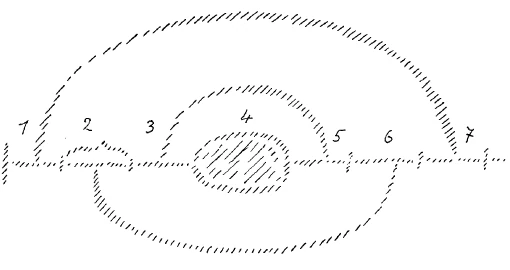
[ 19 ] In fact, something is emerging that, in the worst possible sense, resembles the course of development that is supposed to take place. Just recall the following, which I once explained to you. I spoke to you about evolution in the seven epochs (see diagram). Here, at the beginning, we have the Atlantean catastrophe, then the first post-Atlantean epoch, the second, third, fourth, fifth, sixth, and seventh. The development proceeds in such a way that the fourth period stands alone, forming, so to speak, the center. What was characteristic of the third period reappears, but on a higher level, in the fifth. What was characteristic of the second period reappears, again on a higher level, in the sixth. What was characteristic of the first, the primordial Indian period, reappears in the seventh. Such overlaps take place. Remember how I said that there are individual spirits who are aware of this overlap, as in Kepler—when he attempted, in his own way during the fifth post-Atlantean epoch, to explain the harmonies of the cosmos through his three Keplerian laws, saying: “I bring forth the golden vessels of the Egyptians,” and so on—the awareness arises that what was the essence of the third post-Atlantean epoch is being revived in the human being of the fifth post-Atlantean epoch. In a certain sense, then, one creates something similar to what is about to unfold in the world when one adopts the esotericism and cults of the Egyptian-Chaldean era. But one can use what is adopted in this way not only to deprive the soul of consciousness of its independence through suggestion, but also to dampen and paralyze the very driving force of the soul of consciousness. And from this perspective, they have succeeded in many ways: in lulling to sleep the consciousness soul that is meant to emerge. From this perspective, they have succeeded in many ways.
[ 20 ] Rome—I am speaking figuratively here—needs incense and lulls people half to sleep by inducing dreams in them. The movement I am referring to here lulls people—that is, the conscious soul—completely to sleep. This also seeped into the historical development of modern humanity. And so, on the one hand, you have what takes shape through the tumultuous emergence of brotherhood, freedom, and equality; while on the other hand, there is the impulse that, in the course of the fifth post-Atlantean epoch, prevents people from clearly seeing how brotherhood, freedom, and equality should take hold of them. For they can only clearly perceive this if they can use the soul of consciousness for true self-knowledge, if they awaken within the soul of consciousness. When people awaken within the soul of consciousness, they first feel themselves in body, soul, and spirit. But this is precisely what is meant to be lulled to sleep. So we have these two currents at work in recent history: On the one hand, now that the impulse toward the soul of consciousness is present, there is a chaotic demand for brotherhood, freedom, and equality. On the other hand, various orders strive to extinguish this awakening in the soul of consciousness so that individual personalities cannot use this awakening for their own purposes. These two currents intertwine throughout the entire course of modern history.
[ 21 ] And now something is taking shape. As modern times surge into the 18th century and into the early 19th century—up to about the middle of the 19th century—there is initially a strong surge toward the emancipation of the individual, because when there are so many currents, as I have described to you, the process does not unfold gradually and smoothly, but rather in ebbs and flows. And we see, on a national basis and arising from the other impulses I have described to you for Western Europe, how that which strives toward the emancipation of the individual—that which seeks to move from nationality toward the universal human—develops. But it cannot develop properly on its own, because there is always the countercurrent from those orders which, especially in England, terribly infect the whole of public life, far more than the outside world realizes. It cannot develop. And so we see the emergence of such remarkable figures as Richard Cobden and John Bright, who, on the one hand, are truly gripped by the impulse toward the emancipation of the individual—toward the overcoming of the national by the individual across the entire globe—and who went so far as to touch upon something that could be of the greatest political significance, if it were ever to venture into more recent historical developments—though differentiated according to the various regions, for naturally people characterized it only in terms of their own region: the principle of non-intervention in the affairs of others on the part of the island kingdom as the fundamental principle of liberalism. It was something very significant, but no sooner had it emerged than it was completely blunted by the other aspiration that arose from the impulse of the third post-Atlantic period. And so we see how, from the West, what is commonly called liberalism—a liberal mindset—began to emerge by the middle of the 19th century; soon it was called “liberal-minded”—well, whatever name one prefers. But as you know, I am referring to the worldview that manifested itself most clearly in the political sphere in the 18th century as the political Enlightenment, and in the 19th century as a certain political movement known as the liberal political movement, which gradually faded away and died out in the last third of the 19th century.
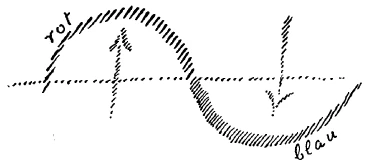
[ 22 ] What, for example, was still widely regarded as a liberal element in the 1960s gradually receded entirely from real life. Something else took its place. Here we are approaching significant symptoms of recent historical life. What was bound to happen? For a time, the impulse of the conscious soul was such that it drove a flood upward: the liberalizing flood (see diagram, p. 50, red). But what swings so far in one direction inevitably swings back in the opposite direction (blue), so that we also have a swing in the other direction. This will be the counter-swing of liberalism (downward arrow). Let us just picture the situation clearly. Liberalism arose because the people who advocated it, inwardly—I would say—really came into their own, really took control, and stormed against the earth’s tentacles, as I have described to you. They broke free, did not allow themselves to be captured—if I may use that trivial expression—and were simply gripped by universal human ideas. But the other force was there all along, shaping the course of modern times and gradually drawing these very sparsely represented so-called liberal ideas over to its side. And by the middle of the 19th century, liberal ideas were already essentially hopeless in the political arena, for those who continued to advocate liberal ideas later on actually gave the impression, to a greater or lesser extent, of being invalids of political thought. The liberal parties of later times were thus merely laggards, for since the mid-19th century, the fruit of what emerged from those Western orders and secret societies had become increasingly prevalent: the lulling to sleep, the soothing of the conscious soul as such. Then the soul and the spirit cease to have any effect at all; at first, only that which exists in the outer, sensory-physical world has an effect. And this has manifested in modern times, since the mid-19th century, as self-conscious socialism in all its various forms.
[ 23 ] This form of socialism that emerged can only be understood intellectually: not with a pseudo-spirit, with the mask of the spirit, or with mere intellectual culture, which can grasp only what is dead. And it was Lassalle who first grappled with such a dead science, but Marx and Engels were the ones who developed it—this dead science. And so, within socialism—which, as a theory, strove to become practical but achieved nothing of substance in practice because it always remained stuck at the theoretical level—one of the most significant symptoms of humanity’s recent historical development emerged. We must bring certain characteristic aspects of this socialism to the forefront of our minds.
[ 24 ] There are, in fact, three beliefs—or rather, aspects of belief—that characterize modern socialism. It is based, first, on the materialist conception of history; second, on the concept of surplus value in an economic and macroeconomic context; and third, on the theory of class struggle. This is essentially what fills millions of people across the globe with conviction today, and it can be summarized in these three points: the theory of class struggle, the economic view of the origin of surplus value, and the materialist theory of history.
[ 25 ] Let’s try to be very clear about this so that we can fully understand the symptoms I’m referring to here as a foundation for what we plan to build upon tomorrow. First: What is the materialist conception of history? — The materialist conception of history holds that everything that happens in the course of human development occurs solely as a result of external, purely material impulses. People must eat, must drink; they must obtain from here and there what they need to eat and drink. They must therefore interact with one another; they must produce what nature does not produce on its own. But that is precisely what drives human development in the first place. If, in any given era, let’s say a Lessing appears—I’ll choose a well-known name—why does Lessing appear, as he did in the 18th century? Well, since the 16th century, but especially in the 18th century, the introduction of the mechanical loom, the spinning machine, and so on had brought about a sharp division—it was in the making—that was taking shape between the bourgeoisie and the emerging proletariat. The proletariat was barely there yet, but it was, so to speak, already smoldering beneath the surface of social existence. But compared to the earlier estates, the bourgeoisie had grown stronger in the course of modern economic life. Through the very way one lives as a bourgeois—having workers beneath one, no longer truly recognizing the earlier estates, and having brought about a system where the production, processing, and distribution of goods are carried out exactly as the bourgeois does— a certain way of thinking becomes widespread, which is nothing other than an ideological superstructure for the way the bourgeoisie produces, processes, and trades goods. This necessitates thinking in a certain way. Those who are not bourgeois—who are still peasants, surrounded by nature and living in harmony with it—think differently. But the way they think is merely an ideology, for what really matters is the way they produce, process, and trade goods. Because the bourgeois is crammed together in cities, he thinks differently from the peasant. He breaks away from the soil, does not see nature, and therefore the connection is abstract to him. He becomes an Enlightened person who thinks of God in general, abstract terms. But all of this is a consequence of the fact that he produces goods. — I’m putting it rather bluntly, but in a certain sense, that’s how it is. — Because goods have been processed and traded in a certain way since the 16th century, a mode of thought has emerged that manifests itself in a particular way in Lessing. Lessing is the representative of the bourgeoisie at the height of its development, behind which the proletariat lags in its own development. — Herder, Goethe, and so on can be explained in a similar way. All of this is a superstructure; for the elementary materialist conception, the only reality is that which arises from the production, processing, and trading of goods.
[ 26 ] This is a materialist view of history. If one wishes to explain Christianity, one must explain how, at the time our calendar began, trade relations between the East and the West had changed; one must explain how the exploitation of slaves and the relationship between masters and slaves had transformed; and then, based on that, explain how an ideological superstructure developed over all this economic interplay: that is Christianity. Because people came to face a different necessity—that of producing what they eat and what they trade for food—than had been the case in the past, they began to think differently. And because a most radical economic upheaval took place at the beginning of our era, that same radical upheaval also occurred in the ideological superstructure, which is characterized as Christianity. — This is the first part of those convictions that have made their way into millions and millions of hearts since the mid-19th century.
[ 27 ] Those who have remained within the bourgeoisie actually have no idea how deeply, deeply ingrained this view is in the broadest circles. Certainly, the professors who speak of the ideas of history, who speak of all manner of historical shadows—they have an audience. But even among the professors, a few have recently felt a quiet attraction to Marxism. Yet they have no audience among the broad masses of people. This, however, is the age of the soul of consciousness, and the impulse of the soul of consciousness continues to take effect. People are waking up, insofar as they are allowed to wake up. On the one hand, attempts are made to lull them to sleep; on the other hand, however—I might say, even in the midst of sleep—they demand to wake up again. Since they have nothing else but the directing of their senses toward the purely material world, they develop a materialistic view of history. And so these peculiar phenomena arose: one of the noblest, most liberal minds, Schiller, was long celebrated and outwardly admired to an extraordinary degree. In 1859, monuments were erected everywhere to mark the jubilee of his birth. In my youth, there lived a man in Vienna named Heinrich Deinhardt who endeavored, in a very beautiful treatise, to introduce people to Schiller’s true trains of thought—the very ideas he had set forth in his Letters on the Aesthetic Education of Man. The entire print run of this work was pulped! The author, this Heinrich Deinhardt, once had the misfortune of being struck—I believe—by a passing carriage; in short, he fell over on the street, broke his leg, and could not be cured—even though it was a minor fracture—because he was so malnourished that it was impossible to restore him to health. He did not survive. This is merely one symptom of the way the 19th century treated those who truly sought to make Schiller understandable, those who wanted to introduce Schiller’s great ideas into the general consciousness of the age. Certainly you will say, or others will say: Are there not noble endeavors in all fields? — There certainly are, and we will speak of them as well in due course, but for the most part they all lead to dead ends.
[ 28 ] That is one aspect of socialist conviction. The second is the theory of surplus value. It can be briefly characterized as follows: The modern mode of production has led to a situation in which those who must be employed to produce and process goods must transform their own life force into labor power, which then becomes a market commodity just like any other. For two classes of people emerge: the entrepreneurs and the workers. The entrepreneurs are the capitalists, and they therefore own the means of production. They own the factory, they own the tools, they own everything that constitutes the means of production. This is one group of people, the employers; they own the means of production. Then there are the workers; they own no means of production, but have only one thing to offer on the market: their labor power. Because of this contrast between the entrepreneur and the worker—because the entrepreneur, who owns the means of production, is opposed by the propertyless worker, who can offer only his labor power on the market—it is possible to drive down the compensation for the commodity “labor”—commodity “labor”!—to a minimum, and everything else flows to the owner of the means of production, that is, the entrepreneur, as surplus value. As a result, what is produced for the market and for humanity—that is, for consumption—is distributed in such a way that the worker receives only a minimum in compensation; the rest flows to the capitalist class as surplus value. — That is Marxist theory. And that, in turn, is the conviction of millions of people. — And this is brought about solely by the very specific economic structure that modern social life has taken on. Ultimately, this leads to the existence of exploiters and the exploited.
[ 29 ] It is essentially these categories that, since the mid-19th century—first in small circles, then in sects, and now among millions and millions of people—have won hearts over to the view of a purely economic structure in social life. For if one takes these views—which I am merely outlining for you—and develops them further, it is very easy to arrive at the conviction that the individual’s ownership of the means of production is the ruin of evolving humanity. The means of production must become common property. All who work must be able to manage the means of production collectively. — The expropriation of the means of production has become the ideal of the working class.
[ 30 ] It is very important, first of all, not to get stuck in the outdated notions—which bear no relation to reality—that many people still hold, people who have remained part of the bourgeoisie and have thus slept right through modern developments. After all, isn’t it true that a great many people who are so entrenched in bourgeois thinking—who have simply slept through what has actually happened in recent decades—still hold the view today that, yes, there are Social Democrats and Communists who want to redistribute wealth, who want everything to be communal, and so on. — These people should actually be astonished now when they hear that a carefully developed, incisive view of how things should and must be is held by millions upon millions of people: the theory of surplus value, which can only be overcome by making the means of production the common property of all. Anyone who is a socialist agitator today—or even just someone who follows in the footsteps of a socialist agitator—naturally scoffs at members of the bourgeoisie who talk to him about communism and everything the Social Democrats want, because he understands that this is about socialization, that is, the collective management of the means of production. For today’s worker sees the root of all evil in the ownership of the means of production by individual human beings, because those who have no means of production are at the mercy of those who do.
[ 31 ] Thus, in essence, the social struggle of modern times is a struggle for the means of production, and it must be a struggle, for this is the third conviction of social democracy: that everything that has developed has done so through struggle. The bourgeoisie rose to power by overcoming the nobility. The proletariat will rise and will win control over the means of production by doing to the bourgeoisie what the bourgeoisie did to the old nobility. Everything is a class struggle. The progress of humanity lies in the overcoming of one class by another.
[ 32 ] This threefold view: first, that what drives humanity forward from one epoch to the next are only material impulses, while everything else is merely an ideological superstructure; second, that the real source of corruption is surplus value, which can only be overcome through the collective management of the means of production; and third, that the only way to make the means of production collective is to overcome the bourgeoisie just as the bourgeoisie overcame the old nobility—this is what has gradually spread throughout the civilized world as the so-called socialist movement. And then there was also this, as a significant historical symptom of the very recent years: that both the members of the remaining nobility and the members of the remaining bourgeoisie retired to their beds of rest, at most adopting slogans such as “sharing” and “communism”—well, those very slogans about which there are sometimes lengthy notes at the very back of history books. But very rarely is there anything written about it at all! So what actually happened was overlooked. And this then developed to the point where—with great difficulty, but under the pressure of circumstances and the influence of these last four years—some people began to take notice of certain things. It’s impossible to imagine how carefree people would have continued to sleep if the last four years hadn’t happened—how unconcerned they would have been that, with each passing year, thousands upon thousands were being won over to these socialist views I’ve just described to you, and that, ultimately, people are dancing on a volcano. But it is uncomfortable to admit that one is dancing on a volcano, and people avoid realizing that they are dancing on a volcano. Yet the volcano does not avoid erupting and burying those who dance upon it.
[ 33 ] With this, I have once again described a symptom of recent history. For this socialist conviction is one of the symptoms of recent history. It is a fact; it is not merely some theory. It has an impact. I do not attach any importance to the rigidity of Lassallean or Marxist theory, but of course I attach great importance to the existence of millions of people who have chosen as their ideal to do what they can recognize from the three points I have cited. But this is something that is radically opposed to the national, which I have shown you as a certain foundation at the outset of recent history. All sorts of things have developed from this nationalist mindset. Now, as for what the proletariat strives for—as was already evident in 1848 when Karl Marx first published the program of this proletariat, which essentially contained the points I have just mentioned—it concluded with the call: “Workers of the world, unite!” And hardly any gathering of these people anywhere on earth concluded without ending with a toast to international revolutionary social democracy, to republican social democracy. That was an international principle. And so, alongside the Roman International with its universal ideal, stands the International of Socialism. That is a fact, for these so-and-so many people are a fact. It is important to bear this in mind.
[ 34 ] To bring this symptomatology of modern times to a close—at least for the time being—we must clearly set our sights on the path that will allow us to trace the symptoms until they reveal to us, to some extent, where we can break through and glimpse reality. On top of all this, other people have created virtually insoluble problems—you must sense how things are unfolding, how they are coming to a head—insoluble problems. We see how, in the 19th century, the liberalizing parliamentary movement developed relatively calmly in England; tumultuously—or rather, without clear motivation—in France. The further east we go, the more we must say: the national is being carried over, transferred, just as I mentioned yesterday. But in the process, insoluble historical problems arise. And that, too, is one such symptom. Of course, those people who do not think for themselves consider everything solvable; they believe that everything can be solved.
[ 35 ] Such an unsolvable problem—and I don’t mean for the abstract mind, where it is of course solvable, but I mean in reality—arose in 1870–71 between Western, Central, and Eastern Europe. This is the so-called Alsace Problem. Of course, intelligent people can solve it. Either one state conquers the other, defeats it, and then the matter is resolved, isn’t it? That’s what both sides have long attempted with regard to Alsace. Or, if that’s not desired, a referendum is held among the population. That’s very simple: the majority decides. Isn’t that right? That’s how it works, say the intelligent people. But those who stand in reality—who do not merely see a single moment in time, but who see how time itself is a real factor, and how what must develop over the course of time cannot be brought to fruition in a short period—in short, the people who stand in reality—they already knew that this is an unsolvable problem. One need only read what the people who tried to look into the course of European development thought, wrote, and said about this problem in the 1870s. Before their eyes, before the eyes of their souls, they saw how the events unfolding there were creating strange preconditions for Europe’s future, and how a drive would arise in the West to challenge the entire East. Even back then, there were people who knew: The Slavic problem will arise because the West will want to solve the matter differently than in Central Europe. — I merely wish to point out how things stand. I want to point out that this is a tangible symptom, just as I presented the Thirty Years’ War to you yesterday to show that in history, one cannot present what follows as an effect of what preceded it. The Thirty Years’ War itself demonstrates: what it began with—what existed before the outbreak of the war—is exactly the same as after its end; but it did not begin with what subsequently arose. There is no question of cause and effect. You can see something characteristic in this symptom, just as in the Alsace issue. I could show you the same thing for many issues of modern times. Problems are raised, but they do not lead to a solution; rather, they lead to insolubility, to ever-new conflicts, and into dead ends in life. It is important to bear this in mind. They lead to such dead ends in life that it is impossible for everyone in the world to share the same opinion; one person must hold a different opinion from another simply because he is in a different part of Europe. And again, it is a characteristic feature of modern historical symptoms that people bring about circumstances that are insoluble problems.
[ 36 ] We now have a whole series of characteristic features of modern human development: the unproductive, the emergence—in particular—of such ideas of community that make no claim to productivity, such as those of the national impulse and so on. Amid all this, however, is the ceaseless surge of the conscious soul. And now the characteristic feature of straying into dead ends—everywhere, straying into dead ends. For a large part of what is being discussed today, of what people are undertaking today, is a movement into dead ends. And another characteristic: the effort to dampen awareness of precisely what is supposed to be developed as consciousness. For there is nothing more characteristic than the dampening of awareness among today’s so-called educated segment of the population regarding the true conditions within the so-called proletariat. In fact, everyone remains oblivious to the true conditions in the proletariat. At most, they see only the outward appearance. Housewives complain about the maids, saying they no longer want to do this or that, and show no inclination to concern themselves with the fact that today it is not just factory workers, but even the maids who are imbued with Marxist theory. People are gradually talking about all sorts of universal human themes. But that is pure rhetoric if one is not genuinely interested in and concerned for the individual human being. To do that, however, one must know what is truly important in the development of humanity; one must truly engage with these matters.
[ 37 ] Truly, not to present any social “theory,” but rather to illustrate to you the symptoms of recent historical developments, I have once again had to present this one symptom of socialism before your minds. We will continue our reflections tomorrow to bring this to a conclusion and, in certain places, I would say, to break through to reality.