

The Developmental-Historical Basis
of Social Judgment
GA 185a
23 November 1918, Dornach
Translated by Steiner Online Library
Seventh Lecture
[ 1 ] In my recent reflections, I have attempted, from a wide variety of perspectives, to present to you some of the ideas and impulses that have long been stirring within proletarian circles, that live on in those circles, and that will contribute the very essence of what will be world-shaking events from the present into the near future. Today, in order to bring these reflections to a sort of conclusion tomorrow, I would like to point out a number of things that, in a sense, are present in the present as forces stemming from the past—things that are perceptible, especially to the observer with a spiritual-scientific perspective, among the forces determining the destiny of humanity, which have been preparing themselves in the past, are present now, but which are not actually as obvious on the surface as most people today believe; yet they must be taken into account by anyone who, at any point in the development of the world—and indeed, everyone stands at such a point—wishes to participate in shaping the events—one can indeed speak of such a shaping of events—that will unfold from the present into the future.
[ 2 ] What happens always arises from certain forces that have their center here or there and then radiate out in a wide variety of directions. We have seen how, over the last four and a half catastrophic years, forces that had been preparing for a very, very long time have, in a sense, discharged themselves in the most diverse directions, taking on the most varied forms, so that what has actually happened in the last four and a half years reveals clearly distinguishable epochs—even if they are brief in terms of time— and it is not sufficient to simply lump all these events of the past four and a half years together and call them the “war” of recent years. At a certain point, I would say, the events reached a point of warlike ignition. But then, in addition to the events that initially—I would say—shone into people’s consciousness in a more illusory way and were interpreted in the most illusory manner by the broadest circles, entirely different forces came into play. People’s decisions and their impulses of will changed in a relatively short time to become quite different from what they had been before.
[ 3 ] All of this must be carefully taken into account. For in the future, we will see that here and there, this or that direction of will will emerge. In one place, in one center, people will want one thing; in another center, they will want another. These impulses of will, which will emanate from groups of people, will interpenetrate and conflict with one another in the most diverse ways. There is not the remotest possibility of harmony among the active forces at play; rather, the primary concern must be for the individual to truly develop an understanding of whatever arises here or there. Today, very few people are at all prepared to assess this or that in the proper way as it arises, for people have become too accustomed to judging things according to preconceived opinions and catchphrases. Over the course of the nineteenth century and up to the present day, people have gradually trained themselves to the point where they have diverted their attention from what really matters. As a result, it is hardly possible anywhere today to properly assess the weight of the impulses of will emanating from this or that group of people. The course of recent events has provided ample evidence of this. This evidence will one day be recorded by history. Perhaps sooner than people believe, it will be recorded by history. But for anyone who wishes to form a judgment that in any way relates to these events, it is necessary to develop, even today, the will to assess the facts and evaluate the events.
[ 4 ] I say: There is an abundance of evidence for what I have just said. One need only provide one compelling piece of evidence—evidence whose significance, alas, alas, still extends far too deeply into the present, in that, in this regard, even in places where judgments ought not to be clouded, such judgments are often clouded. For in the course of recent years, we have had the sad experience that it is precisely those people who held positions of responsibility here and there in a wide variety of fields—people who were tasked with directing or managing this or that, or even merely with judging this or that — for a great deal depends on judgment, on so-called true public opinion, which is sometimes actually the unspoken mental opinion of the people and which nevertheless has a certain profound significance —, we have found—and this continues to have an impact even today—that people in positions of authority, or even in non-authoritative positions that nonetheless carry weight, have formed illusory judgments about everything on which they should have exercised sound judgment. I have, for example, touched upon the fact that the German people, in particular, have been saddled by foreign countries with a negative judgment that has had a greater impact than one might think in the course of recent events: namely, the judgment regarding the German Emperor. This judgment regarding the German Emperor is now being corrected somewhat by the very latest events, but it is actually only just beginning to be corrected. The worst aspect of these judgments—the one that has had a downright devastating effect—was that this man was regarded as a man of significance. Had he not been regarded as a man of significance, but rather as a highly insignificant figure—a man who was, in fact, completely irrelevant to the course of events, as he had been throughout all the years since his accession to the throne—then that terrible judgment from abroad would never have come about, a judgment which—as history will surely show—has wrought greater devastation than one can even begin to imagine today.
[ 5 ] Isn’t it true, however, that it will contribute somewhat to setting the record straight if one considers the desperate fear that a few people in Germany felt when this man—still resisting resignation in his final days—fled to headquarters, perhaps in the hope of finding some way there to hold on, to somehow preserve the old order after all. If one could properly assess the voices of those who always advised him to return to Berlin, where he belongs, then one must say that this is precisely where the weight of necessary judgments becomes apparent. Things must not only be thought through; they must be assessed, they must be weighed. It is extremely reckless, for example, that an article appeared yesterday in a Basel newspaper that, in a sense, served as an excuse for the German Emperor and an indictment of the German people. This German people has truly suffered enough over the decades from all that has been inflicted upon them—precisely through the trivialization and theatrical exaggeration of every situation, and through relentless tyranny. And when a “German abroad,” as was the case in that Basel newspaper yesterday, is now used to accuse the German people in the most foolish manner—in order to make the absurd claim that this man was merely a representative of the German people—which he most certainly was not—this constitutes a profound recklessness that must absolutely be condemned. What matters today is that such reckless judgments do not take root, especially in neighboring countries, and that people take note of such judgments, which are capable of poisoning the very atmosphere into which we must enter.
[ 6 ] These matters really must be viewed today with a more penetrating gaze. One must not remain indifferent to these matters; one must be vigilant. One must truly be able to approach these matters not with an emotional, but with a truly rational mindset, and one must feel indignation—intellectually—when such follies are put forth in the world today that are capable of completely distorting sound judgment. And sound judgment is necessary above all else today. Try, just once, to take things truly as they should be taken today—by weighing them for what they are, by not brushing aside the things that set the tone and spread opinions throughout the world with an indifferent “sense of humor” that is no humor at all, and by not turning a blind eye, since these are, after all, events that, each and every one of which, in and of itself, can be of immense, far-reaching, world-historical significance. These things must also be observed today against a more urgent backdrop. And I would so dearly love to see something take root in the hearts of those who wish to profess their commitment to anthroposophy—something I would call a world-historical capacity for judgment. I would like something to take root in your hearts—something that captures the importance of the moment—so that we may truly move beyond the mindset that has never existed wherever I have sought to bring an anthroposophically oriented worldview into the world; so that we may move beyond the mindset that treats what is presented in anthroposophy is taken merely as a Sunday afternoon sermon—as something intended solely to warm the hearts, to soothe, and to temper the souls. No, everything—precisely on the basis of an anthroposophically oriented worldview—was intended to guide hearts and souls into that cosmic current that has been gathering since the end of the nineteenth century, a current that pointed more and more toward the significant, great events that have shaken humanity and will continue to do so with ever-increasing intensity. Everything was aimed at directing hearts toward the forces at work, not merely toward a casual listening to whatever might slightly soothe the soul and slightly warm the heart, so that, having taken in what the anthroposophically oriented worldview offers, one might then sleep with a somewhat calmer soul than one otherwise would. Today, the individual is in no position to look only to himself, to simply receive, as it were, a kind of new religion for the sake of soothing his own heart. What is demanded of humanity calls upon the individual to participate in what surges and swells through human social life.
[ 7 ] To do this, it is necessary to view things against a broader backdrop. I do admit that over the past few years, driven by the impulse to bring the anthroposophically oriented worldview to people’s hearts, it was necessary—because time was pressing—to present many things in rapid succession, allowing the ideas to follow one another in quick succession. If, at times, we had had a month or even longer to present what we had to convey in the course of a week—if we could have offered in small portions what, due to the urgency of the situation, necessarily had to be brought quickly to people’s hearts—it might have penetrated more deeply into their souls. But that was not possible. Time was of the essence, and events have proven that time was of the essence. I admit that, due to the speed with which the teachings of the anthroposophically oriented worldview were presented to the members of the anthroposophical movement, it was indeed sometimes the case that what came later overshadowed what came before. Yet one cannot be involved in such a serious matter without changing one’s entire outlook. And in a certain sense, the words that had to be repeated over and over again at the time of Christianity’s founding are being renewed in the present: “Change your outlook.” What matters is not merely that we adopt this or that doctrine in substance; what matters is that we change our entire orientation of mind, that we cast off everything that determined the direction of our judgment from the nineteenth century onward—what one can truly call, as I just mentioned in an earlier address, the century of indecent psychology, of indecent spiritual orientation, where, when looking into the human soul—due to that lack of trust in the divine-spiritual forces of the soul of which I spoke yesterday—one can see within human souls only arbitrariness, or only powerlessness, or only inaction, where one has never grasped anything like Fichte’s words: “Man can do what he ought to do; and when he says, ‘I cannot,’ it is because he does not want to.” — This nineteenth century was a century of great scientific achievements. Yet these achievements were such that they paralyzed people’s will and gave rise to the belief that everything that comes from the human breast emerges from it merely by chance. That the Divine-Eternal radiates from every human heart, and that every human being is responsible for embodying the Divine-Eternal through themselves—this is what the nineteenth century completely suppressed; this is what led the Goethean era into the age of philistinism; this is what makes today’s intelligentsia so unprepared for everything I have described to you and for what drives millions upon millions of proletarian souls as an impulse.
[ 8 ] Understanding—that is what matters most in the present. Action—the opportunity for that will only come once people have truly made an effort to understand. Nothing that the middle class, for example, believes today might be good in the future—nothing of that sort—will in any way counteract the impulses that I have described to you in recent days as the impulses of the proletariat striving upward from below. If it weren’t so tragic, much of the quackery emanating today from those who have had decades to learn from events—and who have learned absolutely nothing from them—would seem tragicomic.
[ 9 ] So today, in order to lay the groundwork for the immediately relevant points I still have to address, I would like to say that we should establish a broader framework—create a backdrop, so to speak. You see, everything that influences modern society—everything that acts as forces which will unleash themselves in the most diverse ways toward the future—stems from certain fundamental forces that interact in the most varied ways. I pointed out yesterday at the end that the struggle—which is a purely material one and will plunge humanity into materialistic conflicts—will increasingly be orchestrated from the West; and that from the East, the blood will counteract what is coming from the West as an economic struggle. This concept, which will be extraordinarily important in the future in social terms—and which is important for anyone who wishes to form a clear judgment—must be interpreted in greater detail. Over the past few years, I have had the opportunity to speak with a wide variety of people about the factors that should be drawn from the active forces in order to steer the future in one direction or another. On every occasion when it came to discussing something of practical significance, one was, quite frankly, overwhelmed—I would say oppressed—by the short-sightedness that has gradually taken hold of modern humanity’s power of judgment. Today, of course, people are quick to say that anyone who wishes to think critically about current developments should be familiar with the conditions of the people here and there. But it is precisely this process of getting to know the people that people do not even seek through the channels by which it must necessarily be sought today—and hence the grotesque and grandiose errors. The one error I have cited to you is, after all, only a partial error. To fully grasp the gravity of what is at stake here, one must point out that the period in which vast masses have been driven into the most absurd judgments is now coming to an end.
[ 10 ] Yesterday I showed you that, for the majority of people—that is, the proletariat—the power of belief extends only to purely material things. I had to tell you: If the power of belief—which, for example, has developed among the proletariat over the decades through Marxist influences—had been present even in the slightest degree among the bourgeoisie, things would be somewhat different from what is unfortunately the case today. But it would then have been necessary for precisely those people who had the opportunity, by virtue of their social position, to have taken advantage of that opportunity—since they did not do so, they must do so in the future—to embark on the paths of judgment along which true judgment alone can be attained; I do not mean judgment about this or that, but judgment in general. Just consider for a moment that it was not a single nation, but people across a vast expanse who, for years, were able to regard two generals—Hindenburg and Ludendorff—as significant figures, when in fact they were utterly insignificant: Hindenburg and Ludendorff. Such a distortion of judgment among vast swaths of the population is a defining characteristic of our present age. This is primarily due to the fact that people do not feel a sense of responsibility when forming a judgment. I am, of course, aware that one might initially say: “Yes, even if someone had formed a judgment—a correct judgment, for example, about Ludendorff, who must be regarded as a pathological case, a person who, so to speak, since the beginning of the war can no longer be assessed except from a psychiatric standpoint”—I know that one might say: “What good would such a judgment have done at a time when it was forbidden to voice a judgment?” — Certainly, that is true, but that is not the point; rather, the point is that a person must first form that judgment, at least within themselves; then the rest will follow—that they do not allow themselves to be clouded even in the innermost reasons for their own uniqueness. And now this must be stated all the more emphatically, for the force of events has brought about a situation in which certain judgments must be corrected by the so-called Central Powers. This force of events has not yet brought about a correction of the judgments of the Entente and the American powers. And that would bring immense calamity upon humanity if, in that case as well, one were to wait to correct these judgments until the power of events speaks; if, for example, the outcome were now to lead to the worship of the Entente’s rulers; if the resolve did not mature in people’s hearts to see clearly how things really stand. If adoration of success were to arise now, if the determination of judgments were to be dictated even merely by the external course of events, this would have immensely devastating consequences for the development of humanity. This would not, of course, be a sign of how one person or another might express themselves under the suppression of judgment, but at least in their individuality, human beings should form an independent judgment about what is. One forms such a judgment when one feels within oneself that one is not a personality hurled into the world by chance, capable of thinking whatever one wills, but when one feels that one is a member of the divine world order and that the power which instills a judgment into this heart, into this soul, is a power for which one is responsible even with one’s most intimate thoughts. In the course of the events of the last four and a half years, many things have happened. This or that has taken place here or there. One could say: Almost nothing has taken place about which, for example, the German government or the German military leadership in positions of responsibility has formed a correct judgment. They have misjudged everything and continued to act on the basis of those false judgments. — This is already evidence of how little the present and the recent past have taught people to judge matters.
[ 11 ] I said that I’ve had the opportunity to speak with a wide variety of people. People tend to hold the abstract, superficial view that one must understand, for example, what is happening within the various social forces. They are satisfied when one journalist or another is sent to this or that region to write newspaper articles, and people have no idea what to make of it when the same principle is applied to the realm of intellectual life—the same principle that must be applied, for example, in mathematics, where one starts from elementary principles and arrives at the most far-reaching conclusions. When bridges or railroads need to be built, people admit that the science behind them is necessary—a science that starts with the simplest things in order to reach the most far-reaching conclusions. But when it comes to engaging with history or shaping history, people want to do so without any principles at all, and they will be completely at a loss if you tell them: No one can assess European conditions who does not know at least the basics—that on the Italian Peninsula the soul of feeling is the primary force at work among the people, in France the soul of understanding or sentiment, in the British Empire the soul of consciousness, and so on—as we have come to understand. These things underlie what is happening, just as the multiplication tables underlie arithmetic. And unless one proceeds from these things with an understanding of the real conditions in the world, one is, no matter what position one occupies in the fabric of contemporary social or political life, an incompetent person—just as one would be incompetent at building a bridge if one did not know the simplest principles of mathematics. People must come to realize this; they must learn to see through it. For the future of humanity depends on people being able to see through this. That is what matters.
[ 12 ] For only when one knows these basic facts does one understand the various forces that influence what is happening. You cannot properly assess a country peddler’s journey from the countryside to the city unless you are able to place that journey within the fabric of social life. Humanity was permitted, to a certain extent, to live through social life in an atavistic, slumbering state, and people in the nineteenth century preserved this state in order to sleep more deeply. In the future, humanity will not be permitted to continue living in this way; rather, it will be subject to the necessary obligation to consider what the hierarchies of the Angeloi, Archangeloi, Archai, and so on think, for their part, regarding the course of human development, and what they allow to radiate into what people do. In our daily assessments, the smallest details must be linked to the greatest. If you see councils—workers’ and soldiers’ councils—emerging today in this or that country, if you face the danger that workers’ and soldiers’ councils will spring up everywhere except in the Entente countries, then you must be able to properly appreciate the significance of such a fact. Forming a judgment about these things—that is what is necessary above all else. Do not ask at first: What is to be done? — What is to be done will become clear in due course, provided only that a genuine judgment exists—a judgment such that even the smallest detail can be linked to the broad outlines of world events. The great course of world events—which is the defining feature of our time—is becoming a reality these days; it will no longer be a mere theory, but will become a reality.
[ 13 ] In the course of European events, for example—since American events are, after all, merely a colonial-like appendage to European events—forces come into play that have been preparing for a long, long time. Anyone observing European conditions—and we have been pointing this out from various perspectives in recent days—should pay attention to the particular configuration, shall we say, of social conditions in the British Empire; they should pay close attention to the particular configuration of social conditions in Eastern Europe, in Russia, and in Central Europe; and they should be mindful of the forces at play there. For on the surface of events, these events are often masked, and anyone who observes only the surface of events will easily resort to—as one might say—slogans, or one might also call them catchphrases or catch-all terms, through which they seek to master the events. Today, people’s minds are often filled with rather superficial stuff. But at the root of human impulses, there are forces at work that have been building not just for centuries, but for millennia, and which are only now beginning to take on their truly significant form.
[ 14 ] You see, there is absolutely no possibility that this international phenomenon—which I have described to you as the mood of the proletariat, a mood nourished primarily by Marxist ideas, and naturally by Marxist ideas in the broadest sense—will actually spread throughout all of Europe, for example. That is an illusion of the proletariat. And since the proletariat will come to represent a certain power, this is a very pernicious illusion of the proletariat. Let us not overlook the fact that the worst possible outcome would result if this illusion of the proletariat were to gain dominion over the world, for one would then be compelled to overcome that dominion in turn. It would be better to see how things are unfolding and how they can be addressed. Even assuming that the impulses of the proletariat were to gain dominance in certain regions, what would come of it? Well, they would gain dominance outwardly; one could slaughter just as many people here or there as Bolshevism slaughtered in Russia. But all these ideas are merely suited to exploitation; they are merely suited to consuming the old and failing to establish the new. If the ideas of the proletariat take on a social form and take root, then the existing values will be gradually consumed—consumed at a rapid pace. Please consider just these facts—I will present a few examples to you, though there are many more—take just one such fact: The Russian treasury, for example, still had revenue of 2,852 million rubles in 1917, in that fateful year of 1917: 2,852 million rubles. Bolshevism swept in. It engaged in predatory exploitation. Russia’s state revenue in 1918: 539 million rubles! That is about one-fifth of what was collected the previous year. You can calculate for yourselves from such figures the progression that is bound to occur when predatory exploitation takes place. One must not view these matters through the lens of the judgments formed at face value, but rather in light of how the objective course of events in human history unfolds under the influence of this fact. If this social order were to spread, one would simply end up at zero, at nothing. But before this nothingness sets in, reactions emerge from the subconscious of people here and there, and within the spreading proletarianism—which is permeated by Marxism—what has been prepared over the centuries, sometimes over millennia. It will not, of course, intermingle in the same form in which it existed, but it will intermingle in a transformed form. Therefore, one must understand it and be able to assess it correctly.
[ 15 ] Now, the powers—some of which have fallen into decline, while others still rule the world—have always made it their more or less conscious or unconscious mission to deceive people. What has not been distorted through the detour of so-called history lessons! In all sorts of countries, history is nothing more than a legend; history exists solely to condition people’s minds so that their thoughts take the direction that seems pleasing to those in power and appears to be the correct one. But the time has come when people will have to form their own judgments. Over the years, various efforts have been made here, in this very place, to correct one judgment or another. But today, another question must be asked. Today, among the—one doesn’t even know how many there are—hundreds of questions that are urgently arising, the question that must be asked above all else is: How did the various power structures and social structures come into being—the ones that people here and there have raved about, or used to rave about, or have quickly stopped raving about in recent weeks? — Humanity has, after all, lived for years on slogans—slogans like “Prussian militarism” or “German militarism,” “League of Nations,” “international law,” and so on—which were, in fact, nothing more than slogans. These have actually dominated and confused people’s minds. As I said, much has already been said here to correct these judgments. The important thing, however, is to realize that, of course, things will not appear in the same form in the near future, but that one must be familiar with them so that, when they appear in a new form, one will recognize them for what they are.
[ 16 ] Isn’t it reasonable to assume, for example, that the Hohenzollern dynasty will not reappear as such? But the sentiments of the people—among whom the Hohenzollern dynasty was able to thrive—these sentiments live on, taking on a different form. Or, it is not even very likely that, even given the Entente’s desire—which certainly exists to a certain degree—the ill-fated Habsburg dynasty will somehow reappear. But that is not the point. The sentiments that were capable of keeping the Habsburg dynasty alive in people’s hearts will live on. They will not, of course, lead to the restoration of the Habsburg dynasty, but these very sentiments will contribute to that reaction against proletarianism of which I have spoken; they will reappear in a completely different form. Therefore, it is necessary to truly see through, with sound judgment, what will emerge from the most diverse centers. It is then a matter of looking at the circumstances, but looking with a gaze guided by reality. The facts as such have no value. In my books—you can find this in various places—I have spoken of “fact fanaticism,” which has such a devastating effect. This fact fanaticism is rooted in the belief that what one sees on the outside is already a fact. Something only becomes a fact when it is integrated into correct judgment. But correct judgment must be driven by the impulse of the right guiding force.
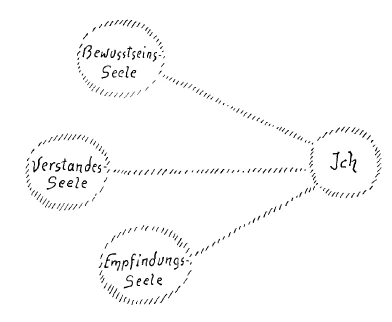
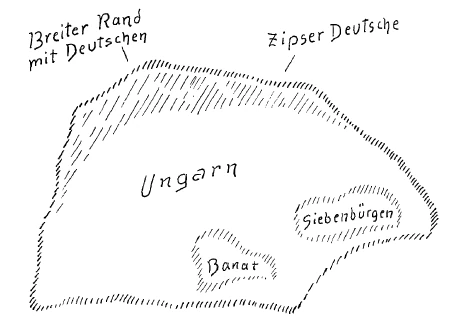
[ 17 ] Take an example. You know, I have often said that in Central Europe, virtually all nationalistic impulses are due to the fact that in this region the national spirit acts through the “I,” in contrast to the various regions of Western Europe. But the “I” has the peculiarity that it, I might say, circles up and down among the other spheres, which are fixed. So suppose: in the south and west, the feeling soul, the intellectual or emotional soul, the conscious soul; but in the center, the “I” (it is drawn). The “I” can be in the soul of consciousness, in the soul of understanding, or in the soul of feeling. It oscillates, as it were, up and down; it finds its way into everything. Hence the peculiarity: when you look toward the west of Europe, you see, I would say, sharply defined national contours. There you find sharply defined national character—a character that you can truly, I would say, define, one that is well-defined within a clear framework. Look at Central Europe, particularly at the German people, and you will see a nature defined in every possible respect. And now trace history by evaluating these fundamental principles correctly. Look wherever you wish—westward all the way to America, eastward as far as Russia—and observe how German national character has acted as a catalyst everywhere. It penetrates these foreign territories, is present there today, and will continue to exert its influence in the future, even if it has become “denationalized,” as they say; it penetrates these territories because the “I” soars up and down. It loses itself within them. You can discern this quite precisely from the fundamental nature of folk culture. Just look at how the entire Russian culture is permeated by the German spirit, how hundreds of thousands of Germans have immigrated there over a relatively short period of time, and how they have imprinted the folk character to its very depths. Look across the entire East, and you will find this imprint everywhere; go back through the centuries yourself, ask about it today—let’s go, for example, to Hungary, where there is supposedly a Magyar culture. This Magyar culture is based in many ways on the fact that all manner of German elements have entered it as a cultural catalyst. The entire northern border of Hungary is inhabited by the so-called Spiš Germans, who were, of course, subsequently marginalized, tyrannized, and denationalized—who suffered unspeakably—but who nevertheless served as a cultural catalyst. Let’s continue eastward to Transylvania, where we find the Transylvanian Saxons, who once lived along the Rhine. Let’s move on to the so-called Banat, where you’ll find the Swabians, who immigrated from Württemberg and who contributed this cultural influence. And if I were to draw you a map of Hungary, you would see here the broad belt of German people who have been absorbed into Magyar culture—here the Spiš Germans, in the southeast the Transylvanian Saxons, here in the Banat the Swabians—not to mention those who have been absorbed there as individuals. And the distinctive feature of this German folk character is that, precisely because its national spirit acts through the “I,” it, so to speak, ceases to exist externally as a people, yet forms a cultural catalyst. This is what can contribute to the assessment of the active forces. This is such an active force.
[ 18 ] Never mind whether it’s Andrássy or Karolyi; let an old-school politician, in the old feudal sense, as they say, have his way; what works is only not a mere catchphrase if one takes into account what such historical events—as I have shown you one example of, and hundreds of others are at play here—will bring about in the future from the depths of people’s subconscious. And this radiates out into the rest of European affairs, and one must, in essence, proceed quite thoroughly if one wishes to understand this complex structure of Europe today. For example, when assessing a key player in the future shaping of Europe—namely, Eastern Europe—one must not forget that, in a sense, anyone who spoke the truth about Russia in a historical context was not only a heretic but also in mortal danger. Russian history is, admittedly, not much different from other histories, but it is also, in its own right, a historical legend. For example, it does not even occur to those who study Russian history in the conventional sense—as was discussed here a few years ago—that at roughly the same time that the Normans were asserting their influence in Western Europe, Norman-Germanic influences were also making their mark in the East. And today’s Russian history has an interest in looking further and further back to show more and more how everything—absolutely everything—derives from Slavic peoples, from Slavic elements; it also has an interest in denying that the defining element—the very element that still profoundly influences what exists in the East today—stems from impulses of Norman-Germanic origin. After all, one doesn’t go much further back in Russian history than telling people—well, that’s, isn’t it, the stereotypical phrase that’s repeated over and over again—: “We have a great country, but we have no order; come and rule over us.” —That’s roughly how it begins, whereas in reality one should point out that what had spread throughout Russia up until the Mongol invasion was of Germanic-Norman origin and had a Germanic-Norman social structure. But that means that what spread in Russia at that time has since been overgrown by later circumstances—something that, I would say, has been preserved and maintained in its pure form, for example, within the social fabric of the British Empire. There is a linear progression. So if you consider the social development of the British Empire, you have a single current that, of course, changes over the centuries, but which today is the direct continuation of the old Norman-Germanic social constitution. To the east, toward Russia, you see the same current spreading out, but—under the Mongol yoke, or rather under Mongol influence, I would say—it breaks off at a certain point. In other words: If the same social structure—which was laid out in the British Empire under Norman-Germanic influence during the time of William the Conqueror and developed through the nineteenth century to the point where it occupies its current position in the world—had continued to develop in Russia, then Russia would be similar to England.
[ 19 ] Nowhere more than in Russia has everything that has had an impact penetrated so deeply into the hearts and souls of the people. Now we must not forget: What, exactly, is it that comes with the Norman-Germanic influence? — As this Norman-Germanic influence took shape, it also encountered counterforces in the West. I say: Here it developed in a straightforward manner—it developed in the most straightforward way—but it also encountered counterforces here. — What it encountered here as a counterforce—from which it emancipated itself in a certain way and which modified its course of development—is, on the one hand, the Western Roman Catholic Church, and, on the other, Romanism in general, which contains within itself an abstract legal element and an abstract political element. Thus, alongside the national influence from which all the estates-based structures, all class and caste formations—as found within the British character—stem, we see the addition of what has come from the Church and from Romanism. All of this is at work there, but in such a way that, in a certain sense—albeit at an early stage—the British character emancipated itself from that profound influence of the Church, which then continued to operate and proliferate in Central Europe and still operates and proliferates today; whereas this character has, relatively speaking, emancipated itself to a lesser extent from the Roman-abstract element of legal-political thought. The truth is that this Norman-Germanic element also extended into the various Slavic regions—which, after all, have existed on the territory of present-day Russia since the earliest times—as a dominant element, as the very element that defined the social structure.
[ 20 ] This Norman-Germanic essence, which is based on a certain worldview that then manifests itself in social realities. This Norman-Germanic essence is based on the view that whatever has a blood relationship, closer blood ties should also have a social impact in terms of inheritance or lineage, is based on a certain social institution of the clan and the over-clan—the immediate family clan and the clan above it—which then leads to the prince who rules over the sub-clan and the broader clan. This is what gives rise to a social constitution based on a certain configuration of blood ties.
[ 21 ] This is what stands in the sharpest possible contrast to what, for example, stems from the Romanic-legal-political nature. The Romanic-legal-political nature introduces abstract relationships everywhere, organizing everything according to contracts and the like, not according to blood, All of this, to put it radically, is something that brings facts to paper rather than to the heart. Only one thing has been thoroughly diverted from this Germanic-Norman essence. Had it acted alone—this is, of course, a hypothesis, since it could not have acted alone—but had it acted alone, a monarchical constitution could never have come into being in any European territory. For a monarchical form of government does not arise from the development of those social impulses that stem from the Norman-Germanic nature; rather, underlying this Norman-Germanic nature is the impulse toward an organization based on clans, on family structures that are relatively individual and independent of one another, and which unite under a prince—who then controls the overarching clan—only under certain conditions. And above all: Aside from the fact that a monarch could never have taken root within this Norman-Germanic essence, pure monotheism could never have emerged from this essence, for it came from the south—I would actually say: from the southeast—through the theocratic-Jewish element. Had the Norman-Germanic element continued to operate purely on its own, it would be easier today to assert that legitimate monotheism, which in turn does not accept an abstract, singular God, but rather accepts the succession of hierarchies, angeloi, archangels, and so on; a monotheism that does not accept the nonsense that the one God, for example, protects both the Christians and the Turks at the same time—penetrating one army and then the other as they rage against each other—and the like, precisely because he is the one God of the whole world. The nonsense that proliferates as abstract monotheism would never have been able to take root, for within this element, abstract monotheism did not exist. The people were pagans in the modern sense—that is, they recognized a wide variety of spiritual beings who guide the forces of nature, and thus lived in a spiritual world, albeit in an atavistic manner. The very nonsense that is monotheism was only imposed from the southeast through the theocratic element. That is why it is so difficult today to get across what must necessarily be understood: the diversity of the spiritual beings—the gods—who guide the forces of nature and natural phenomena. But it was precisely on Russian soil that, in a certain sense, the dulling of what had come from the north took place. Some time ago, I even spoke here once about the name “Russian.” You will recall that I pointed out that the name “Russian” indicates where these people came from in the north. They called themselves Vaeringjar.
[ 22 ] But what the true concept of the state actually is—that is a construct that should be carefully studied. In a certain sense, this concept of the state originates from the same region as many other things of significance to Europe. Precisely when discussing such matters, one must keep firmly in mind that history can only be viewed symptomatically. Thus, when examining any phenomenon that is an external fact, one must assess it as a symptom. In Russia, as long as this Norman-Germanic influence was shaping the social structure, there was no concept of the state. They were, so to speak, self-contained Slavic territories, and what I have called the “clan mentality” had thus spread throughout them. The clan mentality enveloped them in a network-like structure. The various self-contained Slavic regions possessed within themselves that element which modern people might call a democratic element, but at the same time linked to a certain longing for the absence of domination, to a certain insight that centralized, authoritarian powers are not actually needed to bring order to the world, but only to create disorder. This was alive in these self-contained Slavic regions. And in what extended inward from the Norman-Germanic element, the concept of the clan actually thrived—the concept tied to blood.
[ 23 ] Then came the Mongol invasion. These Mongols—they’re often portrayed in a very negative light. But the very worst thing they did was actually that they demanded high tributes and taxes, and they were more or less satisfied when the people paid them—naturally, mainly in the form of payments in kind. But what they brought—and please take this as symbolic and do not think I am saying that the concept of the state came from the Mongols—what they brought at that time, taken symbolically, is the concept of the state. The monarchical concept of the state originates precisely from that corner of the world from which the Mongols also came, except that it had already been brought further west into Europe earlier. It comes from that corner of the world that one encounters when tracing the culture—or, if you will, the “barbarian wave”—sweeping over from Asia. What has remained in Russia from the Mongols is essentially the belief that a single ruler, together with his paladins, must exercise a kind of state sovereignty. This was essentially borne of the monarchical concept of the khans, and it was adopted there. In Western Europe, it was adopted earlier, but it came from the same corner of the world. And essentially, it was a Tatar-Mongolian idea that shaped the so-called state system in Russia. And so, for a long time, precisely in Russia, that which constituted Western culture from many perspectives remained without influence: feudalism, which actually had no influence in Russia because, by bypassing feudalism, the monarchy spread—a monarchy that in the West had always been disrupted initially by feudalism, by the feudal lords, who in fact always fought against central monarchical authority and served as a counterweight to it.
[ 24 ] The Roman Church is the second. This had no effect in the East, because as early as the tenth century, the Eastern Church had separated from the Western Church. Greco-Roman, or Roman-Greek, culture—which had a significant impact in the West and contributed greatly to the emergence of the modern bourgeoisie—was also ineffective in Russia. That is why the monarchical concept of the state, which was introduced by the Mongols, took root most deeply there.
[ 25 ] You see, here are some of the impulses you need to be aware of, because they will appear in the most diverse ways—masked, altered, and transformed. Here and there you will see this or that come to light. You will only be able to assess it correctly if you evaluate it from the perspective I have just outlined. And above all, you will realize the importance of the fact that, within the establishment of world domination by the English-speaking population—which I have been speaking about for many years now—the development of the consciousness soul plays an essential role; that this is precisely appropriate to our age; and that sound judgment must be applied in assessing the circumstances.
[ 26 ] The social question will play a major role in shaping all future conditions. The kind of social thinking that already exists among the proletariat can only lead to overexploitation, decline, and destruction. The point is that it must now truly be recognized that the form the social question takes—specifically, the form the proletarian movement will take—necessitates that what is today, as proletarian sentiment, furthest removed from spirituality must, in fact, be brought closer to spirituality. What appears outwardly to be the furthest apart is, in fact, intimately connected inwardly: proletarian will and spirituality. Today, of course, the proletarian fights spirituality tooth and nail—one might say “tooth and nail,” for he does not fight it much with his head. But what he wants, without knowing it, cannot be achieved without spirituality. Spirituality must join forces with this. And it must do so in all areas. And one must truly come to feel that we are standing at an important turning point in history. The mood that prevailed in the nineteenth century in a wide variety of fields must give way.
[ 27 ] If you look at individual cases and assess them correctly, you can already see today—if I may put it simply—how things are going. Thanks to Mr. Englert’s kindness, I was recently given a letter written from Russia, which vividly describes current conditions there. It also mentions art. The way in which people are drawn to art is, of course, very interesting; but what these people paint—people who are recruited directly from the factory, people who suffer from lung disease and can no longer work in the factory and are then placed in an art institute so that they can learn to do something there, such as painting— —in other words, they are driven directly from the proletariat into art—they don’t paint quite the way things are painted in our circle, but you can see that they are beginning to paint in such a way that, from this beginning, what will ultimately emerge is what is painted in our circle, even if what is painted in our circle is still called Futurism today. That is on its way. It is precisely in those areas where one does not proceed according to a program that the impulses of the present reveal themselves. Anyone who looks to programs—not to mention government programs—will always go astray. Those who look at the impulses developing alongside and between the programs—namely, those emerging from the unconscious—will see much of what is shining forth in the world today. You can be quite certain: the paths, even if they are arduous, will be found. Once people begin to read—not the things themselves, which are, after all, imperfect and must be replaced by others—but rather the very impulses that are emerging today in the proletariat in such a primitive, predatory manner— but works such as my Mysteries or the anthroposophical books—it is precisely the better elements rising up from the proletariat who will read them with genuine interest, whereas the very works that the bourgeoisie relished in the nineteenth century—such as Gustav Freytag’s *Soll und Haben* or similar works, or Gottfried Keller—will interest no one. Today, for example, humanity is insulted by the fact that Gottfried Keller is mentioned in the same breath as Conrad Ferdinand Meyer. While Conrad Ferdinand Meyer represents an element of the future—an element that truly contains within itself genuine spiritual life for the future—Gottfried Keller is the bourgeois poet of the slumbering people of Seldwyler Switzerland.
[ 28 ] Everywhere, in every field, this must be understood. There will be no interest in this in the future, when people set up models in their studios and copy what nature does so much better, and then take delight in debating whether it really looks natural or whether it truly conforms to the model. People will then demand that there be something in the world that is not created by nature itself. An understanding of this will have to be cultivated. That is why the model as such had to be challenged here as well. You may recall how I once spoke about art from this perspective years ago. This must foster an understanding that one should follow the impulses that are present. That nonsense, for example, must stop—the idea that people want to learn how the common folk live, say, by reading Berthold Auerbach’s *Dorfgeschichten* or similar works, where a person who knows the common folk, well, as well as someone who goes out to the countryside on a Sunday afternoon and observes people from the outside, describes them in the way the common people have so beautifully been described. That is not what matters. In general, it is not a matter of observing the transitory, but rather the eternal, which lives within the human being—that is what must be observed more and more. That is what matters.
[ 29 ] We'll talk more about these things tomorrow.