

The Developmental-Historical Basis
of Social Judgment
GA 185a
24 November 1918, Dornach
Translated by Steiner Online Library
Eighth Lecture
[ 1 ] I think you have seen that this significant demand of our time—which rises from the flood of human events and is called the social movement—is, precisely where it is most intensely considered and felt, treated externally according to the peculiar forces of the times, treated from the standpoint that there is, in fact, only a physical, a sensory world. The social question has, after all, taken effect as a proletarian demand. It lives on in proletarian demands in a certain—one might say—abstract-theoretical way, and the danger exists that this abstract-theoretical way, which was never meant to become an external reality, may in fact become one—or at least that it is demanded that it do so. But this proletarian consciousness, from which the social question asserts itself today, is thoroughly permeated by a belief solely in the material world, with its ethical accompaniment of mere ethical utilitarianism—the morality of mere utility.
[ 2 ] This is a fact that virtually everyone today can see for themselves: that the ideas for the social movement are drawn solely from a certain belief in material existence, the usefulness of human life, and the productive forces of human life. But for those who see through life, it is particularly significant that true enlightenment regarding the social question—namely, regarding the ideas necessary for this social question in the present and the near future—cannot be derived from any, however scientific, consideration of the external, physical-material world.
[ 3 ] This is something that the present age must know, something that the people of the present age must come to understand. They must come to understand that the social question can only be solved on a spiritual foundation, and that today its solution is being sought without any spiritual foundation whatsoever. This expresses something immensely important for our time. You see, within the entire realm that can be surveyed by the mere senses and the intellect bound to those senses, within this entire realm, the ideas necessary for the social movement cannot be formed. These ideas, if they are to be perceived in their immediate efficacy, lie entirely beyond the threshold that leads from the physical-sensory world to the supersensory world. What is most essential for the present and for the near future with regard to the development of human destiny is the bringing in of certain ideas from beyond the threshold, and the most characteristic phenomenon of the present is that such a bringing in from beyond the threshold is downright rejected. And all work in this field must be imbued with the will to overcome this aversion to bringing socially effective ideas from beyond the threshold of physical consciousness into the present.
[ 4 ] Of course, this background presents an extraordinary difficulty—a difficulty that simply comes to mind when one considers that, since we are living in the Age of the Conscious Soul, so everything should—or must—actually be pursued more or less consciously, it is necessary—necessary as an important demand of our present time—to familiarize ourselves with truths that lie beyond the threshold of physical consciousness.
[ 5 ] Now, one might well say: Very few people today have a proper appreciation for what lies beyond the threshold of consciousness. Very few people today have a proper appreciation for initiation and the wisdom of initiation, as it must actually prevail—or must come to prevail—in the present day. People today, out of the complacency that is so often attributed to them, do not wish to make use of those faculties that lie within every human soul and that draw certain ideas from the supersensible realm. And it is indeed true that one must say: There is a thoroughly objective difficulty in this area. You must not forget: I would like to say that, in their primordial form, the things and beings that lie beyond the threshold can only be observed by those who have crossed that threshold. But this crossing of the threshold is, after all, one of the most important events in a person’s life. It is also an event in one’s personal life that takes on a special significance when, as I have just done, one has to relate it so closely to the social question. The social question, as its name already suggests, is a matter of groups of people, of human relationships; the mystery of the threshold is a matter of individuality. One might say: No one who knows the mystery of the threshold is actually in a position to communicate it directly to another. One might even say that it signifies a certain crisis in the human soul when the mystery of the threshold dawns upon one inwardly, emerging from certain contexts that one has otherwise absorbed.
[ 6 ] You—or rather, those of you who have been participating for years in the spiritual scientific reflections, insofar as they are anthroposophically oriented—you all have the opportunity to find your way, to discover the mystery of the threshold. As you draw near to the mystery of the threshold, you will certainly come to realize through the matter itself that, while one can speak well of the paths that lead to the mystery of the threshold, one cannot convey the mystery of the threshold directly. Thus, in a certain sense, the mystery of the threshold is an individual matter for each person, and yet it is necessary that the most important ideas for social development be drawn precisely from beyond the threshold. Today, the mystery of the threshold is, after all, such a peculiar matter, for there is little trust between people today. This is something that has terribly dwindled among people—trust between people—and our social life would be quite different if only there were a little more trust between people. Thus it happens that toward those who know the mystery of the threshold today—who know it through their acquaintance with the Keeper of the Threshold—a trust that is far too small takes root, or a trust that is misdirected, misguided, and misguidedly placed.
[ 7 ] As you can see, this would be a rather hopeless situation if it weren’t for one other factor. For one might say: “So, for example, the social question can only be solved by the Initiated.” — But people simply won’t believe the Initiated, given the lack of trust that people have in one another today. People will not believe that they have insight into life. This can only be perceived in a certain realm—namely, beyond the threshold—about which they cannot speak directly from person to person, at least not at all times and under all circumstances. If, for example, someone were to carelessly share his experiences with the Keeper of the Threshold with another person who receives them emotionally or, shall we say, in such a way that he does not place himself in that realm of his soul where he has practiced a certain degree of rigorous self-discipline, and if perhaps even someone who had been told the secret of the threshold in this way were to go on and divulge this secret of the threshold, this would indeed constitute a transfer of the secret of the threshold into social life, but it would have a very serious consequence. For it would—as is sometimes already the effect of merely revealing the path to the mystery of the threshold—divide people more or less into two camps; it would set people against one another. For while the ideas that come from beyond the threshold are capable—when they act in their true power, in their purified spiritual power—of bringing about social harmony among people, when they are scattered among people in an unpurified state, they cause strife and war among them.
[ 8 ] As you can see, there is something peculiar about the “Secrets of the Threshold.” And if it were not for something else, the hopelessness I spoke to you about would indeed be justified. But since something else is valid, one must say: The path that the future must take can be clearly defined. — The fact is that today, socially fruitful ideas can really only be discovered by the few people who are able to make use of certain spiritual faculties—faculties that the vast majority of people today do not wish to use, even though they lie within every soul; they do not merely choose not to use them consciously, but for the most part do not wish to use them unconsciously either. But these few will have to set themselves the task of communicating what they draw from the spiritual world, specifically with regard to social ideas. They will translate it into the language into which the spiritual truths—which are perceived in a different form beyond the threshold—must be translated if they are to become popular. They can become popular, but they must first be translated into a popular language.
[ 9 ] Given the general spirit of the times, people will naturally not believe those who are initiated into the mysteries of the Threshold and who speak about social ideas, because the necessary trust among people is lacking. In today’s era of democratic frenzy—I mean to say: an era addicted to democracy—one will, of course, regard such a purely intellectual social idea—which is not really a social idea at all—as democratically equivalent to what the initiate draws from the spiritual world and what can truly be fruitful. But if this democracy-addicted view or sentiment were to prevail, we would, in a relatively short time, experience a social impossibility, a social chaos in the most desolate sense. Yet the opposite is, in fact, the case and applies to a remarkable degree to the social ideas drawn by the initiated from beyond the threshold. I have emphasized this time and again: Anyone who truly wishes to make use of their sound judgment—not the scientifically corrupted kind, but sound common sense—can, at any time, even if they cannot find what only the initiate can find, examine it, test it in real life, and come to understand it once it has been found. And this is the path that socially fruitful ideas will have to take in the near future. Otherwise, we will not make any progress. This is the path that socially fruitful ideas will have to take. They will emerge here and there. At first, of course—as long as one has not examined them, as long as one has not applied one’s common sense to them—one might confuse any Marxist idea with a thought of initiation. But when one compares, reflects, and truly applies common sense to these matters, one will come to make the distinction; one will realize that what is drawn from the mysteries of the threshold—from beyond the threshold—has a different reality than that which is drawn entirely from the sensory world, such as Marxism.
[ 10 ] In doing so, I have not described just any program to you, for humanity is about to have very bad experiences with programs in the near future; rather, I have described a positive process that must take place. Those who, through initiation, have some knowledge of social ideas will have a duty to share these social ideas with humanity, and humanity will have to resolve to reflect on the matter. And through reflection—simply through reflection with the aid of common sense—the right answer will emerge. This is so extraordinarily important that what I have just said must truly be regarded as a fundamental truth of life for the times ahead—beginning immediately from the present! The demand is not that one should believe one can achieve this or that from any arbitrary idea, but rather that one should believe: people must work together. Direct, personal collaboration among people is necessary so that among those working together there are also those who, from beyond the threshold, possess the relevant ideas. So you see, what is important for the present is not something to be trifled with. It is an immensely serious matter that confronts people from the present. And one can say: Within the broad sphere of human consciousness, there is still little sense of the immense seriousness that is making itself felt precisely in relation to these things.
[ 11 ] There is another difficulty that at least anyone who approaches these matters from a certain humanistic perspective must be aware of. As the social problem presents itself today, it appears as an international problem. Herein lies a fateful error, which has indeed found practical expression in recent times in the fact that a man entirely oriented toward the West, English-American-oriented man like Lenin was transported to Russia in a sealed car under the protection of the German government in order to bring about a situation there with which the German government—specifically in the person of Ludendorff—believed it could conclude a peace and maintain its position. This is based on the misconception that one could actually have something truly universal—something applicable everywhere. And it is precisely in the case of Leninism in Russia that one can see how impossible it is to graft onto Russian national character something that originated entirely in the West, yet which the West itself does not want at all.
[ 12 ] When seeking social harmony for the near future, the issue will not be to return, time and again in an abstract manner, to the idea that all people are equal in their fundamental nature; rather, what will matter is that people must learn to understand one another in their individuality, even within the great, eternal forces that flow through human individualities. Today, it is still something extraordinarily unsettling for some people when one speaks of precisely those things that are meant to help people understand one another better. One can observe today that when one says to someone: “German national character is such that the national spirit speaks through the ‘I,’ whereas Italian national character is such that the national spirit speaks through the feeling soul”—one may find that people today are inclined to say: “Well, then, Italians are less valued because the feeling soul is less than the ‘I,’ for example.” — That’s what people say. It is, of course, utter nonsense, for these matters are not about establishing hierarchies of value, but about providing a framework through which people across the entire globe—and human destinies today can be arranged only across the entire globe—can truly learn to understand one another. From a certain point of view, nothing of this nature is more or less valuable; rather, each has its own role to play in the development of humanity. And then, of course, there is something in every human being—something that is, of course, connected to the mystery of the threshold—through which the individual rises above such group characteristics, which are characterized by the distinction between the feeling soul, the “I,” the spiritual self, and so on. — But one must know these things today; otherwise, people will always pass each other by and still know little more about one another than, at most, two kinds of knowledge: first, that most people have their noses in the middle of their faces, or that what journalists know when they travel through countries is correct. Both are, after all, truths of roughly equal importance.
[ 13 ] This is what it is all about: not an abstract, general concept of humanity, but a genuine connection among people based on an interest in the unique individual character that a person acquires by being immersed in a particular national spirit. The time has now come for such things—which are perceived not only as inconvenient but sometimes even as hurtful—to become widely accepted. We cannot move forward unless such things become widely accepted. This must be fully taken into account. But all these things are, in fact, accessible to sound common sense. And if only this self-confidence could take hold among a large number of people—this self-confidence that does not always say, “Well, I can’t really see into the spiritual world anyway, so I must simply believe the initiate”—but rather says, “Well, this or that is claimed; but I want to use my common sense to understand it”—if this self-confidence, effective and active rather than merely abstract or theoretical, were to take hold among a larger number of people, then that would already be a good thing, and an immense amount would be gained, especially for the path that must be taken with regard to the social problem. But that is precisely the problem: that people have more or less lost this self-confidence in their common sense precisely as a result of nineteenth-century education. The harmful traits that led to the loss of this self-confidence—and thereby the use of human powers of judgment—were also present in earlier times, but they were not as harmful because people did not live in the age of natural science, which—for certain underlying reasons—necessarily demands that they truly apply a unified faculty of judgment and that they apply their common sense to the fullest. Yet this is precisely what has been most lacking in recent times.
[ 14 ] People don’t take the examples one can give in this regard seriously at all. But I want to give you an example that I could multiply not just a hundredfold, but a thousandfold. I have a treatise here; this treatise is titled: “On Death and Dying from a Purely Scientific Point of View.” This treatise is a speech—the transcript of a speech—delivered in the auditorium of the University of Berlin on August 3, 1911, by Friedrich Kraus. He intends to speak from a scientific perspective about the problems of death and dying and says all sorts of things over the course of 26 pages. This lecture, which was delivered in commemoration of the founder of the University of Berlin, King Frederick William III—such lectures were always given, and they are also held at other universities—naturally has a beginning, and I would like to read this beginning to you. So, a treatise “On Death and Dying,” delivered in a strictly scientific spirit—at least in the opinion of the speaker, in the opinion of the deans and senators standing around the university’s leadership, and the other distinguished gentlemen of science—and this speech begins: “Distinguished Assembly! Esteemed Colleagues! Fellow students! Today, the University of Berlin celebrates its founding and its royal founder. The speakers who take the floor at this hour each year, in remembrance of our origins, usually recall the difficult times from whose hardship this university emerged, and the truly royal words about replacing lost physical strength with spiritual strength. Today, in a time of mighty prosperity, when the Emperor’s strong arm honorably shields our peace, we can calmly reflect that even the life of a nation, with its strongest heartbeat, flows in waves of rise and fall.”
[ 15 ] Well, today events are setting the record straight on these matters; today events are setting the record straight on a statement such as this: “Today, in an era of mighty prosperity, when the Emperor’s strong arm honorably shields our peace”! But what should common sense say in such a matter? Common sense would say: A person who is capable of uttering this—which is nothing more than utter folly—must also be regarded as spouting foolish nonsense in everything else he says about death and dying. But who is willing to embrace such soundness of common sense? You see, then, that the issue is not that common sense is incapable of deciding, but rather that people, for certain characteristics of the present, choose to disregard the use of common sense. These things must be clearly understood.
[ 16 ] The Berlin Academy of Sciences was founded by the great philosopher Leibniz. That is one example. One could cite other examples that would have to be characterized similarly—Munich or Heidelberg, for instance. I will omit one country out of a certain courtesy—well, that’s not how one puts it today, so out of a certain sentiment. So let me say: One could find similar examples in Paris, in London, in Washington, and so on, in Rome of course, in Bologna, and so forth. Leibniz undertook to found the Berlin Academy of Sciences under Elector Frederick. Well, it was a good intention. But it could only be realized because Leibniz, the great philosopher, had to condescend to compare the Elector—who was, admittedly, nothing at all like what Leibniz described—to King Solomon and call him the Prussian King Solomon. Yes, he even had to compare the Electress to the Queen of Sheba. But this Berlin Academy of Sciences, which the great Du Bois-Reymond called “the intellectual bodyguard of the House of Hohenzollern,” had by no means already fulfilled its tragicomic fate with this single event. For one day Frederick William I decided that Professor Gundling was receiving too high a salary—specifically because he was too clever. So he left him without a livelihood, drove him away, and Professor Gundling was forced to put on a sort of variety-show act for people in all sorts of taverns, using his special talents to entertain the crowd in a sort of variety performance. King Frederick William I heard about this, and Gundling—whom he had previously driven away—began to interest him. So he made him a court jester and resumed paying him a salary. But he said, “The court jester can also take on another role”—and so he appointed him president of the Academy of Sciences. So, in fact, Professor Gundling became the president of the Academy of Sciences. But this is not merely an isolated incident that arose from a single quirk; even Frederick the Great, who later wanted to appoint Voltaire to the Academy of Sciences in Berlin, heard about the salary Voltaire demanded for joining the Academy of Sciences; so he said: “This salary is far too high for a court jester.” — So, the point was to treat the entire Academy of Sciences based on the assumption that one was dealing with fools.
[ 17 ] One must be able to point out such things if one wants to draw attention to the discrepancy inherent in these events—that in a certain princely house, scholars are actually placed alongside the court jester, and then the scholars are dismissed just like the one individual I just told you about from the year 1911. The point is, quite simply, that one cannot arrive at common sense unless one has the will to look at reality unvarnished, to investigate the things that are accessible to one. And investigating things in one field or another is actually something that can train every person in their sense of reality, in everything that gives one common sense. If one has—one has, of course, naturally, I won’t be so rude as to deny anyone common sense, for I believe, in fact, that every person possesses it—but if one has the ability and the will to use common sense, one can only acquire it by approaching things in any field completely without prejudice and with an open mind. Just try to realize that this is a difficulty, but one that can be overcome. Try to reflect on how much of national or other human prejudice lies within you, preventing you from approaching matters with an open mind and without prejudice. One must have the good will to engage in this self-reflection; otherwise, one can never, ever contribute any sensible input when it comes to deciding: Which ideas are socially fruitful for the present and the near future, and which ideas are not socially fruitful?
[ 18 ] Now that we have established this—which, I would say, pertains more to the nature of our mindset than to any theoretical foundation—let us consider, from this perspective, in a rhapsodic and aphoristic manner, certain details that may be important to our understanding and to our actions in the present and in the near future. I want to start with one of the fundamental ideas that is truly and deeply rooted in the modern proletariat. Drawing on Marxism, this modern proletariat has come to feel that, in the actual progress of humanity, the opinion of the individual, the opinion of the individual person, is actually of no significance. The opinion of the individual has significance only for those aspects of a person’s life that are private matters—so goes the proletarian worldview of today—but everything that becomes historical arises from necessary economic foundations, as I characterized them for you the day before yesterday. This was precisely the contrast I encountered with the modern proletariat through my *Philosophy of Freedom*: that it demands that everything be built precisely upon human individuality—upon the content and vitality of human individuality—to which these modern proletarian ideas attach no significance whatsoever, but which they wish to regard human beings solely as social animals, as social beings. Society brings about everything in history that has any value, everything that is in any way fruitful. Whatever a minister or a factory owner or anyone else does out of their individuality—so the proletarian thinks—has significance within the four walls of their home or at their card table or wherever else they are a private individual; it has significance for their amusement; it has significance for the personal relationships they form with this or that person; but what becomes part of humanity through him does not stem from his individuality; rather, it stems from the entire social and class context and so on, as I have described it to you.
[ 19 ] This idea is deeply rooted in the modern proletariat. It is intimately connected with the modern proletariat’s lack of faith in the individual and his insight. For it does not help the modern proletariat very much when an individual shares any insights with it, because the proletariat then says: What the individual thinks has, after all, only private value for him; only what he says as a member of a class—for my sake, as a member of the proletariat itself—that is, what anyone can say—has real external social value. Linked to the ideas of the modern proletariat is a terrible leveling of human individuality, an absolute disbelief in this human individuality. From this you will see how immensely difficult it becomes for them to grasp what emerges from the most individual of sources—namely, the truly fruitful social ideas. But in our time, the course of events itself is capable of refuting such great world-historical prejudices—for when millions profess them, one can speak of world-historical prejudices—through facts, through reality. There could be no stronger refutation of the proletarian theory, which seeks to derive all development from the impoverishment of the masses—in short, from social phenomena—from the economic crises that inevitably occur from time to time, and so on—from these, it claims, the course of events emerges, not from what people think or recognize— there could be no stronger refutation of this principle, of this world-historical prejudice, than precisely the fact revealed by the most recent events that, in the final analysis—I say, in the final analysis, to be sure, but this “final analysis” is of great significance precisely for this world catastrophe—the outcome of this world catastrophe depended on a very small number of people. On a very small number of people. What has come to pass ultimately hung by a thread of the fears, suspicions, and aspirations of a very few people. And one can say: Like flocks, millions of other people were driven into this catastrophe by a very few people. — That, unfortunately, is the sad truth that presents itself to anyone who, based on reality, sees through the circumstances of the present.
[ 20 ] Isn’t it true that people are now beginning to realize just how much depended on Ludendorff’s will, which was extraordinarily narrow-minded in so many respects? Just think how easily something like that could have remained hidden! It is, after all, conceivable—entirely conceivable—that this terrible catastrophe of the present, with all its dreadful consequences, might never have occurred, and that Ludendorff’s peculiar way of acting might never have come to light. Yet it has come to light. Other statesmen, who certainly do not belong to the Central Powers, may fail in the next election and retire to private life; people will discuss this event, albeit indifferently, but it will not occur to them that these statesmen have harmed humanity just as much as this Ludendorff. This, too, is a chapter that is part of the development of common sense, because one can easily stray from common sense—whether out of a worship of success or for some other reason. Anyone with common sense will not be swayed into viewing Woodrow Wilson—no, I mean those people who grovel before Woodrow Wilson today—and after all, how few do not!—those people who grovel before Woodrow Wilson today, any differently than that Professor Kraus, who in 1911 uttered the sentence I read to you. That is, after all, what one would like to achieve: to encourage people to use their common sense. Of course, this is intimately connected with the willingness to face facts. It is a tremendous detriment to the present that the most impractical people today feel themselves to be precisely the most practical. How extraordinarily practical it all felt—let’s say, in the realm of the Central Powers’ militarism! People felt incredibly practical, yet they were the greatest dreamers, the greatest fantasists; they passed judgments—not merely incorrect, but grotesquely incorrect—on almost everything that has happened over the course of the last, well, let’s say, two and a half years, and acted on the basis of these grotesquely incorrect judgments.
[ 21 ] It is difficult to see how people who are actually good people—in the sense that they are, as one might say, “good people”—often fail to let common sense get through to them. In this regard, one has had the worst experiences over the past four years, seeing, for example, what has happened in Germany in recent years with officers who wanted to control public education, who wanted to drill into the people’s minds how they were supposed to think so that everything would go right, so that the people behind the front lines would “hold out,” as they so nicely and narrow-mindedly put it. It was terrible. When one then gained a closer insight into what was supposed to be drummed into people—and what those who were drumming it in often presented with the very best of intentions—it was likely, in reality, for my sake, an honest endeavor in its own way, but they refused to make use of their common sense. And that is what matters. And that is what is immensely important for the present, because this common sense must look to reality everywhere; it must not reject something simply because it finds it unpleasant based on some prejudice. Isn’t it true that in our time we have witnessed the grotesque combination of the monarchical principle—bordering almost on absolutism—with Ludendorffism—with Leninism in Russia, with Bolshevism, for Bolshevism is actually a creation of Ludendorff’s. Bolshevism was created by Ludendorff in Russia because Ludendorff believed he could make peace with no one else in Russia but the Bolsheviks, so that not only was the misfortune that befell the German people was in many respects brought about by a single individual over the course of two and a half years, but also that Russia’s misfortune is in many respects linked to the grotesque errors of this single individual. These things show just how colossal the proletariat’s error is in believing that the opinion of a single individual has no significance in the social shaping of conditions. These matters must be viewed entirely objectively, using common sense.
[ 22 ] If we take this mindset as our starting point, we find, in particular, a statement that I ask you to take to heart, for this one statement, among other things, can provide a guiding principle for social thought in the future. That one sentence is this: One can get by without ideas in times of revolution and war, but one cannot get by without ideas in times of peace; for if ideas become scarce in times of peace, then times of revolution and war are bound to follow. — One does not need ideas to wage war or carry out revolutions. To maintain peace, one needs ideas; otherwise, wars and revolutions will ensue. And this is an inner spiritual connection. And all the rhetoric about peace is of no use unless those who are charged with guiding the destinies of nations make an effort to have ideas, especially in times of peace. And if these are to be social ideas, they must even originate from beyond the threshold. When a time becomes poor in ideas, peace vanishes from that time.
[ 23 ] One could put it that way; if people are unwilling to examine it, they simply won’t believe it. But the terrible fate of the present hinges on this disbelief in such things. This is a guiding principle that is of extraordinary importance for the present and the near future. You will find another guiding principle in the essay I began on “Theosophy and the Social Question,” which I published years ago in *Lucifer-Gnosis*—a guiding principle that I have come to believe very few people take seriously. In it, I tried to draw attention to something that should serve as a social axiom. In it, I pointed out that, in any social structure, nothing fruitful can emerge if the situation arises where a person is paid for their direct labor. If a fruitful social structure is to emerge, this must not be the case—read the essay; it should still be available—it must not be the case that a person is paid for their work. Work belongs to humanity, and the means of subsistence must be provided to people by means other than payment for their work. I would like to say, as I already did in that treatise: If the very principle of militarism—but without the state—were to be applied to a certain part—I will speak of this part right away—of the social order, then an immense amount would be gained. — But the underlying insight must be that social disaster is inevitable when people are situated in society in such a way that they are paid for their work—depending on whether they do much or little, that is, according to their work. People must derive their means of subsistence from a different social structure. A soldier receives his means of subsistence, and he must work; but he is not directly remunerated for his work, but rather for occupying a specific position as a human being. That is the crux of the matter. This is the most essential social principle: that the fruits of labor be completely separated from the procurement of the means of subsistence, at least within a certain sphere of the social order. As long as these things are not clearly understood, we will achieve nothing socially; as long as that is the case, dilettantes—who are sometimes even professors, such as Menger—will speak of “full return on labor” and the like, all of which is mere hot air. For it is precisely the return on labor that must be completely separated from the procurement of the means of subsistence in a healthy social order. The civil servant—if he were not turned into a bureaucrat by a lack of ideas—and the soldier—if he were not turned into a militarist by a lack of ideas—is, in a certain sense—in a certain sense, do not misunderstand me—the ideal of social cohesion. And it is not an ideal of social cohesion, but rather the antithesis of social cohesion, when this social cohesion is such that people do not work for society, but for themselves. That is the application of the unselfish principle to the social order. Anyone who understands egoism and altruism only in a sentimental sense actually understands nothing at all. But the person who, in a practical way, without sentimentality, and with pure, sound common sense, sees through the fact that any society must necessarily collapse when people work only for themselves—that is, in other words, when the social order is structured in an egoistic manner—that person knows the truth.
[ 24 ] This is a law as reliably effective as the laws of nature, and one simply must be aware of this law. One must simply be able to apply common sense in such a way that such a law appears to be an axiom of social science. Today, we are still far from understanding this. But the restoration of healthy conditions depends entirely on the fact that, just as one regards the Pythagorean theorem in mathematics as something fundamental, one must apply this principle to the social structure: All work in society must be such that the fruits of labor accrue to society, and the means of subsistence are created not as the fruits of labor, but through the social structure.
[ 25 ] There are, of course, quite a number of such social axioms, for social life is, naturally, complicated. But today we are faced with the necessity of considering, in some way, how the social structure of human development can be steered onto a healthy course. Above all, one must have a sound understanding of the various aspects, parts, and elements of social life. One must be able to distinguish clearly between the different elements of social life. You see, with all the issues at hand today, it is not so much a matter of paying attention to the slogans coming from either the Bolshevik or the Entente side, for today they are almost opposites, aren’t they—but rather, what matters is that one recognizes what humanity needs, that one develops sound judgment regarding the structure of social life. Of course, social life must exist. And precisely because social life must exist, people cling so strongly to the Mongolian—well, forgive me, I mean this only symbolically—to the Mongolian concept of the state, to the omnipotence of the state, because people imagine: Whatever the state does not do cannot possibly be for the good of humanity. — Incidentally, this view is not all that old. For it was already well into the nineteenth century when a discerning man wrote the fine treatise: “Ideas for an Attempt to Determine the Limits of the State’s Effectiveness.” He was a Prussian minister, Wilhelm von Humboldt. This treatise was particularly close to my heart because, in the 1890s and even into the early 20th century, my *Philosophy of Freedom*—not by my own will, but by others—was consistently classified as part of the literature of “individualist anarchism.” Wilhelm von Humboldt’s “On the Limits of the State’s Power” was always listed first, while my “Philosophy of Freedom” was usually placed last, arranged chronologically. Well, as you can see, it was possible to be classified under “individualist anarchism”—but at least alongside a Prussian minister!
[ 26 ] Social organization and social structure must exist, but they cannot be standardized. They cannot be designed in such a way that everything is, so to speak, brought under one umbrella. What is needed today—what is important—could have taken a specific form long ago, could have emerged even during this catastrophe of war, and can still emerge now, though always in a modified form. For you must not forget that, in recent weeks, the world has become a different place for Central Europe, and that one thing affects another. Well, I have endeavored all these years to foster understanding here and there for the form that, for example, should be effective from Central Europe to Eastern Europe—for the Entente is not open to instruction, of course, and should not be instructed—a form that is intended to be effective for Central and Eastern Europe; I have endeavored to make this point. The point is that, if one wishes to assert such a thing, one must structure the life that people must lead together in the right way. When these ideas—well, let’s say—were presented to statesmen—I can only briefly outline these ideas to you; the point is that they must become increasingly individualized—when these ideas were presented to a statesman some time ago, when it was already quite late, in any case, for the form I had given these ideas at that time, I nevertheless said to the gentleman: If he were in any way considering taking up these ideas, I would of course be more than willing to adapt them appropriately for the time, which was then the present. — Today, of course, they would have to be adapted once again to the specific circumstances. The point is that one really must appeal to common sense when first presenting such ideas. Then it is a matter of someone being able to see that social and other forms of human coexistence are truly structured correctly. The main question that arises is: How must one distinguish between the various aspects of human communal life? — And the point here is that one must distinguish three elements. Without this distinction, it is impossible to move forward, and no progress from the present into the near future will occur unless this threefold distinction is made. The point is this: first of all, the social group in question may be structured in one way or another, be small or large—that is irrelevant—but any social group must be structured in such a way that order prevails within it with regard to the security of life and security vis-à-vis the outside world. Security services, conceived in the broadest sense—I must use such comprehensive terms—constitute one element. But this security service is also the only element that can be brought into the light of the idea of equality. This security service—all police and military matters, if I may speak in the traditional sense—is also the only aspect that can be treated in the spirit of, for example, a democratic parliament. Every person can have a say in this security service. There must therefore be a parliament—regardless of the nature of the social group—in which representatives, elected—for my part—by universal, secret, and direct suffrage, are responsible for enacting the laws and establishing everything pertaining to this security service. For this security service is a component of the order, but it must be treated separately from the rest and then, from a higher perspective, harmonized with the other elements.
[ 27 ] A second aspect—which, however, must be kept entirely separate from everything related to security services, both internal and external security, and which cannot be treated according to the principle of equality—is the actual economic organization of social groups. This economic organization must not be directly linked to what I referred to as the first component; rather, it must be treated as a separate matter. It must have its own ministry, its own People’s Commissariat—as it is called today—which must be completely independent of the ministry and the commissariat responsible for security services. It must have its own ministry that is completely independent, one whose personnel are selected based on purely economic criteria, so that the people in this economic ministry understand the various sectors, both as producers and as consumers. This second element of the social order must be governed—both in parliament and at the ministerial level—according to entirely different criteria. The first branch can thus, let’s say, be organized along democratic lines; if it suits one’s taste better, it could also be organized along conservative lines. It all depends on the circumstances; if it is done properly, it will work out, and the other aspect is a matter of taste. What really matters is this triad. For in the realm of economic life, fraternity must prevail. Just as everything in the realm of security must be viewed from the perspective of equality, so too must the maxim of fraternity prevail everywhere in the realm of economic life.
[ 28 ] Then there is a third sphere, namely that of intellectual life. I include in this all religious activity, which must have absolutely nothing to do with security services or economic life; I include in this all education, all other forms of free intellectual activity, all scientific endeavor, and I also include all jurisprudence. Without including jurisprudence, everything else is wrong. You immediately arrive at an absurd threefold division if you do not structure it as follows: security services based on the principle of equality, economic life based on the principle of brotherhood, and the areas I have just listed—jurisprudence, education, free intellectual life, and religious life—from the perspective of freedom, of absolute freedom. Again, the necessary administration of this third element of the social order must arise from absolute freedom. And the necessary balance can only be sought through the free interaction of those who guide and determine these three components. In the realm of spiritual life—to which jurisprudence belongs—such a structure, if it were ever truly implemented, would not take the form of a ministry or a parliament, but rather something much freer; its structure would be entirely different.
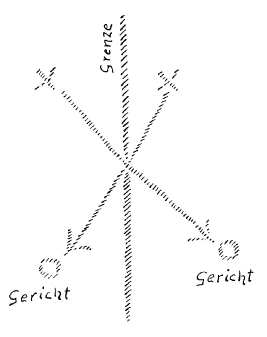
[ 29 ] Of course, there must be transitional forms leading to what we are striving for. But that should be obvious to people. And we will not achieve a recovery until people realize that this threefold structure I have spoken of must underlie everything, that everything must be conceived in such a way that a uniformed state cannot be maintained. For the concept of the state is directly applicable only to the first part—security and military service. Whatever is placed under the omnipotence of the state beyond security and military service rests on an unhealthy foundation, for economic life must be built on a purely corporate or associative basis if it is to develop healthily. And intellectual life, including jurisprudence, is built on a sound foundation only when the individual is completely free. He must be free with regard to everything else. He must also—if you will—be able to appoint his own judge every five or ten years, a judge who serves as both his civil and criminal judge. Without this, it won’t work; without this, you will not achieve an appropriate structure. These national issues could have been resolved without territorial shifts! This is coming from a man who has studied the complex Austrian circumstances, where thirteen different official languages—or at least languages in common use—are employed in official communications, and who was able to learn from these Austrian circumstances precisely what is necessary in the field of jurisprudence. Suppose two countries meet at some border—let them be separated by nationality or by something else, for my sake. Here is one court, and here is another; the border lies between them. The man here decides: “I will be tried by this court over the next ten years”—the other decides: “I will be tried by that court.” The matter is entirely feasible if it is carried out in detail. But all other aspects are ineffective if such conditions are not in place. For everything must, in fact, work together. However, it only works together if things are arranged in such a way that they are carried out with a genuine understanding of what is actually there.
[ 30 ] I have had the opportunity in the past to present these ideas to a wide variety of people, for I was certain—and still am today—that the circumstances of recent years would have taken a completely different turn if this program had been put forward as an alternative to the Wilson Program. And this program would have been the only real program that, had it been put forward before Brest-Litovsk, would have been effective. Of course, Brest-Litovsk would never have taken place if such a program had been met with understanding. Things would have had to take a completely different course. For I had worked it out during those years as a guiding principle not only for domestic policy but also for foreign policy; Domestic policy seemed superfluous to me when everyone was busy manufacturing ammunition. All the talk about the three-class law and its amendment seemed like hot air to me, but what seemed necessary to me was a real impetus—not a program—a real impetus that would have been capable of turning things around. I can only give you a few points of view here, as I have done. Yet the matter can be worked out in such detail that it is thoroughly effective precisely for resolving the most important issues. Admittedly, painful experiences have been had in the process. I entrusted the task to a man—not just one, but many, but I’ll tell you about one case as an example—who wrote to me after several months. That was a good sign, because he had really studied the matter, had made a sincere effort, and had also discussed it with me. Both in his letters and in our conversations, for example, two objections arose that are very characteristic. Over the course of the last few years, I have heard such objections time and again, countless times, in the most dreadful way—objections of this nature. One objection was this: Yes, it is well known that wars to date have mostly been disguised, masked resource wars—that is, they are mostly states of war stemming from resource interests, from international, that is, mutual resource interests. But if one looks at what you have done, then there could no longer be any conflicting resource interests. — Yes, I said, “Mr. Privy Councilor, if you were to tell me this to confirm what I have written to you, then I would understand it; if you were to find that what I have written is good, because then the terrible, disguised resource wars would finally be eliminated from the world through the definitive resolution of tariff relations, which are resolved in this second part of the economic program, if I may call it that.” If you were to tell me something that corresponds to the reality of life, I would understand that; but if you are telling me this as a rebuttal, I certainly cannot understand that.
[ 31 ] The second objection was this: after spending months thinking it over, he wrote to me, “Yes, I simply cannot imagine how, if you were to succeed with something like that, it would still be possible to pursue social democratic policies, because your economic program would make social democratic policies impossible.” — Yes, you’re laughing. I didn’t laugh, because from these things—which I could multiply many, many times over, and which you can find everywhere today—I have learned just how terrible the selection process is that current circumstances impose in determining which people are to be the responsible leaders in this or that field. I spoke to you here a long time ago about how we suffer today from the selection of the worst, who always rise to the top. This is also something that is part of a healthy sense of reality and thus also of common sense: namely, recognizing this selection of the worst.
[ 32 ] With this, I have, so to speak, provided you with guidelines. The restoration of healthy conditions for the future is based on this threefold social order. All misfortune stems from the confusion of these three elements. What is actually applicable only to the first element—security and military service—is applied to economic life, where it cannot possibly bring about any healthy conditions, and is even applied to spiritual life, including jurisprudence, where it is entirely impossible. Oh, if only people would be willing to draw a little closer to what follows from the mysteries beyond the threshold, they would be able to see so easily that precisely such truths as I have told you about the threefold structure of social life must indeed be drawn from the supersensible world, but can be understood here through the sensible realm. That is precisely the point. I have given you guidelines, but they are not guidelines that represent some abstract program; rather, they are guidelines about which I could say—for example, when I entrusted the matter to a man who held a very important position, I don’t even want to say what an important position he held during the past period, and for whom it would have been an immensely significant act if he had drafted a manifesto along these lines—yes, I told that man: You have a choice—either you do one thing, or you experience the other. What I have worked out here does not stem from the kind of ideas that, say, women’s clubs or pacifist societies or the like work with, but rather from the study of humanity’s development over the next thirty to forty or fifty years. This is the essence of what is about to take shape—and will take shape—in Central and Eastern Europe, and you have a choice: either to promote it through reason, or to wait until it is realized through revolutions, via immense detours and through great suffering. —But you see, people must believe such things—believe them by applying their common sense to examine the facts. People must show understanding that reality must be examined. For what develops within humanity does so according to certain impulses that must be studied—impulses of which one can say: they are destined to take shape. If one resists them, one governs poorly, regardless of whether one is a socialist or a monarchist, a republican or the Prince of Monaco, or whatever else one may be.
[ 33 ] But lately, people have been unable to muster the courage for such things precisely because they lacked that very confidence I have been speaking of these days—and that confidence is based on Fichte’s maxim, that is, on the mindset that stems from Fichte’s maxim: A person can do what he ought to do; and if he says, “I cannot,” then he does not want to. — There were people who, to a certain extent, understood what I meant; but those who would have had the courage—which arises solely from the actual use and application of common sense—to put such a thing into practice, they did not come forward. And one can only hope that, now that the forces of trial have grown even stronger, such people will gradually emerge. But one must not believe that what was formulated here years ago does not now need to be reformulated in light of the new circumstances that have arisen. One must think in a way that is so grounded in reality that one knows: at every moment, if things are to be brought into reality, they must be conceived somewhat differently. — And so one has indeed had some truly tragic experiences in recent years. For example, one has heard of a case where one of those monarchs who have now also passed away, when he could already see what was coming, once again asked for these ideas and summoned his advisor to hear them from him, because he had forgotten them and wanted to hear them again; he could not grasp them quickly enough, so he said to the advisor in question: “So write these things down for me again briefly! Yes, but I don’t know—how am I supposed to get the letter? How am I supposed to receive this letter that you’re supposed to write for me? It has to go through the ministry or the Cabinet Office, doesn’t it!” — Nothing came of this matter because it went through the ministry, where everything was rewritten.
[ 34 ] I am talking about these things today—and I will discuss them in greater detail later—because it is essential that we learn a great, great deal from the recent past. For we cannot move forward on a path of prosperity unless we learn from the past. It is not enough simply to focus on what is immediately at hand; rather, what matters is having the will to look into the underlying causes that lie behind the mere symptoms. And one cannot look into them unless one develops sound common sense in understanding the symptoms, unless one cultivates the will to truly assess them. Things are urgent today. One wants to say again and again: If only they were not approached half-heartedly, but with the full seriousness that also entails having a sense of just how entangled things have become through the selection of the worst elements, and how prone people are to letting their judgment be led astray, to be driven by false impulses! — We must do everything in our power to ensure that the continuity of economic life is not disrupted before ideas that are useful for the further development of economic life have, in a certain sense, taken root in people’s minds. We must gain the ability to replace—I was about to say a terrible word—nonsense; I’d rather say that, so as not to use the terrible word—to replace the economic nonsense produced today by university professors of economics in every country with something that is truly grounded in reality. We will not make any progress unless we are first able to tackle the education system in the broadest sense. For we need understanding. Everything that educational institutions have provided so far regarding the necessary structuring of social life or the social body is useless. But this is also what social democracy has inherited, and it is useless. First, it is necessary to instill sensible ideas into people’s minds. Therefore, it is necessary for anyone who wishes to participate in social life—especially in the present era—to first find the possibility of a transitional state that most closely satisfies what can be satisfied at this time. That is: security and public order services. There, one can indeed give the people the very parliament that, well, the democratic element particularly longs for today. But the point is that the economic sphere must truly attain an independent position alongside the other spheres. This must first be carefully transformed into a complete set of provisional measures. Only in the first sphere can one proceed radically today; the others must be transformed into a series of provisional measures. And intellectual life is what must be tackled immediately. The third link—that is where we must begin. And if someone were to suggest that, above all else, the universities must be swept out, and refuses to do so, then—well, then there is simply no talking to him in this area. Of course, they must be swept out first!
[ 35 ] I wanted to discuss these matters with you in the context of the important issues of our time.