

Goetheanism
An Impulse for Transformation and a Concept of Resurrection
Human and Social Science
GA 188
25 January 1919, Dornach
Translate the original German text into any language:
Versions Available:
Goetheanism, tr. SOL
Achter Vortrag
Eighth Lecture
[ 1 ] Worauf es mir gestern besonders ankam, war, an dem Beispiel von Schillers «Briefen über ästhetische Erziehung» einerseits, Goethes «Märchen von der grünen Schlange und der schönen Lilie» andererseits zu zeigen, wie vor der Mitte des 19. Jahrhunderts die ganze Art des Vorstellens und Empfindens über die Welt gerade bei hervorragenden Geistern anders war als nach der Mitte des 19. Jahrhunderts. Gerade an solchen Beispielen kann man so recht sehen, welch ein beträchtlicher, bedeutsamer Einschnitt in dieser Mitte des 19. Jahrhunderts zu verzeichnen ist. Wir haben ja von diesem Einschnitt in die ganze Menschheitsentwickelung von verschiedenen Gesichtspunkten aus gesprochen, haben darauf hingewiesen, daß in dieser Mitte des 19. Jahrhunderts gewissermaßen eine Krisis des Materialismus ist, eine Krisis insofern, als materialistische Empfindungsweise die Oberhand gewinnt in der ganzen menschlichen Vorstellung und Empfindung, Weltanschauung, Lebensauffassung und so weiter.
[ 1 ] What was particularly important to me yesterday was, on the one hand, to use the example of Schiller’s “Letters on Aesthetic Education,” and Goethe’s “Fairy Tale of the Green Snake and the Beautiful Lily,” how, before the mid-19th century, the entire way of conceiving and perceiving the world—especially among outstanding minds—was different from what it was after the mid-19th century. It is precisely through such examples that one can truly see what a considerable and significant turning point occurred in the mid-19th century. We have, after all, spoken of this turning point in the entire development of humanity from various perspectives, pointing out that the mid-19th century represents, in a sense, a crisis of materialism—a crisis insofar as the materialistic mode of perception gains the upper hand in all human thought and feeling, worldview, outlook on life, and so on.
[ 2 ] Nun fällt demjenigen, der diese Dinge eindringlich betrachten will, der den Mut und das Interesse hat, diese Dinge eindringlich zu betrachten, an allem möglichen auf, welcher Umschwung sich da eigentlich vollzogen hat. Nehmen Sie aus der heutigen Vorstellung die Szene mit den Kabiren heraus, versuchen Sie einmal, in dieser «Faust»Szene nachzulesen alles, was sich auf die Kabiren bezieht, versuchen Sie, jede einzelne Zeile wirklich mit tieferem Interesse zu verfolgen, und Sie werden sehen, wie Goethe durch seine vergeistigten Instinkte durchaus noch drinnenstand in dem ahnenden Erkennen. Durch solche Vorstellungen und Mysterienverrichtungen, wie sie die Griechen hatten in Anlehnung zum Beispiel an die Kabiren, drückt sich für den Menschen ein Höchstes in bezug auch auf das Erkenntnisstreben und dergleichen aus. Diese Kabiren brachte Goethe mit Recht zusammen mit dem Wege, der führen soll vom Homunkulus zum Homo. Er brachte diese Kabiren mit Recht zusammen mit dem Geheimnisse des menschlichen Werdens.
[ 2 ] Now, anyone who wishes to examine these things closely—who has the courage and interest to do so—will notice in all sorts of ways what a radical change has actually taken place. Take the scene with the Cabiri out of today’s conception; try to read through this “Faust” scene to find everything that refers to the Cabiri; try to follow every single line with genuine, deeper interest, and you will see how Goethe, through his spiritualized instincts, was still very much immersed in that intuitive insight. Through such performances and mystery rites, such as those the Greeks practiced in connection with the Cabiri, for example, the highest aspects of human existence—including the quest for knowledge and the like—are expressed. Goethe rightly associated these Cabiri with the path that is to lead from the homunculus to the homo. He rightly associated these Cabiri with the mystery of human becoming.
[ 3 ] Drei Kabiren werden herangebracht. Wir reden von drei menschlichen Gliedern zunächst. Bevor wir auf das wahrhaft Innere des Menschen gehen, reden wir von drei menschlichen Gliedern: von dem physischen Leib, dem ätherischen Leib, dem astralischen Leib. Indem man von diesen menschlichen Gliedern spricht, erregt man ja sogleich die Kritik derjenigen Menschen, die sich heute besonders gescheit dünken, die sich heute besonders wissenschaftlich dünken. So wenden zum Beispiel solche Leute ein: Warum denn den einheitlichen Menschen teilen, gliedern? Der Mensch sei doch eine Einheit, es sei schematisch, wenn man den Menschen in solche Glieder auseinanderschält. — Ja, aber so ist die Sache nicht, so einfach liegt sie nicht. Gewiß, wenn bloß eine schematische Einteilung des Menschen zugrunde läge, brauchte man keinen besonderen Wert auf diese Glieder zu legen. Aber diese einzelnen Glieder, die man scheinbar so abstrahiert von dem ganzen Menschen, stehen ja alle mit ganz andern Sphären des Weltenalls in Verbindung. Dadurch, daß der Mensch einen physischen Leib hat, so wie er ihn heute hat, wie sich dieser physische Leib von seiner saturnischen Anlage heraus entwickelt hat bis in die heutige Zeit, dadurch gehört der Mensch dem Raume an, der Sphäre des Raumes. Und durch seinen ätherischen Leib gehört der Mensch der Sphäre der Zeit an. Also indem der Mensch den zwei total voneinander verschiedenen Sphären angehört, indem er, man könnte sagen, aus der Welt der Zeit und des Raumes herauskristallisiert ist, besteht er aus physischem Leib und aus Ätherleib. Das ist nichts Willkürlich-Schematisches, was man da als Einteilung, als Gliederung des Menschen anführt. Das beruht tatsächlich auf dem ganzen Zusammenhang des Menschen mit dem Weltenall. Und durch seinen astralischen Leib gehört der Mensch schon dem Außerräumlichen und Außerzeitlichen an.
[ 3 ] Three Kabirs are brought forth. Let us first speak of the three human members. Before we turn to the true inner being of the human being, let us speak of the three human members: the physical body, the etheric body, and the astral body. When one speaks of these human members, one immediately provokes criticism from those people who today consider themselves particularly clever, who today consider themselves particularly scientific. For example, such people object: Why divide and categorize the unified human being? The human being is, after all, a unity; it is schematic to break the human being down into such components. — Yes, but that is not how it is; it is not that simple. Certainly, if this were merely a schematic division of the human being, there would be no need to place special emphasis on these components. But these individual components, which are seemingly abstracted from the whole human being, are all connected to entirely different spheres of the universe. Because the human being has a physical body—as it exists today, having developed from its Saturnian origins up to the present day—the human being belongs to space, to the sphere of space. And through his etheric body, the human being belongs to the sphere of time. Thus, because the human being belongs to these two entirely distinct spheres—because, one might say, he has crystallized out of the world of time and space—he consists of a physical body and an etheric body. This is not some arbitrary, schematic classification that is presented here as a division or structure of the human being. It is in fact based on the human being’s entire relationship to the universe. And through their astral body, human beings already belong to the extra-spatial and extra-temporal realms.
[ 4 ] Diese Trinität, gewissermaßen die menschliche Hüllentrinität, wird vorgeführt in den drei Kabiren. Der vierte «wollte nicht kommen». Und der ist es, der für sie alle denkt! Steigen wir herauf von den drei Hüllen zum menschlichen Ich, so haben wir in diesem menschlichen Ich zunächst das, was über Raum und Zeit, selbst über das Zeitlose, Raumlose des Astralischen herausragt. Aber dieses Ich des Menschen kam ja erst zum Bewußtsein gerade in dem Zeitraume, der auf die samothrakische Kabirenverehrung folgte. Die Griechen hatten aus der uralt heiligen samothrakischen Lehre allerdings ihren Glauben an das Unsterbliche; aber innerhalb des griechisch-lateinischen Zeitraumes sollte erst das Bewußtsein von dem Ich geboren werden. Daher wollte der vierte nicht kommen, der dasjenige repräsentiert, was als Verhältnis besteht zwischen dem Ich und dem Kosmos. Und wie ferne lag das dem Kabirengeheimnis, das zunächst hinweist auf das, was da war in dem Menschenwerden. Die drei höchsten, der fünfte, sechste und siebente, die sind noch «im Olymp zu erfragen»: Geistselbst, Lebensgeist, Geistesmensch. Die kommen, wie wir wissen, im sechsten und siebenten Zeitraume. Und an den achten hat überhaupt noch niemand gedacht!
[ 4 ] This trinity—the human trinity of sheaths, so to speak—is embodied in the three Kabirs. The fourth “did not want to come.” And it is he who thinks for them all! If we ascend from the three sheaths to the human “I,” we find in this human “I” first and foremost that which transcends space and time, and even the timeless, spaceless realm of the astral. But this human “I” only came into consciousness precisely during the period that followed the Samothracian worship of the Cabiri. The Greeks did, of course, derive their belief in the immortal from the ancient, sacred Samothracian teaching; but it was not until the Greco-Latin period that consciousness of the “I” was to be born. That is why the fourth one did not want to come—he who represents the relationship that exists between the “I” and the cosmos. And how far removed was that from the mystery of the Kabiri, which first points to what was present in the process of becoming human. The three highest—the fifth, sixth, and seventh—are still “to be sought on Olympus”: the Spiritual Self, the Life Spirit, and the Spiritual Man. These, as we know, will come in the sixth and seventh epochs. And no one has even thought of the eighth yet!
[ 5 ] Wir erblicken tatsächlich in der alten Form ausgesprochen das Menschheitsgeheimnis, wie es in Samothrake in denjenigen Mysterien verhüllt war, von denen die Griechen das Beste für ihr Seelenwissen, für ihre Seelenweisheit, ja auch das Beste für ihre Dichtung, insofern sich diese auf den Menschen bezog, genommen haben. Das ist das Wichtige, daß man erkennt: Sobald man den Blick zurückwendet in diese alten Zeiten, die Goethe also wiederum zu beleben versuchte, so schaut man hinein in ein Wissen vom Zusammenhang des Menschen mit dem Weltenall. Der Mensch fühlte sich verwandt mit allen Geheimnissen des Daseins. Der Mensch wußte: er ist nicht bloß eingeschlossen in die Grenzen seiner Haut, er gehört dem ganzen, weiten Weltenall an. Und dasjenige, was in seiner Haut eingeschlossen ist, ist nur das Bild seines besonderen Wesens.
[ 5 ] We do indeed see in the ancient form a vivid expression of the mystery of humanity, as it was veiled in Samothrace within those mysteries from which the Greeks drew the very best for their knowledge of the soul, for their wisdom of the soul, and indeed the very best for their poetry, insofar as it related to human beings. The important thing is to recognize this: as soon as one turns one’s gaze back to those ancient times—which Goethe, in turn, sought to revive—one glimpses a knowledge of the connection between the human being and the universe. Human beings felt a kinship with all the mysteries of existence. They knew that they were not merely confined within the limits of their skin; they belonged to the entire, vast universe. And what is enclosed within their skin is merely the image of their particular being.
[ 6 ] Man kann sagen: Ein Abglanz, ein letzter Nachhall dieser Anschauung über den Zusammenhang des Menschen mit dem Weltenall findet sich noch in solchen Schriften wie in Schillers «Briefen über ästhetische Erziehung», und findet sich als, ich möchte sagen, die durchdringende geistige Lebensluft in einer solchen Dichtung wie Goethes «Märchen von der grünen Schlange und der schönen Lilie». Da hat Goethe tatsächlich in seiner Art bildhaft darzustellen versucht, was den Menschen hineinstellt in die Menschengemeinschaft. Es sind dann zwanzig Seelenkräfte, die Goethe in Form der Märchenfiguren auftreten läßt. Aber indem Goethe diese zwanzig Seelenkräfte auftreten läßt, zeigt er, wie diese Seelenkräfte von einem Menschen zum andern im sozialen Leben hinüberführen. Goethe hat in diesem Märchen Imaginationen geschaffen von dem Gang der sozialen Entwickelung durch die Menschheit hindurch. Diese Imaginationen, so wie sie Goethe geschaffen hat, wie er nebeneinandergestellt hat den König der Weisheit, den König des Scheines, den König der Gewalt, und wie er zerfallen läßt in sich selber den König, der alle drei — Weisheit, Schein und Gewalt — chaotisch miteinander verbindet, diese Art, wie er das darstellt, die zeigt in seiner Art, was heute ganz intensiv und von andern Gesichtspunkten aus bewußt erfaßt werden muß.
[ 6 ] One might say: A reflection, a final echo of this view of the connection between human beings and the universe can still be found in writings such as Schiller’s “Letters on Aesthetic Education,” and is present, I would say, as the pervasive spiritual breath of life in poetry such as Goethe’s “Fairy Tale of the Green Snake and the Beautiful Lily.” Here, Goethe has indeed attempted, in his own way, to depict vividly what places human beings within the human community. Goethe presents twenty soul forces in the form of fairy-tale characters. But by bringing these twenty soul forces to life, Goethe shows how they bridge the gap from one person to another in social life. In this fairy tale, Goethe created imaginative depictions of the course of social development throughout humanity. These imaginative depictions, as Goethe created them—the way he juxtaposed the King of Wisdom, the King of Appearance, and the King of Violence, and the way he allowed the king who chaotically combines all three — wisdom, appearance, and power — chaotically combines all three within himself; this way of depicting it reveals, in its own way, what must be consciously grasped today with great intensity and from different perspectives.
[ 7 ] Man kann aber heute beim Goetheschen Märchen nicht stehenbleiben. Derjenige, der heute beim Goetheschen Märchen und seiner Darstellung stehenbleiben will, spielt eigentlich bloß. Sie wissen ja, dasselbe Thema, dieselben Impulse, die Goethe im Märchen darstellte, sind dargestellt in meinem ersten Mysterium «Die Pforte der Einweihung». Aber sie sind dargestellt mit dem Bewußtsein, daß in der Mitte des 19. Jahrhunderts etwas gekommen ist, was notwendig macht, daß aus ganz andern, eindringlicheren Impulsen heraus solche Dinge heute dargestellt werden. Ich habe gestern aufmerksam darauf gemacht, wie der Übergang sein muß von dem Hinblicken auf das frühere Zeitalter zu dem Zeitalter, an dessen Ausgang wir stehen. Das aber, was wir uns wieder erringen müssen, was in alten Zeiten vorhanden war wie der letzte Nachklang des atavistischen Hellsehens über diese Dinge, das ist das Bewußtsein von dem Zusammenhange des Menschen mit dem ganzen Weltenall, das Bewußtsein von jenem Geheimnis, das Sie in meinem zweiten Mysterium im Anfange ausgedrückt finden, wo dargestellt wird durch Capesius, wie aller Götter Wirken zuletzt darauf hinausläuft, den Menschen darzustellen. Warum ist ein Bewußtsein von dieser kosmischen Bedeutung des Menschen, von diesem Hineingestelltsein des Menschen in den ganzen Kosmos für unsere Zeit so ganz besonders wichtig? Gerade deshalb, weil wir davor stehen, das Alleralltäglichste, das unmittelbar äußere Leben geistig erfassen zu müssen. Und dieses äußere soziale Leben, man kann es nicht erfassen, wenn man nicht zugrunde legen kann eine wirkliche Anschauung von dem Wesen des Menschen. In dem Augenblicke, wo man beginnt, so wie es heute manche Volkswirtschaftslehrer tun und wie es sogar im Trivialbewußtsein der meisten Menschen lebt, in dem Augenblicke, wo man beginnt, den Menschen selber in die soziale Struktur in seiner Gänze hineinzustellen, muß man mit Bezug auf die soziale Frage scheitern, weil der Mensch mit seinem Wesen herausragt aus dem, was die soziale Frage eigentlich darstellt.
[ 7 ] But today we cannot stop at Goethe’s fairy tale. Anyone who wants to stop at Goethe’s fairy tale and its portrayal today is really just playing around. As you know, the same theme and the same impulses that Goethe depicted in the fairy tale are portrayed in my first mystery play, *The Portal of Initiation*. But they are portrayed with the awareness that something emerged in the mid-19th century that makes it necessary for such things to be depicted today from entirely different, more compelling impulses. Yesterday I drew your attention to how the transition must take place from looking back at the earlier age to the age at the end of which we now stand. But what we must regain—what existed in ancient times as the last echo of atavistic clairvoyance regarding these matters—is the awareness of the connection between the human being and the entire universe, the awareness of that mystery which you will find expressed at the beginning of my second Mystery Play, where Capesius describes how the workings of all the gods ultimately aim to bring forth the human being. Why is an awareness of this cosmic significance of the human being—of the human being’s place within the entire cosmos—so particularly important for our time? Precisely because we are faced with the need to grasp spiritually the most mundane, the immediately external life. And this external social life cannot be grasped unless one can base one’s understanding on a genuine insight into the nature of the human being. The moment one begins—as some economists do today and as is even reflected in the trivial consciousness of most people—the moment one begins to place human beings themselves, in their entirety, within the social structure, one is bound to fail with regard to the social question, because human beings, by their very nature, transcend what the social question actually represents.
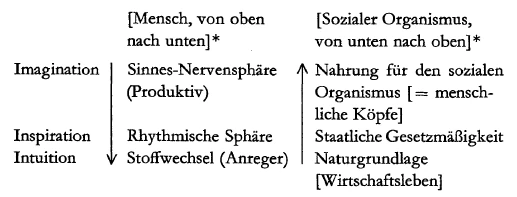
[ 8 ] Ich habe Ihnen gestern gesagt: Drei Glieder hat man zu unterscheiden in der menschlichen Natur. Wie man sie benennt, ist eine Sache für sich. Wir nennen sie heute den Nerven- und Sinnesmenschen, den Menschen des Rhythmus, den Menschen des Stoffwechsels. Dreierlei haben wir zu unterscheiden in bezug auf eine wirklich organisch geordnete soziale Struktur: das Geistige, das rein regulierende Staatliche, das Wirtschaftlich-Ökonomische. Der Mensch berührt sich mit diesem sozialen Leben, der Mensch steht drinnen. Aber er steht gewissermaßen schon in seiner Dreigliederung umgekehrt da, als die Dreigliederung des sozialen Organismus ist. Beachten Sie das: Es ist immer notwendig, darauf hinzuweisen, daß man ja nicht konstruiere, nicht Analogien sucht, nicht in abstrakten Begriffen solche Dinge ausdeutet, sondern wirkliche geistige Forschung treibt. So kommt auch derjenige zu nichts, der den Winter der Erde etwa vergleicht mit der Nacht oder mit dem Schlaf, und den Sommer mit dem Wachen, während für die Erde der Sommer gerade das Schlafen darstellt, und der Winter das Wachen. Nichts erreicht derjenige, der sich die Entwickelung der Menschheit in Analogie denkt mit der Entwickelung des Einzelmenschen. Während der Einzelmensch von der Kindheit bis zum Greisenalter vorschreitet, schreitet die Menschheit zurück vom Greisenalter in die Kindheit. Wirkliche Forschung zeigt eben etwas ganz anderes als das, was die Menschen phantastisch aussinnen. Nur ja keine Analogien spinnen, sondern die Dinge ansehen, wie sie sind! Wenn wir den dreigliedrigen Menschen ins Auge fassen, so haben wir zunächst das Geistige des Menschen in der Sinnes-Nervensphäre. Dann haben wir das Mittlere in der rhythmischen Sphäre, das Untere in dem Stoffwechsel. Sie können das Genauere nachlesen in meinem Buche «Von Seelenrätseln». Aber ich habe aufmerksam darauf gemacht: Im Stoffwechsel ist eigentlich der Abdruck des Höchsten, des Geistigen. Der Stoffwechsel entspricht daher, wenn wir das Geistige sehen, der Intuition, das Rhythmische entspricht der Inspiration, und das Nerven-Sinnesleben entspricht der Imagination. Der Mensch ist ein dreigliedriges Wesen. Aber auch der richtige soziale Organismus, dem die gegenwärtige Menschheit im fünften nachatlantischen Zeitraum zustrebt, ist dreigliedrig. Nur haben wir da, indem wir diese Dreigliederung beobachten, das Folgende nicht außer acht zu lassen.
[ 8 ] I told you yesterday: There are three aspects to human nature that must be distinguished. How one names them is a matter in itself. Today we call them the nervous-sensory human being, the human being of rhythm, and the human being of metabolism. We must distinguish three aspects with regard to a truly organically ordered social structure: the spiritual, the purely regulatory state, and the economic. Human beings come into contact with this social life; they are part of it. But in a sense, they already stand there in their threefold division in reverse, as compared to the threefold division of the social organism. Please note this: It is always necessary to point out that one must not construct, seek analogies, or interpret such things in abstract terms, but rather engage in genuine spiritual research. Thus, one achieves nothing by comparing, for example, the Earth’s winter to night or sleep, and summer to waking, whereas for the Earth, summer actually represents sleep, and winter represents waking. One achieves nothing by conceiving of the development of humanity as analogous to the development of the individual. While the individual progresses from childhood to old age, humanity moves backward from old age into childhood. True research reveals something entirely different from what people fantasize about. By all means, do not spin analogies, but look at things as they are! When we consider the threefold human being, we first have the spiritual aspect of the human being in the sensory-nervous sphere. Then we have the middle aspect in the rhythmic sphere, and the lower aspect in metabolism. You can read more details in my book *The Mysteries of the Soul*. But I have pointed out: Metabolism actually bears the imprint of the highest, the spiritual. Metabolism therefore corresponds, when we perceive the spiritual, to intuition; the rhythmic sphere corresponds to inspiration; and the sensory-nervous life corresponds to imagination. The human being is a threefold being. But the true social organism, toward which present-day humanity is striving in the fifth post-Atlantean epoch, is also threefold. However, when observing this threefold structure, we must not overlook the following:
[ 9 ] Wo liegt eigentlich dasjenige beim Menschen, worauf es im menschlichen Organismus abgesehen ist — nicht im ganzen Menschen, sondern im menschlichen Organismus? Ja, hierüber hat die Welt nun einmal eine ganz vertrackte Ansicht, und die wirkliche Ansicht, die wahre Ansicht, die kommt den Menschen vertrackt vor. Der heutige waschechte Physiologe, der denkt sich, wie ich schon gestern sagte: Die Menschen essen, stopfen so die Nahrungsmittel in sich hinein; dann wählt sich der Organismus aus diesen Nahrungsmitteln das aus, was er braucht, das andere stößt er aus. Das verwandelt er in sich selber, und so geht es, nicht wahr, Tag für Tag. Nun, ich habe Ihnen gestern gesagt, daß dieser Stoffwechsel so überhaupt nur den tagtäglichen Stoffwechsel bedeutet, und daß von diesem Stoffwechsel gar nicht unmittelbar der andere Stoffwechsel abhängt, der den Menschen hinüberführt von den ersten Zähnen zu den bleibenden Zähnen, dann wieder über die Geschlechtsreife und so weiter. Dieser Stoffwechsel, der sich ausdehnt über die großen Zeiträume zwischen Geburt und Tod, der hängt nicht mit dem zugleich zusammen, mit dem Hineinstopfen und Umwandeln von Nahrungsmitteln und so weiter, sondern dem liegen andere Gesetze und andere Substanzverarbeitungen zugrunde. Darauf habe ich ja schon gestern hingewiesen. Was bedeutet denn aber überhaupt diese tägliche Nahrung, die wir in uns aufnehmen? Da kommen wir auf ein Kapitel, wo man nun wiederum in den heftigsten Widerstreit kommen muß mit der gewöhnlichen heutigen Wissenschaft.
[ 9 ] Where, exactly, is that aspect of the human being that the human organism is aimed at—not the whole person, but the human organism? Yes, the world happens to have a very convoluted view on this, and the real view, the true view, seems convoluted to people. Today’s so-called genuine physiologist thinks, as I already said yesterday: People eat, stuffing food into themselves; then the organism selects from this food what it needs and expels the rest. It transforms it within itself, and that’s how it goes, doesn’t it, day after day. Well, I told you yesterday that this metabolism refers only to the day-to-day metabolism, and that the other metabolism—the one that carries a person from their first teeth to their permanent teeth, then on to sexual maturity, and so on—does not depend directly on this metabolism at all. This metabolism, which spans the long periods between birth and death, is not connected to the process of consuming and transforming food and so on; rather, it is based on different laws and different processes of substance transformation. I already pointed this out yesterday. But what, after all, does this daily food that we take into ourselves actually mean? This brings us to a topic where we must once again enter into the most intense conflict with conventional modern science.
[ 10 ] Bitte, ich will Sie jetzt nicht zum Nichtessen veranlassen, bitte nur ja keine vertrackten, unsinnigen Schlüsse aus den Dingen zu ziehen, die um des Wissens, um der Erkenntnis Willen gesagt werden, nicht daß jemand allerlei Tollheiten daraus als Konsequenzen zieht! Aber warum essen wir denn eigentlich? Essen wir, damit wir das, was außer uns ist, in uns haben? Nein, sondern wir essen, damit die verschiedenen Stoffe, die in uns gelangen, besondere Kraftäußerungen vollziehen, und gegen diese Kraftäußerungen wehrt sich unser Organismus, und zu diesem Wehren müssen wir den Anstoß haben durch das Essen. Sie können sich bildlich vorstellen: Indem Sie die Nahrungsmittel in sich aufnehmen, verursachen diese Nahrungsmittel in Ihnen kleine Explosionen; diese Explosionen brauchen Sie, weil Sie sie wiederum zerstören müssen, wiederum ablähmen, vernichten müssen, und in diesem Vernichten entwickelt sich eigentlich Ihre innere Kraft. Der Mensch braucht Anstoß, Anregung, und im wesentlichen ist das, was uns die Nahrung ist, Anregung. Denn dasjenige, was wir als Mensch sind, das bekommen wir in der Tat auf geheimnisvolle Weise ganz woanders her.
[ 10 ] Please, I don’t want to persuade you not to eat; I’m just asking that you not draw any convoluted, nonsensical conclusions from things that are said for the sake of knowledge and understanding—not so that someone might draw all sorts of absurd conclusions from them! But why do we actually eat? Do we eat so that we can have within us what is outside of us? No, rather, we eat so that the various substances that enter our bodies can carry out specific manifestations of energy, and our organism resists these manifestations of energy—and we must be prompted to this resistance through eating. You can imagine it figuratively: As you take in food, it causes small explosions within you; you need these explosions because you must in turn destroy them, subdue them, and annihilate them—and it is in this process of destruction that your inner strength actually develops. Human beings need impetus, stimulation, and essentially, what food is to us is stimulation. For what we are as human beings, we actually receive in a mysterious way from somewhere else entirely.
[ 11 ] Sie erinnern sich, ich sagte schon öfter: Der Kopf ist eigentlich hohl. Dadurch kann er aus dem Weltenall dasjenige aufnehmen, was im Menschen produktiv ist. Und diese Produktion, die wird gewissermaßen aus dem Kopf nur herausgelockt. So kommt der Kopf wiederum zu seinem Rechte. Der Kopf ist ja eigentlich in vieler Beziehung der unwichtigste Teil; er ist das letzte Überbleibsel aus der vorhergehenden Inkarnation. Er ist dasjenige, was zum Beispiel ohne die rhythmische Tätigkeit nicht denken könnte. Man glaubt immer, der Kopf denke. Er denkt in Wirklichkeit nicht, sondern er reflektiert nur die Gedanken. Aber dadurch kommt er wieder zu seinen Ehren, daß er das eigentlich Produktive ist. Und der Mensch ist daraufangewiesen, um diese Produktion zu entfalten, daß außer dem Rhythmus in ihm auch noch der Stoffwechsel herrscht, der der fortwährende Anreger ist. Der Stoffwechsel ist also der fortwährende Anreger, durch den kommt der Mensch mit der Außenwelt in Beziehung.
[ 11 ] You may recall that I have said on several occasions: The head is actually hollow. This allows it to absorb from the universe that which is productive within the human being. And this production is, so to speak, simply coaxed out of the head. In this way, the head once again comes into its own. The head is, in many respects, actually the least important part; it is the last remnant of the previous incarnation. It is that which, for example, could not think without rhythmic activity. People always believe that the head thinks. In reality, it does not think, but merely reflects thoughts. But it regains its honor through the fact that it is actually the productive force. And in order to unfold this production, a person must rely not only on the rhythm within but also on metabolism, which serves as the constant stimulus. Metabolism is thus the constant stimulus through which a person enters into a relationship with the outside world.
[ 12 ] Wie ist es nun beim sozialen Organismus? Da ist es nämlich in Wahrheit umgekehrt. Was beim Menschen innerlich ist, was der Mensch innerlich in sich trägt, durch das er seinen Hohlkopf hat, was da der Anregung von außen bedarf durch den Stoffwechsel, das ist für den sozialen Organismus so die Grundlage, wie für uns die Nahrungsmittel. Was für uns das ist, was wir essen, das ist für den sozialen Organismus das, was die Menschen aus ihrem Nerven- und Sinnesleben hervorbringen. Also der Staat, oder besser gesagt, der soziale Organismus, ist ein organisches Wesen, welches, wenn ich den Ausdruck gebrauchen darf, dasjenige ißt, was die Menschen ausdenken, was die Menschen erfinden, was aus der menschlichen Geistigkeit kommt.
[ 12 ] How does this apply to the social organism? In fact, the situation is actually the opposite. What is internal to the human being—what the human being carries within, which gives rise to the hollow head and requires external stimulation through metabolism—serves as the foundation for the social organism, just as food does for us. What food is to us is to the social organism what human beings produce from their nervous and sensory life. Thus, the state—or rather, the social organism—is an organic being which, if I may use the expression, “eats” what human beings conceive, what human beings invent, what arises from human spirituality.
[ 13 ] Nehmen Sie die eigentliche Grundkraft, die eigentliche Grundeigenschaft aus der menschlichen Geistigkeit hinweg, nämlich die Freiheit, die individuelle Freiheit, so ist das genau so, wie wenn Sie den Menschen heranwachsen lassen wollten, ohne ihm zu essen zu geben. Die freien, individuellen Menschen, die sich in eine soziale Zwangsstruktur hineinstellen und ihre freie Geistigkeit steril machen, lassen ebenso die soziale Struktur absterben, wie ein Mensch absterben muß, dem Sie keine Nahrungsmittel geben. Das, was die menschlichen Köpfe in die Welt hereinbringen, das sind die Nahrungsmittel für den sozialen Organismus.
[ 13 ] If you remove the very fundamental force, the very fundamental quality, from human spirituality—namely, freedom, individual freedom—it is exactly as if you wanted to let a person grow up without giving them food. Free, individual human beings who place themselves within a coercive social structure and render their free spirituality sterile cause the social structure to wither away just as a person must wither away if you do not give them food. What human minds bring into the world is the nourishment for the social organism.
[ 14 ] So daß man sagen kann: Das Produktive aus Nerven- und Sinnessphäre ist die Nahrung für den sozialen Organismus. — Das, was beim Menschen das rhythmische System ist, dem entspricht allerdings im sozialen Organismus alles dasjenige, was eigentlich dem Staate übertragen werden soll, wie ich schon gestern sagte: alles, was sich auf Regulierung, auf die äußere Gesetzlichkeit, also staatliche Gesetzmäßigkeit bezieht. Und was ist nun im Staat das Produktive? Dasjenige, was aus der Naturgrundlage im weiteren Sinne herauskommt, das Wirtschaftsleben. Das ist gewissermaßen der Kopf des Staates. Das Wirtschaftsleben, die Naturgrundlage, alles das, was produziert wird, das ist gewissermaßen der Kopf. Es ist umgekehrt wie beim individuellen Menschen. So daß wir ebensogut sagen können: Wie der Mensch produktiv ist durch seine Nerven und Sinne, so ist der soziale Organismus durch seine Naturgrundlage produktiv. Und wie der Mensch seinen Stoffwechsel von der Natur erhält, so erhält der soziale Organismus seine Nahrung aus dem Menschenkopf heraus.
[ 14 ] So one can say: What is productive in the nervous and sensory spheres is the nourishment for the social organism. — What constitutes the rhythmic system in human beings corresponds, however, in the social organism to everything that is actually to be entrusted to the state, as I already said yesterday: everything that relates to regulation, to external legality—that is, state legality. And what, then, is the productive aspect of the state? That which arises from the natural foundation in the broader sense: economic life. This is, so to speak, the head of the state. Economic life, the natural foundation, everything that is produced—this is, so to speak, the head. It is the reverse of what happens in the individual human being. So we might just as well say: Just as the human being is productive through his nerves and senses, so the social organism is productive through its natural foundation. And just as the human being derives his metabolism from nature, so the social organism derives its nourishment from the human mind.
[ 15 ] Den sozialen Organismus verstehen Sie im Verhältnis zum Menschen nur richtig, wenn Sie den Menschen auf den Kopf stellen. Hier im Menschenkopf ist eigentlich der Grund und Boden des Menschen. Der Mensch wächst von oben nach unten, der staatliche Organismus wächst von unten nach oben. Er hat seinen Kopf, wenn man. ihn schon mit dem Menschen vergleichen will, unten und steht auf dem Kopf und hat seine Beine oben. Seine Nahrung bekommt er aus dem einzelnen individuellen Menschen. So muß man innerlich das, was sozialer Organismus ist, verstehen. Analogiespiel macht nichts aus; aber der Hinblick auf die wahre Wirklichkeit, auf die echte Realität, das ist es, worauf es ankommt.
[ 15 ] You can only truly understand the social organism in relation to the human being if you turn the human being upside down. Here, in the human head, lies the very foundation of the human being. The human being grows from top to bottom, while the state organism grows from bottom to top. If one wishes to compare it to a human being, it has its head at the bottom, stands on its head, and has its legs at the top. It draws its nourishment from the individual human being. This is how one must inwardly understand what the social organism is. Playing with analogies is of no consequence; but the perspective on true reality, on genuine reality—that is what matters.
[ 16 ] Nicht wahr, wir haben im Laufe des 19. Jahrhunderts, gerade indem dieser wichtige Einschnitt in der Mitte des 19. Jahrhunderts sich geltend machte, die eigentliche Neigung zum Materialismus, die Abkehr vom Geistigen zu verzeichnen. Es war die Hochflut des Materialismus. Was:ist da eigentlich geschehen mit Bezug auf die menschliche Weltauffassung? Ja, mit Bezug auf die menschliche Weltauffassung ist das geschehen, daß die Menschen den Geist des Übersinnlichen verloren haben. Sie haben das verloren, was gerade durch ihren Hohlkopf an Produktion geleistet werden sollte; was in den Hohlkopf hineinkommen soll, das haben die Menschen verloren. Sie wollen sich nur verlassen mit Bezug auf alle Erfindungen und Entdeckungen auf den Zufall des Experimentierens. So stolz, so hochmütig man auf die Errungenschaften aus der zweiten Hälfte des 19. Jahrhunderts ist, studieren Sie die Geistesgeschichte, Sie werden sehen, wie selbst die größten dieser Errungenschaften nicht auf der unmittelbaren Initiative des Kopfes, sondern auf Konstellationen beruhen, die eingetreten sind im Verlaufe des Experimentierens. Man hat den Gott, man hat den Geist verloren, indem man mit dem Kopf nicht mehr entgegenstrebte dem Geist.
[ 16 ] Isn’t it true that, over the course of the 19th century—precisely as this important turning point in the mid-19th century took hold—we saw a genuine tendency toward materialism, a turning away from the spiritual? It was the high tide of materialism. What actually happened there with regard to the human worldview? Well, with regard to the human worldview, what happened was that people lost the spirit of the supersensible. They lost precisely what was meant to be achieved through their “hollow head” of production; what was meant to enter the “hollow head”—that is what people have lost. They want to rely solely on the chance outcomes of experimentation when it comes to all inventions and discoveries. No matter how proud, how arrogant one may be about the achievements of the second half of the 19th century, if you study the history of thought, you will see how even the greatest of these achievements are based not on the direct initiative of the mind, but on constellations that arose in the course of experimentation. We have lost God, we have lost the Spirit, by no longer striving with the mind toward the Spirit.
[ 17 ] Was wäre denn im sozialen Organismus das Gegenbild? Da würde man die Naturgrundlagen verlieren, da würde man gerade herumstreiten, ohne auf die Naturgrundlage Rücksicht zu nehmen. Das ist in der Tat der Charakter des sozialen Debattierens in der zweiten Hälfte des 19. Jahrhunderts und bis heute, heute am heftigsten. Denn heute reden die Leute über soziale Einrichtungen, über Sozialisierung der menschlichen Wirtschaft und dergleichen: Gerade so lassen sie weg bei diesem Debattieren die eigentliche Naturgrundlage, die Art und Weise, wie produziert werden soll, wie die Materialisten weglassen dasjenige, was der Kopf in dem Menschen machen soll. Verliert die materialistische Zeit den Geist aus der Weltanschauung, so verliert der entsprechende soziale Organismus die eigentliche Materie aus der Wirtschaft, aus dem sozialen Zusammenhang heraus. Und im sozialen Werden besteht die große Gefahr, die dem Verlust des Geistes in der materialistischen Weltanschauung entspricht: im Verlust einer die Menschheit möglichst befriedigenden Produktion, einer möglichsten Einsicht in das Produktive.
[ 17 ] What, then, would be the opposite of this in the social organism? There, one would lose touch with the foundations of nature; there, people would simply argue back and forth without taking those foundations into account. This is, in fact, the character of social debate in the second half of the 19th century and up to the present day—and it is most intense today. For today people talk about social institutions, about the socialization of the human economy, and the like: in this debate, they omit precisely the actual natural foundation—the way in which production should take place—just as the materialists omit what the human mind is meant to do. If the materialist era loses the spirit from its worldview, then the corresponding social organism loses the actual substance from the economy, from the social context. And in social development, there lies the great danger that corresponds to the loss of spirit in the materialist worldview: the loss of a mode of production that satisfies humanity as fully as possible, and the loss of the deepest possible insight into the productive process.
[ 18 ] Nun, zu dem Verständnis der sozialen Struktur kann man nicht kommen, wenn man nicht sich schult an der Dreigliederung des Menschen und dadurch lernt, wie man das Verhältnis der Menschenwissenschaft zur Sozialwissenschaft gestalten muß. Sonst bewertet man nämlich alles falsch. Unsere gelehrten Nationalökonomen, durch die so viel Elend in die Welt gekommen ist, weil die andern auch so denken, weil sie ja nur die Experimente gelten lassen, unsere gelehrten Nationalökonomen wissen ja in der Tat gar nichts über dieses Verhältnis des Menschen zur sozialen Struktur. Denn das kann nur durch Geisteswissenschaft gewonnen werden. Allen Ernstes streiten sich unsere nationalökonomischen Gelehrten, unsere Volkswirtschaftslehrer, ob ein Ferkel oder ein Mensch ein größerer volkswirtschaftlicher Wert ist. Nicht wahr, für beides läßt sich sehr viel vom Standpunkte derjenigen Argumente, die die Leute gerade haben, vorbringen. Die einen behaupten, ein Ferkel wäre wertvoller in der Volkswirtschaft als ein Mensch, denn das Ferkel stellt eben etwas dar, was man essen kann, also etwas, was zum Konsum geeignet ist, was einen volkswirtschaftlichen Wert hat. Einen Menschen kann man nicht essen, er ißt selber sogar die Dinge weg, er stellt für manche Leute keinen volkswirtschaftlichen Wert dar. Manche denken aber wiederum anders, die sagen: Nun ja, aber der Mensch produziert volkswirtschaftliche Werte, und diese werden dann da sein! Er verhilft also indirekt so und so viel Ferkeln zu ihrem Dasein und so weiter. Nun, wie gesagt, über solche Dinge wird gestritten! Es ist in der Tat dies eine Frage, die erörtert wird unter den Volkswirtschaftslehrern, ob ein Ferkel oder ein Mensch den größeren volkswirtschaftlichen Wert darstelle.
[ 18 ] Well, one cannot arrive at an understanding of social structure unless one trains oneself in the threefold constitution of the human being and thereby learns how to shape the relationship between the science of the human being and the social sciences. Otherwise, one will misjudge everything. Our learned economists—who have brought so much misery into the world because others think the same way, since they accept only experimental evidence—our learned economists, in fact, know absolutely nothing about this relationship between the human being and the social structure. For this can only be gained through the spiritual sciences. In all seriousness, our economic scholars, our professors of economics, argue over whether a piglet or a human being has greater economic value. Isn’t it true that, from the perspective of the arguments people currently hold, a great deal can be said in favor of both? Some claim that a piglet is more valuable to the economy than a human being, because the piglet represents something that can be eaten—that is, something suitable for consumption, something that has economic value. A human being cannot be eaten; in fact, he even consumes other things himself; for some people, he represents no economic value. Others, however, think differently; they say: Well, but humans produce economic value, and that value will be there! So, indirectly, they help bring so many piglets into existence, and so on. Well, as I said, these are matters of debate! It is indeed a question discussed among economists: whether a piglet or a human represents the greater economic value.
[ 19 ] Nun, das ist nur ein groteskes Beispiel. Aber an solchen grotesken Dingen hängt tatsächlich für den tiefer Einsichtigen das, was lebt in unserer katastrophalen Gegenwart. Denn man kann schon sagen: Das Wissen, das ausreicht, um in der Naturwissenschaft grandios weiterzukommen, das Wissen, das großartige naturwissenschaftliche Ergebnisse liefert, das wunderbar in die Möglichkeit versetzt, den Embryo des Ferkels zu vergleichen mit dem Embryo des Hundes, mit dem Embryo des Menschen, mit dem Embryo der Fledermaus und so weiter, und daraus schematisch dasjenige Denken zu bilden, welches ausreicht, um allerlei Physiologisches, Biologisches, Mineralogisches, Geologisches im Sinne der heutigen Zeit zu produzieren, dieses Denken, diese Art, Gedanken zu verbinden, reicht nicht aus, um volkswirtschaftlich zu unterscheiden, was wichtiger ist, ein Schwein oder ein Mensch. Und bevor man dies nicht einsieht, daß man ein großer Naturforscher sein kann, ohne volkswirtschaftlich unterscheiden zu können zwischen einem Schwein und einem Menschen, so lange gibt es kein Heil in bezug auf die Erkenntnis der sozialen Frage. Dies muß rücksichtslos eingestanden werden von den Menschen, daß dasjenige, was heute die Größe des Denkens ausmacht auf dem naturwissenschaftlichen Gebiet, nicht unterscheiden läßt den volkswirtschaftlichen Wert eines Ferkels von dem sogenannten volkswirtschaftlichen Wert des Menschen. Davon wollen wir dann morgen weiter sprechen.
[ 19 ] Well, that’s just a grotesque example. But for those with deeper insight, it is precisely such grotesque things that embody what is alive in our catastrophic present. For one can certainly say: The knowledge that is sufficient to make magnificent strides in the natural sciences—the knowledge that yields magnificent scientific results, that wonderfully enables us to compare the embryo of a piglet with that of a dog, with that of a human, with that of a bat, and so on— and from this to formulate the kind of thinking that suffices to produce all manner of physiological, biological, mineralogical, and geological findings in the spirit of our time—this thinking, this way of connecting ideas, is not sufficient to distinguish, in economic terms, which is more important: a pig or a human being. And until one realizes that one can be a great natural scientist without being able to distinguish, in economic terms, between a pig and a human being, there will be no solution to the social question. People must ruthlessly admit that what today constitutes the greatness of thought in the field of natural science does not allow one to distinguish the economic value of a piglet from the so-called economic value of a human being. We will continue discussing this tomorrow.