

Past and Future Influences on Social Events
GA 190
29 March 1919, Dornach
Translated by Steiner Online Library
Fifth Lecture
[ 1 ] When we speak now at length about the social issue that is shaping our times, it is essential for us—apart from what is, of course, of particular importance in this matter for our contemporaries as such—that the truly ultimate practical solution that can be considered in relation to this issue is intimately connected with the foundations of the spiritual sciences, and that, therefore, anyone interested in the humanities has a special reason to examine this issue from the perspective of the humanities. Certainly, it is urgently necessary today to awaken understanding in the broadest circles for the driving forces behind the social movement; but on the other hand, these broadest circles are, after all, ill-prepared to look into the foundations of the matter, to truly grasp the issue from its very foundations. People interested in the humanities must gradually begin to radiate a certain understanding, particularly in the realm of social movements, and for this it is necessary that we familiarize ourselves with certain fundamental facts, without knowledge of which a true understanding of the social question is simply not possible. For let us make no mistake: in human social life, the unconscious and the subconscious play an immensely large role. What is at work in social life ultimately stems from what people think, what people feel, and what people desire based on their character impulses. But in the age of the development of the consciousness soul, this is becoming more and more individual. People will have to become increasingly diverse in their thinking, feeling, and willing: that is the task of the age of the development of the consciousness-soul. Consequently, a great deal will well up from the subconscious depths of human beings in their social interactions, which will play a role in the social movement that began half a century ago, has now reached a provisional peak, and will continue to move further and further, placing immense demands on people. For what is emerging today are, at first, chaotic demands. These chaotic demands will have to be replaced by ever clearer ideas and ever better and better impulses of will. The fact that these clear ideas and good impulses of will were lacking is precisely what led humanity into this current catastrophe and will continue to magnify this catastrophe in an immeasurable way. For one cannot say that a truly good will already exists today in the broadest circles with regard to these issues. What exists is something like a resignation to what appears to be inevitable. People are willing to make small concessions here and there because they fear that there is no other way, that they might be left high and dry, and so on. But what must emerge is a genuine, inner social understanding. This must take root in people’s minds, and it must even become an integral part of our school education.
[ 2 ] However, this can only be achieved if, based on an understanding of human nature and the relationship between the sensory and supersensory worlds, at least a number of people on Earth develop a deeper understanding of these questions than most people today are able to due to the superficial nature of our times.
[ 3 ] Yesterday you saw what the situation actually is regarding the role that language plays throughout a person’s life. Now consider, on the other hand, the role that languages play in the international coexistence of people across the globe. Consider how an infinite number of feelings and impulses of will of the most diverse kinds depend on languages. And consider, in turn, how an infinite number of ambiguities prevail among people today, particularly with regard to such matters. Let us dwell a little longer on language today. As I mentioned yesterday, we have before us three periods of post-Atlantean human development. We are living in the fifth post-Atlantean period; this will be followed by the sixth, and then the seventh; up to now—and, as you saw yesterday, even with the development of language coming to a halt—we as the human race on Earth have actually developed a certain inclination toward abstract thinking, toward non-imaginative thinking. But what must develop before this fifth post-Atlantean period comes to an end is imaginative thinking, imagination. And it is the specific task of this fifth post-Atlantean epoch to develop the gift of imagination within humanity. Please do not confuse what I am now explaining with the matters discussed in the book *How to Attain Knowledge of the Higher Worlds*. That book deals with the individual human being. That is the subject of the individual’s esoteric development. What I am speaking of now is social life among peoples. The national genius develops imagination. Each person must seek their own imagination for their own esoteric development; but the national genius develops the imagination from which the shared spiritual culture of the future must emerge. An imaginative spiritual culture must develop in the future. Today we have, so to speak, reached the culmination of abstract spiritual culture—the spiritual culture that strives everywhere toward abstraction; from this, a spiritual culture based on pictorial concepts must develop. Our culture must, so to speak, be permeated by that which one would not wish to express in abstract thoughts, but rather in images such as our “Group” exemplifies: with the representative of humanity at the center, with the Luciferic as one pole, and with the Ahrimanic as the other pole. And many people—more and more people—will have to say to themselves: That which actually pertains to spiritual life cannot be expressed in abstract thoughts. One should not always seek abstract thoughts; rather, it is right—and truly in tune with the human soul—to express oneself through images. This pictorial communal life is what must emerge.
[ 4 ] In the sixth post-Atlantean epoch, a kind of inspiration of the national spirits is to develop in particular. And out of this inspiration, legal concepts are to develop that are experienced as a kind of gift for earthly life. The life that develops in a constitutional state is, as I explained to you recently, one that is opposed to all spiritual life. Public life is the antithesis of all spiritual life. If earthly life is to proceed in a salutary manner, rather than a harmful one, then what will gradually assert itself as legal principles must be perceived as gifts from the spiritual world, descending through inspiration to the national genius in order to regulate earthly life, so that it is governed not merely by human arbitrariness but in the spirit of a great spiritual leadership. One could also say: It is precisely through this inspiration, which the national spirit must experience, that Ahriman will be bound. Otherwise, an Ahrimanic being would develop across the entire Earth.
[ 5 ] And the final stage would ideally be devoted to developing intuition. Only under the influence of this intuition can the entire economic life develop in the way that one might actually conceive of economic life as an ideal. But the peculiar thing is that from now on, one cannot separate these things as I have just written them on the board in a more or less abstract way: V.: Imagination — VI.: Inspiration — VII.: Intuition.
[ 6 ] One can quite rightly speak of the Proto-Indian period, the Proto-Persian period, the Egyptian-Chaldean period, and the Greek-Latin period as distinct periods, each bounded by what came before and what followed; within each, a very specific way of human life develops. This will no longer be possible in the future, as cultural impulses will intermingle. Thus, what emerges as intuitive life in the seventh epoch already exerts an influence in the fifth epoch; inspiration, too, exerts an influence in the fifth, while imagination—which is not fully attained in the fifth—can be carried forward into later epochs. Everything becomes intertwined; we are no longer so strictly demarcated from one another. Humanity already needs to work toward what is to be achieved in imaginative, inspired, and intuitive life. But what, so to speak, becomes intermingled in time must be kept separate by human beings on the outside. Spiritual life—which will primarily have to develop imagination with a view to the future—must develop within an emancipated spiritual organization. Inspired life—which will primarily provide the national genius with its concepts of justice—must develop within the separate state. And intuitive life—as strange as that may seem—must develop within economic life. These spheres must be kept distinct from one another externally, a point that has already been presented to you from many different perspectives.
[ 7 ] Now you will delve a bit deeper into this structure when you consider, specifically, what I have just distinguished with regard to language. You see, language appears to be something entirely uniform. You regard language as something uniform, and people perceive language as something entirely uniform. But it is not. Language is something entirely different in relation to the actual spiritual and soul life of the human being; it is again something entirely different in relation to social coexistence in a constitutional state; and yet again, language is something entirely different in relation to economic life.
[ 8 ] Let’s try to characterize, at least to some extent, something that is very difficult to characterize. When thinking about language, consider poetry first. You have often noted in my writings just how much people from every cultural sphere—if they are poets (and who isn’t a poet to some extent?)—actually owe to language. Language actually accomplishes far more than one might think. Language contains great, immense mysteries; linguistic genius is something tremendously creative. That is why it is so rare for one’s own human creativity to emerge within the realm of language. Only those who observe the development of peoples with a certain inner devotion notice this. After all, people are usually confined to a single era within a given incarnation. That is why they lack a proper point of reference to properly assess what I mean here. We Germans, for example, speak with some nuance here and there today; but insofar as we speak the uniform, cultured German colloquial language, we all speak differently than people did, say, in the 18th century. Anyone who closely follows the literature up into the last third of the 18th century will already notice this. For the language we speak today as a common, educated German colloquial language is a creation of Goethe’s work and of those people associated with that work: Lessing, Herder, even Wieland, and to some extent Schiller as well. A vast number of word formations simply did not exist before these great minds! Take Adelung’s dictionary and try to find some terms that are commonplace today in that dictionary—which was written relatively late—and you won’t find them! To a great extent, this era—which gave rise to Goetheanism—was linguistically creative, and we live within what was created in this way. Here you can see the individual creative spirit at play in what constitutes linguistic genius as such. One can also speak of a creative spirit of the highest order in poets; what follows in the form of epigones, however, often draws merely from the language itself.
[ 9 ] That is why I have often told you: Once you see through these things, polished language—a poetic achievement that’s all too polished—often fails to impress you very much. What is original—what truly pulsates from the very depths of the soul—is sometimes much, much clumsier than that which is produced not by any great poetic power, but with a certain perfection of language, with beautiful verses, and the like. It is the same in the other arts as well. Such things must be taken into account if one wishes to grasp how language itself contains a life in which we are immersed. And through deepening one’s engagement with this language, the possibility of imaginative feeling and perception will emerge. There is certainly much today that stands in the way of learning the imaginative aspect of language, because—with a certain justification, given that languages have recently become international—people usually acquire many languages to a certain degree, or at least several languages. This acquisition of multiple languages has not yet brought the deeper aspects of the matter to the surface, but has in fact revealed only its superficial aspects. The sensibility conveyed by the imagination has not yet been brought to the surface. Today, anyone who acquires several languages must inevitably become a slave to dictionaries or to other reference works on those languages. As a result, one learns to accept the monstrous falsehood that a word found in the dictionary of another language—which one regards as a word of one’s own language—means the same thing as it does in one’s own language. Certainly, with regard to what I will mention later, it means the same thing, but it does not mean the same thing with regard to inner experience.
[ 10 ] Take the following example: In German we say “Kopf,” in French “tête,” in Italian “testa,” and so on. What does this indicate? We say “Kopf” for the human head and for the head of an animal for the same reason we call a head of cabbage “Kopf”: because the thing is round, because the thing is spherical. So whoever refers to the head in German is abstracting, stylizing with reference to its shape. Tête, testa—these are derived with reference to bearing witness, testifying. A completely different perspective is taken here to designate this same part of the human organism. We say “Fuß” in German: this is connected to “Furt” (ford), to the impression of the furrow we make when we drag our feet across the ground; that is the perspective from which we, as Germans, designate this organ of the human organism; “pied”—the act of standing, of designating the act of standing on the ground: something entirely different! The meanings of the words arise from different perspectives. And in this impulse to designate the same things from very specific underlying contexts, a subconscious aspect of the national character emerges that is usually not taken into account at all.
[ 11 ] But now imagine that you are not merely dealing with physical human beings walking around on the physical earth, but with human beings in general; you are studying the entire relationship to the dead. That is when the distinctive nature of the matter really comes to the fore. For the dead, this lexicographical way of speaking—moving from one word to another—actually makes no sense at all, whereas the imaginative aspect of the matter holds the deepest meaning for them. If one now forms the thought in such a way that it takes on the nuance of the linguistic sounds, the deceased initially perceives the imaginative form that it takes. When the German word for “head” is spoken to him, he perceives its roundness. If the same word is spoken to him in a Romance language, he perceives the attesting quality. But this systematization, this mere categorization, this abstract reference to some individual organ—the deceased does not experience any of this; rather, he experiences precisely that which, in today’s abstract world, human beings do not even notice, in the most significant way. Thus, the human being, as a soul, has a very special relationship to language. It is actually the soul’s relationship to language that is far more inner than the general, ordinary, everyday relationship of human beings to language. Internally, the soul already senses this difference: whether one designates the foot by standing on it, or by making a ford or a furrow. The soul senses this; externally and abstractly, human beings perceive only the relationship of the word to the individual organ in question. In its inner sense of language, the soul is very similar to the way it is when it is disembodied. And what is often perceived in ordinary life as the sole essence of language merely lies over language like an outer layer. And a true poet, for example, is actually only the one who has a subtle sense of this inner aspect of language—a more subtle sense than others. Only those who truly experience the imaginative aspect of language are truly poets, just as, fundamentally speaking, an artist is not someone who can paint or sculpt, but someone who can live in colors or forms.
[ 12 ] People must make these things their own, from the present into the future. Without them, the continued flourishing of humanity is not possible, because human spiritual life would wither away, and people would be able to develop only an animalistic existence if an understanding of such things were not to take root. And this is what is peculiar: When one observes how children are born, how they develop during their early childhood—first babbling, then gradually learning to speak—there is something in the way they learn to speak that blends into their language development a legacy they bring down from the experiences they underwent in the spiritual world before they were born; something of that blends with what the mother, nurse, father, or anyone else then teaches the child as it learns to speak. Anyone who can observe this process more closely will experience tremendous surprises presented to them by children who are learning to speak. And they will only be able to understand these surprises if they can accept the premise that the child truly brings with them from the spiritual world certain predispositions—something that blends into what comes to them from the outside as they learn to speak. In their inner experience of language, human beings relive something they bring with them from the spiritual world. But that is the only thing about language that is truly spiritual. That is, in fact, the one element of language—this inner experience—which we are able to have precisely because we bring certain impulses with us from the spiritual world.
[ 13 ] The other point is that language is merely a means of communication. As a means of communication, it applies to everything that concerns people as equals. We speak to one another so that one person knows what the other wants to communicate. In this context, the inner structure of language is not so much a factor; rather, a certain convention comes into play. What matters is that we do not assume that when someone says “table,” they mean a chair, or that when someone says “chair,” they mean a table. For this purpose, people here on earth need only communicate with one another, so to speak; the inner experience of language plays no role here. In the present day, this way of understanding language—where language is taken merely as a means of communication—is actually the only one that is truly experienced. For people today, language is, after all, little more than a means of communicating with one another. Few people today are capable of listening to the mysterious inner impulses of language in order to discern from them the divine workings as they are revealed precisely through language. There are some contemporary figures who have noticed that language itself has an inner life; but in all those who have recognized this, this insight actually manifests with a certain air of coquetry—as, for example, in the poet Hofmannsthal or even in the irreverent Karl Kraus in Vienna, who always claimed that he did not write his own sentences at all, but merely listened to what language itself wanted to write. The fact that, while he does listen to what the language wants to write, he does so in exactly the same way as one might listen to one’s own emotions from the spiritual world—skewed and distorted—proves that he writes in such a terribly cheeky manner that the language would never inspire him to do so. — But, as I said, some people today are already noticing this communication from language that comes from other worlds, and this must be nurtured if people are to find their way to an imaginative life.
[ 14 ] This will be an important social factor, because it is precisely something that binds people together socially. A shared language, which fosters a shared imagination, is something that will lend social depth. Language can still serve as a means of communication in a pinch, but it is then externalized; insofar as it is merely a means of communication, it relies heavily on convention. Hence the externalization of inner life today: people essentially use language only to parrot what others say, so that one person knows what the other is thinking. Yes, you might object to this statement: since so many do not think, some people know—when a message is conveyed—what the other person is not thinking! But still—we understand each other, don’t we?
[ 15 ] Thus, in language we have something that points specifically to spiritual life, to life within the spiritual organism. Another aspect of language is the purely cognitive element—which, when people consult a dictionary today, is essentially the only thing they take into account. This points to legal life. And because a word is called one thing in one language and another in another, what matters is merely the external understanding; the underlying nuance is not taken into account at all: whether one designates something out of this impulse and the other out of that impulse! There is, of course, a huge difference in the life of the soul when, in the case of “Kopf,” one must understand the rounded, that is, the shape—just as most noun formations in German are plastic imaginations—or whether, as in the Romance languages, most noun formations are derived from the human stance, from placing oneself in the world—not from observing, but from positioning oneself within the world. Great mysteries are hidden within languages.
[ 16 ] When it comes to economic life, we could all be deaf and mute and still lead an economic life. After all, animals do too. In economic life, language is, in a sense, a stranger—a true stranger. We use language in economic life simply because we happen to be speaking human beings; but one can conduct business in a foreign country whose language one does not know at all; one can buy everything, do all sorts of things. In general—people do not need language specifically for the sake of economic life: there, language is a complete stranger. The true spiritual, inner element of language is present in spiritual life; the inner linguistic element is already externalized in legal life, and everything that language actually means to human beings is completely lost in economic life. But for that very reason, economic life—as I have explained to you—is the very sphere in which, on its own foundation, the preparation for life after death can develop. How we conduct ourselves in economic life, what feelings we develop there—whether we are people who gladly support others economically in a spirit of brotherhood, or whether we are envious misers who want to hoard everything for ourselves—all of this is connected to the fundamental constitution of our soul, and this is essentially the silent preparation for many impulses that are to develop in the life after death. We bring with us an inheritance from our prenatal life which, as I have described, manifests itself in what the child carries into what it learns from the nurse or the mother. We carry out of this life a silent element that springs precisely from the brotherhood unfolding in our economic life and that develops important impulses in the life after death.
[ 17 ] It is good that, in economic life, language is such a stranger to us that we could develop economic life even if we were deaf and mute. For it is precisely through this that this subconscious inner life develops, which can then continue once a person has passed through the gate of death. If a person were to be completely absorbed in what they experience soulfully—in what can be spoken between one person and another—we would not be able to serve one another as human beings in unspoken ways; then we would have little to contribute to the world we must live through after we have passed through the gate of death.
[ 18 ] But on the other hand, it is extremely difficult to discuss precisely the pressing demands of today’s social movement, because those demands are, in many cases, the economic concerns of humanity. And the language we have is actually not at all suited to discussing economic concerns. Our concepts are actually the least suitable for discussing the social question. We might be able to discuss the social question in Europe in a completely different way if we had in our language everything that Easterners have in theirs. There, the national character is merely in a state of decadence; but in the language there are spiritual impulses that offer the possibility of pointing—as if through gestures—to precisely what needs to be discussed in relation to social life, whereas we Europeans actually feel that everything should always, as we believe, be expressed in clear words. But that is simply not possible. We must cultivate the sense that, when we speak, we are actually doing nothing more than producing vocal gestures that point to things. For today, people develop a true inner sense in relation to vocal gestures almost exclusively for interjections; a little, as I explained yesterday, for verbs; a hint of it for adjectives; and none at all for nouns. These are something entirely abstract; that is why the dead do not understand these nouns at all. Gaps remain for them when we try to communicate with them and express things through language. That is why it is necessary to make oneself understood by the dead by inwardly transforming what one wants to say into real gestures, into real images—not by trying to think in words when facing the dead, but by striving more and more to think in images, in the manner I described yesterday.
[ 19 ] Now I must say again and again: What can support us in this perception of images is precisely what we now wish to present as a visible language—the eurythmic element. Eurythmy is the translation of language into the corresponding rhythm of movement, into gesture, and so on. But conversely, we must also learn to perceive what appears visibly before us as a kind of language. We must learn how what we usually merely look at speaks to us: the morning tells us something different from the evening, and noon tells us something different from the night; a plant leaf covered with dewdrops tells us something different from a dry plant leaf. We must learn once again to understand the language of all of nature. We must learn to move beyond an abstract view of nature to a concrete view of nature. Our Christianity must be enriched, as I said yesterday, by a fusion with a healthy form of paganism. Nature must once again become something to us. This is the distinctive feature of human development in the current epoch of the fifth post-Atlantean period: that we have become increasingly indifferent toward nature. Certainly, people still have a sense of nature; they enjoy being in nature, and they also know how to perceive nature artistically and aesthetically. But they cannot rise to the level of truly experiencing the inner life of nature in such a way that nature speaks to them as one human being speaks to another. Yet this is necessary if intuition is truly to re-enter human life.
[ 20 ] Before all three of these periods we are discussing have come to an end, humanity—if it is to develop healthily—must develop a kind of personal relationship with all the details through which it is connected to nature. What we can say abstractly today is this: If you eat sugar, you strengthen your ego; if you eat less sugar, you weaken your ego; tea is what scatters the thoughts, the diplomat’s drink, the means of becoming superficial; coffee is the journalist’s drink, which, through abstract logic, links one thought to the next—which is why journalists love going to coffeehouses, diplomats to tea parties, and so on—we can deduce all this abstractly today from the nature of things, but people will only come to develop a healthy relationship with everything that gives them such a connection to all of nature—as animals instinctively have today—at a later stage. Animals know exactly what they eat; humans, too, originally knew what they were eating in simpler times, but they have forgotten it, have unlearned it—they must regain this relationship. Today there are—as I’ve mentioned many times before—strange people who, while sitting at their tables, have a scale with which they measure out exactly how much meat and other foods they should eat—because that’s been calculated, isn’t it, by food chemists!
[ 21 ] Under this abstract relationship that humans develop with the world, all healthy engagement with the world is lost. We must once again—forgive me for putting it this way—experience the spirit of sugar, the spirit of tea, the spirit of coffee, of salt, the spirit of all other things with which we are connected simply through our organism; we must learn to experience this once more. Today, people perceive things in this realm in the most abstract form. They feel something when they say: “I am a mystic, I am a theosophist.”—What is that? A person who, inwardly through their “I,” feels the divine “I,” who feels the macrocosm within the microcosm; the divine human being within us becomes perceptible, comes to life—well, whatever all that is called. These are, of course, the grayest, the most nebulous of abstractions. But people today believe that one cannot go beyond these abstractions at all. Concrete participation in the experience of the whole world—that is not what people seek today. Mindless chatter about experiencing God within oneself—that seems like something great to people today. If you tell them to experience the God of sugar or coffee or tea—I don’t know, people think about this in very strange ways, and yet this is the true shared experience with the outside world: because human experience of the outside world is crude and material, unless a spiritual element can underlie those material experiences.
[ 22 ] In the second post-Atlantean period, for example, it was still the case that anyone who ate something within the ancient Persian culture could also feel how much light they were taking into themselves. The sun prepares the food and gives off its light; when one eats, one eats the light along with it; everyone felt how much light they were taking into themselves. This was experienced in ancient times, and it must return at a higher level of consciousness. You see, these are, of course, all far-reaching ideals, but they are actually not as far removed from what people need most today as one might think. For it is precisely when one looks at these things that one will come closer and closer, in a concrete and real way, to what people have in common. We now have a great need to draw closer to what people have in common. And precisely in the realm of reverence for nature, in the realm of insight into nature, what will increasingly emerge is that which also presents economic life—which seems so material to us today, this silent economic life—as, in a sense, a link in the divine world order. And then we will understand: The social organism, if it is healthy, must be structured in three parts. It must have a spiritual organization, because it is into this that we primarily bring what we carry with us from our prenatal life; it must have an economic organization, because within this must silently develop what we carry through the gate of death and what becomes impulses after death; and it must have, separate from these other two, the life of the constitutional state, because it is in this realm that what applies to this earthly life is primarily expressed. Schematically speaking:
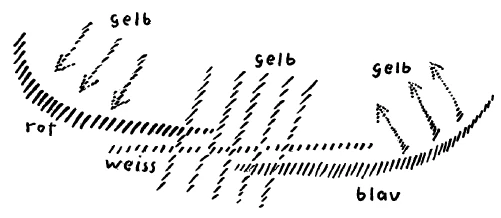
[ 23 ] If this is earthly life (see diagram), then what we bring with us from our prenatal life (yellow arrows, left) enters into this earthly life, so to speak, outshining it; and in turn, we develop in this life what we carry out into the world (yellow, right). What I have marked here as a red line contains, from the very beginning, that which is spiritual; it enters primarily through languages or similar means. In what I have drawn here in blue, the spiritual radiates after death through the impulses we have absorbed in economic life (yellow arrows). This middle section, which I have drawn in white, is, so to speak, radiated through from the side by the spiritual (yellow). Legal life is, as such, entirely earthly, but it is, so to speak, illuminated from the side, so that the inspiration intended to subdue Ahriman may find its expression in legal life. We must advance toward legal concepts that are truly drawn from spiritual life, that are, in fact, concepts of initiation.
[ 24 ] But how can the things I have spoken to you about today be readily understood by broader circles of people today? They simply cannot! For that to happen, it will be necessary for the spiritual-scientific element to permeate our entire conception of time and our culture of time. Without that, we cannot move forward into the future. That is why the healing of our social life is intimately connected with the spread of a genuine understanding of spiritual knowledge. Of course, on the other hand, those people who are willing to embrace social ideas will gradually feel the urge to take in spiritual matters as well. Those who will resist the spiritual most strongly are the ones who want to remain rigidly attached to those things about which I had to say just yesterday that they are repulsive to the children who have been descending from the spiritual world into this earthly world for a number of years now. It is indeed sometimes lamentable to see how little people are inclined to truly learn from events, and how much people today still cling to the ideas they held in the past, before it became clear that the world living within these very ideas is precisely what has driven humanity into this terrible catastrophe of our time. Humanity should be seized by a certain sense of responsibility and an understanding of the need to truly begin to see these contemporary challenges on a broader scale! Just think how people today—and this must be said with regard to a great many people—are so selfishly absorbed in themselves, and how much reason they actually have today to set aside their own selves almost entirely and turn their attention to the great questions facing humanity! These questions of humanity are so overwhelmingly vast today that, if one is a reasonable person, one should hardly find time to focus on the most immediate personal fates—unless those very personal fates can be made fruitful for the great questions of our time, which lie at the very heart of humanity’s current epoch of development. One would like people to notice the stark discrepancy between the insubstantial—which is personal fate today—and the essential, which comes to light in the great, overwhelming questions of humanity today. And in reality, one cannot understand spiritual science—at least not at the present time—unless one has understanding and openness toward these great questions of humanity. Certain things are now beginning to develop; but it is precisely from those who, in a certain sense, profess allegiance to the Spiritual Knowledge Movement that a particularly vigorous effort should be made to understand what is taking place on a broad scale in the social movement of the present—and which, as you can also see from these remarks today, has broader horizons than is generally thought.
[ 25 ] Based on the groundwork laid yesterday and today, we will then build on it tomorrow.