

Past and Future Influences on Social Events
GA 190
13 April 1919, Dornach
Translated by Steiner Online Library
Eleventh Lecture
[ 1 ] From the two lectures given the day before yesterday and yesterday, you will have seen that it is truly not out of any subjective opinion or any subjective desire on the part of anthroposophically oriented spiritual science that we must currently speak of that social threefolding of which we have now spoken so often and which has also been the subject of public presentations. As regards yesterday’s discussions in particular, it should be noted that my intention was to point out the profound impulses at work in the life of nations in the present-day civilized world—that is, the world of the fifth post-Atlantean epoch. I attempted to show how, beginning around the year 1200 in Central Europe, an impulse arose that in this region actually signified the rise of what might be called the bourgeois social order; yet this bourgeois social life in Central Europe was intertwined with a backward spiritual life from earlier centuries—a decaying Nibelung spirit, that decaying Nibelung spirit, which took shape as a spiritual life, particularly among the administrative and ruling upper classes of the Central European countries. And I emphasized in particular what a stark contrast existed in this Central European life from the 13th through the 20th century, where it ultimately led to that terrible social agony that also descended upon Central Europe. I tried to point out what a stark contrast existed between the inner spiritual experience of the broad middle-class population and that of the people who, emerging from the old knighthood, from the old feudal lords, from all that which was, in spiritual terms, a remnant of the old Nibelung spirit, who, in essence, shaped the politics of this Central Europe, while the broad masses of the middle class remained unpolitical and apolitical. One must, especially if one wishes to be a scholar of the humanities from a practical standpoint, seriously try to put oneself in the shoes of this difference in spirit that exists or has existed, namely between the so-called educated middle class and its members, and between all those who have held positions of power of any kind in Central Europe. I characterized this yesterday.
[ 2 ] Now let us take a closer look at why this essentially magnificent spiritual movement—which stretches from Walther von der Vogelweide all the way up to Goetheanism, only to suffer an abrupt decline after Goetheanism—why this spiritual movement has failed so completely to come to terms with social life in any way, to give form to thoughts within social life. One need only consider that even Goethe, who was able to develop the most comprehensive ideas about so many things in the world, could actually speak only in certain hints—about which one can boldly say that they were not entirely clear even to him—regarding what must emerge as a new social order for civilized humanity. In essence, the tendency toward the threefold structure of a healthy social organism had already been present in people’s subconscious since the end of the 18th century. And the calls for liberty, equality, and fraternity—which will only make sense once the threefold structure is realized—testified to the existence of this subconscious longing for the threefold structure. Why, then, did it not come to light?
[ 3 ] This is connected to the entire nature of intellectual life in Central Europe. Yesterday, at the end of my talk, I pointed out a peculiar phenomenon; I said: Herman Grimm, whom I hold in such high esteem—and who, with his ideas, was able to shed light on so many aspects of art, of what is universally human, and of antiquity—fell into the strange error of admiring a mere wordsmith like Wildenbruch. Over the years—if I may be permitted this personal remark—I have often pointed out something that, when recounted in this way, might seem quite insignificant to the listener, but which can have great and profound significance for those who view life symptomatologically. Among the many conversations I had the privilege of having during the time I was on personal terms with Herman Grimm, there was also one in which I pointed out, from my own perspective, various things that must be understood in a spiritual sense. And whenever I have recounted this, I have always pointed out that Herman Grimm’s only response to such talk about the spiritual was a dismissive wave of the hand; he felt that this was something he would not engage with. At that moment, that wave of the hand was an immensely true remark. In what sense was this remark incredibly true? It was true insofar as Herman Grimm, despite all his engagement with various aspects of humanity’s so-called spiritual development, in art, and in the portrayal of the “universally human,” had not even the slightest inkling of what the spirit must actually be for a person of the fifth post-Atlantean epoch. Herman Grimm simply did not know, from the perspective of a human being of the fifth post-Atlantean epoch, what spirit is. When discussing such a matter, it is indeed necessary not to take a brusque stance from the standpoint of truth; at least as far as the spirit was concerned, a man like Herman Grimm was true—because he knew nothing of the way one thinks about the spirit, he made a defensive gesture. Had he been one of those windbags who today once again go about masquerading as prophets and seeking to improve people, he would have believed he could speak authoritatively about the spirit; he would have believed that when people say “spirit, spirit, spirit”—that this expressed something corresponding to a content cherished within one’s own soul.
[ 4 ] Among those who have spoken extensively about the Spirit in recent decades without having the slightest idea of what the Spirit is, the majority of theosophists must also be included. For one could indeed say that, of all the spiritless ramblings that have been indulged in in recent times, the theosophical ones were the most disheartening and have, in part, borne the worst fruits. But if one says something like what I just said regarding Herman Grimm—whom I wish to consider not as a personality but as a representative, as a type of our time— then one can certainly ask how it is actually possible that such a person—who so fully represents Central European life—has no idea how one must think when thinking about the spirit. In this sense, Herman Grimm is truly only a representative of Central European life. For if we consider precisely that culture which I characterized yesterday—the culture of the bourgeoisie, which, let us say, in the year 1200 — approximately, of course — and then extends all the way into Goetheanism; if we consider precisely this culture, this resplendent culture, then what must appear to us as the defining characteristic of this culture—which, of course, need not be held in any lower esteem for this reason—is that it is, in the most beautiful sense, pulsing with what is called the soul, yet it is entirely lacking in what can be called the spirit. One must simply be able to grasp this with all the necessary tragic sensibility: that this very resplendent culture lacks what one might call spirit. Of course, one must understand “spirit” in the sense that one learns to understand it through anthroposophically oriented spiritual science.
[ 5 ] I keep coming back to this prominent figure, Herman Grimm, because the way he thought is the way thousands upon thousands of educated people in Central Europe thought. Herman Grimm wrote an excellent book on Goethe, which compiles lectures he gave at the University of Berlin in the 1870s. With regard to everything Herman Grimm said about Goethe, it is true that he actually expressed the finest and most comprehensive insights into Goethe that have ever been offered by this educated class. And from his soulful perspective, Herman Grimm had the gift of characterizing people, but also the gift of correctly grasping and assessing human characteristics. In this regard, he was brilliant at finding the right words to characterize anything. I would just like to recall one thing. Herman Grimm, of course, was also among those people I spoke of yesterday who were caught up in falsehood regarding the Nibelungen wildlings. He was enthusiastic about Frederick the Great and had a very specific idea in his soul of how he should imagine Frederick the Great as a Germanic-German hero. Now, the English historian and writer Macaulay provided a characterization of Frederick the Great that is, of course, written from an English perspective. In an essay on Macaulay, Herman Grimm sought to make clear how only a truly sensitive German can understand Frederick the Great and draw the lines that define this character; and he characterized Macaulay’s portrayal of Frederick the Great very aptly by saying: “Macaulay turns Frederick the Great into a dandyish English lord with snuff on his nose.”
[ 6 ] Well, finding such a characterization is something that means something—namely, that one can give shape to one’s ideas and concepts, so that these concepts can become vivid. One could give many such examples that illustrate how a mind like Herman Grimm’s can characterize things so aptly—and also examples from other similar minds throughout the cultural history of Central Europe, whom I described yesterday. But if one looks at his monograph on Goethe—which is by far the best of those that have been written—with precisely this goodwill that arises from such an appreciation of Herman Grimm, what impression does one then have? One has the feeling: This is something very beautiful, something extraordinarily good—but it is not Goethe! In essence, there is really only a shadow image of Goethe here, as if one were to take a three-dimensional figure and cast only a two-dimensional shadow of it onto the wall. I would say: chapter by chapter, Goethe wanders like a ghost from 1749 to 1832. A ghostly Goethe is portrayed—not the Goethe who actually was, what Goethe thought, what Goethe felt, what Goethe wanted—but rather that which wandered and moved like a ghost through the decades I have just referred to.
[ 7 ] Goethe himself did not bring everything that lived within his soul—especially that which lived there spiritually—into his consciousness in a spiritual way. This is precisely the great problem with Goethe today: to truly bring to consciousness, in a spiritual way, that which lived spiritually within him—something Goethe himself was not yet able to do, for in his time it was not possible to have anything other than a soulful culture, not a spiritual one. Thus, even Herman Grimm, who is firmly rooted in the Goethean tradition, has only a shadow, a specter, a schema when he speaks of Goethe’s spirit. And it is indeed a characteristic phenomenon that what must be described as the best about Goethe and Goetheanism emerging from today’s culture is merely a specter of Goethe. That is indeed a telling phenomenon.
[ 8 ] Yes, but where does it stem from that, throughout this entire glorious cultural development, the concept, the experience, and the sense of the true spirit are missing? People like Troxler—and sometimes Schelling as well—have tentatively pointed toward the spirit. But viewed purely objectively, one must say: The spirit is missing from this entire culture. And because the spirit was missing, people were also unaware of the spirit’s needs; they were unaware of the spirit’s conditions of life. This, in turn, is something that can well spring forth as a tragic feeling from the perception of this cultural current—that within it, people were unable to perceive or feel the spirit’s conditions of life, including its social conditions of life. But this is precisely why Central European social life was able to develop over the centuries and, because it had no real experience of the spirit, did not feel the need to fulfill the fundamental conditions of this spiritual life by emancipating it, establishing it on its own, and separating it from political life. Because people did not know the spirit, they also did not know the innermost conditions of the spirit’s existence; therefore, they did not feel the necessity—I am speaking only of these areas; in other areas of the present-day civilized world, people did not feel it either, but for different reasons—to establish the spirit on its own, but instead allowed it to merge with that within which it could develop only in chains: the state. The year 1200, as I said, is the point in time when the work of Walther von der Vogelweide can also be documented—the point in time when the spiritual life of Central Europe pulsed with powerful imaginations, of which conventional history records little. Then this intellectual life continued to flow through the centuries, though it actually began to absorb the seeds of its own decline as early as the 15th and 16th centuries, and it was within this intellectual life of Central Europe that the universities of Prague, Ingolstadt, Freiburg, Heidelberg, Rostock, Würzburg, and so on were founded. The founding of these universities, which spread like seeds throughout Central European life, took place almost entirely within a single century. With this way of thinking, with this life that radiated from the universities, came the tendency toward the abstract, toward that which was then idolized and revered as purely scientific thinking—though, of course, one can only speak of “idolization” in a relative sense—and which today so devastatingly interferes with people’s habits of thought.
[ 9 ] And this way of life essentially imparted a certain nuance to the entire educated middle class. What, then, was this nuance that characterized the entire educated middle class? Of course, many factors played a role—factors that did not, I would say, have a direct, source-like effect on every individual, but whose influence extended to each and every one. Another contributing factor was that, during this period, there was a growing receptivity to a completely foreign spiritual life, one that was shaped by the educated members of this bourgeoisie and which then culminated in Goethe, Herder, and Schiller. This developed, in addition to what lay within one’s own soul, essentially foreign elements and foreign impulses.
[ 10 ] With this, I am pointing to an immensely characteristic phenomenon. The souls of these people, who were the bearers of the bourgeoisie, were indeed searching for the Spirit, a concept they did not even possess. But where were they searching for the Spirit? In Greek education. They learned Greek in their secondary schools, and what flowed into their souls as spiritual content was Greek content. If one spoke of the “Spirit” in Central Europe from the 13th to the 20th century, one would always have had to say: that which the instilled Greek education taught one about the Spirit. No independent life concerning the Spirit arose there. Greek education concerning the spirit, however, was not yet the education of that period in human development which we call the period of the development of consciousness. That period did not begin until the middle of the 15th century. Thus, this bourgeoisie carried within itself an outdated education—Greek education—and that alone provided it with what the Greeks actually felt and sensed about the spirit.
[ 11 ] But what the Greeks perceived of the Spirit was, strictly speaking, merely the soul aspect of the Spirit. Therein lies the depth of Greek culture: that the Greeks, so to speak, ascended directly to the perception of the highest soul aspect. They called this the Spirit. Certainly, the Spirit shines down from on high. Just as I depict it here, it shines down from on high, pulsing through the soul. But when one looks upward, one perceives the soulful aspect of the Spirit.
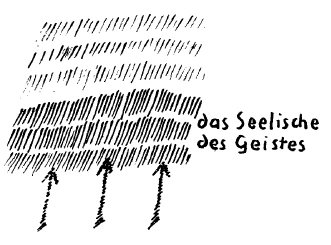
[ 12 ] But it became the task of the fifth post-Atlantean epoch to rise up into the Spirit itself. This cultural development was not yet capable of doing so. This is much more important than is usually thought. For it sheds light on the entire way in which modern-medieval education was able to take hold of the Spirit.
[ 13 ] What, then, was necessary to arrive at a concept of the spirit, at an inner experience of the spirit in the modern sense? It is precisely through a figure as representative as Herman Grimm that we can study what was necessary in modern times to work one’s way toward an inner experience of the spirit. For this, in fact, required something of which a man with such a classical education as Herman Grimm had no idea: scientific inquiry, the scientific way of thinking. Why? The scientific way of thinking is spiritless. Scientific thinking, especially when it is highly developed, contains not a shred of spirit, nothing spiritual at all. All scientific concepts, all concepts of natural laws, are spiritless because they are merely shadows of the spirit; because, in one’s consciousness, when one knows something about natural laws, nothing of the spirit is present. One can then take two paths. One can devote oneself to natural science, as many do today, and be content with what natural science provides; then one becomes devoid of spirit. One can be a great natural scientist precisely because of this, but one must be devoid of spirit. That is one path.
[ 14 ] The other path is to experience the soullessness of natural science—precisely where it has manifested its grandeur—as an inner tragedy, to immerse one’s soul in the knowledge of nature. When one immerses one’s soul in those abstract laws of nature—which are very interesting and shed light on many things, but which are spiritless—when one immerses oneself in the laws of nature found in chemistry, physics, biology—which are derived at the dissection table and thereby already suggest how they yield only the dead from the living—if one tries not only to live with this as a form of knowledge born of human arrogance, but if one tries to ask: What does this give to the human soul?—then it is experienced! There is nothing spiritless about it. This, indeed, is the tragic problem of Nietzsche, whose inner life is fractured and torn precisely by the sense of the spiritlessness of modern scientific education.
[ 15 ] And then the reaction can take place within the soul. Then one can experience how, when contemplating nature, the spirit remains completely silent, utterly still, saying nothing. The soul rears up, gathers its strength, and then seeks to give birth to the spirit from within. This can only happen in an age in which the immediate natural disposition is absent in people such as those of Central European bourgeois education, and in which scientific culture is making inroads. Then, if they are not inwardly dead, if they are inwardly alive, the impulse of the spirit itself stirs within them. Since the middle of the 15th century, the spirit must be born anew in the dead if the spirit is to enter human soul life at all. Therefore, those who, through a classical education alone, live out that lingering echo of the Greek spirit—which causes the soulful aspect of the spirit to pulse through the human soul—can still find satisfaction in the inner experience afforded by the sensation of this Greek soul-spirit, this Greek spirit-soul. But those who are compelled to take natural science seriously in their inner lives and to perceive its death, its corpse-like nature—they will then allow the spirit to arise within their souls.
[ 16 ] In order to have a truly direct experience of the spirit in modern times, one must not only have been in laboratories and smelled hydrocyanic acid or ammonia there, or have been in the dissection room and looked at the fresh specimens of corpses, one must have sensed the scent of death from the entire field of natural science in order to arrive at the light of the spirit through this sensation. This is an impulse that must be revived in modern times. This is one of the trials that people must undergo in modern times. Natural science exists far more to educate people than to convey truths about nature. Only a naive person can believe that there is an inner truth in any natural law recorded by learned natural scientists. No, it is not there; but it is precisely this spiritless natural science that serves to educate people toward the spirit. This is one of those paradoxes of humanity’s development throughout world history.
[ 17 ] It was only in the most recent era—the era that succeeded Goetheanism, for it was then that the true cadaverousness, the true death of the natural sciences, began to emerge—that the spirit shone forth, though only for those people who were willing to receive its light. And so, up until the time of Goethe—and even Goethe himself—people protected themselves against the devastating effects of a spiritual life shackled to state coercion by, in essence, assimilating the Greek spiritual life, which, after all, did not belong to the modern state because it did not belong to the modern era at all. The separation of spiritual life from state life was achieved, as a surrogate, by assimilating a foreign spiritual life—the Greek one. It was precisely this Greek spiritual life that conceals the inner spiritual emptiness of the modern European world. That was one aspect of it.
[ 18 ] On the other hand, however, people did not feel the need to separate economic life from legal life or from the life of the political state proper. Why not? After all, human beings can never escape economic life. To put it simply, the stomach makes sure of that. It is not possible for people to experience such cataclysms in the realm of economic life unnoticed, as they are experienced unnoticed in the realms of legal and intellectual life. Economic activity was therefore present, and this activity developed in a very straightforward manner. What I alluded to yesterday—the transformation of the old, impenetrable forests into meadows and cornfields, with all the economic consequences that entailed—developed in a very straightforward, regular manner. It was a very direct current. But something foreign entered into the experience of this economic life—something that had actually been stronger in the Central European soul for longer than the Greek: the Latin-Romance element entered into it. And everything relating to state and legal life, to politics, stems from the Latin-Romance tradition. And this is, after all, that strange incongruity—again, something that the history of the future will have to emphasize sharply, but which is overlooked by the biased, specifically materialist-biased conventional historiography of the immediate past: that certain economic concepts, certain economic ways of managing life, and a certain approach to economic activity in life developed in a straight line from the social conditions that Tacitus describes for the first century of the Germanic world following the establishment of Christianity. But these economic ways of thinking did not develop unhindered. The Roman-Latin political mindset intervened, thoroughly infecting them and keeping the original European economic customs and political-legal life apart. And so economic life and political life existed artificially side by side, seemingly divided—though the division was merely a mask—because political life bore the character of the Latin-Roman tradition and economic life that of the Old Germanic tradition. Because two layers alien to one another coexisted, people sensed that they did not belong together and outwardly merged, yet they were content because, inwardly and spiritually, they experienced them as separate. One need only study the history of the Middle Ages and modern times to see how, in truth, this history in Central Europe is a continuous rebellion, a continuous resistance, a continuous opposition by the economic conditions inherited from ancient times against the state apparatus and against legal Romanism. If one visualizes these things, one can literally see how Romanism, as a form of jurisprudence, penetrates people’s minds through the heads of administrative officials. Much of Romanism also penetrates precisely into the decaying Nibelung savages. “Graf” is related to *grapho*, to write—I have said this before. That is where Romanism penetrates. As I said: one can literally see it in the picture—how the farmers, filled with this economically oriented way of thinking, either clench their fists in their pockets or rise up with their flails against this Roman, legalistic mindset. Of course, this does not always manifest itself so outwardly. But in the whole moral fabric of things, if one truly examines history, this is indeed the case. Thus, what developed from the seeds of the Central European world was permeated—I am merely characterizing, not criticizing, for everything that took place there also brought its blessings and was necessary; it was unavoidable in the historical development of Central Europe— it was permeated, infected by legal-political Romanism and Greek humanism, by the Greek concept of spirit and soul, the soul-spirit concept. And it was only when the modern international economic element struck, with everything it brought in its wake, that it was actually no longer possible to maintain the old ways. One could very well be classically educated and yet be ignorant of modern scientific knowledge, but one was then, nevertheless, inwardly and spiritually a reactionary. One could not keep up with the times if one was merely classically educated, if one did not delve into what modern scientific knowledge had to offer. And if one was educated in the natural sciences—if one was familiar with what modern natural science sought to achieve—then one could truly only suffer from “cultural diseases,” “cultural scarlet fever,” and “cultural measles” by becoming acquainted with what had emerged from the old Roman legal tradition during the period I have described to you. In the ancient Roman Empire, this legal Romanism had its place. Then this Roman legal tradition—the Res publica, or rather the views regarding it—had been passed down from ancient Romanism, just as, on the other hand, the “Nibelung wildness” had been transmitted through Central European education.
[ 19 ] Yes, my dear friends, one contracts “cultural scarlet fever” and “cultural measles” when one does not merely think about jurisprudence in abstract terms, but instead engages with this “something”—which appears in literature and scholarship as modern jurisprudence—by imbuing it with sound scientific concepts.
[ 20 ] This reached a certain climax when even someone who was actually witty, like Rudolf von Ihering, no longer knew how to make sense of these wretched concepts of modern jurisprudence. The book Ihering wrote on the “purpose of law” became grotesque because a man who had become somewhat accustomed to scientific thinking now wanted to apply the linguistic concepts he had acquired to jurisprudence, resulting in a monstrosity of human thought. It is indeed an ordeal for sound thinking to engage with modern legal literature, for one has the constant feeling that it wriggles through the brain like earthworms. That is indeed the case; I am merely describing these imaginative perceptions.
[ 21 ] We must have the courage to face these realities squarely in order to realize that we have reached a point where not only certain institutions, but also people’s ways of thinking must be transformed and reshaped—a point where people must begin to think differently about certain things. Only then will social institutions in the external world, under the influence of people’s ways of thinking and feeling, be able to become what these terrible, alarming facts demand.
[ 22 ] A thorough re-education is indeed necessary with regard to the most important matters facing modern humanity. But because modern humanity—especially during the period I spoke of yesterday, beginning in 1200 and ending with Goetheanism—absorbed thoughts that crawled through its brain like earthworms without even noticing it, that indifference, that passivity of thought set in, which is a characteristic phenomenon of modern times. This characteristic feature of modern times is, after all, the absence of will in the realm of thought. People let their thoughts come over them; they surrender to them; they prefer to experience thoughts as instincts. In this way, one can never penetrate to the spirit. One can only penetrate to the spirit if one truly and objectively brings the will into thinking, so that thinking becomes an action like any other action, such as chopping wood. Do modern people really feel that thinking is tiring? They do not, because thinking is not an activity for them. Modern people feel that one gets tired from chopping wood. But modern people do not realize—and do not experience—that for those who think not with words but with thoughts, that same fatigue sets in after a shorter time than when chopping wood, a fatigue that is exactly the same as when chopping wood—the point where one can go no further. This must be experienced; otherwise, modern humanity will not be able to accomplish in its communal life that transition of which I spoke yesterday and the day before—that transition from the sensory to the supersensory world. You know, one does not need to become clairvoyant to pass into the supersensible world; rather, one need only use common sense to understand what can be explored from the supersensible world through the path of clairvoyance. It is not necessary for all of humanity to become clairvoyant, but what is necessary is what is possible for every human being: to gain insights into the spiritual world through common sense. Only in this way can harmony enter the modern soul, for this harmony is precisely what is being lost in modern souls due to the conditions of historical development. Today we have reached a point—namely, in European development with its American offshoot and its Asian outposts—where the spirits of the supersensible world are actually drawing a conclusion between what was the norm in earlier times regarding the coexistence of peoples on Earth and what has become the norm in later times.
[ 23 ] How were the peoples of the globe arranged in ancient times? Up to a certain point in time—which actually lies not far before the Mystery of Golgotha—everything that had been brought about in terms of the configuration of peoples on Earth was determined from above, by the fact that souls simply descended from the cosmos, from the spiritual world, into the bodies that were alive in a specific territory during the physical development of humanity. Thus, in ancient Greece, certain human bodies existed as a result of physiological, geographical, and climatic conditions, and certain human bodies existed on the Italian Peninsula. Although parents gave birth to their children, the souls came from above; they were determined entirely from above and intervened very deeply in the entire configuration of the human being, in his or her external physical physiognomy.
[ 24 ] Then came the great migrations. People migrated across the Earth in various waves. Racial mixing occurred, and the mixing of peoples took place. As a result, the hereditary element came to play a significant role in earthly life. A population living in a certain place on Earth migrated to another place; for example, the Angles and the Saxons lived in certain regions of the continent and migrated to the British Isles. That is an example of such a migration of peoples. Now, the descendants of the Angles and the Saxons are, in terms of physical heredity, dependent on what previously developed on the continent; they resemble their ancestors in terms of their physical features, their mannerisms, and so on. As a result, something enters into the development of humanity that is horizontally dependent. Whereas in the past the distribution of people across the Earth depended solely on the way in which souls incarnated and descended, now the migrations and currents that occurred became a contributing factor. But in this regard, precisely at the turn of the 14th to the 15th century, a new cosmic-historical element emerged—a new cosmic-historical impulse. For a time, there was a certain affinity between the souls descending from the spiritual world and the bodies that were down below. To put it concretely: Over the English islands, souls descended who were drawn by the form of the bodies of those living on the British Isles as descendants of the Angles and Saxons. This affinity gradually ceased during the 15th century, and since then, souls have no longer been guided by racial characteristics but rather by geographical conditions—by the climate, and by whether the terrain below consists of plains or mountains. Since the fifteenth century, souls have cared less and less about how people look in terms of race; they are guided more by geographical conditions. As a result, there is today, among humanity spread across the earth, something like a conflict between inherited racial characteristics and the soul, which comes from the spiritual world. And if people today were truly able to bring more of their subconscious into consciousness, then very few people today—if I may put it in trivial terms—would feel comfortable in their own skin. Most people today would say: I came down to Earth to live on the plain, among greenery or above it, to experience this or that climate, and, when it comes down to it, it isn’t all that important to me whether I have a Romance-looking or a Germanic-looking face.
[ 25 ] Yes, it does seem paradoxical at first glance when one describes in concrete terms these things that are of the utmost importance for human life today. Even those who offer sound teachings—who say one should turn away from materialism and turn back to the spirit—speak in pantheistic terms of “spirit, spirit, spirit”; that doesn’t shock people today. But when one speaks of the spirit in such concrete terms, people today still aren’t quite ready to accept it. Yet that is indeed the case. And harmony must once again be sought between, I would say, a geographical predestination and a racial element that spreads across the earth. This is the source of the international tendencies of our time, in which souls no longer concern themselves with racial matters.
[ 26 ] I once compared what is happening now to a vertical migration of peoples, whereas in the past there was a horizontal migration of peoples. This comparison is not merely an analogy; it is based on the facts of spiritual life.
[ 27 ] To all this must be added that, simply as a result of modern intellectual development, human beings are becoming increasingly spiritual in their subconscious, and that, in fact, the materialistic mindset that arises in the conscious mind is increasingly at odds with what people hold in their subconscious. To understand this, however, it is necessary to revisit the threefold structure of the human being itself.
[ 28 ] At first, a person today—who is focused solely on the sensory-physical realm—perceives this threefold structure in such a way that he says to himself: I perceive through my senses, which are distributed throughout the entire body but are mainly concentrated in the head; in my perception, I have the nervous-sensory life. But people today do not get any further than that. At most, they can describe that a person breathes, and that life passes from breathing into the movement of the heart and the pulsation of the blood. But people do not get much further than that. Metabolism is studied very closely, but not as a component of the threefold human being; it is actually regarded as the whole human being. One need not go as far as that scientific thinker who said, “Man is what he eats”—but on the whole, the scientific mindset is quite strongly permeated by the idea that man is what he eats. In Central Europe, he will soon be what he does not eat!
[ 29 ] This threefold structure of the human being, which seeks to find its place within a social threefold structure because it is becoming increasingly evident, also manifests itself in a differentiated way across the earth. Human beings are truly not merely what is enclosed within their skin. It was already in keeping with a deep intuition when, in my first mystery play, *The Gate of Initiation*, I had Capesius and Strader perform all manner of actions and drew attention to the fact that what human beings do here on Earth corresponds to cosmic processes out there in the universe. With every thought we form, every movement of the hand we make, with everything we say—whether we are walking, standing, or doing anything else—something is always happening in the cosmos. Modern human beings lack the perceptual capacity to truly experience these things. People today do not know—nor can one expect them to, and it is paradoxical to speak as I am speaking now—what they would look like if, for my sake, they were to observe from the moon what is happening here on Earth. There they would see that the life of the nerves and senses is something entirely different from what is known of it in physical-sensory existence. Nervous-sensory life—that is, what takes place while you see, hear, smell, and touch—is light in the cosmos, the radiating of light into the cosmos. Through your seeing, your feeling, and your hearing, the Earth shines out into the cosmos.
[ 30 ] The effect of everything that is rhythmic in the human being—breathing, the beating of the heart, the pulsation of the blood—is different. These radiate into the cosmos in powerful rhythms that would be heard by the corresponding organs of hearing. The human metabolism radiates into the cosmos as life flowing out from the Earth. You cannot perceive, hear, see, smell, or feel without radiating out into the cosmos. You cannot circulate your blood without resonating out into the cosmos, and you cannot carry out your metabolism within yourself without it being perceived from the outside as the life of the Earth, the life of the entire Earth.
[ 31 ] In this regard, however, there is a great difference, for example, between Asia and Europe. Viewed from the outside, the unique way of thinking of Asians—even today, when a large portion of them have become unspiritual—would still radiate a sparkling, bright light out into the spiritual realm. This light grows darker the further one goes westward; less and less light shines out into the spiritual realm. In contrast, the further one goes westward, the more life pulsates out into the spiritual realm. Only in this way does what might be called the perception of the Earth’s cosmic aspect arise in the human soul; and humanity is part of the Earth.
[ 32 ] Such ideas will be needed if humanity is to move toward a hopeful—rather than a hopeless—future. That idiocy which is gradually being bred in humanity by merely drawing current geographical maps and teaching people: here is the Danube, here the Rhine, here the Reuss, here the Aare, here lies Bern, here Basel, here Zurich—this mere external, theoretical mapping, which, complementing the globe, merely propagates the sensory; this kind of education will drag humanity down more and more. Certainly, it is necessary as a foundation; it should not be contested, but it will drag humanity down more and more. The globe of the future must show: there the Earth glows because spirituality exists in people’s minds; there the Earth radiates more life out into cosmic space, because that is precisely what corresponds to the people in that region.
[ 33 ] This is also related to what I have already noted here. One must always shed light on one thing through the other. I told you that as Europeans gradually settle in America, they develop hands like those of Native Americans and come to resemble the type of the ancient Native American. This stems from the fact that today, the souls that descend and incarnate in human bodies are guided more by geographical factors, as in ancient times, when Native American culture was still the most readily available. Now souls do not orient themselves according to races, nor according to what develops from the blood; they orient themselves according to geographical conditions. It will be necessary to penetrate inwardly what is taking place within humanity. This penetration awaits humanity, awaiting humanity’s openness to more flexible concepts that can grasp such things. But these can only develop on a spiritual-scientific foundation. And a spiritual-scientific foundation is only possible if the spirit can be born within the human soul. For this, we need an emancipated, free spiritual life. For this, we need the separation of spiritual life from political and state life.
[ 34 ] Well, my dear friends, today I have given you some insights into what pervades that segment of humanity that must now strive for social renewal. Today, one cannot formulate social demands using ordinary, trivial concepts. One must have an understanding of the nature of present-day humanity. One must make up for what one has neglected in the study of present-day humanity.
[ 35 ] Since we will have to leave soon after all, I will speak about these matters one last time tomorrow. So we will gather here again tomorrow at half past seven. Perhaps we will also be able to perform a few eurythmy pieces then, and we will have another lecture here tomorrow, precisely because we will likely have to leave here this week. I’ll also have a few things to say to you tomorrow that tie in with my book on the social question, which has now been printed and will be published very soon. In connection with this book, I’ll have a few things to say that are particularly close to my heart.