

Past and Future Influences on Social Events
GA 190
14 April 1919, Dornach
Translated by Steiner Online Library
Twelfth Lecture
[ 1 ] Today, above all else, it is close to my heart to speak to you about what my upcoming book on the social question—to be published in the coming days—seeks to convey to humanity as a whole, drawing on the impulses of our time and the hardships of our era. The book will be titled: “The Key Points of the Social Question in the Necessities of Life for the Present and the Future.” “From the reflections of the past few days—which were, in essence, merely a continuation and expansion of the reflections we have been engaging in here for many weeks—you will have seen that what I am about to say specifically regarding the social question does not stand merely as a kind of side current alongside that which pulsates through our entire spiritual scientific endeavor, but that, in fact, the matter must be viewed in such a way that this spiritual scientific endeavor, precisely through its own unique mode of understanding, develops an awareness of the needs and demands of our present and the near future, and that the fundamental character of our time lies precisely in the fact that the needs of the time can, in a radical sense, only be met through spiritual impulses. Anything else that might be attempted—as I have emphasized from a wide variety of perspectives—could, at best, be nothing more than a surrogate. Even the external measures that are to be taken will have to be of such a nature that—I do not mean to say a specific form of spiritual science, but rather—a spiritual life that ascends to the true Spirit becomes possible within the social order.
[ 2 ] This is necessary because, as a result of humanity’s development, people today find themselves in a very specific situation. I have described this situation of people today from a wide variety of perspectives. Today I would like to point out once more that, fundamentally, all our considerations have led us to recognize how modern human beings, by virtue of their constitution, are simply caught in a certain conflict at this very moment. It is, of course, easy to view human beings as a unity in terms of their entire being. But they are not a unity. We know that they are threefold beings. But these three aspects of the human being stood in different relationships—during the various epochs of the post-Atlantean era—to the entire external world—the physical, soul, and spiritual external worlds—and to the human being’s own inner world. We can now consider the threefold human being in two ways. Let us do this schematically by simply placing the three aspects of the human being one above the other (see diagram). However we choose to name them—whether according to their physical aspects: the nervous-sensory system, the rhythmic system, and the limb-metabolic system; or according to their spiritual aspects: the intuitive spiritual, the inspired soul, and the imaginative physical—or, in other words, whether we proceed more along the lines of how I have described them from the spiritual perspective in my book *Theosophy*, or whether we take the physical projection of this threefold human being, as I drew attention to it in my latest book *On the Mysteries of the Soul*—from every point of view it becomes clear to us that the human being is a threefold being. But this threefold human being is, if I may say so, not at all simply threefold. For one thing, the human being is a complex being, and the trinity within him is not simply a straightforward tripartite division; rather, we can say that the human being is, in a certain sense, a dual being, a twofold being, and the boundary actually runs right through the rhythmic system—through the respiratory and cardiac systems.
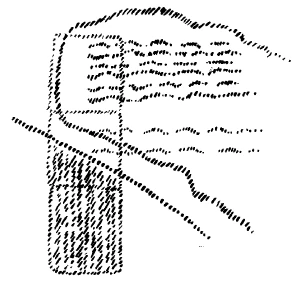
[ 3 ] Today, in our current phase of development, the situation is such that the inner being of the human being truly lives only in the metabolic system and in the lower parts of the lung-heart system—the rhythmic system. In essence, this is where the human being is inwardly centered in the present day. In contrast, with regard to the upper part of the heart-respiratory system and the nervous-sensory system, the human being today is heavily dependent on the external world. You will understand what I mean in a moment. Human beings perceive the external world through their senses. They process the external world through their intellect. They also breathe in the external world through their lungs. This is what human beings take in from the outside—through perceptions, through intellectual processing, and through inhalation. But with regard to what comes into the human being from the outside, the human being is, in a sense, merely a kind of dwelling. In fact, within this part of the human being—the upper part—the whole of external nature is contained: the colors, the sounds from outside, the stars, the clouds, the air, even down to the process of breathing; and you yourselves are, in fact, merely the dwelling for this external world. In ancient times, people still found within this external world something akin to their inner being: elemental spirits, as well as divine-spiritual beings of the higher hierarchies. In their mythologies—which were wiser than today’s scientific wisdom—they spoke of these nature beings. But these have vanished from human perception. Today, human beings perceive only the sensory world and process it. In doing so, they actually carry only the external world within themselves. Very often, we do not pay sufficient attention to how little of what we carry within us—whether as perceptions of the external world or as what remains in our memory of it—is actually our own. When you walk up this hill in the morning or at noon and see the Goetheanum, and then walk back down, carrying the image of the Goetheanum within you along with everything you have seen there, you seem to have something within you—but it is only a reflection, for the Goetheanum stands right here on this hill. Everything you have seen also stands on this hill. You are merely, with the part of the human being that I have distinguished here, the dwelling place of that. And today, human beings are so spiritually impoverished precisely because they can no longer find the spirit in this outer world.
[ 4 ] Yes, there were times in the Earth’s evolution when people who had climbed up this hill and beheld something like this Goetheanum would, on their way down, have perceived certain things not as a fantasy, not as an inner mysticism, but as a world of facts. Just as they would have carried in their souls something they had seen—such as a painting or the like—they would have carried with them those spiritual beings who had emerged from every corner and who had participated in the creative process as people built here. But that is over for human beings, just as if the elemental and spiritual beings had fled from the external natural world. Outer nature has been stripped of spirit, and with it this part of the human inner being as well. And for the inner being, all that really remains is the lower part of the chest and the metabolic body with the limbs. For today’s externalized human being, for this period of human development, this is what a person—unless they truly begin to take an interest in true spirituality—calls their inner being. And humanity has reached the point where, although people speak of their inner self, they essentially mean nothing more by it than their metabolism and, at most, the interplay between their breathing, heart rhythm, and metabolism. Let us not be deceived by this. Let us simply be clear about it: people today come and speak of not being able to cope with their inner self, of having inner difficulties. This is merely a verbal expression for some irregularity in metabolism. One person is cheerful, another is grumpy, stemming from their inner self; one is passionate, another is humorous. Essentially, all of this is a result of metabolism and, at most, the feedback from respiration and cardiac circulation on metabolism. Many people today speak of their inner selves. They talk about the needs of this inner self. They talk about how their soul cannot cope with this or that. In truth, it is their stomach and intestines that cannot cope. And what they refer to as “spiritual life” is, in essence, merely a verbal expression for what is taking place in their metabolism. And the fact is that people, of course, would not admit the truth by saying, “My stomach, my intestines, spleen, and liver—or other such things—are not functioning properly within me,” but instead they say, “My soul is experiencing this or that difficulty.” — That sounds better, more refined to some people; they consider it less materialistic. To those who view things in accordance with the truth, it is simply more disingenuous. For we are currently in precisely that phase of development in which human nature is clearly divided into these two parts.
[ 5 ] And if you ask: What kind of help is there? — there is only one kind of help for people today: to break free from themselves through an interest in the affairs of humanity, through a genuine interest in what concerns all people of our time, and by paying as little attention as possible to these irregularities of metabolism—in the broader sense—that are, after all, so prevalent today. If people can move beyond talking about themselves through a broad-ranging interest—which can only be achieved by taking spiritual science seriously—then salvation alone can pour out upon the present human race.
[ 6 ] One really does have experiences today that are characteristic of such matters. I was recently at that League of Nations congress in Bern, where they discussed all the things that are unnecessary to discuss today—because it leads nowhere anyway—and where they failed to discuss everything that is most essential today. But I don’t even want to mention that as the main point. As the main point, I’d like to mention a certain formal aspect that became apparent in almost all the speakers. In at least every third sentence, these speakers use the little word “I”: “I am of the opinion—,” “I think—,” “It seems to me that this or that is necessary—,” I love this or that—you can hear that in almost every sentence. And people get downright furious if you don’t go along with this tone! If you speak more objectively, if you structure your sentences so that you focus on the inner, objective content—rather than expressing your opinion or stating what you love—then they say you’re speaking authoritatively, that you’re speaking presumptuously. Of course, the height of presumption is when someone drops the little word “I” into every third sentence. But people have forgotten how to sense this presumption. They think someone is smarter if they’re always talking about themselves, and they find it extremely immodest and presumptuous when someone tries to speak from a position of objectivity. They then have the vague feeling that the speaker is claiming to know something other than his “personal opinion.” And today, it is a great sin for someone to claim to know something other than his personal opinion! Well, these personal opinions—! Those well-versed in the humanities often wish to characterize such a gathering more precisely, precisely from their humanities perspective. He hears a speaker of the sort who utters the word “I” in every third sentence: “I mean—,” “I am of the opinion—,” “I find this appealing—,” “I ask you to address this—”; the speaker then talks about a “supra-state” and a “supra-parliament,” and walks off. The person with insight into the humanities says to himself: This man must have a liver ailment after all; something is wrong with his liver, and his metabolism is speaking through him. A second speaker takes the stage, speaks in a similarly formal manner; he leaves. The man probably has gallstones. The third one is prone to stomach upset!
[ 7 ] These things become significant only in an age in which materialism is rampant, where the free soul—independent of matter—does not speak, where in fact the body speaks. And today, the body speaks in many cases. People are simply accustomed to using the old words to describe their physical ailments. Those who see through these things from a spiritual-scientific perspective would prefer it if, instead of speaking of the “superman”—I do not, of course, mean Nietzsche, but the others who also spoke of the “superman” after Nietzsche—they would speak of the “sub-stomach.” For in doing so, they would better capture the reality that is actually speaking through them.
[ 8 ] This is not pessimism, my dear friends; it is quite simply the reality of the present day. And in this day and age, people are pressured to become untruthful, for the simple reason that they would be ashamed to list the facts. There is even a longing to surrender to this person, who is really nothing more than the physical being. In our time, it is indeed a truth that perhaps the only reason we do not have a Molière who wrote *The Imaginary Invalid* is that we needed too many Molières, for today there is a genuine enthusiasm for being sick among those people who, above all, have the time to be sick. Those who do not have time to be sick usually pay no attention at all to those conditions that, for others who do have time to be sick, are sufficient cause to feel ill. The devastating effects of materialism need not be sought only where materialism is discussed or where people speak in materialistic terms; these devastating effects of materialism manifest themselves in countless ways. And sometimes, today’s talk of the spirit is nothing more than the purest materialism, because for very many people, this talk of the spirit is nothing more than an anesthetic for their otherwise complacent materialism. People today lack the will for activity, for genuine inner activity. And all outward activity today must spring from inner activity. That is, after all, the reason why the middle class has remained so utterly passive in the face of the social question that has been emerging for the past seventy years. It is a monstrous materialism that has gripped people in the most diverse forms, and especially those circles that have had the task in recent times of turning toward the spiritual. One must indeed be aware of this regarding the fundamental impulses of our time, regarding what is alive in our time. Anything else would be succumbing to illusions. Spiritual science is of such great importance to people today precisely because it leads them away from themselves. But it must also be understood in this way. We must not allow another illusion to take hold regarding spiritual science. A trait that is so widespread today—precisely because of materialism—can easily assert itself in the realm of spiritual science, and that is superficiality. When people grasp superficially what spiritual science seeks to awaken in them, they may become even more hardened within themselves; they may feel even more confined within themselves. There is simply no other remedy than to return again and again to what has nothing to do with us as individuals—that is, to the content of our spiritual science—and to approach the things found within that content as objectively as possible; and even when speaking of the most subjective matters, we must not treat them subjectively. Just think how clear it actually is that we must resist the obvious temptations on this point.
[ 9 ] When I spoke here recently about how human beings today are actually capable of external development only up to the age of twenty-eight, at which point their development comes to an end—specifically, just before reaching the intellectual soul and the “I,” and thus unable to attain them, thereby heading toward a certain inner emptiness—this is an important truth for our time. It is important to know this; it is important to take it in as an inner experience. “But it is harmful to think afterward: Am I perhaps one of those who, from the age of twenty-eight onward, has not properly developed toward their intellectual soul?” It is precisely the most subjective matters—those relating to what is most important—that should be viewed objectively; we should not look to see if we are the ones to whom such a thing might happen. Especially when it comes to the most important human truths, we should be able to look beyond ourselves and consider the age, consider humanity, rather than always thinking of ourselves in a selfish way.
[ 10 ] This is what characterizes our time, what emerges from the deepest impulses of our age, and what makes it so difficult today to spread ideas that relate to the very, very most important impulses of historical development. In a sense, people are unable to develop any interest out of this underlying mood that I have just described. For them, these ideas remain mere sensations; they do not grip them sufficiently, nor do they spur them on enough to take action
[ 11 ] This is what needs to be said, especially now, when there is a kind of transition for all those who are genuinely interested in our spiritual science. Until now, they have had a body of literature that relates to the inner development of the human being and to knowledge of the spiritual world, and which spoke to people in such a way that they could approach the world, their relationship to the world, and their relationship to other people—insofar as these are of a soul-spiritual nature—from a wide variety of perspectives. Now this spiritual science is giving rise to a certain current—of course, only as a branch; it continues as the great spiritual science, for it is precisely the great spiritual science that is absolutely essential for the healing of all other conditions as well—a current that addresses the social question and the healing of the social organism. Here, spiritual science is flowing into a current that must by no means be regarded as inactive or merely passive; otherwise, it will miss its goal, its purpose. And now it will become clear how many of us, through the many years that have gone by, during which we have absorbed spiritual science, have prepared ourselves above all for a clear understanding of what is now to be understood as the social question, for a clear, unbiased, and unsentimental grasp of what is to be articulated—namely, through my forthcoming book on the key points of the social question—is what will matter most. This will be the test we must now pass.
[ 12 ] Until now, one could be considered a good scholar of the spiritual sciences simply by studying them, without paying any attention to what was happening out there in life. And there are precisely two phenomena within our anthroposophical movement that we really ought to reflect on: On the one hand, we have quite good anthroposophists who, despite knowing an immense amount about cosmic evolution, the structure of the human being, reincarnation, destiny, and karma, have no idea about the practical aspects of life or the reality of life—people who have sought something in anthroposophy precisely to keep themselves at a distance from this reality of life. Yes, those to whom what I am now saying applies in particular do not even suspect that it applies to them. For, in fact, each one naively considers himself a practical person. So this is one phenomenon we have among us.
[ 13 ] The other phenomenon is sectarianism in any form. There is, after all, a deep tendency to engage in sectarianism, particularly in movements that relate to the spiritual. Whether this sectarianism develops out of small cliques—which also exhibit sectarian traits, albeit in very trivial matters—or whether sectarianism is practiced outright, that is not the point. For what really matters is to truly recognize that this anthroposophically oriented spiritual-scientific movement must be characterized by objectivity and impersonality. That has always been the difficulty with our movement: that the personal—usually without anyone realizing it—has been confused with the objective and factual. People act in good faith when they band together in a clique, large or small, believing they have a purely objective interest. Certainly, they are under this good faith, for they do not even realize that, in essence, they are primarily doing whatever they want—because they are close to a particular spiritual scientist who stands in opposition to them in one way or another, because they want to have a particular relationship with that person, and so on. People do not suspect this. They live under the good faith that they are being objective. But this sectarianism, this clique mentality—that is precisely what has led to the terrible reality that the publications and public statements of spiritual science, no matter in which field they make their mark, are not judged on their own merits, but rather on what a society—the Anthroposophical Society—makes of them and has made of them. When one points to the worst damages and the most dreadful weeds of the Seiling variety, one must never—when getting to the root of the matter— never overlook the fact that such weeds have been pampered, bred, and cultivated by the clique-like and sectarian tendencies that have spread so widely over the past seventeen or eighteen years of the anthroposophical movement. And what is happening within this anthroposophical movement is very often projected onto anthroposophy itself, because even among many members there is a failure to heed what is today the most significant impulse of our time: individualism in the spiritual realm. How often do we hear: “We anthroposophists, we theosophists, want this and that!” It is terrible that we have only three principles at all! — We don’t need any principles at all, for that is not what matters; we need truths, not summary principles, and these truths are meant only for the individual human being, for the individuality. The Society, as I have often said, is meant to be something outwardly; but the matter itself is none of the Society’s business. One really must be able to take these things seriously at least once. Today this is particularly necessary; for if what is now about to come into the world through the efforts regarding the social question—even if it were to be driven by a sectarian or clique-like spirit, or by the various forms of narrow-mindedness I have described today—then this very cause would be terribly harmed. Here we must truly develop a broader way of thinking. Here we must truly seek a way into real, practical life. That is what matters.
[ 14 ] When I say something about these matters, please take it only in the friendliest sense. Do not take it as though I were trying to say anything derogatory toward one side or the other. But I feel compelled to warn—to warn strongly—precisely against the social aspect of our cause, I mean, before this social aspect of our cause becomes a matter for all members—as it should, as it truly must—I must urgently warn against it right now: do not, under any circumstances, allow sectarianism, pettiness, and narrow-mindedness—things that lack broad horizons and do not spring from clear thinking—to creep into this social thinking; do not, under any circumstances, but rather strive more and more to think from the perspective of life experience and the reality of life. I was, in fact, greatly astonished when, not long ago, a motto reached my ears—one that must surely have originated from one side or the other here—stating that the things I am now presenting as social ideas should be put into practice. And what was meant was the transformation of these practical ideas into the most impractical thing imaginable. We really must not do what has led us into the most terrible turmoil and damage of our time: confuse true practical living with illusory practical living. What was expressed there is so impractical, so sectarian in its thinking, and so utterly lacking in the will to truly enter into practical life, that I do not even wish to go into it further. I ask you, above all, to look at what is actually happening in real life today, to understand where the various statements I make actually come from. Do you really think it’s a frivolous theory when we speak of labor power as a commodity? This is something that may only be said if one has repeatedly recognized it as the most characteristic feature of real life. And so it is with the other matters. What matters today is a clear, sharp understanding of the reality of life. So, truly sine ira—with the request that you not take these things personally—I would like to say the following, for example. I have been asked whether the threefold social order could not be realized within our society: economic life, legal life, and spiritual life.
[ 15 ] One can certainly put something like that into words if one is deeply immersed in our movement, if one is completely sincere and deeply committed to our movement. But it is as if one had not grasped the very essence of our movement at all when one says this. You have understood absolutely nothing of what I have said about the social question if you think our society here can be divided into three parts like a sect! What, then, are the three branches of a healthy social organism? First of all, economic life. Yes, my dear friends, do you really want to do the very worst thing—to engage in economic sectarianism—by running a communal economy within this society alongside the other economy out there? Don’t you understand at all that today one cannot shut oneself off in a selfish—even if only group-selfish—way and disregard everything else! You are, after all, conducting your economic activities alongside the other economy of this region. You obtain your milk, cheese, vegetables—whatever you need—from an economic entity from which you simply cannot isolate yourselves! You certainly cannot reform the times by detaching yourselves from them. It seems to me that when someone wants to turn a society like this into an economic entity, it is just as if someone with a large family were to say: “I am now going to introduce the threefold social order into my family,”
[ 16 ] These ideas are too serious, too comprehensive; they must not be dragged into the petty bourgeois mindset of the various sects that have always existed. They must be considered in the context of all humanity. This applies to economic life. You would, after all, completely cut yourselves off from real, practical thinking regarding the world’s economic cycle if you were to establish a group-egoistic economy for a sect.
[ 17 ] And as for the legal system: Try establishing the rule of law within our society! If you steal something, it will be completely meaningless for three people to gather here and pass judgment on that theft. The external court will already have taken up your case and passed judgment. As far as the rule of law is concerned, you will truly not be able to withdraw from the external organization.
[ 18 ] And now, my dear friends, regarding spiritual life: Ever since the Anthroposophical Society came into being—or rather, ever since it became part of the Theosophical Society with its anthroposophical content—has anything that has been undertaken here within this spiritual community been in the slightest degree dependent on any state or political organization? From the very first day of this Society, our ideal has been fulfilled with regard to spiritual life—which is, above all, our task! Do you not understand that this ideal has been fulfilled from the very beginning with regard to what we are right now? Do you believe that this should only be achieved today through this Anthroposophical Society? Has this Anthroposophical Society ever received a government subsidy in any country? Are its teachers employed by a state? Is not everything that can be attained from external spiritual organizations already fulfilled precisely within this Anthroposophical Society? Is it not, in this respect, the very most practical ideal? Do you now want to come along and reform this Anthroposophical Society in this direction? You must not have understood at all what kind of society you have been a part of for so many years if you are only now seeking to realize the spiritual third here in this society.
[ 19 ] So consider precisely what we could have been, what could still be saved in some small corner—the freedom of intellectual inquiry and teaching, at least among people who do not demand government positions for what they teach here—and consider that, at the very least, as a kind of starting point for the rest. Do see what is really there, and do not overlook it. In my book *The Key Points of the Social Question*, one of the deep-seated evils of the present age is repeatedly cited: that today’s so-called “practical people” think and speak past what really matters. Should this evil—speaking past what really matters—run rampant among us? Our task here cannot be to introduce free spiritual life; rather, our task can be to take what has always existed here as free spiritual life and carry it out into the wider world, making it clear to people that all spiritual life must be of this kind, must be of this nature.
[ 20 ] What matters is, at least initially, to perceive the immediate reality. In this regard, anthroposophists must first understand what I am putting forward regarding the social question. At the very least within the Anthroposophical Society, one should avoid spreading eccentric ideas under the pretext of wanting to put into practice what is advocated here. Take seriously—as a fundamental theme running through the lectures of the past few weeks, or perhaps even the past few months; above all, take it very, very seriously that the present situation necessitates a new attitude on the part of human beings toward life—that it is not enough merely to take in new ideas, but that we must find a way to approach life in a new way, avoiding everything that pushes us toward isolation and withdrawal. Above all, take seriously the fact that humanity, with its so-called culture, has reached a real dead end in all three areas. How could this dead end be more clearly revealed than in the chaotic, devastating effects in Eastern and Central Europe? This is, after all, the result of what people have been accustomed to feeling, thinking, and believing for decades and centuries. The conditions in Russia do not stem from the war alone—that was merely the culmination—but from what people have thought, sensed, felt, and willed for a long, long time, something that one was compelled to describe as a kind of social cancer. What is most lacking today? What is most lacking today is judgment regarding reality! What is most lacking today is proper social enlightenment! That is what the middle class has neglected the most: proper social enlightenment. After all, people lack a sense of the social. Everyone knows only themselves. That is why judgment becomes so short-sighted. If someone today were to say that economic life should be introduced into the Anthroposophical Society, I could only imagine something real in that statement if someone were to buy a cow, care for it, milk it, thereby produce something, and manage that produce in the proper way; then that would not be sectarianism within our Society, for economic life is, above all, about those measures that increase productivity and take necessary needs into account. A start was indeed made in this regard once, but it failed only in part because of the personality of the person who initiated it. Just remember, we made a start with our bread through Mr. von R. by producing bread not according to the principle of production, but according to the principle of consumption, which is the only truly sound principle. We first wanted to create consumers, which would have been possible through a society. Production could then have been organized accordingly. That was a truly practical beginning. It failed only because Mr. von R. was—or is—a completely impractical man. But the idea could have been realized if Mr. von R. had been a practical man. This would be such a practical idea, but its only connection to the Anthroposophical Society is that the Anthroposophical Society initially formed a group of consumers. The point is to direct attention to the matter itself, not to the Anthroposophical Society—and certainly not to turn it into a closed sect.
[ 21 ] With regard to these external factors underlying production, and with regard to many other things, you will not get very far unless you embrace the ideas set forth in my book on the social question on a grand scale. After all, reforming economic life requires economic practice; one must even know how to milk cows, and it is more important to be able to milk cows than to set up some kind of economy within a small sect and, of course, still have to source the milk from outside. But what really matters for us is that people recognize where the driving force of the present must lie, what is most important at this moment. You can set up whatever institutions you want today: Go to Russia, if you can; do whatever you want there; establish the best, most ideal things; or go to Germany, Austria, Hungary, and so on—in ten years, all these things will have fallen apart, if they even last ten years! That is how things stand today. You can create the most ideal institutions based on the ideas people have today, but they will be in ruins in ten years—of that you can be absolutely certain. It won’t always happen as quickly as it is now in Munich, where one council government is to be overthrown by another, which is then overthrown by an even more radical one, and so on; but everything you see today in such institutions—which seem very sound and good to you—will be thrown out again if the same ideas remain in people’s minds, ideas that have been there for centuries and still haunt them today. These ideas are no longer of any use. Therefore, one must bring oneself to rethink and relearn; one must truly incorporate the new ideas as an integral part of one’s innermost being. You cannot do this overnight. You cannot immediately put these new ideas into practice overnight, but you can break down these ideas—which are in my book because they are practical—down to the most specific details. For my sake, you can set up a dairy farm in the sense intended in this book, but if you don’t just set up a single dairy farm where you milk your own cows yourself—which, of course, won’t have much social impact, that one, single dairy farm, if all the others are still run in the old style—if you don’t set up just one, but instead set up several, then you’ll still need people to run them. But their minds are still filled with the old ideas. These institutions will soon either fail or revert to the old ways, and everything will remain the same. From this you can see what is most important today. Today, the most important thing is not to set up this or that. Of course, you can create good institutions—I don’t want to tempt you to set up bad ones at all—but I’m simply pointing out: even if you set up the very best institution, you won’t change the times with it. In certain areas, you can do so, as I mentioned with regard to bread, or as we’ve done with our literature.
[ 22 ] How did we get started? I first spoke to a very small group in Berlin. Then the groups grew larger and larger. As the groups grew larger and larger, the need arose to have what was said recorded in books. Readers were there for the books even before they were printed. Consider the theories of social thought put forward by more knowledgeable people today: one of the fundamental evils in our social order is the constant crises caused by sporadic overproduction, when production is carried out so recklessly. This is worst of all in the book trade. Consider all the books produced in the book trade with print runs of five hundred—sometimes even more—copies, of which not even fifty are sold, and what a difference there is between a book whose entire print run is sold and one of which perhaps not even fifty copies are sold: You’ve hired typesetters, hired printers, used up paper—all for nothing! All of that has gone to waste; all of that is a misuse of human labor. The moment you start producing indiscriminately, you must be aware that you are misusing human labor if there is no demand to justify the use of that labor, for the use of human labor is justified only by need—by an existing need. It is not the product itself, but the need that must exist; the expenditure of human labor is justified only if one can foresee that what people produce will benefit other people. So in the one area where we could, in a certain sense, act as reformers, we have done so. We even had to resort not to overproduction, but rather to underproduction. The world could not help but think that the magazine *Lucifer-Gnosis* had ceased publication like other magazines: due to a lack of readers. Just as it was about to cease publication—because other demands were being placed on me—the moment had arrived when it would have gained, first one and a half times, then twice, then three times as many readers as it had previously. We even had to decide on underproduction, not overproduction.
[ 23 ] This is how crises are avoided in a healthy way. The book trade exists in a state of perpetual crisis. If one compiles statistics on books that are not purchased, one sees that books are being produced that cannot be bought at all, because there is no way to ensure that they will be purchased. Sometimes people have a certain insight into things. I once spoke with Eduard von Hartmann in the 1980s about epistemological literature. It was around the time I wrote my little book *Truth and Science*, which is now out of print—not a single copy of which was printed in vain, not a single copy was pulped, and through which, therefore, no human labor was wasted. Eduard von Hartmann said: “People have all their epistemological works printed in runs of five hundred copies; yet we demonstrably have at most sixty readers in Germany; one should at most have them mimeographed and send the works to the few readers who are truly interested.” After all, it is a fact that epistemological works did not have more readers at that time.
[ 24 ] Please do not criticize me for having discussed this purely economic issue of anthroposophical literature here. After all, these matters have nothing to do with the content, nothing to do with the spiritual value. But they can at least illustrate what is actually meant, and what is essential in the present: that a sound consumer-oriented association must first be established, rather than producing blindly and haphazardly. Not even truth should be produced out of mere human preference!
[ 25 ] This is what I was referring to in the response I once gave to two Catholic priests in Colmar after a lecture titled “The Bible and Wisdom,” which I mentioned again recently. After the lecture, the two priests came up to me and said that they actually had no particular objection to the content, but they did take issue with the manner of speaking; for just as they spoke from the pulpit, their message was intended for all people. The way I spoke, they said, was not intended for all people, but only for those with the appropriate education. All I could say in reply was: What you mean and what I mean regarding the way one should speak to all people is irrelevant; we may well have all sorts of interesting ideas about that, but that is not what matters—what matters is what the facts demand. And so I ask you: Do all people still come to your church today? You cannot claim that they do. So I speak for those who remain outside—and who nevertheless also have a right to hear about Christ—and today there are just enough of them.
[ 26 ] These are facts. But the old bourgeois education, which is completely closed off within itself, still contradicts this. It deludes itself into thinking: this is how something is right, this is how it must be, this is how it must be done. But that’s not at all how it needs to be done in life! In life, what matters most is observing: this is here and that is there—and allowing what you have to do to be dictated by what is there. These are only seemingly trivial matters, for life today constantly sins against these trivialities.
[ 27 ] What is needed above all, then, is a different attitude. Also, the realization that it is necessary to see how this culture, which has been so highly praised, carried death within itself and has disintegrated. You must not believe that today’s radical socialist movements have corrupted this culture. It has corrupted itself! The culture that the upper class possessed has led itself into nothingness; it is destroying itself. This upper class simply failed to ensure that the lower proletarian classes coming up behind them had any reasonable understanding of social institutions, and now it is surprised when they arrive in their social ignorance and bring about nothing but chaos. The situation is indeed serious, and it is from this grasp of the gravity of the entire modern world that the ideas I felt compelled to articulate in my book on the social question flow. This book will only be properly understood if one realizes that, while the best institutions can be established today, there is simply nothing to be done with people who have the ideas of our time in their heads. Above all, their minds must be filled with different ideas. So what, then, is the real, tangible, truly practical task? To spread enlightenment, my dear friends—above all, to spread enlightenment and teach people to think differently! This is the appeal I make to each and every one of you: to bring enlightenment into people’s minds, not to dwell on eccentric, piecemeal reforms, but to enlighten them in a universal way about what is truly needed. For above all, people today must change—that is, the thoughts and feelings in people’s souls must change. The point is to carry these ideas wherever you can. That is the practical aspect; it means putting these ideas into practice. With every “quarter-person”—forgive me for speaking this way—whom you win over to these ideas, something has been achieved. And the greatest achievement is when you win over people who are actively engaged in practical work. When signing the “Appeal” the other day, I said: It is indeed quite gratifying that writers have signed this “Appeal,” but a bank director who truly understands the “Appeal” and acts in its spirit is worth more than ten writers who simply put their names to it. What matters today is to address life where it needs to be addressed. And today, there is no other way to do this than, above all, by spreading enlightenment and working to educate. For what people need most of all is knowledge of the living conditions of a healthy social organism. If people do not learn to recognize the conditions of life of a healthy social organism, they will continue to destroy the old social organism as long as destruction is possible. Of course, this can only go so far. Everything that is being done now without these ideas is the overexploitation of the old order; it is the dismantling of the old order. This has begun in Russia and will continue from there. What matters is building up. But today you can only build up if people understand how this building up must be done. For we live in the age of the development of the conscious soul—that is, in the age of conscious individualities, the age in which people must know what they are doing.
[ 28 ] My book was written in this spirit, and it is in this spirit that I would like it to be understood. It is in this spirit that I would like to recommend it to you. It simply seeks to serve the times; it seeks to articulate what must be articulated from the spirit of the times. Cliques and sectarian movements within our own social body have done enough to ensure that, when anthroposophy is mentioned, people generally suspect all sorts of mere spiritual nonsense and the like. But the spirit is not sought here merely by constantly speaking of the spirit—that can be left to Messrs. Saitschick and Foerster—but rather it is essential that the spirit be able to truly immerse itself in practical life and understand how practical life must be managed. Anyone who seeks to grasp the spirit only as a shadowy figure hovering above life has little faith in the spirit. Therefore, you yourselves must increasingly turn away from this detachment from life; you must increasingly seek to truly understand life and look closely at it; otherwise, the same phenomena I have spoken of will occur again and again. But the examples could be multiplied a hundredfold or a thousandfold. A lady comes to me and says: “A man has come to me asking to borrow money, but he’s a brewer who uses that money to brew beer.” I certainly can’t support that—the brewery!” —Well, that’s quite something: within this narrow circle, the lady didn’t want to support the brewery because she was a teetotaler, and she didn’t just want to abstain for her own sake, but also wanted to campaign for abstinence. I had to reply to her: “But you have money in the bank that you live off. Do you have any idea how many breweries the bank supplies with your money? Do you have any idea what’s going on there? Do you believe that all of this is in line with the ideal that you’re currently so passionate about regarding the sum you’re supposed to lend to a brewer?” But aren’t you just as much a part of it when the money you’ve deposited in the bank is channeled into economic life? — Do you really believe that being “oriented toward life” means doing nothing more than judging that life within the narrowest of circles, without even attempting to take in the vastness of life?
[ 29 ] But this is what matters: Our Anthroposophical Society is not a testing ground; rather, it is meant to be a nucleus for all that is good that is to come to humanity. With regard to social issues, the most important thing is that a broad stream of enlightenment about social necessities should flow out from it. You are already acting in a practical, life-affirming way when you spread these ideas, but you must also truly strive to spread them in a life-affirming way—not remain within a narrow framework. I hope that not a single one of you gets the crazy idea that we are passing on old economic theories here so that people can learn economics. For heaven’s sake, don’t bring any technical economic theory into this today, because those are all ideas from the very oldest junk drawer! Don’t think for a moment that you’ll learn to think in economic terms if you absorb the standard concepts in a textbook manner—as they’re taught at universities today, for example! By all means, do not devise programs that ostensibly put into practice what I am presenting, but which amount to nothing more than those dreadfully smirking, old bourgeois masks! Let us stand on the ground of the great demands of our time; let us view social life, above all else, through the lens of these demands of our time!
[ 30 ] I felt the need to say this to you before we set out on our trip to Germany, now that we are about to embark on a journey there and various tasks will be coming my way; and even though we hope that our absence this time will be far shorter than usual, we do, after all, live in an age when one should really never make plans or projects for the long term. One can only say: People who have come together in the way that the members of the Anthroposophical Society have come together will remain united, wherever they may be; they will stand firm in their cause with steadfast courage and inner boldness and will not be deterred, no matter what terrible storms the present may bring; They will not usually bring ease; we will experience many things that will raise the question within us: How are things to proceed, especially for us? Do not let this deter you either; do what you can to advance something in the world, and you will be doing the right thing.
[ 31 ] This time, I could only stay until this book was finished; for this book is meant to serve its time. Our friends here will take it over and ensure its distribution in Switzerland, and I hope to be able to return here quite soon to work on this very project, for various reasons. Partly for a reason that is quite misunderstood, especially here in Switzerland. One can already hear from one side or the other: What does this foreigner want here in Switzerland, of all places? He should leave us alone! Our democracy has existed for six hundred years; it is sound, and it is immune to what is happening out there among the wicked Eastern and Central European peoples. I am now convinced that the best could be done today where it can still be done of one’s own free will. If social ideas such as those outlined in my book were to flourish in Russia today, it would be because extreme hardship compels it; and when extreme hardship compels it—just as in Central Europe, just as in Germany—the right impulse is no longer there. The right impulse for precisely these ideas—which aim to bring social salvation to humanity—would exist where they arise out of freedom, on ground where one can say: “The Bolsheviks have not come to us; we still have something of the old ways.” Oh, if, precisely on this ground here—before people’s mouths start watering here as well—an understanding were to develop for cultivating these ideas of one’s own free will, then Switzerland could become the flower of Europe; for its geographical location equips it for this! It is equipped with a vast mission, despite its small size. But it will only be able to fulfill this mission if it accomplishes of its own free will what neither the Eastern nor the Central European states can accomplish of their own free will today—they should have acted sooner—and what the Western states will not do because they lack the necessary aptitude. Here the aptitude exists, here the geographical conditions are in place, here everything is available! All that is needed here is the good will for free human decision-making. This requires, above all, active thinking. It requires the will to think. The will to think is what today’s humanity lacks most of all. The will to think also develops very well geographically among those people—I pointed this out yesterday: souls no longer care much about races; they are drawn to geographical locations—to whom souls are drawn precisely because they want to go into the mountains. The will to think does not develop in regions where poems like “The Three Gypsies” are written. That is a very beautiful poem, but it was composed on the plain. Today, people do not need a plain-minded attitude; today, people need a mountain-minded attitude. That is why much could emerge from the Swiss mountains, and why we would like to have certain foundations here—a starting point for something. And that is why it seems important to me not to remain silent here of all places, but to speak of the great needs of our time while we still can. And I call upon our friends here in Switzerland in particular to understand the call for enlightenment, to ensure that the demands of our time find their way into the consciousness of the local residents in particular. The more Swiss minds and hearts are won over to these social ideas, the better it will be for Europe and the world. I say this especially to the Swiss. After all, my dear Swiss friends among us, you can turn the foreign into something Swiss—and then it becomes Swiss! All these distinctions, after all, have only an ephemeral value.
[ 32 ] I felt the need to tell you this today, and I hope that you have understood me correctly, especially with regard to these matters. I hope that the spirit intended to fill and envelop this building will continue to be sustained by the mindset of our members, and that after some time we will find ourselves here again, held together by this spirit—which has been from the very beginning just as it is now meant to manifest itself, and which cannot be otherwise; for from the very beginning it has sought to realize within itself what the demands of our time entail.
[ 33 ] With that, I’d like to take my leave for now and say goodbye until we meet again in the future—a future that, admittedly, gives us reason for hope, though of course we can’t make any judgments right now about things like train travel and so on. As you know, there are already quite long stretches where passenger service has even been suspended. So these things may happen; but let’s hope they can be overcome. This place here is supposed to have such spiritual significance that, if it ever became necessary—and were still possible for me—to ride here on a completely emaciated, half-dead horse to work, I would not hesitate to ride here on an emaciated, half-dead horse to work here. As I said, however, tasks may arise elsewhere that delay my return. Circumstances may indeed arise that delay my return. Despite all this, however, I look forward to seeing you again in our spirit—namely, in the spirit that I have described a little today and presented to your hearts during this final gathering.