

The Social Question as a
Question of Consciousness
GA 191
11 October 1919, Dornach
Translated by Steiner Online Library
Fifth Lecture
[ 1 ] It has gotten so late that I will keep this lecture brief today and save the main point I have to make in these three lectures for tomorrow. Tomorrow, the eurythmy session will end earlier, and then it will be possible to give the lecture the appropriate length.
[ 2 ] Last time, I pointed out that in order to grasp what lies at the heart of our present declining civilization, it is necessary to differentiate among the various peoples of the earth in such a way that one truly focuses on what is alive within each of these peoples—namely, what is alive within the Anglo-American population, within the truly European population, and within the population of the East. And we have seen that the potential to establish a modern cosmogony is found above all in the Anglo-American population; the ability to develop the impulse toward freedom in the European population; and the ability to develop the impulse toward altruism, the impulse toward religiosity, and that which is connected to human brotherhood in the populations of the East. A new civilization cannot be founded in any other way than by making genuine cooperation among people across the entire Earth possible in the future. But for this to become possible—for genuine cooperation to become possible—various things are necessary. It is necessary to recognize, with true objectivity, how much is lacking in our present civilization, and how much of a downward impulse is present in it. The forces present in our civilization should not be viewed in such a way that one says: Everything is bad. — That would be, first of all, ahistorical; second, it would lead to nothing positive. The impulses inherent in our civilization were, at some time and in some place, entirely justified. But everything that leads to decline in the historical development of humanity does so fundamentally because what was justified at one time and in one place becomes entrenched in another time and another place; and because, driven by certain Ahrimanic and Luciferic impulses, people cling to what they have once become accustomed to and do not wish to participate in the true progress of humanity demanded by cosmogony.
[ 3 ] Our age takes pride in its scientific approach. And yet, fundamentally, it is from this scientific approach that the great social errors and absurdities of our time also arise. Therefore, we must first thoroughly examine the workings of thought and the workings of action, insofar as the actions of the present are entirely dependent on the thinking of the present.
[ 4 ] Yesterday, in the context we had to consider, we drew attention to how the Earth’s overall culture is composed of scientific culture, political-liberal culture, and altruistic-economic culture, which actually traces back to the altruistic-religious element. When people today—as I have already pointed out—consider the forces that are actually at work in our social structure, they remain on the surface; they do not wish to delve deeper. From our lecterns, speakers teach what is supposed to be economic wisdom in a manner derived from the current scientific method. Yet what lives within people and moves their minds and beings is regarded, as it were, as an indigestible mush. The truly objective reality is not taken into account.
[ 5 ] Let us first focus on European culture. What is the most fundamental characteristic of this European culture? If one traces this characteristic of European culture, one must actually go back quite a long way if one wishes to understand it. One must be clear about how, from the impulses of the ancient Celtic indigenous population—and through the fact that various later social strata intermingled with this Celtic indigenous population, which is actually still present at the very foundation of European existence—this European population, with all its religious, political, economic, and scientific drives, came into being. In Europe, in contrast to the American West and the Asian East, a certain intellectualism has essentially always prevailed. What I described yesterday as “true Romanism”—the Romanic element—could never have gained such a foothold if intellectualism were not a fundamental trait of European civilization. Now, intellectualism has two defining characteristics: First, it cannot bring itself to unreservedly expel religious impulses from within itself. Under the influence of intellectualism, religious impulses always take on an abstract character. Nor can intellectualism truly develop into the driving force that penetrates the practical and economic spheres. The experiments currently being conducted in Russia will demonstrate just how impossible it is for European intellectualism to bring order to economic life. What Leninism embodies is, after all, intellectualism in its purest form. It is all conceived in the mind; a social order is constructed from thought alone. And an attempt is being made to graft this social system—spun out of thought—onto the real relationships that exist between people, and in time it will become terribly apparent just how impossible it is to graft intellectualist concepts onto the human social structure.
[ 6 ] People today are not yet willing to fully grasp these things. After all, there is this terrible tendency toward lethargy among the European population—this inability of the whole person to engage with what is so necessary—that it has permeated European social life today. But what must be understood above all else is this: what actually nourishes this European civilization, and where this European civilization fundamentally originates. Through itself, through its own essence, this European civilization has produced only an intellectual, a culture of thought. The dryness and sobriety of thought reign in our science; they also reign in our social institutions.
[ 7 ] We have, after all, witnessed this intellectualism in European parliaments for many, many decades. If only one could sense how this intellectualist, utilitarian perspective—that lifeless element lacking any driving force toward religious impulses or any economic impulses—has permeated all these European parliaments! Just consider how our religious life came about. We acquired it in such a way that, as can be seen from the entire historical spread of this religious life, Europe had no religious impulses of its own. Consider how sober, how infinitely sober the world was when the Roman Empire had expanded—prosaically sober to the point of excess. And that was all just the beginning. Just think for a moment what Europe would have become if Roman culture, with its prosaic sobriety, had continued without the impulse that came from the Asian East—an impulse that was religious in nature: without the Christian impulse. What sprang from the bosom of the Orient—what could only spring from the bosom of the Orient, never from the European bosom—the religious impulse, came over from the East as a wave of culture, as a wave of civilization. Europe, after all, did nothing other than first cram Roman legal concepts into this religious impulse that came from the East, permeating this Eastern impulse with sober, abstract-intellectualistic, legal forms.
[ 8 ] The Eastern religious impulse was, in essence, something foreign to European life; it has remained foreign to it. It has never fully amalgamated with the European spirit. And it has, I would say, been isolated in Protestantism in a peculiar way, as if in a test tube. Just as one observes substances separating from one another in a test tube, so it happened with European civilization in regard to its religious character. In the 6th, 7th, 8th, 9th, and 10th centuries, there was something of an attempt to forge an inner unity out of religious feeling and sensibility and out of scientific and economic thought. But then—just as two substances separate in a test tube—the two—the sober thinking of intellectualism and the religious impulse—drifted apart, and finally Protestantism, Lutheranism, emerged. Science on the one hand, one truth; faith on the other hand, the other truth. The two are not supposed to mix any further! It is regarded as nothing short of sacrilege to attempt to imbue the content of faith with the content of thought, or to warm the content of thought with the content of faith. And then came the most sober of all, the Königsberg school—Kantianism—which, alongside the Critique of Pure Reason, set forth the Critique of Practical Reason, placing the moral alongside the scientific, thereby creating the most terrible chasm between what must be felt and experienced as a unity within human nature. And European civilization actually still lives under these conditions. Under these conditions, European civilization will also slip further and further into decline. The religious impulse has been absorbed as something foreign from the East and has not organically connected with the rest of Europe’s spiritual and physical life. This must be said with regard to the spiritual life of Europe.
[ 9 ] Look, enough has been sung the praises of the progress of modern civilization. It has been praised for so long that millions of people within this civilization have been beaten to death and three times as many have been maimed. For so long have unctuous sermons resounded from every church pulpit until endless blood has been shed. For so long has this much-praised progress been proclaimed from every lectern until that progress has led us into nothingness. Salvation will not come until we look these things squarely in the face. And today, people of Leninist and other persuasions are reflecting on socialism and economism, and they seek to reform our economic and social order based on concepts that have long since proven inadequate for guiding European civilization—without arriving at new concepts or a change in thinking.
[ 10 ] I believe I have already mentioned here on one occasion the wonderful concepts our learned gentlemen come up with in this field, for example. It is simply too wonderful, so I would like to discuss this matter once again here. There is a famous economist, Lujo Brentano. He published an article some time ago titled “The Entrepreneur.” Brentano attempts to define the concept of the capitalist entrepreneur. He compiles the characteristics of the capitalist entrepreneur. The third characteristic that Lujo Brentano cites is that the entrepreneur uses the means of production at his own risk, at his own peril, in the service of humanity. Now, good old Lujo Brentano examines the role of the ordinary manual laborer in social life and says: The manual laborer’s physical labor—that is his means of production; he uses it in the service of society at his own risk and at his own peril. So the worker is an entrepreneur. There is absolutely no difference between an entrepreneur and a worker; they are one and the same! — You see, what is called scientific thinking today has already become so confused that when people form concepts, they can no longer distinguish between the two opposing poles.
[ 11 ] Yet with Brentano, this is not nearly as obvious as it is, for example, with a philosophy professor in Bern who, among other things, has a habit of writing an awful lot of books and who had to write so quickly that he could not think carefully about what he was writing. But he taught philosophy at the University of Bern. And lo and behold, in one of this philosophy professor’s books from Bern, the following sentence was also found: “Civilization can only develop in the temperate zone, for it cannot develop at the North Pole—where it would freeze to death—nor can it develop at the South Pole, for there it is hot, in contrast to the North Pole, where civilization would burn up!” — It’s actually true that a real philosophy professor once wrote in a book that it’s cold at the North Pole and hot at the South Pole, because he was writing so quickly that he didn’t have time to think it through properly!
[ 12 ] The economic errors of the good Brentano stem, in essence, from the same superficial perspective as so much else in Europe. For people regard what is there as simply a given and base their conceptual frameworks on what happens to be there at the moment. This is what one learns from the scientific method; this is what is practiced in scientific institutions; and this is what people today—in an age when, of course, no credence is given to authorities!—repeat with blind faith. For when one hears that someone is an authority today, that is reason enough to assume that he is speaking the truth! People accept it as their truth not out of insight, but simply because he is an authority. And so economic facts are also viewed as if they were all equally significant when considered side by side, whereas in reality they are interlocking elements that must be examined separately.
[ 13 ] Just as European civilization received its religious impetus from the East, so too was something else necessary for Europe’s economic structure. As the fifth post-Atlantic period—the mid-15th century—approached, so too did the time when those events occurred that gave the entire modern civilization its fundamental character, its physiognomy: the discovery of America, the discovery of the sea route around the Cape of Good Hope to the East Indies; these events shaped modern civilization. And the entire economic development of Europe cannot be studied in isolation. It is nonsense to believe that by studying economic facts one can arrive at the economic laws that govern European society. One can only arrive at these laws by constantly bearing in mind that countless resources could be transferred from Europe to America. And the entire social structure Table 4
[ 14 ] Europe came into being only because there was constantly new land over in America, and everything that Europe sent westward flowed into that new land. Just as it received its religious impulse from the East, so it sent its economic impulse westward. Under the influence of this current, its own economy developed, just as its spiritual life developed under the inflow of religious impulses from the East. European life—the entire process of the emergence of European civilization—developed over the past centuries of modern times under the influence of these two currents. European civilization was at the center; the religious impulse flowed in from the East like an inflow (see diagram, violet); the economic impulse flowed out toward the West like an outflow (red). The inflow of the religious impulse from the East and the outflow of the economic impulse toward the West—that was what animated the development of European civilization.
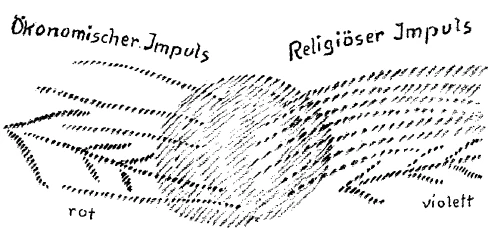
[ 15 ] And around the turn of the 19th to the 20th century, this reached a certain crisis. Things began to stall. They began to no longer proceed as they had for four centuries. And we stand and live today under the influence of this stagnation. The religious impulse has crept in like something foreign and has given rise to our spiritual life. And our economic life has arisen because it has continually undergone a process of dilution. Had America not existed, and had our economy been required to develop according to its own laws—had it not been able to continually expel what it could not use—it would not have been able to develop in Europe. That process has now stalled. Therefore, an internal solution must be found. From within, we must find a way to steer what can no longer be achieved spatially from the outside back onto the right course.
[ 16 ] This is to be achieved through the threefold social order. It is to be achieved by ensuring that what has been haphazardly intertwined is now truly organized in an organic manner. There is not just one reason for accepting the threefold structure of the social organism, but rather all manner of reasons: there are scientific reasons, economic reasons, and historical reasons; and only those who are able to survey all these different justifications can fully judge the validity of the threefold structure of the social organism.
[ 17 ] One would so much like to tell the people of today this; for these people of today suffer from a poverty of concepts that has, little by little, become truly dreadful. This poverty of concepts has truly reached the point where anyone today who has a sense for ideas finds that, in fact, only a very small set of ideas prevails in our intellectual life—ideas that can be found everywhere. Anyone who searches for ideas experiences this: He studies a work on physics; that work contains a certain set of ideas. Then, let’s say, he studies a work on geology; they find different facts, but they find exactly the same ideas. Then they study a work on biology; they find different “facts,” but they find the same ideas. They study a book on psychology that deals with the life of the soul: they find different facts, but these actually consist only of words, for the soul is, after all, known only as a collection of words. When one speaks of “will,” there is a word; we know nothing of real volition. When we speak of thinking—we know nothing of real thinking, for people think only in words these days. Nor do we know anything of feeling. The entire field of psychology today is, after all, a play on words that are jumbled together in the most varied ways: just as the stones in a kaleidoscope form different patterns, so it is with our concepts. They are jumbled together differently in our various sciences, but there is only a very small set of ideas that keep cropping up again and again, ideas that are imposed on the facts. And people do not make the effort to find the appropriate concepts for the matter at hand, to explore the appropriate ideas for the matter at hand! They simply fail to notice these things.
[ 18 ] Some time ago, a congress of radical socialists took place in a city in Central Europe. These radical socialists set out to devise a social structure for Europe. It is roughly the same social structure that you can now read about in a series of articles in the Basel-based *Vorwärts*. What is so peculiar about this social structure? People find it very ingenious; they believe it simply cannot be any other way. But it has turned out the way it has for the sole reason that it was created by people who have actually never had anything to do with real economic life, who have never come to know the true sources and driving forces of economic life. It was created by people who participated in the political life of the past decades. How did people participate in the political life of the past decades? Well, one was either a voter or an elected official. As a candidate, one was either elected in the primary election or in the runoff election. Let’s say one wasn’t elected in the primary election; by then, however, one had already spent one’s enormous campaign funds. You had organized fundraisers; that enormous sum had been raised so that you would have enough voters to get elected. Those sums had been spent. You had launched a fierce attack on your party opponent; he was a scoundrel, a villain, and a fraud—if not something even worse. Now came the runoff election. Up to this point, no party had secured a majority; now the task was to elect one of those who held a relative majority. That’s when the other tactic came into play: they had their opponent—who until then had been a scoundrel, a rascal, and a fraud—repay a third of the campaign funds they’d spent! They had it repaid, and suddenly transformed into an orator who declared: “After all, it is necessary that this man be elected!”—The one who had previously been a scoundrel, a rascal, a swindler—he now had to be elected. Isn’t that right? After all, they had gotten back a third of the campaign funds, and, driven by this interest in having recovered that third, they gradually transformed into someone who now advocated for him. For one of the two had to be elected—the other had no chance; at best, there was still the prospect of recovering that third of the campaign funds.
[ 19 ] So, you see, one had participated in this political life; one had been involved in how political administration was shaped. One had, after all, learned how to direct things from within government offices and so on—in short, one had become familiar with the entire political machinery, but didn’t have the faintest clue about economic life. The political concepts one had acquired—concepts that had, of course, become highly corrupted, but were, after all, political concepts—one simply wanted to impose them on economic life. And so, if one were to carry this out, the result would be an economic life with a purely political structure. Even today, people confuse the structure of economic life with the political structure; they are so unable to distinguish between the two, which have gradually become intertwined and merged. But it is already necessary today for an understanding of what is really the case to be spread in many, many places. People today do not want to engage with that.
[ 20 ] Now, one must certainly not believe that, under the influence of a civilization that does not observe external reality but instead tyrannizes it with a few rigidly fixed concepts, one can approach—with such a collection of concepts—that true reality which is to be sought through anthroposophically oriented spiritual science. For it is precisely through anthroposophically oriented spiritual science that true reality is to be sought. Therefore, anthroposophically oriented spiritual science must not be modeled after what was often called religious creeds in the past.
[ 21 ] You see, people suffered tremendously because of the old Theosophical Movement. What was this old Theosophical Movement, if not a desire to have a kind of “extra” religion! It did not consist of a new impulse that had emerged from European civilization itself, but consisted solely of feelings that people had also “had” in the old religious tradition. It was just that these old religious concepts, ideas, and feelings had become boring to them, and so they had turned to something else. But they were permeated by the same atmosphere that had permeated the old creeds. People wanted to be just as devout as they had been as Protestants, if they were Protestants, or as Catholics, if they were Catholics; but deep down, they did not want what they actually needed: a truly new religious impulse alongside other impulses—because the European population had become accustomed to living through a foreign, Asian-religious impulse. That is what matters. And until those things that were merely inorganically crammed together are organically interwoven, there will be no advancement of European civilization. This must be taken very seriously, and it must permeate everything that is alive in science, in economics, in religiosity, and in political life.