

The Social Question as a
Question of Consciousness
GA 191
12 October 1919, Dornach
Translated by Steiner Online Library
Sixth Lecture
[ 1 ] In these reflections, I have indicated from a wide variety of perspectives how what unfolds—and is usually understood as the history of humanity—is, in many respects, a superficial view of things. Now, in order to understand the circumstances of the present, it is particularly necessary not to harbor any illusions about this superficial view in the face of humanity’s new historical development. We must by no means assume that what applies—and what I would now like to describe as, in a sense, the final phase of historical development, the one that falls within the fifth post-Atlantean epoch—applies to the entire course of human history. We should not imagine that. But what I am about to say applies to this final phase.
[ 2 ] Socialists point out that, in reality, the entire course of human history can actually be found only in economic processes, in the processes of economic life, and in the class struggles that arise from these processes. On the basis of this world of economic facts, the superstructure would, so to speak, take shape—a superstructure that we see developing in law, in customs, in intellectual life in general, and thus also in art, religion, science, and so on. Of course, this is nonsense when applied to the entire course of human history, but one must ask: How did this nonsense come about? — It came about because, in fact, there is some truth underlying the described final phase of human development—our most recent era. Among the events that ushered in this modern era, we note the upheavals in the Earth’s development mentioned yesterday—those brought about by the discovery of America and the discovery of the sea route to the East Indies. But we also characterize this latest phase of human development by pointing to the great spiritual upheaval that took place at the beginning of modern times, which we call the Reformation.
[ 3 ] Today, it is necessary to gain a clear understanding of what this Reformation actually was. And precisely when one examines everything we prepared yesterday—which provides us with a deeper, rather than a superficial, view of history—one does indeed find that what appears to be an intellectual transition at the beginning of the modern era, the Reformation, is in fact very strongly based on something that is, at its core, of an economic nature. And from an understanding of the economic foundation of the Reformation in particular—by adopting a one-sided perspective—socialism concluded that all historical development is in fact merely the result of class struggles and economic realities.
[ 4 ] If one examines—in the light of truth, not in the light of illusion—what has happened and what underwent a metamorphosis as a result of the Reformation at the beginning of modern historical development, one must say: There has indeed been a powerful realignment of the population, a rather rapid realignment of the population at the beginning of the modern era. This restructuring of the population came about because, before the advent of the Reformation, different people—particularly in Western Europe—held land than did after the Reformation. For the leading figures, who were, so to speak, decisive for the social structure before the Reformation, lost their dominance as a result of the Reformation. Far more than one might think, all land ownership before the Reformation was, in the broadest sense, dependent on clerical rule. Before the Reformation, clerical rule was, in general, extraordinarily influential on economic conditions. Those who owned land possessed it, for the most part, on behalf of—and by delegation from—authorities connected in some way to the Church.
[ 5 ] Now, if one examines the course of history—perhaps less idealistically, but all the more accurately—one finds that, throughout almost all of Europe, the Reformation led to the old church and clerical properties being wrested from their owners and transferred to the secular rulers. This was very much the case in England; it was also very much the case in later Germany. In later Germany, a large portion of the territorial princes did indeed convert to the Reformation. But it was not everywhere—to put it mildly—a matter of enthusiasm for Luther or the other reformers; rather, it was a hunger for church property, a longing to secularize it. The vast church estates of the Middle Ages were, after all, transferred to the secular, territorial princes. In England, a large portion of those who owned land were dispossessed, expropriated, and emigrated to America. A large proportion of the immigrants to America—we pointed out yesterday, from a different perspective, what lies at the root of this—were the expropriated landowners of Europe. Thus, economic conditions were to a large extent decisive in that metamorphosis of recent historical development which is commonly referred to as the Reformation. On the surface, the matter appears roughly as follows: it is said that a new spirit must enter human souls, that the old church administration had too strongly linked the secular element with the spiritual element, and that, in general, a more spiritual path to Christ must be found, and so on. Looking a little deeper, a little less superficially, an economic realignment is taking place in the transfer of spiritual goods to secular people.
[ 6 ] This, however, is connected to a very far-reaching fact of world historical development, and one can only understand the specific facts of recent history just mentioned by looking back at the broader scope of human development. We need only look back to that phase of human development which we refer to as the Egyptian-Chaldean period—which, as you know, ended in the middle of the 8th century B.C., at which point the Greek-Latin period began, lasting roughly until the middle of the 15th century.
[ 7 ] If we go back to ancient Egyptian and ancient Chaldean cultures, we find that the actual ruling powers there were quite different from what the ruling powers later became. People today give very little thought to the great upheavals that have taken place in the course of historical development. The true ruling powers of that ancient era—which came to an end around the middle of the 8th century B.C.—were people who, in the old terminology of spiritual science, could be called “initiates.” The Egyptian pharaohs were, after all, thoroughly initiated individuals up to a certain point. They were initiated into the mysteries of cosmology and viewed what they had to do on Earth in the light of cosmology. For people today, when such things are spoken of, certain difficulties of understanding arise, for the simple reason that modern people say to themselves from within their own consciousness: “Yes, but the pharaohs—and ultimately also the so-called Chaldean initiates—did many things that are highly questionable!”—Now, one could certainly object that even modern, uninitiated rulers do many things that do not exactly correspond to the highest moral standards, but that would, of course, be an inappropriate objection here. However, it must be pointed out that beyond the sensory world there are by no means only good gods, but that there are also gods who act in a manner that is entirely contrary to the interests of human beings, as these are usually understood. Thus, one must by no means believe that a true initiate needs to act solely out of good motives. When one speaks, as I am doing now, of the pharaohs as initiates, one must simply be clear that they acted out of spiritual impulses. Spiritual impulses lived within their will. That these could sometimes be quite bad is something that no one who, in our sense, has come to know all that lay behind the sensory world in terms of divine-spiritual powers—powers of a supersensible nature—will dispute. But the true initiate—the one who could take into his will, and not merely into his consciousness, what the divine-spiritual powers bestowed—was the true ruler right up until the middle of the 8th century B.C. Then began the era of which one can say—if one strips it of all the various illusions that permeate our conventional history—that the true ruler was the priest. The secular rulers were, to a greater or lesser extent—even if they were Charlemagne—dependent on the priesthood. Much more than is commonly believed, priestly rule remained the truly decisive factor in European civilization even during the Middle Ages. It permeated everything, asserted itself in all things, and, above all, was the element that determined the social structure. And the people who owned land had, in fact, received it to a large extent as a trust from the priesthood. What soldiering was in ancient times before the middle of the 8th century B.C. was soldiering in the service of the initiated. What soldiering became during the 4th post-Atlantean epoch—the Greco-Latin epoch, from the middle of the 8th century B.C. to the middle of the 15th century A.D.—was that of mercenaries serving the priestly rule. And essentially, even undertakings such as the Crusades were, in essence, military campaigns carried out on behalf of—if I may put it that way—the priestly rule. In one way or another, what was done was connected to the priestly rule.
[ 8 ] We may therefore say: The initiate type was dominant during the Egyptian-Chaldean period, while the priestly type was dominant from the middle of the 8th century B.C. through the middle of the 15th century. From that time on, the economic type of human being became dominant in the actual course of historical development. Ultimately, names do not matter. The further one advances in human history, the less names matter. But what provided a certain foundation for dominance was the ability to intervene in economic affairs. Just as it was essential for the priest and the initiate of antiquity that these particular ruling types of people could intervene in economic conditions—though they did so from a higher perspective—so, in more recent times, the economic type of human being has, in essence, been able to intervene in everything that constitutes social structure.
[ 9 ] But this is also connected to something else. I have already hinted at this to you in relation to the initiated ruler type. The initiated ruler type acts through his will, incorporating into that will the spiritual impulses of the higher worlds. With the priest type, this is no longer the case. The priestly type, in essence, does not live a spiritual life; the priestly type lives an intellectual life. That is why, in a civilization where the priestly type predominates—in European civilization—the intellectual is the dominant, essential element.
[ 10 ] In Asia, in the Orient, it is not intellectual life but spiritual life that is essential. For even what is still considered civilization there today has fallen into a state of decadence; yet, at the very least, it is the remnant of what was once an initiated culture—a spiritual culture. When the religious impulse of the Orient was transmitted to Europe, it gave way to an intellectualistic approach on the part of the priesthood. The initiation into the true realities of the spiritual world gave way to the intellectual processing of the realities of the spiritual world—theology. Theology is the intellectual processing of the realities of the spiritual world. But this type of priest—who intellectually processed the realities of the spiritual world and proclaimed them in intellectual form, so that people actually received only an intellectual religious element—was also superseded in its true significance at the beginning of the modern era by the economic type of human being. One can actually trace, in specific phenomena, how this economic type of human being is emerging. We will speak more about this shortly.
[ 11 ] But of course, one must first ask: How is it that such significant transformations take place in the course of historical development? There is something underlying this that, in turn, makes it necessary not to stop at superficial observations of historical life, but to delve deeper. If one delves a little into what is called history today, it becomes apparent that historians actually assume that, in the spiritual development of humankind, no major change has really taken place over the course of history. Materialist thinkers believe: First, an ape—or an ape-like being—roamed the Earth; then, through all sorts of processes, albeit quite slowly—but slowness is, after all, the hallmark of modern science—this ape-like being evolved into a human being. Once the human being came into existence, he did not change significantly in terms of his states of consciousness or his spiritual constitution. Modern people perhaps imagine the ancient Egyptians as somewhat more childlike, because they were not yet as “clever,” did not yet know as much as modern people do; but in general, modern people imagine the mental state of the ancient Egyptians to be much the same as their own. Nevertheless, if we go back to the time before the 8th century B.C., this state of mind was quite, quite different from what it was later, after the middle of the 8th century B.C.
[ 12 ] If one takes the soul configuration of people today and knows only that, one cannot really imagine what lived in the soul of a person who lived before the 8th century B.C. These people were such that they still had a living connection to their previous incarnation. Unless they belonged to the Hebrew-speaking tribes—in which case it was somewhat different— but if they belonged to the broad circle of the so-called pagan peoples, what they experienced in their souls was indeed the result of previous incarnations, previous earthly lives, and they were clearly aware that what they experienced in their souls was a spiritual experience of the spiritual worlds. For such people, there was no doubt that the greatest part of who they were had not been inherited from their father and mother, but had descended from spiritual worlds and had united with what came from their father and mother. These people possessed a state of soul that was entirely grounded in spiritual culture. Consequently, their social life could also be guided and directed by those who were initiates—people who, to a certain degree, had been initiated into spiritual realities in a genuine, non-intellectual way, not merely through abstract thought. In those days, when people spoke of spiritual realities, they addressed others as if these were things with which they were thoroughly familiar. In fact, all people imagined themselves as centaurs. They imagined that their physical body had indeed arisen from physical heredity; but overlaid upon it was that which had descended from the spiritual world. Everyone knew this; everyone imagined themselves as a kind of centaur.
[ 13 ] Then came the period that begins with the 8th century B.C., roughly coinciding with the founding of Rome. During this time, the genuine spiritual connection was lost—we have, in fact, already considered this same fact from other perspectives. But a certain spiritual connection to the spiritual worlds still remained for human intelligence. Human beings no longer imagined themselves as actual centaurs, no longer in the sense that a higher spiritual being had actually descended into what had come through heredity; but human beings had a clear awareness that their intelligence, their world of thought, was not bound to their blood, was not bound to their physical body, but that it was of spiritual origin.
[ 14 ] It is difficult to understand the great philosopher Aristotle if one does not know that, in calling the highest part of the human soul the “Dianoetikon,” Aristotle was clearly aware that this highest part of the human soul—which is an intellectual one—has trickled down from spiritual-soul worlds. Aristotle knew this very well. Yes, people knew this very well even in the early days of Christianity. This awareness—that human intelligence is of divine, spiritual origin—was not lost until the 4th century A.D. It was not until the 4th century A.D. that people actually began to stop believing that the power of thought they possess within themselves trickles down from above—from the spiritual-soul worlds—at the moment of their birth. A great shift took place within the human soul. If we look back to the 1st, 2nd, and 3rd centuries A.D., we find that people indeed said to themselves: “Certainly, I was born of a father and mother, but just as I know—and have not merely pondered—that my eye sees light, so I know that my intelligence comes from the gods.” — This was a direct awareness that people possessed, like the awareness that arises from a perception. It was not until the 4th century that people increasingly came to feel: Up there, in that bony cavity—for it is indeed a cavity, as I have explained to you in various reflections—there lie the organs of intelligence, and this intelligence has something to do with heredity, with blood kinship. Only in this era, in which this transition took place from the belief in the divinity of intelligence to the physical inheritance of intelligence, could what might be called the intellectualization of the religious impulse through the priestly rule come to pass. And once intellectualization had progressed far enough, and the only view one held of intelligence was that it is bound to human physicality, the priestly rule came to an end. The priestly rule could only endure as long as people could be made to understand the old traditions regarding the divinity of intelligence. The economic type of human being emerged at that moment in world history when faith in the divinity of intelligence had faded, when people increasingly came to believe, on an emotional level, that the physical human being was essentially the bearer, the organ for the development of thought.
[ 15 ] One need only know how the priestly establishment has always fought—and indeed continues to fight to this day. Anyone familiar with Catholic theological literature, for example, knows how the priestly hierarchy still fights today—using all manner of philosophical justifications—to assert that the intellect, which resides within human beings, is something that is added to the human being. Read any random text you can get your hands on from Catholic theological literature, and you will find that this is no longer denied—something that modern people can no longer deny at all: that the other functions are bound up with the human physical body. But they want to preserve intelligence as something divine and spiritual that has nothing to do with the human and physical. For the general human consciousness, however, this is not the case. For the general human consciousness, the feeling and sense have arisen more and more that: The body is what enables one to think; it is also the foundation of intelligence. And so, more and more, human beings have come to the realization that they are, in fact, merely physical beings. And it was only under the influence of such a spiritual outlook—one based on the assumption that one is merely a physical being—that the economic type of human being could come to the fore.
[ 16 ] There are, therefore, deeper spiritual reasons why the economic type of human being has come to the fore. But it has indeed come to the fore, and this was then interpreted and exploited in a one-sided manner in socialist theories. Yet the economic type of human being has been dominant since the Reformation. That is why you can also see what spirit actually prevails in the creeds that have emerged since the Reformation. Just take an unbiased look at this spirit: On the one hand, there is secular science, which, through its technology, is meant to penetrate the external life of everyday existence and which does not want to be dependent on faith at all—after all, one must not disturb the spheres of this external science with all sorts of religious matters. Faith, on the other hand, is to be neatly kept in a separate box, as far removed as possible from the external realities of life! Science: a thing unto itself, a separate ledger; faith: a thing unto itself, a separate ledger. By no means should the two be mixed together! We want faith; we even want to be pious people—so says the economic type of person—the more pious, the better. - On Sundays, you see him walking to church as conspicuously as possible with his prayer book, certainly; but in the ledger, religion must not come into play—it has no business there, except perhaps that the first page says “With God,” but that’s just blasphemy, isn’t it! -— Don’t disturb our circles! Otherwise, one might come to realize that the Reformation was, in many respects, merely a detour to secularize and confiscate church property and claim it for the secular rulers. A German territorial prince or an English lord could not very well say: “We are ushering in a new epoch in world history by taking land away from those who previously owned it!” That is what modern socialists say: “We are expropriating the landowners!” — But people at the dawn of the modern era did not say that. They did that and shrouded the whole thing in a fog: “We are establishing a new religious creed.” People then do not know why they are actually devout. But this illusion—which they spread over the actual reasons why they are devout—does them good. This is how the economic type of human being has emerged.
[ 17 ] You see, the awareness of experiencing something spiritual within oneself has gradually been lost. That is the deeper spiritual reason behind it. If we go back even further, to before the third post-Atlantean epoch—which thus ends in the middle of the 8th century B.C. and begins in the 3rd or 4th millennium—we encounter an entirely different structure. As paradoxical as it may seem to people today, in the 4th millennium—or even the 5th millennium—there was no human being on Earth who believed that what was essential about them came from their father and mother. Back then, people still firmly believed that, in terms of their essential nature, they had descended from heaven, if I may put it that way. That was the firm belief of people. They did not see themselves as being of earthly origin; they saw themselves as being of a spiritual origin. And the Jews record the period when people began to feel themselves as physical beings, as human beings in the flesh, as the Fall, as the beginning when original sin took hold of humanity. But in reality, this original sin has overtaken humanity on several occasions. It first overtook them at the beginning of the third post-Atlantean epoch, when they attributed part of themselves to their father and mother, to their blood, and merely believed that a spiritual essence was superimposed upon them. The second time it took hold of them was when they began to regard the intellectual as merely hereditary. That was around the 4th century A.D.—the second Fall—for from then on, intellectuality was regarded as something hereditary, as something linked to physicality. And in the future, there will be other Falls.
[ 18 ] It is our task in the present to return to spirituality in a different way. To do this, we must first be able to return to a spiritual intellectuality. We must be able to connect such meaning to earthly life that, within this meaning itself, something spiritual is once again revealed. If we take, for example, the ideas presented in my *Outline of Esoteric Science*, one cannot say that the intellectuality with which they are grasped is of physical origin, for one cannot arrive at what is said there about the cosmos and about the human being through the physical intellect. This, in turn, is the re-education of humanity toward a conception of intellectuality that is spiritual. To this end, present-day humanity must be willing, first of all, to regard intellectuality itself once again as something divine and spiritual. Only then will it be possible to embark on the path back to spirituality at all. This is a task that humanity must consciously undertake: to return once more to spirituality, beginning with a spiritualization of the intellect. People must learn to think once again in such a way that this thinking is permeated by spirituality. The best way to begin is by focusing on the ethical and tracing the ethical back to moral imagination and moral intuitions, as I did in my *Philosophy of Freedom*. If one sees in morality something that—as I expressed it in *The Philosophy of Freedom*—derives its impulses directly from the spiritual world, then that is the beginning of spiritualizing the intellect. I did this cautiously and gently at first in my *Philosophy of Freedom*, because, after all, one could not really expect much from the 19th century in terms of spiritualization. But this is the path that must be taken.
[ 19 ] The economic type of human being that emerged with the Reformation actually saw its task as reducing all intellectuality to a mere matter of the body. This economic type of human being rapidly broke away, during the Reformation, from the spiritual foundation of human existence on earth. This can be clearly demonstrated by specific examples. In the early and first half of the 16th century, a man named Thomas Cromwell—to be distinguished from Oliver Cromwell—lived in England; Thomas Cromwell played a major role in introducing the principles of the Reformation to England. James I was, after all, the figure who still sought to preserve the old priestly rule, and one understands James I best when one views him as the conservative—the one who sought to preserve the old priestly rule. But these plans were, of course, thwarted by others. And among those who emerged—who were, so to speak, the first examples of the economic human being—is Thomas Cromwell. Thomas Cromwell can only be understood if one knows that he belongs to those people who, after a very short life, are reincarnated here on Earth between death and a new birth. Among the types of rulers who have emerged in more recent times, it is exceptionally common for people to have lived only a brief life in the spiritual world prior to their current earthly existence. As you know, I have often spoken here about the fact that one of the most significant phenomena in recent history is that, among the types of rulers, a selection of the worst has risen to the top. Over the years, I have told you this time and again on various occasions. Those who are actually the rulers, the governing ones, are not a selection of the best; the times have brought it about that, especially in recent times, the best have remained at the bottom, while those selected to rise to the top—namely, those in leadership positions—are in many cases not the best. It has often been a selection of the inferior. And this selection of the inferior was based, in terms of their human nature, on the fact that they lived an earthly life that was preceded by only a very short interval between their last earthly life and this one. Among many leading figures of recent times, one finds this very fact pronounced: that after a brief spiritual life, they return to Earth once again. As a result, they are scarcely imbued with the spiritual. They have absorbed few spiritual impulses in their previous life between death and a new birth. Instead, they are all the more imbued with everything that can be offered here on Earth.
[ 20 ] These were, in particular, the “economic” types of people—those with short previous spiritual lives who were completely imbued with what only the Earth as such can provide. Not that there haven’t also been people in more recent times who have gone through longer periods between death and birth—people who were relevant to the modern era—but they were pushed aside. This was the result of the fate of humanity’s historical development, the general karma of humanity.
[ 21 ] And it was against this backdrop that the recent history of humanity unfolded. It is truly lamentable to see how common it has become in recent times for people who, in terms of their inner nature, are actually much, much better to look up to far, far worse individuals as if they were special authorities. This is a widespread phenomenon. The revered authorities are truly not those who represent a selection of the better types of people. The time has simply come when we must, in an unbiased manner, cease the adulation of modern civilization and instead address the real facts without embellishment. For people must gradually accustom themselves to viewing life not only according to its outward, superficial appearance, but according to the inner configuration of the soul. And one of the facts that must be taken into account here is precisely this: that one must distinguish between those who have had a longer spiritual life between death and birth and those who have had a shorter one.
[ 22 ] One must view people from a spiritual perspective. Only this view of people from a spiritual perspective will make it possible to consciously put the social structure in order. A deeper understanding of what is necessary in social relations today can only be gained by seeking this understanding on the basis of spiritual insights.
[ 23 ] It was precisely my task during these three days to point out to you how contemporary civilization must be viewed in relation to the possible future development of humankind. You see, our Earth—as a planet with everything on it—has already entered its period of decline, its period of decadence. I have mentioned this many times before: even discerning geologists are already documenting this. One can already demonstrate purely externally, physically, through very rigorous and precise geology, that the Earth is already breaking apart, that the Earth’s upward development has ceased, that we are truly walking on crumbling fragments of the Earth. But it is not only the mineral soil that is breaking apart; everything that moves organically on the Earth is also already breaking apart, already in a state of decay. The bodies of plants, animals, and human beings, too, are no longer in a state of upward development; they are in a state of decay. We no longer possess the kind of organization that existed up until the 4th century A.D., or that existed in the time of ancient Greece. We have a decaying organization, and along with us, the Earth is in a state of decadence. The physical realm of the Earth is in a state of decadence. I first drew attention to this phenomenon many years ago during a lecture in Bonn, but these matters are usually not taken with the necessary seriousness. We are in frail bodies, but we must also consider the other side of this: Although we are in frail bodies, it is precisely from our frail bodies that spirituality develops all the more, if only we surrender ourselves to it.
[ 24 ] In the case of the ancient bodies—if I may draw a schematic illustration—the body (drawing on the left, white) was permeated everywhere by its spirituality (red); the body absorbed the spirituality everywhere. Today, our bodies are often fragile. They are fragile, they are in a state of decay, and the spiritual essence (right drawing, red) bursts forth everywhere; it is liberated from the body everywhere. If we only open ourselves to this, we can grasp the spiritual essence everywhere within our souls, precisely because of the fragility of our bodies.
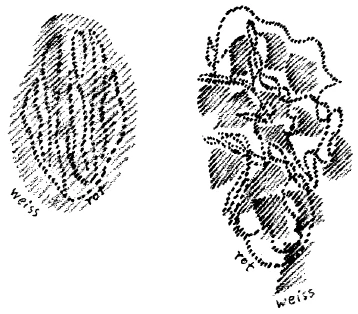
[ 25 ] But we must not rely on the physical; rather, because of our fragility, we must turn to the spiritual. Everything physical becomes fragile; everything physical on earth is already in a state of decay, and we can no longer place our hope in the physical; rather, we can only expect something from that which—if I may put it trivially—springs forth precisely because the physical is in a state of decay: from the spiritual-soul aspect.
[ 26 ] From this you can see one thing: Through our bodies, we are bound to the physical conditions of the Earth, and the conditions of the Earth are expressed socially in economic conditions; since everything is fragile, everything is in a state of decadence, economic conditions, too, are in a state of decadence in a certain sense. And anyone today who believes that economic conditions can be regenerated simply through economic measures is a fool. Basically, anyone who dreams today of an economic paradise on Earth through purely economic measures is like someone who has a corpse in front of them and wants to galvanize it, to bring it back to life. So take all the purely economic theories that exist today; let people tell you how economic life should be organized through economic life itself according to its own laws; let them tell you how to shape the relations of production, how to transition from private property to common property, and so on: all of this is based on the false belief that economic life can be regenerated from within economic life itself, whereas the truth is that everything physical—including economic life—is decaying from within. If something is decaying from within, then it can only be healed periodically; that is to say, we need a remedy for economic life, which is constantly disintegrating from within. If economic life were left to its own devices—if it were turned into what Lenin and Trotsky want to make of it—it would continually disintegrate, continually fall ill. Therefore, the healing force must also be constantly present as the counterpole to economic life: this is the independent spiritual life that stands opposite it. If you have a sick person, or someone who is constantly at risk of becoming ill, you must have a doctor constantly at their side. If you have economic life, which—due to the development of the Earth—is constantly ripe for decay through its own nature, then you need, as a counterbalance, the constant, healing inner spiritual life. That is the inner connection. It is connected to a healthy cosmogony that we develop an independent spiritual life. And without an independent spiritual life—which is a constant healing wisdom alongside economic life, which is perpetually prone to decay—humanity cannot move forward. For it is folly to want economic life to regenerate itself. One must place the healing power of an independent spiritual life alongside this economic life, and both must be bridged by a neutral legal life. We cannot possibly arrive at a proper understanding of what is necessary for the present if we are unable to recognize that the physical life of the Earth is already in decline. It is precisely because people fail to recognize this that there are so many people today who believe that all manner of means of regeneration for economic life can be conjured up from within economic life itself. Such means do not exist. The only possibility is to keep economic life continuously in motion through the spiritual life that stands independently alongside it. Only those who can perceive this mysterious connection in our lives from the standpoint of a truly modern cosmogony will fully comprehend it.
[ 27 ] Consider how serious the situation is, how one must realize that people are rushing toward ruin if they still believe today that economic life can regenerate itself, if they do not acknowledge what springs forth from fragile physical life, can become independent, and can be present as a continuous healing force. People ask: What are the remedies against revolutions? — Yes, when crises have accumulated so many impulses of destruction that they reach the threshold necessary for a revolution, then the revolution comes. For revolutions can only be counteracted by continuously and persistently applying the force that works against them. If economic life is not counterbalanced by a spiritual life that is constantly healing, then economic life will coalesce into revolutions.
[ 28 ] It is indeed necessary that the matters at hand here be taken in all their gravity, in all their weight, so that one does not believe one can play around with spiritual science. One cannot play with it. A Sunday afternoon sermon cannot be cobbled together from genuine spiritual science. The habits that people have acquired from the old religious creeds—where they seek only to cultivate an inner spiritual indulgence through all manner of teachings on reincarnation and karma—cannot be derived from these teachings if one takes them seriously. These teachings seek to intervene in life; these teachings seek to become deeds through what they themselves are. Therefore, it is not a matter of some subjective whim that what lives in spiritual science must now also take shape in all manner of social ideas; rather, it is, in essence, a matter of course. It is part of the whole. Of course, anyone who speaks of development and evolution in the modern scientific sense—and has no real idea that evolution involves first an ascent and then a decline—will not want to understand that, with regard to the Earth’s development, we are already living in a state of decline, and will seek to extract forces from what is decaying in order to bring about regeneration. That is no longer possible.
[ 29 ] What I wanted above all to convey to you through these three lectures is that the profound seriousness of spiritual science be fully understood. Spiritual science is not something to be toyed with; at most, one might water it down into all sorts of mystical sectarianism, but people are very much mistaken if they believe it is something to be toyed with. Spiritual science simply is not something to be toyed with. There is a great deal of opposition to what is advocated in this anthroposophically oriented spiritual science. Almost all those who wish to play around—I would call it “mystifying”—with the life of spiritual science will oppose it. Mysticism: mystifying. Those who want to “mystle” will ultimately not be able to come to terms with spiritual science, because they do not really want to feel the seriousness of life. That is why there are so many opponents of spiritual science, and in particular, there are many opponents who emerge from all sorts of nooks and crannies of “mystle” to become adversaries. Recently, a new offensive is said to be launching against spiritual science, because it is claimed that it has a scientific character, and that what is truly an experience of the spiritual world must arise from direct experience of the spiritual; nothing scientific, or the like, should play a role in it. A new offensive is just emerging from the very corner where we have done so much work, but from which, little by little, more and more mystical, slimy stuff is coming out, precisely in this direction. Once again, a book has now been published—albeit perhaps by a different publisher—from the Munich scene that essentially aims to represent such an initiative and is titled *Vom lebendigen Gotte* (*On the Living God*), a mystical book.
[ 30 ] To see these things in our current era of social gravity shows just how much intellectual frivolity and intellectual cynicism there is in our lives. This must be eliminated. And we must take seriously the task of drawing spiritual life out of this decaying age. We must be able to stand up boldly and impartially against the decay of the earth, for that which dies physically gives birth to what is spiritually alive. But any frivolous treatment of spiritual matters must be sensitively discerned precisely by the anthroposophically oriented spiritual scientist who truly perceives the spiritual, and nothing should find less sympathy among us than any kind of sectarianism or mysticism. For that does not penetrate into the spiritual worlds; on the contrary, it obstructs the paths to the spiritual world. But we need precisely these paths into the spiritual worlds if we are to make real progress socially as well. That is why now is the time when we should very seriously consider the most important question of life and ask: What can we do—actively do—to embrace the impulses that are truly in keeping with our times?
[ 31 ] Look, this building now stands here. It stands and waits to be taken seriously by the world—taken so seriously that people truly see: It has been consciously built into a time of decay, but in order to capture the spiritual from this decaying time. There should be no belief here that one can hold on to the old, which is ripe for decay and decadence. The belief that must prevail here is that the spiritual—which must be entirely unlike the old—will be drawn out of the rolling decay. This cannot be achieved through minor cultural transformations. The point is that we must seriously confront the necessary realization that only through great cultural impulses can we achieve what is necessary for humanity’s progress toward the future. We should consult with one another to gain the strength to truly absorb these new impulses. We must have the courage, as much as we can, to make it clear to people what it means: The Earth is in a state of decadence, and that which has survived as civilization down to the present day—to which we have become accustomed—is perishing along with it. Yet we must rescue from this decline a new spirituality that can be carried over into other worlds once the Earth has completely met its demise.
[ 32 ] To work with full awareness toward a renewal of art, science, and freedom—that is precisely what should be associated with this building. With this building, an attempt has been made to create something whose forms, in a certain way, mock the entire past. So we should indeed have the courage to grasp what should be drawn from the fact that this building stands here. We will not succeed if we continue to rely only on limited means, if we do not work to consciously present to humanity the necessity of a new spiritual culture. For that alone will be the true starting point for a new social culture. The social will no longer be derived from the economic, but will instead be able to be infused into the economic solely from the spiritual. And we must become aware that the economic type of human being has run its course, that a different type of human being must emerge— who is a world-human, who is aware that living within him is not only what is inherited from the Earth, but also what are the forces of the Sun, the Moon, and the starry heavens—the forces of the supersensible world. We should bring this to people’s awareness in forms they can understand; only then can we contribute to the true progress of humanity. Merely imparting mystical teachings serves no purpose at all. What our mysticism is must be a true spiritual life, an active spiritual life.
[ 33 ] That is what I wanted to bring to your attention today. This building in Dornach should actually be viewed in such a way that, without being immodest, we truly take it as the starting point for a great global movement that is entirely international and encompasses all areas of spiritual life. This building in Dornach should be the starting point for casting off all attachment to what is passing away and embracing the impulse of something that aims toward a true renewal of human consciousness. If we could bring something like this into the world—something that would serve as the starting point for receiving the spiritual from the decay of the physical earth—and if we could say: “We wanted to erect this monument to that starting point with this building in Dornach; we wanted to draw people’s attention to the fact that they must look toward what is intended”—if we could create something like this, then we would be fulfilling what actually lies at the heart of the impulses of anthroposophically oriented spiritual science. But we must rouse ourselves to create something that truly speaks to humanity in such a way that we draw its attention to the fact: ‘Look, what is intended here is what lies in the spirit of a genuine further development of scientific, artistic, and religious consciousness.’ If we are able to speak of this positive aspect, we will have a far greater impact than if we try to conform to everything else that others also want. We should be conscious of the need to strive for something new. If we can do that, then we will fulfill a worthy task. But in this regard, we should first speak to our souls and try to tackle the task of anthroposophy in this sense in just the right way.