

The Social Question as a
Question of Consciousness
GA 191
17 October 1919, Dornach
Translated by Steiner Online Library
Seventh Lecture
[ 1 ] Today I would like to speak to you about some fundamental insights from the science of initiation, which will then serve as a kind of foundation for what we intend to examine tomorrow and the day after tomorrow. Today we will first point out something that lies within the consciousness of every human being, but which is usually not grasped clearly enough. When we discuss such matters, we always speak from the perspective of our present time, in the style and spirit that I have often explained here: that insights are by no means valid forever and everywhere, but rather for a specific time, and even for a specific region of the Earth. Thus, certain perspectives of knowledge apply, for example, to European civilization; other perspectives apply to, let us say, the knowledge of the Orient. Now, every person knows that, with our knowledge, we find ourselves, so to speak, between two poles. Every person senses how, on the one hand, there is the knowledge we gain through sensory perception. The simple, naive person comes to know the world through their senses and even reaches a certain point of synthesis regarding what they see, what they hear, and what they perceive through their senses in general. And fundamentally, what science offers—as we now have it in the West—is nothing other than a synthesis of what presents itself to human beings through the senses.
[ 2 ] Now, surely everyone feels that there are other kinds of knowledge, and that it is impossible to be a fully realized human being—in the ordinary sense of the word as it applies to everyday life—unless one adds another kind of knowledge to the one just described. And that is the kind of knowledge that pertains to our moral life. We are not speaking merely of the ideas of natural science, through which we explain one thing or another in nature; we are speaking of moral ideas, of moral ideals that we perceive as the driving forces behind our actions, by which we allow ourselves to be guided when we wish to function in our ordinary world. And surely every person feels that with one pole of our cognitive life—sensory knowledge and its appendage, intellectual knowledge (for intellectual knowledge is merely an appendage of sensory knowledge)—we usually cannot reach up to the moral ideas. Moral ideas are there; but we cannot, for example, by engaging in the natural sciences—through the study of the plant world, the mineral world, or in any other way using our current natural sciences—find moral ideas. This is precisely the tragedy of our time: that people want to find ideas for action in the social sphere, for example, using the methods of the natural sciences. One will never be able to do that if one truly surrenders to common sense. Moral ideas exist on a different plane of life. Indeed, our lives are influenced by these two currents: the understanding of nature on the one hand, and moral understanding on the other.
[ 3 ] You know from my *Philosophy of Freedom* that the highest moral ideas we need as human beings are given to us through the grasping of moral intuitions, and that these moral ideas, once we come into possession of them, constitute the foundation of our human freedom. On the other hand, you may also know that for certain thinkers there has always been a kind of gulf between what constitutes knowledge of nature on the one hand and moral knowledge on the other. Kant’s philosophy is, after all, based on this gulf, on this chasm that it cannot quite bridge. Hence, Kant wrote a “Critique” of theoretical reason—or “pure reason,” as he calls it—in which he deals exclusively with knowledge of nature, setting forth everything he has to say on the subject. And on the other hand, he wrote a “Critique of Practical Reason,” in which he discusses moral ideas. One might say: For him, the entirety of human life springs from two entirely separate roots, which he describes in his two main “Critiques.”
[ 4 ] Of course, humanity would be in a difficult situation if there were no bridge connecting these two poles of our spiritual life. And anyone who is seriously engaged in spiritual science on the one hand, and who takes the tasks of our time seriously on the other, must ask earnestly: Where is the bridge between moral ideas and ideas about nature?
[ 5 ] Today, in order to understand this bridge, we will adopt what I would like to call the historical perspective. As you know from the various observations we have made here, the spiritual constitution of human beings in earlier times was fundamentally different from what it became in later times. The emergence of Christianity truly marks a profound turning point in the entire development of humanity. And only by understanding what actually took shape in the development of humanity with the emergence of Christianity can one truly come to terms with the nature of human beings.
[ 6 ] What lies in the past, prior to the emergence of Christianity—if we set Judaism aside, as we mentioned here just recently—is the entire scope of pagan culture. Judaism was, after all, merely a preparation for Christianity. This entire scope of pagan culture differs fundamentally from our present-day Christian culture. The further back we go, the more this pagan culture was a unified culture. It was a culture founded primarily on human wisdom. I know it is offensive to people today to be told that, in terms of wisdom, the ancients were more advanced than we are today; but that is how it was. In the ancient pagan era, there was a wisdom spread across the earth that was closer—much closer—to the very foundations of things than our knowledge today, particularly our modern natural science. And this ancient, this primeval knowledge was a very concrete knowledge; it was a knowledge that was intensely connected to the spiritual reality of things. People received something into their souls through their knowledge of the reality of things. But what was particularly distinctive about this ancient pagan wisdom was that the people who received it—as you know, people received it from the initiates through the mysteries—received it in such a way that this wisdom contained both knowledge of nature and knowledge of morality at the same time. Today, this truth—which I have just expressed and which is of extraordinary significance for the history of human development—is misunderstood simply because one cannot go back far enough in external history to the truly characteristic periods of ancient pagan wisdom. Historical knowledge does not extend far enough back to encompass the times when people, by gazing up at the stars, received from the stars that wisdom which, in its own way, on the one hand explained the course of the stars to them, but on the other hand also told them how they should conduct themselves in their actions here on Earth. Speaking somewhat figuratively—though not entirely so, but to a certain extent concretely—one could say that even the ancient Egyptian and ancient Chaldean cultures were such that people read the laws of nature in the movement of the stars, but also derived from that movement the guidelines for what they should do on Earth. The codes of the ancient Egyptian pharaohs, for example, contain regulations regarding what was to become law. It was the case that, over many centuries, it had been prophetically foretold what would later become law. But everything contained in these codes was derived from the movements of the stars. So in those ancient times, there was not an astronomy as we know it today—which consists solely of mathematical laws governing the motion of the stars or the Earth—but rather there was a science of the cosmos that was at the same time a science of morality and ethics.
[ 7 ] What is troubling about modern astrology—which has now descended to the level of amateurism—is that one no longer senses that what it presents constitutes a whole only when the laws it sets forth are accompanied by moral laws for humanity. This is something very significant, extraordinarily significant. |
[ 8 ] Now, in the course of human history, that primordial science of humankind, that primordial wisdom of humankind, was essentially lost. And this is based on the fact that certain secret schools—which, in their serious form, had actually already ceased to exist by the end of the 18th century—including certain secret schools of the West, repeatedly and time and again referred back to the lost science, the “lost Word.” Usually, later generations no longer even knew what they were supposed to understand by the term “Word” in this context. But there is a certain fact underlying this. And in Saint-Martin one can still read echoes of how, right up into the 18th century, people felt very keenly that in ancient times human beings possessed a spiritual knowledge that came to them along with their knowledge of nature—a knowledge that also encompassed their moral science—and that this had been lost, lost essentially already during the eight centuries preceding the emergence of Christianity. One might even say: Ancient Greek history is, in essence, the gradual loss of primordial wisdom.
[ 9 ] When one studies the presocratic philosophers—whom Nietzsche called the philosophers of the tragic age of the Greeks: Heraclitus, Thales, Anaximenes, Anaxagoras—I have discussed them in my *Riddles of Philosophy*, as thoroughly as one can externally address them for humanity today, since so little of their work survives in written form—one finds in these sentences, which have remained like oases in a desert, time and again, as if echoing, a great, all-encompassing knowledge and insight that existed in the ancient era of humanity. What Heraclitus says, what Thales, Anaxagoras, and Anaximenes say—all of it is, one might say, as if humanity had forgotten its primordial wisdom and were recalling individual, fragmentary statements here and there. Like fragmentary memories, these few sentences that have been handed down from Thales, Anaxagoras, and the seven Greek sages emerge.
[ 10 ] And then, in PJato, we find a kind of clear awareness of this primordial wisdom, which Aristotle had already fully transformed into external human wisdom. Among the Stoics and Epicureans, this wisdom then disappears more and more. All that remains of this ancient primordial knowledge is a legend. That was the case with the Greeks.
[ 11 ] Among the Romans—who, by nature, were a prosaic, sober people—it was even the case that they denied any sense of primordial wisdom, reducing everything to abstractions. For the development of humanity, it was necessary that the course of events be as I have just described to you with regard to primordial wisdom. Human beings could never have arrived at the development of freedom if primordial wisdom—which came to them through a form of atavistic clairvoyance—had remained in its original intensity and significance for humanity. But connected to this primordial wisdom was everything in the way of moral impulses—I would say, coming down from the heights of the gods—that could have reached humanity. That had to be preserved. The moral impulse had to be preserved for humanity.
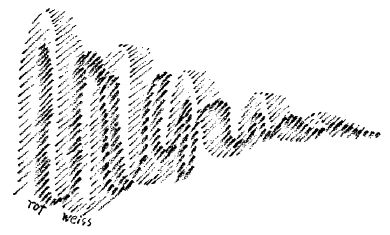
[ 12 ] And among the many things we have already had to say about the Mystery of Golgotha is this: that the divine principle which descended to Earth through the man Jesus of Nazareth carried within it the moral force that, naturally, gradually dissipated and fractured with the waning and gradual demise of the ancient primordial wisdom. It is indeed true—even if it seems paradoxical to people today—that one can say: There was an ancient primordial wisdom (see illustration on page 130, white). Connected to this ancient primordial wisdom was the moral power, the moral wisdom of humankind. This was an integral part of it (red). Now, this ancient primordial wisdom has been paralysed. It could no longer serve as the bearer of the moral impulse.
[ 13 ] This moral impulse had to be, so to speak, taken under the protection and shelter of the Mystery of Golgotha (see illustration on page 132, yellow), and its further propagation within Western civilization was that which sprang from the Mystery of Golgotha as the Christ impulse, into which was carried that which, as it were, remained as a moral essence from the ancient primordial wisdom.
[ 14 ] It is very curious to trace, let us say, what actually constitutes science and true wisdom in Western civilization well into the 8th and 9th centuries A.D. Take a look at the description of Western knowledge up through the 8th and 9th centuries A.D., as I have indicated in my *Riddles of Philosophy*. You will see: there is essentially nothing in this development that can be called knowledge in our modern sense. That only began to emerge in the mid-15th century, during the time of Galileo. What exists there in terms of knowledge is actually all tradition handed down from ancient primordial wisdom—no longer primordial wisdom intuitively grasped from within, no longer primordial wisdom experienced from within, but wisdom transmitted from the outside. I have often told you that story about Galileo—which is not an anecdote—about how Galileo struggled to convince a friend of the truth of what he claimed. The friend was accustomed, like other people of the Middle Ages who devoted themselves to the study of wisdom, to accepting what was written in Aristotle’s books or in other traditional texts. After all, everything one learned in those days was based on tradition. People passed down what was written in Aristotle’s books. And this learned friend of Galileo’s, following Aristotle, claimed that the nerves originate in the heart. Galileo tried to make it clear to him that, according to the science of empirical observation on a corpse, he had to say something else: that in humans, the nerves originate in the head, in the brain. The Aristotelian man—this Aristotelian thinker—did not believe this. So Galileo led him to the cadaver, showed him the fact that the nerves originate in the brain and not in the heart, and said that he must now believe what he saw with his own eyes. Then the man replied: “That does indeed seem to be the case; what I see with my own eyes shows that the nerves originate in the brain, but Aristotle says the opposite.” “If I have to choose between what nature shows me and what Aristotle says, then I believe Aristotle and not nature!”—This is not an anecdote; it is a true story. We are essentially experiencing the same thing, only in reverse, in our own time.
[ 15 ] You see, all the knowledge that existed was based on tradition. New knowledge didn’t emerge until the time of Galileo, with Copernicus and so on. But the moral impetus throughout those centuries was carried by the Christian impulse. It was essentially linked to religious elements. That was not the case in pagan culture. In pagan culture, people were simply aware that when they received worldly wisdom, they also received the moral impetus.
[ 16 ] By the middle of the 15th century, a new movement had emerged that broke completely with all that constituted ancient wisdom, even though it now existed only through tradition. It is extraordinarily interesting to see the fury with which those who brought forth this new knowledge—Giordano Bruno, for example—one might even say, railed against everything that constituted the old tradition of wisdom. Bruno, too, is downright frenzied when he launches into his tirade against the old memory of wisdom. Something entirely new is emerging. And one truly strays far from an understanding of human development if one is unable to view this new thing that is emerging as a beginning.
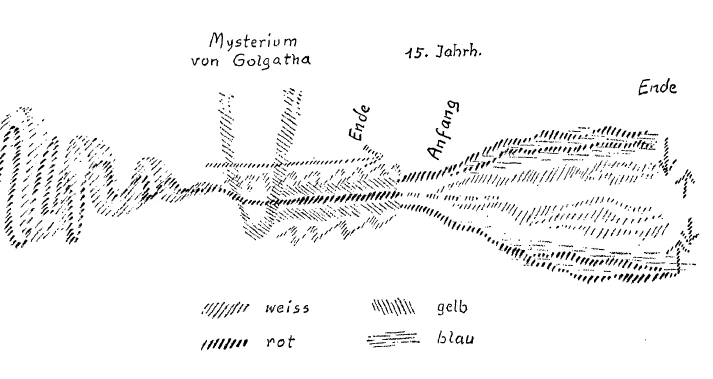
[ 17 ] You see, when we refer here to the Mystery of Golgotha (see diagram, yellow), we can say that the moral impulse continues (red). What, then, was it that was carried through the Mystery of Golgotha from an earlier time into a later time, as it was carried in this direction (arrow to the right)? It was an end. And the further and further we ascend, the more the old wisdom disappears, even in its tradition. We can say: it still ripples on like waves as tradition (white); but with the 15th century, the new emerges—a beginning.
[ 18 ] We are truly still in the very early stages of this process. The few centuries that have passed since the mid-15th century have brought us some scientific knowledge; but we are still in the very early stages of this process.
[ 19 ] But what kind of wisdom is this? Well, you see, this is a wisdom that, as it first appeared, has the peculiar characteristic that—in contrast to the old pagan wisdom—it contains no moral impulse whatsoever. No matter how much we study mineralogy, geology, physics, chemistry, biology, and so on in the spirit of this new wisdom—this “Galilean wisdom”—we will never be able to extract any moral impetus from our knowledge of nature.
[ 20 ] If people today believe they can ground the social sciences on the basis of the natural sciences, that is simply a colossal illusion. For the knowledge of nature, as we possess it today, can never yield the kind of knowledge that could serve as an ideal for human action. This knowledge of nature is still very much in its infancy, and we can only hope that, as it continues to develop further and further, it will reach a point where it, in turn, can contain moral impulses within itself. But if it were to develop only in its own way, it would not, by its very nature, be able to generate moral impulses from within itself. For this to happen, it is necessary that, alongside this natural knowledge, a new supersensible knowledge (blue) now develop. Then this supersensible knowledge will in turn be able to contain within itself the rays of moral will (red). And when the process that began in the mid-15th century comes to an end at the very end of the Earth’s existence, then that which is supersensible knowledge will be able to merge with sensory knowledge (white), and a unity will be able to emerge from this (arrows).
[ 21 ] You see, when the ancient pagan sage—or even the adherent of ancient pagan wisdom—received pagan wisdom from his initiates into the mysteries, he received from these initiates: knowledge of nature, cosmic knowledge, anthropogenesis, and moral science, which at the same time served as his moral impetus. It was one.
[ 22 ] Today, it is necessary for human beings to rise to the following recognition: On the one hand, they acquire knowledge of nature; on the other, they acquire supersensible knowledge. Knowledge of nature, taken by itself, will be devoid of moral impulses. Moral impulses will have to be derived from supersensible knowledge. And since social impulses, too, must ultimately be moral impulses, true social understanding—indeed, not even a sum of social impulses—is inconceivable unless human beings rise to supersensible knowledge.
[ 23 ] It is important for people today to realize that they must take a different path toward social knowledge than the one offered by the methods of the natural sciences. But in saying this, I am also compelled to draw your attention to a curious paradox. I have, in fact, often stated right here that the deepest truths of initiatory science appear paradoxical to ordinary everyday consciousness, seem strange, and even appear preposterous to the crude materialist. But it is necessary in our time to become acquainted with these truths, which today often seem paradoxical. For even in our time, it remains true that what seems like folly to human beings is wisdom before God. It could do no harm if this biblical saying were given a little consideration by those who today either dismiss anthroposophy with a smirk of arrogance or harshly criticize it. For they might consider that perhaps what they regard as folly could be wisdom before the gods. It would actually do some people—and “some” here means a great many—a world of good, especially those who go to church with their prayer books and rail against anthroposophy, to focus less on their arrogant creed and more on looking into what the Christian creed truly contains. In our time, it is indeed necessary to familiarize oneself with certain things that appear paradoxical.
[ 24 ] For example, two things are possible today. One can familiarize oneself with the natural sciences of our time—I want to present these two things rather bluntly today, as I am about to characterize them. One can, for example, absorb what the sciences of chemistry and physics have to offer today, as well as what the science of biology has to offer. One can study diligently and assiduously what has emerged from so-called Darwinism as a history of evolution. By studying all of this, one will be able to become a materialist in terms of one’s epistemological outlook. One will be able to become a materialist—certainly, that cannot be denied. And because people today, I would say, are so quick to pass judgment, they simply become materialistic when they are completely absorbed, in accordance with the intentions of some of their contemporaries, in the external natural sciences. But one can also do something else. One can direct one’s attention not only to what physics, chemistry, mineralogy, botany, zoology, and biology offer—what these sciences teach—but also to what one does in the physics lab and in experimentation. One can pay attention to how one behaves in the chemistry lab and what one does there; one can pay attention to how one examines plants and studies animals in their development.
[ 25 ] Goethe’s knowledge of nature is based, in particular, on the fact that he devoted a great deal of attention to how others arrived at their knowledge. It is precisely this—his deep engagement with the way others arrive at their knowledge—that constitutes the greatness of Goethe. And it is very, very significant to truly study the real spirit of one of Goethe’s treatises, such as “The Experiment as Mediator Between Object and Subject.” There one sees how attentively Goethe followed the handling of natural phenomena. What one might call the method of research, he followed attentively—very attentively indeed. If you read my “Introductions to Goethe’s Scientific Writings,” you will see what magnificent results Goethe achieved through this pursuit of the scientific method. In a certain sense, one can then build upon what Goethe did to advance the achievements of natural science in the 19th century and into the 20th century—something Goethe himself was no longer able to do.
[ 26 ] So I say: two things are possible. Let’s establish that first. One can either stop at the results provided by the natural sciences, or one can examine how one behaves in order to arrive at these scientific results. Let us keep in mind what we have said regarding the understanding of nature. Let us now consider the human quest for knowledge from a different perspective. You know that, in addition to the natural sciences, there is also spiritual knowledge—that, for example, one can pursue cosmology, anthropology (as anthroposophy), and the study of the human being in such a way that it leads to results like those I have described, say, in my *Outline of Esoteric Science*. There we have positive insights that point to the spiritual world. Just as one gains positive insights in the natural sciences—in mineralogy, geology, and so on—so too do we have positive insights that relate to the spiritual world. It was particularly important to me, in the course of our anthroposophical movement, to disseminate such positive insights into the spiritual world in the various books I have written. However, one can also approach this in such a way that one focuses primarily not merely on arriving at these insights, but on examining the manner in which human beings arrive at them; how a person describes them, how a person moves from external observation to internal observation, and how they arrive at higher spiritual insight not only through scientific research in the laboratory, the physics laboratory, the clinic, or the observatory, but also through their inner spiritual development along a mystical path. This would be analogous to examining the scientific method, the procedures, and the way in which things are done. So here, too, there is this twofold aspect: looking at the results and looking at the way in which one arrives at these results through one’s inner spiritual development.
[ 27 ] Now let us hypothetically consider something that seems somewhat paradoxical simply by virtue of its assumption. Let us suppose that someone in the natural sciences were to engage, much like Goethe, primarily in the pursuit of scientific methods—that person would certainly not become a materialist; rather, they would surely embrace a spiritual worldview. In more recent times, a sure way to overcome materialism is to gain insight into the nature of scientific research. And people become materialists in the field of natural science precisely because they either do not concern themselves at all with the nature of their research, or do so only to a limited extent. They stop at the results—at what the clinic, the laboratory, or the observatory yields. They do not move on to Goetheanism, to the examination of the nature of scientific inquiry; for whoever allows the scientific way of viewing the world—of working with things to arrive at knowledge—to take effect upon them will, at the very least, become an idealist, but probably a spiritualist, if they only go far enough.
[ 28 ] If one now tries to avoid arriving at positive results in spiritual science, if one finds it tedious to deal with the details of spiritual science and wants only to have described over and over again how the human soul becomes mystical—in other words, if one focuses one’s attention primarily on the methods for attaining the spiritual—then this is in reality the greatest temptation to become materialistic. The greatest temptation to become materialistic is to refuse to engage with the concrete findings of spiritual science and to emphasize, over and over again, only mystical inquiry, mystical deepening of the soul, and the method of entering the spiritual world.
[ 29 ] You see, this is a paradoxical situation. Anyone who observes the natural sciences and scientific research becomes a spiritualist; anyone who spurns the pursuit of true spiritual insights and speaks only of mysticism—that is, of the methods used to attain spiritual insights—is exposed to the great temptation of becoming, all the more so, a materialist. These are things one must know today. One cannot do without this knowledge. For, you see, today there are monist societies; there, the people who set themselves up as leaders in such societies propagate a superficial worldview. They condense the external, materialistic findings of natural science into a superficial worldview. This appeals to people of today who do not want to exert much effort, who would rather go to the movies than do anything else, and who therefore prefer a kind of “movie science”—for that is what materialism is—rather than what must be worked out inwardly. These leaders of the monist associations thus offer a superficial form of materialism. Certainly, they are a nuisance, for they spread errors. It is not good to let them rise to prominence, for they fill people’s heads with materialistic nonsense. But they are the less dangerous ones, for they are, for the most part, honest. This honesty does not, of course, protect them from spreading errors, but at least they are mostly simply honest, and their errors will be overcome. They will have only temporary significance.
[ 30 ] But there are others who refuse—systematically and knowingly—to guide people toward the concrete, positive results of spiritual science. Indeed, they stoke the aversion that exists today—an aversion born of a certain complacency—among people to engage with the concrete, positive results of spiritual science. They know that things like those found in my *Secret Science*—which one must study for a few years to truly grasp—are not convenient for people today, who, while they send their son to university or college if he is to become a chemist, but who assumes that, if he is to understand heaven and earth and conquer them spiritually, he must do so in the blink of an eye—at least in a single evening—and who demands that every lecture on the supersensible worlds provide him with the entire sum of worldly wisdom. People find the concrete results of positive spiritual research inconvenient. And certain individuals living today exploit this human tendency, convincing people that such things are unnecessary, that there is no need to concern oneself with specific, concrete spiritual facts. They say: “Oh, what are people talking about—higher hierarchies that one must first get to know? What are they talking about—Saturn, the Sun, the Moon, Earth, Jupiter, Venus, Vulcan, and so on?” You don’t need any of that! — People are told: If you just delve deeply enough within yourselves, if you cultivate your soul in a truly mystical way, then you will reach God within your own being. — People are told this, and given such general hints about the relationship between the material world and the supersensible world. They stoke people’s aversion to penetrating into concrete spiritual worlds. And why do they do this? Because they ostensibly want to spread a spiritual mindset; but in reality, they want something else: they want, above all, to foster materialism in this way. That is why the leaders of the monist societies are the least harmful. Those who promote mysticism today and constantly speak to people about all manner of mysticism are often the true, the subtle cultivators of materialism. They persuade people of some path that leads into the spiritual worlds, avoid speaking in concrete terms, speak mainly in generalities, and will certainly ensure that, by the third generation, the world will be thoroughly materialized if they succeed. The surer and more subtle path into materialism today is often to pass on mysticism to people who refuse to engage with positive, spiritual-scientific findings. And much of what appears today in the realm of so-called spiritual literature is a far greater promoter of materialism than, for example, Ernst Haeckel’s books.
[ 31 ] People today find such things uncomfortable to hear because, by presenting them with such ideas, one is appealing strongly to their power of discernment. But people today do not want to have their power of discernment challenged. People would much rather have their inner souls aroused by all sorts of mystical nonsense. That is why so much opposition arises precisely against those endeavors that are sincere about spiritual life today, as they refuse to approach people through general “mysticism.” Anyone who brings true spiritual science encounters opposition. For there are indeed numerous people and communities today who under no circumstances want true spiritual elevation to come to humanity, and who exploit the fact that, when one generally speaks to people in mystical terms, one is quite certainly fostering materialism. They exploit this fact. That is why they fight tooth and nail against the honest paths that are meant to lead into spiritual science.
[ 32 ] I have thus pointed out to you the rich body of literature that exists today. In fact, the situation today is such that anyone who picks up a mystical book, whatever its nature, must rely heavily on their own power of discernment. This is absolutely necessary. Therefore, one must not be misled by the fact that much of the mystical writing appearing today is easy to understand. Of course, it is easy for people to understand when, for example, they are told: You need only look very deeply within yourself; then a God lives within you—your God—whom you can find only by following your own path. No one else can show you this path, for everyone else speaks of a different God. — You will find this presented in an extraordinarily alluring and seductive way in many books today. I urge you most earnestly to take these things to heart. For what our anthroposophical movement aims to achieve can only be attained if you form at least a small group willing to strive for the discernment I have described. It would be disastrous for humanity if people did not summon the will to develop this discernment. One must stand firm even today if one wishes to remain steadfast amid the confusion and chaos of our times. One may often ask oneself today what the actual causes of so much confusion among humanity are. But one can almost grasp these causes. They lie in small facts. One must simply be able to judge these small facts correctly.
[ 33 ] I would like to conclude by sharing a small fact with you that came to my attention just a few hours ago, and which is quite apt for shedding some light on the state of mind of people today. My publisher in Leipzig, Altmann, wrote to me—I received the letter a few hours ago; I don’t know what the situation is otherwise—that a sharp, critical article—which is certainly permitted, isn’t it! — has appeared in a theosophical journal in Leipzig directed against my anthroposophy; a scathing article in the very same issue that also contains my *Soul Calendar* and my *Appeal to Civilized Humanity*, so that the verses of the *Soul Calendar* “by Rudolf Steiner” my “Appeal to the German People and the Civilized World,” and following that, an attack article: “Rudolf Steiner’s Appeal to the Instinct of Mediocrity”—as a characterization of contemporary anthroposophy.
[ 34 ] You see, in such things, at least some aspect of the constitution of the modern human soul becomes apparent. There, it only comes to light in a grotesque form. But it is difficult to see immediately, in its many guises, where it is present everywhere. All sorts of grotesque contradictions—these are not limited to such somewhat unsanitary places, but are also very much present in human life today. And today it is necessary to truly force oneself to clarity—to, I would say, razor-sharp clarity—if one wants to stand firm. That is what matters.