

The Social Question as a
Question of Consciousness
GA 191
18 October 1919, Dornach
Translated by Steiner Online Library
Eighth Lecture
[ 1 ] We have undertaken a whole series of reflections that have essentially focused on showing how a restoration of our social and other conditions of human coexistence can only be brought about when people are moved from within by ways of thinking other than those that have, so to speak, come to prominence over the course of the last three to four centuries. Among the influences that have been particularly significant in bringing about such ways of thinking—which must no longer dominate people—the scientific way of thinking has played a special role. It is difficult to speak entirely impartially today about this scientific way of thinking, for the simple reason that it is an indisputable fact that this scientific way of thinking has fostered great and tremendous progress for humanity. One must, however, be clear that it is precisely these modern advances that have diminished the very spiritual life of human beings. Gradually, things have come to pass in such a way that progress has been made primarily in those areas of human knowledge that could then be applied to external technology. And the rest of cultural life, too, has been shaped by this tendency to constantly orient human thinking and human imagination toward how it can be applied in external technology.
[ 2 ] It would be entirely wrong to believe that this assertion applies only to those aspects of modern intellectual life that are dependent on the scientific way of thinking. That is not the intention here; rather, the point is that the entire way of thinking of modern humanity—insofar as old ideas and elements have not been inherited into this thinking—is of the nature that has been and continues to be expressed, in its most extreme form, in scientific thinking. It is not merely those people who are directly influenced by the natural sciences who think scientifically today. One can even say, somewhat paradoxically, that those people who are directly influenced by the natural sciences are the very ones who think the least in the sense intended here. — It is simply that the general way of thinking among people has found expression in a particularly characteristic form in the natural sciences, so that, in a sense, the natural sciences best reveal how modern humanity thinks. We have spoken repeatedly about these influences of the mode of thought that has found its particular, characteristic manifestation in the natural sciences.
[ 3 ] Now I would like to point out a particular peculiarity that is inherent in our thinking, our entire way of imagining things, and indeed our modern inner life as a whole, precisely because so much of the scientific impulse is present in this inner life. This peculiarity consists in the fact that we, as modern people, have in a certain sense forgotten how to observe things impartially. People believe that they observe things impartially; but they do not. Even our school education today is such that it instills in people a vast number of preconceived notions, which color our pure perception of things. We do not actually have a pure perception of things at present.
[ 4 ] One might ask: Shouldn’t the particularly harmful aspect of the fact that we do not have a clear perception of things be especially evident in scientific research, in the natural sciences? — One would certainly think so. But upon closer inspection, one notices something else as well. Science protects itself from the devastating and pernicious effects of this inability to see relationships clearly by directing its attention more and more solely to the external sensory world—to what is given to the external senses. The external senses, however, are not guided by preconceived notions, and so they continually correct what arises from preconceived opinions and notions—namely, from preconceived views. In this way, observation continually corrects what a person brings from within themselves into their perception of things. That is why, when scientific observations are made, one does not notice that all manner of preconceived views are also brought into the process. But they are brought in nonetheless. And anyone who then considers, in context, what is produced by the natural sciences will find that these very preconceived views are indeed carried into the entire scientific perspective.
[ 5 ] But the particularly harmful aspect of this inability to see anymore becomes especially apparent when people today are asked to reflect on social conditions. In such cases, the facts do not in the least correct the preconceived notions that people bring to bear on those facts. And so, little by little, we have actually reached a point where, with regard to the social facts of life, one can ultimately claim whatever one wishes. Today, in fact, you will find all manner of opinions represented. On the one hand, you will find the view that true social reality consists solely of economic processes, that all spiritual life is merely a kind of superstructure, a kind of smoke that rises or is erected above the economic facts; that is one extreme. The other extreme is this: Since people today have little concept of the real spiritual forces at work in the world, they speak of the prevailing, abstract ideas—ideas of things and so on—and claim that these ideas shape—perhaps through human beings, but they do shape—what constitutes external economic and other realities.
[ 6 ] As you can see, these are two opposing views. The task now is to prove one view and the other. Today, one can present entirely valid, irrefutable arguments for both views—arguments that are equally sound for one view as for the other. If someone were to come forward today and claim that all events are in fact governed by the spirit, by ideas, they could prove it. And another person can come forward and say: What you are proving there is pure fantasy; in reality, all ideas are merely reflections, merely the superstructure of what are economic facts. — He can refute what the other person says in the most elegant way; he can prove his case and the other’s. The arguments are equally sound in both cases.
[ 7 ] This is a phenomenon that is actually far too little appreciated in the intellectual life of our time. People today divide themselves into parties or groups and advocate some maxim or program. They are convinced of this maxim, they are convinced of this program, and they can prove it. The others advocate a completely different maxim, a completely different program; they, too, can prove it, and one cannot say that one side has worse reasons or the other better reasons for its conviction. This is a phenomenon of public life that really ought to be noted, for it is the most characteristic phenomenon of our time. After all, this phenomenon ultimately leads to the most antisocial facts and sentiments. For if one is convinced of a certain maxim and knows the good reasons for it, one regards anyone with a different conviction as a fool, a scoundrel, or some kind of dishonest person. And the other person—who may have the same good reasons, or equally good reasons—in turn regards the first as a fool, a scoundrel, or a dishonest person. The fact that people fail to see this reality for what it is is, in a certain sense, the tragedy of our times. But people today are so inclined that they believe what applies to the human soul today has always been true. And as soon as you draw someone’s attention to this phenomenon today, you can foresee with considerable certainty that they will then come and say: “Yes, what you’re saying—that all opinions prove themselves alongside one another—has always been the case in the development of humanity.” —If only people were willing to educate themselves even a little about the actual development of humanity, they would not make such a claim; for in truth, it has not always been so; well-proven opinions, maxims, and programs have not stood in such open opposition to one another as they do today. For today it is very easy to prove things. Today, if one is as clever as certain left-wing socialists, one can prove Marxism quite clearly and unambiguously; and one can prove, quite clearly and unambiguously—if one is merely willing to take a different standpoint—that Marxism is utter nonsense. Today, it is simply very, very easy to prove things; one should be perfectly clear about that.
[ 8 ] This ability to prove things is already being instilled in children today. But therein lies something extraordinarily sad for our present age: that everything can be proven so clearly and strictly, and that one can therefore be so easily convinced of a matter. For of all the ways to be convinced of something, the easiest is to prove it in the modern sense. There is no easier way to acquire a conviction today than to prove that conviction. It is precisely through this ability to prove that people have completely lost the sense—the true sense—that convictions must be fought for and earned in life, that overcoming obstacles is necessary if conviction is to truly take root in the soul.
[ 9 ] Where does this fact come from—this fact that has such a profound impact on our entire lives, yet which we can prove so easily? It stems from the fact that we are accustomed to thinking only very superficially. People today think only at the surface of things; they make no effort to penetrate very deeply into them. And the more superficially one thinks, the easier it is to prove things. It is extremely important to realize this. The more superficial the concepts are—and on the surface of things, all concepts become superficial and abstract—the better these concepts seem to serve as grounds for proving what one wishes to believe and accept from entirely different, deeply unconscious underlying motives—motives arising from feelings, volitional impulses, and the like. Our entire party life should one day be studied and described from the perspective that has just been outlined here before you.
[ 10 ] What can least be achieved under the influence of this superficial orientation is a true understanding of the human being. That is why so many people today are calling for our thinking to finally deepen in such a way that humanity can advance toward self-knowledge—that is, toward an understanding of its very nature. How many writings, lectures, teachings, and campaign speeches already speak today of this necessary self-knowledge! But one must first lay the foundation for such a possible self-knowledge! It cannot be attained from just any starting point. And what is necessary to move beyond the misery of proving things is to learn to see impartially, to learn to see things truly and simply as they are in external life. For a healthy sensibility and a healthy perspective, it is especially necessary that we learn to see things as they are; for that is what we have forgotten most of all. We prove how things ought to be; but we do not look at them in reality as they are, because observing them is, of course, more inconvenient than proving that things are this way or that way. One can only arrive at certain assertions—made today, for example, in the social sphere—by proving them. But if one maintains an unbiased view of reality, one cannot arrive at such assertions. Thus, what matters above all else is genuine observation—truly seeing things as they are.
[ 11 ] If you read Goethe’s scientific writings, as well as his writings on art, you will see how, even in his own time, he tried with all his might to emphasize the importance of unbiased observation. He saw how all the sciences operate on the basis of concepts that must be proven. He regarded this as something that must be overcome above all else, and his primary goal was to ensure that people truly come to know phenomena, appearances, and facts in their original meaning—to know them as they are. It has been of so little use that the very field in which Goethe made a special effort to let the facts speak for themselves—the field of color theory—remains to this day one in which Goethe’s right to have a say on the matter is entirely disputed. In particular, however, it is necessary for human understanding to arrive at a true seeing of the facts of life, of subjective life. People today, for example, talk a great deal about what is external to a person and what is internal. I believe that if you were to ask many people today: “You see the color red, you hear this or that sound, you perceive this or that in the external world—is that internal or external?”—they would reply: “What the senses perceive is the external!” —Then they’ll point to their inner self: that, they’ll say, is the opposite of the external. Now ask the person if they’re clear about what kind of contrast there is between the external and the internal. They’ll almost certainly tell you: “Yes, I’m perfectly clear on that; I know exactly: What the senses perceive is the external, and what is inside, what belongs to the person themselves, that is the internal.” But if you then press further with your questions and say to them: “Look, you say about the external: ‘The grass is green, the sky is blue, the sun is rising,’ and so on—you describe what you observe and list it in detail—fine. But describe to me just as specifically what you have inside, what you call your inner self!”—Try, just once, to get any clear answer from the majority of people today—an answer based on concrete facts through which a person describes their inner self to you. They delude themselves into thinking they know this inner world quite well in contrast to the outer world; but if you probe a little deeper and say to them: “Describe your inner world to me just as you describe the outer world!”—then you’ll see that there isn’t much substance to this understanding of the inner world. And even if a person does actually get around to describing this inner world, it turns out to be nothing other than a reflection of the outer world—that which has developed from the outer world, preserved at most in memory, faded in memory. But what the person describes to you is not much different from the outer world. After all, as a person of today, they can usually tell you nothing more about their inner world than that the grass is green and the sky is blue; at most, they will tell you what they feel when they see the blue sky, what they feel when they see the green grass, and so on, but a person today will not easily describe to you a real contrast and a relationship between the external and the internal.
[ 12 ] But this has a major consequence. It means that people today are unable to grasp—even superficially—the contrast between the external and the internal as it relates to human beings in any meaningful way. For you see, from its current perspective, natural science endeavors to examine the organs that are supposed to be the vehicles of inner processes. And when one considers what is being demonstrated—without actually seeing it at all—from today’s perspective, one will say: Well, the table is on the outside; the inner life is on the inside. — And so one points to one’s own inner being and thinks, for example, particularly in the natural sciences, that the interior of the skull is the inner being of the human being. One now transfers the ideas—gained vaguely through sight—to the human body as well and says: Somewhere in there, behind the eye, that is the inner being (see drawing). — Even if some people, when they want to grasp more precise concepts, begin to pick apart the ideas presented to them, unconsciously they still think: There, at the tip of my finger, that is the outside, and in there, behind the eye, that is the inside. — But the fact that people speak this way—and especially that they draw this conclusion regarding the physical organs—stems solely from imprecise perception. For in fact, everything that you are justified in calling your “inner self” is precisely what you experience in the outer world, in the so-called outer world. You are constantly in contact with the external world, and what you seem to experience internally, you experience together with the entire vast external world.
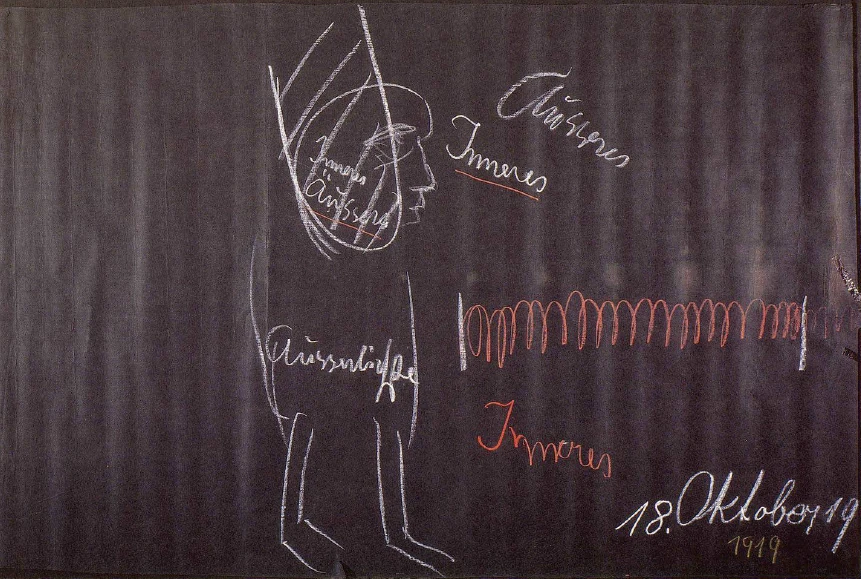
[ 13 ] In one of the “Eight Meditations,” — you can read about it there — I pointed out how human beings, by observing the external world, actually grow ever closer to that external world, and that it is entirely unjustified to distinguish between the external and the internal with regard to what we experience in the external world. What lies within our sphere of consciousness—we could, in truth, only describe it as our inner self if we were truly expressing what we see. But that is precisely our inner self. This is, of course, an uncomfortable notion for some mystics, for they place great emphasis on deepening one’s inner life. But this inward immersion is usually nothing more than labeling certain physical perceptions of the external world as “inner” and even renaming them the “divine inner self” and the like. These are favorite notions borrowed from the external world. What one can see impartially—and what is usually described as the “external”—should actually be called the “inner.” In a sense, a person is inside their own inner self right in front of their face. After all, we are actually much more at home—let’s say—at this very moment, as you all sit here in this hall, than in your so-called “inner self,” especially if you refer to what is inside the skull behind the eye as this “inner self.” For no matter how you may think about this “inner self,” apart from the few terms—which are actually quite sparse—that you have picked up from anatomy or physiology, you know terribly little about what lies behind your eyes or inside your skull. And if you ask yourself: What is more “inner” to me—what is here in this hall around me, or what is behind my skull?—you will tell yourself: Without a doubt, what is in the hall around me is more “inner” to me than what is behind my skull. — In any case, your inner life at this very moment is much more affected by what appears to be the external world in this hall than by what is going on inside your skull. What is going on inside your skull is very external to you; it is something that is not really inside you at all. And if you describe what you see objectively, you must say: The external is actually the internal, and the internal is, for human consciousness, very much an external.
[ 14 ] Now you might say: These are far-fetched concepts. — First of all, it is not the case that they are far-fetched concepts; rather, they are concepts that arise from the observation of what is actually perceived, as opposed to what is theoretically demonstrated or proven. It is what is actually perceived, what is actually seen. It is that which is immediately present to consciousness, and which one would regard as correct if one were to simply ascertain what is actually present to consciousness, and if one did not construct the matter through preconceived notions. That is, first of all, what must be said. But this has a significant consequence. As long as you hold the belief that what is out there is “external” and what is inside is “internal,” you cannot possibly arrive at what I always call “understanding the facts of spiritual science through common sense”; for the facts of spiritual science can only be understood if one takes an unbiased perspective as a starting point. Then, however, one can grasp them—one can grasp them long before one ascends in any way to clairvoyant perceptions. But with the convoluted concepts of everyday life today, it is of course very difficult to grasp what the truth is.
[ 15 ] The fact that we see the external world—what we usually call the external world—the way we do, and that it also encompasses our correctly perceived and defined inner world, stems from our senses; it has to do with the nature of our senses. Through our senses, we live in the immediate present. And we experience what is happening around us in the present through our senses. Our senses essentially make us participants in the present. But while we are absorbed in the external world, our sensory perceptions give rise to our concepts, which we then carry forward in our memory. We remember afterward what we have experienced as participants in the present. We carry that with us. And these are, in essence, our concepts. People’s concepts are mostly memories of what they have taken from the so-called external world. But these perceptions, these concepts, and these ideas are conveyed—not generated, but conveyed—by what is otherwise called the inner world, which we have now come to know as the external world. Through that—which you actually know nothing about—which lies behind your eye, through that, perceptions and concepts are conveyed. Certainly, that is definitely the case. These perceptions and concepts are conveyed through it. But what is actually going on inside this human head?
[ 16 ] If one observes what is actually taking place within the human mind, one cannot say: To the extent that a person thinks, to the extent that a person imagines, he is—just as when he perceives with his senses—a participant in the events of the present. — For as a thinker, he is not; rather, as we think, what we did as an activity before birth—or rather, before conception—continues to have an effect within our minds. That is to say, what is happening inside there (see drawing)—when you imagine—is not an activity you perform by virtue of being a present-day human being; rather, you perform this activity because the activity you carried out in the supersensible world between death and a new birth—or conception—continues to resonate within you.
[ 17 ] You are a person of the present only insofar as you perceive through your senses; by opening your senses to the external world, you perceive the present and live as a person of the present in relation to the external present. But the moment you begin to think, what enters your skull is not what you are as a human being in the present; rather, what enters your skull is the echo of what you were in the spiritual world, in the supersensible world, before birth or, more precisely, before conception. If you want to visualize this, you can quite easily imagine it this way: I strike a note; this note continues to ring out long after I have stopped striking it. Now imagine that, throughout the entire period between your last death and this birth, you have been engaged in some activity in the spiritual world, which I schematically denote as shown here (see diagram, red). This activity continues to resonate; and you carry out this resonating activity by thinking as a present-day human being. You are not carrying out an activity of the present-day human being simply by thinking now, but rather the activity you carried out in the supersensible world between your last death and your present birth continues to resonate.
[ 18 ] Only as a sensory being are you a being of the present. As a thinking being, you engage in an activity that is the reverberation of what you did before your birth in the supersensory world. It is simply not true that, by thinking, we “engage in an activity that originates in the present.” If you examine the present—what is inside your skull—scientifically, you will of course find only material things, because what is at work inside your skull besides the material is pre-birth and merely resonates. The living proof for those who can see clearly is the fact that human beings not only come from the supersensible world, but even now, while living here, continue to live out what they have done in the supersensible world.
[ 19 ] If you imagine that you have experienced intense pain here in this physical world, a pain that continues to resonate within you, that is the aftereffect of pain that is no longer caused by actual events. Thus, your thinking in the present is the echo, the lingering resonance of what you experienced in a much more intense way before you were conceived here for the sensory world.
[ 20 ] Thus, it is only through sensory perception that we are people of the present. If we were merely people of the present, we would never think, for thinking is not granted to us simply because we were born into the physical world, but rather because we are able to let the activity we exercised in the spiritual world before birth—or rather, before conception—resonate within us, and because we apply this activity to what unfolds around us here through our senses.
[ 21 ] One will never understand this fact if one proceeds from the ordinary concepts of “exterior” and “interior,” and one will least of all understand the true reality expressed in the human being if one proceeds from that foolish mysticism that dominates so many minds today and which says: “There, within, there is something to be sought that is the human supersensible.” — What is to be sought is the pre-birth stage: You must not point inward by pointing beyond the external sensory world; you must point to the time you lived through before your conception and before your birth; you must step out of this present human being into the pre-present human being—then you enter into the true supersensible. — That is what matters. Because people are unwilling to work their way toward this sound concept, they speak in words that actually have no content—about all sorts of divine inner life or the like. The inner life that people seek in this present human being should instead be sought in what existed before we were conceived for this life.
[ 22 ] And when we act—when our will is translated into action? Let’s take the simplest action: we walk around the room; that is an action, isn’t it? At first, we see ourselves walking around. Humans have no awareness of how the will is connected to our walking, just as they have no awareness in ordinary life of what they experience while asleep. A person does indeed experience themselves as sleeping. Outwardly, they see themselves just as they see the color blue, or a tree, or the stars—including what this physical individual is doing as it walks around. They observe themselves. They know nothing of how they will. They only know that there is someone walking around who is themselves. And because they are compelled to identify themselves with the one walking around, they say: “I am walking around.” But how this volition is connected to this walking around—there can be no question of a person in ordinary consciousness knowing anything about it at all.
[ 23 ] Well, this, in turn, is very closely related to what is usually called an “exterior,” and what is actually an “interior.” When you walk around—that is, when you move your legs—you see how you move your legs (see drawing on page 158). You see the guy walking around and can tell what he wants. You see this! external process. But here you can actually see much more clearly that it is in fact a human inner process, because—even if you cannot see how it’s connected—you are putting your will into this walking around. This walking around is actually a part of him. You can see this more clearly here than in the sensory world; so that you can more easily call this walking an inner process than you can with the content of the sensory world. When it comes to what moves from willing to action, you can more easily see that it is an inner process.
[ 24 ] Of course, this, in turn, does not sit well with contemporary mystics, who declare external action to be an external matter and who say that one must penetrate to the divine human being within, who is the truly real human being, and so on. But just as we have here (see illustration on page 158, top) an “inner” aspect in sensory perception and an “outer” aspect in the so-called “interior” of the human head, so too do we have, in contrast to this “inner” aspect (illustration below), that which constitutes the “limb-human.”
[ 25 ] And now we come to this strange notion, which, admittedly, does not align very well with what can be proven today, but which, strangely enough, is actually correct if one looks at the matter with an open mind. I do believe, however, that the current state of the human soul is such—forgive me, I must address these matters as well—that many of today’s philistines, and there are quite a few of them, believe that the region of the cosmos extending below their diaphragm has a great deal to do with their inner being. That is what people call something that has to do with their inner being. Well, in truth, this is the outermost aspect of human consciousness within the human being. We can say that if we call this (drawing above) the “outer,” then we can call that which lies below the diaphragm the outermost aspect of the human being (drawing below). What lies below the diaphragm—the human abdomen—is the very, very outermost part of a human being. Every tree, every stone that we see with our eyes is closer to us inwardly than our own abdomen. That is the very, very outermost part. Our true inner self consists of sensory perceptions—that which we perceive as our actions. The contents of the mind are already external, and the outermost part is that which lies below the human chest. This is the true recognition of that which can be seen. And it can be seen.
[ 26 ] You see, this, in turn, has a very specific meaning. Just think about it: ever since we’ve been practicing anthroposophy, we’ve always said that when a person is awake, their “I” and their astral body are within the physical and etheric bodies. — That is correct. But when a person is asleep—from the moment they fall asleep until they wake up—their “I” and their astral body are outside the physical and etheric bodies. I have, however, pointed out on several occasions what this “outside” mainly consists of. This “outside” consists in the fact that what is normally located in the head—the “I” and the astral body—submerges into what lies below the diaphragm. You can even—I would say—have empirical proof of this: you dream of the most beautiful snakes because you have just awakened from your sojourn in your own lower abdomen, where you perceived your intestines. You dream this memory of perceiving your intestines as the most beautiful snake dream. — Thus, when we speak in terms of human conditions, the external and the internal only truly make sense when we know what the external and the internal really are in human beings.
[ 27 ] But only if one can make such observed ideas one’s own—not those that can be “proven,” but those observed ideas—will one once again have the opportunity to grasp the achievements of the spiritual sciences through common sense. For what we want arises, in a certain sense, from the outermost realm.
[ 28 ] Now just think about what healthy idea must take the place of a rather unhealthy one. For people believe that when they want something, it springs from within them. It arises from their outermost part—from that in which they are not at all present while awake, but in which they are present, at most, only when they sleep. When we want something, we are not at all within ourselves. We are in the cosmos. We are carrying out something that is a cosmic event—something that is by no means merely our subjective experience.
[ 29 ] Throughout my entire literary career, I have strived—I might say—to impart to the present generation concepts that are sound from this perspective. You can start with my “Introductions to Goethe’s Scientific Writings,” in which I attempted, based on Goethe’s worldview, to replace the distorted concepts of the present with sound ones, and in which I pointed out that certain things that take place within a human being can only be properly understood if one does not say: “That’s just happening in there, and the human being is doing it”—but rather by regarding this so-called human “inner life” as the stage for human actions carried out on this stage by the cosmos, by regarding the so-called human “inner life” as the stage for the cosmic. My entire development of epistemological concepts in my little book *Truth and Science* ultimately culminates, on the last and penultimate pages, in the realization that the human being is a stage for what the cosmos actually does within him, and that he does it in connection with the cosmos—from the outside in, not from the inside out. These last and penultimate pages of my little treatise *Truth and Science* constitute its most important part. And because these two pages are the most important and significant—because they most intensely address what must change in our conception of the present—I was only able to structure this little treatise, which at the time was also my doctoral dissertation, in this way after the dissertation itself was completed. In the form in which it was submitted as a dissertation, these last two pages were missing; for one could not expect science to draw from these matters the conclusions that have a certain significance for the transformation of the entire worldview. The epistemological groundwork was relatively harmless in the dissertation; for that is an objective philosophical development. But what it ultimately amounted to could only be added in the later printed edition. Only then—when one views things in such a way that one truly engages in this precise observation, no longer succumbing to the illusions caused by preconceived notions—only then is one in a sound position to gain corresponding insights into the will as well. For what we see on the outside—when a “guy” or a “gal” walks around, when we observe ourselves in the simplest of actions, when we move our legs forward—is, after all, only the inner side of our volition. The outermost aspect, the one that has significance for the cosmos, is apparently hidden within us. But hidden within our outermost being is a spiritual element that underlies the inner world—a world that people are, admittedly, reluctant to name. And what is happening there inside—the spiritual element—not, of course, what is happening physically, but what proceeds as a spiritual process parallel to this physical process—is, in turn, not something present in the here and now. What is present is what one observes externally in a man or a woman. What is happening internally is something else; it is something that is actually only just beginning to take shape, occurring in an embryonic state. While you are walking around, or while you are performing some other action with your limbs, something is taking place in your outer being that will only have real significance after your death; it is just as much a foreshadowing of the processes from death to the next birth as that which is in your thinking is an echo of what you were in the spiritual world from your last death to this birth or conception. That which resonates in your outermost being—what people call your innermost self—is the embryo of the processes you will undergo between your next death and your next birth. One sees human volition only when one does not focus on the present human being, but rather perceives, in what lives within the human being—seemingly within the human being, but in the outermost part of the human being—the correlate, the associated element of the action, and in that action sees what belongs to that which passes through the gate of death—becoming an activity between death and a new birth, and developing there in such a way that it can return and now continues to resonate here in the outer world.
[ 30 ] When one examines human volition and seeks, in a deeply mystical way, the source of this volition—the divine source of this volition—within contemporary human beings, then the “word mystics” usually find that they should not do so in the gut, for that is not refined enough for them; after all, they are not concerned with the truth, but with special, unctuous turns of phrase. But if one seeks the truth, the point is that there is indeed a correlate in that which—in relation to the sensory-physical fact—is, let us say, the most unappetizing, a correlate that passes through the gate of death into the world beyond; that is where we must seek the human being of the future. And so we derive the evidence from the thinking of the pre-birth human being and from the willing of the post-death human being, as I have often explained here and as I have even elaborated in public lectures here and there. But these are truths that we absolutely must bring to our consciousness today. It is absolutely essential to realize today that human thinking is something that cannot at all be produced by the human being who lives in the present with his flesh and blood, bones, and nerves, but rather something that resonates from prenatal life, and that volition is not at all something that can be produced by the present human being in his entirety, but that volition has an aspect that remains beyond death. If one truly comes to know that which in the present human being cannot be produced by the physical, corporeal human being, then within the human being standing before us is the eternal human being who always stands before us. But one does not attain these truths by speculating about the eternal, but rather by being able to engage truly and positively with what thinking is on the one hand and willing on the other. Through this, one arrives at such knowledge.
[ 31 ] It is truly necessary: If one wishes to pursue higher insights in the spirit of today’s spiritual science, one must, above all, regard the mysticism of words—which is so prevalent today—as the most harmful thing of all.
[ 32 ] That is why certain things that must be written down today from the standpoint of an honest spiritual science should be accepted. And indeed, they are often accepted. But then, when it comes to what is actually at stake—the intervention of the concrete facts of human life—people no longer go along with it, for then they would rather listen to the ramblings of those who dabble in mysticism, who seek to conjure up an inner world out of words. But the present is too serious in their lives for them to indulge in such a pastime—mysticism is today, for most people, merely a pastime. What needs to be done today is something that shapes people spiritually in such a way that they can truly comprehend what is happening in social life only through these acquired concepts. Can a person arrive at social concepts if they cannot see clearly, if they learn to approach reality—based on the scientific mode of thinking—with nothing but prejudices and preconceptions? The clear-sighted observation of reality that we need today can only be attained if we free ourselves, through ideas from the spiritual sciences, from the thicket of notions to which we have succumbed—a thicket that finds its ultimate, most extreme expression in many of the mystical aberrations of our time. The mystical aberrations of our time are not a sign of an initial upswing toward something better; often they are the final stage of decline, the very extreme of resorting to mere empty phrases instead of genuine insights.
[ 33 ] True insights are along the lines of: Thinking is an echo of prenatal life; volition is a foreshadowing of life after death. — These are concrete insights. When speaking of such concrete matters, one speaks quite differently from those who say: “The eternal lives within the temporal human being; the divine self lives there; if one experiences oneself in it, one has grasped the divine—that is the true self; the other is the false self,” and so on. — One can spend the whole day playing with such concepts. It may create a great sense of inner well-being, but one does not arrive at true insights through them.