

The Social Question as a
Question of Consciousness
GA 191
19 October 1919, Dornach
Translated by Steiner Online Library
Ninth Lecture
[ 1 ] In these reflections, I have spoken to you from a wide variety of perspectives about the connection that exists between the assimilation of spiritual scientific knowledge and the social understanding that is to become increasingly widespread among humanity. You have probably felt the need to explore this question even more thoroughly: What is the inner relationship between the connections among human beings—which we call “social”—and what can develop within us as a feeling as we gradually become attuned to spiritual scientific concepts? — Spiritual scientific concepts reveal to us, first and foremost, a certain inner spiritual disposition by making comprehensible to us that which, although experienced in ordinary life, must actually be perceived as the most incomprehensible thing of all: human destiny. From a certain point of view, this human destiny becomes comprehensible through our coming to know the law of repeated earthly lives and their interconnection—the law of karma. We come to understand how an earthly life that we embark upon and complete depends on our previous earthly lives. We have, after all, already spoken of the forces that carry over from one earthly life into the next, and from this we have seen, as it were, the cosmic mechanism by which destiny is shaped.
[ 2 ] Now, you all realize that today, unless a person attains higher knowledge, they can only dimly sense how their destiny is shaped by the laws governing successive earthly lives. What we call karma is, after all, something that can be understood relatively easily in theory today. You can see this in the latest edition of my *Theosophy*, in which the chapter on karma has been revised. But that true vision of life of which I spoke yesterday—that simple view of life, unclouded by prejudice or preconceptions, which would immediately reveal the law of destiny—is something that very few people possess today. If people were to actually see what happens in life in the way I spoke of yesterday—that simple, unbiased way of seeing—then common sense would speak of the law of destiny in the sense of spiritual science. But that is simply not yet the case for most people today. Above all, because of this lack of simple perception, it is not clear to most people in what way the “I”-consciousness lives within the soul. There are even philosophers today who speak of the “I”-consciousness as if it were the most certain thing of all—in a sense, the most real thing of all. One could say that this is just as true on the one hand as it is one-sided—indeed, almost incorrect—on the other. For how do we actually perceive our human “I”?
[ 3 ] Yesterday, with regard to inner life, you learned how our life of thought is really only a reflection of prenatal life, how our life of will is the embryonic, germinal stage of life after death, and how, therefore, what takes place within our soul is, in essence, not at all bound to that which envelops us as a body from birth to death, and how our extra-physical, indeed extra-temporal being influences our thinking on the one hand and our willing on the other. But you also know how we look back on our lives and have the feeling that we have the completed course of our lives behind us as a memory. As human beings, we can very easily form the idea that we have consciously traversed the course of our lives and preserved it in memory from the earliest point in time we can recall. It seems to a person that, if here (see drawing) is the moment of the present, they recall back to the moment in childhood as far back as they can remember. You can easily see that this is a tremendous mistake. If you trace your life back to the moment you can recall from your childhood and view this as a continuous flow, that is, of course, completely wrong, because in such a recollection you actually perceive, at first, only the “events of the last day on which you are looking back”; then there is the night in between, then the preceding day, then the night again—during which you perceive nothing—then the preceding day again, and so on.
[ 4 ] So it is a tremendous illusion about life if you simply overlook the fact that this recollection—this conscious recollection—does not provide you with a continuous flow, but in reality provides a constantly interrupted flow, since all the times you slept through are omitted from this recollection. So you do not have a continuous line of recollection, but rather a discontinuous line of recollection, a line of recollection that is constantly interrupted.
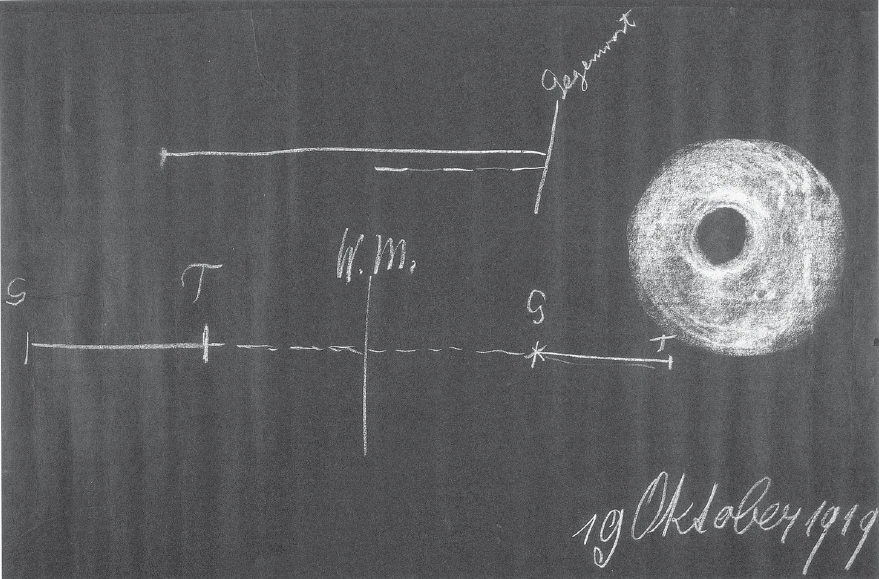
[ 5 ] Now, in order to make clear to you the meaning of what I’m actually trying to say here, I’d like to paint a picture for you. Imagine you have the following image: a white circle, and inside that circle, a dark spot. You might ask: What am I perceiving here? — The white circle. Where there is no white, you see the black spot. I don’t want to discuss here whether the black spot is a real entity or merely the absence of white. But you see this black spot. You see that this black spot is where there is no white, inside the white circle. If you take this image, you can apply it to the way you actually perceive your “I” in everyday life. Just as you perceive nothing here (in the center), where the black spot is, so too do you actually perceive your “I” just as little. You do not perceive your “I” at all; rather, you perceive the experiences you have gone through during your various waking hours. And you do not perceive your “I” at all; it is only because, when you survey your experiences, your experiences are not present—just as there is no white in the black spot here—that you perceive your “I.” By looking back on your life, you perceive the experiences, and you do not perceive these gaps. Instead, you perceive your “I.” It is therefore the absence of daytime experiences that actually gives you the concept of your “I”; that is to say, by saying “I,” you perceive that part of your life which you have slept through.
[ 6 ] In fact, when you look back, what you have left out of your life is the basis for your sense of self. Suppose you never slept at all, that you were always awake; then, looking back, you would have no sense of self. You would feel like a being floating without a self through the events of existence in the world.
[ 7 ] It is extremely important to simply see these things. For everyone believes that the perception of the “I” is an experience. No, the perception of the “I” is the gap in those experiences. I ask you to keep this in mind first of all.
[ 8 ] And now I ask you to remember, as I have told you time and time again, that a person is not only asleep when he sleeps, but that a person is also asleep when he is awake. A person is, in fact, awake only in relation to their sensory and imaginative world. It is only in their sensory perceptions and in their imaginings that a person is truly awake. In relation to their will, they are asleep. Just as a person does not look into what they do from the moment they fall asleep until they wake up, so too do they not look into the inner impulses of their will. Yesterday I spoke of how people observe themselves in their actions but do not see their volition. With regard to volition, a person is asleep. They are also asleep during the day insofar as they are a being of volition. They are awake only insofar as they are a being who perceives through the senses and forms concepts and ideas through the intellect. They are only half-awake; as for the other part—the volitional part of their being—a person remains asleep even while awake.
[ 9 ] And now you will understand what the “I” is really like. It does not enter your sensory perceptions or your ideas as a real entity at all, but remains down in your will and continues to slumber there, even from the moment you wake up until you fall asleep. That is why you can never see it as a real entity, but only as the missing circle in the center. You may have the vague sense that you have a “I,” in that something resonates within you from the realm of volition—something that feels like a void in your soul experiences. But the perception of the “I” is, in fact, an entirely negative one. It is extremely important to recognize this. It is necessary that this superficial conception of the “I”—which also features in many modern philosophies—be recognized for its futility. For only when one sees through this entire situation, which I have laid out for you here, will one understand—truly understand—the relationship between human beings in life.
[ 10 ] I have described this relationship between human beings in the new edition of my *Philosophy of Freedom* in one of the additions I included in the book for this edition. As I have just explained, we not only perceive our own “I”—albeit negatively—but we also perceive the “I” of the other person. We could not perceive it if the “I” were within our own consciousness. If the “I” were within our own consciousness, then the relationship between human beings would be quite disastrous; then we would walk through the world with nothing but “I, I, I” in our consciousness, within our world of senses and imagination. We would pass by other people and perceive them only as shadows, and we would be surprised when we reached out our hand to find that these shadows stopped our hand. We would be completely unable to explain why we cannot reach right through a person. All of this would result from the fact that we would possess the “I” as a substantial entity, not merely as a negative concept within our imagination and sensory life. We do not possess it there. We possess it only in our will and in the feeling that radiates from the will. That is where the “I” actually resides, but not directly within our imagination or sensory life.
[ 11 ] When we perceive another person, we actually perceive them through our will. After all, it is not at all uncommon today—even among those who consider themselves philosophers—to hold the absurd notion that when we stand face to face with another person, we encounter a kind of form: hair on top, then a forehead, then a nose, a mouth, and so on. We’ve seen ourselves in the mirror many times; there we look exactly like the person standing in front of us. And since we have a self, we conclude by analogy that the other person also has a self. — That is a preposterous notion, utter nonsense! For we actually perceive the other person’s self just as we perceive our own self, albeit as a negative image. And precisely because our “I” is not within our consciousness but outside of it—just as volition is—we are able to put ourselves in the other’s “I.” If the “I” were within our consciousness, we would not be able to put ourselves in the other’s “I” and would perceive him only as if in a shadowy existence. And how does this perception of the other take place? Something like a very complicated process occurs when we perceive the other. We stand face to face with them: they, so to speak, capture our attention and lull us to sleep for a very brief moment. They hypnotize us; they lull us to sleep for a moment. Our sense of humanity is thereby actually put to sleep, as it were, for a very brief moment. We resist this and assert our personality. This is like the swing of a pendulum: falling asleep in the other, waking up within ourselves, and then, as a result, falling asleep in the other again, waking up within ourselves. And this complex process of swinging back and forth between falling asleep in the other and waking up within ourselves takes place within us when we stand face to face with the other. This is a process within our will. We simply do not perceive it because we do not perceive our will at all. But this constant back-and-forth oscillation takes place, as described in my *Philosophy of Freedom*.
[ 12 ] You see, in this oscillation between falling asleep in the other and waking up within ourselves lies the primordial element—the atom, so to speak, of human social coexistence. This is the primordial element of what constitutes social life from person to person. So this primordial element—and with it all the complex structures of social life—actually resides in that part of our being that is asleep, even when we are awake. Social life is, in essence, at most a dreamlike state of the waking human being; it is not a fully awake life that a person lives in social life. This is why the social realm is so difficult to grasp in ordinary life: because it is not actually a fully awake life at all, because it is a dreamlike existence, and because, in order to maintain our sense of self within ourselves, we must constantly resist social sentiment—the sentiment we perceive in others.
[ 13 ] Now just think how complicated this makes our lives—that we enter into such relationships with different people that consist of a constant falling asleep and waking up. One person is like this, another is like that. We fall asleep into them. This falling asleep is just as the other person is. As we drift off, we merge with them. Just remember the following: Imagine that you have just spoken—let’s say during the intermission or at some other point here in the hall—with so many people. You have drifted off into each of them, and once you awaken from them, that experience remains within you. In doing so, you carry over something of these people’s essence. All of this vibrates from person to person; it ripples from person to person. It is, in essence, a dim, dark element that prevails in this social coexistence of human beings. And human consciousness in the present moment is largely unaware of this social sensibility, which ripples and weaves darkly and dimly from person to person.
[ 14 ] In our time, it is now the case that it is precisely our task as people of the present—as you can see from the various : observations we have made—to gradually rise above the old blood ties and develop an understanding of that which weaves and undulates so dimly and obscurely among us socially. One of the most important tasks of our time is to gain an understanding of this weaving and undulating. What I call the “threefold social order” is, in essence, simply a structure of human coexistence that enables people, little by little—over the course of several generations—to truly and comprehensively internalize this interweaving and essence of human-to-human relations, which can be described as the social element. This understanding can only come about when legal life and spiritual life stand independently alongside economic life—namely, when spiritual life stands in a completely free relationship to the other two spheres of life.
[ 15 ] It is the most important public task of humanity today and in the near future to bring about this threefold social order, so that humanity may continue to exist at all, and so that it may attain a truly social, inner sense of human life. In recent times, since the middle of the 15th century, humanity has embarked on the path toward this understanding. The difficulty at present stems solely from the fact that, for the first time in the entire history of human development on Earth, the divine-spiritual powers of the world are appealing to human consciousness. All the progress achieved so far has been brought about more or less unconsciously. The first step is to consciously strive for a social structure. Old social structures arose from blood ties—from the immediate and extended family, the clan, the classes, and so on. These then expanded into national contexts. Today, humanity flounders, falsely believing it can cling to such ties—to national communities—while in reality it has long since transcended what national communities represent, and while the need has long existed to move toward forms of social belonging other than those represented by blood kinship through national communities.
[ 16 ] I have told you that, in a sense, the first stage on this path toward the kind of understanding necessary for the present and the near future was the rise, with the Reformation, of the dominance of the economic man. I have pointed out to you how, in ancient times, the initiate ruled; how, later, the priest ruled; and how, since the middle of the 15th century, the economic man has become the ruler. Since the Reformation, those who otherwise wore purple robes and posed as rulers had to become the puppets of the economic man if they wanted to rule. In truth, since the mid-15th century, the economic man—those who managed the economies of the various territories of the earth—has increasingly held sway. If others ruled in name only, it was just that—in name only—and governments were, in essence, completely permeated by economic principles. Of course, people do not like to admit that everything they have done since the Reformation has been done from an economic perspective. They speak of ideals and so on. But for the student of true history, these are merely masks. In order not to lift the veil too much, ministers of religion, ministers of education, ministers of justice, and so on have continued to be appointed since the Reformation. But all of them were, in reality, merely slightly less nuanced versions of ministers of the economy. Anyone who looks at the realities can see this—at most, they carried on old traditions, but essentially they acted according to economic considerations.
[ 17 ] In this regard, the Catholic Church actually understood how to be quite in step with the times, especially during the Age of the Reformation. Essentially, at the dawn of the Reformation, the Catholic Church best understood how to promote progress entirely in line with the newer economic principle. One need only “single out one fact from among the others.” Up until that time, the Church had managed to bring the highest spiritual matters and the most trivial worldly matters into close proximity. In ancient times, one could atone for sins through all manner of deeds. Gradually, it came to pass that one could atone for sins simply by paying. And the Pope—actually more quickly than the other secular powers—understood very well how to capitalize on the progress of modern times. He anticipated his future income from the indulgence of sins. If one has the power to be paid for the sins committed by people in exchange for their remission, that means a truly enormous future income. And if this income is as secure as anything can be through people’s faith, then it represents a very secure source of revenue. The largest Sienese banking house therefore regarded it as a safe investment to purchase a certain amount of humanity’s future indulgences from the Pope. While the Pope was already putting these funds to good use, he received enormous sums from a Sienese banking house. And the banking house enlisted Tetzel to collect these sums. He then traveled throughout the countries of Central Europe and collected the sums on behalf of the Sienese banking house.
[ 18 ] As you can see, the Church has been exceptionally adept at adapting to modern circumstances. That, too, is history! This history must certainly be taken into account.
[ 19 ] The economic man emerged. The Church was there. But ultimately, the administration of spiritual affairs—carried out with the help of the Sienese banking house and its collector, its agent—is, for what is truly spiritual, merely a mask. And if you study recent history, you will find that it is deeply significant when people speak of the “economic man” becoming the dominant figure. The Pope has remained such a powerful ruler only because he understood, at the right moment, that he too had to become an “economic man”—that he had to adapt to the economic model.
[ 20 ] Yes, the economic type had prevailed since the Reformation. It replaced the old priestly type. In the 19th century, humanity as a whole had only reached the point that the Church—which understood progress much better—had already reached at the time of the Reformation. But the economic type of human being prevailed only until the 19th century. In the 19th century, yet another type became dominant. When we say that this type became dominant, it means that the decisive influences in the social structure depend on this type. In the 19th century—specifically, in the first and second decades of the 19th century—the usurer, that is to say, the banker, became the dominant figure. For if you were to seek a proper definition of the banker, history would become extremely precarious. For if one were to formulate a definition—something people are very keen to avoid—of the banker, both large and small, based on genuine socio-economic foundations, one must under no circumstances simultaneously seek a definition of the usurer. For these two definitions would be identical; they can only be identical. But this is something that modern humanity has guarded as carefully as a secret as certain secret societies have guarded their “signs” and “words.” It has not been widely disseminated among the general public. It has remained a secret in social life.
[ 21 ] The banker became the ruler. And if one examines how the social structure developed over the course of the 19th century, one finds that, beginning in the first and second decades of the 19th century, the banker—this specific economic type who deals solely in money— that is, the one who—just as the “economic man” did in the past—now exerts a decisive influence on a broader scale over everything that constitutes social structure, over all the laws of the countries, and so on. It is very important to understand these circumstances; it is very important to realize that the economic type of human being has been dominant since the Reformation, and that the banker has been dominant since the beginning of the 19th century. And one cannot understand the public affairs of the civilized world in recent times unless one sees in them a history of the dominance of the banking system. Toward the end of the 19th century, what I had already pointed out in my 1908 lecture series in Nuremberg came to pass: In the first half of the 19th century and well into the second half, the individual who held the money was the ruler; but then this principle of rule transformed in such a way that money itself became the ruler. In the first half of the 19th century, however, the individual human being, as a banker, was still the ruler. I illustrated this with an example, if you recall. I told you how the Parisian Rothschild was once to be “borrowed from”—well, by the King of France. Isn’t it true that if the Parisian Rothschild was to be “borrowed from” by the King of France, that already reveals a little about who is actually in control? Well, kings don’t borrow directly, do they? So while the king sent his minister—one calls this kind of economic minister the “Minister of Finance”—the Rothschild was in the middle of a transaction with a leather merchant. The servant told the minister sent by the King of France to wait in the anteroom. Naturally, this struck the King of France’s minister as highly unusual—that he should have to wait while the Rothschild was negotiating with a leather merchant. Wait? He didn’t wait; instead, he flung open the door: “I have come to you on behalf of the King of France.” —“Please, have a seat,” said Rothschild. This was, of course, completely incomprehensible to the minister. “Yes, but I am the envoy of the King of France! Take two chairs and sit down!”
[ 22 ] You see, back then it was still the individual banker who held the reins of power. That gradually gave way to the dominance of stocks and banknotes as such. And we have gradually drifted into an era in which the individual money owner is no longer the essential factor, but rather abstract, accumulated capital. One person can be rich today and poor tomorrow. The individual himself rises and falls. The joint-stock company, the abstract entity—I elaborated on this back in 1908 in Nuremberg—is what has come to rule.
[ 23 ] But with this, human development has reached an extreme, an ultimate point. For as soon as money reigns as such, as soon as money is the actual driving force, the time has come when—I would say—the mere bare numbers in money must be replaced by realities. Now, money is the most spiritual aspect of the economy. It is that part of the economy which can only be grasped spiritually. After all, money has only a spiritual value—only a value in human recognition. One can eat bread and meat, but one cannot eat money. One can indeed acquire things that are useful to people through money, provided that the money is recognized. It has only a spiritual value, a conceptual value, a value of the imagination. The time has indeed come; there must be a shift in development from the purely economic-spiritual nature of money to that which is truly grasped in the spirit. And what the threefold social order is intended to bring about—namely, social understanding—is precisely what must immediately follow the dominance of the most abstract economic entity of all: money. For as obscure and dim as social understanding is among people, as I have described, so thoroughly must it actually be healed. For just imagine, for a moment, that this (see diagram) were a human life in the present, from birth to death. This life would be lived in such a way that the human being would acquire social understanding within it, so that social life and social structure would truly be built not on the value of money that one possesses, but on social understanding. Then the person would pass through the gate of death, live through the time until the next birth, and then once again live out their life from birth to death. What a person acquires here between birth and death in terms of social understanding is, after all, also inwardly within them. Above all, this flows into the creative will I spoke of yesterday; it is carried through the gate of death. Thus, a person carries their social understanding through the gate of death to the midnight of the world and then carries it again through birth into the next earthly life.
[ 24 ] What will become of this understanding—which is acquired through social understanding—in the next earthly life? —That is the great question that must already be raised today. It will become an understanding of karma. This means that, in the course of world history and human development, we have now reached the epoch in which humanity must acquire social understanding; for this social understanding provides the understanding of karma for the next incarnation. But no human being can acquire social understanding except by acquiring an understanding of the spiritual.
[ 25 ] You can see how things are connected, You see how social understanding is linked to intellectual understanding, to a spiritual perception of the world and a worldview, and how this determines what must occur as a conscious recognition of destiny in the course of human evolution for those who, endowed with social understanding, pass through the gate of death, are reborn, and will understand their destiny after rebirth.
[ 26 ] This is what matters: truly understanding how things are interconnected in the course of human development throughout Earth’s history. We are living in an era in which social understanding is essential. We will be reborn in an era of understanding the destiny of individual human beings. It is truly not out of a mere abstract impulse that people speak today of the necessity of social understanding, but rather it is connected to the innermost developmental impulses of humanity on Earth as a whole.
[ 27 ] That is what I wanted to share with you today, my dear friends. We will continue discussing these matters next time.
[ 28 ] The lectures in Zurich—as you know, the public lecture in Basel is tomorrow—have had to be postponed by two days because a different hall had to be chosen than the one originally planned, so that the first lecture will take place on October 24, followed by lectures on the 25th, 26th, 28th, 29th, and 30th of October, and on October 31st there will be a eurythmy performance in Zurich. This, of course, makes it impossible for me to give lectures here next Saturday and Sunday, so I will continue next Thursday for those friends who have the time and desire to come here at half past seven on Thursday.