

The Social Question as a
Question of Consciousness
GA 191
23 October 1919, Dornach
Translated by Steiner Online Library
Tenth Lecture
[ 1 ] We have discussed various aspects of the relationship between a spiritual-scientific worldview and a social conception of life. We are discussing these matters because it is necessary today for people from various perspectives to recognize that a thorough revitalization of our lives and a truly fruitful development toward the future are only possible if spiritual scientific views and ideas find their way into people’s ways of thinking and their conceptions of the world.
[ 2 ] In addition to what I said recently regarding looking back on one’s life, there is another aspect to this reflection. I have pointed out to you that when a person looks back on their life, they should actually be aware that, with ordinary consciousness, they perceive only discontinuous segments of their life, and that between these discontinuous segments—which a person looks back upon—lie the states of sleep, which are actually omitted; with regard to these, a person even succumbs to a certain delusion in their retrospective view. They believe that life is continuous; but it is not continuous. Life is such that it shows us only fragmented episodes. But from the perspective of spiritual science, one should be clear that what is not perceived in the retrospective view of life is nonetheless an experience—just as much an experience as that which is incorporated into ordinary consciousness.
[ 3 ] Well, the experiences that the human soul always goes through between falling asleep and waking up are not easy to describe, for the reason that a person must free themselves from various aspects of their ordinary conception of consciousness if they are to form even the slightest idea of the experiences that take place between falling asleep and waking up.
[ 4 ] We live an ordinary life in space and time. When we are fast asleep—speaking from the standpoint of ordinary consciousness—we neither live in ordinary time nor in ordinary space. When we recall what happens to us in the time between falling asleep and waking up, the memory itself is a kind of shadow image or, as they say, a projection of what we experienced in sleep into the space and time of waking daily life.
[ 5 ] But if you want to examine these conditions more closely, you must also bear in mind that the state of sleep is not merely a state of rest in contrast to the waking state. It is precisely in this regard that we again encounter one of those cases in which people judge more on the basis of preconceived notions than on the basis of actual observation. One might ask, if we call ordinary waking life the normal human state: When does rest set in? — Rest actually exists only at two points: at the moment of falling asleep and at the moment of waking up. Falling asleep and waking up are, so to speak, zero compared to the waking state of the day. But the state of sleep is not zero; the state of sleep is the opposite. Here one must resort to the familiar comparison from arithmetic. For example, you may have some amount of money—let’s say fifty francs; in that case, you have something. When do you have nothing? Well, precisely when you have nothing. But if you owe fifty francs, then you have less than nothing; then you have the negative. Thus, in relation to wakefulness, falling asleep and waking up are “nothing”; the state of sleep itself is—in relation to the ordinary waking state—the negative. For while we sleep, processes occur that are the opposite of those in wakefulness—processes of an entirely different kind, processes that, above all, in their reality are not subject to the laws of space and time, unlike the processes of waking daily life.
[ 6 ] But as you may have sensed in my recent lecture, there is something that is truly in its element in this state of sleep—that is, our true self. The self does indeed live in our will, but it also sleeps there, as we know. The true self does not enter into our ordinary thought life. We would not even be aware of the true self if we did not perceive it as a kind of negative. And when we look back on our experiences, we do not say to ourselves, “We have experienced days and nights”—rather, we simply look back on the days. And instead of saying, “We look back on the nights,” we say, “I”—we feel ourselves, we perceive ourselves as the “I.”
[ 7 ] Such truths must gradually sink in, or else people will be overwhelmed by a purely scientific worldview—a worldview that has, after all, come to dominate every other aspect of life and every other outlook on life for the majority of modern people. One will come to know oneself fully as a human being only if, at every moment of one’s life, one tells oneself: You are not merely a human being of flesh and blood who possesses a consciousness as most people living today understand it, but you are a human being who has merely slipped out of your body from the moment you fall asleep until you wake up. But then you live under conditions entirely different from those of ordinary waking life, and only then—between falling asleep and waking up—is your “I” in its true element; there it can unfold; there it is what it can claim to be: substantial. —During the waking hours of the day, our “I” is present only in volition. In thinking, in imagining, and even in a large part of feeling and sensation, only images of the “I” are present.
[ 8 ] That is why it is a great mistake when certain philosophical schools claim that what humans refer to as their “self” is a reality. Only when a person were to awaken from sleep into a higher state of consciousness would he become aware of his true self. Or if he were to see through the nature of the process of the will, then he would experience his true self in the act of willing.
[ 9 ] However, these things must actually become part of a person’s perception and feelings if they are to play the proper role in life. A person must, so to speak, be able to say to themselves: You are a being who, with your ordinary view of the world, actually perceives only one half of yourself; you are constantly immersed, along with the other half of this being, in supersensible experiences that you cannot perceive with your ordinary consciousness alone.” — Human beings will only be able to develop a proper sense of reverence for the creative principles that underlie them if they can connect with the supersensible in this way. Therefore, in a materialistic age such as ours, not only will the belief in the supersensible fade away, but in such an age reverence for the creative principles of the world will also fade. Reverence will disappear from human hearts altogether. There is little reverence today, and few feelings that can truly lift the spirit toward the supersensible! And much of the sentimentality that people still try to cling to is nothing more than a certain sentimentality—and sentimentality is, at the same time, untrue; sentimentality is never entirely true.
[ 10 ] If one—and I must mention this again on this occasion—takes such things into one’s consciousness both intellectually and emotionally, then the fact that human life and the life of the world have something of the character of a great mystery really does appear before the eye of the soul. And without this view—that life and the order of the world are a mystery—it is actually impossible to conceive of real progress in the development of humanity. Epochs such as ours, in which no one really wants to believe anymore that life contains mysteries, can essentially be nothing more than episodes. They may serve to cause people to cut themselves off for a while from their very foundations, and precisely through the reaction against this severance, to advance all the more toward a genuine sense of the mystery of life. But this mystery of life can reveal itself to human beings neither through sentimentality nor through abstraction. It can reveal itself only when a person is inclined to engage concretely with the realities of the supersensible world. And it will be something of a beginning of such engagement with supersensible facts if one can truly develop a kind of sacred feeling toward entering the state of sleep and can develop a sacred feeling in relation to looking back on this state of sleep, in which one—without speaking figuratively—might be said to have been in the abodes of the gods.
[ 11 ] After all, one need only realize how far our current view of life is removed from this idea, and how thoughtlessly humanity today perceives this other side of life. But how can one perceive what lies beyond birth and death if one does not perceive what lies beyond falling asleep and waking up? — For what lies beyond birth and death is, after all, that which is also present within the human being between birth and death; it is merely hidden behind the physical shell during that time. But if there were less egoistic religiosity and more altruistic religiosity—as I have already spoken of—then what a person experiences from birth onward would be seen as the continuation of the pre-birth life, or the life prior to conception, in the spiritual world. Then, however, the phenomena of human life would appear to us as miracles, and we would constantly feel the need to unravel them. We would have a longing to see, through human development, the revelation of that which takes shape and incarnates from the supersensible worlds into the sensory world. And fundamentally, it is already the case today that we can only understand life after death in the right way if we look to prenatal life.
[ 12 ] You see, there are mysteries of life. A number of these mysteries must be revealed in our time because of the demands of humanity’s evolution. Human beings cannot attain full awareness of their complete human nature unless they expand their view of themselves to include life before birth and after death. For we know only a part of our being if we do not allow the pre-birth and post-death realms to shine into and reveal themselves to us within this physical existence. It is still extraordinarily difficult today to speak of these things to people who have not already been somewhat prepared through anthroposophy; for either there is a profound interest in preventing the truth about these matters from reaching people, or there is a lack of proper understanding. You need only look around in life to find that today’s prevailing worldviews pay very, very little attention to pre-birth life. They concern themselves with the afterlife out of selfishness, because they demand not to perish along with their physical bodies. And religious denominations capitalize on this selfishness by, in essence, speaking only of life after death, not of prenatal life.
[ 13 ] However, the matter is not simply that; rather, it is still difficult to speak about these things today because it is, after all, a dogma of the Catholic Church not to believe in prenatal life—a dogma that other Christian denominations have also adopted. As a result, virtually all Christian denominations today regard it as heresy to speak of prenatal life. Yet it has an extraordinarily profound impact on the spiritual development of humanity when one is dogmatically forbidden to consider prenatal life. It is truly hard to imagine—and here I am not always speaking of conscious matters, but rather of unconscious aspects of human development—that anything could be more successful in lulling people into illusions about their true nature than withholding from them insights into prenatal life. For the entire view of human life is distorted by deceiving people into believing the fallacy that human beings are placed on Earth merely through their origin from a father and a mother. The Church has thereby created an immense means of power for itself by withholding from people insight into prenatal life. That is why the Church, as such, will fight in the most fierce manner against all those teachings that address prenatal life. The Church will not tolerate this. One should harbor no illusions about this; nor, however, should one be under the illusion that life simply cannot be understood if one does not take prenatal life into account.
[ 14 ] But there is something to be learned from this that you should really take to heart. Just consider this: it was, after all, in the interest of the church creeds to withhold important insights about themselves from people. The church creeds have virtually made it their mission to withhold the most important truths about themselves from human beings. These church creeds have thus found a way to envelop people in dullness and illusion. And today it is necessary not to succumb to any delusions on this point, nor to seek compromise—out of any kind of leniency—with all manner of views espoused by the church creeds. There can be no compromise on this. And it should be noted that it is of no use if you argue anywhere that “Anthroposophy does, after all, deal with Christ; it is not atheistic, nor is it pantheistic,” and so on. — That will never help you, because the church creeds will not take offense at the fact that you do not concern yourself with Christ—they do not care much about that—but they will take offense precisely because you do concern yourself with Christ. For it is important to them that they have the monopoly on speaking about Christ. In these matters, one must not be lenient with oneself; otherwise, one will always be tempted to shroud the most important things in life in twilight, fog, and illusion. Humanity currently needs to move toward spiritual insights. But it is the dogmatic church creeds—namely those that have gradually developed in the West—that resist spiritual insights the most. The Church as such cannot actually be hostile to spiritual-scientific insights; that is quite impossible, for the Church as such should really concern itself only with human feeling, with ceremonies, with worship, but not with intellectual life. The educated Oriental does not understand Western creeds at all, for the educated Oriental knows full well: he is bound to external worship; it is his duty to devote himself to the ceremonies prescribed by his creed. He is free to think whatever he wishes. In Eastern creeds, one still knows something of freedom of thought. This freedom of thought has been completely lost to Europeans. They have been raised in intellectual bondage, especially since the 8th or 9th century A.D. That is why it is so difficult for people of Western culture to come to terms with the things I mentioned recently: that proving any opinion is easy. One can prove one opinion and can prove its opposite. For the fact that one can prove something is no proof of the truth of what one asserts. To arrive at the truth, one must delve into much deeper layers of experience than those in which our ordinary proofs lie. But certain church creeds have not wanted to bring this experience to the surface; that is why they have separated people from truths such as this: “There you stand, O human being! As your organism develops from infancy onward, what you experienced in your prenatal life gradually develops within you.”
[ 15 ] And what, specifically, develops from prenatal life into an individual human life between birth and death?
[ 16 ] Well, we distinguish between an individual life and a social life in human beings. Unless you distinguish between these two poles of human experience, you cannot form any conception of the human being at all: individual life—that which we experience, so to speak, as our most deeply personal sense of ownership every day, every hour; social life—that which we could not have if we did not continually engage in the exchange of ideas and other forms of interaction with other people. The individual and the social both play a role in human life. Everything that is individual within us is, at its core, the aftereffect of prenatal life. Everything we develop in social life is the seed of life after death. We have even seen recently that it is the seed of karma. So we can say: There is the individual and the social within the human being. The individual is the aftereffect of prenatal life. The social is the seed of life after death.
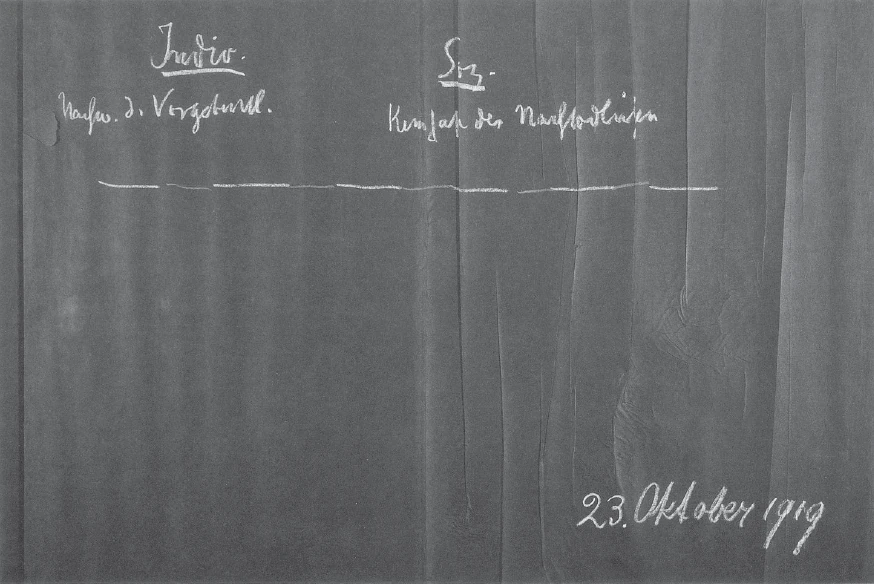
[ 17 ] The first part of this truth—that the individual is, in a sense, the aftereffect of prenatal life—can be seen particularly clearly when one studies people with special gifts. Let us say, since it is good to look at the extremes in such cases, that one studies human geniuses. Where does the power of genius, the genius itself, come from? A person brings their genius into this life through their birth. It is always the result of prenatal life. And since, understandably, prenatal life finds particular expression in childhood—later, a person adapts to life between birth and death, but in childhood everything that a person experienced before birth comes to the surface— that is why the childlike quality is evident in a genius throughout their entire life. It is, in fact, the very nature of genius to preserve this childlike quality throughout one’s entire life. And it is even part of genius to retain youthfulness and childlikeness right up to the very end of one’s days, because all genius is connected to prenatal life. But it is not only genius; all talents, everything that makes a person an individual, is connected to prenatal life. If, therefore, one imposes on people the dogma that there is no prenatal life, that there is no pre-existence, what does one implicitly do by doing so? One spreads the doctrine: There is no reason for special individual talents. — You know that the actual church creeds, if they are entirely sincere and honest, profess this: There are no reasons for personal talents. — It is, of course, not possible to deny personal talents themselves; but by denying their reasons, one can then regard personal talents as quite meaningless.
[ 18 ] This is why the church creeds, as they have prevailed for centuries, have given rise to a system of education for the European people that has ultimately led to the modern leveling of humanity. What, fundamentally, are individual talents to people today? And what would individual talents be if the standard socialist doctrine were put into practice? In these matters, it is important to look less at the outward label of a thing than at its inner connections. Anyone who, on the one hand, is a dogmatic Catholic and, on the other, hates social democratic doctrines, is caught up in a very strange inconsistency. He is caught in the same inconsistency as someone who says: “In 1875, I met a little boy whom I liked very much; I still like him very much today, this little boy.” — But then someone says to him: “But look, that little boy from 1875 has grown into the man who now stands before you as a Social Democrat.” — “Yes,” comes the reply, “I still like the little boy from 1875, just as I did back then, but the person he has become—I don’t like him; I hate him.” — But Social Democracy has emerged from Catholicism! Catholicism is merely the little boy who has grown into Social Democracy. Neither the latter is willing to admit this, nor is the former willing to concede it—but only because people do not want to see any vitality in the outwardly social realm; rather, they really only want to see something like papier-mâché. When you make something out of papier-mâché, it remains stiff and retains its shape as long as it holds together; but what lies at the heart of social life grows and lives, and it can, of course, be preserved alongside it. But here one must distinguish between illusion and reality. You see, you distinguish between illusion and reality when you, for example, rise to the following idea: 8th century: Catholicism; 20th century: The real Catholicism of the 8th century has become social democracy! And what exists alongside it as “Catholicism” is not the real Catholicism of the 8th century, but rather an imitation of it—that is, a counterfeit Catholicism; for the real Catholicism has since grown into social democracy.
[ 19 ] This is generally not recognized, not because people are unwilling to face reality, but because they substitute illusions and deceptions for reality. And they can easily do so. For one simply gives the same name to something that has long since ceased to be what it once was. But if today one were to give the name “Catholicism”—I must rephrase this—to what is represented in Europe from Rome in the same sense as what was represented from Rome in the 8th century, it would be just as if I were to say of a sixty-year-old man: “That’s the eight-year-old boy!” — Once upon a time, there was the eight-year-old boy, but today he is no longer the eight-year-old boy.
[ 20 ] I would like to draw your attention here to something that must be taken into account, because social life, too, may be regarded as something living and not as something lifeless and dead. And until such things are understood, humanity today will not rise to an understanding of true social life. Social life has its roots in spheres that we today can no longer grasp with our abstract terms in any language—perhaps most readily in the Oriental languages, to a lesser extent in the European languages, and least of all in English or American, which are, after all, very far removed from reality. Thus, our languages are obstacles to understanding the social. Therefore, humanity will only advance toward an understanding of the social when it emancipates itself from mere linguistic understanding. But today, anything that goes beyond mere linguistic understanding is strongly shunned. And what one finds most frequently today is that, when something is to be explained, some definition of a word is presented first. But it really doesn’t matter how one names a thing, which word one uses for it; the point is, above all, to lead people to the thing itself and not to the word. So, above all, we must overcome our bondage to language if we wish to advance toward social understanding. But this bondage to language can only be overcome if the greatest prejudices of our time are overcome. During the terrible years we have endured, the cry rang out across the world: “Freedom for the individual nations!”—and today even the smallest nations want to create their own social structures. A passion, a paroxysm of nationalism has swept over humanity, and it is just as harmful to the social life of the earth as materialism is to intellectual life. And just as the individual must work his way out of materialism toward freedom and spirituality, so must humanity work its way out of all nationalism, in whatever form it may appear, toward universal humanity. Without this, there can be no progress.
[ 21 ] But we will not find a way to fully escape nationalism through languages unless those languages draw upon deeper forms of expression for the spiritual. You see, I would like to conclude these reflections, more or less, with an image. If you reflect on this image I am about to use, you will be able to arrive at various insights that may be particularly important for understanding the present age. Take a look at any written document today. These little devils standing on the white paper—we call these little devils “letters,” which are arranged side by side. They have grotesque shapes, and when placed side by side, they represent the sounds of our languages. This goes back to other, more expressive forms of writing. And if we trace this back very far, we arrive at forms of writing—let’s say, like those used by the Egyptians—or like the original Sanskrit, which, in its forms, developed more or less entirely from serpentine motifs. The Sanskrit characters are transformed serpentine forms with all sorts of additions. The Egyptian forms of writing were still painted, drawn forms; they were still images; in their earliest times, they were even the very imagination of what was being depicted. Writing sprang directly from the spiritual realm. Then writing became more and more abstract, until it became what was already more or less bad enough: our ordinary writing, which is connected to what it represents only through the fact that one learns its forms.
[ 22 ] Then came something even more dreadful: shorthand, which now spells the complete demise of the entire system that had developed from the ancient pictographic script. This downward development must in turn give way to an ascent; we must return to a form of development that leads us out of all that into which we have been driven, particularly by writing. And an attempt has been made to make a start on this. Here on this hill in Dornach it stands. Whatever may be lacking in the Dornach building, whatever may be imperfect, in its forms it is something that expresses, in a contemporary way, the supersensible essence toward which people today are meant to look. It is, I would say, also intended as a world hieroglyph. If you truly study its individual forms, you will be able to read much more in them than you can grasp through descriptions of the spiritual; at least, that is the intention. The intention is to realize a universal script within it. Script emerged from art; it must return to art. It must transcend symbolism and allow the spiritual to live directly within it by once again becoming a hieroglyph in a new way.
[ 23 ] What stands here on this hill will only be truly understood if one realizes: There are many demands facing humanity in the present age that require an answer. Fundamentally, the language of today is by no means sufficient to provide such an answer. An attempt at such an answer has been made through the forms of this building. Much about it is imperfect; but this building represents an attempt to provide such an answer. And if one views it from this perspective, then one will view it in the proper way.
[ 24 ] That is what I wanted to add today to my previous reflections.