

Michael's Message
The True Mysteries of Human Nature
GA 194
28 November 1919, Dornach
Translated by Steiner Online Library
Fourth Lecture
[ 1 ] Following up on some of the points I raised here in last week’s lectures, I would like to say a few introductory remarks today, which I will then expand upon tomorrow and the day after tomorrow. The aim will be to remind you of various things in a different way than we have done so far—various things we will need in order to continue exploring the topic we have already begun.
[ 2 ] If we want to understand the course of Earth’s evolution, the best way to do so is by always—I would say—viewing and organizing events in relation to the focal point of Earth’s evolution. For this arrangement brings a certain structure to everything in which the individual is immersed in his or her own development through the evolution of humanity. This focal point is, as you know, the Mystery of Golgotha, through which all other earthly development has only now received its meaning, its true inner content.
[ 3 ] If we look back at the development of Western humanity—which, after all, received the impulse of the Mystery of Golgotha as if struck by a bolt from the East—we must say to ourselves: Around the 5th century before the advent of the Mystery of Golgotha, a kind of preparation for this Mystery began, emerging from Greek culture. We can say that there is a certain unifying thread running through Greek thought, feeling, and will for about four and a half centuries prior to the advent of the Mystery of Golgotha. And this unifying thread begins with the figure of Socrates, continues throughout all of Greek culture—indeed, the same thread is also evident in the arts—and continues in the powerful, towering personality of Plato, before taking on a more, I would say, scholarly character in Aristotle.
[ 4 ] As you know from the various explanations I have given, the Middle Ages—particularly in the period following Augustine—made a special effort to use the guidance that could be derived from Aristotle’s way of thinking to understand everything connected with the Mystery of Golgotha, its preparation, and its aftermath. Consequently, Greek thought became so important—including for the Christian development of the West up to the end of the Middle Ages—that it was actually employed to penetrate the essence of the Mystery of Golgotha. We would do well to clarify for ourselves what actually took place in Greece during those last centuries before the Mystery of Golgotha made its impact there.
[ 5 ] What took place in the thinking, feeling, and willing of the Greek people is, in fact, the final echo of a primordial culture of humanity that is no longer appreciated today. With our historical perspectives, we truly cannot see these things in their proper light, for our historical perspectives do not extend back to those times when a culture of mystery—spanning the then-civilized world—fundamentally permeated all human will and feeling. We must go back to the millennia beyond the reach of history, using the methods you will find—at least in outline—in my book An Outline of Esoteric Science, in order to see what kind of culture this primordial human culture was. It had its source in the ancient mysteries—those ancient mysteries to which great leading figures admitted only those people whom they objectively deemed suitable for direct initiation. Through such initiates, in turn, that which these initiates had come to share as knowledge within the mysteries flowed out to other people. And, fundamentally speaking, one cannot understand the entire ancient culture unless one takes into account the fertile soil of the mystery culture. In Aeschylus, if one is willing to look, one can still see this fertile soil of the mysteries quite clearly. One can also sense it in Plato’s philosophy. But what humanity actually received through the mysteries in the form of revelations about the divine has been lost to history. It remains only in the most primitive form within what has become historically verifiable culture. Now, what actually happened there can best be assessed by realizing what actually remained in the post-Socratic period of Greek civilization from that primordial mystery culture in which Greek civilization itself is rooted. What remained was a certain way of thinking, a certain way of imagining.
[ 6 ] As you know, conventional history tells how Socrates laid the foundations of dialectics, how he was, in fact, the great master of thought—that very thought which Aristotle later developed into a more scientific way of thinking. But this Greek way of thinking and conceiving—it is actually only the final echo of the culture of the Mysteries, for the culture of the Mysteries was a very rich one. Spiritual realities—which are the fundamental causes of our world order—were intellectually incorporated into the overall view of the human being. The contents—those immense, profound contents—have gradually faded away. But the mode of thinking cultivated by the mystery school students—the way of conceiving, the structure of thought—has remained, and it has in fact become part of history, first in Greek thought, then again in medieval thought, in the thought of Christian theologians, who essentially appropriated this Greek thought for their theology in order to comprehend—through their training in thought, using the thought forms, ideas, and concepts that were essentially a continuation of Greek thought—what had flowed into the world through the Mystery of Golgotha. What medieval philosophy—so-called Scholasticism—is, is indeed a convergence of the spiritual truths of the Mystery of Golgotha with Greek thought. The elaboration, the intellectual working through of the Golgotha Mysteries, was indeed—if I may use this trivial expression—carried out with the tools of Greek thought, of Greek dialectics. Approximately four and a half centuries elapsed from the loss of the content of the mysteries—from the emergence of the purely formal, the purely conceptual aspects of the ancient mysteries—up to the Mystery of Golgotha. We can say, approximately: four and a half centuries. So we must imagine the following: In prehistoric times, the culture of the mysteries spread across the then-civilized world. This culture was, as it were, further developed in such a way that only a distillate remained: Greek dialectics, Greek thought. Then the Mystery of Golgotha occurred. This was initially grasped in the West through this Greek dialectics. Anyone who wishes to fully immerse themselves, for example, in the scholarship—which was still thoroughly grounded in theology—of, say, the 10th, 11th, 12th, 13th, and 14th centuries must structure their thinking differently than humanity today is accustomed to, given our scientific way of thinking. Those who commonly pass judgment on Scholasticism today cannot do it justice, because they are all, at heart, trained only in the natural sciences, and Scholasticism presupposes a different kind of intellectual training than today’s scientific education.
[ 7 ] Today we live in an era in which another four and a half centuries have passed since this different way of thinking—the scientific way of thinking—took hold of humanity. It began around the middle of the 14th century. That is when people in the West began to think in the way we find clearly developed to a certain degree in the works of Galileo, for example, or Giordano Bruno. This line of thought has been carried forward right up to our own time. Yes, this is apparently the same logic as Greek logic, and yet a completely, completely different logic. It is a logic that has been gradually derived from natural phenomena, just as Greek logic was derived from what the initiates—the mystics—beheld in the mysteries.
[ 8 ] And now let us clarify the difference that exists between the four and a half centuries prior to the emergence of the Mystery of Golgotha in what was then virtually the only civilized world—the Greek world—and our own four and a half centuries, during which humanity has been educated through scientific training. The best way I can illustrate this is with a diagram. (He begins to draw on Board 6:)
[ 9 ] Imagine the mystery culture as a kind of Chimborazo of human spiritual culture in very ancient times (white). This mystery culture then developed in Greece—I’ll describe this using colors—into logic, up to the Mystery of Golgotha (red horizontal line up to the first red vertical line). This was then continued in the Middle Ages through Scholasticism (white line up to the second red vertical line). There (upper red bracket) we have this final offshoot, this culmination of the ancient mystery culture spanning four and a half centuries (written above the red bracket: 4½ centuries). And now, since the 15th century, a new way of thinking has begun; we could call it the Galilean way. We are roughly as far removed from the starting point (small red circle and third red vertical line) as the time it took from the emergence of this Greek way of thinking to the Mystery of Golgotha (lower red bracket before the first red vertical line). But while that is a closing phase (the white arc beneath the lower red bracket)—a kind of evening glow, so to speak—we are dealing with a foreshadowing (the white arc between the second and third red lines and 4½ centuries), with something that must develop upward, something we must raise to a certain height. Greek culture stood at one end. We stand at a beginning.
[ 10 ] We will only fully understand this combination of an end and a beginning if we approach the development of humanity from a certain perspective within the context of the humanities.
[ 11 ] As I have explained to you before—and have returned to this point repeatedly—it is not without reason that humanity is currently striving for that self-knowledge which is to be provided by anthroposophically oriented spiritual science. For the vast majority of humanity is, after all, facing a significant possibility for the future. You see, it is necessary to take seriously the fact that humanity, as it evolves through history, is an evolving organism. Just as sexual maturity occurs in an individual organism, and epochal transitions occur later on, so too have epochal transitions already occurred in the history of humanity. Today, people still repeatedly raise the same objection to the doctrine of repeated earthly lives: “Yes, but people don’t remember them; people don’t remember their previous earthly lives.”
[ 12 ] Anyone who, as I just suggested, views the history of human development as an organism should not be surprised—if they truly consider this history objectively—that people today do not remember their past earthly lives through ordinary cognition. For I ask you: What does a person actually remember in everyday life? That which they first thought about. They do not remember what they did not think about. Think about how many events go unnoticed by you throughout the day. You do not remember them because you did not think about them, even though they may have taken place in your surroundings. You can only remember what you have thought about.
[ 13 ] The development of humanity in earlier centuries and millennia did not proceed in such a way that people truly came to understand the nature of the human being. Although there has been a kind of longing for “Know thyself” since the time of Greek thought, this “Know thyself” is to be fulfilled only through true spiritual knowledge. Only by devoting a lifetime—something for which humanity has only now, in our time, become ready—to grasp one’s own self in thought, only then is the memory for the next earthly life prepared. For one must first have reflected upon that which one is to remember. Only those who, in earlier times, were able to look truly and appropriately into their own self through initiation—which, after all, need not always be acquired through the mysteries—can, in the present—and there are, in fact, quite a few people who can do so—truly look back on previous earthly lives. But the fact is that human beings also undergo a transformation with regard to their purely physical development. These things cannot be observed physiologically from the outside, but they can be observed through spiritual science. Humanity today is not the same as it was two millennia ago in terms of its physical constitution, and in two millennia it will not be the same as it is today. I have, in fact, spoken about this matter on several occasions. Humanity is living into a future era in which—to put it simply—brains will be structured differently than they are today in terms of their external form. The brain will possess the ability to recall past lives on Earth. But those who have not prepared themselves today through reflection on their own selves will perceive this ability—which will nevertheless be inherent in them—only as an inner nervousness—to use today’s expression—or as an inner deficiency. They will not be able to identify what is missing, because humanity is now maturing, in terms of its physical nature, to the point of being able to look back on its past earthly lives. But if they have not prepared themselves for this looking back, they will not be able to do so. Then they will perceive this ability only as a deficiency. Therefore, it is essential to correctly recognize the present forces of transformation within humanity itself, so that through anthroposophically oriented spiritual science, people may be led to self-knowledge. Now, as I would like to suggest at the outset today, it is already possible to point out what the specific experience will be that will prompt people to take their past earthly lives into account.
[ 14 ] Today we still live in an age where those nuances of feeling are actually present—albeit only in a few people—but they will become increasingly common. Today, these nuances of feeling are not yet given much attention. I want to describe them to you in the way they will one day manifest. People will be born into the world and will say to themselves: Yes, as I live together with other people, I am—either consciously or unconsciously—being shaped toward a certain way of thinking. Thoughts arise within me. I am born into and raised with a certain way of imagining things. But at the same time, I look at my external surroundings: my thinking, my imagination, does not quite fit with the external world around me. — This nuance of perception is already present in some individuals today. They must think in a direction that makes it seem to them as if external nature were saying something entirely different, as if external nature were demanding something entirely different of them. Wherever such people have appeared—those who have sensed this discrepancy between what they must think and what external nature says—they have been ridiculed. Hegel, for example, is a classic example of this. He expressed certain thoughts—not all of Hegel’s thoughts are foolish, after all—about nature and systematically compiled them. Then the philistines came along and said: Yes, those are your ideas about nature. But take a look at this or that process in nature—that’s not how it is. To which Hegel replied: So much the worse for nature.
[ 15 ] This seems, of course, quite paradoxical, and yet there is a subjective, well-founded basis for this feeling. It is entirely possible to surrender oneself quite uninhibitedly to one’s innate way of thinking and to tell oneself that nature would actually have to be shaped differently if it truly corresponded to this way of thinking. Then, after some time, one does indeed come to get used to what has been gleaned from nature. At that point, most people do not realize that, once they have matured to the point of observing what has been gleaned from nature, they essentially possess something like a dual soul within themselves—truly something like two truths. Those who have already truly recognized this can suffer greatly because it introduces a discrepancy into the soul. But what I am describing to you now—which is already present in a few people today, though they often do not see it—will become increasingly prevalent. People will increasingly say to themselves: “Yes, just as I was born, my mind actually compels me to form a picture of nature. It doesn’t really align with nature. Then I immerse myself in life, and over time I also come to embrace what nature says. Then I must find a way out.”
[ 16 ] Our souls will experience these conflicting feelings most acutely when they return to Earth. For then a kind of inner wellspring of thoughts and feelings will clearly emerge, through which one will say to oneself: Yes, you sense how the world should actually be, but it is not like that; it is different. — Then, in turn, one will adapt to this world, come to know a second kind of order, and have to seek a balance. What will this be based on?
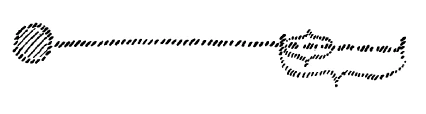
[ 17 ] Suppose (as we begin to outline) that a human being enters physical existence through birth. He brings with him that which, in his thinking and feeling, is the result of his previous earthly life. While they were not united with this earthly life, the outer earthly life has in fact changed in a certain way. They sense a discrepancy between the thinking—the effects of which they bring with them from their previous earthly life—and how things have become during the time they were absent from Earth. And now he is gradually settling into his new life and by no means fully taking into his consciousness everything that can be perceived from his surroundings. He takes it in, I might say, as if through a veil. He processes it only after death, and then carries it over into the next life. Human beings will always find themselves within this duality of their soul life. Human beings will always become aware: You bring with you something in relation to which the world—into which you have grown as a physical human being through birth—is new. But through your physical human being, you now take in something in this world that does not immediately penetrate your soul completely, something that you must process again only after death.
[ 18 ] Modern people would actually have to immerse themselves very deeply in this way of experiencing life. For it is only by immersing oneself in something like this that one becomes aware of the forces that actually pulse through our existence—forces that would otherwise escape us entirely. And we are entangled in them. But if we do not try to penetrate them with our consciousness, they remain in the subconscious and, to a certain degree, make us spiritually ill. Human beings will increasingly perceive this disintegration: the disintegration of what remains to them from their previous life course and of what is being prepared in this life course for the next. And because human beings will increasingly sense this duality, they will need an inner mediation—a true inner mediation. And the great question will become ever more pressing: How does a person attain this inner mediation? We can find an answer to this question only if we consider the following.
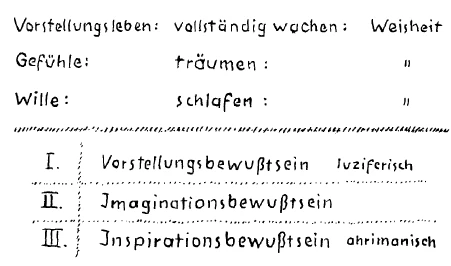
[ 19 ] I have often explained to you: In our everyday lives, between waking and falling asleep, we as human beings are actually fully awake only for our life of imagination. (In what follows, the upper part of the diagram on page 74 is written on the board.) The life of imagination—that is what it means to be fully awake. Even when we are otherwise awake, we are not fully awake with regard to our emotional life. For even when we are fully awake to our ideas and thoughts, our feelings exist within our consciousness on no other level of being than that of dreams. Anyone who can investigate this field knows through direct observation that feelings are no more alive in our consciousness; it is merely the idea through which we have represented the feelings that makes them appear otherwise. But emotional life as such rises from the depths of consciousness in such a way that what surges up there is akin to dreaming. And the will, in its true nature, represents for us something that lies dormant within us, even when we are otherwise awake. With regard to the will, we are asleep. Thus, we carry these three states of consciousness within us even while awake. We go about our days awake in our life of imagination, deluding ourselves that we are also awake in our will, because we have mental images of what our will accomplishes. But what the will experiences does not rise into our consciousness; only the mental image does. We dream our feelings; we spend our volitional acts in sleep. But when, through imaginative insight, one brings up what otherwise dreams within the feelings and raises it to a complete, clear understanding of the world, then one realizes: Wisdom is not found only in our ideas and thoughts—if I may call it that for now—we can technically call it that, even if for many people it is a lack of wisdom—wisdom is in our thoughts, but wisdom is also in our feelings, and wisdom is also in our will. (At this point, “wisdom” was written on the board.)
Imagination: Fully Awake: Wisdom
Emotions: Dreaming: Wisdom
Will: Sleeping: Wisdom
[ 20 ] When it comes to human existence today, we can really only speak clearly about what is present in our imagination. As for what lives in the world of feelings, humanity today generally has hardly any more ideas about it than it does about the world of dreams, and yet there is wisdom to be found there.
[ 21 ] It is most likely for those who earnestly apply the exercises described in my book How to Attain Knowledge of the Higher Worlds to their own souls to experience a certain inner stirring of the soul that unfolds in a dreamlike manner—for most people, it unfolds only in a dreamlike manner, with little more regularity than ordinary dreaming. But a certain degree of order can be brought into this inner experience relatively quickly, so that one notices: Although the same logic does not prevail in this inner experience—sometimes a very grotesque logic prevails, and the most diverse fragments of thought come together, playing out in a dreamlike manner, there is sometimes a strange logic at work within it—but that something is indeed taking place there can, as I said, be recognized as a first inner experience—one that is still very primitive—by anyone who applies just a little of what is described in my book How to Attain Knowledge of the Higher Worlds to their own inner life. Indeed, when a person dives down into this maelstrom of waking dreams, a new reality does emerge in contrast to the ordinary reality of external life. Then the person can notice relatively quickly that a new reality is emerging. They may also realize relatively quickly that there is wisdom within this whole experience—but a wisdom they cannot grasp, for which they do not feel mature enough to fully bring into consciousness. It slips away from them time and again, and they do not know what to make of it. And so the person realizes—or at least can realize—that wisdom not only permeates the upper layer of their consciousness, which permeates them in ordinary waking daily life, but that beneath it lies another layer of their consciousness that seems illogical to them simply because they themselves call it that, because they cannot yet grasp its wisdom. One might say: At the moment when one has fully mastered imaginative cognition, these waking dreams cease to be as grotesque as they appear in ordinary life; then they become imbued with a wisdom that points only to a different reality, to a world other than the sensory world that we survey with ordinary wisdom.
[ 22 ] In ordinary life, only the world of feelings wells up into our everyday consciousness from this lower layer of consciousness. And from a deeper layer, which lies even below that, the world of the will wells up—a world that is, however, thoroughly permeated by wisdom. We are also connected to this wisdom, but we certainly do not bring it up into our ordinary consciousness. So we can say: As human beings, we are actually governed by three layers of consciousness. The first is our conceptual consciousness, in which we live every day. The second is a consciousness of imagination. And the third is an inspired consciousness, which, however, remains very deep within; it does indeed work within us—and works effectively—but we do not recognize its nature in ordinary life. (It was written on the board:)
I. Consciousness of Representation
II. Consciousness of Imagination
III. Consciousness of Inspiration
[ 23 ] If only our contemporary philosophy were not quite as slow on the uptake as it is, this would strike contemporary philosophy very strongly—I am not speaking of those who have nothing to do with this philosophy, but philosophers should be able to grasp such things; yet today they do not— but it should be very apparent to contemporary philosophy—and indeed, it should be apparent with even greater intensity—just how great a difference there is between the truths one perceives purely on the basis of external observation of nature and those one finds in the sciences, for example in mathematics and geometry, through which one strives to understand external nature.
[ 24 ] One can say, with some justification: As for the truths that humans acquire through external observation—it has, after all, been repeated so often in the history of philosophy that it should actually be superfluous for philosophers themselves to analyze these matters with particular rigor—as for what can be observed externally, we can never truly speak of certainty. Kant and Hume, in fact, made this point particularly clear, even going so far as to claim—somewhat grotesquely—that although we observe the sun rising, we have no right, based on that observation alone, to assert that the sun will rise tomorrow as well. We merely infer from the fact that the sun has always risen up to now that it will rise tomorrow as well.—Such is the case with the truths we derive externally from observation. But this is not the case, for example, with mathematical truths. Once we have grasped them, we know that they will remain valid for all time. Anyone who knows—and can prove from internal reasons—that the square of the hypotenuse is equal to the sum of the squares of the two legs knows that no one will ever be able to draw a right triangle for which this is not true.
[ 25 ] These mathematical truths are different from the truths we know from external observations. We are aware of this fact, but we are unable to understand the reason for it using the methods of modern research. The reason lies in the fact that mathematical truths arise from deep within the human being; that mathematical truth springs from the third level of consciousness—here, in the lower layer of consciousness—and, without the person having any inkling of it, shoots up into their highest level of consciousness, where they then perceive it inwardly. We possess mathematical truths because we behave mathematically in the world. We walk, stand, and so on; we describe lines in the process. It is through this relationship of the will to the external world that we actually gain the inner insight into mathematics. Mathematics arises down there in the third level of consciousness (see diagram, p. 78) and shoots upward.
[ 26 ] So, basically, even though in this case the origin is not accessible to ordinary consciousness, we at least have very clear ideas about a part of this subconscious layer. Mathematical and geometric ideas come up from there. Only the middle layer becomes dreamlike and confused. The middle layer has something of a dreamlike, confused quality. Up there in the upper regions of the mind, where ordinary waking life takes place in our imaginative life, we are clear-headed again. And then what is clear within us is what emerges from the third layer of consciousness. What lies in between is experienced by most people only as a confused waking dream. It is very significant that we make this fact clear to ourselves. For the Greeks, in particular, were connected to this consciousness during those four and a half centuries. They took up this consciousness—the very thing that remained to them as a remnant of the mystery culture. And that is a purely Luciferic element, a purely Luciferic element. I described it to you recently. It is intellectualistic culture. In our minds, it is very clear. It is permeated by wisdom, by a universally valid wisdom. But this is a Luciferic element within us. (The word “Luciferic” is written on the board.) And again, what lies down there—what today’s scientists love so much, and what Kant already loved so much that he said: “There is only as much science in relation to nature as there is mathematics in it”—that is a purely Ahrimanic element that rises up through our human being. That is the Ahrimanic element. (“Ahrimanic” is written on the board. The diagram is now complete.)
[ 27 ] It is not enough for us to know that something is true. We know that the things we intellectually grasp in our minds are true, but this is a gift of the Luciferic element. And we know that mathematics is true, but we owe this powerful truth of mathematics to Ahriman, who dwells within us. And the most uncertain element lies in the middle—these are seemingly illogical, undulating dreams.
[ 28 ] I would like to cite another characteristic so that you may grasp the full importance of this matter. Essentially, the entire mathematical penetration of the world—as it emerged through Galileo and Giordano Bruno—stems from this deeper layer of consciousness. Four and a half centuries have passed since we began to assimilate this, four and a half centuries since we have been striving to introduce this Ahrimanic element into our human thinking and feeling. While the last echoes of the mystery culture shone into the brightest clarity of consciousness in Greek thought, in the lowest, darkest layers of our consciousness there is only the dawn of that which is to reach its Chimborazo only in the future. That must rise up from there.
[ 29 ] We human beings are truly in such a state with our soul life that this soul life is like a balance beam that must first seek equilibrium between the Luciferic element on one side and the Ahrimanic element on the other. Except that the Luciferic element lies in our bright mind, while the Ahrimanic element lies below, in the wisdom that permeates our will. Between these two, we must seek balance in something that, at first, does not appear to us as being permeated by anything.
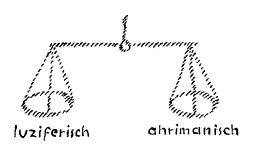
[ 30 ] How does wisdom enter this middle part of the human being? As the human being first stands in the world, he is held by Lucifer in terms of his head, and by Ahriman in terms of his metabolic wisdom and the wisdom of his limbs. But as for the heart—for what is described here as the middle state of consciousness is just as dependent on our heart’s organization and the human rhythm; read more about this in my book Mysteries of the Soul, and how our intellectuality is connected to the head—into this sphere of our existence, an order just as great as that which has entered head wisdom through head logic must gradually come; just as it enters into everything we know in an Ahrimanic way through mathematics, geometry, and, in general, through this outwardly rational observation of nature. How does inner logic, inner wisdom, and the ability to orient ourselves enter this middle part of our human being? Through the Christ impulse, through that which has passed into earthly culture through the Mystery of Golgotha.
[ 31 ] There is an anatomy of the humanities that shows us what “culture of the mind” is, that shows us what “culture of metabolism” is, and that also shows us what the sphere of organization is that lies between the two, and what that sphere requires. Being permeated by the Christ impulse is part of our human nature.
[ 32 ] So we can say to ourselves: Let us hypothetically assume for a moment that the Mystery of Golgotha had not entered into Earth’s evolution; then human beings would still possess intellectual wisdom. They would also possess what has emerged since the 15th century. But with regard to his central being, he would be empty and desolate. He would increasingly feel only the conflict between the two inner spheres mentioned. He would not be able to bring about a state of balance. We can bring about this state of balance only by allowing ourselves to be increasingly permeated by the Christ impulse, which brings about a state of balance between the Luciferic and the Ahrimanic elements.
[ 33 ] From this you can see that we can say: During these four and a half centuries before Christ, humanity was granted—as a kind of preparation for the Mystery of Golgotha—the final remnant of the ancient mystery culture, which took root as a memory preserved in the mind of that ancient mystery culture. And in more recent times, over the course of four and a half centuries, the human being has undergone a preparation for a new spiritual orientation, for a new kind of mystery culture. But for these two to be linked even in the historical development of humanity, the Mystery of Golgotha had to be objectively placed within the course of human development. Viewed from the outside, human development proceeds in such a way that the Mystery of Golgotha is inserted as an objective fact. Inwardly, however, the course of human development is such that people gradually mature until, beginning in the fifteenth century, they receive that new impulse which I have just characterized for you as an Ahrimanic impulse, and through which they will feel all the more keenly that they need the possibility of building a bridge between the one and the other.
[ 34 ] In this way, we can gain an inner understanding of the threefold human being. And we will understand it even more precisely if we connect what I have told you today with something I have mentioned repeatedly. It would not have been possible at all for the ancient Greeks, with their last remnants of the ancient mystery culture—except that it did occur among a few degenerates, but not to the same degree as in our time—it would not have been possible for them to be atheists. Atheism is, in essence, a relatively recent phenomenon, at least in its radical forms. For the Greek who truly grasped dialectics still sensed, even in thought—even in thought devoid of content—the workings of the divine.
[ 35 ] When one knows this and then considers the phenomenon of atheism—the complete denial of the divine—one comes to understand what this atheism is actually based on. Atheists—and of course one needs methods from the humanities to recognize this—are simply those people in whom—it may be a matter of very subtle structural relationships, but this is the case—something is not in order organically. Atheism is, in reality, an illness.
[ 36 ] This is what we must first establish: Atheism is a disease. For when our organism is completely healthy, its individual parts cannot interact in any other way than to make us ourselves feel that we have our origin in the Divine—ex deo nascimur.
[ 37 ] The second point, however, is somewhat different. A person can sense the divine, but may have no way of sensing Christ. Today, people do not make very subtle distinctions in this regard. People today are too content with words, even in other areas. For if one examines the actual spiritual content of quite a few Western people today—and does not go by their words alone (they say they believe in free will and so on)—it becomes clear how the entire structure of their thinking contradicts what they claim to express. It is only within the context of Western culture that they have become accustomed to speaking of Christ, of freedom, and so on. In reality, a large number of people living among us are nothing more than Turks; for the content of their faith is exactly the same fatalistic belief—even if this fatalism is often described as a natural necessity—as that of the Muslims. Islam is much more widespread than one might think. If one looks not at the words but at the spiritual and psychological content, then some Christians are actually Turks; many Christians are Turks. And so people call themselves Christians even though they cannot find the bridge between the God they feel and Christ.
[ 38 ] I need only point out to you the classic example of a modern “theologian,” Adolf Harnack, who wrote The Essence of Christianity. Please try this experiment: strike out the name “Christ” everywhere in The Essence of Christianity and simply write in the name “God”—it changes absolutely nothing about the content of this book. There is no necessity whatsoever for this man to attribute what he says to Christ. He need only attribute it to the universal Father-God who underlies the world. There is absolutely no requirement that he relate what he says to Christ. Where he proves something, it is outwardly and inwardly untrue, precisely because he borrows individual accounts from the Gospels; but in the way he processes them, there is no reason to attribute them to Christ. One must gain the ability to conceive of Christ in such a way that one does not identify him with the Father-God. This is something that, in particular, many modern Protestant “theologians” are no longer capable of: distinguishing between the general concept of God and the concept of Christ. Failing to find Christ in life is different from failing to find God—namely, God the Father. You know that this is not a matter of doubting the divinity of Christ in any way. It is simply a matter of making a precise distinction within the sphere of the divine between God the Father and God the Christ. But this is also reflected in the inner life of the human being. Not finding God the Father is an illness; not finding Christ is a misfortune. For human beings are so connected to Christ that they are inwardly dependent on him. But they are dependent on something that took place as a historical event. They must find a connection with Christ in their outer life here on earth. If they do not find it, that is a misfortune. It is a sickness to be an atheist, to fail to find God the Father. It is a misfortune to fail to find God the Son, the Christ.
[ 39 ] And what does it mean not to find the Spirit? Not to have the ability to grasp one’s own spirituality in order to discover the connection between one’s own spirituality and the spirituality of the world—that is a weakness of the spirit; it is a spiritual idiocy not to acknowledge the Spirit.
[ 40 ] I ask you to recall once more these three shortcomings of the human soul—so that we may continue this reflection properly tomorrow—to recall what I have told you today about the three states of consciousness from a different perspective, and to remember this: To be an atheist—to fail to find the God from whom we are born—whom we must find in a completely healthy constitution—is an illness; to fail to find Christ is a misfortune; and to fail to find the Spirit is a form of spiritual insanity.
[ 41 ] In this way, the paths that human beings take toward the Trinity also differ from one another. And it is becoming more and more necessary for humanity to engage with these concrete aspects of the life of the soul, rather than always getting stuck in general, vague, nebulous concepts. And today there is a very particular tendency toward this vagueness. Replacing this tendency with a tendency to re-enter the concrete realities of the life of the soul is an essential task of our time.