

Michael's Message
The True Mysteries of Human Nature
GA 194
29 November 1919, Dornach
Translated by Steiner Online Library
Fifth Lecture
[ 1 ] Human beings can attain a true consciousness—one that sustains their soul—only by taking in at least the most important, the most essential laws of human development. We must recognize what has taken place in the course of human development and bring it into our inner life. This, then, is the task of the human being today. Now it is a matter of taking completely seriously—as I have already noted in recent days—that the development of humanity itself is a kind of living development, a kind of evolution of the human essence. Just as there is a lawful growth within the individual human being, so too is there in the development of the entire human race. And since the present is the moment when certain things must rise into consciousness—and since human beings have, through their repeated earthly lives, participated in the various forms of human history—it is also necessary to develop an understanding of the differences in human soul dispositions across the various epochs of human development. I have said many times before: What we call history today is actually a “fable convenue,” because in this abstract enumeration of events and in this search for cause and effect in the most superficial sense—as applied to historical processes—no account is taken at all of the transformations, the metamorphoses, of human soul life itself. If one conducts experiments from this perspective, one can readily see how prejudiced it is to believe that people’s souls were disposed in roughly the same way in those times—as far back as the earliest historical documents—as they are today. That is not the case. People—even the simplest, most primitive people of the 9th and 10th centuries A.D.—were disposed quite differently in their souls than people were after the middle of the 15th century. One can trace this all the way down to the lowest strata of the human race, and one can also trace it up to the highest. Try, for example, to familiarize yourself with Dante’s remarkable work on “Monarchy.” If you read something like this—not as a curiosity, but with a certain cultural-historical intuition—you will notice how a book by a representative of his time contains things that could never have been expressed by a person of our own time. I’ll mention just one example.
[ 2 ] In this book—which he intended to be a serious treatise on the legal and political foundations of monarchy—Dante seeks to demonstrate that the Romans were the most outstanding people on earth. He attempts to demonstrate that it was a natural right of the Romans to conquer the entire globe, as far as it was known at the time. He seeks to demonstrate that this conquest of the entire globe by the Romans constituted a greater right than, for example, the right to self-determination of individual small nations, for God had willed it so that the Romans should rule over these individual small nations, for the benefit of those very nations. Dante presents many arguments, entirely in the spirit of his time, to justify Roman dominance over the world. One of these arguments is the following. He says: The Romans are, after all, descended from Aeneas. Aeneas was married three times. First to Creusa. Through this marriage, however, as the progenitor, he acquired the right to rule Asia. Second, he married Dido. Through this marriage, as the progenitor of the Romans, he acquired the right to rule Africa. Then he married Lavinia. Through this marriage, he acquired the right—that is, for the Romans—to rule Europe. Herman Grimm, who once discussed this matter, makes the following remark, which I do not believe is inaccurate: “It was pure luck that America and Australia had not yet been discovered at that time!”
[ 3 ] But this conclusion was something entirely self-evident to an enlightened mind of Dante’s time—indeed, to the most outstanding mind of Dante’s time. Such a thing was, back then, a legal argument. Now I ask you to imagine that such a conclusion might occur to any contemporary jurist. You cannot imagine it. Nor can you imagine that the way of thinking regarding other reasons Dante puts forward could stem from the state of mind of a contemporary person.
[ 4 ] Thus, a very obvious fact emerges regarding how one must view the transformation of people’s states of mind. Failure to understand these things has, in a certain sense, persisted right up to our own time. This is no longer acceptable in our time and will certainly not be acceptable for humanity in the future, for the simple reason that up until our time—or at least until the end of the 18th century—things had gradually begun to change since the French Revolution, though remnants of those states of mind have always lingered—because humanity, right up to our own time—that is, with the qualification I just made—possessed certain instincts. And out of these instincts, it was able to develop a consciousness that sustained the soul. But given the way the ever-changing organism of humanity has now evolved, these instincts are no longer present, and human beings must consciously cultivate a connection with all of humanity. That, after all, is the entire significance—the deeper significance—of the social question in the present day. What people often say along party lines is merely a superficial formulation. What is actually stirring in the depths of people’s souls is not expressed in such formulas. But what is stirring is precisely this: humanity feels that one must consciously achieve the connection of the individual with all of humanity—that is, acquire a social impulse.
[ 5 ] Now, one cannot do this without truly taking the law of development into account. Let us do this once more, as we have already done repeatedly for other issues. Let us take, for example, the period from the 4th century A.D. to around the 16th century A.D. There we see how Christianity spread throughout civilized Europe. We find that this spread bears the character I spoke of yesterday and on other occasions. We find that during this period, every effort was still being made to understand the mysteries of Golgotha through human ideas and concepts as transmitted by Greek culture. But then a new phase of development begins. We know that it actually began earlier, around the middle of the 15th century. It only became visible and clear around the 16th century. Then scientific thinking began to take hold first among the upper classes, but continued to spread farther and farther.
[ 6 ] Now let’s take a closer look at this scientifically oriented way of thinking in terms of a specific characteristic. There are many such characteristics that could be mentioned in connection with scientific thinking, but today we want to highlight one in particular. It is this: if one is a truly down-to-earth thinker of the modern sort, one cannot come to terms with the question of natural necessity and human freedom. Modern scientific thinking has increasingly tended to view human beings as a part of the rest of nature, which is understood as a stream of causes and effects that are firmly interdependent. Certainly, there are many people even today who are clearly aware that freedom—the experience of freedom—is a fact of human consciousness. But this does not prevent one from becoming confused when one truly immerses oneself in the specific framework of naturalistic thinking. If one thinks about the nature of humanity in the way that modern natural science demands, one simply cannot reconcile this way of thinking with the concept of human freedom. Some people take a simplistic view of human freedom and the sense of human responsibility. I knew a professor of criminal law who began his lectures on criminal law every time by saying: “Gentlemen, I am here to lecture you on criminal law. We will begin by accepting as an axiom that human freedom and responsibility exist. For if there were no freedom and no responsibility, there could be no criminal law.” But criminal law does exist—since I have to teach it to you—so responsibility and freedom must also exist.” —This line of reasoning is somewhat simplistic, but it does point to how difficult it still is for people today to come to terms with the question: How does natural necessity reconcile with freedom? In other words, this means nothing other than: Through the developments of the last few centuries, human beings have been increasingly compelled to conceive of a certain omnipotence of natural necessity. People do not express it in these exact words, but nevertheless, they do conceive of a certain omnipotence of natural necessity. What is this omnipotence of natural necessity?
[ 7 ] We will understand each other best if I remind you of something I have mentioned many times before. Today’s thinkers believe they are acting—or rather, thinking—without prejudice, merely conducting scientific inquiry, when they claim that human beings consist of body and soul. Isn’t it true that, right up to the supposedly great philosopher Wilhelm Wundt—who is in fact great only by the grace of his publisher—people claim that, if one thinks impartially, one must divide human beings into body and soul, if the soul is even acknowledged at all. And only timidly does the attempt to arrive at the truth venture to divide human beings into body, soul, and spirit. The philosophers who today believe they are dividing human beings into body and soul without prejudice simply do not know that their division is merely the result of a historical process that took its starting point at the Eighth Ecumenical Council of Constantinople, where the Catholic Church abolished the spirit by elevating to dogma the notion that from then on, the true believer was to think only that that human beings consist of body and soul, and that the soul also possesses certain spiritual qualities. That was a church decree. Philosophers still teach this today, unaware that they are merely following the church’s decree; they believe they are engaging in unbiased science. Such is indeed the state of affairs today regarding much of what is called “unbiased science.”
[ 8 ] The situation is similar with regard to natural necessity. This entire development from the 4th century through the 16th century increasingly crystallized a very specific concept of God. If one examines the subtleties of the spiritual development of these centuries, one comes to realize that a very specific concept of God was increasingly refined through human thought—a concept that actually culminates in the dictum: God the Almighty. Very few people realize that, for example, it would not have made much sense for people before the 4th century A.D. to speak of God the Almighty. We are not peddling catechism truths; of course, it says there: God is almighty, all-wise, and all-good, and so on. These are all things that have nothing to do with reality. Before the 4th century, no one who was knowledgeable about these matters—who had truly engaged with them—would have thought to regard omnipotence as a fundamental attribute of the divine being; rather, the influence of Greek concepts still persisted. And when one thought of the divine nature, one would not have said first and foremost (writing on the board:) “God the Almighty,” but rather: “God the All-Wise.”
[ 9 ] Wisdom was initially regarded as the fundamental attribute of the divine being. And the concept of omnipotence only gradually found its way into the idea of the divine being beginning in the 4th century. This continues to develop. The concept of personality is abandoned, and the attribute is transferred to the mere order of nature, which is conceived in an increasingly mechanical way. And the concept of modern natural necessity—this omnipotence of nature—is nothing other than the result of the development of the concept of God from (writing on the board:) the 4th century through the 16th century. The only difference is that the attributes of personality were discarded, and that what had once been taken to represent the concept of God was incorporated into the structure of natural philosophy.
[ 10 ] Today’s true natural scientists would, of course, strongly object if someone were to say such a thing to them. Just as some philosophers believe they are thinking about human beings without prejudice by reducing them to nothing but body and soul, while in truth they are merely following the Eighth Ecumenical Council of Constantinople of 869—just as these philosophers are dependent on a historical current— so they are all—the Haeckelians, the Darwinists, all of them, right down to the physicists with their natural order—nothing other than followers of that theological tradition that developed in the period from Augustine to Calvin. These things must be understood. For this is the peculiarity of every evolutionary current: that it encompasses a certain evolution within itself, but also an involution or devolution. And while the concept of “God the Almighty” was developing, there was an undercurrent present in the subconscious spheres of human soul life that later became the dominant mainstream: natural necessity (see diagram, red). And since the 16th century, a new undercurrent has been present, one that is now, in our own time, preparing to become the dominant current (see diagram, white).
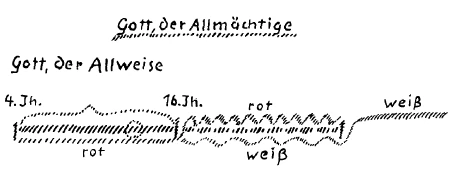
[ 11 ] This is what we must cite as the defining characteristic of the Michael Age: that what has been preparing itself as an undercurrent of natural necessity must now become an overt current. But one must understand the inner spirit of Earth’s evolution if one is to arrive at any possible conception of what is actually being prepared there.
[ 12 ] I recently pointed out to you that, in fact, the natural course of earthly evolution—and particularly the evolution of humanity—is moving in a downward trajectory. Humanity on Earth and earthly evolution itself are, in fact, in a state of decline. I have pointed out to you that this is already a geological truth today—that serious geologists admit the Earth’s crust is already in a process of decay. But humanity itself, in particular, is in a process of decay due to forces that are essentially sensory and earthly. And the process of humanity must continue in such a way that humanity absorbs spiritual impulses that work against this decline. Therefore, a conscious spiritual life must enter into humanity. We must be clear about this: we have already passed the peak of Earth’s development. For Earth’s development to continue, the spiritual must be absorbed ever more clearly and distinctly.
[ 13 ] At first glance, this seems like an abstract fact. For the spiritual researcher, however, it is by no means an abstract fact. You are surely aware that we trace the evolution of what later became the Earth through the Saturn, Sun, and Moon stages all the way to the Earth stage. We can also characterize this evolution by saying that, when we speak of present-day humanity, what developed from this humanity through the Saturn, Sun, and Moon periods was, in essence, a preparation, a preliminary stage. On Earth itself, it was only when human beings assumed their “I” that they truly attained human existence, and they will continue to infuse this existence with further substance through the Earth’s subsequent stages of development.
[ 14 ] Now you know that at the same stage of development—albeit in entirely different forms and with a completely different outward appearance—the so-called Archai, today’s spirits of personality or time spirits, existed during the Saturn stage; they were at the same stage of development but with a different appearance than that of human beings today. So I have expressed this in my books by saying: What we regard today as Archai, as spirits of personality, were human beings during the Saturn era; the Archangeloi were human beings during the Sun era; the Angeloi were human beings during the Moon era. During the Earth era, we are human beings.
[ 15 ] Of course, we have always evolved alongside this process. If we go back even to the Moon stage, we must say: there were human beings there—the Angeloi; they did not look like us, for the ancient Moon stage had entirely different conditions. But apart from these lunar human beings, the Angeloi, we, too, were already developing there in a preliminary stage—the preliminary stage of Earth’s evolution—at a very advanced stage, so that we were actually already being considered as candidates for the Angeloi. Especially when the lunar evolution was already in decline, we were occasionally considered—in a rather troublesome way—as candidates for the Angeloi. But the same is true for us with regard to the declining phase of Earth’s evolution. Ever since Earth’s evolution has been in decline, other beings have been arriving. This is a significant, an important finding of spiritual scientific research that must be taken very, very seriously: that we have already entered this stage of Earth’s evolution where beings are making their presence felt who, on Jupiter—which is the next stage of Earth’s evolution—will have advanced to human forms, albeit different ones, but forms that can be compared to the human being. We will, of course, be different beings on Jupiter. But these so-called “Jupiter humans” are already here, just as we once were on the Moon. They are here, though not outwardly visible, of course; but I spoke to you recently about what it means to be outwardly visible, and that human beings are also supersensible beings. In a supersensible sense, these beings are very much present.
[ 16 ] I emphasize once again: It is an extraordinarily serious truth that certain entities, which are indeed present around humanity, are making their presence felt. They have been making their presence felt more and more since the middle of the 15th century. These entities have, for the time being, primarily developed the impulse of a force that is very similar to human willpower—that willpower of which I spoke to you yesterday, as it lies deep within the lower strata of human consciousness. These invisible beings are related to what remains unconscious to ordinary modern consciousness, yet they are already making their presence felt very strongly in the development of humanity today.
[ 17 ] For anyone who takes spiritual research seriously, this is a problem of immense proportions. I was confronted with this problem particularly acutely—and I expressed it at the time to various friends of ours in one form or another—I was confronted with this problem particularly acutely, I would say, in a demanding way, when this catastrophe of war broke out in 1914. One had to ask oneself: How could an event have swept over the people of Europe that is, in fact, impossible to assess in terms of its causes in the way we are accustomed to doing with earlier historical events? Anyone who knows that, when it came to the decisive matters, hardly more than thirty to forty people in Europe were involved in 1914—and anyone who knows the state of mind in which most of these people found themselves—will see the truly significant problem emerge: For most of these people—as strange as that may sound today—most of them were in a state of clouded consciousness, of darkened consciousness. In general, an immense amount has taken place in recent years that has been caused by clouded human consciousness. At the decisive moments of 1914, we see everywhere how, at the very end of July and the beginning of August, the most important decisions were made precisely out of this darkening of consciousness—and again throughout these years right up to the present. This is a problem of a terrible nature. If one examines it from the perspective of spiritual science, one finds that these clouded consciousnesses were the gateways through which precisely these beings of will took possession of the consciousness of these people—took possession of their clouded, veiled consciousness—and acted through their consciousness. And these beings who have taken possession—who are still subhuman beings—what kind of entities are they, in turn? We must ask ourselves this question very seriously: What kind of entities are they, actually?
[ 18 ] Well, we have asked about the origin of human intelligence, about the origin of human intelligent behavior, which, simply put, uses the organization of our brain as its tool. And we have seen that this intelligent constitution of our soul stems from that act of Michael, the archangel, which is usually symbolically represented as the fall, the casting down of the dragon. This is actually a very trivial symbol. For if one correctly imagines Michael with the dragon, one must imagine it this way: the Michael being—and the dragon is actually everything that enters into our so-called reason, into our intelligence. Michael does not cast his opposing hosts into hell, but into human minds. (A drawing is made.) There this Luciferic impulse lives on. I have, after all, characterized human intelligence as what is essentially a Luciferic impulse. We can therefore say: If we look back at the process of becoming human, we find the Michaelic deed, and bound up with this Michaelic deed is the enlightenment of the human being through reason.
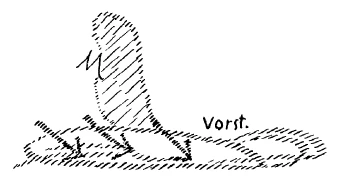
[ 19 ] What is now taking place is that the subhuman beings—whose primary characteristic is an impulse that very strongly corresponds to the human will, to human volition—are, so to speak, coming up from below, whereas those hosts or forces cast down by Michael came from above. And while the former take possession of the human imagination, the latter take possession of the human will, unite with it, and are beings generated from the realm of Ahriman.
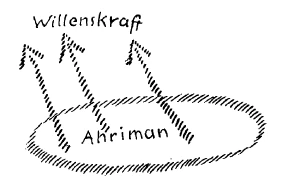
[ 20 ] It was Ahrimanic influences that were at work through these clouded consciousnesses. Indeed, as long as one does not treat these forces in the same way as forces objectively present in the world—such as what we today call magnetism, electricity, and so on—one will not gain insight into the nature that, according to Goethe’s poetry and his prose hymn, also encompasses human beings. For in the nature as conceived by modern natural science, human beings are not included—only the human physical body.
[ 21 ] These beings, who thus represent an ascent of the Ahrimanic nature just as the descent of the Luciferic being did at the beginning of Earth’s evolution; these beings, who exert an influence on the human will just as the other beings exert an influence on the Luciferic imagination—we must recognize these beings as they enter the course of human evolution. We must be clear that these beings are arriving and that we must reckon with a view of nature that, at first, extends only to human beings. For the animal kingdom will not be included until later in Earth’s history; they have no influence on animals yet. But the human race cannot be understood without taking these beings into account. And these beings, who, I would say, are being driven from behind—for behind them actually stands the Ahrimanic, which gives them their strong willpower, instills in them their driving forces, and so on—these beings, who in themselves are subhuman entities, are nevertheless, as a mass, dominated by higher Ahrimanic spirits and thereby possess something within them that far transcends their own nature and being. As a result, they reveal in their conduct something that, even when it captivates people, has a stronger effect—far stronger than what the weak human being, unless strengthened by the spirit, can master today. What is the aim of this host? You see, just as the hosts that Michael cast down—these Luciferic hosts—set out toward human enlightenment and human rationalization, so these hosts set out toward a certain permeation of the human will. And what do they want? They delve, as it were, into the deepest layer of consciousness, where human beings today still sleep even while awake. Human beings do not notice how these forces enter into their soul nature, as well as into their physical nature. But there they draw, with their forces of attraction, upon everything that has remained Luciferic, everything that has not been permeated by Christ. They can achieve this; they can take possession of it.
[ 22 ] These issues are very timely! I have already mentioned a phenomenon that is culturally and historically significant in the highest sense. After all, we are reading so-called “justifications” today. All sorts of people, from Theobald Bethmann on down to Jagow—everyone, absolutely everyone, is writing; Clemenceau and Wilson will also have their turn later—they, too, will write: everyone is writing. Well, one need only pick out a few examples, such as the two thick volumes by Tirpitz and Ludendorff. It is highly interesting for a person who thinks—who thinks in the spirit of their time—to trace the manner in which people like Tirpitz and Ludendorff write. In terms of content, they are very different from one another, for they could not stand each other; they held entirely different views. But we don’t want to talk about their views here; rather, we want to talk about the configuration of their minds. The books are, of course, written in modern German—or at least roughly in modern German—but the forms of thought—and one must have an understanding of such things, otherwise one won’t notice it; otherwise, one would simply place such a book in the present because it bears the date 1919—are written in such a way that one asks oneself: “What kind of thought structure is this, actually?” I have asked myself this question quite seriously and examined the two books mentioned specifically in this light, for it is a complete untruth—a real untruth—that these books are written in German. Outwardly, they are written in German, but in reality they are merely a translation, for the thought forms are those of the time of Caesar. Exactly the same kind of thinking that existed in Caesar’s time exists in these people.
[ 23 ] It is precisely when one has gained an understanding of the metamorphosis of humanity, as I described it earlier, that one realizes how backward such souls are, for they have not actually undergone the metamorphosis. The Tirpitz memoirs and the Ludendorff memoirs merely happen to deal with events of today; they might just as well be about Caesar’s military campaigns. This can be proven precisely by anyone who possesses the method to prove such a thing. But to put it another way: Christianity has passed these people by entirely; they have nothing Christian within them. Words, certainly—they may well have prayed in Christian churches in their youth, perhaps; I don’t know—I don’t believe it of Tirpitz, nor really of Ludendorff either, but that wouldn’t mean anything anyway—but the true Christ impulse, that they do not have in their hearts, in their souls. They have remained stuck at an earlier stage of human development. The spirits I have spoken of can approach this kind of mental configuration; they can take possession of it, and it draws them to itself. Through this, they seek to establish their dominion. But through this, a foreign element—an element from a spiritual world that is now asserting itself—enters into these people’s decisions. In Ludendorff’s case, this is directly verifiable historically, even though historical psychopathology is not yet practiced today—though it will be practiced in the not-too-distant future—in Ludendorff’s case, it is directly verifiable. It was on August 6, during the capture of Liège. The entire army corps was backed up in one of the streets, with Ludendorff right in the middle of it, still a colonel at the time. All decision-making power rested upon him. It was only through his swift decision that what took place in Liège came to pass. In the process, however, the normal functioning of his consciousness was lost. This led to that state of mind—which is still the “Caesar-state” of the soul’s life—the darkening of consciousness that serves as a gateway to the Ahrimanic world.
[ 24 ] Our times present us with these problems today. As human beings, we can no longer ignore these issues. They are not comfortable to deal with. For it has become comfortable to think differently about people—that is, not to think about them at all, to avoid engaging with them entirely. And it is not without risk in the present day—when so many individuals do not cherish a sense of truth—to speak about these matters in their full truth. Not to mention that misguided sentimentality might find these matters emotionally cruel.
[ 25 ] But what will result from such a view is a profound understanding of the necessity of the Christ impulse. One must recognize where the Christ impulse is absent. For just as we showed yesterday that the Christ impulse must take hold in the middle layer of consciousness, so we can add today: If this Christ impulse takes hold in the middle layer of consciousness, if a person truly becomes Christ-imbued, then these Ahrimanic forces cannot pass through the middle layer, cannot ascend through it, and cannot use their spiritual forces to drag down the intellectual forces. That is what everything depends on.
[ 26 ] It is absolutely necessary today to recognize that just as important as certain influences rooted solely in the human world are those influences that come to us from non-human, subhuman beings—upon whom, in turn, other beings exert their influence. Eight days ago, I spoke to you about the Michael influence. I described this Michael influence to you. It is a very necessary one. For just as it is true that the Luciferic influence on human intelligence came about through the Michael influence, so too is it true that the counterpole is now emerging—the rise of certain Ahrimanic beings. And only through Michael’s continued activity will human beings be equipped to withstand what is now rising. It is already quite dangerous today—even from a physiological standpoint—to cling solely to natural necessity, to that kind of fatalism that finds expression in natural necessity. For being educated by school and by life through concepts based solely on natural necessity—on the omnipotence of natural necessity—weakens the human mind, and people thereby become so passive in regard to their consciousness that other forces can enter into this consciousness, and that very strength is lacking which is necessary if the Christ impulse, in its present form, is to enter into the human soul’s constitution.
[ 27 ] I am, so to speak, obliged to speak at this time about what I began to discuss today—I will continue tomorrow—namely, the influx of certain Ahrimanic beings that we must reckon with. A wide variety of people on our Earth are already aware of this influx today. But they misinterpret it. They misinterpret it because they know nothing—or want to know nothing—about the true Trinity of Christ-Lucifer-Ahriman, but instead lump Ahriman and Lucifer together. Then one can no longer distinguish between them; then one can no longer properly recognize the true fundamental character of these Ahrimanic beings that are now emerging. Only when one clearly distinguishes the Ahrimanic and understands its contrast to the Luciferic can one know the nature of the supersensible influences that—I would say—are now rising as the counterpart to Michael’s defeat of the dragon. It is like a rising from Ahrimanic depths, like the emergence of certain beings. And these beings find particular points of attack in human beings when people give in to unbridled instinctive impulses and do not strive to gain clarity about their impulses.
[ 28 ] But today there is, in fact, a method—I might even call it an “anti-method”—for obscuring the instinctive by, so to speak, driving one concept into the ground and sliding another over it, so that one cannot properly assess what is actually there. Just think for a moment of the battle cry of the proletariat in modern times. Behind this battle cry lie—as I have often enough explained—very legitimate demands of humanity. But these demands are not the ones being appealed to at first. — In our threefold social order, they are appealed to for the first time. — The appeal is to something fundamentally different: “Workers of the world, unite!” What does that mean? Cultivate that feeling of hostility toward the other classes that is characteristic of you as proletarians; cultivate something akin to hatred as individual human beings; and unite—that is, love one another; unite your feelings of hatred; seek the love of a class; seek the love of comrades within a class for one another out of hatred. Love one another out of hatred or on the basis of hatred. — You have set up two opposing polar concepts here. This makes the conception of the human being so nebulous that instincts are suppressed and one does not know what one is dealing with within oneself. It is, if I may use the paradoxical expression, a kind of “anti-method” designed to use current human thinking to veil the workings of an instinctive life that provides particularly strong points of attack for the Ahrimanic entities described.