

Michael's Message
The True Mysteries of Human Nature
GA 194
30 November 1919, Dornach
Translated by Steiner Online Library
Sixth Lecture
[ 1 ] You have seen from the presentations of the past few days how, in order to fully understand the human being, it is necessary to examine the structure of the human being—and above all, to distinguish the profound difference between what we might call the primary organization of the human head and what we might call the organization of the rest of the human being. Admittedly, you know that we also subdivide this “rest of the human being” so that we arrive at a threefold division there as well; but for now, in order to understand the significant impulses in human evolution that we are facing at present and in the near future, the distinction between the “head human” and the organization of the rest of the human being is important.
[ 2 ] Now, when we speak of human beings in the context of spiritual science in such a way that we say: “head-human” and “rest of the human being,” then the head organization and the organization of the rest of the human being are, at first, more like images—images created by nature itself for the soul and the spirit, of which they are the expression and the revelation. Throughout the entire development of humanity on Earth, the human being is situated in a way that can really only be understood by considering the different ways in which the head organization and the rest of the human organism are situated within this development. That which is connected to the head organization—that is, what manifests itself specifically as the human life of imagination through the head—is something that, if we consider only the period of post-Atlantean human development for the time being, goes far back in this post-Atlantean human development. If we consider the period immediately following the great Atlantean catastrophe—that is, the 6th, 7th, and 8th millennia before the Christian era—we do indeed find, in the regions that were then part of the civilized world, a spiritual mood among humanity that can scarcely be compared to our own. What people held in their consciousness back then—what characterized their conception of the world—is difficult to compare with what now characterizes our sensory perception and our intellectual conception of the world. In my Outline of Esoteric Science, I have called this culture, which dates back to such ancient times, the “primordial Indian” culture. We can say: The organization of humanity at that time—which was primarily centered on the head—differed from our own to such an extent that the very concept of space and time, as we understand it, was not at all inherent in that ancient population. Their view of the world was more of a panoramic overview of immeasurable expanses of space, and it also involved a interweaving of different moments in time. This strong emphasis on space and time in the worldview was absent in those ancient times.
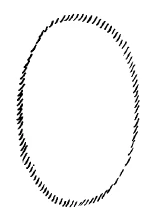
[ 3 ] We find the first hints of this only around the 5th or 4th millennium, specifically during the period we refer to as the Proto-Persian era. But the entire atmosphere of spiritual life in that era is also one that is difficult to compare with the spiritual and worldly atmosphere of human beings in our own time. Above all, people in that ancient era were always inclined to interpret all things in such a way that they perceived a balance between light and brightness on the one hand, and darkness and gloom on the other, everywhere. Those abstractions in which we live today were still completely foreign to that ancient population of the Earth. There was still something of a universal, holistic worldview present—an awareness that everything perceptible was permeated by light and its shadows in darkness. This was also how the moral world order was viewed. A person who was benevolent and kind was perceived as light and bright, while a person who was suspicious and selfish was seen as a dark person. In a sense, one could still perceive, as an aura around a person, that which constituted their moral individuality. And if one had spoken to a person of that ancient, primordial Persian era about what we today call the natural order, they would not have understood any of it. The natural order, as we understand it, did not exist in their world of light and shadow. For him, the world consisted of light and shadow, and he would, for example, describe a certain nuance of sound in the world of tone as “bright” or “light,” and another nuance as “dark” or “shadowy.” For him, the world was a world of light and shadow. And what was expressed through this interplay of light and dark were, for him, both spiritual and natural forces. For him, there was no difference between spiritual and natural forces. Something like the distinction we make today between natural necessity and human freedom would have seemed like madness to him, for this duality—between human arbitrariness and natural necessity—did not exist for him. For him, everything was, so to speak, to be encompassed within a spiritual-physical unity. If I were to sketch a picture for you—the meaning of which will only become clear through what follows—of the character of this primordial Persian worldview, I would have to draw a line roughly like the World Serpent, the symbol of the cosmos, which unified the human worldview.
[ 4 ] Then, after the collective mood of humanity had been this way for a little over two millennia, there emerged that which we can still perceive echoes of in the Chaldean worldview, in the Egyptian worldview, and, in a particular form, in the worldview whose reflection has been preserved for us in the Old Testament. Here, in a certain sense, something already emerges that is closer to our present-day worldview. Here, one already begins to sense the nuance of a certain natural necessity entering into human imagination. But this natural necessity is still far removed from what we today call the mechanical—or even merely the vital—order of nature. For this era, natural events still coincide with divine will, with providence. Providence and natural events are still one and the same. Human beings knew: when they moved their hand, it was actually the divine within them that permeated them, that moved their hand and their arm. When a tree was shaken by the wind, the sight of this shaking tree was no different to him than the sight of his own moving arm. He saw the same divine power as Providence in his own movements and in the movements of the tree. But people already distinguished between the God outside and the God within; they simply conceived of Him as one and the same—the God in nature and the God in man—only that He was the same. And it was clear to people at that time that there is indeed something within man through which, so to speak, the providence that is outside in nature and the providence that is within man meet one another.
[ 5 ] This is how people perceived the human breathing process at that time. They said that when a tree sways, that is the God on the outside, and when I move my arm, that is the God on the inside. When I inhale the air, process it internally, and exhale it again, that is the God from outside entering and then leaving again. Thus, people perceived the same divine presence both outside and inside, yet at a single point simultaneously outside and inside. They said to themselves: By being a breathing being, I am at the same time a being of nature outside, and at the same time myself.
[ 6 ] If, just as I have characterized the original Persian worldview for you using this line (the previous drawing), I were to characterize that of the third age for you, I would have to characterize it using this line (a lemniscate is drawn inside the oval; see p. 106 above).
[ 7 ] This line would represent, on the one hand, existence in nature, and on the other, human existence, but they would intersect at a single point: the process of breathing.
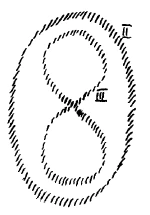
[ 8 ] This changes in the fourth age, the Greco-Latin age. There, the contrast between the outer and the inner, between natural existence and human existence, stands starkly before people. There, human beings begin to feel at odds with nature. And if I were to describe to you, once again, in characteristic terms, how human beings now begin to feel in the Greek era, I would have to draw it like this (it is drawn inside the lemniscate):
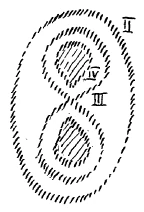
[ 9 ] On the one hand, he perceives the exterior; on the other, the interior; and between the two, there is no longer a point of intersection.
[ 10 ] In a sense, this aspect—what humans have in common with nature—remains outside of consciousness. It has already fallen out of consciousness. In Indian yoga culture, people try to bring it back into consciousness. Therefore, Indian yoga culture is an atavistic return to earlier stages of human development, because it seeks to bring back into consciousness the breathing process, which in the third age was naturally experienced as that in which one felt both outside and inside at the same time. This fourth age, after all, began in the 8th century B.C. And that is when those late Indian yoga exercises also began, which in turn sought to recall, in an atavistic way, what had been present earlier—particularly in Indian culture—but which had since been lost.
[ 11 ] So this awareness of the breathing process was lost. And if one asks: Why did Indian yoga culture attempt to reclaim it, and what did it actually believe it could achieve by doing so? — one must say: Yes, what was to be achieved through this was a true understanding of the external world. For by understanding the breathing process in the third cultural epoch, one came to understand inwardly within oneself something that was at the same time an external reality.
[ 12 ] This is what must be achieved once again by a different path. For we are still living—the fourth age does not end until about the year 1413, that is, not until the middle of the 15th century—under the aftereffects of this culture, which has a dual nature in the human soul. Through our head organization, we have an incomplete view of nature—what we call the external world—and through our inner organization, through the organization of the rest of the human being, we have an incomplete knowledge of ourselves. (Two separate entities are outlined.) In between, that which we would otherwise perceive—in which we would see both a process of the world and a process of ourselves—is missing, eludes us.
[ 13 ] The point is that what has been lost must be regained—but this time it must be regained consciously. That is to say, we must once again come to grasp something that is within the human being, something that belongs simultaneously to the outer world and to the inner world, something that spans both like a loop. (A lemniscate is drawn around the two figures.)
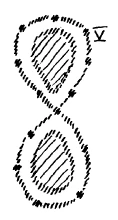
[ 14 ] This must be the goal of the fifth post-Atlantic epoch. The goal of the fifth post-Atlantic epoch must be to once again find something within the human being, where, in what we find within ourselves, an external process is taking place at the same time.
[ 15 ] You will probably recall that I have already alluded to this important fact; that I alluded to it in my last essay, “The Social Future,” where I ostensibly dealt with the significance of these things for social life, but where it is clearly pointed out that something must be found in which human beings simultaneously grasp within themselves something they recognize as a process of the world. As people of the present, we cannot achieve this, for example, by falling back on the culture of yoga; that is a thing of the past. For, you see, the breathing process itself has changed. Of course, you cannot prove this in a clinic today. But the human breathing process has become different since the third post-Atlantean cultural epoch. Roughly speaking, one could say: In the third post-Atlantean cultural epoch, human beings still breathed the soul; now they breathe air. It is not merely our ideas that have become materialistic; reality itself has lost its soul.
[ 16 ] I ask you not to regard what I am about to say as something trivial. For consider what it means that the reality in which humanity lives has transformed itself to such an extent that the air we breathe is different from what it was, say, four millennia ago. It is not merely humanity’s consciousness that has changed—oh no—there was a soul in the Earth’s atmosphere. The air was the soul. That is no longer the case today, or rather, it is so in a different way. The spiritual beings of an elemental nature, of whom I spoke yesterday, are once again penetrating it; one can breathe them in when practicing yogic breathing today. But what was attainable through normal breathing three millennia ago cannot be artificially restored. The belief that it can be restored is the great illusion of the Orientals. What I am saying now describes a reality. That animation of the air, which belongs to human beings, is no longer there. And that is why the beings—I would like to call them the anti-Michaelic beings—of whom I spoke yesterday can penetrate the air and, through the air, enter human beings; and in this way they enter humanity, just as I described yesterday. And we can drive them out only if we replace the yogic approach with what is right for today. We must realize that this right approach must be strived for. This right approach can only be striven for if we become aware of a much finer relationship between the human being and the external world, so that something takes place in relation to our etheric body that must enter our consciousness more and more, similar to the process of breathing. Just as we inhale fresh oxygen-rich air and exhale waste carbon dioxide during the breathing process, a similar process takes place in all our sensory perceptions. Imagine, for a moment, that you are looking at something. Let’s take a radical example. Suppose you look at a flame; you gaze at a flame. Something happens there that can be compared to inhalation, only it is much more subtle. Then close your eye—and you can do similar things with each of the senses—close your eye, and you will see the afterimage of the flame, which even changes gradually, as Goethe says, fading away. In this process of taking in the light impression and its subsequent fading, apart from what is purely physiological, the human etheric body is very much involved. But there is something very, very significant in this process. Within it lies the soul, which three millennia ago was breathed in and out with the air. And we must learn to understand the sensory process in its spiritualization in a similar way to how the process of breathing was understood three millennia ago.
[ 17 ] This is related to the fact that one could say humans lived three millennia ago in a kind of “night culture.” Yahweh revealed Himself through His prophets from within the dreams of the night. We, however, must develop the subtleties of our interaction with the world so that in our perception of the world we have not merely sensory perceptions, but also spiritual ones. We must become certain that with every ray of light, every sound, every sensation of warmth and its fading, we enter into a spiritual interaction with the world, and this spiritual interaction must become something meaningful to us. But we can also support ourselves so that this may come to pass for us.
[ 18 ] I have already explained to you that the Mystery of Golgotha occurred during the fourth post-Atlantean epoch, which—if we are to be precise—begins in the year 747 B.C. and ends in the year 1413 A.D. The Mystery of Golgotha falls within the first third of this period. However, what enabled people to initially grasp this Mystery of Golgotha were still the echoes of the old way of thinking, of the old culture. The way of understanding the Mystery of Golgotha must become a thoroughly new one. For the old way of understanding the Mystery of Golgotha has run its course. It is no longer commensurate with the Mystery of Golgotha. And many attempts that have been made to enable human thinking to grasp the Mystery of Golgotha have proven no longer suitable for rising up to the Mystery of Golgotha.
[ 19 ] You see, all things that appear outwardly in a material form also have a spiritual-soul aspect. And all things that appear in a spiritual-soul form also have an outwardly material aspect. The fact that the Earth’s air has been de-spiritualized, so that human beings no longer breathe the originally spiritualized air, had a significant spiritual effect on the development of humanity. For by breathing in the soul—with which they were originally connected, as it says at the beginning of the Old Testament— “And God breathed into the man the breath of life as a living soul”—by inhaling the soul in this way, human beings gained the capacity to become aware of the pre-existence of the soul, of its existence before it descended into the physical body through birth or conception. And to the same extent that the breathing process ceased to be animated, human beings lost the awareness of the pre-existence of the soul. And even by the time Aristotle appeared in this fourth post-Atlantean epoch, there was no longer any possibility of comprehending the pre-existence of the soul with human understanding. There was no longer any possibility of doing so.
[ 20 ] Historically speaking, we are faced with the remarkable fact that the greatest event in the history of the Earth—the Christ event—is unfolding, yet humanity must first mature in order to understand it. It is still capable of receiving the rays of the Mystery of Golgotha with the ancient remnants of the capacity for comprehension that stem from the primordial culture. But then this capacity for comprehension is lost, and dogmatism drifts farther and farther away from an understanding of the Mystery of Golgotha. The Church does not forbid belief in pre-existence because pre-existence is incompatible with the Mystery of Golgotha, but because, through the de-spiritualization of the air, human capacity ceased to receive into the soul—as a force—the consciousness of pre-existence. Pre-existence disappears from everything that has become intellectual consciousness. When we regain the animateness of our sensory perceptions, we will once again have a point of convergence, and at this point we will grasp the human will that flows upward from the third layer of consciousness, as I have described to you in recent days. There we will simultaneously have something subjective-objective, for which Goethe so yearned. There we will once again have the opportunity to first grasp, in a subtle way, just how remarkable this human sensory process actually is in relation to the external world. These are, after all, all crude notions, as if the external world merely acted upon us and we then merely reacted to it. All the talk that goes on about this is, after all, nothing but crude, clumsy notions. The reality is rather that a psychological process takes place from the outside in, which is grasped by the deeply subconscious, inner psychological process, so that the processes overlap. From the outside, the world’s thoughts work their way into us; from the inside, the will of humanity works its way out. And the will of humanity and world thoughts intersect at this point of convergence, just as the objective and the subjective once intersected in the breath. We must learn to feel how our will acts through our eyes, and how, in fact, the activity of the senses quietly intermingles with passivity, through which world thoughts intersect with the will of humanity. We must develop this new yogic will. Through it, we will once again be imparted something similar to what was imparted to people three millennia ago in the process of breathing. Our understanding must become much more soulful, much more spiritual.
[ 21 ] Goethe’s worldview strove toward such things. Goethe wanted to recognize the pure phenomenon—what he called the “primordial phenomenon”—in which he merely compiled what acts upon human beings in the external world, without the interference of the Luciferic thought that arises from the human mind itself. This thought was to serve only for the compilation of phenomena. Goethe did not strive for the law of nature, but for the primordial phenomenon. That is what is significant about him. But when we arrive at this pure phenomenon, at this “Urphänomen,” then we have something in the external world that enables us to sense the unfolding of our will as we contemplate the external world, and then we will soar once more toward something objective-subjective, as, for example, the ancient Hebrew teaching still possessed. We must learn not to speak only of the contrast between the material and the spiritual, but rather to recognize the interplay of the material and the spiritual in a unity, precisely in our sensory perception. Just as the Yahweh culture was three millennia ago, so will it be for us when we no longer view nature as merely material, nor—as Gustav Theodor Fechner did, for example—project something spiritual into nature through our imagination. When we learn to perceive the spiritual aspect of nature through sensory observation, we will have the Christ-relationship to external nature. There, the Christ-relationship to external nature will be something like a kind of spiritual breathing process.
[ 22 ] We can support ourselves by coming to understand this more and more—but now through common sense: Yes, pre-existence is something that underlies our spiritual existence. And we must supplement the purely egoistic notion of post-existence—which is purely egoistic, arising solely from our need to be there after death—with the knowledge of the pre-existence of the soul. We must, in a different way, rise once more to the vision of the soul’s true eternity. This is what can be called the Michael Culture. When we walk through the world in the awareness that with every glance, with every sound we hear, the spiritual and the soul-life flow into us at the very least—and at the same time we pour the soul-life out into the world—then, then we have attained the consciousness that humanity needs for the future.
[ 23 ] I’ll return to the image once more. You see a flame. You close your eyes and see the afterimage, which fades away. Is this merely a subjective process? Today’s physiologists say so. It is not true. In the world ether, this represents an objective process, just as the presence of carbon dioxide in the air—which you exhale—represents an objective process. You imprint upon the world ether the image that you perceive only as a fading afterimage. This is not merely subjective; it is an objective process. Here you have the objective aspect. Here you have the opportunity to recognize how something taking place within you is, in a subtle way, simultaneously a cosmic process—if only you become aware of the following: When I look at a flame, close my eyes, and let it fade—it does fade even if you keep your eyes open, though you don’t notice it then—then this is something that is not merely taking place within me; it is something taking place in the world. But this is not only true of the flame. If I encounter a person and say, “This person said this or that, which may or may not be true”—this is a judgment, a moral or intellectual act taking place within me. It fades away just like the flame. This is an objective cosmic process. When you think well of your fellow human beings, it radiates out and exists in the world-ether as an objective process; when you think ill of them, it radiates out as an objective process. You cannot, for example, shut away in your little room what you perceive or judge about the world. Although you seem to do it for your own understanding within yourself, it is at the same time an objective cosmic process. Just as the third epoch was aware that the process of breathing is both something that takes place within the human being and an objective process, so must humanity in the future become aware that the soul life of which I have spoken is at the same time an objective world process.
[ 24 ] This transformation of consciousness is something that requires a greater strength to take root in the human soul than people are accustomed to today. This is what the Michael Culture entails: becoming imbued with this consciousness. In a sense, if we regard light as the general representative of sensory perception, we must rise to the level of conceiving of light as animated—just as it was natural for people of the second and third millennia B.C. to conceive of air as animated, because it was indeed so. We must thoroughly break the habit of seeing in light what the materialistic age is accustomed to seeing in light. We must thoroughly break the habit of believing that the sun emits only those vibrations of which our physics and the general human consciousness speak to us today. We must realize that the soul penetrates through the cosmos on the wings of light. And at the same time, we must recognize that this was not the case in the era that preceded our own. In the era that preceded our own, the same thing reached humanity through the air that now reaches us through the light. You see, this is an objective difference in the earthly process. And if we think on a larger scale, we can say: the air-soul process, the light-soul process. (Written on the board:)
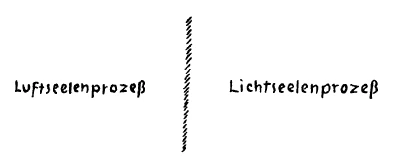
[ 25 ] And this is roughly what we can observe in the evolution of the Earth. And right at the heart of it all, signifying the transition from one to the other, lies the Mystery of Golgotha. It is not enough for the present and future of humanity to speculate about the spiritual in abstract terms, to fall into some nebulous form of pantheism or the like; rather, it is a matter of beginning to recognize—in all its spiritual vitality—that which humanity today actually perceives only as a material process.
[ 26 ] The point is to begin to speak: There was a time before the Mystery of Golgotha when the Earth had an atmosphere. Within this atmosphere was the soul that belonged to the human soul. Now the Earth has an atmosphere that is emptied of the soul that belongs to the human soul. Instead, the very same soul element that was previously in the air has now entered the light that surrounds us from morning to evening. Christ’s union with the Earth made this possible. Thus, in the course of Earth’s evolution, air and light have also become something different in a spiritual-soul sense.
[ 27 ] It is a childish view to describe air and light in purely material terms for the millennia during which Earth’s evolution has unfolded. Air and light have become something different in their inner nature. We live in a different atmosphere, in a different sphere of light, than our souls did in earlier earthly incarnations. Learning to recognize what is outwardly material as spiritual-soul-related—that is what matters. There will be no true spiritual science if, on the one hand, people describe purely material existence as we are accustomed to doing today, and then—yes, as if it were mere decoration—add in passing: “But within this material realm, the spiritual is present everywhere!” Indeed, in this regard, people are quite peculiar; in this regard, they are determined today to retreat into the abstract. What is necessary, however, is this: in the future, not to distinguish between the material and the spiritual in an abstract way, but to seek the spiritual within the material itself—so that it can be described as spiritual at the same time—and to recognize within the spiritual the transition into the material, the way it operates within the material. Only then, when we have achieved this, will we truly attain an understanding of the human being itself. “Blood is a very special fluid,” but what is discussed today in physiology is not a very special fluid; it is simply a fluid whose chemical composition one attempts to specify just as one would any other substance’s composition. That is nothing special. But once we have gained the starting point—the ability to truly perceive the metamorphosis of air and light from a soul perspective—then we will gradually be able to ascend to a point where we can once again comprehend the human being in all his individual members from a spiritual-soul perspective; then we will not have abstract matter and abstract spirit, but rather spirit, soul, and body interacting with one another. That will be Michael Culture.
[ 28 ] This is something our times demand. This is something that should be grasped with every fiber of their spiritual being by people who want to understand the times we live in today. For a long time, there has always been resistance to anything that had to be introduced into the human worldview as something unfamiliar. I have often cited the amusing example, which took a rather crude turn: In 1835—so it hasn’t even been a century since then—the learned Medical College in Bavaria was asked, when plans were being made to build the first railroad from Fürth to Nuremberg, whether it was hygienic to build such a railroad. The Medical Council replied—the document exists; this is no fairy tale—that no railroad should be built, because people traveling across the ground in this manner would become nervous. — But then they added: If there were indeed people who absolutely insisted on having railroads, then high wooden walls would have to be erected on both sides so that those whom the trains passed by would not suffer concussions. — Yes, you see: It is one thing to pass such a judgment; it is quite another to consider the course of human progress. Today we smile at a document such as the one issued by the Bavarian Medical Council in 1835. But then again, don’t we really have no right to laugh so readily: if something similar were to happen to us today, we would react exactly the same way. For we cannot, after all, say that the Bavarian Medical Council was entirely wrong. If one compares the nervous state of humanity today with that of humanity two centuries ago, people have become more nervous. Perhaps the Medical Board merely exaggerated a bit, but people have indeed become more nervous. However, the further development of humanity is not about such things, but rather about ensuring that certain impulses seeking to enter actually do enter into the Earth’s evolution—that they are not rejected. And what seeks to enter human cultural development from time to time does indeed run counter to human comfort, and one must discern what is a duty with regard to human cultural development from objectivity—not from human comfort, not even from greater human comfort. And I conclude today with these words for this reason: for it is quite beyond doubt—as signs from all sides indicate—that a certain struggle, already swelling quite strongly, is about to arise precisely between anthroposophical knowledge and the various denominations. The denominations that wish to remain on their old, familiar paths—that do not wish to rise to a new understanding of the Mystery of Golgotha—will increasingly reinforce the strong “battle position” they have already taken, and it would be very, very reckless if we did not become aware that this struggle is about to begin.
[ 29 ] Well, you see, I am by no means eager for such a struggle, especially not a struggle with the Catholic Church, which, it seems, is now being forced upon us with such vehemence by the other side. Anyone who is truly familiar with the deeper historical impulses behind today’s creeds will be very reluctant to fight against the venerable traditions. But if the struggle is forced upon us, then it simply cannot be avoided. And today’s priesthood is by no means inclined to allow in, in any way, that which must come in: spiritual science. One can also foresee that the necessary struggle against something like what I read to you the other day is, in fact, grotesque: namely, that it is said one should learn about anthroposophically oriented spiritual science from writings opposed to mine, since my own writings have, after all, been banned by the Pope for Catholics. This is not at all ridiculous; it is a matter of the utmost seriousness! A struggle that appears so grotesque, that is capable of spreading such a judgment throughout the world—such a struggle is not to be taken lightly. And it is especially not to be taken lightly when one is quite reluctant to engage in it. For you see, let us take the example of the Catholic Church. It is no different with the Protestant Church; the Catholic Church is simply more powerful, with its time-honored institutions. One need only consider what envelops the priest when he celebrates Mass—every single piece of the chasuble—one need only understand every single act of the Mass, and then one has ancient, sacred, venerable institutions—institutions that are even older than Christianity itself, for the sacrifice of the Mass is merely an ancient mystery cult transformed in the Christian sense. This is the essence of today’s priesthood, which makes use of such weapons of warfare! So when, on the one hand, one has the deepest reverence for both the ritual and the symbolism of what is there, and on the other hand sees the poor means by which what is there is defended, and the poor means by which that which seeks to enter into human evolution is attacked—only then does one realize the seriousness required today to take a stand on these matters. It is truly something that must be carefully studied and thoroughly understood. And what has been announced from this side is only just beginning. And it is not the time—nor is it right—to remain oblivious to it, but rather to keep our eyes wide open! Isn’t it true that for a long time—throughout two decades, during which the anthroposophical movement in Central Europe has been driven—we allowed ourselves that sectarian lethargy, which was so difficult to combat within our own circles, and which still lies so deeply embedded in the hearts of those who are part of the anthroposophical movement? But the time is past when we could allow ourselves to indulge in sleepy sectarianism. It is profoundly true, as I have often emphasized here, that we need to truly take the world-historical significance of the anthroposophical movement to heart and look beyond trivialities, but also to take even the small impulses seriously and regard them as significant.