

Michael's Message
The True Mysteries of Human Nature
GA 194
6 December 1919, Dornach
Translated by Steiner Online Library
Seventh Lecture
[ 1 ] You have heard in various discussions how, in order to truly understand the human being, it is necessary to truly trace the division of this human being into three parts. Within the human being, the head—roughly speaking, of course—the chest organs, and the limb organs are organized relatively independently; though we must bear in mind that a good portion of what lies within the torso belongs to the limb organs. Now you have also been able to gather from lectures and from my exposition in The Mysteries of the Soul how the life of thought and imagination is connected to the human head; how everything that constitutes the sphere of feeling is connected to all that constitutes the rhythmic activity in humans—that is, as I said, roughly speaking, the chest system; and how the sphere of will, which in humans represents the actual spiritual aspect, is connected to the limb system, to the organization of the limbs. These three systems of the human organism are relatively independent. The life of imagination, the life of feeling, and the life of will are also relatively independent, yet they interact with one another. Now you know that, from a spiritual point of view, the best way to grasp how these three systems differ is to say: In ordinary waking life, a person is truly fully awake only through their head system—through everything that, in psychological terms, is connected to the life of imagination and thought. In contrast, everything connected to the life of feeling—that is, to the actual rhythmic system, in physical terms—is, even during waking life, a dream life that permeates that waking life. We know what is going on in our emotional sphere indirectly through our waking ideas, but never directly through the feelings themselves. And the life of the will remains even more obscure; in terms of its actual content, we do not grasp it any differently than we do the life of sleep as such. Thus, we can state more precisely than is usually done to what extent subconscious states underlie ordinary human consciousness: Subconscious representations underlie the emotional life, and—if I may use a comparative—even more unconscious representations underlie the life of the will.
[ 2 ] It is now very important to realize that each of the three human systems—thinking, feeling, and willing—actually contains all three. In the head system, the system of thinking, there is certainly also a life of feeling and a life of willing; they are simply much less developed than the life of imagination. Likewise, thoughts are present in the sphere of feeling, though they come to our consciousness only in a dreamlike way—weaker, that is, than in the sphere of the head. But what is usually overlooked in our age of abstract scientific thinking is that these subconscious aspects of the human being are all the more objective to the extent that they come less subjectively to our consciousness. What does this mean? It means that what we experience through our life of imagination, through our head life, consists of processes that take place relatively within us. But what we experience through our rhythmic system, through our chest system—what takes place in our emotional sphere—is by no means merely our individual property; it is something that occurs within us at the same time but represents objective world processes. That is to say, when you feel something, it is certainly an experience within yourself, but at the same time it is something that happens in the world, something that has significance in the world. And it is particularly fascinating to trace which worldly processes underlie our emotional life. Let’s suppose you experience something that engages your emotions extremely strongly—an event that stirs you with joy or sadness. You know that a person’s entire life unfolds in such a way that we can divide it into periods of roughly seven years each. The first period extends roughly from birth to the loss of baby teeth; the second period extends to sexual maturity; the third extends to the beginning of the twenty-first year—all of this is approximate—and so it continues. This is a division of the course of human life. (See Figure 5.124: horizontal line with vertical markings.)
[ 3 ] When we consider this structure, we arrive at key points in human development that are very clearly expressed at the beginning of human life on Earth in the change of teeth and in sexual maturity; these then become more or less concealed, yet remain very clear later on to those who are able to observe them. (The turning points are outlined.) For what takes place in a person’s soul and body around the age of twenty-one is just as clearly perceptible to the observant person as, for example, sexual maturity is perceptible in terms of external physiology. But it is usually observed less frequently. Well, this gives us more of a general outline of the course of human life. But when something like what I have described occurs—some significant event, for example, between the change of teeth and sexual maturity, that has a very stirring effect on the emotional sphere (the spiral is drawn in red)—then something very peculiar takes place, which—because it is observed only superficially today—is in reality usually not observed at all. But this event does take place. In a sense, the impression is there; the emotional impression resonates within consciousness. But if it is an emotional impression, then—quite apart from what is taking place in your consciousness or in your inner life in general—something is happening in the objective world. And we can compare what is happening in the objective world to a kind of vibrational excitation: it spreads out into the world. And the remarkable thing is that it does not spread endlessly; rather, once it has spread far enough—once, so to speak, its elasticity has reached its limit at one end—it oscillates back (left semicircle), and during the next seven-year period it appears as though it is returning and, in some way, is an impulse penetrating your inner life from the outside. I do not mean to say—since this is connected to the individual’s life path—that such an event always returns after about seven years; that would not be correct. But it does fall within the next seven-year period; it is simply not noticed by the person. We continually pass through such experiences in our soul life—experiences that strike our emotional life and are the world’s reaction to what we have somehow experienced in the emotional sphere during the preceding seven-year period. So an event of this kind, which stirs us emotionally in some way, resounds once more into our soul life in the next phase of life. People usually do not pay attention to such things. Anyone who makes a little effort can observe such things even from the outside.
[ 4 ] Who hasn’t experienced this: suddenly, someone you know well seems to be in a bad mood, and you have no idea where it’s coming from. The person changes out of the blue, as they often say. If you look into things and can truly keep an eye—an eye of the soul—on a person’s unusual behavior, if you can specifically sense what such a person is saying between the lines, or what they’re saying in their words, then you’ll be able to trace it back to some earlier emotional event—as I’ve described it—that stirred them. And in the meantime, something has actually happened in the world that would not have happened if the person had not experienced that emotional stir. But the whole thing is a process that, apart from the fact that the person experiences it, also takes place objectively outside of the person. You see how many occasions there are when these things take place outside of the person—things that exist because of the person, and that are simply objective world processes.
[ 5 ] Intermingled with these objective world processes are the events that take place among the elemental beings—including those elemental beings, as I recently characterized them, that exist outside of human beings. I have, after all, linked them in another context to the respiratory system and the rhythmic system. Here you see them interacting with the rhythmic system indirectly through emotional stirrings. If we understand these things correctly, they compel us to say: Human beings constantly generate something around themselves, like a rather large aura. But elemental beings intermingle with the waves they send out, and depending on the nature of the human being, these beings can influence what comes back. So think of it this way: You have an emotional state; you radiate it. When it returns to you, it is not unaffected; rather, in the meantime, elemental beings have been working with this emotional state. And when it then reacts back on the human being, you receive the effect of the elemental beings back—along with what these elemental beings have done with what lies outside of you. (The right half-arc has been drawn. The drawing is now complete.)
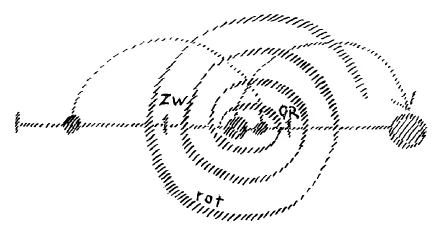
[ 6 ] Through the spiritual atmosphere that a person radiates, they interact with elemental beings. Everything that unfolds for a person as a matter of destiny throughout the course of their life is connected to these things. After all, we also experience a kind of fulfillment of our destiny within the course of our lives. Isn’t it true that when we experience something today, it has significance for the future? But this is the very process through which our destiny is actually shaped. And in the shaping of our destiny, elemental beings play a part—beings who are drawn to us by our own nature. They are drawn to us, and they influence us.
[ 7 ] There you see an interaction between human beings and their environment, and, in a sense, you see spiritual forces at work within that environment. If one follows this interplay, much of what becomes a matter of fate for human beings becomes clear. Insight into these relationships is very far removed from our “enlightened” age—and “enlightened” must always be written in quotation marks—and I would say that only the traditions of earlier times, in which human beings were more closely connected to reality through more elemental stages of consciousness than they are today, extend into our own time. You will find these traditions beautifully expressed in the poetry of antiquity, in which what is fateful for human beings is linked to the intervention of elemental beings. And indeed, one of the most beautiful poems that has come down to us—and which deals with such fateful intervention by elemental beings in our surroundings—is the one you now often see presented in eurythmy. There you see how the elemental beings from the realm of the Erl-King intervene in the course of destiny. As you know, the poem is called:
The Erl-King’s Daughter
Mr. Oluf rides so late and so far
To invite his wedding guests.There the elves dance on green fields,
The Erl-King’s daughter offers him her hand.“Welcome, Sir Oluf, why are you hurrying away?
Step into the circle and dance with me!”“I must not dance, nor do I wish to dance,
For my wedding day is early tomorrow morning.”“Listen, Sir Oluf, come dance with me,
I’ll give you two golden spurs.A little silk shirt, so white and fine,
My mother bleached it in the moonlight.”“I must not dance, nor do I wish to dance,
Early tomorrow morning is my wedding day.”“Listen, Mr. Oluf, come dance with me,
I’ll give you a heap of gold.”“I’d gladly take a heap of gold,
But I must not and shall not dance!”“And if you won’t, Mr. Oluf, dance with me,
May plague and disease follow you!”
[ 8 ] Here you have the interweaving of the elemental world into the fateful course of human life, insofar as this then extends into the most conspicuous manifestations of fate: illness and death.
She would strike a blow to his heart.
[ 9 ] I ask you to take such things into account. These things are not found in old poetry—Herder, after all, merely drew them from folk poetry—as they appear in more recent poetry. With regard to our literary poetry, one can safely say that about ninety-nine percent of it is excessive. The poems that truly spring from ancient knowledge are always such that they correspond to what is factual and real. It would never say here: “she would strike him on the head, or on the mouth, or on the nose,” but rather:
She struck him a blow to his heart,
Never before has he felt such pain.
[ 10 ] This must be connected to a rhythmic organ—hence the heart.
She lifted him, pale, onto his horse.
“Ride home to your beloved.”And when he came to the door of his house
His mother stood there trembling.“Listen, my son, tell me at once,
Why are you so pale and wan?”“And if I were not pale and wan,
I was in the realm of the Alder King.”“Listen, my son, so dear and trusted,
What shall I tell your bride?”“Tell her I am in the forest at this hour
To train my horse and dog there.” — —Early in the morning, when the day had barely dawned,
The bride arrived with the wedding party.They served mead; they served wine.
“Where is Lord Oluf, my bridegroom!”“Sir Oluf has ridden into the forest at this hour
He is out there testing his horse and dog.”The bride lifted the scarlet cloth—
There lay Sir Oluf, and he was dead.
[ 11 ] What I wish to draw your attention to is precisely the poetic—and entirely appropriate—depiction of what unfolds around a person at such a fateful moment, and what in fact is always unfolding around a person, though it becomes particularly pronounced in those contexts that can be perceived during the periodic recurrence of emotionally stirring experiences. For these experiences always return in such a way that they intervene in our destiny—not entirely unchanged, but after having passed through what such elemental beings have done with them. Just as we live in the outer physical air, just as we live amid the products of the mineral, plant, and animal kingdoms, so too do we live with those parts of our humanity that are initially subconscious, with our rhythmic system, in the spiritual sphere of the elemental beings. And there, as much of our destiny is shaped as can be shaped in the course of life between birth and death.
[ 12 ] It is only by being fully awake with our main life that we rise above this interplay with the elemental beings. It is only through our alert mental life that we are not integrated into the realm of the elemental beings. There we rise, as it were, above the surface of the elemental sea in which we, as human beings, are constantly swimming.
[ 13 ] Here you see the recurrence of events—the fateful recurrence of events—even within ordinary life, through what takes place in our rhythmic system and in our system of limbs. This also involves interactions with the environment, but more complex ones—much, much more complex—and these, too, oscillate back, only they have a further amplification of their oscillation. They do not return until the next earthly life or one of the subsequent earthly lives. So we can say that what we call our destiny, our karma, need not be all that mysterious to us when we consider that it is simply an amplification of what we can study within human life itself in the recurrence of such events. For these events do not return unchanged; they return greatly altered.
[ 14 ] I would like to draw your attention to something. In my lectures on education—wherever I have given them—I have always emphasized that during elementary school, there is an important turning point in a child’s life around the age of nine. In elementary school instruction, one should pay very, very close attention to this important turning point in human life. Until then, for example, one should not teach natural history to children in any other way than by linking the description of natural processes—through myths, legends, and the like—to human moral life. Only then should one begin—because only now is the child ready—with a truly simple, elementary description of nature. What one might call a curriculum arises entirely from a genuine observation of the human being down to the smallest detail. I have already drawn attention to this in the essay you have on “The Pedagogical Foundation of the Waldorf School.” There, too, I pointed to this stage around the age of nine. This stage can be characterized by saying that self-consciousness takes on a new form. The child becomes capable of viewing the external world more objectively. Previously, the child connects everything they see in the external world with their own being. Now, ego-consciousness does develop during the first seven-year period of life, around the ages of two, two and a half, and so on. But in the second seven-year period, it returns around the age of nine. This is, so to speak, one of the most striking returns—this return of ego-consciousness around the age of nine. Self-consciousness returns there in a more spiritual form, whereas in the second or third year of life it is more of a psychological phenomenon. This is just one of the events that recur in a very noticeable way. But one can certainly perceive this in relation to less significant events in human life as well.
[ 15 ] These intimate aspects of human life will be urgently—very urgently—necessary for the future of human development. An understanding of such things will gradually have to become part of general education. This general human education, of course, changes from one era to the next. Nowadays, aren’t we already unhappy when our children have turned ten and still cannot do certain calculations? The Romans were not at all like that; but they were unhappy if such a boy did not yet know the Twelve Tables, whereas we, in turn, pay less attention to ensuring that our children know the provisions of the law. Our spiritual constitution would also be in a sorry state if that were still the case. But what is believed to be general consciousness is changing, and we now stand at the starting point of an era in which, out of the development of the Earth and of humanity, such intimate aspects of spiritual life must enter into general consciousness. Human beings must come to know themselves more intimately than has been deemed necessary until now. Otherwise, these things would have the most adverse effect on the very fabric of human life.
[ 16 ] The fact that we do not know where anything that stirs us originates does not mean that it does not take place in our inner life. These things return; they exert their influence on our inner life. We cannot explain them; we do not even bring them into our consciousness. The result is that we experience all sorts of states. And people today suffer greatly from such states, which they simply accept—states of which they naturally do not realize are rooted in earlier experiences. Whatever is emotional comes back in some way. You can understand this, I would say, in terms of memory simply by connecting it to what I often refer to as a kind of representation of these things. When we teach a child to pray—that is, to develop a prayerful mood emotionally—this also resonates back at some point. Admittedly, it resonates back later, after a very long time; it also resonates back in between, but it continues to resonate outward and then resonates back again. After a very long time, prayer returns through our ability to develop the spiritual disposition of blessing. That is why I so often say: No elderly person will be able to bless effectively through the imponderables unless they learned to pray in childhood. Prayer transforms into blessing. These are the cycles of life.
[ 17 ] These things will have to be understood little by little. The fact that these things are not yet understood today is the reason why people cannot grasp the great significance of the Mystery of Golgotha. After all, what significance does it have for people who are so completely caught up in today’s education when they are told: after Christ had passed through the Mystery of Golgotha, he united himself with the life of humanity on Earth? People do not want to form any conception at all of how they themselves are interconnected with that in which Christ is present. To our intellectual understanding, little of the influence of the Christ impulse is apparent. But as soon as we look down into the unconscious, into the sphere of feeling and the sphere of will, we find ourselves first of all in the sphere of the elemental beings; yet this sphere of the elemental beings is, at the same time, interwoven with the Christ impulse. Through our rhythmic system—physiologically speaking, through our sphere of feeling—we descend into the realm with which Christ has united Himself for earthly existence. There, so to speak, we find the place where Christ can be found in reality—not merely through tradition or subjective mysticism, but in reality, objectively. At the same time, however, we are living in the epoch from which onward the events emanating from this place—as I explained to you recently—have great objective significance for human life, for they gradually exert an unconscious influence on human decisions and on what people do, even when they resist them. If people respond to this, they can experience a conscious influence; that is to say, we can count on them; we can, so to speak, call upon the spiritual worlds that belong to us to work with us.
[ 18 ] Even from an external perspective, it is evident that we are at a turning point in human development in this regard. I need only point to a fact that I have spoken to you about on more than one occasion from one perspective or another. When we consider historical accounts—the ordinary history as it is presented today—we will say to ourselves: These historical accounts have not yet truly penetrated to the mystery of Golgotha. Just take, for example, what has usually been presented to you as world history. Certainly, it describes the eras of the ancient Assyrian and Babylonian empires, the ancient Persian Empire, the Egyptian Empire, Greece, and Rome. Then it may be mentioned that the Mystery of Golgotha also took place, but then the narrative continues through the Migration Period and so on—for some, up to Louis XIV or the French Revolution or Poincaré; for others, up to the fall of the Hohenzollerns and so on. But in the ordinary “fable convenue” that is called “history,” you will find nothing—absolutely nothing—about the continued influence of the Christ impulse. From a historical perspective, it is actually as if the Christ impulse had been eliminated from the narrative. It is remarkable how, for example, a historian like Ranke—who was a devout Christian and who, subjectively, attached great importance to the Christ impulse—is, as a historian, unable to incorporate the Christ event into history. He cannot make sense of it. The Christ event plays no role in the historical narrative. So we can say: For the spiritual insight of humankind that has been revealed in its history thus far, Christianity is not yet truly present. And only our anthroposophically oriented spiritual science takes into account, in a positive way, the necessity of the fourth post-Atlantean epoch—through which the event of Golgotha had to break into concrete historical development—when presenting history. And we present history in such a way—as you know—that this event of Golgotha is at the very heart of our historical account. Indeed, we go further: We do not merely present the historical development of humanity by incorporating the event of Golgotha, but we also present world development—cosmic development—in such a way that the Mystery of Golgotha is embedded within cosmic development.
[ 19 ] If you allow my Outline of Esoteric Science to sink in, you will see that it does not merely speak of solar eclipses that have passed, or lunar eclipses that have passed, or any explosions or eruptions in the cosmos, but rather speaks of the Christ event as a cosmic event. And it is strange: when one can initially say about history only that historians—the so-called historians—find no way to place the Christ Event within the course of historical development, the official representatives of the denominations become downright furious. When they hear about something like anthroposophically oriented spiritual science, which speaks of the Christ Event as a cosmic event, these people—who are the official representatives of the denominations—begin to rant and rave terribly. From this you can see how little these denominations are inclined to truly meet the great demands of our time—to relate the Christ event to world events in general. It must be said: People who speak of Christ today—even theologians—speak of this Christ in no different way than they speak of some general divine being, no different from the way the ancient Jews or the Jews of today speak of their Yahweh or Jehovah. And as I told you recently: You can take Harnack’s book The Essence of Christianity and cross out the name “Christ” wherever he uses it, replacing it with the general name for God, and the meaning will not change, because the man has absolutely no idea about what is specific to Christianity. Yes, Harnack’s book The Essence of Christianity is, page by page, a description of the very opposite of the essence of Christianity, for it is not about Christianity at all; it is about a general doctrine of Yahweh. It is very important to point out these things, for they are closely connected with the most essential demands of our present time. And what must flow into the development of human culture is people’s awareness of the existence not only of a general, abstract spiritual world, but of the concrete spiritual world in which we live with what we feel, will, and do—and from which we protrude only through what we think, protruding only with our heads. It is indeed the case that a new kind of worldview is justified by the striving for a genuine interpenetration of what we feel, will, and do with the Christ impulse.
[ 20 ] The fact that our astronomy and our theory of evolution have developed entirely in the form of abstract formulas in recent times has only been possible because the Christ impulse did not initially take hold of people inwardly, but remained a tradition and affected people in a highly subjective way, but it did not move them so deeply that their inner experiences were at the same time objective experiences of the world—that is, where we are in interaction with what is happening spiritually around us.
[ 21 ] Here and there today, one can see a growing awareness dawning that new impulses are necessary for the development of humanity. But people find it so difficult to bring themselves to embrace a concrete spiritual life. When they speak of the spirit, they still have, to a greater or lesser extent, a longing to live within the abstract.
[ 22 ] Even our awareness of our relationship to our thoughts must change in a certain way. From one perspective or another, I have already drawn attention to what I actually mean by this, for I have often pointed out in public lectures that the presentation of anthroposophically oriented spiritual science—especially in our present time—does not take place as part of any programmatic goal, nor out of a preference for becoming enthusiastic about a particular ideal in this direction, but rather out of an understanding of what humanity needs today. And this requires reconnecting with certain spiritual dispositions of earlier times, which also existed in epochs when people were more closely connected to their true spiritual environment. Things were different in earlier times. Today, however, we should feel this particularly strongly. I have often explained: From the outside, nothing can truly blossom for us as human beings today. We must draw the impulses for human development from within, from our connection with the spiritual world, and we must actually be keenly aware of how what we experience—without any action on our part—is, in fact, increasingly becoming an experience of decline. In a sense, we are already in the downward phase of Earth’s evolution, and we as human beings must rise above it so that we can transcend Earth’s evolution through our connection to the spiritual world. Through this, however, what we strive for in terms of knowledge must be perceived as a force that enables us, as the entirety of humanity, to pass over into the next stages of development when the Earth dies beneath us—just as we pass over into other stages of development on a smaller scale when the body dies, when we pass through the gate of death. As individual human beings, we pass through the gate of death—that is, we enter the spiritual world—while the body dies away beneath us. So it will one day be for humanity as a whole. Humanity as a whole will evolve into a Jupiter-like existence—I call it a Jupiter-like existence. The Earth will become a corpse. We are already in the process of dying. The individual human being develops wrinkles and gray hair. For the geologist who can truly observe—I spoke to you about this just the other day—the Earth today shows clear signs of aging. It is dying away beneath us. What we seek spiritually today is, in fact, a counteraction to the Earth’s process of aging. This awareness is what we must allow to permeate us.
[ 23 ] From another perspective, people in earlier times described their esoteric knowledge as something related to the power of healing, including physical healing. This awareness must once again begin to permeate humanity today. The striving for knowledge must give rise to the awareness that, in doing so, one is contributing to the further development of all humanity. Of course, one will never arrive at this awareness if one does not take into account the concrete realities that surround us in the way I have described, for then one will view what a person feels, wills, and does as nothing more than their own personal affair. One will not realize that this is something that is also taking place out there. But it will be necessary—and here I must make a remark that may not be entirely understandable to everyone—that even the, shall I say, more exact branches of human knowledge accommodate such endeavors. But today they are not yet up to the task—really not at all. For example, even today you can still find the most impossible notions in the exact sciences. I’ll just mention a few things that might be generally understandable. Let’s say people usually imagine it in a trivial way (it is drawn): Somewhere there is the sun. Light radiates from the sun in all directions, just like from any other light source. And you can see everywhere that people who follow this propagation of light using mathematical concepts say: Well, the light simply spreads out into infinity, and then it somehow disappears. As it spreads out into infinity, it is lost due to its own weakness. — But that is not how it is. Everything that spreads out in this way reaches a boundary, and from this boundary it oscillates back again, returning to its origin as something else. Sunlight does not go into infinity, but oscillates back into itself, not as light, but as something else; yet it does oscillate back.
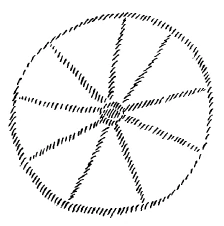
[ 24 ] And that is essentially the case with every kind of light. That is essentially the case with all effects. All effects are, in essence, subject to the law of elasticity, which has a limit of elasticity. Such ideas, however, are commonplace today in our so-called exact scientific descriptions, and far too little account is taken of reality. If you were a physicist, I would point out to you how people in physics today calculate using distance traveled and time. And then they call the speed—usually denoted by c or v—a function of distance and time, and represent it as a quotient (it is written on the board: “distance,” “time,” and the formula:)
$$c = \frac{s}{t}$$[ 25 ] But that is entirely wrong. Speed is not a result; rather, speed is the fundamental element that anything—be it material or mental—contains within itself, and we break speed down into distance, space, and time. We abstract these two things out. Space and time as such are not real. Speeds are real in the world—different speeds. This is a remark I make only for physicists, but physicists will understand me when I say that even in all the things that today form the theoretical basis of our understanding of time, fragile conditions prevail. Everywhere there are conditions that exist solely because we are unable to grasp the spiritual as something concrete.
[ 26 ] This is the requirement of the Michael era: that humanity be enabled to grasp the spiritual in its concreteness—that is, to relate to the human environment in such a way that, just as we say air and water are part of the environment, we recognize the various elemental and higher beings in the environment. That is what matters, and that is something that human education must once again become, just as it was in ancient times. People simply do not want to admit it. They are absolutely unwilling to acknowledge such turning points in human development as those that took place, for example, in the middle of the 15th century. Yet one can demonstrate from specific details that this is indeed the case.
[ 27 ] Some guy—I don’t know, a Swede or a Norwegian—recently wrote a book in which he quotes extensively from alchemists. In particular, he quotes a passage from an alchemist that mentions all sorts of things: mercury, antimony, and so on. And now this modern writer—who, as his book shows, is an excellent modern chemist—says he can’t make sense of this chemical formula given by an alchemist. — He really cannot make sense of it, for the simple reason that when today’s chemist speaks of “Mercury”—meaning quicksilver—he refers to the mineral quicksilver; when today’s chemist speaks of “antimony,” he refers to the metal, and so on. But in the book he is quoting, these words mean something entirely different—not the external metal at all, but certain processes that take place within the human organism. It is human inner knowledge. If one writes it down in the sense in which it was present in the consciousness of the author whom the good gentleman of today is quoting, one can read it today as a description of a laboratory process involving retorts and the like. But one derives no meaning from it. One can only regard these things as nonsense. Yet it does make sense once one understands what was meant in those ancient times by antimony, mercury, and so on—and that while an aspect of the external mineral was indeed involved, these processes primarily referred to inner processes of human nature, for which, however, people had different means than we do today. Therefore, anyone reading literature from before the 15th century must read it with a completely different understanding than someone reading it afterward. Through such things, one could also study, from an external perspective, the entire transformation of the soul’s constitution. Now, we live today in an age in which we must begin to place great value on such things—things to which humanity has attached no value for centuries.