

Michael's Message
The True Mysteries of Human Nature
GA 194
7 December 1919, Dornach
Translated by Steiner Online Library
Eighth Lecture
[ 1 ] What I have had to say to you over the past few weeks boils down to the fact that we are truly facing the emergence of a spiritual world into our present world, which is essentially the result of the cultural development that began around the middle of the 15th century. Around the middle of the 15th century, everything changed in the world known as “civilized.” What people brought into their consciousness before the mid-15th century dealt more with the inner workings of the human organism. In ancient writings—to the extent that they are still available today, as I mentioned yesterday—you can find language that is very similar to our chemical and physical terminology and so on. But today’s chemist or physicist will not truly understand what is written in these books, for the simple reason that he believes these texts describe external processes. These external processes are not described there; rather, internal processes are described—processes taking place within the human physical or etheric body. It was only from the time of Galileo and Giordano Bruno that humanity began to direct its attention more toward the external world, and today we have reached a point where we possess a understanding of nature—one that has already influenced all thinking, particularly popular thought and sentiment—a understanding of nature that speaks of many things in the mineral, plant, and animal kingdoms, but which cannot in any way shed light on the nature of the human being itself, nor even on the physical nature of the human being. Today, however, human beings must already ask the question: How do I, as a human being, relate to the outer kingdoms of nature—to what surrounds me as the animal, plant, and mineral kingdoms; as the outer physical human realm; as the realm of air and water, of fire and clouds, of the sun, moon, and stars? How do I, as a human being, relate to these?
[ 2 ] Now, we cannot answer this question thoroughly unless we revisit some of the points we have repeatedly considered regarding human beings. If we first consider human beings as sensory and rational beings as they appear to us, we can say: We perceive the external world through our eyes, our ears, and our other sense organs—which, although they serve the rest of the body, are nevertheless primary organs, organs of the head. We then process this external world through the ideas and concepts that are linked to our brain as an instrument. We retain—for this is necessary for our inner integrity as human beings—from what we have thus experienced through our senses and what we have thought through with our so-called rational intelligence, our memory-based perception. And ultimately, it is what we initially take in from the external world—what enters us from the external world through our senses—and what we make of this externally received material through our intelligence that we retain as a memory image. What, then, are we actually, in relation to the fact that we, as human beings, face the world in the way I have just described?
[ 3 ] Let’s start with a simple phenomenon of sensory perception. I have already referred to this phenomenon in recent days. Imagine that you are seeing a flame with your eyes. You close your eyes: you have an afterimage of this flame. This afterimage of the flame, which you carry within your eye, gradually fades away. Goethe, who always speaks vividly about these things, says: “The afterimage fades away.” — The original constitution of the eye and its associated nervous system is restored after having been altered by the impression of light that was made upon the eye. What is taking place in your sensory organ is simply the simpler version of what occurs with your memory—with your recollection—when you generally receive external impressions, reflect on them, and they remain with you as mental images. The only difference is this: when you take in an impression with your eye—let’s say a flame—and then have the image of the flame, which in turn fades away, this lasts only a short time. When you take in something with your whole being, reflect on it, and can recall it again and again later—when this powerful afterimage of memory emerges—it lasts a long time; under certain circumstances, it may last your entire life for these experiences. What is the reason for this? Well, when you allow that simple image you see with your eye—which perhaps lingers for only a few minutes or even just fractions of a minute—to fade away, it is only because it does not pass through your entire organism but remains in one part, in one section of your organism. That which becomes a memory image first passes through a large part—I will describe it in more detail in a moment—of your entire organism, and from there enters the etheric body, and through the etheric body into the surrounding world ether. And at the moment when an image does not merely remain as a sensory impression in a single organ, but passes through a large part of the whole human being, pushes its way into the etheric body, and moves outward—that is when it can remain as an afterimage for the rest of one’s life. It is simply a matter of the impression being deep enough, and of it seizing the etheric body—and the etheric body not retaining it, but transmitting it to the outer world ether, inscribing it there, imprinting it there. Do not believe that when you remember things, this is merely an internal process. It is true that when you have an experience, you cannot—though many people today with a great many experiences do just that—always write it down in your notebook and then take it out again to read it. But what you remember, you inscribe into the world ether, and the world ether calls it forth within you, as a kind of seal impression, when you are to remember it. Remembering is not merely a personal matter; remembering is an engagement with the universe. You cannot be alone if, as a person who maintains inner stability, you wish to remember your experiences. Failing to remember experiences destroys the very essence of a human being.
[ 4 ] Just consider for a moment what this means—I’ve cited this example many times: a man I knew very well, who held an important position, suddenly felt the urge to go to the train station for no reason and buy a ticket there to travel to distant places unknown to him, where he had absolutely nothing to do. He did all this in a completely different state of consciousness. But during the time he was traveling, he was unaware of his usual circumstances, and he only came to his senses again when he found himself being taken in at a poorhouse on Kurfürstenstraße in Berlin. The entire period had been erased from his consciousness from the moment he boarded the train in Darmstadt. It was later determined, based on information from various people, that he had been in Budapest, in Lemberg, and had traveled from Lemberg back to Berlin, and he regained consciousness again when he was in a poorhouse in Berlin. Consider this: his mind was completely sound; there was nothing amiss with his mental faculties. From the time he boarded the train in Darmstadt until he was admitted to the poorhouse in Berlin, he knew exactly what to do to buy tickets, how to feed himself in the meantime, and so on. But during the time he was carrying out these actions, he had no memory of the rest of his life. And afterward, although he regained his memory of his earlier life up to his departure from Darmstadt, he had no memory of the entire journey. What had happened during that time could only be determined from external accounts. That is one example. I could recount many similar examples. This example is meant only to draw attention to what our lives would be like if a continuous, uninterrupted stream of memory did not run through all our experiences. Imagine, if for any period of time other than the ones you slept through—which, of course, you don’t remember—but imagine if, for any period of time other than the ones you slept through, there were no memory at all, what you would have to think about your self as a human being. That which belongs to our sensory perception, to our intelligence, is our personal affair. The moment this begins to take the form of memory, what a person experiences in their inner life becomes an engagement with the universe, an engagement with the world. To the extent that it is necessary, present-day humanity does not yet realize that what I have explained is a fact. But it will be part of humanity’s future development—leading the etheric human being to remember—not to regard it as a merely personal matter, but as something through which the human being is responsible to the world.
[ 5 ] When I began this series of lectures here, I spoke to you about how, in the period we usually look back on in history—for example, even among the Greeks—there was initially a sense of the land that did not extend very far. How this consciousness then transformed into an earthly consciousness, but how—only in more recent times—a cosmic, a world consciousness must emerge for the future of humanity, and how human beings must once again recognize themselves—as was indeed the case in primeval times—as citizens of the entire cosmos. The path to this will be to feel, clearly and distinctly within oneself, a sense of responsibility for one’s thoughts, which can lead to remembrance.
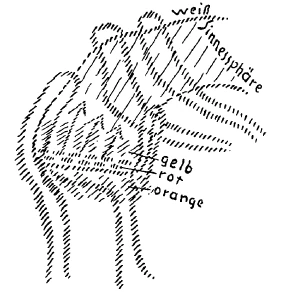
[ 6 ] But what I have described to you so far, as I told you, pertains to a large part of the human being, but not actually to the whole human being. And in order to illustrate what is happening here, I must outline it schematically. Let us assume that this is the sensory region (white)—by which I mean all the senses collectively, including the region of the intellect—then we would arrive, so to speak, at that part of the human organism (red) which reflects back the thoughts we harbor (arrows, red), so that they can become memories—that which in the human being comes into contact with the objectivity of the cosmos. I have already pointed out to you the places in the human body where the human being comes into contact with the cosmos.
[ 7 ] If you trace, say, a nerve that runs from some part of the body to the spinal cord—I’ll draw a schematic diagram—you will find that for every such nerve there is another, or at least for nearly every such nerve there is another, that runs back from somewhere to somewhere else. Physiologists of the senses call one a sensory nerve and the other a motor nerve.
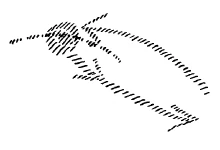
[ 8 ] Well, I’ve spoken quite often already about this nonsense—that there are sensory and motor nerves. But the important thing is that every complete nerve pathway actually originates at the surface of the human body and returns to the surface, but is interrupted somewhere; just as an electrical wire produces a spark, so there is a kind of “spark”—a sensory fluid—that flows from the so-called sensory nerve to the so-called motor nerve. And at those points—there are countless such points, or at least a great many, in our spinal cord, for example, and in other parts of our body—at these points lie the spatial locations where a person does not belong solely to themselves, but belongs to the universe. If you connect all these places with one another, and also include the ganglia of the sympathetic nervous system, then you arrive at this boundary—a boundary that is also physical and physiological. So that you can say: You are, in a sense, dividing the human being in half—it is actually more than half, but let’s assume we split the human being in half—and regard him as a great sensory organ, regard perception through the senses in general as sensory receptivity, processing through the intellect as a further, finer sensory activity, and the emergence of memory images as afterimages that, however, are enduring for life between birth and death, because when memory forms, it comes into contact with the world-ether. Our own ether comes into contact with the world ether, and interactions take place between us and the world ether. The other part of the human being is the one whose terminal organ, so to speak, consists of the limbs—everything that constitutes the limbs. Just as this one part has the sensory sphere as its terminal organ (the word “sensory sphere” is written out), so the other part of the human being has the growing limbs (the drawing on p. 143 is continued): the feet grow, the arms grow. Of course, it is drawn roughly and schematically.
[ 9 ] This is precisely what I would have to depict inwardly—everything that pertains to the will—just as I have depicted everything that pertains to intelligence through the senses, and this connects to the other part of the human being. This aspect of the will is the other pole of the human being. Between the two lies the boundary—the inner boundary—that you obtain when you connect all the nerve endings and all the ganglia. There, if you cross this boundary slightly from one side—so that you imagine this boundary to be a sieve, with the will pressing through the holes of this sieve on one side (see drawing on page 143, orange) and intelligence pressing through the holes of this sieve on the other side (yellow)—then you arrive at the middle: the soul, the sphere of feeling. For everything that belongs to feeling is actually half will and half intelligence. The will pushes from below, intelligence from above: this gives rise to feeling. In feeling, intelligence is always present on one side in a dreamlike state, while the will lies dormant within it on the other side.
[ 10 ] Now that we have, so to speak, dissected the human being from a spiritual-scientific perspective—on the one hand, the pole of intelligence; on the other, the pole of will—and now that we have seen that the physical organs are, in a sense, the outward expression of the pole of intelligence, you may now ask: What in the external world actually corresponds to what is inside the human being—we have now become acquainted with the two poles, the two sides of the human being? Nothing, absolutely nothing, in reality. In the external world, we have a mineral, a plant, and an animal kingdom. What is within the human being—including the physical aspect—does not truly correspond to any of these kingdoms in any way.
[ 11 ] You may now raise a significant objection—one that is, of course, terribly obvious. You will say: Well, we are, after all, made up of the same substances as the external world, for we consume these substances and thus unite ourselves with the substances of the mineral kingdom by salting our food, ingesting other mineral substances, and consuming plants as well. After all, there are meat-eaters, aren’t there? They, too, unite with the substances of animals, and so on. But the fact is that this belief—that we really have something to do with the substances of the external world within our own physicality—contains a terrible error. What our physical body actually does is that it must constantly defend itself against the influences of the external world, including the influences that enter us through our food. It is still very difficult even today to make this fact understood by our fellow human beings, for the essential function of our body does not consist in taking in nutrients, but in expelling them again. Some things we eliminate very quickly, but others only over the course of seven or eight years. Yet none of what you have eaten today will still be within you after eight years. For it has all been replaced, and the activity of your body consists in eliminating, not in absorbing.
[ 12 ] The fact that you must eat has, in essence, no other significance for your body than what the ground has for your walking. If you had no ground beneath your feet, you could not walk, but as a human being you have nothing to do with the ground; it must simply support you. Thus, your bodily activity simply must have a point of support; it must continually meet with resistance, which is why you must eat continuously so that your bodily activity meets with resistance. Just as you would sink into the ground, so would bodily activity sink into nothingness if it did not constantly encounter the ground that is prepared—but now it permeates the entire body. You do not eat in order to unite the food with yourself, but you eat in order to be able to carry out the activity necessary for extracting the food. For your human existence consists in the activity of extracting the food. And just as you cannot count the floor as part of the sole of your foot, so too, if you wish to think the truth, you cannot count what is in the food—insofar as it exists in the external world—as part of your humanity. All in all, a human being is nothing more than a reaction to his environment. A human being is a reaction—nothing but a reaction. For, fundamentally speaking, a human being is activity through and through.
[ 13 ] What I have just explained takes place in very different ways for the organs of the sensory and intellectual spheres, and quite differently for the organs of the volitional sphere. Certainly, in this respect, the human being is a polar entity. But what takes place within these two poles of the human polar being has little to do with what exists in the external world.
[ 14 ] In the outer world, we have the mineral and plant kingdoms. These mineral and plant kingdoms are not closely related to our own being. If we want to find something to which these mineral and plant kingdoms are related, then we must look to the world we experience before our birth—the world we pass through before we descend from the spiritual world into the physical world through birth or conception. When we cast our gaze upon the plant world and the mineral world, we must actually say to ourselves: Before my birth, I was in a spiritual world. I do not perceive this spiritual world through my physical senses, nor do I comprehend it through my physical mind. But this world, which is thus veiled from me when I am a sensory being, reveals itself outwardly in the plant world and in its foundation, the mineral world. The mineral and plant worlds have far more to do with our life beyond this world than with our life between birth and death. Of course, this does not refer to the plants we see in our surroundings through our senses, the ones that reveal themselves to us here: those are the effects of the forces with which we are connected between death and a new birth. Nor does the animal kingdom have much to do with what we are as human beings; it has more to do with the time immediately following ‘death,’ of which it is an outward, polar opposite manifestation. So we can say: We do not come to know what is within the human being when we study the human environment through the natural sciences. And so it is the case that the science of the present—which places particular value on the present—is a science that, in reality, contains nothing of the human being. You may have a thorough understanding of everything that is currently being researched using the scientific method, yet you will learn nothing at all about the essence of the human being through it, for the essence of the human being is not contained within scientific knowledge.
[ 15 ] However, for the past four centuries, all of our popular ideas have stemmed from the popularization of the scientific method. Even the farmer out in the countryside thinks in scientific terms today, even if he still expresses it in his own words. Even Catholicism, with its dogmatic materialism, thinks in scientific terms. Scientific thinking essentially dominates everything. But we have now reached the point where it has become necessary to build a new social order. A large part of today’s civilized world—and this part is growing ever larger and will eventually encompass the entire civilized world—is now driven by the urge to establish a new social order. People are reflecting on the structure of society. Social demands are alive today within civilized humanity. Where did they arise from? They arose from very subconscious impulses within human nature. How does one intend to satisfy them? With the findings of scientific thinking. And today, these scientific findings are broadly referred to as “social thinking,” because they are applied to people’s social lives.
[ 16 ] And so it came to pass that, in Eastern Europe, a new state and social order was to be established based on purely scientific and materialistic thinking. The men whom Dr. Helphand—who calls himself Parvus—imported into Russia, following the instructions of Ludendorff and Hindenburg, so that they might establish Bolshevism there—these men are the embodiment of scientific methods. One might even say: The men of Bolshevism show us the practical test of what the scientific method becomes when it takes root in the minds of certain social revolutionaries. The scientific method in the flesh now resides in Russia thanks to Helphand’s services as a conductor, for he drove the sealed train through Germany to transport the men of Bolshevism to Russia under the auspices of Ludendorff and Hindenburg.
[ 17 ] One must not overlook the significance of this embodied scientific method! I have drawn your attention to a few facts. There were two philosophers—highly bourgeois, narrow-minded philosophers. One taught at the University of Zurich, Avenarius, a man who certainly set out to develop a bourgeois, narrow-minded way of thinking. The other is Ernst Mach, who taught in Prague and Vienna. I myself heard him lecture at the Vienna Academy of Sciences in 1882. To me, this Ernst Mach has always seemed something of an embodiment of bourgeois narrow-mindedness and integrity. If you ask today about the “political philosophy” of Bolshevism, it is no coincidence but an inherent necessity that the philosophy of Avenarius and Mach is its political philosophy, for these things belong together: the utmost rigor of the scientific method transformed into a metamorphosis of social thought. That is why one must take the matter seriously. At first, scientific thinking blossomed as a social phenomenon in the East. It will continue to flourish unless the issue is tackled at its root—in scientific-materialist life itself.
[ 18 ] The point is that a certain wave of thought and feeling is sweeping through the world today. This wave is stirred up by materialistic thinking in the social sciences. As this wave spreads, it is now taking hold of necessary social thought, becoming a destructive force for humanity—an absolutely destructive force for humanity. The ruling, leading circles have not had the power or strength to infuse human thought with a truly sustaining spiritual wave. That is why the materialistic wave has taken hold among the broad masses of the proletariat, in the social thinking of the broad masses of the proletariat. And Marxism, which has in turn experienced such a grotesque resurgence in the last four to five years, is the social flowering and fruit of the materialistic, natural-scientific method in social thinking. One should not fail to recognize that this is the configuration of the present-day civilized world. If one fails to see it, one misses the most important phenomena and symptoms of this life. One is not fully human in the present if one misses these phenomena.
[ 19 ] Some individuals stand out from the general consensus. These individuals already sense to a certain extent today: If we continue to think and feel the way we have been, we cannot go any further—it simply won’t work. We are sinking deeper and deeper into chaos. That is why wake-up calls like the one that follows are rare today, but they do exist—these wake-up calls. Let me read one such wake-up call to you.
[ 20 ] An interesting essay by Karl Polanyi titled “Weltanschauungskrise” appeared in the 31st/32nd issue of the cultural-socialist weekly Neue-Erde in Vienna. In it, he states that a general aversion to the capitalist economic order has set in, coinciding with a turn away from Marxist socialism.
[ 21 ] “Even today, there is still a conflation of Marxism and socialism that is the bane of all modern thought. Every attempt to intellectually address the most pressing social problems of our time fails in the quagmire of this intellectual wasteland...”
[ 22 ] “...The outbreak of the World War marked a turning point for all capitalist—and thus Marxist—thought. The leaders of humanity clearly recognized it, and the masses sensed it vaguely: that the so-called vital interests would never again rule the world, but rather forces of a completely different kind and nature. For the omnipresent economic interests that the imperialists pursued—and against which the socialists fought a quixotic battle—proved not only to be unreal and abstract to the point of being mere clichés, but also to be nothing more than economic superstition and empty fantasies. It became clear that it is not the material, but the idea of this material that is the driving force—and no matter how false or erroneous this idea may be—and that it is therefore ideas, and not the material, that guide the masses. Indeed, even the notion of material interest—this supposedly most concrete and real thing—becomes historically effective only as soon as it is elevated to a belief, when the sacrifices made in its name are no longer counted, and its intrinsic value alone serves as compensation and justification for all the irrational acts committed in its name. This age of the most monstrous paradoxes believed in egoism. It was no longer denied, no longer whitewashed by idealism; on the contrary! Humanity marched to its death in the hallowed name of economic interests, which it surrounded with a halo, and of “Sacro Egoismo,” which had exalted itself to the status of heaven. The material had declared itself to be the sole ideal, and thus the materialistic world completed its course. After all, the capitalists had already called this idealization of the material as the only real and essential thing “the fatherland,” while the Marxists openly called it “socialism!”
[ 23 ] “Utilitarian ethics, a materialist view of history, positivist epistemology, deterministic philosophy: these are no longer viable in the new atmosphere. Marxism, however, as a worldview, is built on these pillars. Its time is over.”
[ 24 ] This is how you see the wake-up call of a soul that, after all, perceives the negative forces leading us into the chaos of our time. And now comes the question—a terrible, fateful question. It is this: “What should take its place?”
[ 25 ] This question is raised by the very person who wrote everything I just read to you. He goes on to say: “The answer to this question is not decisive for the fate of Marxism.” For sincere minds striving for clarity, this is a secondary concern. Even if the sun were to go out, one would have to find one’s way in the dark rather than mistake a will-o’-the-wisp for the sun.”
[ 26 ] “But what darkens the sun for our generation is a new one, even brighter and more radiant, rising on the horizon. Freed from the nightmare of a theory of evolution, in whose treadmill we were condemned to eternal collaboration, restless and homeless, eking out our meaningless existence; awakened from the hallucination of a distorted view of history, which imagined that in world events it heard not the echo of those crying out in the struggle, but in their cries the mere echo of world events; having outgrown the delusion of a clownish determinism that portrayed our free will as a game of chance orchestrated by forces acting behind the scenes, finally born from the belief in the dead mass to the belief in ourselves, we will find within us the strength and the calling to make socialism’s demands for justice, freedom, and love a reality for humanity as well.”
[ 27 ] Yes, a yearning soul that sees: we are heading toward chaos, a soul that even raises the fateful question: What will take its place? — and which then goes on to offer an answer, only to serve up the same old clichés that have become nothing more than empty phrases: justice, freedom, and love. They have been preached long enough. This phrase truly does not contain the concrete path forward.
[ 28 ] “Marxist socialism today merely obscures the question of destiny facing humanity; it stifles the free forces needed for a radical solution, keeps thought in the twilight of an outdated world of dogma, and paralyzes action through dark prophecies, obscure authorities, and mystical symbols. It blocks humanity’s clear view.”
[ 29 ] True: “It obscures humanity’s clear view”—but empty phrases will not clear that view! And then the author continues: “The Church has outlived its purpose by a thousand years. Marxism may outlive us, but the new spirit born of the misery of this world war will certainly outlast it.”
[ 30 ] But where is this new spirit? So says the author, who, it seems, has a sense of the futility of our time, of that which leads into chaos. Well, a friend of ours, who has long been part of our worldview, adds a few lines to what I have just read to you. What I have read to you so far is precisely from someone who sees that something new must come, but who ultimately sticks to the old clichés. Our friend adds: “Here we see a worldview that recognizes that Marxism—as it appears today in its most consistent form in Bolshevism—belongs to the old way of thinking. It is merely the antithesis of the old capitalist world. Like the latter, it suffers from a deficiency in spiritual life. While it is its economic opponent, it is one with it in its spiritual foundation. In its place—and in the place of the modern scientific worldview—a new one is to emerge: an anthroposophical worldview arising from a ‘Philosophy of Freedom.’”
[ 31 ] These are, admittedly, just a few lines added by a friend of our movement, but it is clear to anyone who looks into the workings of humanity today that, precisely because things are as they are, this anthroposophical spiritual science seeks to emerge. And until we admit that the disease afflicting our present-day existence can only be healed through anthroposophically oriented spiritual research, there will be no way out of this chaos.
[ 32 ] One can therefore say without modesty: If only there were enough people who, when asked, “What should take its place?”—would give the same answer as Dr. Kolisko in Vienna gave to Karl Polanyi. As long as people believe that the salvation of our movement lies in some form of sectarianism, they will never recognize the meaning of this movement. Only when they realize that we are dealing with a global issue will they recognize the meaning of this movement.
[ 33 ] Only those who not only recognize the meaning of this worldview in this way but also make it the innermost impulse of their own will can truly embody it. I do not wish to embellish with many words what I wanted to say to you in this lecture. After all, we will see each other again here for similar discussions before too long. We don’t even need to say goodbye, because this time it won’t take so long.
[ 34 ] But I must say that it would fulfill a deep longing of my heart if quite a few of you would take the words I used to point out a most important aspect of our current global situation very much to heart, especially in the coming weeks.
[ 35 ] We have spoken of various harmful influences from the elemental world in our present time. You know that an ancient, true view—which one need only understand correctly—states that with the end of the civil year, as the Christmas season approaches, there come those days when the most spiritual influence that can act upon human beings within the earthly sphere is at its most intense.
[ 36 ] Perhaps, especially during this time of year—which for centuries has been so important and essential to people, yet in our time is little more than an occasion to give “appropriate gifts”— are we perhaps, in keeping with an ancient spiritual custom, seeking refuge in those equally ancient spiritual powers that can still influence our human destiny—if we allow the full gravity of the relationship between the spiritual world and the human world to take effect upon our souls!
[ 37 ] That is what I wanted to talk to you about today.
[ 38 ] When I give another presentation here, you will be notified.