

Michael's Message
The True Mysteries of Human Nature
GA 194
12 December 1919, Dornach
Translated by Steiner Online Library
Ninth Lecture
[ 1 ] Since our departure has been delayed by a few days, I am able to speak to you here today, tomorrow, and the day after tomorrow. This gives me particular satisfaction, as a number of friends from England have arrived here, and in this way I will be able to say a few words to them before we leave.
[ 2 ] These friends will have seen that construction of the Goetheanum has progressed during these difficult years. It has not, of course, been completed to this day, and we can hardly predict with any certainty at this time when it will be finished. But what already exists today will show you the spiritual foundations from which this building has grown and how it is connected to the spiritual movement represented here. Therefore, on this occasion in particular—when, after a long time, I am once again able to speak to a large number of our English friends—it will be appropriate to take our building itself as the starting point for our reflections today. Over the next two days, we will then be able to add to what can be said about the building some other points that, it may be argued, are particularly important to address at this very moment.
[ 3 ] Anyone who looks at our building—which, at least in concept, can already be grasped today—will notice the unique connection between this building and our spiritual movement, and will gain an impression, perhaps precisely from this building, this representation of our spiritual movement, of the nature of this movement. Consider this: if any sectarian movement—no matter how widespread—had felt compelled to build such a house for its gatherings, what would have happened? Well, a building of greater or lesser size, in one architectural style or another, would have been erected according to the needs of that society or association, and you might have found within it, through one or another more or less symbolic sign, a hint as to what is intended to take place there. You might also have found a picture here or there that would have alluded to what is intended to be taught or otherwise presented within this building. All of this, as you will have noticed, did not come to pass in the case of the Goetheanum. This building was not merely erected in an external sense for the use of the anthroposophical movement or the Anthroposophical Society; rather, just as it stands, in all its details, it has emerged from what our movement seeks to present to the world—both in spiritual terms and in other respects. This movement could not be content merely to erect a building in this or that architectural style; the moment the possibility of building such a home of our own arose, this movement felt compelled to find its own style based on the foundations of our spiritual science—a style through which, in every detail, is expressed that which flows as spiritual substance through our movement. Here, for example, it would have been unthinkable to simply have any house built in any architectural style specifically for our movement. From this one should conclude from the outset just how far removed what is intended by this movement is from any other movement—be it a sectarian one or similar—no matter how widespread it may be. We needed not merely to build a house, but to find an architectural style that expresses exactly the same thing as is expressed by every word, by every sentence of our anthroposophically oriented spiritual science.
[ 4 ] Yes, I am convinced that if one delves sufficiently into what can truly be felt in the forms of this building—note that I say “can be felt,” not “can be imagined”—then those who can feel this will be able to read from the felt forms of this building that which is otherwise expressed through words.
[ 5 ] This is not a superficial matter; it is something that is deeply connected to the very nature of how this spiritual movement is conceived. This spiritual movement aims to be something different from, in particular, those spiritual movements that have gradually emerged within humanity since the beginning of the fifth post-Atlantean cultural epoch—let us say, since the middle of the 15th century. And underlying this is the conviction that today—that in the present—it is necessary to introduce something different into the evolution of humanity than what has been introduced into this human evolution since the mid-15th century. The most characteristic feature of everything that has taken place in civilized humanity over the last three to four centuries seems to me to be the following: External life practices in the broadest sense—which have, after all, become highly mechanized—now constitute a realm of their own. They form a realm of their own that is, in a sense, claimed as a monopoly by those who imagine themselves to be practitioners of life. Alongside these external life practices, which have taken shape in all areas of so-called practical life, we have a body of spiritual views, worldviews, philosophies, or whatever one wishes to call them, which have, in essence, gradually—but especially over the course of the last three to four centuries—become alienated from life; which, in a sense, hover above the actual practice of life in terms of the feelings and sensations they impart to human beings. And so stark is the difference between these two currents that one can say: With our present age, a time has dawned in which these two currents no longer understand one another at all—or perhaps better said, in which they find no common ground upon which to interact with one another. Today we run our factories, we keep our railroads running on the tracks, and we send our steamships across the seas; we operate our telegraphs and telephones—we do all this by, so to speak, letting the mechanics of life run automatically and allowing ourselves to be drawn into these mechanics. And alongside all this, we preach. In fact, there is a great deal of preaching. The old creeds are preached in churches; politicians preach in parliaments; the various movements in different fields speak of the demands of the proletariat and the demands of women. There is much, much preaching, and the content of this preaching is, in the sense of today’s human consciousness, certainly something clearly intended. But if we were to ask ourselves: Where is the bridge between what we preach and what our outward life actually builds in practice?—then, if we wanted to answer honestly and truthfully, we would not find a proper answer within the current movement of our times.
[ 6 ] The only reason I mention the following phenomenon is because it is most clearly illustrated by this example: As you know, in addition to all other opportunities to preach, there are all sorts of secret societies for humanity today. If we take, for example, the ordinary Masonic lodges—including those with their deepest or highest degrees—we find a set of symbols: the triangle, the circle, the square, and the like. We even find a term frequently used in such contexts: “the Architect of the Universe.”
[ 7 ] What is all this? Yes, if we go back to the 9th, 10th, and 11th centuries and look at the civilized world—within which these secret societies, these Masonic lodges, spread like the cream of civilization—we find that all the tools that today lie as symbols on the altars of these Masonic lodges were used for building houses and churches. They had protractors, they had compasses, they had spirit levels, plumb lines—they used them in their practical daily lives. In the Masonic lodges, drawing on things that have completely lost their connection to practical life, people give speeches and say all sorts of beautiful things about them—things that are certainly very beautiful, but which are completely alien to external life and practical living. We have arrived at ideas, at mental constructs, that lack the driving force to intervene in life. We have gradually reached a point where our people work from Monday through Saturday and listen to the sermon on Sundays. These two things have nothing to do with one another. And often, when we preach, we use the things that in earlier times were intimately connected with the practical realities of life as symbols of beauty, of truth, and even of virtue. But these things are alien to life. Indeed, we have come to believe that the more detached from life our sermons are, the more they rise into the spiritual realms. The ordinary, secular world is something inferior. And today we look upon all manner of demands rising from the depths of humanity, but we do not truly understand the essence of these demands. For what connection is there, after all, between those social sermons—delivered in more or less beautiful rooms—about how good human beings are, about how one should, well, let’s say, love all people without distinction of race, nation, and so on, or even color—what connection is there between these sermons and what happens outwardly, and what we thereby promote, what we thereby do, when we clip our coupons and have our pensions paid out by the banks, which use these funds to sustain outward life—according to principles that are truly quite different from those we speak of as the principles of good people in our living rooms? For example, we establish theosophical societies in which we speak of brotherhood for all people, yet what we say lacks even the slightest impetus to somehow control what also happens through us when we clip our coupons. For by clipping the coupons, we set in motion a whole series of economic processes. Our lives are completely divided into these two separate currents.
[ 8 ] So it can happen—I’m not telling a textbook example, but a real-life one—it can happen, and it has even happened, that a lady came to see me and said: “Yes, someone comes along and asks me for a donation, but then it’s used to support people who drink alcohol.” “As a Theosophist, I simply cannot do that!”—that’s what the lady said. All I could reply was: “Look, you’re a pensioner; do you have any idea how many breweries are founded and maintained with your wealth?” — What really matters is not that, on the one hand, we preach for the sensual satisfaction of our souls, and on the other hand, we throw ourselves into life just as the routine of daily life—which has developed over the last three to four centuries—demands. Few people today are even inclined to address this fundamental problem of our time. Where does this come from? It stems from the fact that this dualism has truly taken hold—and has become most pronounced over the last three to four centuries—between our external life and our so-called spiritual aspirations. When most people speak of the spirit today, they speak of something entirely abstract, something alien to the world, not of something capable of intervening in everyday life.
[ 9 ] The question—the problem to which this alludes—must be addressed at its root. If action had been taken here on this hill in keeping with the aspirations of the last three to four centuries, then perhaps one would have turned to any architect—a famous architect—and had a beautiful building erected here, which could certainly have been very beautiful in any architectural style. That could never have been the point. For then we would have entered this building, we would have been surrounded by all manner of beauty from this or that style, and we would have spoken words inside that would have suited this building—much as all the fine speeches delivered today suit the outward way of life that people practice. That could not be the case, for that was not the intention of spiritual science, which seeks to be guided by anthroposophy. From the very beginning, it was conceived differently. It was conceived in such a way that the old, false opposition between spirit and matter was not erected—an opposition in which spirit is then treated in the abstract and has no possibility of immersing itself in the essence and interplay of matter. When is it justified to speak of the spirit, and when does one truly speak of the spirit? One speaks truly of the spirit—and justifiably so—only when one regards the spirit as the creator of that which is material. The worst kind of talk about the spirit—even though this worst kind of talk is often regarded today as the most beautiful—is when one speaks of the spirit as existing in a cloud-cuckoo-land, in such a way that this spirit should not be touched at all by the material. No, one must speak of the spirit in such a way that one means the spirit that has the power to immerse itself directly into the material. And when one speaks of spiritual science, it must not be conceived merely as something that rises above nature, but as a fully-fledged natural science at the same time. When one speaks of the spirit, one must mean the spirit with which human beings can connect in such a way that this spirit can also weave itself into social life through human mediation. A spirit of which one speaks merely in the salon as the one whom one seeks to please through goodness and brotherly love, and who is careful to avoid immersing himself in immediate life—such a spirit is not the true spirit. Such a spirit is a human abstraction, and the elevation to it is not an elevation to the true spirit, but is, in fact, the ultimate manifestation of materialism.
[ 10 ] Therefore, we had to establish a structure that has been carefully conceived in every detail, drawing upon what is otherwise alive in our anthroposophically oriented spiritual science. And this is also connected to the fact that, in these difficult times, an approach to the social question has emerged from this spiritual science—one that does not wish to dwell in a fantasy world, but rather sought to be a matter of life from the very beginning of its work; one that sought to be the exact opposite of any kind of sectarianism; one that sought to discern what lies in the great demands of the times; and one that sought to serve these demands of the times. Certainly, much has not gone well with this building. But today it is truly not a matter of everything succeeding at once; rather, it is a matter of making a start—a necessary start—in certain things. And it seems to me that this necessary start has at least been made with this building. Thus, when this building is one day completed, we will not be carrying out what we must accomplish within something that surrounds us like alien walls, but just as the nut shell belongs to the nut and is perfectly adapted in its form to that nut, so too will every single line, every single form and color of this building be perfectly suited to that which flows through our spiritual movement.
[ 11 ] It is essential that at least some people today recognize this desire, for it is this desire that matters.
[ 12 ] I must return once more to certain characteristic features that have come to light in the evolution of civilized humanity over the last three to four centuries. In this evolution of civilized humanity, we find phenomena that so characteristically express the deeper foundations of that which is currently being driven to absurdity in human life; for it is indeed a driving to absurdity. It is true that today a large part of the human soul is actually asleep—truly asleep. If one is somewhere where certain things—which today, I would say, are true counter-images, opposites of all civilized life—are taking place; if one is somewhere where these counter-images do not appear directly before one’s eyes, but are nonetheless unfolding in numerous regions of today’s civilized world and are significant and symptomatic of what is bound to spread further and further, then one finds: Yes, people’s souls are out there, outside the most important events of the times. People go about their daily lives without clearly keeping in mind what is actually happening in the present, as long as they are not directly affected by these events. But indeed, the actual impulses of these events also lie in the depths of people’s subconscious or unconscious soul life.
[ 13 ] Underlying the dualism I have mentioned is, in fact, a different one today: the dualism that finds expression, for example—and I mean to cite a characteristic example—in Milton’s Paradise Lost. But this is merely an outward symptom of something that pervades all of modern thinking, perception, feeling, and volition. In the modern human consciousness, we have a sense of a contrast between heaven and hell; others call it spirit and matter. Fundamentally, there are only differences of degree between the heaven and hell of the farmer out in the countryside and between the matter and spirit of the so-called enlightened philosopher of our day. The actual thought impulses underlying them are exactly the same. The real opposition is that between God and the devil, between paradise and hell. One thing is certain to people: Paradise is good, and it is terrible that humans have left Paradise; Paradise is something lost, it must be sought again, and the Devil is a terrible adversary who opposes all those forces associated with the concept of Paradise. People who have no idea how spiritual opposites extend all the way to the outermost reaches of our social oppositions and social demands cannot even imagine the far-reaching significance of this dualism between heaven and hell or between the lost Paradise and the earth. Today one must speak in rather paradoxical terms if one wishes to speak the truth; in fact, it is often nearly impossible to speak the truth about certain things without that truth appearing to our contemporaries as madness. But just as, in the Pauline sense, the wisdom of humans can be folly before God, so too might the wisdom of today’s humans—or the madness of today’s humans—appear as madness to the perspective of future generations. People have gradually deluded themselves into seeing such a contrast between the earth and paradise; they equate paradise with what is actually the human-divine ideal to which one should aspire, and do not realize that striving for this paradise is just as harmful to human beings—if they seek it uncritically—as striving for its opposite would be. For if one conceives of the structure of the world as it underlies the Milton’s Paradise Lost, then one is effectively rebranding a power that is detrimental to humanity—when pursued one-sidedly—as a divinely good power, and setting it against a contrast that is no true contrast: the contrast of the Devil, the contrast of that which in human nature resists the good.
[ 14 ] The protest against this view is to be embodied in the group that is to be placed inside the eastern part of our building—a nine-and-a-half-meter-tall wooden sculpture in which, in place of—or rather, replacing—the Luciferic opposition between God and the Devil, is placed that which must underlie the consciousness of humanity in the future: the trinity of the Luciferic, the Christ-like, and the Ahrimanic.
[ 15 ] Modern civilization is so unaware of the mystery that underlies this that the following can be said. For certain reasons—which I may well return to here—we have named this building the “Goetheanum,” as it is founded on Goethe’s approach to art and knowledge. But at the same time, it must be said here: In the contrast that Goethe established in his Faust between the good powers and Mephistopheles lies the same error as in Milton’s Paradise Lost: on the one hand, the good powers; on the other, the evil power of Mephistopheles. In this Mephistopheles, Goethe has jumbled together the Luciferic on one side and the Ahrimanic on the other, so that in Goethe’s figure of Mephistopheles, for those who see through the matter, two spiritual individualities are mixed together—mixed together in an inorganic way. Human beings must recognize how their true nature can only be expressed through the image of balance: how, on the one hand, human beings are tempted, so to speak, to reach beyond their heads—to reach into the realm of the fantastical and the dreamy, into the realm of the false mystical, into all that is fantastical. That is one power. The other force is the one that, so to speak, pulls a person down into the materialistic, into the sober, the dry, and so on. We can only understand a person when we conceive of their nature as striving for a balance between, let us say, the Ahrimanic on one side of the scale and the Luciferic on the other. (See illustration, p. 165.)
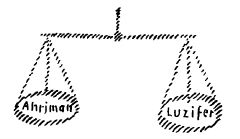
[ 16 ] Human beings must constantly strive to maintain a balance between these two forces: the one that seeks to lift them above themselves, and the one that seeks to drag them down below themselves. Now, modern spiritual civilization has confused the fanciful and enthusiastic nature of the Luciferic with the Divine. Consequently, what is described as paradise is in fact a depiction of the Luciferic, and people commit the terrible error of confusing the Luciferic with the Divine because they do not realize that what matters is maintaining a balance between two forces that pull human beings in opposite directions.
[ 17 ] This fact had to be revealed first. If a person is to strive for what is called “Christianity”—a term that today is often understood to mean strange things— then they must be clear that this can only be a striving toward a state of balance between the Luciferic and the Ahrimanic, and that the last three or four centuries, in particular, have so thoroughly obscured the knowledge of the true human nature that little is known of this balance, and the Luciferic has been rebranded as the Divine in Paradise Lost, and has turned the Ahrimanic into an antithesis—one that is no longer Ahriman, but has become the modern devil, or modern matter, or something of the sort. This dualism—which is in reality a dualism between Lucifer and Ahriman—haunts the consciousness of modern humanity as the opposition between God and the devil. And “Paradise Lost” should actually be understood as a depiction of the lost Luciferic realm; it has merely been renamed.
[ 18 ] Today, it is so important to point people toward the spirit of modern civilization because humanity needs to become clear about how it has strayed onto a downward path—it is a historical necessity, but necessities are also meant to be understood—how it has strayed onto a downward path and, as I said, can only find its way back up again through the most radical course of action. Today, the description of the spiritual world is often understood as a depiction of what is supersensory, but which does not live here on our Earth. People wish to use a spiritual vision to escape from what surrounds us here on our Earth. People do not realize that—by fleeing into an abstract spiritual realm—they find not the spirit, but the Luciferic region. And much of what is called mysticism today, what is called theosophy today, is a seeking out of the Luciferic region. For mere knowledge of a spirit cannot underlie people’s spiritual striving today, because it is appropriate to this present-day spiritual striving to recognize the connection between the spiritual worlds and the world into which we are born to live between birth and death.
[ 19 ] This question should particularly strike a chord with us when we turn our gaze toward the spiritual worlds: Why are we born from the spiritual worlds into this physical world? — Well, we are born into this physical world—and tomorrow and the day after tomorrow I will elaborate in greater detail on what I am outlining today—because here on this Earth there are things to experience, things to live through, that cannot be experienced in the spiritual worlds; rather, in order to experience them, one must descend into this physical world, and one must carry the results of these experiences from this physical world back up into the spiritual worlds. To achieve this, however, one must also immerse oneself in this physical world; one must immerse one’s spirit in this physical world through knowledge. For the sake of the spiritual world, one must immerse oneself in this physical world.
[ 20 ] Let’s take, to put it in radical terms—which is what I want to say—a normal person of today who eats a healthy diet, gets his fair share of sleep, eats breakfast, lunch, and dinner, and so on, and who also has spiritual interests—even lofty spiritual interests—and who becomes a member, let’s say, of a theosophical society because of those interests, and who goes to great lengths to find out what is happening in the spiritual worlds. Let’s take such a person, who, so to speak, has at his fingertips everything that is reported in this or that contemporary theosophical literature, but who otherwise lives according to the ordinary customs of life. Let us take this person! What does all the knowledge he acquires through his higher spiritual interests actually mean? It means something that can provide him with a certain inner, soulful pleasure here on Earth—a truly Luciferic delight, even if it is a refined, sophisticated pleasure of the soul. None of it is carried through the gate of death; absolutely none of it is carried through the gate of death. For among such people—and they are very common—there may be those who, even though they have in their little finger what an astral body, an etheric body, and so on are, have no idea what is going on when a candle burns. They have no idea what magical feats are being performed so that the streetcar can run out there. They ride it, yes, but they know nothing about it. But there’s more: although they know all too well what an astral body, an etheric body, karma, and reincarnation are, they have no idea what is being discussed or strived for, for example, in today’s gatherings of working-class people. They aren’t interested. They’re only interested in what the etheric body looks like, what the astral body looks like; they aren’t interested in the paths capital has taken since becoming the de facto ruling power at the beginning of the 19th century. Knowledge of the etheric body and the astral body is of no use once people have died. This is precisely what must be said based on a genuine understanding of the spiritual world. It has value only when this spiritual understanding becomes the instrument for immersing oneself in material life and, there in material life, taking in that which cannot be taken in within the spiritual worlds themselves, but which must be carried into them.
[ 21 ] Today we have the natural sciences, which are taught at our universities in a wide variety of fields. Experiments are conducted, research is carried out, and so on. That is how the natural sciences come about. We use these natural sciences to advance our technology; with them, we are already healing people today and doing all sorts of things. Alongside this, there are church creeds. But I ask you: Have you ever paid attention to the content of such ordinary Sunday afternoon sermons, where, for example, they speak of the Kingdom of Christ and so on? What connection is there between the natural sciences and what is being said there? For the most part, none at all. The two run parallel to one another. Some believe they possess the right authority to speak about God, the Holy Spirit, and all manner of things. Even if they say they feel these things, they still speak of them in abstract terms, through abstract concepts. Others speak of a spiritless nature. No bridge is built! Then, in more recent times, we have even encountered all sorts of theosophical and mystical views. Yes, these mystical views speak of all manner of things far removed from life, but they do not speak of human life, because they lack the power to immerse themselves in human life. I would like to ask: would one truly be speaking of a Creator of the world in the proper sense if one conceived of him as a very interesting and beautiful spirit who could never have brought about the creation of the world? The spiritual powers that are often spoken of today could never have brought about the creation of the world, for the ideas we form about them are not even capable of intervening in what constitutes our knowledge of nature or our knowledge of human social life.
[ 22 ] Perhaps I may, without being immodest, illustrate what I mean with an example. In one of my most recent books—On the Mysteries of the Soul — I drew attention to this, and I have often spoken about it in lectures: the nonsense taught in modern physiology—which is, after all, a natural science—namely, the notion that there are two kinds of nerves in humans: motor nerves, which underlie the will, and sensory nerves, which underlie perceptions and sensations. Well, ever since the advent of telegraphy, we’ve had this image of how it works. So: a nerve runs from the eye to the central organ, and then from the central organ it runs back to some limb. We see something moving there—a limb—so the telegraph wire runs from this organ, the eye, to the central organ, which activates the motor nerve, and then the movement is carried out.
[ 23 ] They let the natural sciences teach this nonsense. One must let it teach this, for people speak in abstract, intellectual terms about all manner of things, yet they do not develop thoughts that can positively intervene in the workings of nature. Intellectual concepts lack the power to develop knowledge of nature itself. For there is, in fact, no difference between motor and sensory nerves; rather, what are called “volitional nerves” are also sensory nerves—they exist solely to enable us to perceive our own limbs when movements are to be carried out. The textbook example of tabes proves precisely the opposite of what is supposed to be proven. I do not wish to go into this further, because you lack the necessary prior knowledge of physiology. I would, however, very much like to discuss these matters at some point with a group of people who have a background in physiology and biology. Here, though, I simply want to point out that, on the one hand, we have the natural sciences, and on the other, talk and preaching about spiritual worlds that do not penetrate any of the real worlds present to us in nature. But that is precisely what we need. We need an understanding of the spirit that is so strong that it can simultaneously become natural science. We will attain this only if we take into account the will to which I wanted to draw your attention here today. If we had wanted to found a sectarian movement that merely espouses some dogmatism about the divine and the spiritual and that requires a building, we would have erected some building—or had one erected. Since we did not want that—but rather wanted to indicate, even in this outward act, that we wish to immerse ourselves in life—we had to build this structure ourselves, entirely out of the will of spiritual science. And in the details… of this building, one will one day see that truly important principles—which today, under the influence of the two dualisms mentioned, are cast in the most false light—can be placed on a sound foundation. I would just like to draw your attention to one thing today.
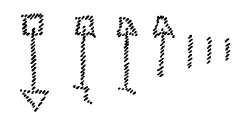
[ 24 ] Take a look at the seven consecutive columns standing on each side of our main building (it is drawn): Above them are capitals, and below them are bases. They are not identical; rather, each subsequent one develops from the preceding one. So that you can gain a sense of the second capital if you immerse yourself fully in the first and its forms, bring to life the idea of metamorphosis as an organic process, and now truly have such a vivid idea that this thought is not abstract, but rather follows the process of growth. Then you can see the second capital develop from the first, the third from the second, the fourth from the third, and so on up to the seventh. In this way, an attempt has been made to develop one capital, one architrave, and so on from another through living metamorphosis, to replicate the creative process that lives as spiritual creation within nature itself, as nature brings one form forth from another. I have the feeling that no capital could be any different from what it is now.
[ 25 ] But something very strange has come to light in this regard. When people talk about evolution today, they often say: development, development, evolution—first the imperfect, then the somewhat more perfect, the more differentiated, and so on—and the more perfect things always become the more complicated ones. I couldn’t follow that approach when I was developing the seven chapters based on metamorphosis; but when I got to the fourth chapter, it became clear to me that I had to make this fourth chapter—since I now had to develop the next one, the fifth, which was supposed to be more perfect than the fourth—the most complex one. That is to say, when I was not, like Haeckel or Darwin, merely pursuing abstract concepts in my mind, but when I had to create the forms in such a way that each form emerged from what preceded it—just as in nature itself one form follows another from the vital forces— I was compelled, while making the fifth form more artful in its surfaces than the fourth, to ensure that the entire form became simpler rather than more complicated. And the sixth became simpler again, and the seventh even simpler still. And so it became clear to me that evolution is not a progression toward ever greater and greater differentiation (a straight line is drawn on the board), but rather that evolution is an ascent to a higher point, followed by a descent into ever simpler and simpler forms.
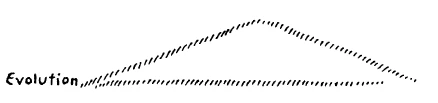
[ 26 ] This simply emerged from the work itself. And I could see how this principle of evolution that arises in artistic work is the same as the principle of evolution in nature.
[ 27 ] For if you consider the human eye, it is certainly more perfect than the eyes of some animals. But the eyes of some animals are more complex than the human eye. For example, they contain certain blood-filled organs—the sword-shaped process and the fan—which are not present in humans; they have, so to speak, been eliminated. The human eye, in turn, is simpler compared to the structures of some animal eyes. If we trace the evolution of the eye, we find that it is primitive and simple at first, then becomes increasingly complex, but eventually simplifies again; and the most perfect form is not the most complex, but rather one that is simpler than the intermediate form.
[ 28 ] And one was compelled to do it this way, by artistically giving form to what an inner necessity demanded be given form. The aim here was not to conduct research into something, but rather to establish a connection with the vital forces themselves. And in our building here, the aim was to shape the forms in such a way that these very forces—which, as the spirit of nature, underlie nature itself—are embodied within them. We seek a spirit that is truly creative, that lives within the world’s creations, and that does not merely preach. That is the essence. That is also the reason why there was some friction here with those who wanted to adorn our building with all sorts of symbols and the like. There is not a single symbol in the building; rather, everything consists of forms modeled after the creative work of the spirit in nature itself.
[ 29 ] This, however, marks the beginning of a desire that must be carried forward. And it would be desirable for this very aspect of the matter to be understood—for people to understand how, in fact, we should seek the original sources of human intention and human creativity, which are necessary in all areas for modern humanity. After all, we live today amidst a multitude of demands. But these are all individual demands; they spring up from various spheres of life. Yet we also need a synthesis. It cannot come from anything that merely hovers within the sphere of external, visible existence, for everything visible is grounded in the comprehensible, and this is what we must grasp today. I would like to say: One should listen very closely to the things happening today, and one will find that it is not such an absurd idea that the old is collapsing. But then there must be something that can take its place. Yet to come to terms with this idea, one needs a certain courage that is not acquired in external life, but must be acquired from within.
[ 30 ] This courage—I do not wish to define it, but rather to characterize it. The slumbering souls of today will certainly be delighted if, here and there, someone appears who can paint like Raphael or Leonardo. That is understandable. But today we must have the courage to say that only those who know that it is neither possible nor permissible today to create as Raphael and Leonardo did have the right to admire them. Finally, one can say something quite philistine to illustrate this: Only those who do not believe that the Pythagorean theorem is something to be discovered anew today have the right to recognize its intellectual significance. Every thing has its time, and things must be understood within the context of their specific time.
[ 31 ] Today, one actually needs more than some people are willing to muster, even when they join some kind of spiritual movement: today, one needs the realization that we must face a renewal of the very nature of human development. It is facile to say that our time is a time of transition. Every era is a time of transition; what matters is knowing what is changing. So I do not wish to state this truism—that our time is a time of transition—but I would like to say this instead: People are constantly saying that nature and life do not make leaps. It is very wise to say: “Gradual development, no leaps anywhere!” — Well, nature is constantly making leaps. (A diagram is drawn:) It gradually forms the green leaf, transforming it into the different-shaped sepal, into the colorful petal, into the stamens, into the pistil.
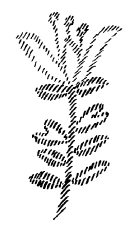
[ 32 ] Nature constantly makes leaps by forming a single structure; higher life constantly undergoes transformations. We see in human life how the change of teeth brings about entirely new circumstances, and how sexual maturity brings about entirely new circumstances. And if the powers of observation of people today were not so limited, one would be able to perceive a third epoch around the age of twenty, and so on and so forth, in human life.
[ 33 ] But history itself is also an organism, and such leaps do occur. People simply pass them by. People today have no awareness of what a significant leap took place at the turn of the 14th and 15th centuries—or, more precisely, in the middle of the 15th century. But what was set in motion back then is destined to come to fruition in the middle of our century. And it is truly no mere speculation, but something that can stand alongside all exact truths, when one speaks of how the events that so stir humanity—and which have reached such a culmination in recent times—point toward something that can truly be identified as preparatory and as breaking in with great force upon human evolution by the middle of this century. Anyone who does not wish to establish ideals for human development out of mere caprice, but who seeks to find spiritual science through the creative forces of the world—a science that can then flow into life—must address such matters.