

Michael's Message
The True Mysteries of Human Nature
GA 194
13 December 1919, Dornach
Translated by Steiner Online Library
Tenth Lecture
[ 1 ] Yesterday I spoke to you about the relationship between anthroposophically oriented spiritual science and the forms of our building. I wanted to emphasize in particular that the relationship between this building and our spiritual science is not merely external, but that, in a sense, the spirit that reigns in our spiritual science has flowed into these forms. And special emphasis must be placed on the fact that, in a sense, it can be said that a genuine, intuitive understanding of these forms involves discerning the inner meaning present in our movement. Today I would like to address a few more points regarding the building, and then, building on that, present some important aspects of anthroposophy to you today or tomorrow.
[ 2 ] If you look at the building, you will see that its floor plan consists of two interlocking circles, one smaller and one larger, so that I could sketch the floor plan roughly like this (the floor plan is drawn).
[ 3 ] The entire building is oriented from east to west. (An east-west line is drawn.) You will have noticed that this east-west line is the only axis of symmetry, meaning that everything is symmetrically oriented relative to this axis.
[ 4 ] Incidentally, we are not dealing here with a mere mechanical repetition of forms, as is otherwise found in architecture—such as identical capitals or the like—but rather, as I explained yesterday, with an evolution of forms, with later forms emerging from earlier ones.
[ 5 ] Finally, you will find the outer colonnade, with seven columns on the left and seven on the right. (The columns are indicated.) And as I mentioned yesterday, these seven columns have capitals and bases, and above them are the corresponding architraves, which evolve in form over time.
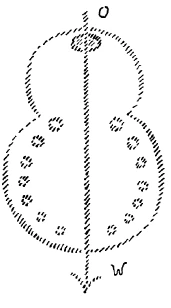
[ 6 ] If you sense this outline, then you will simply find within these two interlocking circles—but you must grasp it intuitively—something that points to the evolution of humanity. I already said yesterday that around the middle of the 15th century, a very significant turning point in the development of humanity can be observed. What is conventionally and superficially called “history” is, after all, nothing more than a fable convenue, for it records external facts in such a way as to create the impression that human beings were, in essence, already in the 8th and 9th centuries in the same state as they were, say, in the 18th or 19th centuries. Even more recent historians, such as Lamprecht, have come to realize that this is nonsense—that in fact, the spiritual constitution and mood of people were entirely different before and after the periods in question. And we today are in the midst of a process of development that we can only understand if we become aware that we are developing toward the future with unique soul forces, and that those soul forces which underwent their development up to the 15th century—though they still, one might say, still haunt human souls—they are fading away—but that they belong to what is passing away, to what is doomed to fall out of the course of human evolution. We must develop an awareness of this important turning point in human evolution if we are to become capable of having a say in the affairs of humanity in the present and in the near future.
[ 7 ] Such things are particularly evident when people want to meaningfully express what they feel and what they experience. We need only recall one aspect of the development of architecture—which we have already mentioned here, but to which I would like to draw attention once again today—in order to illustrate, by means of an example, how the development of humanity progresses.
[ 8 ] Consider the forms of a Greek temple. How can one understand the forms of a Greek temple? One can only understand them if one is clear that the entire architectural concept of this Greek temple is oriented toward making the temple the dwelling place of the god or goddess whose statue stood within it. All the forms of the Greek temple would be nonsensical if one did not conceive of it as the enclosure, the dwelling place of the god or goddess who was to stand within it.
[ 9 ] As we move on from the forms of the Greek temple to the next, equally significant forms of architecture, we arrive at the Gothic cathedral. Anyone who enters a Gothic cathedral and feels that they are looking at something complete and finished does not understand the forms of Gothic architecture, any more than someone understands the forms of the Greek temple if they view it as a space that contains no image of a god. A Greek temple without a divine image—we need only imagine it inside, but to understand the form, it must be imagined inside—a Greek temple without a divine image is an impossibility for the sensuous understanding. A Gothic cathedral that is empty is also an impossibility for the person who truly feels such things. The Gothic cathedral is not complete until the congregation is inside, until it is filled with people, and in fact only then—when it is filled with people and the Word is spoken to them, so that the spirit of the Word reigns over the congregation or in the hearts of the congregation. Then the Gothic cathedral is complete. But the congregation is an integral part of it; otherwise, the forms are incomprehensible.
[ 10 ] What kind of evolution are we actually looking at here, from the Greek temple to the Gothic cathedral? The others are, in essence, intermediate forms, no matter what erroneous historical interpretations may claim. What kind of evolution are we looking at here? When we look at Greek culture—that flowering of the fourth post-Atlantean period—we must say: In the Greek consciousness, there still lived something of the presence of divine-spiritual powers among human beings, except that people were led to build dwellings for their gods, whom they could only visualize through images. The Greek temple was the dwelling place of the god or goddess whom people were conscious of as walking among them. Without this awareness of the presence of divine-spiritual powers, the place of the Greek temple within Greek culture is simply inconceivable.
[ 11 ] As we now move forward from the heyday of Greek culture to the twilight of that culture toward the end of the fourth post-Atlantean period—that is, toward the 8th, 9th, and 10th centuries A.D.—we enter the realm of Gothic architecture, which the community demands at that time. Everything corresponds to the emotional life of the people of that time. Naturally, people’s spiritual disposition was different during this period than it was during the height of Greek thought. There was no awareness of the immediate presence of divine-spiritual powers; these divine-spiritual powers were regarded as distant, situated in a realm beyond. The earthly realm was often condemned as one of apostasy from the divine-spiritual powers. The material world was viewed as something to be avoided, from which one’s gaze should be turned away, while one’s attention should instead be directed toward the spiritual powers. And one person after another in the community—seeking, as it were, the group spirit of humanity—sought the influence of the spiritual, which had thereby also taken on the character of a certain abstraction. This is why Gothic forms also make an abstract-mathematical impression compared to the more dynamically effective forms of Greek architecture, which have something of the cozy embrace of the god or goddess. In Gothic forms, everything is soaring upward; everything points to the fact that what the soul thirsts for must be sought in spiritual distances. For the Greeks, their gods and goddesses were present. In a sense, they heard their murmurs with the ear of the soul; only the yearning soul could sense the divine in forms that tapered upward during the Gothic period.
[ 12 ] Thus, in a sense, humanity had become yearning in terms of its spiritual disposition; it built upon these yearnings, built upon the search, and believed that through this search it could find greater happiness by uniting in the congregation, but was always convinced that what must be recognized as the divine-spiritual is not something that reigns directly among human beings, but rather something hidden in mysterious depths. If one now wished to express what one was longingly striving for and seeking, one could only do so by somehow linking it to something mysterious. The architectural expression of this entire state of mind among people is the temple or cathedral—we might also say—which, in its true, typical form, is the Gothic cathedral. But when, in turn, one brought into the spiritual field of vision that which one longed for as the most profound mystery, one had to—precisely at the time when one sought to rise from the earthly to the supernatural—move beyond mere Gothic architecture to something else that, one might say, no longer united the physical congregation, but rather allowed the entire converging spirit of humanity—or the converging soul-spirits of humanity—to strive toward a focal point, toward a mysterious focal point.
[ 13 ] If you imagine, for example, the totality of human souls converging from all the cardinal directions of the earth, then you have, in a sense, the entire human race of the earth united on this earth as if in a great dome—one that was not conceived in the Gothic style, although it was meant to have the same significance as a Gothic cathedral. Such ideas were linked to biblical themes in the Middle Ages. And if you imagine, for example, that the seventy-two disciples—one need not think of physical history, but rather of the spiritual, which in those times thoroughly interwove the physical view of the world— if you imagine, then, as was conceived in the spirit of the age, that the seventy-two disciples of Christ spread out in all directions and planted in people’s souls the Spirit that was to converge in the Mystery of Christ: then in all that flowed back from those into whose souls the disciples had carried the Christ Spirit—in the rays emanating from all these souls from every direction—you have what early medieval people conceived, in the most comprehensive and universal way, as the striving toward the Mystery. I may not need to draw all seventy-two, but I can suggest them (they are being drawn). I am only suggesting this, but imagine that these are the seventy-two pillars. From these seventy-two pillars, then, would come the rays that strive from all of humanity toward the Mystery of Christ. Enclose the whole thing with a wall of some sort—it wouldn’t be Gothic then, but I’ve already explained why we didn’t strictly adhere to the Gothic style—whose floor plan is a circle, and imagine the seventy-two pillars here, and you would have the cathedral that, in a sense, encompasses all of humanity. Imagine it oriented from east to west as well; naturally, you would perceive a completely different floor plan within it than in our building, which is composed of two circular segments. The impression one gets from this floor plan must be entirely different, and I have tried to sketch out this impression for you. One might then imagine that the main orientation lines of such a building, constructed according to this floor plan, would form a cross, and one might imagine that the main aisles would be arranged according to this cross-shaped layout.
[ 14 ] This, however, is how people in the Middle Ages imagined their ideal cathedral. They reasoned (as the drawing continues) that if this is the east and this is the west, then here would be the north and south, and there would be three gates in the north, south, and west; here in the east there would be a kind of main altar, and at each pillar there would be a kind of side altar. But where the arms of the cross intersect, there would have to stand the temple of the temple, the cathedral of the cathedral: there would be, so to speak, the synthesis of the whole—a miniature repetition of what the whole is. In modern, abstract language, we might say: Here would stand a tabernacle, but in the form of the whole.
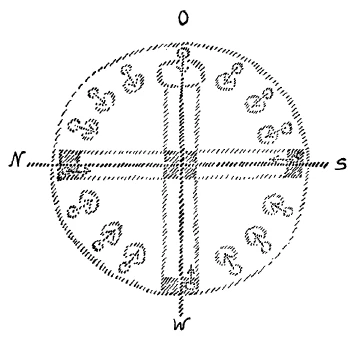
[ 15 ] Imagine what I have sketched for you here in a style—an architectural style—that is only an approximation of true Gothic, one that still incorporates all sorts of Romanesque forms, but which is certainly oriented in the direction I have indicated here—then I have thereby sketched for you the Temple of the Grail as medieval people imagined it, that Temple of the Grail which, in a sense, was the ideal of architecture in the era approaching the end of the fourth post-Atlantean epoch: A cathedral in which the longings of all humanity oriented toward Christ converged, just as the longings of the members of the congregation converged within the individual cathedral, and just as people felt connected in the Greek temple, even when they were not inside—for the Greek temple requires only that the god or goddess be inside, not the other people— so too did the Greek people of a given territory feel connected to their god or goddess through their temple. To put it accurately, one might say: When the Greek spoke of his relationship to the temple, he described the matter roughly as follows. Just as he might say of any person on earth—Pericles, for example: “Pericles lives in this house”—so this sentence: “Pericles lives in this house”—does not imply that the person uttering it has any ownership or other relationship to the house, but he nevertheless senses the nature of his connection to Pericles when he says: “Pericles lives in this house!” — With precisely the same nuance of feeling, the Greek would also have expressed his relationship to what could be discerned in the architectural style, thereby expressing: Athena lives in this house; this is the goddess’s dwelling, or: Apollo lives in this house!
[ 16 ] The medieval community that owned the cathedral could not say that. For that was not the house in which the divine-spiritual being dwelt; rather, it was the house that expressed, in every single form, the place of gathering where one attuned the soul to the mysterious divine. Thus, in what I would call the “primordial temple” of the late fourth post-Atlantean epoch, at the very center of the temple of temples, stood the cathedral of cathedrals. And of the whole, one could say: If you enter here, then within it you can rise up to the mysteries of the universe! — One had to enter the cathedral. Of the Greek temple, one need only say: “This is the house of Apollo; this is the house of Pallas.” — And the center of that primordial temple, where the beams of the cross intersect—the center that held the Holy Grail—was preserved there.
[ 17 ] You see, one must trace the spirit that characterizes each historical period; otherwise, one cannot come to know what actually happened. And above all, without such an analysis, one cannot understand which spiritual forces are now at work in our present.
[ 18 ] So, the Greek temple enclosed the god or goddess, whom people knew to be present among humanity. But people in the Middle Ages did not feel this; they felt, as it were, that the earthly world had been forsaken by God, abandoned by the divine. They felt a longing to find the path to the gods or to God.
[ 19 ] Today, however, we are really only at the starting point, for only a few centuries have passed since the great upheaval in the mid-15th century. Most people hardly notice what is dawning, but something is dawning; something is changing within people’s souls. And what must now flow back into the forms in which a sense of time is embodied must also be different. These things, however, cannot be spun out of thin air by the mind or the intellect; they can only be sensed, felt, and viewed artistically. And anyone who tries to reduce them to abstract concepts does not really understand them. But one can still point to these things in a variety of characterizing ways. And so it must be said: The Greek, in a sense, felt the god or goddess as his contemporaries, as his fellow inhabitants. The medieval person had the cathedral, which did not serve as a dwelling place for God, but was meant, in a sense, to be the gateway to the path leading to the divine. People gathered in the cathedral and, in a sense, sought within the group soul of humanity. This is the defining feature: that all of medieval humanity possessed something that can only be understood from the perspective of the group soul. Until the middle of the 15th century, the individual human being was not regarded in the same way as he has been since that time. Since that time, what has been most essential in human beings is the striving to be an individual, the striving to bring together individual personality forces, to find, as it were, a center within oneself.
[ 20 ] Nor can one understand what is emerging in the wide variety of social demands of our time unless one is aware of this prevalence of the individual spirit in every single person, this desire of every single person to stand on the foundation of their own being.
[ 21 ] As a result, however, something becomes particularly important for human beings during this era, which began in the mid-15th century and will not end until around the fourth millennium. This marks the onset of something that is of very special importance for this era. For, you see, there is a certain vagueness in the statement: Every human being strives for their own unique individuality. The group spirit—even when it encompasses only small groups—is something far more tangible than what each individual strives for from the very source of their individuality. This is why it becomes particularly important for people of the modern era to understand what might be called: seeking balance between opposing poles.
[ 22 ] One, so to speak, wants to go beyond the head. Everything that leads a person to be a dreamer, a fantasist, or a delusional person—everything that fills them with vague mystical yearnings for some indefinite infinity—indeed, everything that fills them when they are a pantheist or a theist or something of that sort, which is so common today—that is one pole. The other pole is that of sobriety, of dryness—to put it trivially, but not unrealistically in relation to the spirit of the present, truly not unrealistically: the pole of philistinism, the pole of petty-bourgeois narrow-mindedness, the pole that drags us down to earth into materialism. These two poles of force exist within the human being, and the human being stands between them, seeking balance. In how many ways, then, can one seek this balance? You can picture this, again, using the image of a scale (it is drawn). In how many ways, then, can one seek balance between two poles pulling in opposite directions?
[ 23 ] Isn't it true that if there are fifty grams or fifty kilograms on one side of the scale, and the same amount on the other, then the scale is balanced? But if there’s one kilogram on one pan of the scale and one kilogram on the other pan, the scale is also balanced, and if there are a thousand on one side and a thousand on the other, the scale is also balanced.
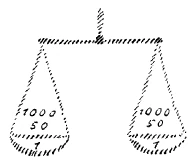
[ 24 ] There are an infinite number of ways to seek balance. This corresponds to the infinite ways of being an individual human being. That is why it is so essential for people today to realize that their very nature consists in the pursuit of balance between opposing poles. And the indeterminacy of the search for balance is precisely that indeterminacy I spoke to you about earlier.
[ 25 ] Therefore, people today can only cope with their search if they ground that search in the pursuit of balance.
[ 26 ] Just as it was important for the Greeks to feel that Pallas and Apollo reigned in the community to which they belonged—that this was the house of Pallas, that this was the house of Apollo—so it was important for people in the Middle Ages to know: there is a place of gathering that holds something—be it the relics of a saint, be it the Holy Grail itself— there is a gathering place where, when one gathers there, the soul’s longings for the indefinable and mysterious can flow—it is just as important for modern people to develop a sense of what they are as individual human beings: that as individual human beings, they are seekers of balance between two opposing, polar forces. Spiritually, one can express this by saying: On the one hand, there is that which drives a person, as it were, beyond their own head—the dreamy, the fantastical, that which seeks to develop a desire that pays no heed to the real conditions of existence. Just as one can describe one extreme in psychological terms in this way, so the other extreme can be described as tending toward the earth, toward the sober, the dry, the dryly intellectual, and so on. Expressed in physiological terms, one can also say: One pole is everything to which the blood flows, and if it flows too strongly, it becomes feverish. Physiologically speaking, one pole is everything connected with the forces of the blood; the other pole is everything connected with the ossification, the petrification of the human being, which, if taken to a physiological extreme, would lead to sclerosis in its various forms. And between sclerosis and fever—as the radical extremes—human beings must also maintain their physiological balance. Life essentially consists of seeking a balance between the sober, dry, philistine, and the dreamy-fantastical. We are mentally healthy when we find the balance between the dreamy-fantastical and the dry-philistine. We are physically healthy when we can live in balance between fever and sclerosis, or ossification. And this can happen in an infinite number of ways; within this, individuality can thrive.
[ 27 ] This is precisely where, especially in modern times, people must come to understand the ancient saying of Apollo: “Know thyself.” But “Know thyself” not in some abstract sense: “Know thyself in the striving for balance.” That is why we must place in the eastern part of the building that which can allow people to feel this striving for balance. And this is to be depicted in the sculptural wood group mentioned yesterday, which has the figure of Christ as its central figure—a figure of Christ that has been shaped in such a way that one can imagine: “This is truly how Christ walked in the person of Jesus of Nazareth at the beginning of our era in Palestine.” The conventional images of the bearded Christ are, after all, actually creations of the 5th and 6th centuries, and they are truly not, if I may use the expression, true to life. An attempt has been made here to create a Christ true to life, who is at the same time meant to represent the seeking human being striving for balance. (He is drawing.)
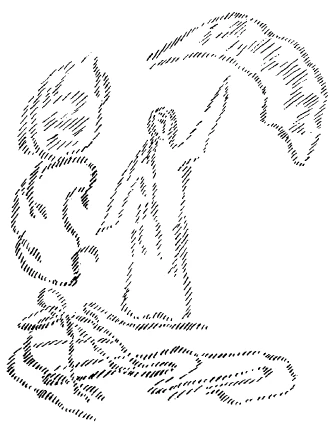
[ 28 ] You will then see two figures in this group: here, Lucifer in his fall; here, Lucifer aspiring upward. Down here, connected to Lucifer, so to speak, is an Ahrimanic figure, and here is a second Ahrimanic figure. Placed between the Ahrimanic figure—the philistine, the sober, dry, materialist—and the Luciferic figure—the dreamer, the fantasist—stands the representative of humanity. The Ahrimanic figure represents everything that leads human beings toward petrification and sclerosis; the Luciferic figure represents everything that leads human beings feverishly beyond the measure of health they can endure.
[ 29 ] And so, once the Gothic cathedral has been placed, as it were, at the center—a cathedral that does not enclose such an image, but rather either the relics of the saints or even the Holy Grail—that is, something no longer connected to those walking here—one arrives, I would say, once again to the idea that the building becomes something enclosing, but now it encloses human existence in its striving for balance.
[ 30 ] If fate wills it—and once this building can be completed—the one who sits within it will, in a sense, have directly before him that which prompts him, as he gazes upon the essence that gives meaning to Earth’s evolution, to say: the Christ-essence. But the matter must be perceived artistically. It must not be thought of intellectually, in a speculative way, merely as the Christ, but must be felt. The whole is conceived artistically, and what is expressed artistically in the forms is what is most important. Nevertheless, it should be presented to the human being purely through feeling—I would say, with the exclusion of the intellectual, which should serve only as a guide to feeling—so that the person may look toward the East and be able to say, “That is you,” but not as an abstract definition of the human being, for balance can be established in an infinite number of ways. It is not an image of a god that is embodied—for it is also true for Christians that they should not form an image of God—it is not an image of a god that is embodied, but rather that which has emerged from the group soul of humanity to become the individual force-being of each individual human being. And the workings and interplay of the individual impulse are taken into account in these forms.
[ 31 ] If you don’t think about what I’ve just said with your intellect —which is, after all, a popular approach today—but instead if you take it to heart and realize that nothing here is symbolic or intellectually contrived, but rather that, above all, an effort has at least been made to let it flow out in artistic forms, then you have grasped the fundamental principle that is meant to be expressed in the architecture of the Goetheanum. Then you will also understand how what seeks to be an anthroposophically oriented spiritual science is connected to the inner spirit of human evolution. In this day and age, one cannot come close to this anthroposophically oriented spiritual science unless one seeks the path arising from the great demands of the modern era—of the present human condition and the immediate human future. We really must learn to speak differently about what actually sustains the people of the future.
[ 32 ] There are now all sorts of secret societies that pride themselves on their importance, but which, when it comes down to it, are more or less nothing more than the bearers of what still lingers from the time before the great turning point in the 15th century. This is often expressed in very outward ways as well. We, too, have often observed that such aspirations find their way into our ranks. Time and again, when people seek to express the particular value of a so-called occult pursuit, they point out just how ancient the matter is. For example, we once had a man among us who liked to put on a bit of a show as a Rosicrucian. And whenever he said anything—which was usually nothing more than his own highly personal, trivial opinion—he never failed to add: “as the ‘old’ Rosicrucians used to say.” But he never left out the word “old.” And if one looks at various contemporary secret societies, everywhere one sees that the value of the things they advocate lies in their ability to point to their great antiquity. Some trace their origins back to Rosicrucianism—in their own way, of course—while others, naturally, go back much further, especially to ancient Egypt; and if anyone today can peddle Egyptian temple wisdom, a large portion of humanity will fall for it at the mere mention of it.
[ 33 ] Most of our friends know that we have always emphasized: this anthroposophically oriented spiritual movement has nothing to do with this longing for the past. It strives for what is now being revealed to this physical world directly from the spiritual world. For this reason, it must speak differently about many things than do secret societies—which, though they should be taken seriously, are nonetheless based on antiquated ideas—that still play a major role in the course of human history today. If you hear such people speak—for their mouths are sometimes opened of their own volition today—who are initiated into certain secrets of the present-day secret societies, you will hear them speak mainly of three things. First, of that experience which the true seeker of the spiritual world has when he crosses the threshold into the spiritual world—an experience that consists in the fact that, as soon as one crosses that threshold, one cannot help but encounter powers that are the true enemies of humanity, that are the true, real, essential adversaries of the physical human being living here on Earth, as this physical human being is intended by the divine powers. That is to say: These people know that what is veiled from ordinary human consciousness is interwoven with those forces that may, with some justification, be called the essential causes of illness and death—forces with which, however, everything connected with human birth is also interwoven. And you may then hear from those people who know something of such matters that these things must be kept secret—I say this in the subjunctive—because, as is said, meaning, in fact, the immature souls who have not made themselves strong enough for it—and indeed, a large part of humanity falls into this category—one cannot reveal what lies beyond normal consciousness.
[ 34 ] The second experience is that at the very moment a person begins to recognize the truth—and one can only begin to recognize the truth by coming to know the mysteries of the supersensible—one also begins to recognize the extent to which everything that can be stated through mere sensory observation of the environment is an illusion, a deception; even if it has been investigated with the utmost precision—indeed, all the more so—it is an illusion. This loss of solid ground beneath one’s feet—which modern people in particular need—this loss of firm footing, so that one can say, “This is a fact, for I have seen it”—this comes to an end once the threshold is crossed.
[ 35 ] The third point is that the moment we begin to perform human labor — whether by working with tools or tilling the soil, or performing any human work at all, but especially when we perform human work by weaving it into the fabric of the social organism — we are then doing something that concerns not only us as human beings, but something that belongs to the entire universe. People today naturally believe that when they design a locomotive, or when they make a telephone or a lightning rod or a table, or when they heal a sick person—or fail to heal them, leaving them sick—or do anything else, these are things that take place only within the course of human development on Earth. No, what I hinted at in my mystery drama The Portal of Initiation—that events unfold throughout the entire cosmos whenever something happens here—remember the scene between Strader and Capesius—that is a profound truth.
[ 36 ] People today who have some understanding of these matters draw on these three experiences, which are preserved in these societies in the form they had before the mid-15th century—and are often preserved in a highly misunderstood way. People draw on these things by pointing, first, to the mystery of illness, health, birth, and death; second, to the mystery of the great illusion in the sensory realm; and third, to the mystery of the universal significance of human work. And they speak of these things in a certain way. All these things—and especially these most important things—must be spoken of differently in the future than in the past. And I would like to give you an idea of how differently such things were spoken of in the past, what then flowed out into the general consciousness, permeated ordinary knowledge of nature, ordinary social thinking, and so on, and how we must speak in the future—where we truly speak of the truth—and how what flows from the secret sources of the quest for knowledge must then find its way into external knowledge of nature, into external social outlook, and so on.
[ 37 ] I would like to speak to you further about this tremendous metamorphosis—which we must understand today, because human beings must fully awaken from group consciousness to individual consciousness—about this great metamorphosis, this historic metamorphosis.