

Michael's Message
The True Mysteries of Human Nature
GA 194
14 December 1919, Dornach
Translated by Steiner Online Library
Eleventh Lecture
[ 1 ] Today I would like to discuss a few points—some of which are more general in nature—that build on what was said yesterday and the day before. From those two reflections, you will also be able to see that spiritual science, as it is conceived here, is to arise from the deepest and most serious demands of human development in our time and for the near future. As I have often mentioned, this is not a matter of ideals that spring from human subjectivity, but rather of what can be gleaned from the history of humanity’s spiritual development. And from this history of humanity’s spiritual development, one can truly discern that the science of initiation—that is, the science that draws its insights from beyond the threshold to the spiritual world—is absolutely necessary for the further development of humanity. However, the forces that represent the old order are also resisting everything that can be advanced today in the name of a true understanding of the spiritual world. And the resistance of those people in whom, so to speak, the forces of the old world live—this must be overcome. The call for the necessity of re-learning and rethinking with regard to the most important matters of human development must be understood thoroughly and seriously. Therefore, I would like to ask you to place particular emphasis on the fact that our aim must be to overcome everything merely sectarian that still thrives even within the anthroposophical mind, and to truly see the significance of anthroposophically oriented spiritual science for the world and for humanity.
[ 2 ] People today are still far from having awakened from the slumber into which they have been enveloped by that development—the broad outlines of which I have already described to you—that began around the middle of the 15th century. Certainly, what has been incorporated into human evolution—the external natural sciences with their great triumphs, the materialistic view of the laws of the world, and with it the erroneous social ideas that are so clearly evident today—all that which has lulled humanity to sleep from this side continues to exert a powerful influence. And fruitful progress will not be possible without rousing humanity from this slumber. Let us not forget that the recognition of the spiritual has powerful enemies in all those who, above all else, want to continue believing what they have become accustomed to thinking—out of sheer intellectual laziness. One cannot say: If hostility and opposition to spiritual science—as understood here—arise all the more from this quarter the more this spiritual science becomes known, then one should not take these obstacles into account. Certainly, it might be a possible view to disregard entirely what arises in this way. However, that would be a completely wrong way of thinking in our present day, for we do not ignore, for example, vermin that attacks us; rather, we try to remove it ourselves, and sometimes we must remove it by force. This is something that must, of course, be decided on a case-by-case basis.
[ 3 ] These matters must also be understood in light of the necessities of the times. That is why it is a source of particular satisfaction to see that, even in these increasingly difficult times of ours, there are still people who are moved by the strength of will necessary to stand up for our cause. But unfortunately, there are still far too few of those who fully grasp the gravity of what is at stake today for the evolution of humanity. On the one hand, there are those who—not for any intellectual reasons, but out of intellectual laziness and other considerations—do not want to break away from what they have long been accustomed to. On the other hand, there must be those who, with their whole being, stand in opposition to what is ripe for destruction. And we must not believe that leniency toward what is ripe for destruction can be anything that holds us back today. Over the past five to six years, people could have learned how the old ways lead to absurdity. And those who have not yet learned this will have ample opportunity to do so in the near future. But we must have within us the fire for that which is to be planted as something new in the evolution of humanity.
[ 4 ] That is why I felt a certain sense of satisfaction when I was presented with the letter, the main content of which I would like to share with you today by way of introduction. The matter is that in Reutlingen, a city neighboring Stuttgart, that very same professor has once again taken the stage to rail—with equally foolish arguments—against what is sought by the anthroposophically oriented spiritual science, just as he did in that foolish treatise whose contents I recently discussed with you here. In any case, that professor—one of the “ornaments” (for that is how the “ornaments” are now on this side)—one of the “ornaments” of the University of Tübingen (and they are no different at other universities around the world)—must have spoken now in the same way he did in that treatise. Then our friend Dr. Walter Stein stepped forward to confront him—but this time, as is evident from a letter, with the genuine vigor that is necessary today when one grasps the full gravity of what is at stake. And regarding that discussion that took place a few days ago, our friend Dr. Stein writes to his wife here: “Yesterday I was in Reutlingen, where Professor Traub spoke against Steiner. I volunteered to participate in the discussion. It was a life-and-death struggle. I portrayed Traub as an unscrupulous man who was completely ignorant of the subject matter he was addressing. He could barely stammer out his closing remarks. He was broken. The town pastor, who had opened the meeting, was so cornered by me with Bible passages that he said, referring to the passage where Christ speaks of reincarnation: ‘Here Christ is mistaken’—the town pastor of Reutlingen. Then I stood up and cried out: ‘Listen! This is religion today—a God who is mistaken!’ — The audience went wild. At first they tried to interrupt me, to cut me off, shouting, “Get to the point!” They shuffled their feet and stamped their feet. But I spoke completely calmly, pointed with one hand at Professor Traub, and said, “This is the authority!” I received applause and prevailed. That man is finished. I’m still half dead today.”
[ 5 ] That a strong hatred would arise against that anthroposophically oriented spiritual science, which has now been practiced here in Europe for two decades, was something that could have been foreseen—anyone who knew, and knows, how intimately connected what is here called “anthroposophically oriented spiritual science” is with the forces that must be called upon to advance humanity in the present and in humanity’s immediate future could have foreseen this. But this anthroposophically oriented spiritual science must not be confused with drowsiness, with that mindset that seeks to create a little sensual pleasure in the soul through spiritual ideas and concepts. And if Dr. Stein feels that this is a matter of a life-and-death struggle, then that is a perception of something entirely correct. We are at the beginning. The battle waged by the will to destroy rages against us. We have never made any move to act aggressively, insofar as we have understood the true impulse of our spiritual science. But we must not shy away from what is necessary in the face of the aggressive force that will come from outside with ever-increasing intensity. We must not let our courage falter; we must not proceed with a drowsy attitude. It will not be easy to establish the truth of human evolution, and leniency is certainly not something we can afford in certain matters. For we have indeed come a long way when those who are officially charged with representing Christianity, when they can go no further, are even prepared to say: “Here Christ is mistaken!” — Of course, the parish priest is not mistaken! But if what the parish priest has to say does not agree with the plain text of the Bible, then Christ is in error, not the parish priest! Yet this is precisely the mindset one encounters today—one that people simply refuse to see because it is inconvenient to face. One could see it in every area, if only one were willing to do so.
[ 6 ] But for those who can see the connections in life, it is also clear that the misfortunes Europe has suffered in recent years—even if they appear to have played out on the surface—are intimately linked to what people have become accustomed to thinking, and—forgive me for using a somewhat trivial, banal expression—what people so love to talk about: “How wonderfully far we’ve come”—all the while licking their fingers with delight.
[ 7 ] But what is necessary is this: to become objectively minded within oneself. Under the influence of modern culture, people have lost their objectivity. Personal factors play a role everywhere. And when the history of the last five to six years is eventually written, it will only be possible to write it based on material from the humanities. Then these chapters of world history will contain much about how infinitely the personal has played a role in the great events of world history. I said that it will be impossible to speak of the events of the last five to six years without a foundation in the humanities. I need only allude to what I have already hinted at here on several occasions. Of the thirty to forty people who, in 1914, held prominent leadership positions and were involved in what is called the outbreak of the World War—people today love to speak imprecisely, because it serves to obscure the truth; it was neither an “outbreak”—it was something entirely different—nor was it a “World War”: it was something entirely different, which is far from over—of the thirty to forty people involved at that time, a large number were not in their right minds; they did not have all the powers of their soul and spirit at their disposal. But where consciousness is clouded, there are gateways through which the Ahrimanic forces have particularly easy access to human decisions and human will.
[ 8 ] The Ahrimanic forces played a significant role in setting in motion the events that unfolded in 1914. Even today, if one were only willing, one could see—simply by observing the matter from a purely external perspective—how necessary it is to incorporate spiritual insight into human evolution. But how far removed are we, due to our habits of thought, perception, and feeling, from considering such things with complete seriousness. On the one hand, there is the fact—and even more so the impending fact—that the time is ripe for the emergence of people who, with a suitable and capable soul, can respond to the spiritual impulses that have been pouring into our physical world since the last third of the 19th century. In addition to the fact that we have sailed into a materialistic age, there is also the fact that the gates leading from the spiritual world to ours have been open since the last third of the 19th century, and that people who meet these spiritual impulses with an open soul and an open consciousness can have a connection to the spiritual world. Certainly, the number of people in whose consciousness the spiritual world is already making its presence felt today may be small. But the fact remains that the spiritual world is making its presence felt in many a human soul. And we can say: The next ten, twenty, thirty years, up to the middle of the century, will be a time in which more and more people will have learned to listen quietly to their inner selves, in order to hold forth this inner self to the impulses of the spiritual world seeking to enter.
[ 9 ] Those people who today receive such impulses from the spiritual world—who today are aware of the truths and insights that must enter into human evolution—know the following: Unless what we call knowledge of nature—and specifically what we call art—is enriched by this science of initiation, which must be practiced by such people, humanity is heading toward rapid decline, a terrible decline. Let teaching continue for three more decades in the same way it is taught at our universities; let thinking about social matters continue for another thirty years as it is today—and after those thirty years, you will have a devastated Europe. You can set forth as many ideals as you like in this or that field; you can talk yourselves hoarse over specific demands arising from this or that group of people, you can speak in the belief that, no matter how urgent the demands, something is being done for the future of humanity—it will all be in vain if the transformation does not take place from the very foundation of the human soul: from the way we conceive of the relationship between this world and the spiritual world. If there is no re-learning there, if there is no rethinking there, then a moral deluge will sweep over Europe!
[ 10 ] The point is precisely to understand what it would actually mean if a number of people who have a glimpse into the knowledge of the world beyond the threshold were to realize: The confusion, the materialistic tendencies, and the social errors continue, and people are unwilling to change their thinking or re-educate themselves—and if these few individuals who possess the science of initiation were to see how humanity is descending out of sheer intellectual and emotional complacency! But one should not delude oneself about how many forces are at work today in the so-called civilized world that contribute to such a situation. Many forces are at work there, for is it not actually more natural to expect that today’s humanity, in its arrogance, would reject everything that comes from the science of initiation? After all, humanity is so infinitely clever in each and every one of its individuals! Humanity is so inclined to mock everything that can only be attained by working on the progress of one’s own soul. After all, humanity believes it knows everything without having to learn anything. Neither the natural nor the social problems of our time can be solved without the spiritual world enriching human thought, feeling, and will. For many people today, it is nothing short of a figment of the imagination when one speaks of this science of initiation, when one speaks of such things as the threshold to the spiritual world. It is true that not everyone today can cross the threshold into the spiritual world; but no one should actually be prevented from recognizing the truth of what those who have crossed the threshold into the spiritual world say. It is incorrect when, time and again, people on this or that side say: “Well, how am I supposed to know that what this or that person presents as the science of initiation is true, if I cannot see into the spiritual world myself?” — That is incorrect. Sound common sense—unmisled by the erroneous natural or social ideas of today—can decide for itself whether there is a spirit of truth in whatever anyone says. When someone speaks of spiritual worlds, one need only take everything into account—the manner of speaking, the seriousness with which things are conceived, the logic that is unfolded, and so on—and then one will be able to form a judgment as to whether what is presented as knowledge from the spiritual world is charlatanism or whether it has substance. Everyone can decide this for themselves, and there is no obstacle preventing anyone from applying what is drawn from the source of spiritual life—by those who are authorized to speak of the principle of initiation—to their natural and social thinking.
[ 11 ] The forces of human development that have unconsciously guided humankind, enabling it to progress, have been exhausted and will continue to be exhausted until approximately the middle of the century. New forces must be drawn up from the depths of the soul. And human beings must come to realize how they are connected, in the depths of their souls, to the roots of spiritual life.
[ 12 ] Of course, not everyone today is capable of crossing the threshold. For over the course of the last few centuries, human beings have become accustomed to viewing everything that comes their way as unfolding within time. But the first thing one experiences beyond the threshold is that there is a world in which time, as we understand it, has no meaning. One must step out of temporal thinking. That is why it is so helpful for people who wish to prepare themselves to understand the spiritual world to at least begin by imagining things in reverse. Let us say, for example, imagining a play—which outwardly begins with the first act and progresses to the fifth—in reverse, starting from the end and working backward to the beginning of the first act; imagining and experiencing a melody not in the sequence in which it is played, but with the notes running backward; and imagining the course of the day not from morning to evening, but running backward from evening to morning. In this way, we seriously accustom our thinking to the suspension of time. We are accustomed, in our everyday life, to conceiving of things such that after the first comes the second, after the second the third, after the third the fourth, and so on (the numbers are written out), and we always think in such a way that our thinking is a reflection of external events. Let us now begin to think in such a way that we think backward to forward, feel backward to forward; then we must impose an inner compulsion upon ourselves, and this compulsion is good, for it forces us out of the ordinary sensory world. Time flows from one, two, three, four, and so on in this direction (arrow to the right). When we think in reverse—from evening to morning instead of from morning to evening—we think against the flow of time (arrow to the left). We suspend time.
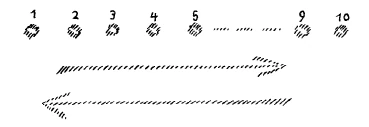
[ 13 ] If we can continue this line of thought by looking back as far as we can in our lives, then we will have gained a great deal. For those who cannot step outside of time cannot enter the spiritual world.
[ 14 ] We say that the human being is composed of a physical body, an etheric body, an astral body, and the I. Only the physical body and the etheric body are initially relevant to the physical world, to the sensory world. The etheric body still exists within earthly events in time; the astral body can only be found once one steps outside of time. The physical body exists in space. The I—the true I—can only be found once one steps outside of space. For the world in which the true I exists is spaceless.
[ 15 ] There are, then, two aspects to these initial experiences: that we step out of time and out of space when we cross the threshold into the spiritual world. I have often pointed out in the past various things that can lead to concepts of a non-spatial nature, by drawing your attention to dimensions—not in the childish way that spiritualists often speak of four-dimensional space and the like, but in a more serious manner. But consider what you lose of all that you call the content of your consciousness when you are no longer in space and no longer in time. Your life is entirely adapted to space and time. Human spiritual life, too, is entirely adapted to space and time. You enter a world to which you are not adapted: this lack of adaptation to the world means a sense of pain and suffering. Thus, without overcoming pain and suffering, it is initially impossible to enter the spiritual world. People do not bring this to their consciousness, but they shy away from the spiritual world out of fear, because they do not wish to enter the abysmal nature of a world in which there is no space and no time.
[ 16 ] If I merely recall before your mind’s eye this first experience of what lies beyond the threshold, you will become vividly aware that very few people today possess the inner strength and courage to venture, so to speak, into the bottomless and timeless realm—and to do so through direct experience. But by their very fate, certain people are bound to cross that threshold. And without the wisdom that can be brought back from beyond the threshold, one cannot move forward. From this, you sense what is necessary. What is necessary is that, in the future, what might be called one person’s trust in another be strengthened. It would be a social virtue, a fundamental social virtue. In our age of social demands, this virtue is least present, for people demand that one live for the community, yet no one has trust in another. In our age of social demands, the most antisocial instincts prevail. It will be necessary for the general education of humanity to progress in such a way that people grow into the spiritual world; it will be necessary for trust to be placed in those who are rightly permitted to speak of the science of initiation—not trust born of blind faith in authority, but of common sense. For one can always discern what is brought as a message from beyond the threshold, provided one is truly willing to apply common sense.
[ 17 ] And here one must always turn from common sense—which looks, on the one hand, to Him—and turn one’s gaze to what confronts us today. Even if not everyone says so explicitly: “Christ is mistaken here”—people speak in this vein; such is the logic of life today. And when people come and say they cannot distinguish between what is proclaimed from the spiritual worlds with inner logic and what university professors say, then they simply lack common sense—or at least the will to exercise it. After all, one can easily say, based on common sense, that if someone says, “Christ is mistaken here,” then from this point of view, one cannot take that person seriously any further.
[ 18 ] We have lost a true science of the soul. We no longer have it. And I have, in fact, pointed out in public lectures—most recently in Basel and in other places—why we have lost the science of the soul. The science of the spirit, for example, had already become a source of discomfort for the Catholic Church as early as the 9th century; I have mentioned this often. That is why, as I have also explained many times, the spirit was abolished at the Eighth Ecumenical Council in Constantinople in 869. At that time, the dogma was established that a true Christian must not believe that he consists of body, soul, and spirit, but only of body and soul, and that the soul possesses spiritual qualities. Today, psychology still teaches this, believing it to be based on unbiased science, but it is merely parroting the dogma of 869. But even with regard to everything that is supposed to point to the soul, it has been monopolized in the form of faith, in the form of creed, in the form of dogma by the confessional churches. Everything that is supposed to be human insight into the soul has been monopolized by the confessional communities. And actual insight—free insight—was confined solely to the external natural world. No wonder we have no science of the soul today. For secular scholarship has devoted itself exclusively to the science of nature, since the science of the soul was monopolized and the science of the spirit was abolished. We have no science of the soul. We cannot make any progress if we rely on what is today’s dominant science. For if we rely on what is today called “psychology”—which is, after all, not much more than that—we cannot arrive at a true understanding of what reigns within the soul. You know from my exposition in How Does One Attain Knowledge of the Higher Worlds? that when one crosses the threshold into the spiritual world, thinking, feeling, and willing separate within consciousness. In the ordinary, prevailing consciousness of today, thinking, feeling, and willing form a kind of chaos; they are interlayered. The moment the threshold to the spiritual world is crossed—the moment one merely sets out to gain knowledge of the science of initiation through experience—thinking, feeling, and willing become independent forces within consciousness. They become independent. It is then that one comes to know them; it is then that one truly learns to distinguish thinking from feeling and from willing.
[ 19 ] In particular, one learns to distinguish thinking from willing. Thinking, which reigns within us as human beings—if we do not consider it in terms of its content, but rather in terms of its nature as a force; that is, if we consider the power of thought within us—then precisely what constitutes the power of thought is something like a shining through of what we experienced in spiritual worlds before birth or, more precisely, before conception. And the will-being in the human being is something embryonic, something in its nascent stage, which only comes to full development post mortem, after ‘death.’ So that we can say: If this here (see the following diagram) is the course of human life between birth and death, then within the course of human life, thinking, as it exists in human beings, is only an illusion, for its true nature lies before birth or, more precisely, before conception; and what constitutes volition is only a seed, for what develops from this seed only develops after death. Thinking and willing are fundamentally different in human nature.
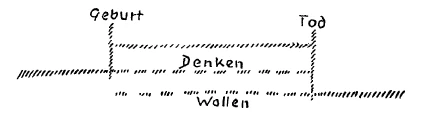
[ 20 ] If someone now comes along with the logic of the present—which neatly categorizes everything and loves to create systems—they will say: We have been told today that thinking is the force that flows in from prenatal life, and that willing is the force that points toward life after death. Now, through definition, we have neatly separated thought and will. But definitions alone are not enough. People usually fail to see the inadequacy of every definition. There are, of course, some definitions—especially those considered scientific—that appear very clever, but they all have a catch somewhere that reminds one of that definition once given in ancient Greece in response to the question: “What is a human being?” — “Man is a two-legged creature without feathers”—whereupon, the next day, a student brought in a plucked rooster and said, “This is a man, for it is a two-legged creature without feathers.” — He had carefully plucked it beforehand. Things are not so simple, you see, that they can be handled with the usual tools of the intellect. For, you see, one could very well say: Of what we experience as thinking, we must assert that its true essence exists prior to birth, and that what plays out within us is merely something like a reflection of that thinking. — Herein lies a certain difficulty. But with a little mental effort, you will overcome it.
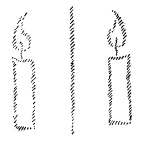
[ 21 ] Isn't it true that if you have a mirror here and an object here—for example, a candle—then you have a reflection here: you can distinguish the reflection from the object; you won't confuse the two. If, for some reason—say, by covering the candle itself with a screen—you were to do so, you would see only the image in the mirror. The image will do everything the candle does. You can tell from the image everything the candle does. You are accustomed to thinking in spatial terms, which is why you can easily imagine how the image relates to the reality of the candle. But what constitutes our power of thought is, as a force, a reflection, and reality lies before birth. The real power, whose image we use in this life, lies before birth. Therefore, the fundamental principle of human consciousness—which arises when one looks at one’s own consciousness—is: I think, therefore I am not. Cogito ergo non sum! — This is the fundamental truth one must grasp: that the nature of images reigns in thinking, and that the power of thought lies before birth. Recent developments have begun to present the opposite as a fundamental axiom of philosophy: cogito ergo sum, which is nonsense. You can see what trials modern humanity must undergo. But we are at a turning point. We must learn to rethink the foundations of soul life.
[ 22 ] In this way, we have, in a certain sense, traced thought back to its essence, and we could now make a similar claim regarding volition. Volition is not to be understood as image and reflection, but rather as seed and fulfillment—in relation to the power of will between birth and death and what becomes of it after death. This arrangement—that we have the image from thinking and the embryo from volition—is what alone enables our freedom between birth and death. You can read more about this in my books The Riddle of Man and The Riddles of the Soul, as well as in the second edition of my Philosophy of Freedom, where these matters are also discussed philosophically.
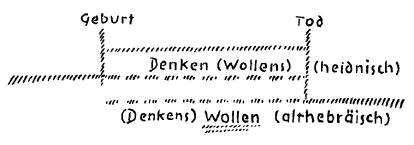
[ 23 ] But now comes the peculiar thing, from which you must see how little our comfortable, everyday way of thinking suffices to penetrate reality. We have grasped the essence of thinking. But when we grasp this essence of thinking within ourselves, we must at the same time tell ourselves: This thinking is not merely thinking; rather, within this thinking there is also a power of willing. With the very same inner essence with which we think, we also will. It is primarily thinking, but it has an undertone of willing; just as our willing has an undertone of thinking. We do indeed have two things within us: something that is primarily thinking, but which has an undertone of volition (in the diagram begun on page 204, the word “volition” is written in parentheses next to the word “thinking”); and something that is primarily volition, but which has an undertone of thinking (the word “thinking” is written in parentheses next to the word “volition”). When you observe reality, you do not arrive at pure concepts that you can categorize into systems; rather, one is always, in a certain sense, the other at the same time. Only when one penetrates these things does one gain an insight into certain connections between human beings and worlds that lie beyond those we see with our eyes and hear with our ears—worlds in which we are no less immersed than in this world of the senses. We cannot say that worlds other than the sensory world have nothing to do with us; we are right in the midst of them. We must be clear that, as we walk here on this earth, we are walking through the spiritual worlds just as we walk through the sensory air.
[ 24 ] Relationships, I say, to the spiritual worlds arise when one looks into these subtleties of human soul life. Through that which is more thinking and has only a hint of willing, we are connected to a certain kind of spiritual being in the spiritual worlds. And again, we are connected to another aspect of the spiritual worlds through that which is more volition and less thinking. This has a deeper significance. For what we find in this way is imprinted in human life, and the distinctions that exist in the world arise from the fact that one or the other force of human nature has always developed more strongly in one direction or the other. Those forces that lie in the will, which has an undertone of thinking, were developed, for example, in the most eminent sense in ancient Hebrew culture. And those forces of the human soul that are based primarily in thinking, which has an undertone of will, were developed in what is called ancient pagan culture. (The terms “ancient Hebrew” and “pagan” are added to the diagram begun on page 204.) And at present, we have these two currents running side by side. At present, in the civilized world, we have these two currents intertwined: one, which is a continuation of ancient paganism, in our view of nature; and the other, which is a continuation of ancient Hebrew culture, found in our contemporary social outlook, in our ethical and religious concepts.
[ 25 ] And this dualism lives within the individual human being today. On the one hand, people worship nature in a pagan way; on the other hand, without finding a proper basis in nature—except by carrying over their habits of thought into so-called social science or sociology—they reflect on social, and even ethical, life. And when they then engage in philosophical reflection, they say: In one realm they find freedom, in the other they find natural necessity, and then they find themselves caught in a ghostly realm between freedom and natural necessity—between which there is said to be no bridge—and so on, and the confusion is immense.
[ 26 ] But this confusion is, in many respects, the essence of life today—the essence of today’s fading way of life. For what is missing from our life today? We have a view of nature: it is merely a continuation of ancient paganism. We have a moral and social outlook: it is merely a continuation of the Old Testament. Christianity was an episode that was initially understood historically, but today it has, so to speak, fallen through the sieve of human culture. Essentially, Christianity is not there. For with people who often speak of Christ, you can do as I recommended to you regarding Harnack’s The Essence of Christianity. You can approach Adolf Harnack’s The Essence of Christianity in such a way that wherever he writes “Christ,” you cross out the word “Christ” and write “God the Father” in its place, or you can also substitute a mere pantheistic “God” or something similar—essentially, everything will still be essentially correct. And where it doesn’t add up, he’s talking nonsense—attributes that don’t belong to the subjects.
[ 27 ] All these things must be said today, for it is here that we must recognize, from the very foundation, what the content of our awareness of the future must be. Likewise, you see, today’s theory of evolution speaks of this: Human beings have evolved from lower beings and so on; these lower beings have evolved up to the level of human beings. Certainly, you need only read my Outline of Esoteric Science to see that this must also be stated by us from one perspective. But the fact is that when we consider the human head—as we carry it on our shoulders today—it is already in a state of descending evolution. If our entire organism—please understand me correctly here—had the same structure as our head, we would have to die continuously. We live only through that which is vital force in the rest of our organism and is constantly sent up into the head. The forces through which we ultimately die are at work in our head; they are within our head. The head is a being that is constantly dying; it is in a state of regression. That is why the soul-spiritual can also develop within the head. For if you imagine the head schematically, you must picture it this way: its ascending development has already given way to a backward development; here there is a void. (A diagram is drawn; see the diagram below.) And into this void—into that which is constantly being destroyed—the soul and spirit enter. This is literally true. We carry the soul and spirit out through our head precisely because our head is already in a state of dying development. That is to say, we are continually dying within our head. And the undertone of will that is inherent in our thinking lies within our head. But this undertone of will is a constant driving force, a constant impulse toward dying, toward overcoming matter.
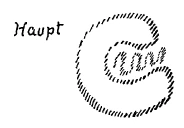
[ 28 ] When we truly die, this will comes into being. And as our body is returned to the earth, what has been taking place in our head from birth until our death continues—already physically—throughout our entire body, within the earthly body. You carry your head on your shoulders. Within it, the process unfolds of its own accord—it is merely continually refreshed and hindered by what arises from the rest of the organism—and this process then takes place when you are returned to the earth through fire or decay. There, the very same thing continues that you do within your skin between birth and death. This continues in the earth: The earth thinks according to the same principle as you do with your human head, through your dissolution within it, through the burial of corpses in the earth. As we pass through the gate of death, we carry into the physical earth, through our dissolving corpse, the process that we otherwise reserve for ourselves during our life between birth and death. This is a truth of natural science. People in the future must come to know such truths. Today’s natural science is child’s play when it comes to such matters, for it does not get around to thinking about them or researching them.
[ 29 ] And conversely: What we have in our minds as a process of destruction is, after all, the continuation of what existed before birth—or rather, before conception. Destruction only begins with our birth, for that is when we first acquire a mind; before that, there was no destruction. Now we are truly touching upon the edge of an extraordinarily significant mystery of worldly existence. What lives within our head—through which we enter into relationship with other people and with the external natural world—is the continuation of what takes place in the spiritual worlds before we enter the physical body. If one thoroughly comprehends this, one comes to understand how the forces from the spiritual worlds interact with this physical world. This is most vividly apparent when one considers these things not in the abstract, but in the concrete.
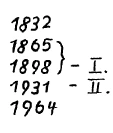
[ 30 ] An example (the numbers are written on the board): Goethe died in 1832. The era belonging to the first generation after his death, up to 1865, was not one in which many forces stemming from his spirit came into play. I am choosing an example; of course, forces from other people also influence us in the same way—this is merely a representative example. So up until the year 1865, anyone who had focused their attention on Goethe’s soul would have noticed little of his forces at work. Then, after the first 33 years, what flows into our earthly evolution from him out of the spiritual world begins. And this became stronger and stronger until the year 1898. If we then trace it further, beyond this era, we can say: The first period of the inflow of Goethe’s supersensible forces into our earthly culture thus spans 1865 to 1898. As I said, it was not significant until 1865; then it begins. Thirty-three years later, in 1931, we see the end of another period, which would be the second. And in 1964, we would then have the end of the third period.
[ 31 ] We can say that such an example truly teaches us how, relatively soon after a person has passed through the gate of death, the forces they then develop play a role in what is happening here on Earth. One simply needs to know how these forces come into play. Those who work spiritually—that is, in a truly spiritual sense—know how the forces of the spiritual worlds are at work within the forces with which they work. And when I said the day before yesterday that the middle of this century marks an important juncture, this was based—as in this example here—on such observations from which one can see how the forces from the spiritual worlds influence the physical world.
[ 32 ] This midpoint of the century, however, coincides with the end of the period during which the forces—which, in a sense, were still atavistically stuck in the past—from before the mid-15th century have fallen into the worst kind of decadence. And humanity must resolve, before the middle of this century, to turn toward the spiritual. Even today, one still encounters many people who say: “Why does misfortune come? Why don’t the gods help?” — We are now in an epoch of human development where the gods help immediately when people reach out to them, but where the gods, according to their laws, are dependent on working with free human beings, not with puppets.
[ 33 ] And here I am at the point I referred to yesterday. If, let us say, a person of insight—even as far back as the Greek era, indeed up to the middle of the 15th century—pointed to the phenomena, to the manifestations of human birth and death, he could point to the world of the gods, pointing out how human destiny is woven from the divine worlds through birth and death. Today we must speak differently; today we must speak in such a way that human destiny is determined by one’s previous earthly lives and by the way in which, through them, one creates the forces through which the divine worlds can approach him. We must learn to think in reverse regarding the relationship between human beings and the divine-spiritual worlds; we must learn to seek within the human being the source from which the forces develop through which certain divine beings can approach us. We have now reached this important juncture in Earth’s evolution. And what is happening externally must be understood today as an expression of inner processes that can only be grasped from the perspective of spiritual scientific insight. Every person today has the opportunity—I would say—to observe the outermost manifestations of these events. After all, enough people have been murdered in the last four to five years. There are at least ten to twelve million in the civilized world, probably more; three times as many have been maimed in various countries—our civilization has truly come a long way! But we will gradually have to recognize these as the outflow, and we will have to seek the source in what is taking place within human souls—in that resistance to the spiritual world seeking to break through, which aims to carry the human being into the future. And all things today must be viewed from this perspective—that is, they must be explored in depth, truly explored in depth.
[ 34 ] One might say today that perhaps some of what has happened would be more accurately described if we were to change our perspective. Roughly speaking, I will now say something intended to bring this lecture to a very timely conclusion, just as these three lectures have just been given a special nuance by the gratifying presence of a number of our English friends: Today we can speak of victors and vanquished. It is a striking perspective—a striking point of view—but perhaps it is not the most important one. Perhaps another perspective is much more important, and this other perspective might perhaps be derived from the following.
[ 35 ] I once read aloud from this very spot a lecture by Fercher von Steinwand, that German-Austrian poet who, in the 1850s, spoke about the future of the German people. The lecture is remarkable, if only because it was delivered before the then King of Saxony and his ministers. In those 1850s—as those of you who were there at the time have heard—Fercher von Steinwand spoke of how his German people were predestined to one day represent something similar to what the Gypsies had represented back then. Fercher von Steinwand cast a profound gaze into the development of humanity. These matters can be viewed with complete objectivity. If one looks at these matters with complete objectivity, then one might adopt a different perspective than the one frequently taken today. One will ask: What has actually changed—what has changed among the so-called vanquished, and what has changed among the so-called victors?
[ 36 ] Well, the real victors—that is, after all, the Anglo-American essence. And this Anglo-American essence is destined for future world domination through the forces that I have often described here as well.
[ 37 ] Now one might ask: Since the German people will be cut off from witnessing the events that will dominate the outside world in the future, what is actually going on there? Responsibility—not that of the individual, of course—but the responsibility of the people, the responsibility for the events of humanity, will cease to exist. Not that of the individual, but the responsibility of the people will cease to exist for those who have been crushed, for that is what they are. Nor can they rise again. Everything that is said along these lines is short-sighted. Responsibility disappears. All the greater, then, becomes the responsibility on the other side. That is where the true responsibility will lie. External dominion will be easy to attain. It will be attained through forces that are not one’s own doing. Like the ultimate necessity of nature, this external transition to external dominion will take place. But accountability will be something of profound significance for the souls. For the question is already written in the book of humanity’s destiny: Will there be, among those to whom external dominion falls as if by an external necessity, a sufficiently large number of people who feel the responsibility—since they are being placed within this purely external, materialistic dominion —for it will be a purely external, materialistic dominion; make no mistake about that—that the impulses of spiritual life will be placed within this purely external, materialistic dominion, within this culmination of materialistic dominion? And this must not happen too slowly! The middle of this century is a very significant juncture. One should feel the full weight of this responsibility, especially when one is, as it were, chosen by external natural destiny to usher in the reign of materialism—for it will indeed be the reign of materialism—in the outer world of the Earth. For this reign of materialism simultaneously carries within it the seed of destruction. The destruction that has begun will not cease. And to assume this outer dominion today means: to take on the forces of destruction, the forces of human illness, and to live within them. For what humanity will carry into the future will spring from the new seed of the spirit. That seed will have to be nurtured. And the responsibility for this lies precisely with the side to which world dominion falls.
[ 38 ] Even in these matters, we must not take a frivolous approach today. We must think deeply about these matters; in these matters, we must not be merely seemingly spiritual while in reality being materialistic. There are two things one hears very often today. One is that people say: “Oh, what are you talking about—social ideas? Ideas never put bread on the table!” — This is the facile objection that is raised very frequently today. And the other is that people say: Once people are working again, everything will be fine, and the social question will take on a different character. — Both statements are disguised materialism, for both amount to a denial of spiritual life.
[ 39 ] First, how do we differ from the animal kingdom? Animals go out and obtain their food, as long as it is available, according to their innate instincts. If there is not enough, they must starve. What advantage does man have? He works to produce his food. The moment he begins to work, thought begins. And only at that moment, when thought begins, does the social question also begin. And if humans are to work, they must have a motivation to work. The motivations that have existed until now will no longer be there in the future. New motivations are needed for work. And it cannot be a matter of simply saying: if people start working again, everything will be fine—no, when people, out of a sense of global responsibility, give rise to thoughts that sustain their souls, then the forces arising from these thoughts will flow into their hands and will, and work will emerge. But everything depends on thought. And thought itself depends on our opening our hearts to the impulses of the spiritual world.
[ 40 ] Today, there is much talk about responsibility and the importance of thought. That is why I wanted to emphasize precisely this nuance in this lecture.
[ 41 ] Since it is now simply fate that one cannot actually leave today if one wants to travel, we will still be here tomorrow as well. I therefore intend to speak specifically tomorrow at eight o’clock about the anthroposophical foundation—the spiritual-scientific, occult foundation—of the social question. This way, before we leave, I can also speak to our friends about the social question, but I will explore the deeper foundations of the social question from a spiritual-scientific perspective.