

Michael's Message
The True Mysteries of Human Nature
GA 194
15 December 1919, Dornach
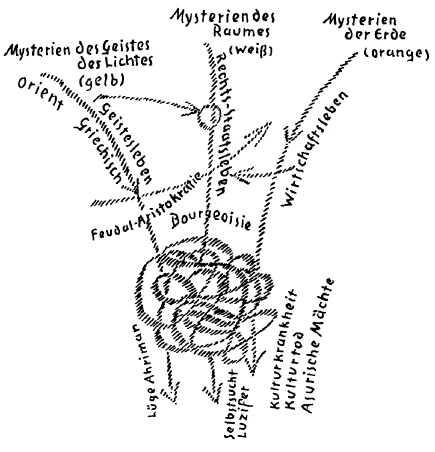
Translated by Steiner Online Library
Twelfth Lecture
[ 1 ] The tasks facing humanity in the present and in the near future are far-reaching, significant, and immense. And the fact is that it truly requires great spiritual courage to do anything to meet these challenges. Anyone who looks at these challenges today and seeks to gain a true insight into what humanity needs must often reflect on the superficial lightness with which public—or so-called public—affairs are treated today. One might say that people today engage in politics without any real basis. People form their views on life based on a few emotions, on a few entirely selfish or nationalistically selfish perspectives, whereas the gravity of the present moment would call for a certain longing to truly grasp the actual foundations for sound judgment. Over the course of the last few months and even years, I have given lectures and offered reflections here on a wide variety of subjects, including contemporary history and the demands of our time, always with the aim of providing facts that can enable people to form their own judgments—not to present a ready-made judgment to you. The longing to get to know the facts of life—to know them more thoroughly and ever more thoroughly—in order to have a genuine foundation for judgment: that is what matters today. I must say this in particular because the various statements and written expositions I have made regarding the so-called social question and the threefold social order are, as one can clearly see, taken far too lightly; far too few questions are asked about the serious factual foundations underlying these matters. People today find it so difficult to get to these factual foundations because, even though they do not want to admit it, they are actually theorists in all areas of life. Those who imagine themselves to be to be practitioners are the strongest theorists, for the reason that they generally content themselves with forming a few ideas—very few ideas—about life and seek to judge life based on these few ideas, whereas today only a genuine, universal, and comprehensive engagement with life makes it possible to arrive at a proper judgment of what is necessary. One might say that, in a certain sense, it is today at least an intellectual frivolity to engage in politics or to fantasize about one’s outlook on life without a proper foundation. One would wish for a sense of the seriousness of life to reside at the very core of people’s souls today.
[ 2 ] If, so to speak, the other side—the practical side—of our recent spiritual scientific endeavors has been presented to the world in the form of the threefold social order, it is true that the very nature of the thinking and imagination that governs the development of this threefold social order is today met with prejudices and, in particular, preconceptions. Where do these prejudices—especially these preconceived notions—come from? Indeed, people today form ideas about what the truth is—I am speaking here always of social life—they form ideas about what is good, what is right, what is useful, and so on. And once they have formed certain ideas, they believe these ideas now hold absolute validity everywhere and forever. For example, let’s take a person of socialist orientation in Western, Central, or Eastern Europe. They have very specific, socialist-formulated ideals. But what, so to speak, are the underlying assumptions he holds regarding these socialist ideals? He has the underlying assumption that whatever he imagines will satisfy him must also satisfy all people across the entire earth, and that this must apply without end to all future human existence on earth. There is little appreciation today for the fact that everything intended to serve as a guiding principle for social life must spring from the fundamental character of the time and place. Consequently, it is not easily recognized how necessary it is that the threefold social order be integrated—with various nuances—into our present-day European culture and its American offshoot. If it is incorporated, the necessary nuances with regard to space—that is, to the various regions of the peoples of the Earth—will arise of their own accord. Furthermore: After the time has come when, due to the evolution of humanity, the ideas and thoughts I have mentioned today in The Key Points of the Social Question can no longer apply, new ones will simply have to be found.
[ 3 ] These are not absolute ideas, but rather ideas for the present and for humanity’s immediate future. But to fully grasp the significance of how necessary this threefold division of the social organism—into an independent spiritual life, an independent legal and political life, and an independent economic life—is, one must take an unbiased look at the way in which the interplay of spirit, state, and economy has come about in our European-American civilization. This interplay of threads—the spiritual thread, the legal or political thread, and the economic thread—is by no means a simple matter. Our culture, our civilization, is a tangled ball of thread; when unravelled, it reveals three threads of entirely different origins. Our spiritual life has a fundamentally different origin than our legal or political life, and in turn, a completely different origin than our economic life. And these three currents, with their different origins, are chaotically intertwined. Of course, I can only sketch this out today, because in this brief presentation—I would like to say—I will trace these three currents back to their very source.
[ 4 ] Our spiritual life, as it first presents itself to those who take things as they are on the surface—as objectively real, as perceptibly real— is appropriated by people in that they allow themselves to be influenced by that continuation of the ancient Greek and Latin cultural life—the Greek-Latin spiritual life—as it initially flowed through what later became our high schools and through what became our universities. For the rest of our so-called humanistic education, all the way down to elementary school, is entirely dependent on what flows in—let us say—as a current (it is marked in yellow; see page 229), primarily from the Greek element. For what we have as spiritual life—our European spiritual life—is, after all, of Greek origin, having merely passed through Latin. Latin is a waystation. However, in recent times, this spiritual life originating in Greece has become mixed with other elements stemming from what we call the technology of various fields that were not yet accessible to the Greeks: the technology of the mechanical realm, the technology of the commercial realm, and so on. I could say: Technical universities, business schools, and so on have joined our universities, bringing a more modern element to what flows into our souls through our humanistic schools, which trace their roots back to Greek culture; it does not merely flow into the souls of some so-called educated class, for what are today’s socialist “theories”—what haunts even the minds of the proletariat—is merely a derivation of that which actually stems from Greek spiritual life. It has merely undergone various metamorphoses. But this spiritual life, tracing its further origins, goes all the way back to the Orient. And what we find in Plato, what we find in Heraclitus, in Pythagoras, in Empedocles, and especially in Anaxagoras—all of that goes back to the Orient. What we find in Aeschylus, Sophocles, and Euripides goes back to the Orient; what we find in Phidias goes back to the Orient. Greek culture definitely traces its roots back to the Orient. It underwent a significant transformation on its journey from the Orient to Greece. Over in the East, this spiritual culture was far more spiritual than it was in ancient Greece, and in the East it was an outflow of what one might call the mysteries of the spirit—or, I might also say, the mysteries of light (this is illustrated again; see page 229). Greek spiritual life was already a filtered, diluted form of the spiritual life from which it originated—the Eastern spiritual life. The latter was based on very special spiritual experiences. If I were to describe these spiritual experiences to you, I would have to characterize them in the following way.
[ 5 ] Of course, we must go back to prehistoric times, for the mysteries of light—or the mysteries of the spirit—are thoroughly prehistoric phenomena. If I am to describe to you the nature of this spiritual life and how it developed, I must say the following. We know, after all, that when we go very far back in human evolution, we find more and more that the people of ancient times possessed an atavistic clairvoyance, a dreamlike clairvoyance, through which the mysteries of the universe were revealed to them. And we are quite correct in saying that throughout the third, fourth, fifth, sixth, and seventh millennia before the Mystery of Golgotha, the civilized regions of Asia were inhabited by people to whom spiritual truths were revealed through their clairvoyance—a clairvoyance that was entirely bound to nature, to the blood, and to the physical constitution. This was, so to speak, the population spread over a wide area. But this atavistic clairvoyance was in a state of decline; it fell more and more into decadence. And this decline of atavistic clairvoyance is not merely a cultural-historical phenomenon; it is at the same time a phenomenon of the social life of humanity.
[ 6 ] Why? Because from this vast mass of the Earth’s population, originating from various centers—but mainly from one center in Asia—a special kind of people emerged, so to speak: a kind of people with special abilities. In addition to the atavistic clairvoyance that had, in a certain sense, remained with them—a dreamlike perception of the world’s mysteries still arose from their inner soul life—they also possessed, as the first human beings in the course of human evolution, what we call the power of thought. They were the first to possess the dawning intelligence.
[ 7 ] It was a significant social phenomenon that those ancient people, who had nothing but dreamlike visions of the world’s mysteries, saw immigrants arriving in their territories whom they could still understand—because those immigrants, too, had visions—but who already possessed something they themselves lacked: the power of thought. This was a special kind of people. The Indians regarded the caste they called the Brahmin caste as the descendants of these people, who combined atavistic clairvoyance with the power of thought. And as they descended from the higher northern regions of Asia into the southern regions, the name “Aryans” came to be applied to them. This is the Aryan population. Their defining characteristic is that they—if I may now use the later term—combined the plebeian abilities of atavistic clairvoyance with the power of thought.
[ 8 ] And those mysteries that are called the mysteries of the spirit—or, more specifically, the mysteries of light—were founded by people who linked atavistic clairvoyance with the first spark of intelligence, the inner light of the human being. And our spiritual development is a consequence of what came into humanity at that time as an illuminating spark—but it is indeed nothing more than a consequence.
[ 9 ] Much of what had been revealed has been preserved among humankind. But one must bear in mind that even the Greeks—especially the more educated among them—saw the ancient, atavistic gift of clairvoyance fade and die out, and that what remained to them was the power of thought. Among the Romans, only the power of thought remained. Among the Greeks, there was still an awareness that the power of thought, too, sprang from the same sources as the ancient atavistic clairvoyance. That is why Socrates still spoke of something he knew from personal experience when he spoke of his daemon, who inspired him with his truths—which were, admittedly, only dialectical and intellectual.
[ 10 ] The Greeks also artistically emphasized the prominence of the intellectual—or, more precisely, the intellectual’s rise above the rest of humanity: For in their sculpture—one need only study it closely—the Greeks present three types that are markedly distinct from one another. They have the Aryan type, as seen in the head of Apollo, the head of Pallas Athena, the head of Zeus, and the head of Hera. Compare the ears of Apollo with those of a Mercury head, the nose of Apollo with that of a Mercury head, and you will see what a different type this is. The Greeks wanted to point out how, in the Mercury type, what had been ancient, bygone clairvoyance—which still lingered as superstition and constituted a lower form of culture—had merged with intelligence in Greek civilization, how this lay at the foundation of their culture, and how the Aryan stood out, whose artistic representation was the head of Zeus, the head of Pallas Athena, and so on. And the races at the very bottom, still clinging to the murky remnants of ancient clairvoyance—races that also lived in Greece but were perceived by the Greeks especially on the periphery of Greece—are in turn vividly preserved in yet another type: the satyr type, which is again quite different from the Mercury type. Compare the satyr’s nose with Mercury’s nose, the satyr’s ears with Mercury’s ears, and so on. In his art, the Greek brought together what he carried in his consciousness regarding his own becoming.
[ 11 ] What thus emerged—the mysteries of the Spirit or of Light, gradually filtered through Greece and then into the modern era—possessed, however, a certain distinctiveness as a spiritual culture. As a spiritual culture, it possessed such inner momentum that it was able, of its own accord, to establish the legal life of humankind at the same time. Hence, on the one hand, the revelation of the gods in the mysteries, which bring the spirit to humankind, and the implantation of this spirit—acquired from the gods—into the external social organism, into the theocracies. Everything goes back to the theocracies. And these theocracies were not only able, out of the very essence of the mysteries themselves, to permeate the legal system and the political order, but also to regulate economic life from within the spirit. The priests of the Mysteries of Light were at the same time the economic administrators of their territories. They managed their affairs according to the rules of the Mysteries. They built the houses, they built the canals, they built the bridges, they also ensured the cultivation of the land, and so on.
[ 12 ] In prehistoric times, this was a culture that sprang entirely from spiritual life. But this culture became increasingly abstract. It transformed from spiritual life into more and more of a collection of ideas. By the Middle Ages, it had already become theology—that is, a collection of concepts—in place of the old spiritual life; or, because it was no longer connected to spiritual life, it was compelled to remain abstract and bureaucratic. For when we look back at the ancient theocracies, we find that the ruler received his mandate from the gods through the mysteries. The final link in this chain is the Western ruler. One can no longer tell by looking at him that he is the final link in the chain of the theocratic ruler who emerged from the mysteries with his mandate from the gods. All that remains is the crown and the coronation mantle. These are the outward insignia that later evolved into orders of knighthood. If one understands such matters, one can sometimes still tell from the titles how they trace back to the age of the Mysteries. But everything has become externalized.
[ 13 ] What flows through our high schools and universities as spiritual culture—as the final echo of the divine messages of the mysteries—is hardly any less alienated. Spiritual life has flowed into our lives, but it has become entirely abstract; it has become a mere life of the imagination. It has become what socialist-oriented circles ultimately call an ideology—that is, a collection of thoughts that are nothing more than thoughts. This is truly what our spiritual life has become.
[ 14 ] It is within this spiritual life that what we now call social chaos has developed, because a spiritual life that has been so filtered and so abstracted has lost all its driving force. And we must restore the spiritual life to its own foundations, for only in this way can it flourish. We must once again find our way from the purely conceptual spirit to the creative spirit. We can do this only if we seek to develop a free spiritual life out of the state-controlled spiritual life—a life that will then have the power to awaken to life once more. For neither a spiritual life constrained by the church, nor one preserved and protected by the state, nor a spiritual life gasping under the burden of economic activity can be fruitful for humanity—only a spiritual life that stands on its own.
[ 15 ] Yes, today is the time for us to summon the courage within our souls to declare openly and freely before the world that spiritual life must be grounded in its own foundation. Many people ask today: What are we to do? The next crucial step is for us to enlighten people about what is necessary. That we win over as many people as possible who recognize how necessary it is, for example, to place spiritual life on its own foundation; that we win over as many people as possible who recognize that what 19th-century pedagogy has become for elementary, secondary, and higher education can no longer serve humanity’s good, but that a new foundation must be built out of a free spiritual life. There is still little courage in people’s souls to truly make this demand in a radical way. And one can only make it if one works toward ensuring that as many people as possible gain an understanding of these circumstances. All other social work today is provisional. This is what matters most: to see to it and to work toward ensuring that more and more people can gain an understanding of social necessities—of which the one just described is one example. Providing enlightenment about these matters by all means at our disposal—that is what matters today.
[ 16 ] We have not yet become productive in terms of spiritual life, and we will only become productive in terms of spiritual life. There are signs of this, which I will discuss shortly, but we have not yet become productive in terms of spiritual life. We must become productive by making our spiritual life independent.
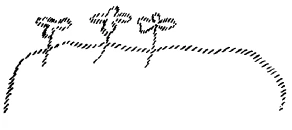
[ 17 ] Everything that comes into being on Earth leaves traces behind. The mysteries of light are less filtered in today’s Eastern culture and in Eastern spiritual life than in the West, but they are by no means still in the form they took back then, during the period I have described. Yet when one studies what the Hindus still have today, what the Eastern Buddhists have, one can much more readily discern the echoes of that from which our own spiritual life springs; it is simply that in Asia it has remained at a different stage of development. But we are unproductive; we are highly unproductive. When news of the Mystery of Golgotha spread throughout the West—where did the Greek and Latin scholars obtain the concepts needed to comprehend the Mystery of Golgotha? They drew them from Eastern wisdom. The West did not give birth to Christianity; it was taken from the East.
[ 18 ] And another example: When intellectual culture in English-speaking regions was felt to be quite barren and people longed for a revitalization of spiritual life, the Theosophists turned to the subjugated Indians and sought there the source for their modern Theosophy. There was no fruitful source within their own lives for what they sought to improve their spiritual life: they went to the East. And in addition to this example, you could find much evidence of the barrenness of spiritual life in the West. And every piece of evidence for the barrenness of spiritual life in the West is at the same time evidence for the necessity of the spiritual life becoming self-governing within the threefold social organism.
[ 19 ] A second current within the tangled web is the state or legal current. There lies the crux of our culture—the second current. When people today look at it from the outside, when they become acquainted with it superficially, they see it when our venerable judges sit on their benches with the jurors and pass judgment on crimes or offenses, or when administrative officials rule over our civilized world from within their bureaucracy, much to the despair of those who are governed in this way. Everything we call jurisprudence, everything we call the state, and everything that arises in connection with jurisprudence and the state as politics—that is this current (see diagram on p. 229, white). Just as I can call that (orange) the current of spiritual life, so this is the current of law, of the state (white).
[ 20 ] Where does this come from? It actually traces back to the culture of the mysteries. It goes back to Egyptian mystery culture, which spread through the southern regions of Europe and then, passing through the sober, unimaginative nature of the Romans, merged within that unimaginative nature with a branch of the Eastern tradition, thereby becoming Catholic Christianity, or rather the Catholic Church (see illustration). This Catholic Church, to put it somewhat radically, is essentially a form of jurisprudence. For from individual dogmas all the way to that immense, grand judgment—which was always depicted as the “Last Judgment” throughout the Middle Ages—the entirely different spiritual life of the Orient, with its Egyptian influence stemming from the mysteries of space, was, in essence, transformed into a society of cosmic judges with cosmic judgments and cosmic punishments, and sinners, the good, and the evil: it is a form of jurisprudence. And this is the second element that lives within our tangled web of thought—in the confusion we call civilization—and has by no means organically connected with the other. Anyone can see that it has not connected simply by going to a university and, for my sake, listening first to a legal lecture on constitutional law and then to a theological lecture—on canon law, for my sake, even. They lie side by side. But these things have shaped humanity. Even in later times, when their origins have been forgotten, they still shape people’s minds. In an abstract sense, legal life influenced later spiritual life, but in outward life it was creative in human customs, habits, and institutions. And what was the final social offshoot in the decadent spiritual current of the Orient—what is it, the origin of which can no longer be recognized? It is the feudal aristocracy (see illustration). You could no longer tell by looking at a nobleman that he has his origins in the Oriental theocratic spiritual life, for he has shed everything; only the social configuration remains. The journalistic intelligentsia sometimes experiences such strange, nightmarish delusions! It experienced such a delusion in recent times and coined a curious term of which it became particularly proud: “intellectual aristocracy.” You could hear that from time to time. That which runs through the Roman ecclesiastical constitution, through the theocratizing jurisprudence, through the jurisprudential theocracy, then becomes secularized in medieval urban life, and is completely secularized in modern times—what is that in its ultimate form? That is the bourgeoisie (see illustration). And so these spiritual forces, in their most extreme forms of dependence, are faithfully jumbled together among human beings.
[ 21 ] A third current is also connected to this. If you observe it today from the outside (drawing, orange), where does this third current manifest itself in a particularly characteristic and immediately apparent way? Yes, in Central Europe there was, in a sense, a method for demonstrating to certain people where these extreme dependencies—which had originally developed differently—manifested themselves. This happened when a Central European sent his son to a trading office in London or New York so that he could learn the customs of business there. In the customs of economic life, whose origins lie in the folk traditions of the Anglo-American world, one can see the ultimate consequence of what has developed into dependencies stemming from what I would like to call the mysteries of the Earth—of which, for example, the Druidic mysteries were only a particular variant. In the early days of European civilization, the Mysteries of the Earth still contained a unique form of the life of wisdom. That European population, which knew nothing and was entirely barbaric in the face of the revelations of Eastern wisdom, the mysteries of space, and what later became Catholicism—that population, which stood in opposition to the spreading Christianity—possessed a unique form of wisdom that was entirely physical in nature. Historically, one can at most study the most extreme customs recorded in the history of this movement: how the festivities of those people were connected to the customs and traditions that later became those of England and America. Here, the festivals took on entirely different meanings than in Egypt, where the harvest was linked to the stars. Here, the festive occasion was the harvest itself, and the year’s most important festivals were connected to things other than those in Egypt—things that were entirely part of economic life. Here we certainly have something that goes back to economic life. And if we want to grasp the whole spirit of this matter, then we must say to ourselves: From Asia and from the south, people transplant a spiritual and legal life that they have received from above and bring down to earth. There, in the third current, an economic life springs up that must develop upward, that must climb upward—a life that, in its legal customs and spiritual institutions, was originally nothing but economic life, so thoroughly economic that, for example, one of the special annual festivals consisted of celebrating the breeding of the herds as a special festival in honor of the gods. And there were similar festivals: all conceived out of economic life. And when we travel to the regions of northern Russia, central Russia, Sweden, Norway, or to those regions that until recently were part of Germany, to France—at least northern France—and to what is now Great Britain, when we travel through these regions, everywhere we find a widespread population that, long before the spread of Christianity in ancient times, possessed a distinctly pronounced economic culture. And what can still be found in the form of ancient customs—legal customs, customs associated with festivals of the gods—is an echo of this ancient economic culture. (The drawing on the blackboard is now complete.)
[ 22 ] This economic culture comes into contact with what comes from the other side. At first, this economic culture did not lead to the development of an independent legal and intellectual life. The original legal customs were cast aside because Roman law was incorporated; the original intellectual customs were cast aside because Greek intellectual life was incorporated. Initially, this economic life becomes sterile, and gradually works its way out again, but it can only do so if it overcomes the chaos caused by the intellectual and legal life adopted from outside. Take today’s Anglo-American intellectual life. In this Anglo-American intellectual life, you have two things that are very distinct from one another. First, you have—more so than anywhere else on earth—the so-called secret societies in Anglo-American intellectual life, which exert quite a strong influence, far more than people realize. They are indeed the guardians of an ancient spiritual life, and they take pride in being the guardians of Egyptian or Oriental spiritual life—a spiritual life that has been completely filtered, distilled down to symbols; distilled down to symbols that are no longer understood, yet still wield a certain great power among the leaders. But this is an ancient spiritual life, not one that has grown from its own soil. Alongside this, there is a spiritual life that is certainly growing on the soil of the economy, but is only just sprouting tiny little flowers—properly sprouting as tiny little flowers on the soil of the economy.
[ 23 ] Anyone who studies and understands such things knows full well that Locke, Hume, Mill, Spencer, Darwin, and others are indeed these “little flowers” that have sprung from economic life. One can derive the ideas of Mill and the ideas of Spencer quite precisely from economic life. Social democracy then elevated this to a theory and regards intellectual life as a subsidiary of economic life. This is what is initially present—all drawn from what is called the “practical,” actually from the routine of daily life, not from the actual practice of life. Thus, things like Darwinism, Spencerism, Millism, Humeism, and the filtered mystery teachings coexist, finding their continuation in the various sectarian evolutionary movements, the Theosophical Society, the Quakers, and so on. The economic life that is striving to emerge has only just put forth its first little blossoms; it has not yet come very far. That which is spiritual life, that which is legal life: foreign plants! And above all, foreign plants—I ask you to take note of this—foreign plants all the more so the further west we go within European civilization.
[ 24 ] For in Central Europe, there has always been something that, I would say, was a form of resistance, a struggle against Greek intellectual life on the one hand and Roman Catholic legal life on the other. There has always been a rebellion there. An example of this rebellion is Central European philosophy. In England, people actually know next to nothing about this Central European philosophy. In reality, one cannot translate Hegel into English—it is simply not possible. People know nothing about him. In England, German philosophy is called “Germanism,” and by that they mean something a reasonable person cannot concern themselves with. But precisely in this German philosophy—with the exception of one episode—namely, when Kant was thoroughly “corrupted” by Hume, and this hideous Kantian-Humean element was introduced into German philosophy, which truly wreaked such irreparable havoc in the minds of Central European humanity— with the exception of this episode, we nevertheless saw the subsequent resurgence of this rebellion precisely in Fichte, Schelling, and Hegel. And we already find the search for a free spiritual life in Goethe, who wants nothing more to do with the last echoes of Roman Catholic jurisprudence in what is called natural law. Do you sense, just as you do in the shabby robes and strange caps that judges from the old days still wear—today they’re petitioning to be allowed to do away with them—do you sense, in the natural sciences, in the “natural law,” that the legal concept is still lurking within! For the entire term “natural law,” for example, makes no sense in the context of Goethean natural science, which works only with the primordial phenomenon, only with the primordial fact. There, for the first time, a radical challenge was mounted—though, of course, it all remained in its infancy—and that was the first foray toward a free intellectual life: Goethean natural science. And in this Central Europe, there is even already the first impetus toward an independent legal or political life. Read a work such as that by Wilhelm von Humboldt. The man was even Prussian Minister of Education. Read Wilhelm von Humboldt’s work. It used to cost—I don’t know how much it costs now—just twenty pfennigs in the Reclam Universal Library. Read this work: “Ideas for an Attempt to Determine the Limits of the State’s Authority,” and you will see the first steps toward constructing an independent legal or political life—the autonomy of the political sphere itself. Admittedly, it has never progressed beyond these initial steps. These steps date back to the first half of the 19th century, and even to the end of the 18th century. But one need only consider that, after all, there are important impulses in this direction right here in Central Europe—impulses that can be built upon, that should not be ignored, and that can flow into the impulse for the threefold social organism.
[ 25 ] In one of his earliest books, Nietzsche wrote the very words that I quoted again in my book on Nietzsche right on the first few pages—words that foreshadow something like the tragedy of German intellectual life. In his essay “David Strauss, the Confessor and Writer,” Nietzsche attempted at that time to characterize the events of 1870–71—the founding of the German Empire—with the phrase: “the extirpation of the German spirit in favor of the German Empire.” Since then, this decapitation of the German spirit has been thoroughly carried out. And when, over the past five to six years, three-quarters of the world turned against this former Germany—I do not wish to speak of the causes or the culprits, but merely to describe the configuration, the state of the world—it was, in essence, already the corpse of German intellectual life. But when one speaks as I did yesterday, objectively characterizing the facts, one should not infer that there is not still much within this German intellectual life that, despite its future vagabond-like nature, must come to the fore—that must be taken into account, that demands to be taken into account. For what, fundamentally speaking, has brought the Germans to ruin? One must also answer this question objectively at some point. The Germans have come to ruin because they wanted to go along with materialism, and because they have no talent for materialism. The others have a natural aptitude for materialism. The Germans, in general, possess that peculiarity that Herman Grimm once so aptly characterized when he said: “The Germans, as a rule, retreat when it would be beneficial for them to advance boldly, and they charge forward with tremendous force when it would be beneficial for them to hold back.”—This is a very apt description of an inner character trait specific to the German people. For the Germans have possessed driving force throughout the centuries, but not the ability to sustain that driving force. Goethe was able to present the primordial phenomenon, but he could not carry it through to the beginnings of spiritual science. He was able to develop a spirituality—as, for example, in his Faust or in his Wilhelm Meister—that could have revolutionized the world if the right paths had been found. In contrast, the outer personality of this brilliant man led him only so far that he put on weight in Weimar and developed a double chin, becoming a portly privy councilor who was immensely diligent even as a minister, but who was nevertheless compelled to “let things slide,” as they say, especially in political life.
[ 26 ] The world should recognize that figures such as Goethe and Humboldt represent the beginnings of this trend everywhere, and that the world would truly be acting to its own detriment—not to its benefit—if it were to ignore what is alive within German evolution, what is by no means yet fully developed, and what is bound to emerge. For the Germans, after all, do not possess the capacity—which others possess so magnificently the farther west we go—to ascend to the highest levels of abstraction. People call what the Germans have in their intellectual life “abstractions” simply because they cannot experience it; and because they squeeze the very life out of it, they believe that others do not possess it either. But the Germans do not possess the gift of penetrating to the utmost abstractions. This was particularly evident in their political life—the most unfortunate of all political lives. Had the Germans always possessed the great talent for monarchism that the French have so brilliantly preserved to this day, they would never have fallen prey to “Wilhelminism.” They would not have needed to let this strange, caricature-like figure of a monarch stand there or put him on display. The French may call themselves Republicans, but they have a secret monarch among them who holds the state structure firmly together, who keeps tempers terribly in check: for, deep down, the spirit of Louis XIV is still present everywhere. It is only natural in a state of decadence, but it is there. There is indeed a secret monarch within the French people; this is evident, in essence, in every expression of their culture. And that talent for abstraction that came to light in Woodrow Wilson is, in the external, political sphere, the ultimate talent for abstraction. Those Fourteen Points of the “world’s schoolmaster,” which bear the stamp of impracticality and unworkability in every word, could only have sprung from a mind entirely built for the abstract, one that has absolutely no sense of true realities.
[ 27 ] There will one day likely be two things that the cultural history of the future will find difficult to comprehend. I have often described one of them to you in the words of Herman Grimm: it is the Kant-Laplace theory, which some people still believe in today. Herman Grimm puts it so beautifully in his Goethe: one day, people will find it difficult to comprehend that affliction—which people today call “science”—that manifests itself in the Kant-Laplace theory, according to which everything we see around us today arose from a general cosmic nebula through condensation. And this is supposed to continue until all that stuff falls back into the sun! A scrap of meat around which a hungry dog circles is a more appetizing morsel than these fanciful notions, this fantastical conception of the world’s development.—So says Herman Grimm. Of course, it will one day be very difficult to explain this Kant-Laplacean theory in light of the scientific madness of the 19th and 20th centuries.
[ 28 ] The second part will be an explanation of the incredible fact that there could ever have been a large number of people who took Woodrow Wilson’s “Fourteen Points” seriously, in an era that is so socially serious.
[ 29 ] If we study the things that exist side by side in the world, we find that economic life, political and legal life, and spiritual life are entangled in a peculiar way. If we do not wish to perish under spiritual and legal life that has degenerated to the very extreme, then we must turn to the threefold social organism, which builds economic life from its own independent roots—a life that seeks to rise but cannot do so unless legal life and spiritual life meet it from a place of freedom. These matters have deep roots in the entire evolution of humanity and in human coexistence. These roots must be sought out. People today must be made to understand how, down there—I would say, crawling right at the very bottom—economic life, shaped by Anglo-American ways of thinking, will only be able to rise if it works in harmony with the whole world, with that for which others are also capable and gifted. Otherwise, its quest for world domination will be its undoing.
[ 30 ] If the course of the world continues as it has, with the degenerating spiritual life coming from the East, then this spiritual life—which was the most sublime truth at one end—will plunge into the most terrible lie at the other. Nietzsche had to describe how even the Greeks had to protect themselves from the lie of life through their art. And fundamentally, art is the child of the gods that protects humanity from sinking into lies. If this first branch of culture is pursued only one-sidedly, this current flows into lies. In the last five to six years, more lies have been told within civilized humanity than in any other period of world history. The truth has hardly been spoken at all in public life; almost no word that has gone out into the world has been true. While this current flows into falsehood (see diagram $229), the middle current flows into selfishness. And an economic system like the Anglo-American one, which was meant to lead to world domination: if it does not deign to allow itself to be permeated by an independent spiritual life and an independent political life, it flows into the third of the abysses of human life—the third of those three. The first abyss is the lie, the degeneration of humanity through Ahriman. The second is selfishness, the degeneration of humanity through Lucifer. The third is, in the physical realm, illness and death; in the realm of culture: cultural illness, cultural death.
[ 31 ] The Anglo-American world may achieve world domination: without the threefold social order, it will use this world domination to unleash cultural death and cultural disease upon the world, for these are just as much a gift of the Asuras as the lie is a gift of Ahriman, and as selfishness is a gift of Lucifer. Thus, the third—which stands worthily alongside the others—is a gift of the Asuric powers!
[ 32 ] We must draw from these things the enthusiasm that will inspire us to truly seek ways to enlighten as many people as possible. Today, the task of the discerning is the enlightenment of humanity. We must do as much as possible to counter that folly which fancies itself wisdom and believes it has come so wonderfully far; we must set against that folly what we can gain from the practical aspect of anthroposophically oriented spiritual science.
[ 33 ] If, with these words, I have been able to awaken in you even a little sense of the profound seriousness these matters must hold today, then perhaps I have achieved something of what I specifically hoped to achieve with these words. When we meet again in a few weeks, let’s continue talking about similar topics. Today, I simply wanted to convey to you the sense that, at present, the most important social work is to educate people as widely as possible.