

Spiritual and Social Transformations
in Human Evolution
GA 196
14 February 1920, Dornach
Translated by Steiner Online Library
Fourteenth Lecture
[ 1 ] I would like to very briefly reiterate what I presented to you here yesterday, because today I will be building on that with further remarks concerning the nature of the human being. What I had to say to you yesterday was as follows: We first turned our attention to the three faculties of the human soul that are more devoted to cognition. We pointed out that there are essentially three cognitive faculties in the human soul: first, what is known as the faculty of memory; second, what is known as intelligence; and third, what is known as sensory activity. I then drew your attention to the fact that these three soul faculties can only be understood by examining their development. To understand memory—which is, relatively speaking, one of the younger faculties of the human being—one must, however, turn one’s gaze back to times when the Earth was not yet what it is today, when the Earth was undergoing its development as the Moon that preceded it. Thus, the earliest seeds of what has become our capacity for memory today are to be found in the ancient Lunar era, where they appeared not as memory but as the dreamlike imagination pervading human beings—a phenomenon I have often described in other contexts. What was dreamlike imagination during the ancient Lunar era in those beings from whom human beings evolved has become the capacity for memory during the Earth era. This memory, as I told you, is, of all the soul’s cognitive faculties, the most closely interwoven with physical embodiment. Intelligence, on the other hand, is less closely interwoven with the physical body. It is more detached from it in the way I described yesterday. But to discover its earliest origins, one must go further back than the ancient Lunar Era; one must go back to the ancient Solar Era, where one then finds the earliest seed of what exists within us today as intelligence in the form of dormant inspiration. One must go back the farthest for that which, as I explained yesterday, is most detached from our physicality—even though this is the hardest to believe given the materialistic worldview of our time: for sensory activity, one must go back to the ancient Saturn era. And as the very first origin of this sensory activity in both beings from which human beings later emerged, one finds a dull intuition.
[ 2 ] Furthermore, we have seen that, by possessing these three soul faculties within us, we simultaneously serve as hosts to beings of higher hierarchies within the organization that underlies these soul faculties. Thus, through the organization of our sensory activity, we are the hosts of the Archai, the spirits of time. They dwell within our humanity. Through that which we possess as intelligence—insofar as this intelligence is linked to the reflective apparatus within us, which reflects back to us our concepts and ideas (which, however, come from the spiritual world) and thus brings them to our consciousness—we are the hosts of the Archangeloi. And through that which operates within our organization and mediates our memory, we are the hosts of the angels. Thus, through our cognitive faculties, we stand in relation to the past; through our cognitive faculties, we stand in relation to the beings of higher hierarchies.
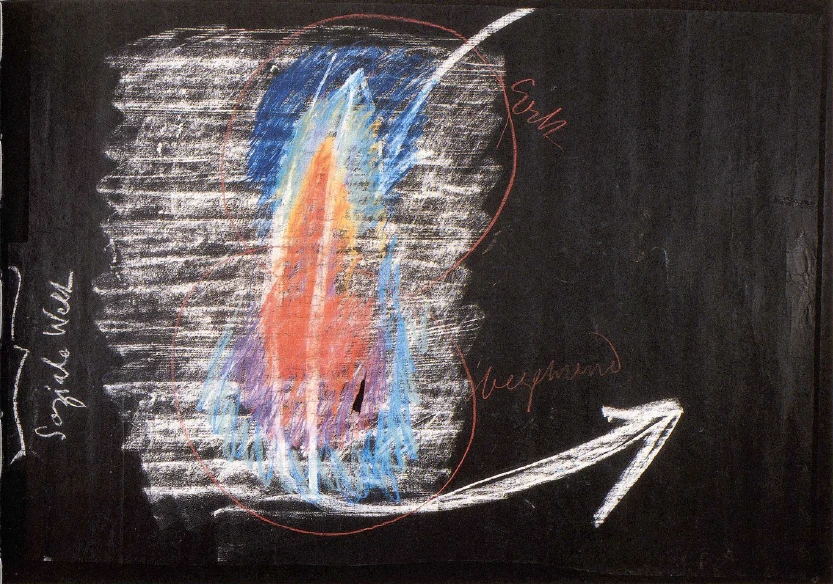
[ 3 ] According to an ancient custom, these three human faculties are called the higher faculties. And if I were to sketch out the human being before you schematically—if I were to present you with a diagrammatic image of humanity—I would have to draw something like the following as this diagram of the human being. First, I would have to draw the faculty of sensory perception. I will try to do this by creating a white background (see drawing, white hatching). First, I would have to sketch sensory activity schematically within the human organism; to get the proportions right, I would have to draw it something like this (blue). The primary sensory activity is, of course, centered in the head. Although the entire human being is permeated by sensory activity, I would like to begin by sketching the main sensory organization here (blue).
[ 4 ] If I were to illustrate intelligence, I would have to depict it in the following way to make it clear: sensory activity is directed more outward (blue); intelligence (green) has its reflective apparatus located more within the brain. Deeper still lies that which underlies memory, already very closely connected to the physical organization. In truth, memory (red) is bound to the lowest nerve organisms and to the rest of the organism. I could then create transitions between sensory activity and intelligence by, for example, drawing this here (indigo) as a transition. As you know, we also have concepts and ideas that are, in a sense, of a more concrete nature. While I must depict sensory activity as such in blue, I would have to draw indigo here as a transition. For the more abstract concepts, I would have to use green, and for what exists within us as concepts related to memory, I would have to draw yellow as a transition from green to red via orange. In this way, moving from the outside in, I would have to depict the human being in its organization with regard to its capacity for cognition. Thus, in the sequence of these colors—if you imagine the organization of the eyes and ears, in particular, in shades of blue, and as sensory activity transitions into intelligence, with indigo shifting toward green, lightening through yellow to red toward memory— a kind of schema—one that, however, falls far short of the reality of what the human soul’s cognitive faculties or cognitive abilities actually are.
[ 5 ] Now, everything is all mixed up in human nature. That is precisely what makes the task so difficult for those who think in materialistic terms: that everything is all mixed up in human nature. One cannot neatly and precisely separate one thing from another in space. Nor is it so clearly separated in human nature, but if one wishes to draw a schematic diagram, one can still make out quite a lot. Thus, one can indeed see that, just as the color red relates to the color green, so too do the capacity for memory and the capacity for intelligence relate to one another through their inner qualities; and just as green relates to blue, so does intelligence relate to sensory activity. But we also have other faculties in the human soul—faculties that, for us as earthly human beings, are more or less bound in the strictest sense to our physical body. First and foremost among these is feeling. While memory, intelligence, and sensory activity are gradually bound to waking consciousness, feeling is already something very “dreamlike” in the human being. I have explained this on several occasions. While memory is something that developed in its basic form in the distant past on the ancient Moon, intelligence on the Sun, and sensory activity on Saturn, feeling—as we experience it today—belongs to the earthly human being, even though early signs of it were already present during the Lunar period; however, these are of lesser significance. It is essentially something bound up with the human earthly constitution. What we, as earthly human beings, received as an integral part of our constitution is what actually made us feeling beings in the first place. But just as memory is something that has gone beyond its initial potential and reached a higher stage of development on Earth—and, if one possesses sufficient supersensible insight, one recognizes that memory is, in a sense, an ancient human capacity—so too does one recognize that feeling is currently present only in potential. One can see this in what human beings today call “feeling,” if one has the necessary understanding to realize that it will become something quite, quite different in the future. Just as if, as an observer during the ancient Lunar Age, one had looked upon dreamlike imagination and had to say to oneself: “This will later become human memory”—so, as one who understands, one must say of today’s feeling: When the Earth ceases to exist and has become something else—when the Earth has become the future Jupiter—only then will feeling have become what it is capable of becoming. — Today, feeling is still only embryonic in human beings, something present as a seed. Only then will what feeling is capable of becoming blossom forth from it. $o in our feelings we carry within us something that relates to what it will become on Jupiter in the same way that a child in the womb relates to the human being born into the world. Our feeling is something embryonic, and it will only later, during the Jupiter era, become what will blossom as complete, fully conscious imagination.
[ 6 ] Another faculty of the soul that is bound to our physical organization is desire. This desire is even more embryonic than feeling. Everything within us that constitutes the world of desire will only become, during the future Venusian era, what it is today merely in embryonic form. Our desires are very strongly bound to our physical organization today. They will break free. Just as our intelligence was bound to the physical organization of the Sun during the ancient Sun era—as I described in my Outline of Esoteric Science—so too is the human world of desire bound to the physical organization today. It will appear detached from the physical organization during the future Venus era, and it will then emerge as fully conscious inspiration.
[ 7 ] Of all our soul faculties, the will is the most embryonic. In the future, the will is destined to become something truly immense and cosmic—something through which human beings will belong to the entire cosmos, will be individual beings, and yet will live out their individual impulses as a fact of the world. But this will only come to pass during the Volcanic Age, when the will will be fully conscious intuition.
[ 8 ] Advanced Skills
| Sensory Activity | Saturn [dull intuition] | Archai |
| Intelligence | Sun [dormant inspiration] | Archangeloi |
| Memory | Moon [dreamlike imagination] | Angeloi |
[ 9 ] Lower-Level Skills: Social World
| Feeling | Jupiter [fully conscious imagination] | Mineral Kingdom |
| Desire | Venus [fully conscious inspiration] | Plant Kingdom |
| Will | Vulcan [fully conscious intuition] | Animal Kingdom |
[ 10 ] Thus, through our feelings, desires, and will, we in turn belong to future times. These faculties are inherent in us, for through them human beings are prepared for their future being. But here, too, we stand in a relationship with the world in which these human faculties are connected to the environment. Just as, in relation to the spiritual environment, memory, intelligence, and sensory activity are related to the Angeloi, Archangeloi, and Archai, so too are feeling, desire, and will related to the physical environment—but in such a way that our feeling is related to the world around us in a manner that, during the Earth period, gradually consumes the mineral world. Everything that constitutes the mineral world around us will disappear at the end of the Earth era, and the forces that will consume the mineral world through human activity are the forces of feeling. Thus, we must assume a special relationship between feeling and the mineral kingdom (see diagram). We must assume a special relationship between desire and the plant kingdom. Just as there will be no mineral kingdom on Jupiter—which, as a future planet, will be the next incarnation of our Earth—because feeling will have consumed the mineral kingdom during Earth’s existence, so too will there be no plant kingdom during the Venusian era, because human desire will consume this plant kingdom during the Jovian era, and human will will consume the animal kingdom during the Venusian era. And when the volcanic era draws near, this future volcanic embodiment of our Earth will no longer contain the three kingdoms, but only that which, of the present kingdoms, will then have become the human kingdom.
[ 11 ] In contrast to what I have just told you, people living in the present might say: I care little about what I once was—with my memories, my intelligence, and my sensory faculties—on good old Saturn, the Sun, and the Moon; I’m happy with my existence as an Earthling—why should I care about what things I no longer remember went through on earlier planetary incarnations of our Earth? That doesn’t interest me! And I’m certainly not interested in what will become of my feelings—which interest me very much right now—on Jupiter or even on distant Venus, or what will become of my desires there. These desires drive me now, but Lady Venus—she doesn’t interest me yet, for she is, after all, not a present lady, and I’m only interested in present ladies. And so, isn’t that right, only with desire in such a distant, distant future!
[ 12 ] Certainly, this is how many people today feel, and the prevailing culture is very, very much in favor of letting them sleep through everything that seeks to assert itself from the present into this insight—so that they do not wake up to these insights. But human development cannot be guided into the future without such insights. For it is profoundly true that in the human organism—the physical, the psychological, and the spiritual—everything interacts in a complex interplay; yet one must still be able to distinguish between these things. Just as the higher faculties could be schematically depicted—proceeding from sensory activity inward toward memory—so I can now depict here the lower faculties specifically formed on Earth (see diagram on page 213). I must then do this in the following way: A somewhat deeper red—unfortunately, I do not have the distinctions here—would correspond to our feeling. But this feeling extends into intelligence, into all sensory activities, and even through memory. If I were to depict the activity of desire, I would have to draw a true red-violet. And if I wanted to depict volition as it is today, I would have to draw a blue-green. Thus, the human being is a dual being: an upper human (circle above), who is essentially a knower, and a lower human (circle below), who is essentially a desirer, with feeling and volition regarded as the two poles of desire.
[ 13 ] Indeed, in the earthly human being, that which constitutes the lower human being acts upon the higher human being; will, desire, and feeling all act upon the higher human being (upward-pointing arrow T). In other words, our sensory activity is such that it encompasses everything that has gradually emerged from the dull intuition of ancient Saturn. But if, through our eyes and ears, we were to carry within us only that which comes from the dull intuition of ancient Saturn, we would be quite dry beings. We would perceive the outer world as if through automatically functioning senses. We would think soberly and dryly about this external world, and we would recall what we have experienced without warmth. The fact that we experience what we have lived through as our own affair—that we do not, so to speak, merely look into our experiences with indifference and recall them, viewing our personal life like the individual pieces of a kaleidoscope—is what causes our remembered thoughts, our intelligent being, our sensory perceptions, our feelings, our desires, and our will to rise up within us. When we view things from the outside, they appeal to us. They appeal to us through our desires, through our feelings, or through our will. When we think, we do not merely think in a sober and dry manner, but we infuse our ideas with a certain enthusiasm. We would not infuse this enthusiasm if we possessed only what the Sun has given us as intellectual power; we have it in our thinking because the Earth has endowed us with volition, desire, and feeling—even if these are still in an embryonic state. The same applies to the capacity for memory. Our higher soul faculties are always influenced by what, according to an old custom, are called the lower faculties, because they are more closely bound to the body. Let us note this first. Our higher soul faculties—which would cast us into the world like dried-up intestines if they were merely what they have become through Saturn, the Sun, and the Moon—are illuminated and enlivened by the lower soul faculties: volition, desire, and feeling; and we become warm, feeling human beings, even when we think. There are, however, quite a number of people today who strive for objectivity by expelling feeling and desire from their intellect; but this is either merely an illusion—if people believe they can expel the lower soul faculties from sensory activity, intelligence, and memory—or, if one does actually expel them—to a certain extent, one can only do so—then one becomes just that! For it is only ever possible to a certain degree to expel the lower soul faculties from the higher ones. For example, one can cast them out when one steps up to the lectern and expounds all manner of sciences to the foxes and other, later students. There, one can cast out of the intellect the lower, essentially earthly faculties of the soul. But one cannot cast them out entirely. When one then returns home from one’s philosophical musings and finds that the midday meal does not taste good, real desires and feelings—as one grumbles about what the housewife has prepared—permeate the intellect and, in particular, the sensory faculties of taste, smell, and so on. Thus, there sometimes exists within a person, in a state of complete confusion, the dry philistine—who has cast out the lower faculties from his higher soul faculties—and the person who is quite capable of enthusiasm when something is over-peppered, oversalted, or even burnt, or otherwise not cooked properly in any way!
[ 14 ] Our lower soul faculties must contribute to the higher soul faculties. But in fact, ever since the beginning of the fifth post-Atlantean epoch—since the middle of the 15th century—there has been a wave of development within humanity aimed at making sensory activity and intelligence purer and ever purer; and later this will also apply to memory. Memory has not yet been affected by this. People want to liberate these qualities; indeed, they want not only what I just mentioned about the dry philistine—which stems solely from the fact that this dry philistine is, in fact, more caught up in what human nature generally does—but also for the physical aspect of the human being to wither away entirely, as I have already explained in an earlier reflection, and will be able to warm and illuminate the higher faculties of the soul less and less. They will then indeed become that which is parched, unless they are filled with what can come from spiritual revelation.
[ 15 ] We must indeed enrich sensory activity, intelligence, and memory in the Earth’s subsequent stages of development with what is revealed from the spiritual world, because the Earth’s own gift—which provides the foundation for these higher faculties of will, desire, and feeling—is gradually withering away. We do not wish merely to disparage the stiff-necked philistine, as we have just done, but we also wish to acknowledge that he is a pioneer of the future withering of our higher soul faculties, that he already feels within himself what will afflict all of humanity; only, he still rarely feels the necessity today that this must be replaced by spiritual revelation. It must be replaced by spiritual revelation. Just as human beings have been accustomed to experiencing the upward flow (upward arrow) of will, desire, and feeling in memory, intellect, and sensory activity—must instead experience the revelations of the spiritual world flowing down from above through spiritual knowledge (downward arrow, top right), so that his sensory activity, his intellect, and his memory may be filled with that which they are no longer filled with, as our physical body withers away more and more amid the decadence of the Earth.
[ 16 ] Let us first note that we are moving toward a time in which everything that human beings engage in—through sensory experience, intelligence, and memory—must be received as spiritual revelation within them, so that human culture can move forward. Let us now turn to the lower human faculties, which today exist only in an embryonic state. These lower human faculties are the ones that primarily bring us into relationship with our environment. Even inwardly, they stand in relation to the environment—to the mineral, plant, and animal kingdoms—of which our environment is composed. When we feel, we feel about the things in our environment; when we desire, we desire the things in our environment; when we will, we intervene directly in the active essence of our environment. There we stand, fully immersed in our environment. And what, we might ask, is the outcome of this—what becomes of the feeling, desiring, and willing of the people who live together on Earth?
[ 17 ] If you take in with your mind’s eye everything that is called the social world, you will see that it is entirely the result of the will, desires, and feelings of people living together. And what we experience emotionally as human beings—what people desire from one another and from nature, and what is done out of volition—that is, in fact, the external world. By desiring, we belong to the social order far more than we realize. We are made into desiring beings by our position in the social world, and our will intervenes everywhere in the social world in such a way that what happens in the social world happens as a result of our will. Therefore, within what we call the social order of life, there lives an independent existence in what people feel, desire, and will. Today’s Social Democratic Party says: “What exists out there is the result of an economy, of economic forces as they develop.” — No, what exists out there is the objectification of the feelings, desires, and will of people living together in society. That which first arises in human beings as feeling creates conditions that then determine people’s social life; the same is true of desire, and even more so of the will. But everything in human nature is interconnected. The colors shown below correspond to feeling, desire, and will. The intellectual faculties—sensory activity, actual intelligence, and memory—act downward and, through our will, extend outward into the social world (arrow below, pointing to the right).
[ 18 ] If, in fact, human beings were to wither away more and more in terms of their physical constitution as they move toward the future, then little from the physical constitution would be able to flow into the social order; instead, sensory experience, intelligence, and individual human memories would flow into the social world without first passing through human feeling, desire, and will. In other words: If things were to develop in a way consistent with the mere organization of the Earth—that is, if our physical constitution were to wither away, leaving us with only sensory activity, intelligence, and memory, and if these were not even fertilized by the spirit—then a dry intelligence, a merely external sensory perception, and the purely egoistic memories of individual human beings would seek to dominate social life. This would, as it developed further and further, result in what is now beginning in Russia. In Russia, a social order is now beginning to take shape in its embryonic form within Leninism and Trotskyism—an order derived solely from sensory experience, intelligence, and the few memories of an egoistic nature held by individual human beings. One does not yet even notice that this order in Eastern Europe is striving to be a purely rationalistic order—an order that is to be shaped solely from the cognitive faculties of the Earth-human, as he has emerged from the Saturn-, Sun-, and Moon-human—and that everything that can be received from the spiritual world is to be consciously excluded.
[ 19 ] That feeling which teaches one to what state of stagnation human civilization is coming, so that human beings will become nothing more than walking machines—that feeling which teaches us what would happen if dictators like Lenin and Trotsky were to continue to rule the world—must arise from such an understanding of the essence of human nature as we have now set before our souls over these past two days. Such an insight shows us that it is simply a necessity of human nature for the higher faculties of the soul to be illuminated and enlivened by spiritual revelation, so that what intelligence, sensory activity, and memory would become if they were not enriched by the spiritual world does not spill over into social life. Human beings must learn to feel what binds them to the whole of earthly existence, and they must learn to feel—out of spiritual insight—what is brewing in the East and what threatens to consume all of Asia at an ever-accelerating pace. Humanity must learn to perceive this as the great, terrible disease of our present civilization, which must be healed. And it can only be healed if it can be diagnosed correctly.
[ 20 ] To pursue spiritual science today means to seek out the healing process for our ailing civilization. This must be felt by a sufficiently large number of people, and it must be felt very deeply and thoroughly. Without spiritual science, people will not feel this. And now all the events that set the tone are taking place without any sense of what is actually being done. The event at Versailles was nothing other than—and is nothing other than—the inoculation of a poison of civilization, a toxin that is bound to make humanity even sicker than it was before. For everything that is created without an understanding of the future living conditions on Earth is a source of disease for evolving humanity.
[ 21 ] Today, we are accustomed to accepting such things as statements arising from feeling or emotion. Here, however, they are not derived from such a source. Here they are derived from an understanding of the essence of human nature. And here it can be shown that the spiritual life of human beings—which is sustained by memory, intelligence, and sensory activity—cannot continue to exist without being nourished by the spiritual world. People do not admit this today. But why do they not admit it? They do not admit it for a historical reason. Since the middle of the 15th century, the structures that are today regarded as the true bearers of civilization—the modern states—have become increasingly established. These modern states, however, can in the future be only that which—as I have explained here in another context—pertains to human life between birth and death. They must not interfere in anything that relates to the connection between human beings and the spiritual worlds. In the future, human beings must become capable, as individual human beings, of bringing the spiritual world into their memory, their intelligence, and their sensory activity. They can do this only as individual human beings; only the individual can do this. In the future, the individual must become the mediator between heaven and earth, between the spiritual world and the physical world. And people today rightly feel—even though their perceptions are virtually inverted in the way they experience it—that it is inappropriate when currents that should only influence the individual human being come to play a role in so-called public affairs of state. If the Russian tsar and tsarina made use of the inner experiences of a Rasputin in their acts of governance, people were right to fear this, for revelations from the spiritual world may only influence spiritual life; they must not influence state affairs. Only that which has become our sound reason through spiritual revelations may influence state affairs. Well, Rasputin did not reach the level of sound reason, even if he did reach the level of revelation.
[ 22 ] On the other hand, in social life out in the world, one can find only that which is connected to people’s lower faculties—the faculties that develop on Earth, such as desire, feeling, and will. These develop through human interaction; and they develop not through interaction with abstract humanity as a whole, but only with groups connected by common interests—groups bound together by their specific desires and interests, by their specific feelings, or by the will they must develop.
[ 23 ] But this justifies the need for a threefold division of public affairs. In the future, the state—which must not allow direct spiritual life to enter into its affairs at all—must not be allowed to extend into spiritual life. Spiritual life will have to have its own independent administration, because it cannot progress unless it receives spiritual revelations. If the state is to be healthy, it must refrain from interfering with spiritual revelations. If, therefore, it directs spiritual life according to what is good for itself, it makes it as bad as possible. It must be separated from the state and become an independent sphere. But economic life, too, cannot be intertwined with the life of the state, for this economic life must be deeply rooted in the communities of interest formed by individuals bound together by shared interests—in their feelings, desires, and will—as these take shape in associations and smaller communities.
[ 24 ] In short, just as the physicist understands the complex phenomena of the physical world from the simple experiences he has, so must we today understand human nature—with its higher faculties: memory, intelligence, and sensory perceptions; and its lower faculties: will, desire, and feeling—what is to come to pass in the development of humanity. And anyone who today presents himself with a social will drawn from a strong but empty sense of self-consciousness, and with the tone that many people today call the “voice of conviction,” and who develops social ideas, is like a person who stands before a telegraph system, has no clue about electricity and magnetism—these simple facts—and now, out of his ignorance, attempts to explain a telegraph system. People who speak about sociology today usually speak from roughly such a mindset—even if it sounds very scholarly to many people—like someone who has never heard of the nature of electricity and looks at a Morse code apparatus in a telegraph station and says: “There are just these tiny little riders in there—you can’t see them—riding over to the other station; you just can’t see any of it.” —And he explains it all quite neatly. That is how Marxism explains social facts; that is how our university sociologists explain social facts. Reality only becomes apparent when one recognizes human nature. But human nature can only be understood within the context of the entire cosmic order. For memory is connected to the extraterrestrial, intelligence is connected to the extraterrestrial, and sensory activity is connected to the extraterrestrial. Feeling is only something that, once the Earth is no more, will become what it is meant to be; desire and will likewise in an even more distant future. Just as one must, in order to be a physicist, know the simple facts of the organism’s thermodynamics and the simple facts of acoustics, so too must one—in order to have a say today, and so that as many people as possible may have a say regarding social facts—delve into the simple, elementary connections between the human being and the world; for whatever is socially grounded, the human being carries into the social order. But human beings bring the entire universe into this world through their very nature. That is why those chatterers are in such a sorry state—those who, drawing on all sorts of old traditions, speak of human beings as a microcosm, a small world in contrast to the macrocosm, and who remain stuck in these abstractions. Only those who know that there were once human ancestors—the “lunar beings”—who possessed dreamlike imaginations have a true right to speak of the macrocosm and the microcosm. The moon has passed away; the Earth has come into being. Human memory arose from that which is no longer there but once existed. It has no earthly origin. Only the human “I” and its manifestation—the present physical human body with its form—have an earthly origin. One must grasp concretely that which one otherwise has no right to call merely a microcosm.
[ 25 ] My dear friends, this decadent civilization can only be saved if it is finally recognized that we must speak of human beings as cosmic beings—especially in those institutions where philosophy is taught today as a mere sum of forced abstractions. What has become of humanity—a humanity that is abstracting, that is merely abstracting—appears only in symptoms in philosophies such as those of the American William James, the Englishman Spencer, the Frenchman Bergson, or the German Kant of Königsberg. These abstractions conceal from humanity what it truly is. But the living knowledge of the spiritual, which spiritual science seeks to attain, can lead human beings to self-knowledge.
[ 26 ] More on that tomorrow.