

Spiritual and Social Transformations
in Human Evolution
GA 196
15 February 1920, Dornach
Translated by Steiner Online Library
Fifteenth Lecture
[ 1 ] Yesterday and the day before, I attempted to explain how necessary it is for the future development of humanity that people attain true self-knowledge—that is, an understanding of what it means to be human—and yet how impossible it is to attain such an understanding without, in turn, discovering the connection between the human being and the extraterrestrial worlds. Of all that a human being carries within their being throughout their life’s journey, the physical body is, after all, only the smallest part. But only this physical organization, as human beings possess it today, is, strictly speaking, a product of the Earth. That which otherwise belongs to the essence of the human being is not, in this sense, a product of the Earth, as I have again explained in these two lectures from a certain point of view.
[ 2 ] Yet even the current physical organization of humankind suggests that human beings, as such, are beings that point beyond the immediate present. Although the physical organization certainly points to the earthly realm, within that earthly realm, human physical organization in turn points us beyond the immediate present moment of world history—into the past and into the future. Among human faculties, we have had to emphasize those of a cognitive nature: sensory activity, intelligence, and the capacity for memory; and we have had to emphasize feeling, desire, and volition: faculties that are more of a desiring nature.
[ 3 ] Now, when we ask ourselves: What must a human being possess in his physical constitution in order to develop cognitive abilities? — we must turn our attention to the human head structure and everything connected with it. It is precisely only in the way I explained it yesterday and the day before—but precisely in that way—that the organization of the head is necessary to develop the cognitive faculties for the “I,” for earthly human consciousness. It is incorrect to believe that the eye is the sole source of the sensation of sight; but it is correct to recognize that the eye serves as the mediator of the sensation of sight for the “I”-consciousness. And this applies equally to the other senses, particularly the higher ones.
[ 4 ] In this way, and with manifold variations, the human physical constitution points to the earthly realm; but at the same time, it points beyond the present moment, so that we can say: The human being, as we see him before us in terms of his physical constitution, points to his previous earthly life. — Just as our intelligence points to the distant, primeval past life in the Sun, so does our present physical head organization—with its earthly nature of cognitive faculties, that is, the organization of these faculties toward “I”-consciousness—point back to our earlier earthly existence. I have already drawn attention to what the human head actually is. Schematically, you can think of it this way: The human being consists of the head and the rest of the organism. — Let’s say (see drawing): this is the current life cycle (center), this is the previous life cycle (left), and this is the next life cycle (right). Thus we can say: The head of our present life cycle (Figure 15) arose through the metamorphosis of the rest of our physical body in the preceding life cycle, and we have lost the head from our previous life cycle. — Of course, I do not mean here—since that is self-evident—the physical body, but rather the forces, the formative forces, that the physical body actually possesses. That which we now carry within us—apart from the head organization, the bearer of the cognitive faculties for the “I”—as the rest of the human body, the torso with limbs, will become the head organization of our future earthly life.
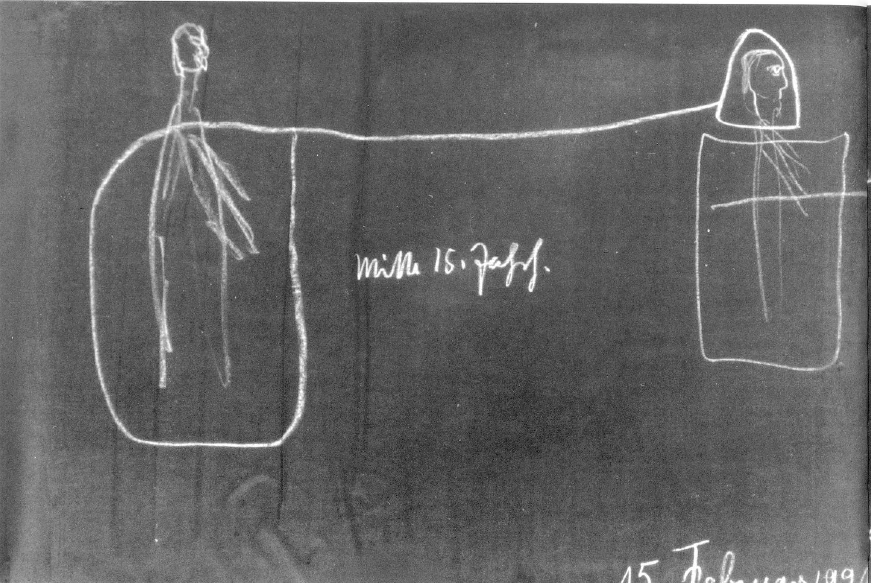
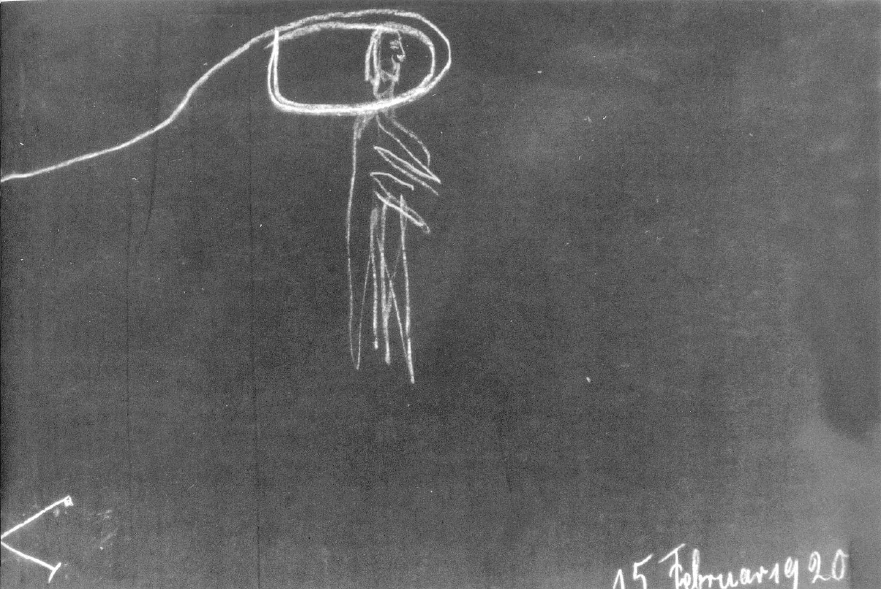
[ 5 ] You all already carry within you the forces that will be concentrated in your head during your next earthly life. What you accomplish today with your arms, what you accomplish with your legs—all of this will become part of the inner organization of your head in your next earthly life. And the forces that radiate from your head in your next earthly life will become your karma, your destiny for that next life. But what will be your destiny in your next earthly life travels, by a roundabout route, through the rest of your being—through which you enter human life today—and on into your future life centered in the head.
[ 6 ] If today, let’s say, you behave lovingly toward another person during an earthly life, that is something your non-mental organism has carried out. This becomes a mental force that shapes your destiny in your next earthly life. Thus, our head, with its faculties, always points back to the course of our previous earthly lives, particularly to the organization of the limbs. Human beings undergo this great metamorphosis. Their head is a metamorphosed organism from the previous incarnation, and their present torso—and especially their limb organization—forms the basis for the organization of the head in their next earthly life.
[ 7 ] This is certainly something that, in a certain sense, must take on practical significance in human coexistence. For when a person knows that they are thus integrated into the development of humanity, only then do they feel truly at home in this earthly life, and they will come to understand many things that would otherwise be incomprehensible. As I have often explained, we are now living in the fifth post-Atlantean epoch. It began in the middle of the 15th century; that is to say, in the middle of the 15th century, new conditions of existence arose for European civilization and its American offshoot, insofar as the latter developed later. But the consequences of these new conditions of existence have not yet materialized. People in civilized countries often live according to habits—even habits of thought—that correspond more to the earlier, fourth post-Atlantean epoch. We have educated our intellectuals not in the matters pertaining to the present, but rather we have had them study Latin and Greek, and so on. A Greek would have held different views in this regard. He would have been quite taken aback, during the heyday of Greek culture, if his boys had been taught not Greek but Egyptian or Persian or the like. But the time has passed when this is permissible, when we may still cling to the remnants of the Greco-Latin era. For the people born after the middle of the 15th century are, in essence, all reincarnations of those physical earthly human beings who lived during the Greco-Latin period. What did these people bring with them from that time? The heads of the bodies they had during the Greco-Latin period. So if someone was born, say, in the 16th or 17th century, they came into the world with a head—that is, with cognitive faculties—insofar as the head is the mediator of cognitive faculties for the “I”-consciousness, which arose from their body during the Greco-Latin period. Therefore, they were still born with inclinations that originated from this Greco-Latin period. But this has now been partially exhausted or is in the process of being exhausted. Very soon, not many people will be born with heads from that period; instead, more and more people will be born who already had their previous incarnation in the fifth post-Atlantean epoch—not all of them, but many—namely those who set the tone, or at least those who, toward the end of the fourth post-Atlantean epoch, lived with bodily functions quite different from those in the prime of the fourth post-Atlantean epoch.
[ 8 ] So this is what one must take into account if one wishes to engage fully and consciously in human evolution: you know that you have your head from your previous earthly incarnation, and you have your body so that you can prepare a future head for your next earthly incarnation. — And a time must come when people’s lack of awareness of this connection with their previous and next incarnations will be just as much a sign of stupidity as it would be if someone did not know how old they were, if someone believed they had been born only last week, even though they are already an adult, or if they believed—or were led to believe—that, as a ten-year-old boy, they would always remain a ten-year-old boy and would never even become an old man. Today, people live only selfishly in their single earthly life. At most, they believe that there are a number of earthly lives, but this remains a belief; it does not become practical wisdom about life—such as the sense of how one must position oneself between incarnations; just as it must be practical wisdom, when one has reached the age of forty, to know that this fortieth year is the continuation of childhood and youth and marks the beginning of growing old and becoming senile. What human consciousness encompasses must expand. It will not expand in a living way unless it is enriched by insights from spiritual science. Otherwise, it remains a mere abstract belief; otherwise, people will simply say: “Yes, I know, I have been on Earth countless times, and I will come back to Earth countless times again.” — But this belief amounts to nothing; only the living sense of being immersed in human evolution, the feeling: With your head, you are actually quite an old fellow, for that is merely the fully developed body of a previous incarnation; with the rest of your physical constitution, you are a baby, for that will only grow into a mature head in the next incarnation—this sense of the human being as a true duality set within time is something that must become an integral part of living consciousness. And just as people today try to determine, through all sorts of skull measurements and similar interesting data, how individual human beings, peoples, and races differ on Earth, so in the future we will have to recognize the differentiation among the people inhabiting the Earth based on soul-spiritual insights—insights that, however, cannot be gained without the foundations we have developed in our time. In particular, we will have to inquire into the spiritual and psychological characteristics of humanity scattered across the Earth. And salvation cannot come until, in particular, our university sciences are thoroughly permeated by the very attitude and perspective that we have come to know in our time. Our universities will lead humanity into decline if they are not enriched in all their aspects by that cosmic knowledge which today can be gained only through spiritual science. Likewise, people’s religious feelings in the future must be sustained by what human beings can know about the spiritual and soul realms. Otherwise, we will make no further progress. For once we begin to direct our gaze toward the spiritual-soul realm at all, we will become accustomed to characterizing groups of people across the earth according to their distinctive spiritual-soul qualities, not merely according to their physical characteristics, as is often done in contemporary anthropology. Anthroposophy must take the place of mere anthropology. But the matter has a very serious, practical aspect. Certain things taking place in the present—which underlie the grave events of our time—cannot be fully understood at all unless one has the opportunity to focus one’s attention on the spiritual qualities of the members of humanity. And here I would like to draw attention to something that I consider extraordinarily important to highlight. Well-meaning people have frequently emphasized one thing for Europe during these terrible events of the war, and in fact, this one thing for Europe was already emphasized in 1870 by Ernest Renan, the French author of The Life of Jesus and The Apostles; during this time of war, it has been repeated many times. Renan said that for the salvation of Europe, it is absolutely necessary that a coming together take place—a peaceful coming together between the French nation, the English state, and the German people. In particular, this was often emphasized during the war by people who had not allowed themselves to be misled by what was officially prescribed as the prevailing opinion or by what was propagated as opinion by those with a vested interest in one cause or another—it was emphasized by many well-meaning and impartial people. Now, however, one might say: The development of Europe in recent decades has been such that it runs completely counter to what discerning people had to regard as a fundamental condition for the progress of civilization in Europe. Without this peaceful cooperation—so these impartial people said—Europe could not move forward. But this peaceful cooperation has never truly materialized in recent years; at most, a mere semblance of such peaceful cooperation has emerged.
[ 9 ] Now, even if one considers European conditions from the outside—but with the intention of examining the spiritual-soul aspect—one can see what essentially distinguishes these three branches of humanity. We must not forget that ever since the time when Europe began to develop—around the start of the fifth post-Atlantean period and then throughout the course of that part of the fifth epoch which has just come to an end—the French nation has increasingly taken shape as a unified nation, whose members felt themselves to be part of a unified nation. One might say: The entire spiritual life of the French nation was directed toward feeling itself to be a unified nation, carrying within its consciousness the sense of “I am a Frenchman.” — One can study how, over the course of the centuries, what is summarized in those four words—“I am a Frenchman”—gradually came to be. — If one pays attention to how something like this develops—“I am a Frenchman!”—then one must look at the parallel phenomenon within German development. For example, something did not develop in the same way within the now-defunct German Empire that could be—or had always been able to be—expressed as: “I am a German!” — To declare with full intensity: “I am a German!” — meant, up until the year 1848, that one would be locked up, that one would be imprisoned. It was the worst political crime. People have forgotten that. It was the worst political crime to feel oneself a German. For in that Germany, the territorial principality had overwhelmed everything, and it was forbidden—forbidden in one’s heart as a conviction—to regard the territory inhabited by Germans as a single entity. It was not until 1848 that the idea arose among some people that those belonging to the German people could somehow be regarded as a single entity. But even then it was still regarded as something heretical; it was viewed as heretical. And so it was that, in fact, only those people who were historically linked to the development of the German people felt it as something deeply personal—they regarded it as part of their very being. Read about how such people—who truly reflected on and spoke about these matters, such as Herman Grimm—looked back on their own youth, which still fell within the years before the 1850s, and how they describe having no opportunity to express, in any way, the judgment of feeling, the emotional judgment: “I am a German.”—There is a tremendous difference here. But consider this enormous difference from within. Consider the fact that, even though calling oneself a German was still a political and a police offense in the first half of the 19th century, Germany’s unified spiritual culture had long since been established by then. Goetheanism, with all that it entailed, was there; people may not have read Goethe, but he had made his mark; people may not have understood Goethe, but he had spoken words of great significance for all Germans. Yet these “all Germans” were never allowed to admit in public life that they belonged together in any way. At the very least, such a thought could not claim to be a reality; that is to say, something lived within the German people, as if in the depths of their consciousness, which, of course, had no external political reality. In its historical development, French identity has experienced a process whereby everything it felt internally—everything that constituted its unity—became an external political reality. In Germany, everything that existed in the form of external institutions contradicted what had lived as an inner spirituality within the German people. This is a very significant distinction that exists between Central Europe and Western Europe. If one were to take this up and describe these matters in detail, only then would one truly grasp the history of the 19th century. And if these matters were to live in detail within the European minds—which are, after all, dependent on coexistence and shared sentiment—then those feelings of dread that have led to today’s decline would very soon cease. But one cannot develop such feelings of an international nature without viewing the human being in his entirety as a being—and knowing how to regard him also in terms of his capacity for knowledge and his capacity for desire; for it is only by directing human consciousness toward these mysteries of human existence that one becomes aware of the need to engage in such reflections. For these reflections we have now undertaken are what ultimately teach us what is right, what really matters. Why, then, has the French people become such a cohesive mass, within which everyone feels themselves to be French—something that was forbidden to the Germans until the German Empire of Bismarck’s stamp came into being? What is the reason for this? It is because the old Latin-Romanic essence has found a continuation in France—that very essence which I described to you here weeks ago as being, above all, the legal-statist essence. From Egypt, through Roman civilization, the legal-statist essence found its way into the Latin world. The French people have adopted this. No people on earth understands better, from the depths of their feelings, what the legal spirit is, what the spirit of the state is, than the French people. But once we find the right ways to penetrate through that— one might call the oppressive aspects of German development even in the 19th century—this contradiction with external state development, which made it necessary to be imprisoned if one felt German rather than Prussian, Württemberger, Bavarian, or Austrian—and if one looks closely at everything connected with it, and if one studies it concretely in detail—not in the way the unscrupulous school tradition today drills into people’s heads what German intellectual life became at the turn of the 18th to the 19th century—if one studies how Goetheanism flows into the great minds who are no longer even mentioned, while their spiritual antipodes are celebrated as great figures; if one studies how Goetheanism flows into people like Troxler, Schubert, and so on, then one discovers that it was precisely this lack of talent for statecraft, this apathy toward statecraft, and the danger of being imprisoned if one wished to be a citizen of the German persuasion that predestined the German people to eventually develop a deep understanding of the spiritual realm and of spiritual life. At first, it was merely set back by the industrial and commercial development since the 1770s. That development thoroughly swept away the German spirit in Germany; as an invasion from abroad, it swept away everything that existed there in terms of spirituality. Goetheanism has been forgotten. High school students should know better that a thinker like Leibniz, for example, lived among the Germans than they do what Cicero wrote, yet they hardly know that Leibniz ever lived.
[ 10 ] These are factors that must be taken into account and that run deeper than anything currently cited to distinguish Central Europe from Western Europe. And when one speaks of the need for peace efforts between Central Europe and Western Europe, one must be clear that the entire course of history shows that such a peace can only come about if the Germans themselves feel: They are not predisposed to external, legal, state-centered life; they are predisposed to cultivating spiritual life. — But one must make it possible for them; today it has been made impossible for them, and today they no longer bear any responsibility for it. One must realize that the true nation-state is the French people, because they best understand how the individual feels as a citizen. Thus, spiritual life and legal and political life are distributed across Europe’s most significant civilization. These things have, I might say, been distributed among the peoples as gifts. And economic life—the true domain of humanity’s recent development—has been entrusted to the Anglo-American people. Everything pertaining to the understanding of economic life has therefore found its finest expression within England and America. The French know nothing about business; they are better bankers. The Germans have never understood economics; they have no talent for it either. And when they have tried, in recent decades, to engage in economic activity by constantly speaking of an “economic upswing” and a “place in the sun” or similar phrases, this meant that they were speaking of something entirely beyond their talents—and thereby they utterly destroyed the very essence of the German spirit. For even everything that emerged as economic parliamentarism in the second half of the 19th century originated in England. All the way to Hungary, those who were good parliamentarians in an economic sense were disciples of England. If you look at which people achieved the greatest success in “parliamentarism” in the parliaments—as was the case for a time in the Austrian Parliament, but especially for a long time in the Hungarian Parliament—and if you look at where these people were educated, you will see: they learned economic parliamentarism in England. — And if you ask: Where did German social democracy come from? — then you will find: Marx and Engels first had to go to England to distill from English economic conditions what was then incorporated into German intellectual life as theory and worked through to its logical conclusions. — And where are the very earliest roots of Leninism and Trotskyism? They lie in English economic thought; except that the English will be careful not to think through their economic ideas to their ultimate consequences.
[ 11 ] Thus, these three spheres—which, as I have often said, must be in harmony with one another—are related in a threefold division: in German, the spiritual; in French, the political-legal; and in English, the economic. How can we find a way for international cooperation? By applying this threefold division across all these spheres. For only then can what one person is gifted for be passed on to another; there is no other way. This is the driving force of history. This is why the history of the 19th century, in particular, should be studied.
[ 12 ] You cannot study history if you are taught only what is taught in today’s schools. That kind of history is meant only to be forgotten, because it has no practical use in life. History lessons only make sense if you can apply what you learn to your life. But such history instruction can only be developed if one understands the whole nature of the human being. And so it is with the other branches of our higher education today. The way these disciplines are currently taught at universities is leading to their downfall. Only the inspiration of spiritual science can lead us toward a new beginning. For what is to happen today has, in fact, already been prepared within historical circumstances. But do not believe that anyone can properly perceive these historical circumstances unless they first know enough about anthroposophy to, for example, understand the interrelationship of these three “beautiful” figures (drawing on p. 229) or to grasp what we discussed here yesterday and the day before. For it is only by rising to such thoughts that one can then perceive the other in its deeper essence. Otherwise, one has no interest in this other; otherwise, one is simply content with what conventional science provides. And if one is satisfied with what conventional science provides, then one is simply compelled to spend one’s free time on the very things that people today spend their free time on.
[ 13 ] Such things should truly be made known far and wide today, so that a sufficiently large number of people may be found who understand these matters. For today, it really comes down to nothing other than finding a sufficiently large number of people who, to begin with, understand such things. Until a sufficiently large number of people can be found who understand such matters, nothing can be done with them. One cannot immediately turn to institutions; one cannot immediately establish new organizations. Rather, the point is to bring together as many people as possible whose cognitive faculties are attuned to these matters; then, with these people, one will be able to form institutions. But then, the opposing forces will never again be able to resist.
[ 14 ] Today, one discovers some curious things when one looks at the ideas people have about European life, about the way this European life is supposed to unfold from person to person. I must always share with you a few details of what is happening. Today I would like to offer you just a small sample, once again, of what we had to consider as important matters. Monsieur Ferriere, about whom I have told you that he spread the slander— that I had been an advisor to the former German Emperor, or even the German Emperor’s “Rasputin” and the like—has been exposed by Dr. Boos in an “Open Letter,” and in a note appended to this letter from Dr. Boos, I also cited what I had previously stated here regarding my relations—or rather, lack thereof—with the German Emperor. Now the man had to admit that he had lied. But he admits it in a highly peculiar way, and this way is characteristic. I will endeavor to render the French sentences into German as clearly as possible. I actually quite like to render them in German, because only then do they acquire a certain character that I would like to give them. According to Dr. Boos’s letter, it reads as follows: .
[ 15 ] “We [the editors] forwarded the above letter from Dr. Roman Boos to our correspondent”—that is, Mr. Ferrière—“who replied as follows: ‘The above document is typical of the psychologist. Here we see what Latin irony becomes in the eyes of the Germanic. Truly, these people”—he means those with Germanic eyes—“‘take everything seriously. But my readers—they, they have not been misled! My article contains jests—de la plaisanterie—but no malice—méchancetés. —And if I was misinformed—I admit this as my own fault, in the conviction that my interlocutor will not hold it against me.’ —Elegant—it is assumed ‘that he will not hold it against me—ne m’en voudra pas’! —“By ‘interlocutor’ I mean the sociologist of whom I spoke as a sociologist [Dr. Steiner], and not the author of the above letter, whom I did not mention in my article [Dr. Boos]. In fact—au fait—what is to be made of this affair?”»
[ 16 ] So a man is capable of excusing himself with such nonsense after he has not only lied but also slandered in the worst possible way. But one runs the risk of being taken as “clumsy” again if one takes things so “seriously,” if one claims that slander is not a “joke” but a “malicious act.”
[ 17 ] Then it goes on to say—and now comes something especially beautiful:
[ 18 ] “At the time I wrote my article, I knew Mr. Rudolf Steiner only through his published works. Since then, I have come to know him through people who are close to him. My opinion has completely changed, and I had prepared an article in which I express my respect for the moral significance of his personal work. I admit that the letter from M. R. Boos has somewhat dampened my enthusiasm.”»
[ 19 ] Cute, isn't it? — very cute! He would have written the most wonderful article, full of praise, if he hadn't been ratted out! But I still can’t bring myself to believe that this is precisely the characteristic of the Latin race (compare “Germanic” above), for it would be somewhat offensive if one were to regard lies and slander among the Latin race as something elegantly praiseworthy, merely a “plaisanterie.” That surely cannot be a characteristic of the Latin race... Now the gentleman goes on to say:
[ 20 ] “I could respond with a lot of things to this letter, but what good would that do? — à quoi bon? — One of the virtues of Latin is brevity. I was wrong—I admit it—to stray from the realm of verifiable facts. I retract my erroneous assertions and conclude that the rumors circulating, even if they come from various circles and from people whom one has reason to believe are well-informed, may be false. I take note of this.”
[ 21 ] So, first of all, the man is so naive that he believes he must accept all the rumors going around, since he is only now taking note of them; but secondly—well, one again runs the risk of being “clumsy” in one’s thinking or, as Ferriere says, “Germanic”: If one tries to think such “elegant” thoughts through—it doesn’t work, because, after all, one obviously isn’t allowed to, otherwise one belongs to the kind of people about whom it is said here: “Vraiment, ces gens-là prennent tout au sérieux.” But one simply can’t help it; one does ask oneself: so the man takes note that one shouldn’t believe all the rumors that are circulating; but if people are like him, then they are precisely the ones who spread the rumors most of all in the most diverse circles. It’s just that with such people, one mustn’t immediately look for the thought behind the words.
[ 22 ] As you can see from a document like this, it is truly impossible to reason with such people. One need only draw the attention of the general public to the kind of despicable people who are out there in the world, writing articles and spreading slander. For the point is not at all to refute these people, but merely to render them harmless, because the very fact that these people exist is the harm.
[ 23 ] Unless something happens on the part of spiritual wisdom, we are moving ever more rapidly toward a time when such a mindset will spread more and more. For eventually, materialists of all stripes and from all walks of life will say more and more about those who take things spiritually: “Oh, these people—truly, they take everything so seriously!”—It will soon be considered serious to even speak of the spirit at all. It is serious, of course; but one isn’t supposed to be serious! As long as this mindset spreads—and it is spreading—there will be no ground for improvement in Europe. These are the people who have brought Europe to this state. But we must work to ensure that a sufficiently large number of people come to understand that things must change. That should really be obvious today, at least to those who have in some way come into contact with spiritual scientific endeavors.
[ 24 ] Next Friday, I will speak specifically about the development of imperialism in the world—that is, I will give a lecture in the form of a historical overview of the development of imperialism from the earliest times, from Egyptian imperialism up to the imperialisms of today. I would like to provide a brief overview of the historical development of imperialism.