

Contrasts in Human Development
GA 197
24 June 1920, Stuttgart
Translate the original German text into any language:
Versions Available:
Polarities in the Evolution of Mankind, tr. Unknown
Fünfter Vortrag
Lecture Five
[ 1 ] Da heute noch einmal Gelegenheit ist, zu Ihnen gerade als zu den Freunden der anthroposophischen Bewegung zu sprechen, bevor ich abreise, so möchte ich dem nachkommen, was mir in gewisser Beziehung ein Herzenswunsch ist: einiges zu besprechen, was jetzt notwendig ist zu besprechen. Vielleicht wird ja das meiste von dem, was ich gerade heute zu sagen habe, eine Art Wiederholung sein von Dingen, die öfter aus den verschiedensten Gesichtspunkten heraus erwähnt worden sind, die heute auch schon eine Rolle spielen in den Betrachtungen, die in öffentlichen Vorträgen dargestellt werden. Aber aus gewissen Gründen heraus ist es doch notwendig, daß wir uns über einige Dinge heute noch einmal unterhalten.
[ 1 ] Today's meeting provides a further opportunity for me to speak to you who are friends of the anthroposophical movement before I leave. I wish to do something which in a way is particularly close to my heart, to discuss some of the things that really need to be discussed. It is possible that most of what I have to say today is a repetition of things that have been discussed on a number of occasions from all kinds of different aspects, things now also taken into consideration in public lectures. There are reasons, however, why it is necessary for us to consider some of them once again today.
[ 2 ] Es muß ja, wie ich oftmals betont habe, durchaus verstanden werden von einer genügend großen Anzahl von Menschen, wenn der Niedergang, in den wir uns hineingeritten haben als gegenwärtige zivilisierte Welt, nicht zum völligen Ruin führen soll, daß die gegenwärtige Zivilisation durchtränkt werden muß mit gewissen Impulsen, die nur aus der geisteswissenschaftlichen Erfassung der Welt im weitesten Umfange kommen können.
[ 2 ] I have often stressed that it is necessary for a sufficient number of people to fully understand the following. To prevent the decline into which we have got ourselves in the civilized world from continuing into utter ruin, certain impulses must be brought into modern civilization that can only arise if spiritual science reveals the nature of the world to its fullest extent.
[ 3 ] Der Materialismus, der heraufgezogen ist seit den letzten drei bis vier Jahrhunderten in der europäischen Welt, der dann seinen Höhepunkt erlangt hat im 19. Jahrhundert und sich überschlagen hat im 20. Jahrhundert, dieser Materialismus hat ja eine Eigentümlichkeit, die besonders paradox sich ausnimmt, wenn man nicht richtig auf die Gründe einzugehen weiß, um die es sich dabei eigentlich handelt. Dieser Materialismus hat nämlich die Eigentümlichkeit, daß ihm völlig versagt ist, die materielle Welt in ihrer Wirklichkeit zu erkennen. Ich habe Ihnen ja vielleicht auch hier schon ein Beispiel dafür angeführt. Überall findet man aus der materialistischen Denk weise der neueren Zeit heraus die Anschauung vertreten, die eine breite Offentlichkeit ergriffen hat, daß unser Herz innerhalb unseres Organismus eine Art von Pumpe sei, welche das Blut durch den Organismus pumpt. In den mannigfaltigsten Varianten findet man diese Anschauung von dem Pumpwerk des menschlichen Herzens heute ausgebaut. Nun ist ja die Sache nicht so, sondern dasjenige, was Wirklichkeit ist, das muß so aufgefaßt werden, daß man sagt: Unser ganzes rhythmisches Zirkulationssystem ist ein Lebendiges, und nicht irgend etwas, was zu vergleichen ist mit irgendwelchen Kanälen oder dergleichen, durch die Wasser fließt, das durch ein Pumpwerk in seinen Kreislauf getrieben wird. Unser rhythmisches Zirkulationssystem, unser Blutsystem ist ein Lebendiges. Es wird in seiner Lebendigkeit erhalten durch die verschiedenen Faktoren, von denen die gröbsten sind: Atmung, Hunger, Durst und dergleichen, also Dinge, die durchaus geistig-seelischer Natur sind. Es bringen ganz primäre Ursprünge unser lebendiges Blutsystem in rhythmische Bewegung, und das, was Bewegung des Herzens ist, rührt davon her, daß dieses Geistige sich einschaltet in diesen Blutrhythmus. Der Blutrhythmus ist das Primäre, Lebendige, und das Herz wird mitgerissen von diesem Blutrhythmus. Die Tatsachen sind also völlig entgegengesetzt dem, was heute von der gebräuchlichen Physiologie von allen Lehrkanzeln herunter verkündet und daher auch von der Schule und von frühester Kindheit an den Menschen eingepaukt wird.
[ 3 ] Materialism has come to Europe over the last three or four centuries, coming to a crest in the 19th and then tumbling over in the 20th century. It has a peculiarity that seems paradoxical, particularly if one fails to realize the true causes. The peculiar thing about materialism is that it has no possibility of recognizing the material world as it really is. I think I have already given you an example of this. The materialistic way of thinking has in more recent times given rise to an idea that is believed by a great many people, namely that the heart is a kind of pump in the human organism that pumps the blood through the organism. This idea of the human heart being a pump comes up in all kinds of variations nowadays. The facts are rather different, however, and should be seen like this: The whole of our rhythmical circulatory system is something alive. It cannot be compared with a system of channels or the like with water flowing through them, water kept circulating with the aid of a pump. Our rhythmical circulatory system, our blood system, is something alive. It is kept alive by a number of factors, the major factors being breathing, hunger, thirst and so on. These clearly function at the level of soul and spirit. Our blood system is set in motion by entirely primary causes, and the movement of the heart arises when this spiritual principle enters into the rhythm of the blood. The rhythm of the blood is the primary, living principle, and the heart is caught up in this rhythm. The facts are therefore entirely the opposite of what every professor of physiology is teaching today, with the result that it is dinned into people's heads at school and indeed from their earliest childhood.
[ 4 ] Wir müssen also sagen: Der Materialismus hat nicht einmal vermocht, das in Wirklichkeit zu erkennen, was die materiellen Vorgänge im menschlichen Organismus sind, die sich auf das Herz beziehen. Er hat gerade das Materielle völlig mißverstanden. Das ist aber nur ein Beispiel für viele. Gerade das Materielle ist absolut unerklärt geblieben unter dem Einflusse des Materialismus. Das Herz ist keine Pumpe, sondern es ist etwas, was man eher ansehen kann als ein Sinnesorgan, das einzuschalten ist in den menschlichen Organismus, damit der Mensch in seinem Unterbewußtsein durch das Herz eine Art unterbewußtes Wahrnehmen hat von seiner Zirkulation, so wie man durch das Auge eine Wahrnehmung hat von den Farben der äußeren Welt. Das Herz ist im Grunde genommen ein in die Blutzirkulation eingeschaltetes Sinnesorgan. Von alledem wird das völlige Gegenteil heute gelehrt.
[ 4 ] It therefore has to be said that materialism has not even managed to get a real understanding of the physical processes relating to the heart in the human organism. The material aspect in particular is completely misunderstood. This is just one of many examples. Material things in particular have found no explanation whatsoever under the influence of materialism. The heart is not a pump. It it something we might regard more as a sense organ incorporated within the human organism to give human individuals a kind of subconscious perception of their circulation, just as the eye perceives colour in the world outside. Basically the heart is a sense organ within the circulatory system, yet exactly the opposite is taught nowadays.
[ 5 ] Nun, das ist scheinbar ein recht in der Ecke stehendes Beispiel. Ich kann mir denken, daß mancher Philister heute geneigt ist zu sagen: Was soll das schon für Unheil anrichten, wenn die Menschen eine ganz falsche Ansicht über das Wesen des menschlichen Herzens haben! Eher wird man schon zugeben müssen, daß es eine ganz allgemein bedenkliche Bedeutung hat, wenn alle Ärzte eine falsche Ansicht über das Wesen des menschlichen Herzens haben. Denn ob die Ärzte eine richtige oder falsche Ansicht über das Herz haben, davon hängt doch vieles im menschlichen Leben ab. — Aber so ist es ja mit andern Dingen auch. Und dadurch, daß alle Dinge im Leben zusammenhängen, dadurch ist die Menschheit heute geradezu erfüllt von lauter verkehrten Gedanken, von ganz inversen Gedanken. Und man könnte glauben, wenn man nur wollte, daß das Hängen in verkehrten Gedanken nun überhaupt unser ganzes Denken ruiniert. Das tut es nämlich auch. Unser Denken wird gründlich ruiniert dadurch, daß wir uns auf den verschiedensten Gebieten gewöhnen, weil es uns eingepaukt wird von unserer Kindheit an, das Gegenteil von dem Wirklichen zu denken. Wir gewöhnen uns dadurch niemals ein sicheres, zielbewußtes Denken an. Denn wie kann ein zielbewußtes Denken herauskommen zum Beispiel im sozialen Leben, wenn man in den Dingen, wo vor allen Dingen die Wahrheit gesucht werden muß, auf dem entgegengesetzten Wege ist?
[ 5 ] This would appear to be an example of limited relevance. I can imagine some philistine saying: ‘Well, it can't do much harm if people have entirely the wrong idea about the nature of the human heart. Of course, if doctors had the wrong idea about the nature of the human heart that would be cause for general alarm. After all, it does make quite a difference in human life if doctors have the right or the wrong idea about the heart.’ But this also holds true for other things. Everything is connected with everything else in life, and because of this humankind is absolutely full of wrong ideas, completely upside-down ideas. One might well think, if one was serious about it, that being hung up on wrong ideas would cause real havoc in our thinking processes. It certainly does. Our thinking is utterly ruined because it has been dinned into us and we have become used to thinking that things are the opposite of what they really are. That is why we never acquire the habit of steady, purposeful thinking. How can our thinking grow purposeful in social life, for example, if in areas where truth should be sought above all else we are in fact going in the opposite direction?
[ 6 ] Aber sehen Sie, gewisse Dinge bleiben überhaupt heute dem Menschen verschlossen, die wichtig sind zu wissen. Wenn heute in den gebräuchlichen Anstalten, in den physiologischen, biologischen Laboratorien oder Kliniken oder sonstigen Anstalten der menschliche Organismus untersucht wird, so untersucht man, sagen wir, das Gehirn, indem man es Stück für Stück, so wie es zunächst ausschaut, analysiert, und man untersucht die Leber, indem man sie geradeso analysiert. Aber indem man das tut, sieht man niemals auf etwas, was ganz spezifisch ist für das Verständnis des Menschen. Unsere ganze heutige Hauptesorganisation und alles das, was von derselben beherrscht wird, ist etwas wesentlich anderes als unser übriger menschlicher Organismus.
[ 6 ] You see, some things that are important to know are a closed book for people today. When the human organism is investigated in conventional institutes nowadays, in physiological and biological laboratories, in hospitals and similar institutions, the brain for instance is examined by analyzing it bit by bit as it presents itself to the eye. The liver is examined by the same kind of analysis. In doing so, people never consider one thing that is absolutely essential if one wishes to understand the human being: The whole of the head organization as we have it today and everything it governs is entirely different from the rest of the human organism.
[ 7 ] Was da zugrunde liegt, will ich Ihnen auf folgende Weise zeigen: Es ist etwas, was Sie zeichnen können in der folgenden Weise. Ich will allmählich zu dem, was ich eigentlich sagen will, hinführen. Sie können sagen: Der Mensch hat zwei Wahrnehmungsorgane, deren Wahrnehmungsrichtungen etwa diese sind (siehe Zeichnung, a). Und in einem gewissen Verhältnis zu diesen Wahrnehmungsrichtungen stehen zwei andere Wahrnehmungsrichtungen, die, wenn ich sie schematisch zeichnen will, so zu zeichnen sind (b):
[ 7 ] Let me show you what lies behind this. You can draw it like this. I intend to lead up gradually to what I really want to say. You can say that the human being has two organs of perception, and the direction in which they perceive is approximately like this [see (a) in the diagram]. Two other directions in which we perceive show a certain relationship to these. In diagrammatic form I would draw them like this (b):
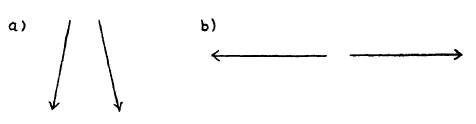
[ 8 ] Das sind vier Wahrnehmungsrichtungen, die der Mensch hat, deren Linien so verlaufen, wie ich es hier in dieser Weise aufgezeichnet habe.
[ 8 ] The human being thus perceives in four directions, as shown in the diagram.
[ 9 ] Ich habe absichtlich nicht gesagt, wo am menschlichen Organismus diese Wahrnehmungsrichtungen liegen. Wenn ich hier nichts zeichne als zwei Richtungen (a), die man gewissermaßen ausstreckt und mit denen man wahrnimmt, und da zwei andere (b), durch die man seitlich wahrnimmt, so ist es völlig gleichgültig, ob das hier die Gefühls- oder Empfindungsrichtungen sind, die durch meine zwei Beine gehen, und ob das da die Gefühlsrichtungen sind, die durch meine Arme gehen. Da haben Sie etwas Zusammenstimmendes. Ich nehme gewissermaßen meine eigene Schwere wahr, indem ich mit meinen zwei Beinen auf dem Boden stehe. Da nehme ich wirklich etwas wahr. Und ich nehme etwas wahr jedesmal, wenn ich auch nichts berühre, wenn ich meine Hand, meinen Arm ausstrecke. Das kann ich so zeichnen (a). Aber ich kann auch etwas ganz anderes meinen mit derselben Zeichnung. Denken Sie sich, ich habe die Horizontale, dann kann ich mit diesen beiden Richtungen die beiden Augenachsen meinen, dann zeichne ich die beiden Augenachsen so hin. Und mit dieser Richtung (b) kann ich die Ohrenrichtung meinen, und ich kann dasselbe Schema für Augen- und Ohrenwahrnehmungen haben. Das eine Mal habe ich den ganzen Organismus, nur im rechten Winkel gedreht, im Kopfe, das andere Mal in dem übrigen Organismus drinnen. Von einem gewissen höheren Gesichtspunkte aus ist beides dasselbe. Unsere zwei Beine sind nur fleischgewordene Richtungen des Wahrnehmens, die wir in einer geistigeren Weise auch haben, indem sie sich vom Gehirn durch die Augen ausstrecken und da Farben wahrnehmen, während wir sonst die Schwere wahrnehmen und alles, was damit zusammenhängt. Wir sehen unser Gewicht und wir treten auf die Farben, könnten wir etwa sagen, wenn wir die beiden Dinge, aber ganz organisch, miteinander verwechseln wollten. Ich höre die Kreide, ich berühre das C oder Cis. Das ist nur ein gradueller Unterschied. Das, was da am Kopfe ist, ist im rechten Winkel gedreht, geistiger, das andere ist in der Vertikalebene und ist materiell. Aber beides geht zum Schluß auf dasselbe zurück. Nur von dem einen weiß ich, von dem, was meine Augen betreten an Farben, was meine Ohren berühren an Tönen, von dem weiß ich, das ist in meinem gewöhnlichen Bewußtsein. Von dem, was meine Beine sehen von den Verhältnissen der Schwere, und von dem, was meine Arme hören von allen andern Verhältnissen, die da in Betracht kommen, ist alles im Unterbewußtsein. Und das, was da im Unterbewußtsein ist, das sind die Verhältnisse des Kosmischen. Mit diesem ganzen Uhnterbewußtsein weiß ich das Kosmische, weiß ich das Verhältnis der Erde zu den andern Weltenkörpern, weiß ich dasjenige, was mit der Schwere universell zusammenhängt. Mit den Armen höre ich die Sphärenmusik, nicht natürlich mit den Ohren. So daß wir sagen können: Wir bestehen aus unserem sogenannten niederen Organismus, der ein unterbewußtes kosmisches Bewußtsein hat, und aus unserem Haupte, das ein irdisches Bewußtsein, aber eben ein «bewußtes» Bewußtsein hat. Auf diesen Unterschied ist die ganze menschliche Organisation hingebildet. Wie wir äußerlich gestaltet sind, das hängt durchaus ab von diesen Gegensätzen. Und Sie wissen ja: Das, was wir heute als Kopf an uns tragen, das ist der umgestaltete Leib aus der früheren Inkarnation, dem früheren Erdenleben, während unser jetziger übriger Organismus zum Kopf im nächsten Erdenleben wird. Diese Metamorphose machen wir von einem Erdenleben zum andern durch. Der Kopf ist daher der übrige umgestaltete Organismus. Der ist gewissermaßen mehr vollkommen, mehr fertig. Und weil er das ist, sind die Beine so fein geworden, daß sie sich als Sehfühlfäden aus den Augen heraus erstrecken, um da höchst beweglich auf die Farben zu treten. Die Arme des vorigen Lebens sind so ätherisch geworden, daß sie sich jetzt bei den Ohren herauserstrecken und die Töne berühren.
[ 9 ] I deliberately did not tell you where these organs are to be found in the human organism. If I draw nothing but two arrows to indicate direction (a) here, where one stretches out, as it were, to perceive, and two others here, (b), where we perceive sideways, it makes no difference at all if these are the directions in which feeling and sensation pass through my legs and these where they pass through my arms. Here we have something that is in accord. I perceive my own gravity, as it were, I stand with my two feet on the ground. I really perceive something. And I also perceive something when I stretch out my hand, stretch out my arm, even if I do not actually touch anything. I can draw it like this (a). The same drawing can also stand for something different. Imagine this is the horizontal plane. The two arrows could represent the two visual axes; I could draw the two visual axes like this. And these arrows (b) could indicate the directions of my ears. The same diagram would serve to indicate perception by the eyes and ears. On the one occasion I have the whole organism within the head, though the plane has turned through a 90° angle, on the other within the rest of the organism. There is a higher point of view where both are the same. Our two legs are merely directions in which we perceive that have become flesh. The same directions exist in a less physical form where they extend from the brain through the eyes to perceive colour. Elsewhere we perceive gravity and everything connected with it. We see our weight and we step on colour, we could say, if we were to change the two things over, entirely in organic terms, of course. I hear the blackboard chalk, I touch a C or C sharp that is sounding. The difference is merely one of degree. In the head everything has gone through a 90° angle and is less physical; the other is in the vertical plane, and is physical. In the final instance both are the same. It is only that I am aware of the way my eyes step on colours, my ears touch sounds; I know about it, it is part of my ordinary conscious life. Everything my legs see with regard to gravity and all kinds of other things that my arms hear—all these are in the subconscious sphere. Conditions belonging to the cosmic sphere are present in the subconscious. With the whole of my subconscious I have knowledge of the cosmic sphere, knowledge of the way the earth relates to other bodies in the universe, knowledge of the universal background to gravity. I hear the music of the spheres with my arms and not with my ears. Thus we may say that we have a lower organism, as it is called, with subconscious cosmic awareness, and we have a head with early awareness; this however is a ‘conscious’ awareness. The whole of the human being is organized on the basis of these differences. Our outer form and configuration depends entirely on these differences. You know that the head we carry today is the transformed body of our previous incarnation, our previous earth life, and that the rest of our present organism will be the head in our next life. The head, then, is the rest of the organism which has undergone a transformation. It is more perfect, more finished in a way. As a result the legs have become fine visual threads extending beyond the eye and stepping on the colours in a very lively way. The arms of our former life have become so ethereal that they now extend from our ears and touch the sounds we hear.
[ 10 ] Nehmen Sie einmal diese konkreten Erkenntnisse des Menschen. Es ist ja gar nichts damit getan, wenn die Leute wissen, es gibt wiederholte Erdenleben und so weiter. Das sind schließlich Dogmen, und da ist es gleich, ob man Dogmen der katholischen oder evangelischen Kirche hat, oder ob man das Dogma von der Wiederholung der Erdenleben hat. Es beginnt das eigentliche Denken erst dann, wenn man in die konkreten Ereignisse eintritt, erst wenn man begreifen kann: Du schaust das menschliche Haupt an, da siehst du es als Umgestaltung deines Leibes aus dem vorigen Erdenleben, den du dir allerdings hauptlos denken mußt, denn das vorige Haupt ist die Umgestaltung eines Leibes in einem noch früheren Erdenleben. Aber in dem, was du jetzt als Haupt siehst, siehst du den umgestalteten Organismus des früheren Erdenlebens. Und was du jetzt siehst als übrigen Organismus, darin siehst du, was im nächsten Leben zum Haupte werden wird, wo sich die Arme so metamorphosiert haben werden, daß sie zu Ohren geworden sind, und die Beine sich so metamorphosiert haben werden, daß sie zu Augen geworden sind. Erst dann, wenn man so hineinschaut in das Materielle und es in seiner geistigen Umwandlung begreift, wenn man den Geist so hat, daß er in das Materielle hineinleuchten kann, dann erst ist dasjenige da, was die Menschheit heute notwendig braucht. Und erst wenn man den menschlichen Geist so organisiert hat, daß er nicht solche Torheiten verkündet, wie sie verkündet worden sind, namentlich in der zweiten Hälfte des 19. Jahrhunderts, als mögliche soziale Anschauungen, erst dann ist man wirklich reif dazu, solche sozialen Anschauungen zu gewinnen, die als Wirklichkeiten in die Welt hineingetragen werden können. Es ist heute notwendig, daß dieses gründlich durchschaut werde. Es ist eine ernste Angelegenheit, daß sich heute die Leute sagen: Dasjenige, was verehrt wird als die Wissenschaft, die sich heraufgebildet hat, das, was verkündet wird überall, das muß durch etwas anderes ersetzt werden. Es geht gar nicht anders.
[ 10 ] These are concrete facts about the human being. It does not get people anywhere to know about repeated earth lives and so on. Those after all are dogmas and it makes no difference if you have the dogmas of the Catholic or Protestant church or the dogma of repeated earth lives. Real thinking only starts when you enter into concrete events, when you come to realize that looking at the human head you are looking at the transformed body of your previous earth life, and that the head you had then was the transformed body of the preceding life—you must imagine it without the head, of course. The head you see now is the transformed organism of the last life lived on earth. The rest of the organism as you see it now will be the head in the next life. Then the arms will have metamorphosed and become ears, and the legs will have become eyes. We must look at the physical world and understand it in its transformed non-physical form, our intellect must illumine the material world in this way. Then at last we shall have what humankind is much in need of today. Once the human mind has been organized so that it no longer produces the kind of folly that has been put forward as a potential social theory, particularly in the second half of the 19th century, human beings will indeed be ready to develop social ideas that can be put into effect in this world. It is necessary to gain a thorough understanding of this today. It is a serious matter when people say today: Something else will have to take the place of the science which has evolved and is so highly respected, of all the things that are generally disseminated. There can be no other way.
[ 11 ] Es ist ein Unsinn, wie ich neulich auch in einem öffentlichen Vortrage sagte, von der Errichtung von Volkshochschulen zu reden und zu glauben, man könne das, was getrieben wird heute in unseren gewöhnlichen Hochschulen, in die Volkshochschulen verpflanzen. Das, was an unseren Hochschulen getrieben wird, das hat uns ja in diese Katastrophen hineingetrieben, weil es die wenigen führenden Persönlichkeiten als ihre materialistische Grundgesinnung gehabt haben; nun soll es in die ganzen Massen hineingetragen werden, das heißt, es sollen Millionen hineinreiten in die Katastrophen, in die sie hineingeritten worden sind durch eine falsche geistige Führung von wenigen. Was für wenige nichts taugt, soll jetzt für viele ausgestreut werden. So bequem geht es doch nicht mit der Verbreitung der Volksbildung, daß man das, was an Universitäten lebt, einfach hinausträgt, denn dadurch trägt man hinaus, was für den Menschen überhaupt ungeeignet ist. Das klingt heute radikal, aber es gehört zu dem Allernotwendigsten, daß das unbedingt durchschaut wird,wenn man nur im Entferntesten daran denkt, daß der Niedergang nicht weiterrollen soll, sondern daß ein Aufbau zustande kommen soll.
[ 11 ] It is nonsense, and I also said so recently in a public lecture,30‘Die Erziehung und der Unterricht gegenüber der Weltlage der Gegenwart’ (Education and teaching in the light of the present world situation), Stuttgart 10 June 1920. Published in Geisteswissenschaft und die Lebensforderungen der Gegenwart 6, Dornach 1950. To be published in GA 335. No record of translation into English. to talk about setting up adult education thinking that the same kind of work can be done there as at ordinary universities. It is the work done at the universities that has brought us to these disastrous situations, because it has become the materialistic view of a few leading personalities. This is now to be presented to the masses; that is, millions are to head for the disasters that so far have come about because the wrong lead was given by a few. Something that proved useless for a few is now to be spread among many. It is not as easy as that, however. Popular education cannot be introduced simply by teaching outside the universities what until now has been alive inside them. It would mean teaching something that is altogether unsuitable for human beings. This may sound radical, but it is absolutely essential that it is fully understood if there is to be even the least hope of the decline being halted and something new and positive developing.
[ 12 ] Das ist es, wovon man möchte reden können in Worten, die wirklich die Herzen ergreifen. Es müssen möglichst viele Herzen ergriffen werden von diesen konkreten Wahrheiten. Deshalb war es mir ein solches Bedürfnis, in öffentlichen Vorträgen darauf hinzuweisen, wie wir es doch schon dazu gebracht haben in unserer Waldorfschule, daß in einzelnen Zweigen Anthroposophie positiv hineingetragen wurde in den Geschichtsunterricht. Ebensogut konnte ich auch den anthropologischen Unterricht in der fünften Klasse erwähnen, wo auch Anthroposophie wirkte, wirkte, nicht indem man den Kindern Anthroposophie lehrt — das würde uns nicht einfallen —, sondern indem man belebt den Unterricht durch das, was aus der Anthroposophie kommt, indem man Anthroposophie in den Unterrichtsstoff einfließen läßt. Das wirkt weckend auf die Seelen der Kinder; sie werden ganz anders durch diese Einflüsse. Es wäre eine Bequemlichkeit, wenn man Anthroposophie in den Schulen einfach lehren wollte. Darauf kommt es wahrhaftig nicht an, sondern darauf, daß man dasjenige, was man lehrt, den Kindern zu beleben versteht durch Anthroposophie. Dazu allerdings muß die Anthroposophie in einem selbst völlig lebendig werden, und das ist ja etwas, was so unendlich schwierig geht: daß die Anthroposophie lebendig wird in den Menschen. Denn es wäre heute schon möglich in einer gewissen Beziehung, daß die mannigfaltigsten Zweige nicht etwa nur der Wissenschaft, sondern ich sage geradezu: die mannigfaltigsten Zweige des Lebens durchdrungen wären von dem, was durch das Leben in der Anthroposophie kommen kann.
[ 12 ] These are the things one wishes one could speak of in words that truly go to the heart. These concrete truths must reach as many hearts as possible. It was therefore important to me to point out in my public lectures that something has been achieved in the Waldorf School, that anthroposophy has positively influenced the history lessons in some places. I was also able to refer to the teaching of anthropology in class 5. There, too, anthroposophy was effective. Not that one would teach anthroposophy to the children—we would never think of doing such a thing—but lessons come to life if anthroposophy is the foundation, if the inspiration of anthroposophy is there in what we teach. This brings the souls of the children to life; they are quite different when this influence is there. It would be taking the easy way simply to teach anthroposophy in our schools. No, that is not what we are about, but rather to use anthroposophy to enliven the subject matter. It will of course be necessary for anthroposophy to come alive in oneself first of all, and that is something that really comes hard, to let anthroposophy come alive in human beings. Otherwise the potential is there today for all kinds of disciplines, not only in science but all kinds of disciplines in life, to have the full benefit of what life in anthroposophy is able to give.
[ 13 ] Das ist so eine allgemeine Betrachtung. Ich will eine spezielle Betrachtung daran knüpfen, aus der Sie werden ersehen können, wie die Dinge zusammenhängen, die hier in Betracht kommen.
[ 13 ] That is a general way of looking at it. Let me go on to something specific, so that you can see the things we are considering in their proper context.
[ 14 ] Sie wissen Ja, in der heute weitverbreiteten marxistischen Weltanschauung und Lebensauffassung, die ihren radikalen Ausdruck in dem weltzerstörenden Leninismus und Trotzkismus findet, in dieser marxistischen Lebensauffassung spielt eine große Rolle die Anschauung, die man die «materialistische Geschichtsauffassung» nennt, und namentlich das Dogma von der grundlegenden Wirkung der Produktionsverhältnisse. Es ist ein Dogma, zu dem heute Millionen von Menschen aus dem Proletariat sich bekennen, das Dogma, daß dasjenige, was Sitte, Recht, Wissenschaft, Religion und so weiter ist, etwas ist, was wie ein Rauch, wie eine Ideologie — Sie können in den «Kernpunkten» Genaueres darüber nachlesen — aufsteigt aus den Produktionsverhältnissen, während die Produktionsverhältnisse das einzig Wirkliche wären, dasjenige, was man in der Geschichtsbetrachtung zugrunde zu legen habe.
[ 14 ] Marxist philosophy, Marxist views are widespread today. They have their most radical expression in Leninism and Trotskyism, which are destroying the world. A view of history known as ‘historical materialism’ plays a great role in Marxist philosophy, particularly the dogma of the fundamental importance of the modes and relations of production. Millions of proletarians have accepted this dogma according to which tradition, law, science, religion and so on are like smoke, like an ideology rising from the modes and relations of production — you will find further details in my book Towards Social Renewal — and that the modes and relations of production are the Only reality on which to base one's view of history.
[ 15 ] Ich hielt es von ganz besonderer Wichtigkeit seinerzeit — und eigentlich hängt das zusammen mit meiner ganzen Meinung, daß ich etwas habe tun können in der Berliner Arbeiter-Bildungsschule, von dem man hätte ausgehen können —, in proletarischen Kreisen über diese Anschauung von der alleinigen Wirksamkeit der Produktionsverhältnisse im menschlichen Werdegang aufklärend zu sprechen, und ich habe daher nicht materialistische Geschichtsauffassung, sondern die Wahrheit zu verkünden versucht. Das war dann ja auch der Grund, warum ich herausgeworfen wurde, weil das geradeso damals den Führern widerstrebt hat wie jetzt die Idee der Dreigliederung, weil tatsächlich innerhalb der sozialistischen Bewegung dazumal und heute noch ein viel blinderes Autoritätsgefühl und Autoritätsglaube war und ist als in der Katholischen Kirche.
[ 15 ] It was very important to me on past occasions—this has to do with the feeling I have that I was really able to achieve something and create a potential basis at the Worker's Education Institute in Berlin — to speak in proletarian circles about the view that the modes and relations of production are the only effective element, and to present a clear picture. My aim therefore was not to teach historical materialism but the truth. That was of course also the reason why I was thrown out, for it offended those in charge at the time just as much as the idea of a threefold social order offends people today. Authoritarian thinking and belief in authority were and still are as great in the socialist movement as in the Catholic church.
[ 16 ] Aber Sie sehen, dasjenige, um was es sich gerade handelt, das ist, zu durchschauen, richtig zu durchschauen, wie die Dinge auch sozial in der Welt zusammenhängen. Wer eine richtige Einsicht gewinnt in das, was ich angedeutet habe in meinem Buche «Von Seelenrätseln» als die naturgegebene Dreigliederung des menschlichen Organismus, wer diese Gliederung des Menschen in den Nerven-Sinnesorganismus, den rhythmischen Organismus und den Stoffwechselorganismus versteht, der denkt so, daß er dieses Denken dann auch auf das soziale Leben anwenden kann. Wenn man so etwas tut, so kommen die Toren von heute und sagen: Du machst Analogien; weil der menschliche Leib dreigegliedert ist, gliederst du auch den sozialen Organismus. — Das ist Unsinn! Das tun die «Kernpunkte» gewiß nicht, da wird nicht mit Analogien gearbeitet. Es wird bloß gesagt, daß, wenn einer sein Denken aus den spanischen Stiefeln herauskriegt, in die es durch die heutige Gelehrsamkeit und namentlich das heutige öffentliche Leben eingeschnürt ist, er dieses Denken dadurch, daß es auf Wirklichkeitsgemäßes kommt im menschlichen Organismus, so weit frei bekommt, daß er auch im Sozialen ordentlich denken kann, während das Denken, das das Gehirn des Menschen neben die Leber legt und alles als gleiche Substanzen untersucht, niemals zu einer vernünftigen Einsicht kommen kann.
[ 16 ] What really matters is to gain a clear understanding of social relations in this world. Real understanding of the natural threefold order of the human organism, of the way the human organism is an organism of nerves and senses, rhythmical organism and a metabolic organism, as shown in my book Von Seelenrätseln, leads to a way of thinking that can also apply to social life. People of little understanding will say: ‘You are using analogy in applying the threefold order of the human body to the social organism’. This is nonsense of course. Analogy is not the method used in Towards Social Renewal. All I said was that if people succeeded in letting their thinking escape from the strait jacket put on it by modern scholarship and particularly public opinion, they would free their thinking to the extent that it will be possible to think sensible thoughts concerning social issues. The kind of thinking that puts the human brain side by side with the liver, examining everything as though it were of the same substance, will never come to sensible conclusions.
[ 17 ] Wenn man so äußerlich Analogien bilden würde, dann würde man sagen: Wir haben die Dreigliederung des sozialen Organismus und die Dreigliederung des menschlichen Organismus. Der Kopf ist das geistige Organ, also muß man es vergleichen mit dem geistigen Leben des dreigliedrigen Organismus; das rhythmische System, das bringt Einklang zwischen den verschiedenen Funktionen als Herztätigkeit, als Atmungstätigkeit — also Rechtsteil des sozialen Organismus; den Stoffwechsel, das Gröbste, Materiellste, dasjenige, worauf der Mystiker mit einer gewissen Verachtung herabsieht, trotzdem auch er erklärt, daß er essen und trinken muß, den vergleicht man mit dem wirtschaftlichen Leben.
[ 17 ] Using external analogies we might say: The social organism is threefold by nature and so is the human organism. The head is the organ of mind and intellect; it should therefore be compared with the cultural and intellectual life in the threefold organism. The rhythmical system establishes harmony between different functions in the action of the heart, in respiration—that would be the rights sphere in the social organism. Metabolism, the most physical, material aspect—something mystics tend to look down on to some extent, though they say they also have to eat and drink--would be compared to the sphere of economics.
[ 18 ] Das ist aber nicht so! Ich habe öfter darauf aufmerksam gemacht bei andern Gelegenheiten, daß die Dinge eben in Wirklichkeit anders liegen, als man nach bloßen Analogien glaubt, daß man zum Beispiel nicht sagen kann, die Sommerzeit lasse sich mit dem Wachzustand der Erde vergleichen und die Winterzeit mit dem Schlafzustand. Die Wahrheit ist eine andere. Im Sommer schläft die Erde, im Winter wacht sie. Das habe ich ja in seinen Einzelheiten ausgeführt.
[ 18 ] This is definitely not the case, however. I have repeatedly pointed out on other occasions that in reality things are very different than mere analogy would make them to be. It cannot be said, for instance, that summer is comparable to the waking state for the earth and winter to a state of sleep. The reality is different. In summer the earth is asleep, in winter it is awake. I have gone into this in detail.
[ 19 ] Aber so ist es auch, wenn man auf die Wirklichkeit und nicht auf Analogien geht, bei dem Vergleichen des sozialen Organismus mit dem menschlichen Organismus. Da muß man vergleichen just das Wirtschaftsleben im sozialen Organismus mit der menschlichen Kopftätigkeit; dasjenige, was Rechtsleben ist, das muß man allerdings — weil es das Mittlere ist, so haben sich die Leute auch nicht geirrt bei der Analogie — mit der rhythmischen Tätigkeit vergleichen. Aber das Geistesleben, das muß man vergleichen mit dem Stoffwechsel. Also das Wirtschaftsleben ist zu vergleichen mit den geistigen Organen, das geistige Leben im sozialen Organismus mit den Stoffwechselorganen. Da hilft nichts. Das Wirtschaftsleben ist der Kopf des sozialen Organismus, und das geistige Leben ist Magen, Leber und Milz für den sozialen Organismus, nicht für den einzelnen individuellen Menschen. Das ist natürlich wieder viel zu unbequem, wenn man in spanischen Stiefeln steckt, daß man zu unterscheiden hat das soziale Leben und das Leben des einzelnen, des individuellen Menschen.
[ 19 ] The same applies if we consider the real situation in comparing the social and the human organism. The economic sphere of the social organism actually compares to the activities of the human head. As to the sphere of rights, the legal sphere, people were quite rightly comparing this, the middle realm, with rhythmical activities in the human organism. The life of mind and intellect however has to be compared with the metabolism. This means that economic life has to be compared with the organs that serve the mind and intellect, and the cultural and intellectual sphere of the social organism with the metabolic organs. There is no way round this. Economic life is the head of the social organism; cultural life is the stomach, liver and spleen of the social organism but not of the individual human being. It is of course too much of an effort for anyone whose thinking is in a strait-jacket to make distinction between social life and the life of an individual person.
[ 20 ] Hier kommt es abermals darauf an, durch Geisteswissenschaft vorbereitet auf die Wirklichkeit hinzusehen und nicht Analogien und vertrackteSymbolistik zu treiben. Dann kommt man schon auf mancherlei wichtige Dinge. Man kommt zum Beispiel darauf, daß man sich sagen kann: Ja, dann aber muß ja das Wirtschaftsleben, wenn es eigentlich der Kopf ist im sozialen Organismus, so wie der menschliche Kopf von dem übrigen Organismus zehren. Dann kann man nicht sagen, Sittlichkeit, Erkenntnis, religiöses Leben sei eine Ideologie, die aufsteigt aus dem Wirtschaftsleben. Nein, ganz im Gegenteil! Das Wirtschaftsleben ist etwas, was abhängt von dem geistigen Leben, vom Stoffwechsel des sozialen Organismus, wie der menschliche Kopf abhängt vom Atmen, von Magen und Leber und Milz. Dann kommt man darauf, einzusehen, daß das Wirtschaftsleben dasjenige ist, was aufsteigt aus dem geistigen und religiösen Leben. Wenn der Mensch keinen Magen hätte, könnte er keinen Kopf haben. Gewiß könnte er auch keinen Magen haben, wenn er keinen Kopf hätte, aber schließlich wird der Kopf vom Magen genährt, und ebenso wird unterhalten das Wirtschaftsleben vom geistigen Leben und nicht umgekehrt. Daher ist das ein Irrwahn, ein furchtbarer Aberglaube, der heute sich als sozialistische Theorie über die ganze zivilisierte Welt zu verbreiten droht, weil niemand darauf bedacht war in den letzten Jahrhunderten, die Wahrheit zu erforschen, sondern jeder nur aus den Emotionen heraus dasjenige als Wahrheit verkündigte, was ihm nach seiner Klasse und nach seinem Standpunkt angemessen war. Jetzt erst sieht man ein, welcher Irrwahn es ist, die Produktionsverhältnisse als die Grundlage für das geschichtliche Geschehen anzusehen. Denn man kommt jetzt darauf, wirklich die Tatsachen zu vergleichen, nicht Analogien zu verbreiten. Man schaut jetzt in der richtigen Weise hin und sieht ein, daß, wenn der Stoffwechsel untergraben wird im menschlichen Organismus, der Kopf leidet, daß also jedesmal, wenn das Ethische, das Religiöse, das Erkenntnisleben untergraben wird, im sozialen Organismus nicht ein gesunder Stoffwechsel wirkt und das Wirtschaftsleben dann zugrunde gehen muß. Vom Wirtschaftsleben hängt gar nichts ab, sondern primär hängt alles ab von Anschauungen, von Ideen, von dem geistigen Leben der Menschen.
[ 20 ] Again the essential point is that spiritual science prepares us to see things as they really are and not to produce analogies and elaborate symbolism. We will then arrive at important conclusions. We shall find, for example, that we can say: But in that case economic life, if it really is the head in the social organism, will have to live on the rest of the organism, just as the head does in the human organism. In that case we cannot say morality, religious life and the search for knowledge are ideological elements arising from economic life. Quite the contrary, in fact. Economic life is dependent on cultural life, on the metabolism of the social organism, just as the human head depends on respiration, on stomach, liver and spleen. We then come to see that economic life arises out of cultural and religious life. If we did not have a stomach we could not have a head. Of course we also could not have a stomach if we did not have a head, but it is the head after all that is fed by the stomach, and in the same way economic life is fed by cultural life and not the other way round. The socialist theories that now threaten to spread through the whole of the civilized world are therefore quite erroneous, a dreadful superstition. No one has thought to look for the truth in recent centuries; on a purely emotional basis everyone has been promulgating the kind of truth their class and point of view suggested to them. Now at last it is realized that it is a total delusion to see historical evolution as the product of the modes and relations of production. The idea is now to compare the actual facts and not to talk in analogies. Now a realistic view is taken and it is realized that if the stomach is undermined in the human organism, the head will suffer. In the same way there can be no sound metabolism in the social organism and economic life must fall into decline if morality, religious life and intelligent thought are undermined in the social organism. Nothing in fact depends on economic life; primarily everything depends on the views, the ideas, the cultural life of humankind.
[ 21 ] Und so wie unser Kopf eigentlich fortwährend stirbt — ich habe das in andern Vorträgen ausgeführt —, so wie wir unseren Kopforganismus nur dadurch unterhalten, daß er in fortwährendem Absterben ist, gegen das sich der übrige Organismus auflehnt, so ist es mit dem Wirtschaftsleben. Das Wirtschaftsleben ist dasjenige, welches den geschichtlichen Fortgang der Menschheit fortwährend zum Absterben bringt, das nicht etwa das übrige aus sich hervortreibt, sondern nur den Tod von allem hervorbringt. Und dieser Tod muß fortwährend wieder ausgeglichen werden durch dasjenige, was im geistigen Organismus hervorgebracht wird. Also gerade das Umgekehrte ist wahr. Wer im materialistischen Sinne behauptet, das Wirtschaftsleben sei die Grundlage von dem, was fortschreitet, sagt nicht das Wahre. Die Wahrheit ist, daß das Wirtschaftsleben die Grundlage dessen ist, was immer wiederum in Etappen abstirbt und dessen Absterben vom Geiste aus ausgeglichen werden muß. So vorzugehen, wie jetzt in Rußland vorgegangen wird, bedeutet, der Welt zum Absterben zu verhelfen. Es gibt keine andere Möglichkeit, wenn man in dieser Weise fortarbeitet, als der Welt zum Absterben zu verhelfen, aus dem einfachen Grunde, weil in dem, was man da verrichtet, die Gesetzmäßigkeit des Absterbens drinnen liegt.
[ 21 ] The head is always dying—I have spoken of this in other lectures—and we only maintain the head organism because it is constantly dying and the rest of the organism rebels against this. The same applies in the sphere of economics. Economic life is constantly bringing death and decay into the progress of history; rather than generating everything else it brings about the death of everything. This element of death constantly has to be counterbalanced by what the cultural organism is able to produce. The situation is therefore exactly the other way round. Anyone speaking in materialistic terms and saying economic life is the basis for progress is not speaking the truth. The truth is that economic life is the basis of something that is always dying in stages, and the mind and spirit have to make up for this dying process. To proceed the way people are now proceeding in Russia is to help the world to its death. The only possible outcome of proceeding in this way is to help the world to its death, for the simple reason that the laws of death are inherent in the things that are being done there.
[ 22 ] Sie sehen, welche sozial eminent wichtigen Dinge hier vorliegen. Das war es, was ich immer wieder in den verschiedensten Tönen versuchte, seit den zwei Jahrzehnten, seitdem Anthroposophie unter uns getrieben wird, durch die verschiedenen Vorträge durchleuchten zu lassen und klarzumachen, daß es sich bei uns wahrhaftig nicht darum handelt, eine innere seelisch-wollüstige Weltauffassung und Lebensanschauung, eine Art geistigen Snobismus zu kultivieren, sondern daß es sich handelt um dasjenige, was das Zeitalter als seinen wichtigsten Impuls braucht.
[ 22 ] You can see the eminent social importance of these things. We have now been working in anthroposophy for twenty years, and all the time I have tried to make it utterly clear and apparent in all kinds of lectures that what matters to us is not the cultivation of a philosophy full of inner self-gratification, a kind of spiritual snobbery, but to develop the most important impulse that is needed in the present age.
[ 23 ] Ich wollte dies heute noch einmal vor Ihnen aussprechen in einer wieder etwas andern Form, zusammenhängend mit verschiedenen Dingen, die uns aufklären können über das Wesen des Menschen, weil es jetzt wichtig ist, daß diejenigen, die als Freunde unserer anthroposophischen Bewegung sich bekennen, den Zusammenhang dieser anthroposophischen Bewegung mit dem, was sonst jetzt unter uns vorgeht, einsehen.
[ 23 ] I wanted to present this to you again today in a slightly different form in connection with a number of things that can help us understand the essential nature of the human being. It is important that those who call themselves friends of the anthroposophical movement clearly perceive the connection between this anthroposophical movement and other events as we know them.
[ 24 ] Es ist ja, da jetzt oftmals alles in einer recht entstellten Form besprochen wird, was von mir oder andern Freunden ausgeht, es ist ja schwer, einer großen, auch anthroposophischen Versammlung so ganz frei die Dinge zu sagen, aber es muß, weil man ja keine andere Gelegenheit hat, im engeren Kreise so ohne weiteres zu sprechen, und weil über die Dinge gesprochen werden muß, auf einiges aufmerksam gemacht werden. Wir müssen uns dessen bewußt sein, besonders hier in Stuttgart, daß dasjenige, woran wir gehangen haben seit zwei Jahrzehnten als anthroposophischer Bewegung, eben doch in ein neues Stadium getreten ist, und daß wir dadurch, wenn wir es ehrlich meinen mit dieser Bewegung, die Verpflichtung auf uns genommen haben, mitzugehen mit diesem Umschwung, uns anzupassen diesem Umschwung. Sie müssen das nur ordentlich erfassen, daß, indem durch unsere Freunde Molt, Kühn, Unger, Leinhas und einige andere hier der Versuch unternommen worden ist, praktisch die Konsequenz der anthroposophischen Lebensauffassung zu ziehen, daß dadurch eben etwas geschehen ist, was uns alle angeht, was uns alle so angeht, daß wir uns dafür interessieren müssen in unserem ganzen Verhalten. Es ist so, daß bis dahin eigentlich — fassen wir das nur ganz scharf ins Auge — die anthroposophische Bewegung eine Weltenströmung war. Eine geistige Weltenströmung ist eben etwas Geistiges. Etwas Geistiges, das geht seinen Weg. Es mögen sich Cliquen bilden, es mögen sich noch so verwerfliche kleine Zusammenrottungen bilden, die persönliche und was weiß ich welche Interessen noch haben, selbst über einen solchen Un-«Rat» wie den Max Seiling kann eine geistigeBewegung hinweggehen. Man muß es ja natürlich in dieser oder jener Weise richtig behandeln, aber so lange es sich um eine bloß geistige Bewegung handelt, kann darüber hinweggegangen werden. Aber nun haben wir doch drei Dinge herausgebildet aus dieser geistigen Bewegung.
[ 24 ] The ideas put forward by myself and other friends are often seriously distorted. It is therefore difficult to speak freely to such a large audience, even if it is anthroposophical. As there is no immediate opportunity, however, to discuss these things at a more intimate level and yet it is necessary to speak of them, let me draw your attention to a few things. We must be aware, particularly here in Stuttgart, that the anthroposophical movement we have now had for twenty years has indeed reached a new stage. If we are serious about the movement this means we have accepted the obligation to follow this change, to adapt to this change. You must properly understand that because our friends Molt, Kühn, Unger, Leinhas and others have attempted to take the anthroposophical approach to its practical conclusion something has happened that concerns us all. It concerns us all and we must take account of it in everything we say and do. The fact is—and let us be very clear about this—that until then the anthroposophical movement was a current in the life of the mind and spirit. Such things continue on their way, cliques and closed groups, however objectionable, that go by personal and heaven knows what other interests, may form; a spiritual movement may even proceed by the agency of privy councillors like Max Seiling.35Seiling, Max, first a follower then an opponent of Rudolf Steiner. Bore the title Privy Councillor.
Rudolf Steiner used word-play here, calling Hofrat (Privy Councillor) Seiling an Un-Rat. The word Unrat means garbage, refuse, ordure. One does of course have to approach it properly in view of what is called for, but for as long as it is a purely spiritual or cultural movement it can be ignored. Now, however, three things have grown out of this spiritual movement.
[ 25 ] Das erste war dasjenige, was sich an meinen Aufruf vom vorigen Jahr angeschlossen hat. Das ist übergegangen in die ja heute noch fragwürdige Dreigliederungsbewegung, in den Bund für Dreigliederung des sozialen Organismus, der eigentlich dasjenige, was gewollt worden ist, bis jetzt auch nicht in annähernder Weise hat erreichen können. Denn das, was mit dem Aufruf gemeint war, ist ja in einem gewissen Sinne abgelehnt worden, und es wäre gut, wenn ein vollständiges Bewußtsein davon vorhanden wäre, daß es abgelehnt worden ist, daß das wenigste davon erfüllt ist, was mit diesem Aufruf gemeint war.
[ 25 ] The first followed the appeal I made last year.36An das deutsche Volk und an die Kultunvelt! (Appeal to the German nation and the civilized world), pamphlet, 1919, reprinted a.o. in Towards Social Renewal (ref. 31). It now forms part of the struggling threefold movement, the Association for a Threefold Social Organism. This has not yet been able to get anywhere near the real objectives. What the appeal had to say has in a sense met with rejection, and it would be a good thing to be fully aware that there has been this rejection, that only very little of what was intended has come to fruition.
[ 26 ] Ich bin dadurch selbstverständlich zu manchem genötigt. Als zum Beispiel in Dornach die Idee auftrat, man solle einen weiteren Aufruf machen, der im internationalen Leben klarmachen würde, was Dornach der Welt bedeutet, da mußte ich den Freunden klarmachen: Ja, draußen im gewöhnlichen Leben, das aber jetzt seinem Zusammenbruche entgegengeht, da ist man gewöhnt, Aufruf an Aufruf, Programm an Programm herauszusetzen. Das kann man nicht aus der anthroposophischen Bewegung heraus. Da handelt es sich darum, einzusehen, daß es in einer gewissen Weise im höchsten Grade ungesund ist, wenn irgend etwas gemacht wird, was nicht gelingt. Da handelt es sich darum, daß man tatsächlich in der allerpräzisesten Weise die Chancen des Gelingens ins Auge faßt, daß man nicht bloß das, was einem gerade einfällt, tut, sondern daß man nur das tut, was gelingen kann. Deshalb sagte ich dazumal das Wort, das wichtig ist und das ich bitte zu erwägen: Es wird mir nicht einfallen, in einer ähnlichen Weise wiederum einen Aufruf zu machen, denn ein zweites Mal darf nicht mit einem Aufruf dasselbe geschehen, was mit dem ersten geschehen ist. — Ich konnte hier noch geschehen lassen den Kulturratsaufruf, der nicht von mir selbst gemacht worden ist, aber man muß sich klar sein, daß die Dinge anfangen, ungeheuer viel ernster zu sein, als der Mensch heute geneigt ist, sie aufzufassen, wenn etwas wie die anthroposophische Bewegung im Hintergrunde ist.
[ 26 ] This does of course mean that I have many requests made to me. The idea has come up in Dornach, for example, of issuing a further appeal that would make it known internationally what Dornach means to the world. I had to explain to our friends that in the ordinary life outside that is now heading for a breakdown, appeal usually follows appeal, programme on programme. We cannot do this if we work out of anthroposophy. It is important to realize that, in a way, it is not at all healthy if something is undertaken that does not come off. It is important to make a careful assessment of the chances of success, and not just do what comes to mind but only the things that have a chance of success. This is why I then said—it is important and I must ask you to consider it carefully—that I would not dream of making a similar appeal again, for what has happened to the first appeal should not happen a second time. It was possible to let the appeal for a Cultural Council37Appeal to establish a Council for Culture. Whitsun 1919, signed by many well-known figures in cultural life. go out, for that was not my work, but we must be very clear that things are getting a great deal more serious than people are inclined to think if something like the anthroposophical movement stands behind them.
[ 27 ] Nun haben wir drei Dinge gewissermaßen herausgebildet aus der anthroposophischen Bewegung, von denen jedes etwas ganz anderes darstellt:
[ 27 ] Three things have now evolved out of the anthroposophical movement, in a way, each of them quite distinct.
[ 28 ] Die Dreigliederung aus jenem Aufruf — wir müssen daran arbeiten, denn sie wird zum Teil abgelehnt; das zweite Glied ist die Waldorfschule; das dritte die finanzielle, kommerzielle, industrielle Unternehmung «Der Kommende Tag».
[ 28 ] A threefold order following that appeal—we will have to work at it, for it partly meets with rejection; secondly the Waldorf School;38Waldorf School: integrated primary and secondary school established by Emil Molt in 1919 for the children of workers in the Waldorf Astoria Cigarette Factory and the general public. This was done under the guidance of Rudolf Steiner who also appointed the teachers and himself gave the preparatory teachers' seminars. thirdly the financial, commercial and industrial enterprise called Der Kommende Tag (Dawn of Tomorrow).39Der Kommende Tag, Aktiengesellschaft zur Förderung wirtschaftlicher and geistiger Werte (join-stock company for the promotion of economic and cultural values), established in Stuttgart in March 1920. Rudolf Steiner was Chairman of the Board until 1923. The company became a victim of post-war inflation in Germany and had to be dissolved in 1925.
[ 29 ] Nun bin ich in früheren Zeiten, als wir nur die anthroposophische Bewegung hatten — ich spreche heute nur von Stuttgart —, hierhergekommen nach Stuttgart, da war ich ja vielleicht drei bis vier Tage da, aber Sie wissen, mit wievielen Menschen ich immer einzeln sprechen konnte. Das alles waren Dinge, die, wie jetzt der Erfolg zeigt, von einer gewissen Bedeutung waren. Es war nicht bedeutungslos, daß dasjenige, was sich mittlerweile ereignet hatte — man wird mich verstehen, wenn man mich verstehen will —, in solchen Unterredungen mit einzelnen Persönlichkeiten wiederum zurechtgerückt werden konnte. Dann konnte die Sache wieder fortgehen bis zum nächsten Mal. Nun, so wie die Sachen unmittelbar stehen, hat man eigentlich jetzt, nachdem sich diese äußeren Dinge herausgebildet haben, mit Sitzungen vom Morgen bis zum Abend, ja bis in die Nacht hinein zu tun, und es kann nicht die Rede sein davon, jene alten Gewohnheiten fortzusetzen, die da waren, als wir noch eine anthroposophische Bewegung waren. Von alledem empfinden sehr viele nichts anderes, als daß es eine Unannehmlichkeit sei, daß es nicht mehr ist wie früher. Es ist aber notwendig, auf den ganzen Umschwung hinzuschauen und sich wirklich zu sagen: Es ist etwas anders geworden seit dem Frühling des vorigen Jahres, und dem muß Rechnung getragen werden.
[ 29 ] Coming to Stuttgart in the past, when we only had the anthroposophical movement — I am referring only to Stuttgart — I would spend three or four days here and you know how many personal interviews I managed. These things have had some effect, as is now becoming apparent. It was not without significance that whatever had happened in the meantime—people will understand what I mean if they want to—could be put to rights again in those personal interviews. Events could then proceed until the next time. Now the position is such that following those outer developments one has to attend meetings from morning till night, and indeed well into the night, and there is no question of continuing in the ways we got used to when we were only an anthroposophical movement. Now there are many people who feel that it is a nuisance that things are no longer the way they were. It is necessary, however, to look at all the changes and really say to oneself: Things have changed since the spring of last year and this will have to be taken into account.
[ 30 ] Nun wird es ja nicht so bleiben können, wie es jetzt ist, aber daß es nicht so bleiben kann, dazu muß mitgearbeitet werden. So kann es aus dem Grunde nicht bleiben, weil alles das, was geschieht, sei es für die Waldorfschule, sei es für den Dreigliederungsbund, sei es für den «Kommenden Tag», ja auf der Grundlage der geistigen Arbeit entsteht. Ohne die geistige Arbeit, die geleistet worden ist und weiter geleistet werden muß, hat ja das alles keinen Sinn. Diese geistige Arbeit muß dem Ganzen Konfiguration, muß dem Ganzen Kraft und Inhalt geben. Wenn wir dazu kommen, wozu wir kommen würden, wenn die Sache so weitergehen würde, so wäre die Folge, daß die jetzigen Einrichtungen die ursprüngliche geistige Bewegung auffressen würden; da entziehen wir der Sache ihre ursprünglichen Grundlagen. Es darf das, was herauswächst aus der anthroposophischen Bewegung, nicht auffressen diese anthroposophische Bewegung selbst.
[ 30 ] The situation cannot remain as it is, but a united effort must be made to see that it does not remain this way. It cannot remain as it is because everything that is done—be it for the Waldorf School or the Kommende Tag—has its basis in spiritual work. Without the spiritual work that has been done and must continue to be done there is no point to it all. The spiritual work must give form, vigour and content to the whole. To continue the way we are going would mean that the institutions which have now been established would swallow up the original spiritual movement. We would be taking away the original basis. Nothing growing out of the anthroposophical movement should be allowed to swallow up the movement as such.
[ 31 ] Sie sehen, ich muß sehr ernste Dinge heute besprechen, und es werden mich einige wenigstens verstehen. Aber die Sache kann nicht anders werden, wenn wir nicht das eine Realität sein lassen, daß eben anthroposophisch wirklich viele Jahre, jahrzehntelang gearbeitet worden ist. Diese Arbeit muß eine Realität sein.
[ 31 ] You see, these are serious matters we have to discuss today, and I think at least some of you will understand what I mean. Things will not be different unless we accept it as a reality that anthroposophical work has been done for many years, for decades. This work must be seen as something real.
[ 32 ] Nun bitte ich Sie, zu dem hinzuzunehmen eines: In der Welt gibt es viel Kampf, aber wo ist eigentlich am meisten Kampf? Er spielt sich nur in einer gewissen Form ab, man merkt es nicht, aber er ist am allermeisten im geistigen Leben. Und zum Beispiel in dem, was sich anthroposophische Bewegung nennt, da ist ja kein Ende des Kampfes. Als aus den alten Usancen heraus — man mußte anknüpfen an sie, Sie wissen ja warum — unsere Bewegung sich gestaltete, das heißt, viele von den Leuten mit den alten theosophischen Gewohnheiten sich anschlossen an unsere Bewegung, hatte ich die Empfindung, daß ein Herr, der damals ein ganz besonders heftiger Verteidiger gerade unserer Richtung war, sehr bald mit allen möglichen andern Leuten streiten werde; denn der Kampf ist etwas, was sich da gerade furchtbar herausbildet. Ja, ich habe sogar immer betont: Der Herr, der so ein ganz waschechter Theosoph ist, er wird nicht nur mit andern Leuten streiten, sondern seine linke und seine rechte Hälfte werden in einen furchtbaren Kampf kommen. Man wird erleben, daß die linke Seite dieser Persönlichkeit mit der rechten in der furchtbarsten Weise zankt.
[ 32 ] I would ask you also to consider the following. There is much conflict in the world, but where is most of this conflict to be found? It takes a certain form and people fail to notice, but most of it takes place in the sphere of spiritual endeavour. There is no end to the conflict within the body we call the anthroposophical movement, for example. When our movement evolved out of older practices — it was necessary to start from these, you know the reasons—that is, when many people familiar with the old theosophical practices joined our movement, I had the feeling that a gentleman, who at the time was particularly vehement in his defense of the line we were following, would very soon be in conflict with various other people. Conflict is likely to be particularly bad in this sphere. In fact I always made it quite clear that the gentleman in question, a theosophist of the purest water, would not only come in conflict with others, but that his right side and his left would be involved in a desperate struggle. People will find that the left side of this individual will have the most dreadful quarrel with his right side.
[ 33 ] Es muß eben selbstverständlich der andere Pol entwickelt werden, der Pol, der die fortwährend vorhandenen, aus dem Wesen jeder geistigen Bewegung entstehenden Kämpfe — weil jede geistige Bewegung auf die Individualität hinarbeitet — überwinden muß. Es muß der andere Pol vorhanden sein, der Pol der Menschenverständigung, der Pol, der darin besteht, daß man in den Menschen eindringen kann, daß man in die Lebensimpulse eines andern Menschen sich vertiefen kann und so weiter. Es muß möglich sein, daß dasjenige, was wir jetzt als Dreigliederungsarbeit, was wir als «Kommender Tag», was wir als Waldorfschule treiben, getragen wird von einer guten, moralischen Grundlage unserer anthroposophischen Bewegung hier in Stuttgart, von derjenigen moralischen Grundlage, die erarbeitet worden ist seit Jahrzehnten, oder wenigstens erarbeitet werden sollte. Davon muß es getragen sein, denn nur so kommen wir weiter und können uns wiederum ein Gleichgewicht zurückerobern zwischen dem Leben in Sitzungen und dem notwendigen geistigen Arbeiten, das doch die Grundlage bilden muß. Aber wir kommen natürlich nicht dazu, wenn fortwährend solche Dinge sich abspielen hier wie etwa, daß man gesagt bekommt: Da ist wiederum etwas Schreckliches geschehen, da ist ein Mensch, der stänkert fortwährend, der ist schädlich für alle übrigen. — Das mag sein, das kann richtig sein. Aber mir ist es bis jetzt, trotzdem mir solche Dinge während meiner jetzigen Anwesenheit unzählige Male entgegengetreten sind, nicht gelungen, eine solche Sache so weit zu verfolgen, daß, wenn ich zu dem zweiten gekommen bin, er mir dasselbe gesagt hätte wie der erste. Und beim fünften, sechsten wurde es schon das Gegenteil von dem, was mir der erste verkündet hatte. Ja, ich erzähle nur Tatsachen. Ich will keine Kritik üben, ich will nicht tadeln oder loben, wirklich auch das erstere nicht, aber es ist so. Dasjenige aber, was notwendig ist, daß es gerade auf anthroposophischem Boden sich entwickele — ich habe es ja öfter ausgeführt —, ist ein absolutes, treffsicheres Wahrheitsgefühl. Es ist sehr schwierig, in all diesen Dingen weiter zu arbeiten, wenn nicht die Grundlage da ist von Wahrheit, von unmittelbar wirklicher Wahrheit. Ist diese Grundlage von wirklicher Wahrheit da, dann muß es doch so sein, daß, wenn irgend etwas an einen herantritt und man verfolgt es noch bei dem fünften oder sechsten, es sich noch in derselben Weise darstellt. Aber ich erlebe, daß mir etwas, was «furchtbar» ist, mitgeteilt wird und jeder, den ich frage, etwas anderes sagt. Ich kann ja selbstverständlich nicht die Dinge, die ich von andern Quellen her weiß, im äußeren Leben anwenden; das habe ich oftmals ausgeführt. Darum handelt es sich nicht, ob ich die Sache weiß oder nicht, ob das richtig sei oder nicht, sondern darum handelt es sich, ob der erste dasselbe sagt wie der sechste, siebente; nicht um mein Wissen handelt es sich. Ich lasse mir in der Regel keine Illusionen vormachen und frage auch gar nicht darum irgend jemand, sondern um ganz anderer Gründe willen. Mich interessiert gewöhnlich gar nicht sehr stark, was mir mitgeteilt wird, aber es handelt sich jetzt darum, daß ich hinschauen kann auf das, was der erste und was der siebente sagt, und da stellt sich sehr häufig heraus, daß der eine etwas sagt, und beim siebenten ist es eben das Gegenteil. Nun glaube ich, folgt mit einer gewissen Evidenz daraus etwas: daß eines davon nicht wahr ist. Das scheint mir doch daraus zu folgen.
[ 33 ] It will of course be necessary to develop the other extreme, where the conflicts that constantly arise are overcome. Such conflicts are due to the very nature of spiritual movements, because they all aim to develop the human individuality. The other pole, the other extreme, of human understanding, must be there as well; it is the pole of human understanding where it is possible to enter into a human individual, to go deeply into the life impulses of another person, and so on. It must be possible for the Kommende Tag and the Waldorf School we are now running to be given a sound moral basis by the anthroposophical movement here in Stuttgart, the moral basis that is the work of decades, or at least should have been such. That has to be the foundation, for it is the only way in which we can go ahead and restore the balance between a life consisting of meetings and the necessary spiritual work which after all should be the basis. We cannot achieve this, of course, if things go on all the time where one is told, for instance, that dreadful things have been going on again, with someone causing trouble all the time, someone upsetting all the rest. Well, that may be so. To date—and on this visit such things have come up again countless times — I have not been able, however, to pursue such an affair to the point where the second person, when approached, told the same story as the first. When it came to the fifth or sixth person, I would hear the absolute opposite of what the first had told me. I do not want to criticize, to apportion praise or blame, really, not even the latter, but that is how it is. What is needed, particularly among anthroposophists, and I have said this on many occasions, is an absolute and unerring feeling for the truth. It is very difficult to continue working in all these areas unless there is a basis of truth, of genuine, immediate truth. If there is this basis of genuine truth, surely it must happen that when something comes up and one pursues the matter further a fifth or sixth person would still present the same facts. Yet it happens that I am told about something ‘dreadful’ and everybody I ask tells me something different. I cannot, of course, apply the things I have from other sources to external life; I have said this many times. It is not a question of whether I know about it, know who is right and who is wrong. The question is whether the first says the same as the sixth or seventh. What I know has nothing to do with it. As a rule I do not allow people to pull the wool over my eyes, and that is not why I ask people. The reasons are quite different. As a rule it does not interest me very much what people tell me. The point is that I hear what the first person says and then the seventh, only to find on many occasions that one person says one thing and the seventh says the opposite. It evidently follows that one of the two things cannot be true. It seems to me that this does follow.
[ 34 ] Ja, im äußeren physischen Leben, das ja jetzt gerade deshalb dem Niedergang entgegengeht, hat man immer nicht bemerken wollen die Funktion, die einschneidende Bedeutung der Unwahrheit. Auch wenn sie nicht beabsichtigt ist, wirkt die Unwahrheit doch zerstörend. Auf dem Boden, auf dem anthroposophisch orientierte Geisteswissenschaft steht, müßte man unter allen Umständen einsehen: Das, was im physischen Leben eine zerstörende Bombe ist, das ist im Geistigen eine Unwahrheit. Sie ist eine zerstörende Kraft, ein zerstörendes Instrument, und zwar ein ganz real zerstörendes Instrument. Es würde tatsächlich wiederum möglich sein, trotz der vielen Gründungen zu großer fruchtbarer Arbeit zu kommen auch auf geistigem Gebiete, wenn man diesen Dingen einige Aufmerksamkeit zuwenden würde, aber eine sachliche Aufmerksamkeit, nicht eine persönliche Aufmerksamkeit.
[ 34 ] In outer physical life which for this very reason is going into a decline people have always wanted to shut their eyes to the function, the crucial significance, of untruths. Even unintentional untruths are destructive in their effects. In spiritual science working towards anthroposophy it is absolutely essential to realize that an untruth in the life of mind and spirit is the same as a devastating bomb in physical life. It is a devastating force, an instrument of destruction, and this in very real terms. It would certainly be possible to do important and fruitful work in the spiritual sphere again, in spite of the many new developments, providing these things are given some attention—objective attention, however, not subjective attention.
[ 35 ] Sie wissen, es ist nicht meine Art, Philippiken zu halten; Moralpauken zu halten ist ja nicht meine Art. Aber ich muß Tatsachen, die mir insbesondere jetzt stark entgegengetreten sind, wirklich einmal zur Sprache bringen, weil wir in einer ernsten Lage drinnenstehen. Wir stehen vor Unternehmungen, die nicht mißlingen dürfen, die gelingen müssen, bei denen gar keine Rede davon sein kann, daß sie irgendwie mißlingen, von denen wir heute sagen müssen: sie werden gelingen. Aber daß sie nicht die ursprüngliche anthroposophische Bewegung auffressen, das hängt davon ab, daß ein jeder wirklich mitarbeitet daran, daß das, was sich moralisch ergeben sollte aus der jahrzehntelangen Arbeit, wirklich da sei. Dazu muß jeder mitarbeiten. Das ist schon einmal notwendig, daß dazu jeder mitarbeitet.
[ 35 ] You know I do not normally go in for tirades; it is not my habit to moralize. Just for once, however, I really must discuss the facts that have become very obvious at this time, because the situation is serious. We are looking at undertakings that must not fail, that will have to succeed, and there can be no question of any kind of failure; we have to say today that they shall succeed. They must not however swallow up the original anthroposophical movement, and this means that everybody must do his share to ensure that the moral foundation established in the work of many years really exists. Everybody must do his part. It is really necessary for everybody to to their part.
[ 36 ] Mir tut es im Herzen weh, daß ich fast keinen der Wünsche befriedigen kann, die jetzt so zahlreich an mich herantreten. Aber ich muß immer die Freunde abweisen, weil ja einfach die Zeit sich nicht verdoppeln läßt und nicht bloß vom Morgen zum Abend, sondern in die Nächte hinein Sitzungen sind. Man kann nicht zu gleicher Zeit mit einzelnen Menschen sprechen selbstverständlich. Aber wenn nicht — die Dinge hängen zusammen — durch eine Besinnung im weitesten Kreise unserer Mitarbeiterschaft diese Dinge weggenommen werden, die so hineinspielen in alles Leben hier und die eben charakterisiert sind mit dem, was ich eben jetzt charakterisiert habe, wenn diese Dinge nicht durch Insichgehen jedes einzelnen gerade heute an diesem Orte aus der Welt geschaffen werden, so ist es gar nicht möglich, daß man die Zeit findet, um die wirklich grundlegende geistige Arbeit zu leisten. Dasjenige, wozu Anthroposophie geführt hat, das wird gelingen. Aber wenn in gewissen Dingen nicht Änderungen eintreten, dann wird es die ursprüngliche geistige Bewegung auffressen und dann würde man durch den Willen der sogenannten Träger dieser geistigen Bewegung einen neuen Materialismus haben, indem eben die geistige Bewegung, die zugrunde liegt, zum Absterben gebracht worden ist. Der Geist will gepflegt sein, wenn er nicht zum Absterben kommen soll. Und der Materialismus besteht nicht durch sich selber etwa, den Materialismus kann man nicht begründen, geradesowenig wie man einen Leichnam macht. Ein Leichnam entsteht, wenn der Organismus von der Seele verlassen wird. So auch kann alles dasjenige, was hier aus geistigen Grundlagen, aus Beseeltem heraus geschaffen wird, ein bloß Materielles werden, wenn nicht die Neigung dazu da ist, das Geistige nun wirklich zu pflegen. Dazu ist aber notwendig, daß vor allen Dingen die moralische Grundlage, die ethische Grundlage, die hat erarbeitet werden können, aufmerksam ins Auge gefaßt wird. Vor allen Dingen muß aufmerksam ins Auge gefaßt werden, daß man sich nicht Illusionen hingibt, daß man sich nicht mit Beurteilungen zufrieden gibt, die einem bequem sind, sondern daß man rücksichtslos auf das Leben hinschaut.
[ 36 ] It saddens my heart that I am unable to respond to almost all the many requests that are made to me. I had to keep refusing to help my friends because time cannot be used twice, and meetings go on not only from morning till night, but even well into the night. Quite obviously I cannot use the same time to talk to individuals. The membership in the widest sense must come to its senses and get rid of the things that play a role in all aspects of life here, the kind of thing I have just been mentioning. Every single member must reflect and see that here in this very place these things have to be done away with. Unless this is done—and these things are connected—it will not be possible to find the time to do real fundamental spiritual work. Everything arising out of anthroposophy will succeed. Yet unless some things change the original spiritual movement will be swallowed up. The will impulses of those who consider themselves the bearers of this spiritual movement would then lead to a new materialism, as the original spiritual movement will have been aborted. The spirit needs to be nurtured or it will die. Materialism does not arise of its own accord; you cannot create materialism, just as you cannot create a corpse. A corpse is produced when the soul leaves the organism. In the same way everything created here on a spiritual basis, out of something that has soul, will become entirely material unless there is a genuine desire to nurture the spirit. It means that above all the moral and ethical basis which we have been able to establish is given careful attention. It is necessary above all to ensure that we do not become subject to illusion, that we do not think it is enough to accept certain views just because they are easy to accept. We must look at life without flinching.
[ 37 ] Es ist wirklich sehr schlimm, wenn man zum Beispiel sagt: Dreigliederung ist ein schönes Ding, dem muß man anhängen, und weil man sich dann so wohl fühlt, sagt man: Ich gründe jetzt etwas, das ist ganz im Sinne der Dreigliederung; da bin ich dann ein braver Mensch. Ich kann mich als ein so braver Mensch fühlen, wenn ich etwas gründe, was ein Kern der Dreigliederung ist. — Moralisch sich die Finger ablecken vor lauter innerer Wollust, das kann man, wenn man so etwas macht, aber Wirklichkeitssinn braucht man deshalb nicht zu haben. Denn die Dreigliederungsidee ist gerade deshalb eine so wirklichkeitsgemäße Idee, weil man suchen muß, sie mit allen Kräften in die Wirklichkeit umzusetzen. Aber sie ist wegen des unwirklichkeitsgemäßen Geistes in manchem so widerstrebend, daß sie vor allen Dingen erst in eine genügend große Anzahl von Köpfen hinein muß. Man muß den nötigen Wirklichkeitssinn und praktischen Sinn haben.
[ 37 ] It is really very bad for people to say things like: ‘The threefold order is a good thing; we must take it up.’ Feeling rather good about it they will say: ‘I am getting something organized and it is very much in accord with the threefold order; aren't I good! It makes me really feel good getting something organized that is a nucleus of threefoldness’. Licking your lips morally speaking, full of inner self gratification—you may feel like this when you are doing such things, but it does not mean that you have a sense of reality. The threefold idea is true to reality because it requires genuine effort to bring it to realization. Many people's ideas are however so unrealistic that the idea of threefoldness goes against the grain with them. The first and most essential thing is for this idea to be taken up by a sufficiently large number of people. We must have the necessary sense of reality and practical common sense.
[ 38 ] Vor acht Tagen mußte ich hier reden über die Konsequenzen der Dreigliederung für die Bewirtschaftung von Grund und Boden. Ich habe gesagt, daß die Dreigliederung selbstverständlich dahin arbeitet, daß der soziale Austausch, die sozialen Verhältnisse für Grund und Boden so sein werden, daß man Grund und Boden nicht kaufen und verkaufen kann wie eine Ware. Das ist etwas, was ganz aus der Realität heraus ist, und das entgegengesetzte Verhältnis ist ein Irreales. Das mußte ich an dem Tage auseinandersetzen, an dem ich hier sogar zu spät gekommen bin, weil wir den ganzen Tag auf dem Lande herumgefahren sind, um Güter zu kaufen. Man kann sich nicht, wenn man Sinn hat für Wirklichkeit, so auf den Boden der Dreigliederung stellen, daß man sagt: Ich muß doch ein guter Mensch sein; ich bilde einen Kern der Dreigliederung. — Nein, man muß ohne Illusionen sich dem hingeben, daß es unmöglich ist, heute für die Dreigliederung in gewisser Beziehung anders zu arbeiten, gerade das zu arbeiten, was das Wichtigste ist, wenn man nicht herausarbeitet aus der unmittelbaren Gegenwart.
[ 38 ] Eight days ago I had to speak here in Stuttgart about the consequences the threefold order has for the management of landed property.40Stuttgart 16 June 1920; published in Landwirtschaft und Industrie/Neuordnung des Bodenrechtes als soziale Forderung der Gegenwart (Agriculture and industry/New proposals for land ownership as a social requirement for the present age); quoted from the writings and lectures of Rudolf Steiner, Roman Boos ed., Stuttgart 1957, S. 84 ff. (to be published in GA 335). No record of translation into English. I said that the threefold order obviously aims to achieve a situation where social exchange, social conditions relating to landed property, are such that land cannot be bought and sold like other goods That is entirely based on reality; to say the opposite would be unrealistic. I had to discuss the subject on a day when I actually got here late because we had been going round the countryside all day trying to buy land. If we have a sense of reality we cannot base ourselves on the threefold order and say: ‘I must be good; I am forming a nucleus for the threefold order.’ No, it has to be accepted, and there can be no illusions, that in a certain respect the only possible way in which we can work for a threefold order is by working on the most important aspect, not basing our work on the immediate present.
[ 39 ] Nicht darum handelt es sich, daß man sich die Finger moralisch ableckt, um zu sagen, man ist Anhänger einer Idee. Dadurch wird sie unfruchtbar und abstrakt. Es handelt sich aber darum, daß man die Wirklichkeit durchschaut, daß man das Notwendige erkennt. Das ist der Unterschied zwischen Utopisten, Dogmatikern und den Praktikern, daß allerdings der Praktiker in der Idee so weit geht, als irgend gegangen werden kann, daß er aber nicht in irgendeinem Weltfremden lebt bloß aus innerer Wollust, sondern daß er die Wirklichkeit anfaßt. Illusionen geben wir uns wirklich nur aus innerer Wollust heraus hin. Das muß eingesehen werden. Und vieles andere noch muß eingesehen werden, was in dieser Richtung liegt. Und ich konnte nicht umhin, trotzdem mancherlei auch für diese Stunde vorgelegen hätte, als diese Stunde noch zu benützen vor meiner Abreise, um gerade auf so manches hinzuweisen, was mir in der mannigfaltigsten Weise so en passant gezeigt worden ist, das aber hineinbrandet in die fruchtbringende Tätigkeit. Die leidet vor allen Dingen dadurch, daß es eigentlich immer notwendig wird, endlose Debatten über Dinge zu führen, die in einer halben Stunde abgetan sein könnten, weil immer sich Dinge hineinmischen, die eigentlich gar nicht da sein sollten. Wenn man heute gewöhnt ist an gesundes Denken — und daran muß man sich gewöhnen, wenn man die Geisteswissenschaft zustande bringen will, die hier vorgetragen wird —, und wenn man dann versetzt wird, ich rede da nicht Theorien, inmitten desjenigen, was heute im Geschäftsleben in der sogenannten Praxis vor sich geht, so läßt sich das eigentlich am besten so charakterisieren, daß man soviel als möglich die Zeit tottritt, die Zeit verschwendet. Denn es gibt heute Praktiker, die sich rühmen, den ganzen Tag zu tun zu haben. Wenn sie nicht die Zeit verschwenden würden, könnte ihre vielleicht zehnstündige Arbeit in einer Stunde reichlich gemacht werden. Zeit totgetreten wird gerade im heutigen sogenannten praktischen Leben. Und man erzeugt dadurch, daß die Zeit totgetreten wird, ein Auseinanderzerren der Gedanken. Man hat eigentlich das Gefühl, wenn man heute in diesen Betrieb des sogenannten praktischen Lebens hineinkommt, daß man sich fortwährend in einer Nudelfabrik glaubt, wo die Gedanken, die konzentriert da sein sollten, wie der Strudelteig oder Nudelteig auseinandergezogen werden, wo alles breit auseinandergezogen wird. Es ist entsetzlich, diesen auseinandergezogenen Gedanken zu begegnen, die heute als Lebenspraxis kultiviert werden. Wenn man mit diesen Gedanken die Welt durchschauen will, diejenigen Dinge durchschauen will, von denen ich heute gesprochen habe, um eine Einleitung zu geben, dann würde man niemals zu irgend etwas kommen. Denn dieses ganze strudelteigige Denken ist eben aus dem Totschlagen der Zeit entstanden, indem dasjenige, was konzentriert sein sollte und nur dann als Gedanken wirken könnte, auseinandergezogen nichts mehr ist. Denn das, was in einer gewissen Dichtigkeit seine Funktionen vollzieht, taugt natürlich nichts mehr, wenn es dünn und schleißig wird. Und so taugt vieles von dem, was in der neueren Wirtschaft figuriert, ganz und gar nicht dazu, irgendwie die Welt weiterzubringen. Das würde gerade unsere Aufgabe sein, auch in bezug auf das praktische Leben zu einem wiederum kompendiösen Denken zu kommen, und nicht die Zeit totzuschlagen. Aber heute muß noch die Zeit totgeschlagen werden, wenn die anthroposophische Bewegung, die gerade hinter unseren Unternehmungen steht, nicht ist, was sie sein müßte: Eine durch und durch wahre Bewegung, in der dasjenige, was lügenhaft ist, sich selber ausscheidet, weil man es nicht darin brauchen kann, weil es sich gleich offenbaren wird.
[ 39 ] It is not a question of morally licking our lips as we say that we follow a particular idea. This would make it unfruitful and abstract. It is a question of really seeing the reality, seeing what is necessary. This is the difference between people whose approach is utopian and dogmatic and those who take a practical view. The latter will take an idea as far as it can go, but they are not unworldly people living for some private pleasure; they take hold of the reality. We really only give ourselves up to illusion for our own private pleasure. This must be realized. It is also necessary to realize that many other things go in the same direction. I am sorry, it could not be helped. There were quite a number of things that I could have talked about on this last occasion before my departure. I might have drawn your attention to many things that were put to me more or less in passing, things that do have an effect on the fruitful activities. One of the main problems with those fruitful activities is that there is a constant need to have endless discussions on matters that should be dealt with in half an hour, because things are thrown into the pool that really should not be there. If you have sound thinking habits—and those are the habits we must acquire if spiritual science as it is presented here is to come about—and then find yourself—I am not speaking theoretically—right in the middle of what is nowadays called business practice, the best way of defining what goes on is that people kill as much time as possible, that time is wasted. There are practical people today who boast of being busy all day long. If they did not waste so much time, their work, which let us say takes ten hours, could be easily done in one hour. Time is killed particularly in what is called active life today. This killing of time causes thoughts to be drawn out. Entering into practical life as it goes on today one really gets the feeling that one is in a noodle factory where thoughts that ought to be concentrated are drawn out, pulled apart like strudel or noodle dough; everything is pulled well apart. It is dreadful to come across those spread-apart thoughts that are cultivated in practical life. If you wanted to use thoughts like these to get a clear understanding of the world, of the things I have spoken of today by way of an introduction, you would not get anywhere. All this ‘strudel-dough thinking’ has arisen in the process of killing time. Thoughts that ought to be concentrated, for that is the only way for them to be effective, simply come to nothing by being drawn out. Something which functions properly at a certain density will of course be useless once it has become thin and worn. Many of the things that play a large role in modern economics are quite useless when it comes to making world affairs progress. Our particular task would thus be to grow concise in our thinking also with regard to practical things, and not to kill time. However, time still has to be killed these days, unless the anthroposophical movement, which after all supports our enterprises, becomes what it ought to be: A movement based on truth in every respect, a movement where all untruth eliminates itself because we have no use for it and because it would immediately show itself to be what it is.
[ 40 ] Das ist dasjenige, was ich, ohne irgend jemand zu meinen — ich bitte, nicht wieder zu erzählen, ich habe das öder jenes treffen wollen —, Ihnen heute sagen wollte. Ich wollte allgemeine Tatbestände charakterisieren, ich habe sie charakterisieren müssen, denn wir stehen heute vor ernsten Weltsituationen, und im Grunde genommen spielt sich wirklich in dem, was hier unter uns in Stuttgart vorgeht, das ab, was an Ernst in der ganzen Zivilisation drinnen ist. Und wir könnten an dem, was zwischen uns spukt, manches lernen über das, was in der ganzen Welt spukt.
[ 40 ] This is what I wanted to say to you today. It is not addressed to anyone in particular. Please do not continue to go around saying that I was aiming at one thing or another in particular. I wanted to give you a clear picture of the facts as they are in general. The world situation is serious today and the things that have been going on among us here in Stuttgart really reflect the serious situation that exists for the whole of civilization. The things that haunt us in our community here can teach us a lot about the things that haunt the world as a whole.
[ 41 ] Es war nicht bös gemeint. Es sollte auch keine philiströse Philippika sein, keine Kanzelrede, sondern eine Besprechung desjenigen, was mir eigentlich erst indirekt in den letzten vierzehn Tagen immer wieder und wiederum vor Augen und vor die Seele getreten ist.
[ 41 ] I do not wish to hurt anyone's feelings. Nor do I want to moralize, to preach at you. The intention has been to discuss the things that have been obvious to the eye and to the soul on so many occasions over the last two weeks.