

Healing Factors for the Social Organism
GA 198
20 March 1920, Dornach
Translated by Steiner Online Library
First Lecture
[ 1 ] What is regarded today as an almost uncontested authority is science—science precisely in the sense in which it is practiced today at our state-sanctioned institutions of higher learning. We have often spoken about the scope of this science’s influence and have also pointed out how contemporary humanity must free itself from this very authority. Today I would like to point out that it has become a characteristic phenomenon—albeit only in the last three to four centuries—to regard medicine as one of these sciences that hold sway and possess authority. Everything related to medicine is simply one science among others—a science that, in its further pursuit, is intended to lead to healing, to the healing of the sick person. People hardly think today that this relationship between medicine and other sciences—and to the totality of the sciences—has only emerged in the last three to four centuries. For the further back we go in human development, the more we see that everything humanity was able to develop in terms of science and knowledge was, to a greater or lesser extent, regarded as medical—as something related to healing. And if we look back, in particular, at the development of the occult sciences in earlier times, the concept of the occult sciences—the secret sciences—has always been linked to the concept of healing. The spiritual sciences have always been connected in some way to healing. So that in those earlier times, one could not say, “Medicine is one science among many”—but rather, in those earlier times, when at most the purely intellectual was not counted among the occult, it was said: In all science, in all knowledge, one must seek something that ultimately aims at the healing of the whole human being. — People spoke, then, in the sense that they brought this thought to the forefront of their souls.
[ 2 ] But one must ask: What was there to heal, and what was there to be healed? — Today, in this age of materialism, we speak of illness when something abnormal is observed in a person as a result of external material processes or their behavior in the sensory world. This, one might say, materialistic concept of illness is, at its core, merely a product of humanity’s more recent development—a product of the post-Greek era. For in that ancient Greece, inhabited by a more alert humanity, more receptive to the world than later humanity has been, the concept of illness—and specifically the possibility of illness—that was characteristic of all eras dating back further than, say, two or three centuries before Christ was, in essence, still present. One must speak of such things rather radically so that they may be understood, so that their true meaning is not overlooked. The fundamental view in earlier times was that, in fact, all of humanity constantly carries within itself the predisposition to perpetual illness. All people, in essence, are constantly walking around in the world with predispositions to illness—that, in essence, was the view. All people are, at the very least, in need of preventive healing; one must constantly heal humanity—that was the opinion. Perhaps one can best understand these matters by comparing this view with one that we frequently encounter today, particularly in light of our social conditions and social demands. Today we see many people emerging who feel called upon to speak in an agitative manner about what humanity needs—let’s say, in social terms or in other respects—so that it may move toward a better future. These people describe what would be achieved if their ideas were put into practice as a kind of paradise on earth. It is also said that the Millennium must finally dawn if the ideas of certain people were to gain acceptance. Certainly, it is an opinion that may intend good, but stems from poor understanding and even poorer reasoning; yet it is an opinion that can have a demagogic effect. And what could be more inflammatory than promising people—especially in a materialistic age—paradise on earth! If one even promises it to them before they themselves die, one is very likely to win them over as followers.
[ 3 ] In contrast, it will be difficult to counter when something like the idea of the “threefold social order” arises—an idea that does not speak of paradise on earth, but rather of what is viable as a social organism, of what can live. In contrast to this view—which, after all, implies that such a paradise on earth is possible, that a general, ideal healing of humanity can be brought about merely through institutions on the physical plane—there stands, with a completely different emotional tone, that view from ancient times which I tried to characterize for you when I said that this view held: All human beings, insofar as they live and act here on the physical plane, are to a certain degree afflicted with predispositions to illness and are in constant need of healing. — For this view was based on the following. It stated: Here in the physical world, human beings can do whatever leads to the establishment of institutions on this physical plane. Human beings can do what concerns their economy, what concerns their legal system, and so on. — But if everything that is thus managed continues solely through their own power, if nothing influences it other than what relates to the external institutions of the physical plane, then the social organism of humanity becomes ever sicker and sicker. For it is simply not possible to bring about a healthy social organism through external measures alone; rather, such measures can only produce one that grows ever sicker and sicker. To prevent this from happening, it is necessary to allow spiritual life to run parallel to the measures taken for the physical world. And this spiritual life works in such a way that it, so to speak, paralyzes the germs of disease that are constantly being generated within human beings. Any insight, it was thought, that does not ultimately serve to absorb the poison of the social order that is constantly forming—any such insight is an absurdity in humanity. The process of insight is a healing process. And if, as people thought in ancient times, insight were to cease entirely for any given epoch, then the social organism would fall into illness. Therefore, the power of knowledge was regarded from the outset as a healing power; and only in the course of time did the physician, the teacher, the priest, and so on separate from the initiate—who was at the same time the leader of the social order, a physician, and a priest. All of this first differentiated itself from what lived together within the human being who possessed that knowledge, which, by its very nature, was at the same time the medicine of humanity. In earlier periods of human development, people also concerned themselves far, far less with individual diseases than they do today. People had their own particular views on these individual illnesses—views that one cannot even share with people today, for they would offend their sensibilities and strike them as cruel. But what people did, what they sought to create from deep sources of knowledge, was intended as social medicine.
[ 4 ] Such a view, however, could only have existed in all its power at a time when people had a different relationship to themselves than they do today. We have often discussed how intellectualism—which today prevails especially in the realm of cognition—is, in its current form, essentially only two, three, or four centuries old. This intellectualism, which sees its ideal in the laws of nature perceived through abstract thought, does not intervene in the human personality. I have often described to you how this lack of engagement manifests itself. Imagine, for a moment, a student today studying any science—any field of study—at one of our typical educational institutions throughout the civilized world. The fact is that one must say: This student sits there, listening only with his head, with his mind, with his intellect to what is presented to him, observing what is demonstrated to him through experiments; but his soul, his heart, his whole being is involved only to a very limited extent in what is being presented. This was not the case with the ancient wisdom of the mysteries. Back then, one could not remain indifferent in this way. Everything that affected the mind, everything that affected the intellect, simultaneously moved the whole person—it engaged the soul and the will—so that one could be fully present as a whole person. Through abstract thinking and abstract natural science, our lives, too, have become abstract—so abstract, in fact, that people today scarcely have the capacity to view in the proper light what was once connected to the entire social life of ancient humanity. We have often spoken here as well of what was called in Hebrew antiquity the unpronounceable name of God, which later became pronounceable in the sequence of sounds Y-H-V-H. Why was this name unpronounceable? Because whoever uttered it in those ancient times had their everyday mindset and everyday consciousness subdued by the power of the sounds. Another world arose before them, and it was dangerous to pronounce the name because ordinary consciousness had to fade away. It was indeed the case that people felt: When this name vibrates through their physical being, they are transported as human beings into another world—a world in which different things take place than in this physical world. — This is a state of mind that modern people no longer have any inkling of, nor can they know anything about it. For today, a combination of sounds no longer has the shattering effect it once had.
[ 5 ] All of this is connected to the fact that more could arise from that other state of soul and body of the ancient human being than can arise today from the state of soul and body of modern humans. Today, what first arises from this state of soul and body is the organic. Hunger, thirst, and other emotions arise; this or that desire, this or that emotional stir, this or that sympathy or antipathy arises. Everything that arises in this way from the human organism relates, fundamentally, to the individual human being, to the individual human ego. But in the people of old, along with hunger and thirst—and the desires related to ordinary life—a revelation of the divine arose. The people of old sensed, in what they utilized, as it were, from their own physicality and their own soul life, the presence of God, who was at work within them just as He was in nature. What arose within them gave these ancient people the ability to see in all of the surrounding nature not only what we see today, but also the spiritual. Modern people are generally very reluctant to conceive of the idea that even the capacity for perception in earlier humans was different from that of people today.
[ 6 ] This prejudice is, of course, quite understandable; it consists in the assumption that the way we see the world today is the way it has always been seen. But even external facts prove, with all the necessary clarity, to those who wish to rely solely on such evidence, that even the Greeks—so we need not go far back in the development of humanity—viewed the natural world surrounding human beings differently than we do. Spiritual science arrives at this with complete clarity through spiritual insight; but what spiritual insight brings to light with complete clarity in this regard can also be arrived at through the external knowledge of physical facts, if one surveys Greek literature and notices the peculiar fact that the Greeks had a word for green: chlorós. But curiously, they used the same word—which they applied to what we call green—to describe yellow honey and the yellow leaves in autumn; they also used it to describe yellow resins. The Greeks had a word they used when they wanted to refer to dark hair; they used the same word to describe the stone lapis lazuli, the blue stone. No one can assume that the Greeks had blue hair. Such matters can indeed be substantiated to a high degree of certainty, and it becomes clear from this that the Greeks, as a people, simply did not distinguish yellow from green, did not perceive blue as a color in the same way we do, and that they viewed everything in living terms—tending toward the reddish and the yellowish. All of this is further corroborated by the fact that Roman writers tell us that Greek painters used only four colors: black, white, red, and yellow
[ 7 ] If we judge by our current understanding of color theory, we must say: A fundamental characteristic of the Greeks was that they were color-blind to blue—that is, they did not perceive the blue hue in green, but only the yellow hue. The entire environment appeared much more fiery to the Greeks because they perceived everything with a reddish tinge. This way of seeing is part of the evolutionary metamorphoses of humanity. As I said, this can be demonstrated externally. Spiritual vision shows with complete clarity that the Greeks had shifted their entire color spectrum toward the red end and did not perceive the blue and violet ends. They saw violet as much redder than we do, than modern people do. If we were to paint the landscape that the Greeks saw according to our present-day visual perception, we would have to paint it with colors quite different from those we are accustomed to today. And what we see as nature was unknown to the Greeks, and what the Greeks saw as nature is unknown to us. The development of humanity proceeds precisely through metamorphosis, and the essential point is that the era in which intellectualism arose—in which human beings became reflective (the Greeks were not reflective; they lived concretely in the natural world)—is the very same era in which the perception of dark colors, of blue, and of blue-violet took shape. It is not merely the inner life of the soul that changes, but also that which flows from the soul into the senses.
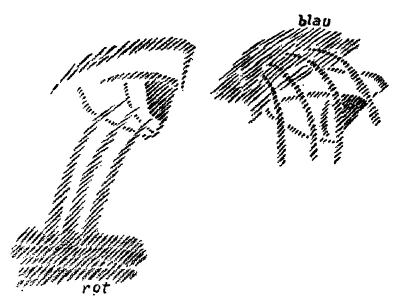
[ 8 ] So you can say to yourself: Even in terms of our sensory abilities, we today—in the fifth post-Atlantean epoch—are different people than even those who were characteristic of the fourth post-Atlantean epoch, the Greco-Latin period. All of this is connected to what was discussed earlier. In the era when spiritual forces still arose from emotions, from sympathies and antipathies, and even from physical sensations such as hunger, thirst, and satiety, these spiritual forces flowed all the way into the sense organs, and these forces—which, so to speak, flowed up from the lower abdomen and poured into the sense organs—are, for the sense of sight, the ones that primarily enliven the yellow and red color nuances, enlivening the ability to perceive these color nuances. Today we have entered an age in which the reverse has become an important task for humanity. The Greeks were still organized in such a way that their beautiful worldview was conveyed through their senses, as their spiritualized organic life poured into these senses. As humanity, we have suppressed this spiritualized organic life for centuries. We must revive it from the soul, from the spirit. We must acquire the ability to penetrate into the soul-spiritual realm, as spiritual science seeks to teach us. And by acquiring the ability to penetrate into the spiritual-soul realm, as spiritual science seeks to teach us, we will take the reverse path. With the Greeks, the currents emanated, as it were, from the physical body and flowed all the way into the eye (see diagram, red); for us, the opposite must take place. We must develop the spiritual-soul realm (see diagram, blue); the current must extend from this spiritual-soul realm to the human organism, and we must channel the currents from the spiritual-soul realm into the eye and the other senses. This reverse path must become the path of future humanity, in contrast to the path humanity followed until the middle of the fourth post-Atlantean culture. Then the thinking human being will once again become the spirit-knowing human being—one who, in a different form, perceives the spirit—a being shaped from above. We have grown into a receptivity for the blue part of the spectrum.
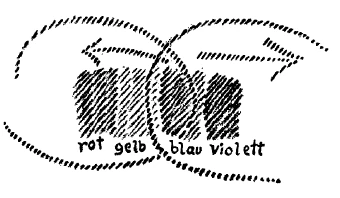
[ 9 ] If I wanted to illustrate this schematically, I would draw it like this: The Greek was particularly receptive to the color red; he lived in the color red. The Greek immersed himself in this part of the spectrum (see drawing, left); we must immerse ourselves more and more into this part (see drawing, right) of the spectrum. But as we immerse ourselves into this part of the spectrum—as we, in a certain sense, grow to love the blue and blue-violet colors more and more—our sensory organs must undergo a complete metamorphosis, a transformation.
[ 10 ] The sensory organs must, in their finer structure, become something entirely different from what they were. What flows into the sensory organs is that which gradually, in a natural way, develops imagination through the eye, for example, inspiration through the ear, and intuition through the sense of warmth. Thus, the following must be developed: through the eye, imagination; through the ear, inspiration; and through the sense of warmth, intuition.
[ 11 ] The finer structure in the course of human development—the finer structure of the human organism in the course of human development—undergoes a metamorphosis and becomes something else.
[ 12 ] People today must pay attention to such things, for they are in the midst of an important transitional period; they are in a time when it must be decided whether they are indeed capable of making the transition—of, so to speak, receiving impressions from above. We must not remain at the level of mere intellectualism; we must spiritualize and imbue intellectualism with soul. Then, however, that which develops within us as spiritual and soul-related will have an effect right down into the human organism. And what if we do not develop it? If any organ is intended for a particular purpose and is not used for that purpose, it withers away, it dies. There you have, within the human organism itself, what an earlier era—based on different premises of knowledge—assumed regarding the development of all humanity. Look at your eyes: into these eyes must pour that which is to flow down from above as spiritual life into the humanity of the future. If it does not flow in, then these eyes are doomed to become sick. By their very nature, human eyes must become sick, as must the ears and the sense of warmth.
[ 13 ] What kind of knowledge, then, must we seek? Knowledge that heals these predispositions to illness within our own organism. We must once again find our way back to the understanding that all knowledge, insofar as it seeks to reach human beings, has a medical character. We must once again be able to grasp the idea that we must seek knowledge for the sake of healing, that medicine is not merely one form of knowledge among others, and that all knowledge, in the process of human development, must be a healing factor, because humanity needs to have what arises within it on the physical plane continually healed. It is not the one who promises humanity an earthly paradise who speaks the truth to it, but only the one who makes it clear to people: Even if we do everything to create favorable earthly conditions, human beings must seek their connection with the spiritual world! — For even the best earthly conditions must be continually healed, healed right down into the human organism. The human organism, too, is constantly permeated with predispositions to illness. This means that there must be a spiritual life within humanity that has the power to generate healing forces from within itself.
[ 14 ] Among the various reasons that led to the emergence of the idea of “threefold social order” from an anthroposophically oriented worldview are those that you can glean from my discussions today, for this idea of threefold social order is such that one can look into this corner, into that corner, into a third and fourth corner of human development—if one can only observe correctly, the necessity of this threefold division becomes evident to today’s human faculties, which truly seek the truth. Those who, with their limited logic, believe that once they hear of this threefold division they cannot immediately understand it or find it to be in contradiction with something else, should wait until they have familiarized themselves more closely with the matter. Then they will see that there is not just one proof or line of reasoning for the necessity of this threefold division, but countless ones. For wherever one looks, there are observations that, independently of one another, prove what I might call the necessary emergence of the idea of the “threefold division of the social organism” in our present time. And one of the most important cornerstones is, after all, the recognition and understanding of human existence itself. But where is today’s science—so proud of its abstraction—willing to engage with what is truly concrete? Even the ancient Greeks had a clear awareness of this: when they allowed their emotions to rise, the divine revealed itself to them. — We must acquire the ability to bring down from spiritual heights the spiritual powers of the soul, and these must reveal nature to us; they must show us what nature is like. That is to say, we must be able to realize that we cannot know nature through outward observation alone, but only with those sense organs that are sharpened by what comes from above—with an eye that is sharpened by imagination, with an ear sharpened by inspiration, with a sense of warmth sharpened by intuition, through the selfless experience of the things and processes that exist in our surroundings.
[ 15 ] The will to heal has become science. Science must, in turn, flow back into the will to heal. What we regard as science today and revere so highly as an authority is merely an intermediate state—one that, however, leads to the most terrible disharmonies, especially in the social sphere. We will continue discussing all of this tomorrow.