

Healing Factors for the Social Organism
GA 198
10 July 1920, Dornach
Translated by Steiner Online Library
Thirteenth Lecture
[ 1 ] Today, from the entire sequence of ideas that forms the basis for the reflections we are now presenting here, I would like to present something more specific, so that we can then expand upon it tomorrow from a more general perspective. You have surely gathered from the reflections we have been cultivating here for quite some time that, in order to revitalize the declining culture of the West, it is necessary to develop a genuine understanding of the human being based on the principles of spiritual science. This understanding of the human being has, after all, been hindered for a long time. In the form in which it will be needed for the future development of humanity, it has been hindered first by that kind of spiritual life that emerged in the 13th and 14th centuries of the Middle Ages, and then again by the spiritual current of the period from the mid-15th century to the present, which has been moving ever more toward materialism. On the one hand, we have seen the development of a detached, unworldly, religiously tinged worldview that separated the spiritual from the world, prevented it from reaching human beings, and thus left human nature unexplained. One might say: In the final centuries of the fourth post-Atlantean epoch—the final centuries of Greco-Latin development up to the mid-15th century—humanity became increasingly accustomed to looking up to a divine-spiritual realm that was entirely detached from the world, and lost the ability to recognize the human here and now in its divine origin. Then came the time when humanity turned its gaze to the subhuman realm—to the principles of nature—which, however, could explain only those aspects of the world that are not human: the mineral, the plant, and the animal, and in this way, in turn, left humanity unexplained, so that, in a sense, in an earlier era there was a looking upward toward an alien spiritual realm, while from later times up to the present day there has been a looking toward a subhuman material realm. Humanity fell through the cracks in between. To once again fully grasp human beings in their spiritual and soul aspects—that is, first and foremost, the task of our time, and to this end we have indeed sought to contribute more and more elements through anthroposophically oriented spiritual science.
[ 2 ] Today I would like to speak about how human beings initially find themselves positioned in the world between two extremes in their inner experience. Let us first focus today on human inner experience. On the one hand, human beings experience the world of ideas; yet they experience it in such a way that the more they immerse themselves in this world of ideas, the more abstract and cold it appears to them. When a person rises to the level of ideas, they feel that they cannot warm up inwardly. But they also feel something quite different. They feel that in these ideas—which are then extended to become laws of nature and laws of the world—there is something that, as an idea, does not encompass reality; that, as an idea, is essentially nothing more than an image. Consequently, a person does not feel, in relation to the world of ideas, that he would like, so to speak, to consciously implant his own existence into this world of ideas. No matter how much a person may reflect—and no matter how gladly he does so—he gradually retains, even within the most thoroughly developed philosophy, the feeling that proof of his real existence in the universe cannot be derived from the world of ideas. Ideas have something rootless about them, as they are experienced in ordinary life between birth and death. This is one aspect—in a sense, one pole—of external experience in ordinary existence: the abstract, sober, cold ideas in which one cannot, nor does one wish to, anchor the reality of actual human being. And finally, modern humanity has not warmed to Descartes’s maxim: “I think, therefore I am”—cogito, ergo sum—because, no matter how much one thinks, one simply feels: “No form of being can be derived from thought alone.”
[ 3 ] The other pole of inner experience is memory images. Anyone who truly practices the science of the soul—psychology—rather than that verbal art often passed off as psychology at universities today, knows that these mental images of memory we have are, in essence, exactly the same as the imaginative images we create, so to speak, freely—except that we use the same power we employ in weaving imaginative images differently when we remember. By remembering, by cultivating our memory, we ultimately live in the same realm as when we create imaginatively, except that we draw upon what we have experienced through the senses or through life in general, and thus shape the “phantasms” in memory according to certain laws, whereas in imagination we allow them to roam freely. This is the other pole in inner experience.
[ 4 ] In the world of ideas—which we then extend to include the laws of nature—we have the firm awareness that our will cannot, in and of itself, actually bring about anything in the shaping of that world; it must conform to the inner logic, the fabric of reality, of ideas. If we wish to grasp reality, we cannot use our will to string one idea after another; we must adapt to the inner regularity of this purely pictorial world of ideas, which initially bears no being. At the other extreme—in the case of phantasms, which also live in recollection and memory—we recognize very clearly: our will reigns there—and our will is quite appropriately placed there as well; and we observe in two respects that these phantasms, insofar as they shape memory, do indeed have a great deal to do with our “I,” with our personality, with what constitutes our reality. No matter how much we may rail against mere fantasy or the fantastical, as we sense that our “I” acts within them at will, we simultaneously feel that these phantasms contain precisely our “I,” our personality. That is one aspect.
[ 5 ] The other point is this: At the very moment when, due to some illness, the continuity of our memory is disrupted—when the thread of our memory breaks somewhere, so that we cannot recall a part of our life—at that very moment, the true solidity of our inner sense of self is also disrupted. So, on the one hand, our sense of self is not initially connected to our world of ideas. On the other hand, we feel that this sense of self is contained within what we call our world of phantasms, even though we cannot rely on this world of phantasms and, in a certain sense, must not seek the essential self within it—even though we know that it is active there, indeed, that it cannot truly live in our consciousness unless this memory is in contact with it.
[ 6 ] What I have now explained to you in more or less abstract terms contains the deepest mysteries of life, and we approach these mysteries by bringing together various elements today that are scattered throughout our anthroposophical reflections. The world of ideas—it appears abstract to us, it appears pictorial to us! Where, then, do we use it first and foremost? We use it when we penetrate with our thinking that which acts upon our senses from the external world—colors, sounds, warmth, and cold. We penetrate our perceptions through thinking. You will find this explained in greater detail in my books Truth and Science and The Philosophy of Freedom. When we penetrate our perceptions through thinking, we use this world of ideas to, so to speak, imprint it upon our spiritual and soul experience—upon what we experience as the world of perception. But we must look a little more closely at what is actually happening there. And we can do this by directing our own soul faculties through the methods of spiritual science, as described in various places in my books. For one might ask: What would happen to our sensory perceptions if they were to impinge upon us solely from the outside—that is, if only what, so to speak, enters our eye as color from the light, what reaches our ear as sound, what enters our sense of warmth as heat, and so on—if only these things were to rush in upon us, what would become of us then?
[ 7 ] Let’s be clear: When we are awake, we never simply allow this world to flow into us. Even if we develop only a little active thinking in ideas, we still, in a sense, bring forth from within—in response to the sounds, colors, smells, tastes, and indeed all sensory qualities rushing toward us—the counterforce of the world of ideas rising up from within us. And anyone who does not think in terms of the abstract, verbal psychology of the present, but who has truly learned to observe, may ask: How do the contents of perception rushing in from the outside and the counterforce from within—the world of ideas—meet within our sense organs? — You see, if we were merely surrendered to the world of perceptions, then we would actually be living as human beings in our etheric body and, with that etheric body, in an etheric world. You need only imagine how, if you were surrendered through your eyes to the world of colors, you would live in a surging, ethereally surging world of colors; how, if you were surrendered through your ears to the world of sound, you would live in a surging sea of sound—which, admittedly, is not ethereal at first, but would become ethereal if you did not provide the counterforce through ideas. For just as sounds are to us humans at first, so are they to the ethereal. We swim in the sea of air and thereby in the condensed ethereal. It is, therefore, the ethereal that is condensed into matter only up to the level of air; sounds are, in turn, merely the air-like, material expression of the ethereal. And so it is with the qualities of warmth, with those of taste, with those of smell, with all sensory qualities. So imagine, for a moment, the absence of the counterforce from the world of ideas coming from within; imagine that you were living in an etheric sea as an etheric being—you would never attain that human consistency with which you actually exist in the world between birth and death. How, then, can you attain this consistency? By being organized to kill off, to numb, this etheric element. And how do we paralyze it? How do we kill it off? Through the counterforce of ideas! It is truly the case that—if I were to sketch it schematically—the world of perceptual content in living ethericity (red) would, so to speak, come from the outside, and we would be swimming as ethereal beings in living ethereality, were it not for the counterforce we send in from within—the world of ideas (blue)—which, as it is the world of ideas between birth and death, kills off the ethereal and causes the world to appear to us as a physical world. We would have an ethereal world around us if we did not, through the world of ideas, kill off this ethereal quality, bringing it down to physical form. The world of ideas, as we experience it as human beings, connects in our entire organism with the qualities of the senses, dampens these sensory qualities, and brings them down to what we experience as the physical world.
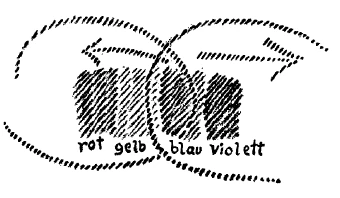
[ 8 ] That is the state of affairs. You can see from Dr. Stein’s short booklet—his dissertation—how close he came, through a brilliant interpretation of what can be gained in the field of anthroposophy, to this character of the world of perception. In fact, there is nothing in current physiological literature on sensory physiology as good as this little book by Dr. Stein.
[ 9 ] So, on the one hand, we have the fact that, through the world of ideas, we dampen the ethereal surging of the sensory qualities. How does this relate to what follows? It relates to the fact that our world of ideas—which we, as human beings, experience between birth and death as rising from within—does not appear in its true form. People cannot see through this—that the ideas, as experienced by a human being in a physical body, do not possess the true form of these ideas. People are still so crudely organized in our present civilization that it never even occurs to them to say to themselves, for example: You wake up from sleep; you have experienced an entire dream that symbolically expressed to you what is being shouted out on the street: “Feurio!” — You experience something symbolically that is quite different from what is happening outside. What we have in the world of ideas is very different from this formation of an external event in the dream fantasy; but in the world of ideas we nevertheless also have something that is nothing other than the shining in of a completely different world. And what world is it? We have spoken of this many times. It is the world that the human being passed through before birth, or let us say before conception. That is what is concretely experienced here in life, cast as a shadow all the way down to the abstract world of ideas. Between death and a new birth, we live in the reality of what exists here in the world of ideas only in these shadow images of concepts, representations, and ideas. Just as the external world shines into the dream, so the prenatal world shines into our world between birth and death by continuing to influence the formation of ideas. But while everything lives in what the ideas are between death and a new birth, while what is real in the world of ideas touches our own being, while we there—by touching ourselves—touch our ideal substance, just as we now touch our physical body, only that aspect of the substantiality of the world of ideas is cast as a shadow into this earthly life—the very aspect of which we do not even know that we draw from it, in the earthly realm, the reality of our own “I.” Yet we use this shadow of our spiritual existence precisely to make our existence on earth possible. What, then, do the gods bestow upon us when, through birth, they send us into this world? They give us the shadow image of that existence we have between death and a new birth. This shadow image consists of ideas, and these ideas serve us here so that we may become human beings in the physical sense at all; otherwise, we would float as ethereal beings in the ethereal sea. We put an end to ethereal life with the shadow images of our life between death and a new birth.
[ 10 ] This is how we place the human being within the entire universe, within the cosmos. Here again is one of the points where we gain true insight into human nature. Here we connect what we experience in the present moment to eternal experience. Here we say: If you think that by looking at the outer world through your senses and using your ideas to dull the ethereal life unfolding before your eyes and in your ears—so that you can endure it and be human—then you are doing so with the legacy, with the aftereffect of your eternal human being, as you have shaped it for yourself between death and a new birth.
[ 11 ] To expand human consciousness in this way, to infuse the human being with some of the knowledge that connects us to the entire universe—that is a need of our time. And all external science will wither away; all external culture will lead to decline. The death of the West will come about if people do not resolve to acquire a understanding of humanity that, through the observation of external living conditions, reconnects humanity to the cosmos—and does so in such a way that, by experiencing the world of ideas here, humanity becomes conscious of the eternal. Precisely for this reason, this world of ideas is something so sober and abstract: because it is only the shadow of the eternal, and because, fundamentally, it is destined here to subdue the sensory life that would otherwise flood us in an ethereal way.
[ 12 ] Thus, our lives are connected to the pre-birth realm. Traditional religious creeds are reluctant to point to this pre-birth realm; indeed, they even reject it outright. I have already touched on the fact that this is precisely what is distinctive about contemporary traditional religious creeds: that they speak only of the afterlife, not of the pre-birth realm, of pre-existence. They do not want to speak of it because then one cannot appeal to human egoism—the very thing one appeals to when preaching to people solely about life after death; for people want to enjoy the knowledge of life after death between birth and death. That which imposes obligations on them for this life—because the gods have sent them from the spiritual world to fulfill their mission—does not appeal to human selfishness; it appeals to human responsibility and human obligation. That is why one finds little approval when speaking of this pre-birth life. And these religious creeds have been so successful in lulling people into oblivion regarding this pre-birth life that, while we do have a word for “immortality”—that is, we negate mortality—we have no word for “pre-birthness,” which would be just as justified. For just as we do not die with our spiritual-soul aspect, neither are we born with it. We should have a word in our language that conveys this. Yes, the word “unborn” must be incorporated into language just as much as “immortal,” for human beings only recognize half of themselves if they can only appreciate the word “immortal” and not also the word “unborn.” The inability of language reveals the inability to rise to the spiritual heights in this realm.
[ 13 ] Let us now turn to the other pole and examine how, within the phantasms—from which, however, a person also forms his or her memories—there is something in which the “I” surges and flows, though often in a chaotic manner. Although the human being knows that his “I” lives within this, he does not rely on the phantasms to reveal anything about the nature of this “I.” If, on the other hand, one examines the facts—and you can glean this from various passages in our anthroposophical literature—one must ask: What, then, is actually that which develops from within us as the sum of our memory images—or, for my part, as the sum of our imaginative images? — It is nothing other than the transformation of that which, before it metamorphoses into the power of memory or the power of imagination, lives within us as a growth force. What lives down in the body as a growth force, when it emancipates itself from the physical, becomes a spiritual-psychic power of memory. As you know, up until the age of seven, when the teeth begin to change, the same force appears in human beings that later forms well-defined memories in the psychic memory; this force works to shape the body. What ultimately drives the teeth out is the same force that lives within us as the capacity for memory and imagination. In short, what lives within us as phantasms is the very same force that actually causes us to grow—the force that underlies our organic development. We emancipate it from the organism. What does that mean?
[ 14 ] Here, too, lies a significant mystery of life; it goes like this: We, so to speak, tear this phantasm-forming force out of our organism. If we were to leave it inside, how would we then stand in the world? Imagine that everything you, so to speak, detach inwardly from your organism—so that you can consciously control it with your “I,” with your personality—all of that would be surging within your organism. You would not say, “I will”—but rather you would feel the surging of your blood driving your movements; you would not say, “I take up the pen”—but you would feel the mechanism of your arm muscles. You would feel yourself losing yourself within the world if you did not detach the world of phantasms from your organism. Your independence would vanish. What moves within you, what lives within you, would be merely a continuation within your skin of what lies outside. Human beings must therefore tell themselves: The grass grows from certain forces outside my skin; inside my skin, my spleen and my liver grow; but I would not perceive a difference if I could not tear my phantasms away from what acts to organize my inner being. Out there, I do not tear anything away; there, I take the essence in its totality. Inside my skin, I detach the world of my phantasms. Through this, I attain my independence. — This is what makes it possible at all for us to find the bed, the foundation for the “I” within the human being. This is the other pole of inner experience.
[ 15 ] While we must suppress our sensory experiences through the world of ideas so that we can place ourselves within the physical world—for otherwise we would float like spectres in the etheric sea—we must also inwardly sever the world of phantasms from our organic processes; otherwise, we would simply be a part of nature, like a growing tree. We would not stand as an independent entity, emancipated from the rest of world events.
[ 16 ] This is how one recognizes oneself as a human being in one’s very essence within the human being. And if one looks further, one says to oneself: This personal life between birth and death is what causes us to experience the “I” here, precisely between birth and death. But we do not experience the whole organic being within us, not that which lies within our skin; that, in turn, remains a shadow of what constitutes our being after death. Just as we are connected to the pre-birth realm through one pole—the pole of ideas—so too are we connected to the post-death realm through the pole of phantasms, in which the will lives. We are connected to our pre-birth self through our world of ideas, and to our immortal self through our world of phantasms—which is now a world of phantasms so that, when we pass through the gate of death, it may take shape as a regular cosmos in which we then weave, live, and exist after death.
[ 17 ] This is how true self-knowledge—a spiritual attunement to the cosmos—works. Human beings know where they come from, where they stand, and where they are going by answering these questions based on what they truly recognize within themselves, based on what has flowed in from the cosmos into our inner being. Such knowledge is not like the knowledge that Western culture has gradually destroyed. Such knowledge has a different significance. Western culture has truly been ruined by its own knowledge. Look back at the knowledge that people possessed up until the middle of the 15th century. People today scoff at this knowledge. They regard it as the childish knowledge of a childish humanity. They say to themselves: We have come so wonderfully far in the present; only now do we have true chemistry, true physics, true biology, and so on. — But there is indeed a significant difference between the ancient knowledge—when it can reveal itself in its truth, if only properly understood—and the rootless knowledge of the present. If you look into the ancient knowledge as it existed up until the mid-15th century, you will see: whenever a person appropriated elements of knowledge from the world, they always took with them something that connected them to the world. Just consider this: No matter how intelligently you reflect on a tree, and no matter how much conceptual content you take into your soul regarding the tree, you are still aware that there is far more life within the tree than you can grasp with your ideas; the same is true of a flower, and even of a crystal. When you look at the modern world, which has gradually become mechanized, it is only then that human beings stand, I would say, before objects that have become completely transparent in an ideal sense. We see right through the machines we build and the mechanisms we construct. We know: the machine is constructed from these forces, in this or that combination. — Following the model of what humanity has built in technology, it has also formed a worldview for itself, and now imagines the universe itself as a great machine.
[ 18 ] Because we have lost our reverence for the mystery in our mechanized cultural order, and because the machine has become intellectually transparent to us, we need—especially today—to reconnect with humanity so that we may rediscover spirituality. People who were still able to seek spirituality by seeking the spiritual in natural objects at the same time did not need the kind of knowledge extracted from human beings that we need. We, who have gradually torn ourselves away to the point of mechanically grasping the world, to the point of building a mechanized technology—we need, in the face of dead technology that also intrudes into our life of thought, a living spiritual science which, in the way we have again indicated today, connects human beings to the spiritual universe, to the spiritual cosmos. But we must achieve this connection in the present by truly transforming our inner selves to some extent before we turn to the outer world. Anthroposophically oriented spiritual science takes this transformation into account wherever it is applied in practice.
[ 19 ] We founded the Waldorf School in Stuttgart. Little by little, people are coming and wanting to observe classes at the Waldorf School. That’s what people do these days; if something interests them here or there, they go there, take a look, and then they “know” it—and under certain circumstances, they might even set up something like that themselves. That’s how our life has gradually come to be. But that is not what the Waldorf School is really about; rather, it is about being able to immerse oneself, above all, in the inner life that has been introduced into the didactics and pedagogy of the Waldorf School. It is about truly grasping the relationship between the human being and the world in a completely new way. When it comes to the world of ideas, people are, of course, generous. People do not like to keep their world of ideas to themselves. They would like everyone to have the same ideas; that is, they would like to share their ideas with everyone. When it comes to other goods, people are not so generous; they prefer to keep those for themselves. But when it comes to ideas, they are happy to share them with everyone. This is precisely what constitutes the radical difference between the spiritual world on the one hand and the economic world on the other. This difference is already radically present if one is only willing to look for it, and fundamentally, if someone under the old system has a tendency to be a teacher, this consists solely of generosity with regard to the world of ideas. For children are even better recipients of gifts than adults, who may meet one with criticism and resistance. It is even easier to bestow the gifts of knowledge upon children.
[ 20 ] Well, of course these instincts must also be taken into account at Waldorf schools and by Waldorf teachers. But a new element comes into play here, one that can only arise from the spirit of anthroposophically oriented spiritual science. This is that, in addition to what has always been traditional in earlier creeds—the focus on the afterlife—there is now a decisive focus on the pre-birth period, so that we are clear that in the child as it grows up, what descends from the spiritual worlds is gradually revealed. We came down from the spiritual worlds at a specific time. The gods sent us into this world, and we carry out what the gods have placed within us. The children come down later; they spent more time in the spiritual world. We look upon what shines forth from the children’s souls. They bring us messages from the spiritual worlds, where they have been longer than we have. A sense that something from the spiritual world descends into the present, that it enters the children—something the teacher must first unravel—and that alongside the giving we so gladly do, there is also a receiving—this can only come from the spirit of true spiritual science, when the idea of pre-existence is joined to the idea of post-existence in a living sense of feeling.
[ 21 ] What matters is this new element that has been infused into the pedagogy and didactics of the Waldorf School; that is to say, fundamentally, the Waldorf School can only be understood by those who have taken anthroposophically oriented spiritual science into their own hearts and souls. And only then should they begin observing classes; otherwise, from the few hours they spend observing at a Waldorf school, they will see nothing more than someone writing on the blackboard or speaking to the children, and so on. But it has become so uncomfortable for people today to truly immerse themselves in spirituality. When you get right down to it—why is that?—if we want to seek the cause of this, we can pick up works that have truly emerged from a current of the ancient past and ask: What do they say about how human beings appropriate spirituality?
[ 22 ] I have laid out before me the Textbook of Philosophy on an Aristotelian-Scholastic Basis for Use in Higher Educational Institutions and for Self-Study by Alfons Lehmen, S.J., fourth expanded and revised edition, edited by Peter Beck, S.J. The work was first published in 1899, and the fourth edition was published in 1917. I would like to read to you what is written on page 8 of the introduction regarding the spirit of this philosophy, which is, in fact, genuine Catholic philosophy. We will see shortly that we are indeed dealing with genuine Catholic philosophy. It reads:
[ 23 ] “From what has been said, it is not difficult to see what is to be made of the principle of ‘absolute freedom of science.’ This principle grants every individual the right to formulate and defend any opinion whatsoever without having to fear objection from any teaching authority. However, freedom does not mean the absence of limits. The Church’s Magisterium has the right to condemn a philosophical opinion if it contradicts a revealed teaching or logically leads to such a contradiction. We take it as proven here that the Church’s Magisterium was established by God with the mission to protect and interpret divine revelation. This mission directly confers the right in question. For in order to carry out the mission entrusted to it, the Church’s Magisterium must be empowered to explain the true meaning of the Word of God and to identify false interpretations as such. Therefore, if the opinion of a philosopher or a philosophical school directly or indirectly challenges the true meaning of the content of revelation, the Church’s Magisterium possesses the power to judge the error as such and the authority to condemn it publicly.”
[ 24 ] And this as the introduction to a philosophy textbook! Well, if you take the whole spirit of such a discussion—such as the one being engaged in again today—what does it reveal? It reveals the entire Christian spirit that Paul meant when he said, “Not I, but Christ in me.” As Christ lives within us, He awakens the spiritual element within us, and it is precisely through this “Christification” that we become capable of connecting human beings to the spiritual cosmos. We have, of course, often spoken about this significance of the Mystery of Golgotha, and we will discuss it in greater detail again tomorrow. But there was one thing Christ had to make clear to humanity in order to show people how they must draw their truth from the Spirit, from the divine Spirit. One need only recall another saying of Christ Jesus, and everything in this regard is made clear: “My kingdom is not of this world”; that is to say, the kingdom that Christ seeks to kindle within the human being must not be established in this world. It must be established by the human being finding the path from this sensory world into the supersensory world.
[ 25 ] My kingdom is of that other world, which is not this sensory world—who has sinned most against this word of Christ? The one who claims that a kingdom founded on this world—a kingdom centered in Rome, in physical Rome; a kingdom that acts through physical counsel and decisions; such a physical kingdom, which is entirely of this world—is the kingdom that can somehow spread Christian truth. — Since the Kingdom of Christ is not of this world, it is most certainly not of Rome either. By this we point out that, in the present, people must come to understand as truly anti-Christian everything that is of this world—everything that seeks to shape even the truth so strongly in the image of this world that it says: “The Church’s Magisterium has the right to condemn a philosophical opinion if it contradicts a revealed doctrine or logically leads to such a contradiction”—that is, insofar as this is decreed by the Church! Therefore, such books do not appear as books by anthroposophists, for example, must appear—where one enters with one’s entire personality and only with that, and says: “What I have to represent, I represent out of my connection with the Spirit of Truth”—but here the title is: “Textbook of Philosophy on an Aristotelian-Scholastic Foundation,” by Alfons Lehmen, S.J., fourth edition, 1917. If one turns the pages, it reads: Imprimatur Freiburg, Thomas, Archbishop. This means that here it is not an individual who advocates what he, as an individual, is called upon to advocate, but a secular body from which anyone who wishes to publish something that is to be recognized must obtain the imprimatur; here, a body that is of this world and shapes the truth of this world advocates what is presented as truth!
[ 26 ] Today, we must not be cowards, but must look courageously at what true Christianity is and what so-called Christianity is. We are living in a time that—precisely because people have been cowardly enough not to live out outwardly what they have more or less recognized inwardly—has led us into this catastrophe. Our catastrophe is, at its root, a spiritual catastrophe—as we have often said—and we will not emerge from this catastrophe until we turn to the Spirit of Truth, who seeks in spiritual vision the power that grants him the “Imprimatur,” not a supreme ecclesiastical authority appointed by a worldly organization.