

Healing Factors for the Social Organism
GA 198
18 July 1920, Dornach
Translated by Steiner Online Library
Seventeenth Lecture
[ 1 ] Yesterday I attempted to unfold before you the full significance of the seriousness of anthroposophically oriented spiritual science by striving to show the difference between merely abstract ideas and concepts and that which also arises in the soul in the form of ideas and concepts—which also takes on the form of ideas and concepts—but is then reality, is actuality. The point is to fully realize how, by becoming more and more dominated by a materialistic mindset—by turning away entirely from spiritual concepts and concerning oneself only with concepts of the natural world and so on—human beings make themselves more and more like the material world, as they actually descend further and further into this material realm, so that in the end it is no longer wrong for him to claim that the material substance of his body thinks, that his brain thinks; rather, it is even the correct view that human beings actually become a kind of automaton of the universe, and that, little by little, through the denial of the spiritual-soul aspect, the loss of this spiritual-soul aspect also occurs. I said that this is, of course, an uncomfortable worldview for many, and that many regard this worldview as something they absolutely do not want to accept, for the reason that they believe human beings can somehow have their spiritual and soul aspects saved in the long run without any effort on their part. But that is not the case. Human beings can become so deeply absorbed in the material world that they detach themselves from the spiritual-soul aspect, that they immerse themselves in the Ahrimanic forces and continue onward with these forces in a world current foreign to our own, but without their “I,” which, after all, cannot belong to the Ahrimanic world, but can find its true development only when a person follows the normally progressing evolution—that is, when they connect with all that is related to the Mystery of Golgotha; when, above all in our time, he recognizes how to seek a connection with what can be brought to humanity through spiritual research. For our Western world, a phase has indeed begun in the course of human evolution since the middle of the 15th century in which, when a person looks out at his surroundings, he perceives only the sensory world. And when he looks within himself, he has, since the middle of the 15th century, been increasingly led to abstract his inner soul experiences, to intellectualize them, and to render them insubstantial.
[ 2 ] What we experience today as concepts—what we derive for our worldview from the prevailing official scientific doctrines—has, in essence, no connection whatsoever to existence. Nor can it be used to penetrate into reality. It is merely a prejudice to believe that human beings, by engaging in ordinary abstract thought, are actually living a spiritual life. These abstract thoughts are actually an element alien to reality; they are merely a collection of images, so that we can say: Outwardly, a person perceives the sensory world, and inwardly, a person perceives what is, in essence, only a world of images—a world that, fundamentally, has no real connection to existence. — This has, in fact, been the fate of humanity since the mid-15th century: to perceive the sensory world on the outside—and we will soon see what significance this sensory world has in relation to the overall worldview—and to experience, on the inside, a spiritual life that is increasingly becoming nothing more than mere images. One might ask: Why has humanity in the civilized world, since the mid-15th century, become more and more of a mere image in regard to its inner life? The reason is simply that only in this way can human beings ascend to true freedom.
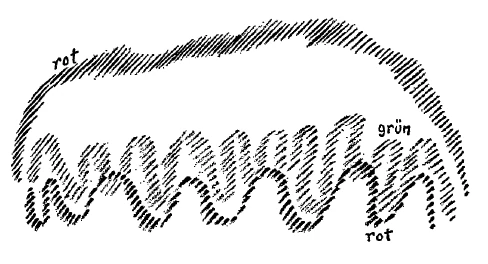
[ 3 ] To understand this, let’s take a closer look at our world as it appears to us today, and at our own place within it. Set aside the human being for a moment in this vast world; look at everything that exists in this vast world—let’s say clouds, mountains, rivers, and the forms of the mineral, plant, and animal kingdoms—and let’s ask ourselves: What, in fact, is contained within the entire scope of what we might describe as I just did? — Let’s sketch out schematically what we’re dealing with here. Let’s say: everything we can see above us (see drawing, above), everything that extends around us as the mineral realm (red), the plant realm (green), and, to a certain extent, also as animal life—we set aside the human being here, which of course cannot actually exist in reality but which we can hypothetically bring to mind—so we imagine this to be nature stripped of humanity. There, in all of this nature stripped of humanity, there are no gods. This is what must be understood! There are just as few gods in this nature stripped of humanity as there is an oyster in an isolated oyster shell or a snail in an isolated snail shell. This entire world, of which I have now spoken to you hypothetically—in which we disregard human beings—is what the divine beings have shed in the course of evolution, just as the oyster sheds its shell. But the gods, the spiritual beings, are no longer within it, any more than the oyster or the snail is within its separated shell. What we have around us—the world I have described—is a thing of the past. When we look at nature, we are looking at the past of the spiritual and at what has remained from this past of the spiritual as a residue. Therefore, there is also no possibility of attaining a truly religious consciousness merely through the observation of the external world; for one must certainly not believe that anything exists in this external world that corresponds to what the spiritual-divine beings who actually created humanity are. Elemental beings, certainly, lower spiritual entities—that is something else; but that which is actually the creative spiritual entities, which must enter into religious consciousness as such, belongs to this world only insofar as this world is its shell, its residue.
[ 4 ] Things such as what has just been mentioned are sometimes perceived by exceptional individuals as profound truths that take root in the souls of such individuals. The person who, in the spiritual development of the 19th century, felt most deeply how what surrounds human beings as “nature” is a remnant of divine-spiritual development is Philipp Mainländer, who, through the full weight of this realization, arrived at his philosophy of suicide and then also ended his life by suicide. It is sometimes the fate of human beings, through their karma, to immerse themselves in such one-sided truths. Then this fate itself becomes one-sided and difficult for an incarnation; such was the case with Philipp Mainländer, the unfortunate German philosopher.
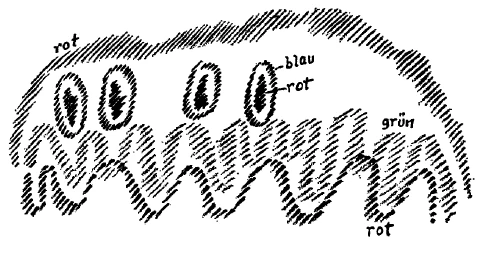
[ 5 ] Now, after you have taken in what we have to say about this hypothetical external nature, you may ask: Where, then, are the gods—those gods whom we must speak of as the true creators? — Then I must redraw the schematic diagram for you; I must schematically draw the human being into it and, within the human being, the gods. If I may put it this way: Within the human skin, within the human organs, are the truly creative gods (see diagram: O). Human beings, in their very essence, are the bearers of the present divine-spiritual. So the divine-spiritual, which is also the truly creative force in the present, is inside human beings. And if you imagine all of external nature today and then envision a future that lies so many thousands of years ahead of us, there will be nothing left of these clouds, these minerals, these plants, or even the animals. Nothing will remain of all that lives in nature outside the human body. But that which spiritualizes and animates the human organism from within will continue to develop; that will be the future.
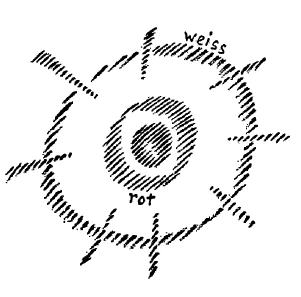
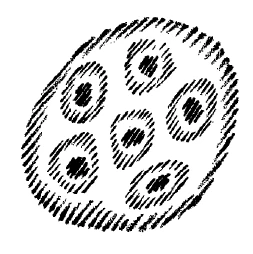
[ 6 ] If I were to draw this schematically, I would have to say: If this is nature (large circle), that is humanity (small circle), and within humanity lies the human-divine, then nature will be scattered in the future (rays). Humanity will have expanded to encompass the world, and that which is within humanity today will become its external environment (red); it will itself then be nature.
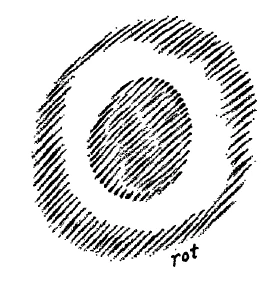
[ 7 ] The realization that the divine-spiritual—which we must address as the truly creative force of the present—lies within the human body is an immensely serious insight. For this imposes a responsibility upon human beings toward the entire universe. It enables human beings to understand something like a saying of Christ: “Heaven and earth will pass away”—that is, the outer world—“but my words will not pass away.” And when the Pauline saying is fulfilled in the individual human being—“Not I, but Christ in me”—then the words of Christ in turn live in the individual human being: “Heaven and earth will pass away, but my words”—in the individual human being, that is to say, that which lies within the human body and is taken up by Christ—“will not pass away.”
[ 8 ] But what does what I have said point to? It points to the fact that, through his abstract concepts—through what he intellectualizes—man has, in a sense, been emptying himself inwardly since the middle of the 15th century. Why is he emptying himself? He empties himself precisely in order to receive the Christ impulse—that is, the creative-divine—into his inner being. We look at the outer world, I said, and we see only the sensory. There we see only the divine past. Among what remains of this divine past are also the elemental spirits and so on, who have remained on lower levels. We look within ourselves and see there, at first, merely pictorial, abstract concepts—things that are becoming increasingly intellectualized—which only become concrete and real when a person takes in the spiritual impulse through spiritual science and connects it with their inner being. Humanity has a choice—and this choice has become increasingly serious since the mid-15th century—either to remain at the level of intellectualistic, abstract concepts, or to take in the living content of spiritual science. If they remain with the intellectualistic, abstract concepts, they will develop a brilliant natural science, for these concepts are dead, and they will comprehend dead nature with these dead concepts in a marvelous way. But all of this turns them into mummies; all of this makes them resemble matter; all of this leads to their sinking into the Ahrimanic. To carry on earthly affairs, to continue the entire development of the Earth, humanity needs to take in the spiritual—which today does not approach human beings atavistically or instinctively, but must be worked out by them. Thus, the reception of spiritual science is not a theory, but the working out of something real. It is the filling of the otherwise empty inner soul with spiritual content. Empty within, yet facing the past from without—this is how humanity as a whole would like to remain today, by accepting only the logic of thought combined with the art of experimentation, and refusing to embrace what constitutes a living spiritual life. The world today faces not only the danger of perishing in the Ahrimanic, but also the danger that the Earth’s mission will be lost.
[ 9 ] Anyone who thinks this through and truly feels it will all the more appreciate the gravity that should be associated with the study of spiritual science as such. And they will then not underestimate the insight that is knowledge of humanity. Knowledge of the human being—it does not exist at all within today’s scientific knowledge or within the ancient religious traditions. What do the ancient religious traditions offer? They direct the human gaze upward toward abstract, otherworldly heights; they do not speak of how the gods dwell organically within the human being. They would declare this idea to be heretical in the most eminent sense. If one were to try today to teach the traditional European and American religious denominations that the gods dwell within human beings—that the ancient saying is true: “The human body is the temple of God”—they would rebel against such heresy. That is one side of the matter.
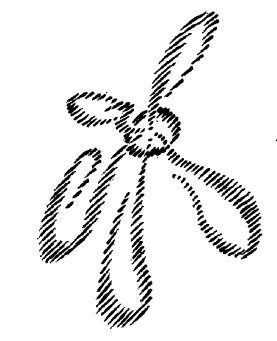
[ 10 ] On the other hand, we have a materialistically oriented natural science that, precisely because it is materialistic, does not understand matter. What does this natural science understand about the function of the human brain? What does this natural science understand about the function of the human heart, and so on? I have shown you on several occasions, and have also stated publicly, that materialistic science, for example, holds the view that the human heart is a kind of pump that pumps blood into the body. This general understanding of the heart, as taught in universities, is sheer nonsense—nothing more and nothing less than sheer nonsense. For it is not a matter of the heart being a pump that forces blood in all possible directions and then allows it to flow back; rather, what is truly alive is the circulating blood. There, in the blood, in the blood circulation itself, lives that which is the actual driving force in human existence, in the human organism, and the heart is nothing other than the expression of this. That is where the movement manifests itself (see drawing). Anyone who, in the spirit of modern science, speaks today of the heart driving blood through the body is speaking much as if someone were to say: “When it was ten minutes to nine, one hand was pointing toward nine, the other hand was past ten, and these hands, along with the entire clockwork mechanism, drove me up here onto the podium.” — But that is not the case; the clock is merely an expression of what is taking place! Nor is the heart the pumping mechanism that causes blood to be driven through the body; rather, it is an expression of this process; it is integrated into this entire system of movement and expresses this system of movement.
[ 11 ] Natural science, as it is generally practiced today, does not lead into the inner being of the human being any more than dissecting corpses does; at most, it turns the inner into the outer. But that does not lead one into the inner world; it merely results in turning the inner world into an outer one; for the moment one anatomizes the human being from the inside, one turns what one discovers there into something external. So the point is that in today’s entire spiritual life there is no inclination to truly penetrate into the inner being of the human being. This is precisely what spiritual science must provide; spiritual science must bring about knowledge of the human being. But most of our contemporaries shy away from this knowledge of the human being. Why is that? Because the religious traditions of the centuries have literally clouded people’s minds with regard to any genuine striving for knowledge. Just consider the vagueness, the muddled use of words that traditional creeds present to people, and how they then escalate this into the doctrine that a person should not seek to know the supersensible, but should believe in it, should merely sense it dimly. All of this is designed to give rise in a person—out of their pride, their overestimation of themselves, and at the same time their inertia—to the idea: There is no need to think about the divine; it must rise up from the depths in dark feelings and instincts. — But then nothing else rises up but the vapors of the organic, which transform into illusions, which in turn are transformed by practitioners and theologians—who rely on convenience—into all manner of nebulous things.
[ 12 ] For centuries, the instinct for knowledge—the only thing that can truly propel human beings forward on the path of earthly evolution and into spiritual evolution—has been suppressed. People today literally get goosebumps when they are asked to begin developing an understanding of reality and to rise up into the spiritual world. But to the very extent that one gets these goosebumps, to that very extent one cuts oneself off from one’s spiritual-soul nature and becomes more and more like the material world.
[ 13 ] One could say that when such matters are tackled in earnest, people immediately shy away from them; for today, everything is viewed from an external perspective. And I would like to reiterate here something I noted recently. We founded the Waldorf School in Stuttgart. This Waldorf School was founded entirely in the spirit of anthroposophically oriented spiritual science; that is to say, a pedagogy and didactics were presented to those who had been specifically selected for this school. It is indeed the spirit that has permeated this pedagogy and didactics. Today it has even come to the point—because everything we have founded becomes a sensation—that people want to visit this Waldorf School, take a look around for a few hours, to see if, in those few hours, they might encounter something that is different from what they find in other schools—so it’s just another sensation! But one comes to recognize the spirit of the Waldorf School through anthroposophically oriented spiritual science, not by requesting to sit in on classes, sitting there, and more or less disrupting the lessons. To take in anthroposophically oriented spiritual science is simply more inconvenient and less sensational than sitting in on classes—and sitting in on classes, after all, basically means wanting to make oneself comfortable.
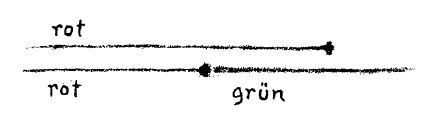
[ 14 ] The pedagogy and didactics in question take into account the spiritual worlds and, above all, the pre-existence of the human being. What, then, is the nature of this pre-existence of the human being? Well, let us think back to the year of our earthly birth. Let’s assume that at that time we had descended here (see drawing, lower line) into earthly-physical life. Children born much later were still up in the spiritual world during that time; they descend, for example, only at that point (see drawing, upper line). We were already on Earth during the time when these children were still up there. They bring us something that was experienced in the spiritual world while we were already down here in the physical world.
[ 15 ] One can consciously observe this in the children before one when teaching using the pedagogy and didactics as they are intended to be practiced in a Waldorf school. One must actively immerse oneself in the spirit of the child; that is, develop practical skills in everyday life to bring to life the reality of what must be conveyed through concepts and ideas derived from anthroposophically oriented spiritual science. But it was precisely these things that people were kept from by traditional religious creeds, which, above all, did not want that inner activity to be cultivated within people—an activity that then leads to true knowledge of humanity and teaches people the profound truth that the dwelling place of the gods is within the human skin itself.
[ 16 ] Let’s look at our planet from the outside. In everything else on the planet, there is nothing divine or spiritual. From the human-like beings who dwell upon it, the divine radiates from the planet (see drawing). Is it therefore any less present on the planet simply because it shines forth from the bodies of human beings? You will also be able to come to terms with this idea in a formalistic sense if you remove it from earthly life and transpose it to another planet. Standing here on Earth, however, you will certainly find that the idea has something compelling and urgent about it—that you and your fellow human beings are the bearers of the divine-spiritual. But if you turn your spiritual gaze upward toward another planet, then you will be better able to grasp the idea that the beings who constitute the highest realm of nature there are the sources from which the Divine-Spiritual shines forth toward you.
[ 17 ] The thought we have developed today complements, from a certain perspective, the other serious thought we allowed to arise in our souls yesterday. Yesterday we allowed the thought to arise in our souls that within the human being there develops that which is to bring about the further reality of Earth’s evolution—that which is to carry Earth’s evolution forward—while it lies within the will of the human being to hinder this evolution by embracing only the Ahrimanic current. And today we add to this the other thought that, in fact, everything around us is transitory external nature, for it already represents today only a remnant of divine-spiritual creation. Divine-spiritual creation, which is at work in the present and will continue to be at work into the future, is present within the human body; so that, although it may seem paradoxical, it is nevertheless true to say: Everything that the eyes see and the ears hear in the human environment will pass away with the Earth. Only that which lives today within the spaces enclosed by human bodies will live on into the realm of Jupiter; it is this that carries earthly existence into future planetary developments. — One will once again feel an urge to truly understand humanity’s relationship to the universe when one faces the immensely serious necessity of learning to know human nature.
[ 18 ] Human beings actually live between two extremes. We have called these extremes the Luciferic and the Ahrimanic extremes. We can also, I would say, understand them in more elemental terms. Philosophers have always said that one cannot actually approach Being through thought alone. That is indeed true; for where does the sense of being that human beings experience actually come from? Before entering physical earthly existence through conception or birth, human beings exist in supersensible worlds. They descend from these supersensible worlds into their earthly, physical, sensory existence. There, above all else, they experience something new that they did not experience in the supersensible worlds—something that immediately envelops them once they have descended. This is what one might—though only symbolically—call the heaviness, the gravitational pull of the Earth, or what one might call “having weight.” Now you know: the expression “having weight” is actually derived only from the most important manifestation of gravity. For what we feel, for example, as fatigue is also something similar to having weight, and what we feel in our limbs when we move them is also something related to having weight. But because “having weight” is the representative aspect of this, we can say: Human beings place themselves within gravity. And secretly, human beings always perceive something of this gravity whenever they describe any earthly thing as real.
[ 19 ] Conversely, when a person is between death and a new birth, just as they are connected to heaviness here on Earth, they are then connected to the light. For light, too, has a meaning; “with the light” is again used in a representative sense, because since we receive most of our higher sensory perceptions through the eyes when we are seeing, we speak of light. But what exists in the sensory perception of the eye as light is the same as what exists in the sensory perception of the ear as sound and manifests itself in individual tones, just as light manifests itself in individual colors. And so it is with the other senses as well. Essentially, it is the coloring of all the senses that is representatively referred to as light, just as heaviness is representatively referred to. We are absorbed into the utmost heaviness when we descend to the earth. We are absorbed into the utmost light when, in death, we enter the world between death and a new birth. And we are actually always situated in the middle state between light and heaviness, and every sensory perception is, in essence, as we experience it here, half light and half heaviness. At the moment when we—perhaps due to a pathological condition or a dream—experience things without our heaviness, we experience only the spiritual, as in a dream or during a feverish paroxysm. Psychologically, a feverish paroxysm consists in a person having experiences without experiencing their own heaviness in connection with them. This balance between heaviness and light, into which we are placed—precisely this is, for much of what we experience here in the world as human beings who are spiritual-physical beings, intimately connected with the mystery of the world. But neither the world current that finds expression in traditional religious creeds nor the one that finds expression in scientific fantasies leads to this breakthrough: from abstract concepts into the light, from sensory perceptions down into heaviness. People today have indeed become blind, deaf, and numb to these things.
[ 20 ] Human beings live on Earth, connected to gravity. They perceive gravity as pulling them toward the Earth (drawing on the left). Let’s take a crystal; it gives itself its own shape (drawing on the right). What kind of force is at work inside it? Inside it is the same force that humans feel pressing them down—the same force that gives the entire Earth its shape. Just consider where the Earth can give form: across the entire surface of the sea, in the water; there, gravity gives form. In the same way, the same force gives the crystal its form. Only there, it acts from within. Scientific speculations tend to say: What lies behind matter, or within matter, is unknown; it is a “mystery of the universe.” We experience what lies behind the surface of matter by experiencing our own gravity, for in relation to the entire Earth we are placed within the same forces that act, for example, within the small body and hold its individual parts together. One must simply be able to recognize the small in the large and the large in the small, rather than speculating about what might lie behind matter. What transcends matter—the divine-spiritual that reigns within beings—must be recognized by kindling that which can be kindled within, which leads to a higher inner experience, which leads to an understanding of concepts and ideas that truly relate to what dwells in the temple, which, according to ancient traditions, is represented by the human being himself.
[ 21 ] As I have often emphasized here, there is something in ancient, atavistic forms of wisdom that one can deeply revere. In the present, we are called upon to consciously bring this back from the depths of being and make it the guiding principle of people’s spiritual and social actions and lives.