

Healing Factors for the Social Organism
GA 198
17 July 1920, Dornach
Translated by Steiner Online Library
Sixteenth Lecture
[ 1 ] I would like to recall once more the points I mentioned yesterday at the conclusion of my remarks here on the paradoxical nature of our present age. It seems to me that no era has been so clearly defined by its most outstanding representatives as our own. For consider this: yesterday—let us just take a clear look at the facts—I had to speak of an outstanding figure of our time, a man of whom I could say that he has completely outgrown what is known as the “intellectual substance” of our time—Oswald Spengler. There is no doubt that he is, first and foremost, one of those who exert the greatest possible influence, particularly on the youth of Central Europe, and that this influence must be taken into account. But as I mentioned yesterday, one can already see this influence extending far beyond Central Europe. The Times has published articles on the contents of Oswald Spengler’s book The Decline of the West, and it is, for one thing, a remarkable phenomenon that, with a coherence one is accustomed to seeing today only in so-called scientific discourse, a man equipped with twelve to fifteen fields of study—which he has fully mastered—strictly proves that by the beginning of the third millennium, our Western culture must perish and descend into barbarism. It is a significant phenomenon that, using the very same methods, the very same approaches to research and thought with which our age believed it had come so far, someone proves clearly and unequivocally that this civilization must disappear completely in such a short time.
[ 2 ] We are certainly not dealing here with a perspective that, as is so often the case today, remains stuck in the realm of fiction or the arts and culture pages; we are dealing with something that is backed by the most rigorous tools of scholarly expertise, and, above all, we are dealing with a man of genius. This man of genius uses Western scholarship to substantiate the view that Western culture is in decline. And yesterday, in order to fully characterize Oswald Spengler, I had to point out the most glaring paradox to you. I had to tell you that this Spengler is undoubtedly a man of genius, but that he utters the greatest follies. I have given you examples of this, so that we are faced with the remarkable phenomenon in contemporary intellectual life where genius and folly intersect. It is, in fact, a characteristic feature of our present age that the utmost extremes intersect, and one could indeed get a sense of this jarring intersection if, on the other hand, one were not living life in such a drowsy state.
[ 3 ] For I imagine: if, at a gathering in Central Europe one hundred and thirty years ago, people had had to speak the way they spoke yesterday about Oswald Spengler, such a gathering would have been completely thrown into a frenzy; for back then, people were still alert! It is a general phenomenon that the paradoxes of our time are interwoven, and that people have already become completely desensitized to these paradoxes, because, fundamentally speaking, intellectual matters no longer make any impression on people today.
[ 4 ] And secondly, I had to tell you that this Oswald Spengler is a thoroughly clever man—that one has to be as clever as he is to produce such grandiose nonsense as he has produced. I followed that up with the remark that there are plenty of fools who, for example, have accused me of saying one thing one moment and another the next about the very same phenomenon. Yesterday I took the liberty of saying two different things about a single person on the very same evening: that he is both brilliant and foolish, that he is both intelligent and magnificently stupid. We are experiencing these things today. And until it is seriously understood that these things can be experienced today, that they arise from the depths of contemporary consciousness, we will not gain such insight into the necessities of our time that we can truly grasp the full significance of the spiritual science referred to here.
[ 5 ] This is connected to what I must characterize in this way: the change in the way supersensible knowledge is used and applied. Yesterday I explained to you how, over the course of millennia, supersensible knowledge was preserved within the mysteries, and how it was virtually a matter of course that silence was maintained regarding it. I told you that something different has become necessary today. Even though it has just become apparent that secrecy could not even be maintained in the outward form of preserving my lecture cycles, the course of action—to treat certain truths, which admittedly do not yet reach the highest level, quite openly—still had to be strictly adhered to. The kind of secrecy we experienced in the ancient secret societies or even in the mysteries is no longer feasible today, in an age when so many have “proof” of “how wonderfully far we have come.”
[ 6 ] A certain degree of democracy is indeed necessary today. For more than a century now, democracy has been a necessary requirement of our time. And just as it cannot be abolished—that only individuals can ever become spiritual researchers, that only individuals can ever rise into the spiritual worlds through the power of their own inner life— it will also be necessary—precisely in order to establish social life in the right way—that the wisdom gained through insight into the supersensible worlds be carried out into the widest circles. Just how necessary this is should become clear to you from the following reflection—a reflection of the kind that many still reactionary, regressive, yet otherwise honorable representatives of certain secret societies find highly offensive when such things are shared today.
[ 7 ] As you know, the traditional religious creeds actually speak only of one kind of immortality; that is to say, they believe that in their sermons and in their theology they should speak to people only of the continued existence of the human soul after death. Yes, not only do theology and sermons speak of nothing other than this continuation after death, but the traditional European creeds even declare it heretical to speak of pre-existence—of the soul’s life in spiritual worlds before birth or, let’s say, before conception. I have also explained to you why this view has gradually emerged in the course of European intellectual currents. To whom, then, do the advocates of traditional religious creeds actually speak? Essentially, they speak only to the sophisticated egoism of souls. When it comes to immortality, they offer nothing other than what people, out of their egoism, want to hear—because it is out of this egoism that they yearn for and desire life after death.
[ 8 ] This desire is, after all, indulged in thousands upon thousands of sermons and theological and religious writings. Because people do not want to perish in death, an appeal is made to the instincts of this subtle egoism of the soul, and on that basis, people are drawn to believe in immortality. But for that which is truly eternal in human beings—and about which one cannot speak without referring to pre-existence—there is little sense of it. We do not even have a corresponding word for it in European languages. We have the word “immortality,” but we do not have the word “unbornness.” Just as we have the word “immortality,” we would likewise need to have the word “unbornness” if we were truly to set out toward the eternal in the human soul. We merely negate transience at one end of life by attaching a negative particle to mortality and speaking of immortality. We have no common word such as “unbornness.” But such a word must take root. For if one speaks to people of unbornness, one cannot appeal to their egoistic soul instincts. I would like to say: Immortality becomes self-evident when one understands this “unbornness” in the right way; but this “unbornness” makes life more uncomfortable than most people want it to be—and, above all, than the representatives of traditional religious denominations would like it to be.
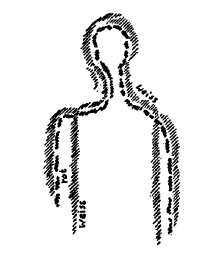
[ 9 ] All of this has not only theoretical significance; it has a very practical, real significance. For we must not take lightly a truth such as the one I presented here a few weeks ago. I told you: Today, people actually speak of humans being materialistic only in a theoretical, academic, or doctrinal sense. People say: They think materialistically. — But what does it actually mean when one says: People think materialistically? — The implication is: People are thinking incorrectly, because materialism is not right; people do, after all, have an immortal soul; the true nature of the human being is spiritual; therefore, materialism is wrong. So one must simply combat materialism and strive for what is right in theory. — But that is not what matters; rather, the situation is as follows. Certainly, the human being is, first and foremost, spiritual and soulful. Let us assume—for the sake of simplicity—that this is the spiritual and soulful nature of the human being (red). But from this spiritual-soul nature of the human being, a faithful imprint is formed in the physical body after conception or birth, so that a complete imprint of what is spiritual-soul exists in the physical body (white). Everything that is in the spiritual-soul realm is imprinted in the physical body. Now you can experience two things. You can experience that people become acquainted with thoughts drawn from the spiritual world, such as those found in our anthroposophical books—thoughts that materialists consider nonsense, that materialists regard as fantasy when one thinks such thoughts. You don’t have to be a spiritual researcher yourself, but if you think with the spiritual-soul realm, the physical-bodily realm is its faithful reflection. But if you are a natural scientist in the present day, if in ordinary life you think while denying the spiritual-soul realm, then you are truly thinking with the physical brain, and you become merely a reflection of materiality. If one denies the spiritual-soul aspect, then one truly becomes a materialist. So materialism is correct; it is not wrong! That is the essential point. One can go so far as to say that when one advocates materialism, one is not merely holding a false view, but has fallen so deeply into matter that one truly thinks materialistically. Therefore, materialistic theories are correct. Therefore, the most essential characteristic of our time is not that people think incorrectly when they are materialistic, but rather that the majority of people are becoming materialistic by denying the spiritual and soul aspects and thinking solely with the physical body—using the physical body to produce an imitation of soul life. In combating materialism, we are not dealing with a mere reversal of theory, but with a resolute decision of the will to break free from the material, so that we may not merely be non-materialists in theory, but so that we do not sink into matter, so that materialism may become false. It is true for our time, and it must become false! Our energy must be directed toward rendering materialism invalid. It is therefore not a matter of merely reversing theories, but rather of inner spiritual acts that humanity must perform in our time in order to free itself from materiality.
[ 10 ] But there is a significant, a great truth connected with this. Traditional religious creeds speak only of the afterlife, of life after death. We know from our literature, our lectures, and other accounts that it is, of course, legitimate to speak of this afterlife, of this life after death. Indeed, we describe it faithfully in all its details. But we do not speak in the same spirit as the traditional creeds; we speak in a different spirit. We speak in the spirit of knowledge, not merely in the spirit of blind faith. Yet the traditional creeds appeal to egoism—to a sophisticated egoism of the soul—and they reject with the utmost severity the idea of a pre-birth life. Just look at how heretical, how blasphemous, the assumption of a life before conception is regarded by the traditional creeds. Of course, the concept of pre-existence is necessarily linked to the understanding of repeated earthly lives; but by opposing pre-existence, repeated earthly lives are simultaneously opposed. By focusing in theological and religious discourse, as well as in sermons, solely on the post-mortem life—that is, life after death—the human soul is influenced in a certain way: feelings and sensations take root within the human soul.
[ 11 ] The human soul is of a certain nature. It is not correct to say that a human soul through which thoughts—for example, those in my Outline of Esoteric Science—have passed looks exactly the same as a human soul whose egoistic instincts are discussed solely in traditional religious terms with regard to the life after death. I have often drawn your attention to this: Real logic—the life of spiritual impulses—is different from mere logical thought. — I have often cited the example of Avenarius, who taught here in Switzerland at the University of Zurich. He was a thoroughly honest, respectable bourgeois, a man of the middle class; he expounded his materialist philosophy, and no one could say anything other than that he was a respectable man who fit right into the ordinary, middle-class, philistine customs. If, as early as the beginning of the 20th century, you had asked those people in Russia who later became Bolsheviks what their official philosophy was, you would have received the answer: It is that of Avenarius; it is the official philosophy of Bolshevism.
[ 12 ] Of course, if someone is a clever philosopher, a good logician, and he examines Avenarius’s philosophy and draws conclusions from it, then Bolshevism certainly does not result; something entirely different results. But life follows a different logic than that of abstract thought. In life, once the third generation has come of age, Bolshevism emerges from Avenarius’s philosophy. That is the logic of life. One enters into this logic by assimilating insights from the spiritual sciences. One remains stuck at the level of mere abstract, intellectual logic if one merely accepts what is offered by today’s scientific or religious worldview.
[ 13 ] Such a difference between the two logics also applies to the effect of traditional religious creeds and to the effect of spiritual science, as understood here in the anthroposophical sense. For people who sometimes spice up their vile attacks on anthroposophy with a few phrases—which our anthroposophists then usually fall for!—sometimes say: “We theologians fight for the supersensible just as much as the anthroposophists do, and therefore we are, in a certain sense, comrades-in-arms.” — This is sometimes tacked on as a platitude—after the worst insults have been hurled—by those who are still regarded as the more good-natured members of our circles. There is, after all, a tendency to avoid looking seriously at what is actually going on. Nevertheless, the logic of the facts is quite different. If you derive the logic of the facts from what is said about life after death in pulpit sermons—which appeal to the subtle instincts of the soul and to subtle egoism—then it might appear as though even there a life beyond the sensual realm is being sought, a life through which the soul is to enter the supersensible world after passing through death. But this is not the case; rather, it is precisely because religious creeds have, one-sidedly and theoretically, cultivated the mere post-mortem life for centuries—indeed, millennia—that the denial of the supersensible world has been logically fostered in reality; it is precisely through this that materialism has in fact been brought about. For while the mind is taught by faith to believe in a life after death, the subconscious strives to bring that life to an end with earthly mortality. And while the churches have merely chosen, for the sake of convenience, to speak to people’s instincts regarding immortality, European culture—and its American offshoot—has fostered a form of materialism that, deep down, actually strives to bring life to an end with earthly death. Those materialists who today strive not only theoretically but also socially—by seeking institutions, social institutions, that are in fact calculated solely for life up to the point of death—these pure materialists draw, all the way to Bolshevism, the faithful logical consequences of what religious creeds have instilled in people within Western culture. For merely speaking of immortality after death means fostering in the subconscious the longing to die spiritually as well as physically. That is the truth I wish to speak to you about today. This longing to know nothing of a supernatural life has been nurtured precisely by the one-sided talk of the eternal after death.
[ 14 ] If one does not grasp this truth in all its profound depth, one simply fails to see the connections between the present state of European and American civilization and the past. For advocating a mere afterlife is to instill a subconscious longing to conclude one’s life with physical death. And it must be said that there are already a great many people in the so-called civilized world who, in their subconscious, actually harbor a very intense longing to have nothing to do with the ideology of an afterlife and to bring life to a close with physical death. All those people from whose hearts materialistic views spring actually harbor, in their subconscious, the most intense longing to perish with physical death. Even if, in their conscious mind, they succumb to the illusion—because their egoism cannot bear anything else—of wanting to live on after death, their subconscious mind strives to perish with physical death.
[ 15 ] The reality is, in truth, even more serious. For if a person cultivates this subconscious longing to perish with physical death with sufficient intensity over a sufficiently long period of time, then he does indeed perish with physical death. Then what exists as the spiritual-soul aspect—and which created its own image—ceases to have any significance; it then reunites with the spiritual worlds and loses its sense of self. The image of the “I” is transformed in an Ahrimanic way, and the Ahrimanic forces get what they want: they gain control of earthly life. This means that a large part of today’s civilized world strives not to continue the civilization of the Earth, but to bring about the death of human beings and to hand over earthly life to beings entirely different from human beings.
[ 16 ] There is no point in failing to point out these things today. Of course, it is uncomfortable to accept these things, and it is much more comfortable simply to say to oneself: Materialism is simply wrong; well, one gradually converts to a better worldview. — No, that is not the point. What are thoughts within a person become realities, and materialistic thoughts gradually become materialistic realities. In our spiritual science, however, we are not dealing with theories, but with things that are realities within the human being; and as long as one does not fully grasp that these are things that are realities within the human being, one will neither comprehend the depth of spiritual science as understood in the anthroposophical sense nor grasp the full gravity of the cultural necessities that must be recognized in our time. So you see, our time faces the danger of destroying the culture of the Earth—not merely of fostering false views, but of producing in human beings reflections of these false views and leading people away from their eternal being.
[ 17 ] I know how strong people’s longing is, time and again, not to face such truths; for when one makes such things clear to them, people keep coming back and saying: “But isn’t there still a possibility that even those who have absolutely no desire to do so might attain salvation?” — Certain representatives of religious denominations have it easier in this regard. They teach those who really only want a “superficial religion” that they cannot participate in the spiritual world through their own inner actions, but that they need only passively surrender to faith in Christ, and then Christ will save them. That is precisely the great difficulty one faces when one wants to seriously advocate spiritual science today: one must not speak to what is so convenient for people. For many would like to be good anthroposophists; but his aunt doesn’t approve, and he doesn’t want his aunt to lose her individuality—and so, at the very least, the intensity of his anthroposophical conviction is very, very greatly compromised. — Many of you will know how strongly I point to these realities, which prevent anthroposophical spiritual science from being taken with the seriousness that it must be taken with. As I have already said here: Materialism is not harmful merely because, in theory, it cannot lead people to spiritual knowledge, but first of all for the reason I have cited today—that a person actually becomes, little by little, purely material if he allows materialistic ideas to influence him; and second, throughout the entire cultural process, because materialism is, by its very nature, incapable of exploring the mysteries of matter. We have held a course here for physicians and medical students. It consisted, first of all, of applying anthroposophical science in a very concrete way to demonstrate how one can understand the healthy and the sick human being. At least as a starting point, it was shown that one can recognize the nature of the brain, the nature of the teeth, the nature of the bones, the spleen, and the liver from a spiritual perspective. Materialistic science, of course, cannot do this. Materialistic science is precisely incapable of recognizing the nature of matter, of material existence. You can truly see this in a symptom.
[ 18 ] Take a look at modern psychiatry. Modern psychiatry is really nothing more than a description of abnormal mental life as it manifests itself as mental activity. Now, every so-called mental illness has its counterpart in the physical realm. If someone has this or that confused idea, then the spleen is not functioning properly or the lungs are not functioning properly; but the connection between the spiritual-psychic and the physical—which is in reality also spiritual-psychic—can only be recognized through spiritual science, not through materialistic science. This materialistic science is precisely doomed to be unable to recognize the essence of matter, and therefore, for example in medicine, to be unable to help some people, because in such cases one must provide material assistance. One must even provide material help to the mentally ill. When what lies in the depths of anthroposophically oriented spiritual science is truly recognized, this will bring about the infusion of spiritual scientific insights into material existence and, thereby, into social life as well. It was therefore only natural that the concept of the threefold social order should emerge from this spiritual science; for all other contemporary science is simply far too superficial, is far too much mere intellectual speculation, fails to grasp realities, and therefore cannot influence social life. I have often said this, particularly in connection with social considerations: People today speak of social ideals; they speak of how entire countries should be socially organized; nothing is discussed more today than socialism. Yet no era has been so antisocial; in no other era have people been so antisocial in their instincts as they are today. People today pass each other by without knowing anything about one another. No one, so to speak, looks into the other. Why is that?
[ 19 ] One can either perceive, as is the case in anthroposophically oriented spiritual science, a supersensible world above our own. You know, we are not speaking—as those convoluted pantheists do—of a “spirituality” in general. We speak in exactly the same way that we speak here on Earth of an animal, a plant, or a mineral; as we rise from the human realm to a realm above the human, to a realm of angels, a realm of archangels—that is, to a realm of the Angeloi, the Archangeloi, and so on. We speak of very concrete spiritual beings; that is to say, we rise to the knowledge, to the insight into the essential nature of the spirit. One can either do this or one can refrain from doing so. But if one refrains, as has been done for centuries in Western culture, what follows from this in terms of real logic—not the logic of thought? It follows that one no longer has any sense of, or feeling for, the spiritual-soul aspect; for in its true form, the spiritual-soul aspect can only be conceived by us in the supersensible realm. One loses the sense of the spiritual-soul aspect. But when one person encounters another, if one wishes to know the whole person—including the spiritual-psychic aspect within that person—one must approach that spiritual-psychic aspect! Yet one cannot find the spiritual-psychic aspect in the physical human being unless one has first acquired a sense for the spiritual-psychic through thinking in the supersensible. Whoever shies away from communion with the gods loses the ability to relate to the supersensible human being—to the people living here on Earth. For whoever has no sense of communion with the gods will see only the physical body in the people on Earth and not the spiritual-soul aspect; that is to say, they will not be able to develop a truly spiritual-soul life. We simply need communion with the gods in order to be able to perfect our communion with human beings in the right way, and we need this communion with the gods in such a way that our spiritual and soul life turns toward these gods—not merely our thoughts, for then we would become pantheistic or something of the sort—but our whole being must turn toward them.
[ 20 ] The Catholic Church has, in its own way, understood this latter truth well, for what does it do? It does not limit itself merely to teaching in the catechism what can be conveyed to people through abstract theological concepts, but it administers the Eucharist as a sacrament, and it faithfully teaches its faithful that the true Christ is present in the Most Holy Sacrament, that Christ actually takes the path of digestion when the Eucharist is received. There are perhaps too few among you who can grasp the full significance of what I am now saying, because very few may know in what form the Eucharist is presented to Catholics. There truly lives in the Eucharist something of primordial wisdom, of the surrender of the whole person to the Divine. This may also explain why a pastoral letter such as the one issued not so long ago by an archbishop came into being—a letter stating that the priest is more powerful than God, for the priest is capable of compelling God to be present in the Eucharist, in the Most Holy Sacrament. God must enter the Host if the priest so wills; therefore, the priest is more powerful than God. — So it is written in the pastoral letter of an archbishop issued a few years ago. This is a Catholic mindset. Protestants or Evangelicals find it completely out of the question. An Indian Brahmin would, of course, have found it acceptable from his own standpoint. Indeed, something lives on in Catholicism that belongs to the most ancient elements of primordial wisdom and merely needs to be properly understood—and, of course, must not be transformed from white magic into black magic, as happened in that pastoral letter. But in all of this—in what, I might say, takes shape in Catholicism as the aura of the sacrament of the altar—there lives the impulse: You should not turn toward the Deity only in your thinking, in your abstract thinking; you should, for example, also turn toward the Deity with the very longing that lives within your hunger. You do not go to God merely by thinking; you go to God by partaking of the Eucharist at the altar, and God, who lives in matter, takes the path through your body that all digestible food takes. You unite with your God in a wholly material way! — In the spread of this mindset lies the secret of an immense power. This secret of an immense power must not be overlooked, at least not now, when the Catholic Church intends to steer its triumphal march through the entire Western world and its American offshoot.
[ 21 ] In one of the first works I published, my “Grundlinien einer Erkenntnistheorie der Goetheschen Weltanschauung” (Outlines of an Epistemology of Goethe’s Worldview), you will find this insight described; and at a specific point in the introduction to the second volume of Goethe’s Scientific Writings, which appeared immediately afterward, you will find the word “communion” used to describe this insight—that is, that which is a spiritual process: Knowledge is the spiritual communion of humanity. — I do not know how many people understood the full cultural-historical significance of this word, of this sentence, in one of my very earliest writings. For in this sentence lay the shift from a materialistic conception of communion with God to a spiritual conception of communion with God: the transformation of bread into the soul substance of knowledge.
[ 22 ] If one were to recognize the full context of what has been attempted since this short work “Fundamentals of a Theory of Knowledge Based on Goethe’s Worldview,” and what has since been further developed within anthroposophically oriented spiritual science, one would see what the anthroposophical perspective considers necessary in order to truly comprehend what must flow into present-day social life for the healing of that life. But this seriousness—which recognizes such a connection—is often lacking in the slumbering souls of the present; and so little attention is paid to the paradoxes that life actually brings today, and to what these paradoxes of life necessitate.
[ 23 ] Yesterday I had to speak to you about the paradoxes of life as reflected in the characteristics of our present age. Now I ask you to familiarize yourselves with speeches delivered, for example, by distinguished bishops or archbishops on significant occasions in the near future. There you will find—as, for example, in the recent speeches by the Archbishop of Munich-Freising, which are truly very interesting to read—a description of how workers today, both the educated and the uneducated, are to be won back to Catholicism. There you will find a discourse stemming from a spiritual substance that is, admittedly, in a state of decadence and decline—but stemming nonetheless from a spiritual substance—and you must first take up a thread that initially seems abstract if you wish to grasp what is real here. That Archbishop of Munich-Freising says, for example: “Catholicism must win back the workers.” — And he then lists the various conditions under which Catholicism can currently win over the working class for the Catholic Church. Shouldn’t one counter such statements today by saying: “Yes, but you have truly had enough time to win over the working class ever since, in your view, Catholicism was founded through the pontificate of Peter in Rome!” If you find it necessary today to speak of “winning back” the working class and the educated, this proves that you have lost them through what you have been advocating for centuries. So if you wish to continue advocating the same thing, can you adopt any other view than to admit that you will once again achieve what you have achieved so far—namely, that you will lose those you wish to win over? — Isn’t it an implicit admission that one has acted incorrectly when one feels compelled today to speak in this way of “winning back” both the uneducated and the educated?
[ 24 ] But humanity today simply does not pay attention to such real contradictions. It is precisely necessary to pay attention to such real contradictions. Therefore, it is absolutely necessary that such things be deeply understood. Yes, human beings have a spiritual-soul aspect, but we live in a time when they can deny it. It is not true that the materialistic theory—that the brain thinks—is incorrect. No, when a person denies their spiritual-psychic nature, the brain begins to think like an automaton. And if a person does not want their brain to think—if they want their spiritual-psychic nature to think—then they must turn to a spiritual-psychic reality that tears this thinking away from matter. For this detachment from matter—from true materialism—is not merely a matter of adopting a different worldview, but is something that must be embraced by the whole human being, something that must be torn away from mere material existence by the whole human being. For a person does not merely become materialistic when they deny the spiritual; rather, a person becomes material when they deny the spiritual. He becomes merely an image of the spiritual; he becomes the material that can simply dissolve into the Ahrimanic cosmos and need only continue to work in the Ahrimanic world as a dependent, impersonal link, whereas he is called—if he understands the Mystery of Golgotha in the right way—to preserve his “I” and to carry on earthly civilization.