

Spiritual Scientific Insight into the
Fundamental Impulses of Social Organization
GA 199
6 August 1920, Dornach
Translated by Steiner Online Library
First Lecture
[ 1 ] I must begin with the very gratifying fact that, upon my arrival here, I found a large number of friends who have recently arrived to learn about what has been happening here and what is planned from here onward in our anthroposophical movement. I extend my warmest welcome to all the friends who have arrived and hope that they will take away all sorts of inspiration from their stay here. Among the friends we are able to see here again, there are a number whom we have not seen for years. And the very fact that we have not been able to see some friends for years—along with many other things—points to the difficulties of the times in which we live. I myself have just returned from a stay in Stuttgart, which was filled with a wide variety of tasks within our anthroposophical movement, including, among other things, the conclusion of the first school year at the “Waldorf School” founded in Stuttgart. This Waldorf School is, after all, one of those institutions that have been conceived in the most eminent sense out of our anthroposophical spiritual movement. And what the conclusion of the first school year has shown is, I believe, something that can be described as satisfying—even when one sets very high standards. I may say this here because one can indeed be objective about such matters, even when one is wholeheartedly committed to them, and even when one has, in a certain sense, organized the endeavor oneself.
[ 2 ] What is particularly satisfying with regard to this Waldorf school is that the teaching staff has fully understood, first of all, how to ground themselves completely in anthroposophy, just as was intended. This grounding in anthroposophy was to be such that—and given the circumstances of the time, this had to be the case—the Waldorf School was not meant to be a school based on a particular worldview, nor a school where anthroposophy was simply taught. That was not the intention. We therefore deliberately structured religious instruction so that children whose parents wanted them to attend Protestant classes could be taught by the Protestant pastor, Catholic children by the Catholic pastor, and only for those who did not wish to affiliate with any of the existing denominations was a kind of anthroposophical religious instruction provided separately from the rest of the curriculum. But apart from that, it was by no means the intention to establish a school based on a particular worldview; rather, the intention was to take the practical, pedagogical, and didactic impulses that arise from our spiritual-scientific perspective and our spiritual-scientific aspirations, and to ensure that these are truly applied in the education and instruction of young people. Thus, it was in the conduct of instruction—in the management of the entire school system, not in the content—that anthroposophy was to find expression in the distinctive character of pedagogy and didactics and in the various teaching methods. However, when the anthroposophist, acting out of his or her anthroposophical intent, has enriched the teaching, it is precisely in this enrichment of the teaching that it becomes evident how invigorating anthroposophy is when it truly becomes a reality. I have always had the opportunity to observe the progress made during the first school year at the Waldorf School; I would be there from time to time for a week or two at a time, was able to observe the lessons, and could also see how the individual classes were developing. For example, I noticed how our friend Dr. Stein had succeeded in enlivening history lessons by incorporating anthroposophical impulses into what is already history instruction for the older students. One could see how the anthropology lessons in the fifth grade were enriched by Dr. von Heydebrand, not by presenting the children with that dry, uninspiring anthropology as is usually the case in our schools, but by truly infusing these lessons with an anthroposophical spirit. And so I could cite many specific examples from which you would see how, without teaching anthroposophy in even the most remote abstract sense, it is precisely the methodology—the way anthroposophy is approached—that can be enriched, and how this practical application of anthroposophical intent demonstrates that anthroposophy need not remain a detached, abstract worldview, but that it can intervene directly in human activity—even if, unfortunately, we are permitted to intervene in this human activity only to such a limited extent, and always only in such restricted areas, and really only in areas such as the Waldorf school itself. And when we concluded the first school year, something occurred that, I would say, at first seemed to point to something purely external, but which in reality points to something very internal, as I will explain shortly: a complete innovation took place—the report cards.
[ 3 ] This grading system is truly the most deplorable aspect of our school system—this superficial fumbling on the part of teachers as they write the grades 1, 2, 3, 4, 5, and so on into the report cards. At its core, this is something that has a terribly stifling effect on the school system. Our report cards emerged from genuine educational psychology, from the absolute practical application of the study of the human soul. By the end of the first school year, our teachers had reached a point where they could give each child a report card that corresponded to the child’s character traits and individually indicated the prospects for further progress. No two report cards were alike. They contained no numerical grades; rather, based on the teacher’s individual understanding of the student, the student’s nature was characterized. And the teachers had already sought to delve so deeply into the child’s soul over the course of the first school year that they were able to provide each child with a personal message on the report card, appropriate to the individual character of that child.
[ 4 ] These certificates represent an innovation. But do not conclude from this that something like this can simply be introduced anywhere, or that it can simply be copied elsewhere; rather, it is in fact based on the entire spirit of the Waldorf school, on the fact that in the Waldorf school, educational psychology has been practiced in the most intensive way during the first school year. We carefully studied the origins of certain subtle phenomena affecting a class’s faster or slower progress. And already in the course of the first school year, we came across things that are surprising in a certain respect. For example, it turned out that the entire configuration of the class is quite specific when there are an equal number of boys and girls in the class. The configuration is entirely different when boys are in the majority and girls in the minority, and conversely, when girls are in the majority and boys in the minority. We have seen all these examples in our own classes. These intangible factors, which are otherwise completely overlooked, are in many respects the most essential elements.
[ 5 ] When one tries to articulate or define certain aspects of psychology, they are, in essence, no longer what they actually are. And that is precisely a great folly of our time—the tendency to try to express things too rigidly in set phrases. You cannot study things properly if you try to express them in rigid sequences of words. You just have to be aware that, by expressing things, you are actually only ever describing them approximately.
[ 6 ] However, we are always in a peculiar situation when we speak of the results of our anthroposophically oriented spiritual science movement. This Waldorf school, whose teaching staff has proven itself in the most eminent sense, was only able to prove itself because, from the very beginning, the most capable people—those best suited to education—were brought together. Unfortunately, today, whenever one wants to carry out anything in practice, one encounters—far more often than anyone realizes—that one major obstacle, which I can only describe as follows: the world today is lacking in people who are suited for any real life tasks, and the difficulty would be considerably greater if a second Waldorf school were to be founded. The question of finding suitable, truly capable individuals who could work in the spirit of anthroposophically oriented spiritual science would then become considerably more difficult, because, of course, all those who are truly serious candidates had to be brought together at that one [school]. Nevertheless, something has undoubtedly been achieved in a specific area. But I would like to say that what we see there is an island. On this island, over the course of the first school year, a spirit of teaching truly drawn from the foundations of anthroposophy took shape. But this island has shores; it is externally bounded, and beyond these shores lie the school’s finances and its economic circumstances, which are, of course, embedded in the declining economic and political life of the present. And here something is already beginning about which one must say: the prospects are not as they should be—and should be so because such an endeavor deserves our understanding. But do we actually approach what the Waldorf School has ultimately achieved out of the spirit with a certain degree of understanding? To begin with, our friend Molt founded the Waldorf School to provide education for the Waldorf children—the children of the Waldorf-Astoria factory. Yet even in the very first year, there were many children from outside the Waldorf-Astoria factory attending this school; there must have been around two hundred eighty of them. Many new students have already been enrolled; of course, no more from the Waldorf-Astoria factory than there were before—at most those born in the relevant year, and there aren’t many of them, so just the next generation. But if everything really goes well—that is, if, in addition to other matters, the financial situation can be sorted out—then, based on current enrollments, we will already have over four hundred children at the Waldorf School. This will require construction, the hiring of new teachers, and the establishment of parallel classes. All of this must happen, and in a certain sense it will be a test of whether people’s financial commitment will match the understanding they have already demonstrated by sending their children to us from outside the school. I must say that I found it rather charming when, in the hallway, I was introduced to the mother of a child attending the Waldorf School as “Mrs. So-and-so, the Minister.” So even those who are so closely connected to the current government, and other similar people, are sending their children to the Waldorf School.
[ 7 ] We should really take a closer look at these matters from a social perspective as well. It is perhaps precisely through phenomena such as the Waldorf School that we might come to realize what our time truly needs.
[ 8 ] What became so strikingly apparent in the Waldorf School was the emergence of a certain superficiality, which, as I have often explained here, is a characteristic of our time in particular. Of course, the Waldorf school administration has also had to deal with the fact that here and there people turned up who simply wanted to sit in on a class—that is, to get a glimpse of what goes on at the Waldorf school. But there isn’t much to see there, because it’s not the details that matter; rather, it’s the overall spirit that prevails in the Waldorf school—and that is simply the anthroposophical spirit. And instead of people who find it too tedious to engage with anthroposophical books going in to see what goes on at a Waldorf school, they would do better to immerse themselves in anthroposophy. For what gives the Waldorf school its spirit—its very foundation—can only be seen in the spiritual impulses that underlie anthroposophical spiritual life. This anthroposophical spiritual life is, as I have often explained to those of you who have been sitting here for some time, not merely something that addresses the individual when, out of the hardships of life and the distress of the soul, he looks up to the spiritual forces of the world; rather, this spiritual science is something that must speak today to the distress of our time, to the entire decline of our age. However, the understanding of what spiritual science has to say is hindered by the particular kind of understanding that the average person today brings to everything that presents itself to them in a spiritual context. It is often necessary that, when speaking from a spiritual-scientific perspective, one must essentially speak in a language quite different from the usual one. One might say: Through spiritual science, words take on a new meaning in a certain sense.
[ 9 ] To feel that, to sense that—that is absolutely necessary. And today I would like to show you a few things that may help you see how necessary it is not only to be willing to hear a slightly different worldview in old words, but also to learn to perceive those words differently through your feelings.
[ 10 ] Let’s take a specific case as an example. When people talk today about any worldview, they refer to it by an abstract name: materialism, idealism, realism, spiritualism, and so on, and they simply hold the view that one can say: one or the other is right or wrong. Let’s say there is a spiritualist today. A materialist comes to him and explains his way of thinking—for example, how he conceives of human thoughts and feelings as a product of the brain. Then the spiritualist will say: “You are wrong; I will refute you logically,” or he will say: “I will refute you based on the facts.” — In short, what is at stake when people today discuss questions of worldview is that they designate one view as correct and the other as incorrect; that is, the spiritualist, for example, wants to refute the materialist—that is, to prove to him that he is wrong and that it would be good for him to adopt the correct view, as the spiritualist supposes he holds.
[ 11 ] Spiritual science is not merely in such a position. Spiritual science does not merely seek to lead to a different kind of logical understanding than other worldviews; if it is to fulfill its task, spiritual science must become practical knowledge. Knowledge must become action within it—action within the entire cosmic context of the world. I would like to illustrate this to you with specific examples. When people today view the world naively, yet with a touch of materialistic sensibility—when they turn their eyes and ears outward, hear sounds, perceive colors, feel warmth, and so on—they are seeing the external sensory world. If they then become scientists—or even if they merely take in, in a popular sense, what science purports to be—they will form or simply absorb certain ideas and concepts that have arisen through the combination of these elements of color, sound, warmth, and so on, as perceived in the external world. There are, of course, people who say that everything one sees at first glance is merely an external appearance. But people do not take this view—that everything is an external appearance—deeply enough. They see, for example, the rainbow. However, when they look at the rainbow, they are already convinced—based on what they have learned in school—that the rainbow is merely an appearance; that, for example, one cannot go to where the rainbow is and, say, first set one foot on the bridge and then march right across the rainbow as if it were a solid object. People are convinced that they cannot do this, that the rainbow is merely an illusion, a phenomenon that rises and then fades away. But they are convinced that they are dealing with illusions out there in the external world only as long as they do not come into contact with this external world through their sense of touch or their sense of feeling. As soon as they can grasp something in the external world, then—according to their perception—it is no longer an illusion to the same degree, even though modern philosophy has often claimed otherwise; but to people, based on their perception, it is not an illusion. At the very least, on an emotional level, the impressions of the sense of touch, for example, are regarded as something that attests to a different external reality than, for example, the phenomenal realities of the rainbow.
[ 12 ] And yet, everything we perceive with our external senses consists solely of the world of appearances—perhaps modified in comparison to the appearances of a rainbow, but still only the world of appearances: No matter how far we cast our gaze, no matter how far our hearing extends, no matter what we can hear, no matter what else we can perceive—in the external world, we are dealing everywhere with appearances, with phenomena. I have already attempted to illustrate this in my introduction to the third volume of Goethe’s scientific writings. In the external world, we are dealing with a web of appearances. And anyone who attempts—whether through experimentation or through any kind of intellectual speculation—to find something out there in the realm of appearances that corresponds to the concept of matter, as we imagine it, is on the wrong track. There is nothing out there that could be identified as matter. What we are dealing with is the world of appearances.
[ 13 ] This is something that, if I may use the expression, emerges from the very spirit of spiritual science. We are dealing here with the world of phenomena. Now, someone who today stands on the ground of a common worldview will come and say: So it is incorrect to seek matter out there in the realm of phenomena. — Anthroposophy cannot share this line of reasoning. It must put it differently. It must say: Through the entire structure of their mind, human beings may come to want to seek matter in the fabric, in the surging of phenomena and appearances—to want to seek out there something consisting of atoms, molecules, and so on, which are points of stillness within the phenomenon. Some imagine them as tiny grains of shot, albeit very small ones; others imagine them as points of force and take great pride in conceiving of them that way; still others imagine them as mathematical fictions and take even greater pride in that. It does not matter whether one conceives of them as tiny grains of shot, as points of force, or as mathematical fictions; what matters is whether one conceives of the external world in atomistic terms. That is what matters. But for the spiritual scientist, it is not merely incorrect to think atomistically. Such a concept of right and wrong is logical, is abstract, and spiritual science deals with realities. I ask you to take this very seriously when I say: Spiritual science deals with realities. — Therefore, certain concepts—which are mere logical categories for the ordinary worldview that has become so abstract today—must be replaced by reality. That is why, in spiritual science, we do not merely say that someone who seeks atoms and molecules in the external world is thinking incorrectly; rather, we must regard such thinking as unhealthy, as diseased thinking. We must replace the purely logical concept of “incorrect” with the real concept of “sick” or “unhealthy.” And we must point to a very specific mental illness—no matter how many people it may have afflicted—that manifests itself in atomistic thinking. And this mental state is that of mental deficiency. For us, thinking atomistically is not merely logically incorrect; it is the expression of a feeble-minded spirit to think merely atomistically—that is, to seek in the external world something other than what phenomena are, which is ultimately equivalent to the appearance of a rainbow. In other worldviews, it is relatively easy to set things straight: one refutes. One believes one has accomplished something once one has refuted a claim. From a spiritual scientific perspective, however, refutation alone is not enough; what matters is pointing out the healthy and unhealthy aspects of the soul life—the real processes that unfold within the whole human being, in the physical, soul, and spiritual realms. And atomistic thinking is unhealthy thinking; it is not merely incorrect thinking. It is a real, unhealthy process that takes place within the human organism when we think atomistically. This is the one thing we must become clear about with regard to the phenomena of the external world, with regard to the nature of appearances in the external world.
[ 14 ] We must also gain clarity regarding our inner selves. Many people seek the spiritual within themselves. To begin with, the spiritual cannot be found within the human being. A truly objective examination of any form of abstract mysticism demonstrates this. What is sometimes called mysticism—or perhaps not just sometimes, but what is very frequently called mysticism in our time—consists of brooding over one’s inner self, of seeking, as they say, self-knowledge through this brooding over one’s inner self. What does one find when one engages in such one-sided mysticism? Certainly, one finds interesting things. But when one looks into the human being and those experiences arise within—experiences that are so pleasing to the soul and are described as mystical content—what are they, actually? Well, these are precisely the things that point us toward material existence. We do not find matter in the external world, where the phenomena of the senses are; we find matter within ourselves. We have now reached the point where we can characterize these things correctly. Within the human being, metabolism is seething and boiling on a vast scale; and the flame that metabolism creates, when it flares up into consciousness—that is the one-sided mysticism that many believe to be the spirit one can find within. It is not the spirit; it is the flames of metabolism within the human being. We do not find matter in the external world; we find it within ourselves, and it is precisely through one-sided mysticism that we find it. Therefore, many are mistaken—those who do not wish to be materialistic but who accompany this desire not to be materialistic with words they express something like this: “Out there is the lower matter; I rise above it and turn to my own inner self; there I find the spirit.” — At first, nothing of the spirit is either outside or inside. Outside are the phenomena, the interwoven phenomena, and within us is matter; there is the boiling and bubbling of matter. And this boiling and bubbling of matter causes the flames to flare up, which burst into consciousness and form mysticism. Mysticism is the bodily matter of metabolism perceived inwardly. And this mysticism, in turn, is not something that can be logically refuted, but rather something that must be traced back to real processes when a person devotes themselves to metabolism in a one-sided manner. Just as the belief that one can find something of matter in the external world points to mental deficiency—that is, to a real illness of the human being’s spiritual, soul, and physical nature—so does one-sided immersion in mysticism point to physical unhealthiness. It points to something that does indeed sound a bit offensive when expressed so simply. But a term must be used here that is, so to speak, spoken from beyond the Keeper of the Threshold, and that term is “childishness.” Just as one becomes mentally deficient through atomistic thinking about the external world, so one becomes childish when one devotes oneself to a form of mysticism that seeks to sense the spirit in the seething of the inner metabolism.
[ 15 ] Childishness, of course, also has a positive side, for when we look at a child, we see that there is a great deal of spirit within the child, and genius often consists in a person retaining that childlike spirit well into old age. And when we look at the world from beyond the threshold, we see how it is the spirit that shapes the brain in the child, for example—that spirit which already emerges from the spiritual world when we enter the physical world through conception or birth. This spirit, which emerges from the spiritual world, is most active in the child but is later lost. And so “childish” is not a term of abuse, but simply means that it is the spirit itself that shapes the brain out of an almost chaotic mass—the spirit that has descended from the spiritual world into the physical world through the act of the spirit. But if this spirit—which is actually meant to shape the child’s brain—does not later act in such a way that it pours itself into logic, into experience, and into lived experiences, but instead acts one-sidedly and excludes individual material experiences—if it continues to act as it did during the first seven years of life—then instead of becoming a genius, one becomes childish. And childishness is a characteristic of a large number of often very haughty mystics. They wish to weave and live within the spirit that should actually be active in the childlike organism, but which has remained with them; and they now marvel at it in their consciousness, taking extraordinary pride in it, and while they perceive the mere matter of metabolism, they believe they are perceiving a higher spirituality in their one-sided, abstract mysticism.
[ 16 ] Once again, if we truly stand on the ground of an anthroposophically oriented spiritual science, we do not merely wish to refute the one-sided mystic; rather, we must show that it stems from a diseased constitution of the spirit, the soul, and the body when a person, brooding one-sidedly within themselves, seeks to find the spirit.
[ 17 ] I have cited these two examples here—which you are, of course, well acquainted with from anthroposophical literature—from a certain perspective in order to show you how serious things become when one plunges from today’s ordinary spiritual life into the anthroposophical one. Here one is not dealing with something as trivial as “wrong” or “right,” but rather with “healthy” or “unhealthy” in organic functions. Thus, on a higher level, one must describe that which moves in a certain direction as healthy, and that which moves in another direction as unhealthy. And I would like you to understand from these hints how spiritual science is knowledge of the act itself, how it cannot remain confined to the nature of ordinary knowledge, but rather how it becomes that which is reality. The process of cognition, insofar as it expresses itself in spiritual science, is something that actually takes place within the human organism.
[ 18 ] In a similar way, we must characterize that which lives in the realm of the will. When we speak of the realm of the will in our age—an age marked by that magnificent decline we have often discussed—and when we speak of what takes shape as human impulses of the will and of the character of these impulses, we say: A person is good or evil. — And here again, good and evil are moral categories that are, of course, just as necessary as the logical categories. But for what flows forth as impulses from spiritual science, it is not merely a matter of what one means when one describes one human action as good and another as evil. It is a matter of the fact that—even in a karmic context—when one describes an action as good, one intends to say: The human being must in some way balance the good against the evil. One is referring to something that pertains to the moral judgment of human beings. The moment we enter the realms of spiritual science, however, the matter is more complex; it concerns the fact that there is a certain way of thinking, feeling, and willing for human beings that leads to ascent, to fruitful development, and to progress in evolution. On the one hand, we have the abstract good—the morally abstract, extraordinarily valuable, yet precisely morally abstract good; but when it comes to the impulses of spiritual science, a person must not only do good, or will a person not only do the good that makes them appear to be a morally good person, but they can also do, think, or feel whatever advances the world in its development—even if only in the outer sensory world—or they can do something that is not merely evil and subject to moral judgment, but that has a destructive effect on the forces of the world. This was already hinted at in *The Gate of Initiation*, where Strader and Capesius are speaking and it is pointed out: What is done here in the sensory world—what is subject here to moral judgment of good and evil—are phenomena behind the scenes of existence that are either forward-moving and constructive or downward-moving and destructive. Just try to feel this entire scene—where there is lightning and thunder, where events unfold in the world of the soul in a very real way while Capesius and Strader discuss this or that—try to sense this scene, and you will see how what we experience here on the physical plane as the moral world rises to the level of reality.
[ 19 ] All of this is meant to show you how one begins to take the world seriously the moment one moves beyond the mere judgments we are accustomed to today—based on logical or purely external, human categories—and ascends to the realities that confront us when we view the world through the lens of spiritual science. Things are getting serious, but they must be spoken of today, for the world today demands a new spiritual life. Today, events are unfolding in the world that everyone sees, but which no one really wants to understand in their true significance, because people cannot take the step from external abstractness to reality. I would like to point out some other examples to you.
[ 20 ] You are experiencing today that you are growing up in a world where, among many other things—in the social sphere, for example—there are political parties: liberal, conservative, and all sorts of other parties. People are oblivious to what these parties actually are. When they receive their ballots, they declare their allegiance to one party or another without giving much thought to what it actually is that exists as “party opinion,” permeating all of public life. One simply cannot take these things seriously. There is a whole crowd of people who parrot all sorts of “Maya” concepts from the outer world in the most eloquent way; but as soon as they want to take a step into that outer world, they no longer stick to what they are parroting in the abstract. For otherwise they would ask, for example: “Maya? So are the parties also Maya? What, then, is the reality to which this Maya points?”
[ 21 ] If we examine this matter more closely from a spiritual-scientific perspective—and we will discuss this in greater detail tomorrow—we find that political parties exist in the outer physical world because they have programs and principles; that is, because they pursue abstract ideas. But everything that exists externally in the physical world is always the image, the reflection of what is a reality of a more intense nature in the spiritual world. There we always have the physical world (see drawing, horizontal line). But everything here in the physical world points to the spiritual. And up there in the spiritual world lie the true realities corresponding to these physical things (see diagram, red). Down here, for example, are the political parties (white); what are they a reflection of? On Earth, these parties fight one another; there they seek to unite a multitude of people under an abstract program. What, then, are these parties a reflection of? What is it up there in the spiritual world if here in Maya there are political parties? In the spiritual world there are no abstractions, and political parties are subject to abstractions. Up there, there are only beings. Up there, one cannot commit to a party platform; rather, one can be a follower of this or that being, of this or that hierarchy. One cannot simply adhere to a platform with one’s intellect—that does not exist there; one must follow another being with one’s whole being. What is abstract here is essential up there; that is to say, the abstract here is merely a shadow of the essential up there. And if you take the two main categories of political parties—conservative and liberal—it is true that the conservative party has a platform and the liberal party has a platform; but when one looks up to see what these are reflections of, it becomes clear: The Ahrimanic being is reflected here (see drawing, lower part) in the conservative, while the Luciferic being is reflected here in the liberal. Here, one pursues a conservative or a liberal program; up above, one is a follower of an Ahrimanic being of some hierarchy or a Luciferic being of some hierarchy.
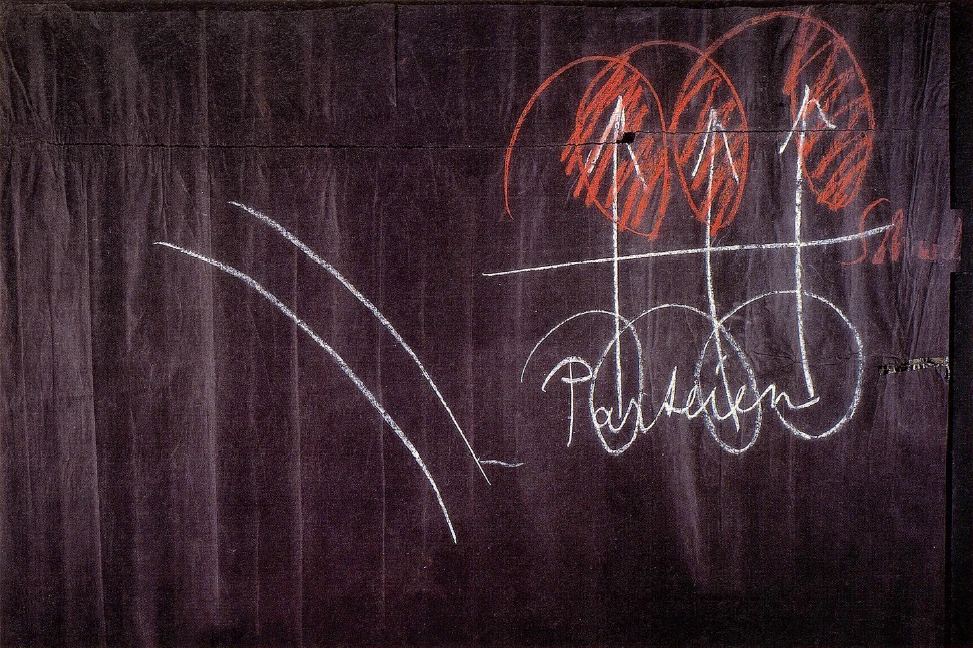
[ 22 ] However, it may happen that at the very moment one crosses the threshold (the word “threshold” is written on the board), one must be truly clear that one is not deceived by words and does not give in to illusions. It is very easy to believe that one belongs to some kind of good being. But just because one gives a being a good name does not make it a good one. For example, someone might say: “I profess my faith in Jesus, the Christ.” — In the spiritual world, one cannot profess allegiance to a program; but judging by the very way in which the ideas and concepts of this Jesus, the Christ, live in one’s soul, it is only the name of Jesus, the Christ—in reality, one is then attached to Lucifer or Ahriman and merely gives the name Jesus or Christ to Lucifer or Ahriman.
[ 23 ] But I ask you: How many people today are aware that party opinions are reflections of essential realities in the spiritual world? Some know this, and they then base their actions on this knowledge. I can point you to those who know such things. Take the Jesuits, for example; they know this. Do not believe that when the Jesuits, for instance, write against anthroposophy in their journals, they think their arguments strike at something specific that cannot be refuted. But refutations are not the point here. And the Jesuits know very well what one can ultimately object to regarding such refutations, for the Jesuits are not concerned with debating for or against with arguments; rather, they are concerned with being followers of a certain being—one I do not wish to name today—whom they call their leader, Jesus, to whom they belong. Whatever this being may be, they call it Jesus. I do not wish to go into the details of the matter; but they describe themselves as soldiers, him as the leader, and they do not fight to refute—they fight to recruit followers for the companies, for the army of Jesus—that is, of the being they call Jesus. And they know full well that, as soon as one looks beyond the threshold, it is not a matter of abstract categories, nor of logical assertions or refutations, but rather of which being’s army one follows, whereas down here on earth it is all a matter of rhetoric. But this is precisely what people today find so difficult to grasp: that if we want to emerge from the decline of our age, we can no longer deal with mere abstractions, not merely with what one can conceive of, but must deal with realities. We begin to ascend to realities when we no longer speak merely of right or wrong, but of healthy or sick. We begin to ascend to realities when we speak not of party platforms or ideological programs, but of the following of certain real entities that immediately meet us when we point to the things that lie beyond the threshold. The task today is to truly take that serious step from abstraction to reality, from merely logical knowledge to knowledge as action. And only that can lead us out of all the confusion in which the world finds itself today.
[ 24 ] The state of the world—we will be discussing this very topic in the coming days, tomorrow and the day after tomorrow—can be soundly assessed today only by those who view it through the lens of what spiritual science is able to provide. Otherwise, one will not be able to see the significant contrasts that exist today between the West and the East in their proper light. But what appears outwardly as observable realities—what is it other than the inherently absurd expression of the thoughts that live in people’s minds today? How do these thoughts present themselves to us? — In conclusion, I would like to point out an obvious example once again. I have already pointed out on various occasions the mendacious campaign currently being waged by Catholic and clerical circles against spiritual science—particularly here in Switzerland—with the aim of destroying it. And you—those of you who were here—have already seen many examples of what is being brought to bear, especially by Catholic-Jesuit circles, to destroy this spiritual science. Consider this: the disciples of Catholic Jesuitism are rising up—albeit with unsavory weapons—and I need not describe them to you; those who have not yet informed themselves can easily do so. But you see, Switzerland is also part of the world, as is Central Europe, where the same thing is happening—all of this is actually part of the world, isn’t it? And America is also part of the world. I was recently given a magazine published in America in which anthroposophically oriented spiritual science is portrayed in a positive light—at the very same time that it was being portrayed here by Jesuit circles in the worst possible light as something directed against the Catholic Church and against Christianity. As you know, Father Kully said there are three evil things in the world: the first is Judaism, the second is Freemasonry, but the worst of all evils—worse than any form of Bolshevism—is what is taught here in Dornach. — That comes from the Catholic side. This is how the Catholic side characterizes anthroposophy. And what about America? I’d like to read you a short passage written at the same time as what the Catholic newspapers here have published: “Just as the Roman Catholic hierarchy has always insisted that the Roman Church is the only one endowed with authority”—the Protestant sects are out of the question for them; in the opinion of the Roman Church, they stand outside the gates; they are regarded merely as a crowd of heretics, “so it goes without saying that the Church to which Steiner refers in his writings can be none other than the Roman Catholic Church. This premise is confirmed, and any doubt on the matter ceases when one examines Steiner’s other occult books. They all point to the same thing: namely, that his writings are purely misleading; the sheep’s clothing of superficial occultism conceals the wolf of Jesuitism.”
[ 25 ] So you see, in America, anthroposophy is regarded as Jesuitism, while in Europe, Jesuitism is fiercely opposed to anthroposophy as the greatest enemy of the Catholic Church. That is how people think in the world today. But that’s more or less how people think even when they stand side by side in Europe; they just don’t realize it. Then there are a few beautiful sentences that conclude this article: “Steiner claims to be an initiate. That may be so. But whether he belongs to the White Lodge or to the Brothers of the Shadows can be surmised when one learns that he sided with the ‘Blood and Iron’ men... and that a number of his students here (in America) were interned as German spies.”
[ 26 ] Well, you see, sometimes the message comes from the Roman Catholic camp, and sometimes from the American camp! But all of this can give you an idea of what is going on in the minds of our contemporaries. But what was conceived in people’s minds has developed into what has led to the decline of the present, and the rise must truly be sought somewhere entirely different from where many people are looking for it today. We’ll continue talking about this tomorrow.