

Spiritual Scientific Insight into the
Fundamental Impulses of Social Organization
GA 199
7 August 1920, Dornach
Translated by Steiner Online Library
Second Lecture
[ 1 ] Yesterday, in a specific context, I pointed out what party opinions actually are here on the physical plane. And since our present life is thoroughly dominated by party opinions of every shade, it is certainly one of the necessary insights to examine the nature of party opinions to some extent. I also pointed out yesterday how people today, in this age of abstraction, are inclined, at least in general, to subscribe to the following statement: Everything that can be perceived by the senses or grasped by ordinary reason is mere appearance; all of that is Maya. — But when it comes to comprehensively applying such a general, abstract truth—to which one purports to subscribe—in life, then, so to speak, the thread of life through which, for most people today, the soul is connected to the reality of life snaps. Party opinions on the physical plane must likewise be understood as reflections of something of a supersensible nature, something that has its reality in the spiritual worlds and has only its image here in the physical world—just as one must acknowledge this, for example, in the case of natural phenomena, or even the most complex natural phenomena, as they appear to the physical human being. As I said yesterday: Party opinions arise when a number of people come together under some more or less clearly defined, abstract program. They set forth a number of demands that are to be fulfilled by one means or another; they then take one course of action or another—most often they merely talk about one thing or another—in order to help bring such programs, such party ideas, to fruition. So groups of people, united, as it were, under the banner of an abstract idea—one that they hope, however, can be realized—that is what constitutes a party.
[ 2 ] For those who wish to examine matters more deeply—especially from a humanities perspective—the programmatic aspect is not the primary consideration, since they must first investigate the nature of this programmatic aspect within its global context. For them, the initial consideration—as an external phenomenon—is the formation of human groups.
[ 3 ] Now, yesterday I said: When one ascends from the physical plane to the higher worlds, to the worlds beyond the threshold, there are no abstractions, there are no abstract demands like those set forth in party platforms; rather, as soon as one crosses the threshold—as soon as one passes the Guardian of the Threshold and does not stop there, as so many do—one finds that beyond the threshold there are only beings. There, one cannot follow a program at all; there, one can only follow this or that being; there, one cannot group oneself according to an abstract idea, but must instead group oneself around a being. With regard to such matters, humanity today has an urgent need for knowledge. But it is precisely with regard to such things that people today resist such knowledge to a very considerable degree. For people today have come to cherish the idea of uniting under abstract programs and longing for a certain realization of such abstract programs. That abstract programs exist only in the physical world, that whatever can be grasped as an abstract idea can be only an object of the physical world—people do not want to acknowledge this; they do not want to see it, for it is inconvenient for them. Thus people unite—if I indicate the threshold here with this line (see drawing on page 30), here the party groups (blue circles), here their programs (X)—thus these people unite into groups under party programs. But in the spiritual world, these party programs correspond to beings (orange), and thus those who chain themselves to a party program attach themselves to certain beings of the supersensible world. Corresponding to what is merely an image in the physical world, we have groupings around beings (red circles) in the supersensible world.
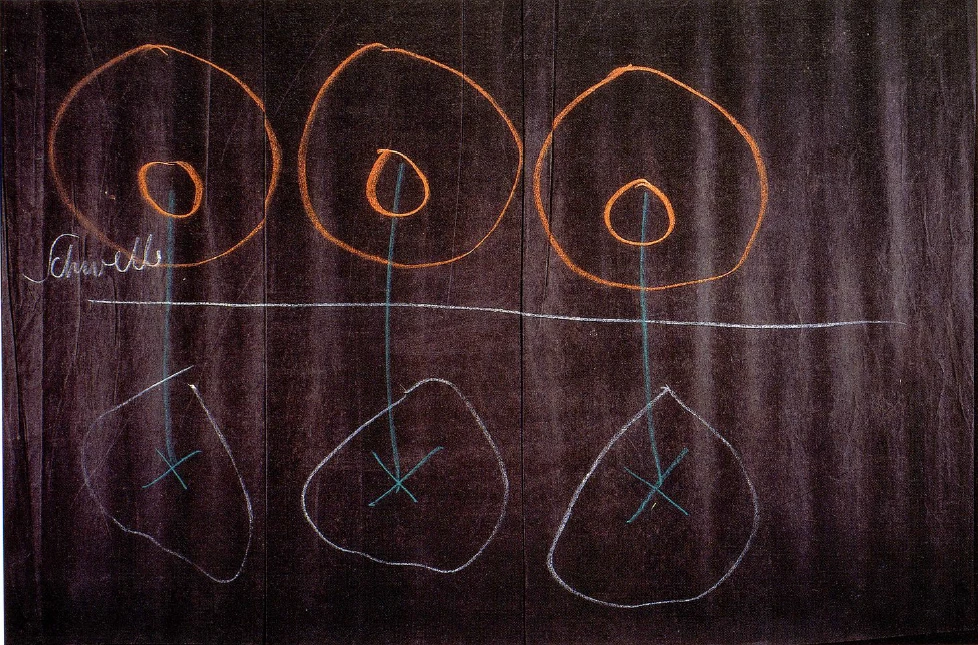
[ 4 ] It is certainly worth noting that this knowledge is absolutely necessary for a prosperous development into the future, because consciousness must increasingly take the place of instinct if humanity is to advance in its development. It is still very much a remnant of old, instinctive banding together when people today unite under party platforms and believe that what they are doing with these groups is exhausted by their gathering together, their commitment to the corresponding platform, and their actions—or, more often than not, their words—which are done or spoken to bring this platform to fruition. People claim to belong to some party—a socialist or liberal party, a women’s rights party, a spiritualist party, and so on; if I were to list even a small fraction of all the parties existing today, it would drag out this evening terribly. By believing that what they do and say within a party exhausts the essence of what they are doing here on the physical plane, people unconsciously follow an entity in the supersensible world that they do not wish to acknowledge. For the fact that people do not know something does not mean that it is not real. If anyone is a liberal and adheres to a liberal program, if anyone is a women’s rights advocate and adheres to a women’s rights program, this does not mean—simply because they do not know that they are following certain beings of the supersensible world—that they are not in fact following them. They are in fact following them; they form the following. But in doing so, they are directly opposing the very spirit of progress in our age. For this spirit demands the transformation of everything instinctively unconscious and subconscious into conscious will, into conscious action, speech, and thought.
[ 5 ] We are, of course, familiar with older groupings of people, older groupings based on racial connections, and then those groupings of people who still lead an ephemeral, shadowy existence today—an existence that is no less vociferous or delusional for that: the groupings into nations; we know this, of course. And if you recall the lecture series I gave in Kristiania in 1910 on the nature of national souls, you will find that if one wishes to grasp these connections between races and nations, one cannot remain on the physical plane; one must also ascend into the superphysical worlds. In this lecture series, we have indeed explained how such human groupings are held together and guided by beings whom we must count among the hierarchy of the Archangels. We have seen there how, even within such national groupings, supersensible beings stand among human beings.
[ 6 ] Let us now visualize with the eye of the soul the difference between the relationship that groups of people—as races and as nations—have to their supersensible beings, and the relationship in which political parties stand to these supersensible beings, we see that the former instinctively carry out and realize the impulses given to them by these supersensible beings. And so it is justified that instinctivity prevails in the following of the impulses of these supersensible beings. Humanity had to work its way out of this instinctive following of the supersensible beings. — It goes without saying that humanity could not, from the very beginning, consciously follow, for example, national spirits or archangels, but that instinctive forces had to play a role in this following. In a sense, human beings first had to be gradually educated toward consciousness.
[ 7 ] But the further back one goes in the history of human development, the more one finds that the people of ancient times had—if only an instinctive, yet distinct—awareness that, as groups of people, as racial groups, and as ethnic groups, they followed such supersensible beings. Certainly, in the Middle Ages, which preceded our own era, such an awareness was partly lost. People have, after all, had to rely less and less on their knowledge of the supersensible worlds; but precisely the further back we go, the more we find that people—even if, as mentioned, only instinctively—interpreted their belonging to races and nations in such a way that they recognized a spiritual, a supersensible being as their guide. In earlier times, even when a visible leader of human groups was recognized, it was nevertheless clearly in the consciousness of the vast majority of those who followed such a visible leader that the spirit of the people was incarnated, embodied in this visible leader, so that such groups of people felt that what they saw—the outward human form—was, in a sense, inwardly possessed by the supersensible leader. One may view this today however one wishes; one may regard it as an old superstition: those who think differently about these matters of “old superstition” can, after all, wait until the third millennium to see whether our chemistry, our botany, and our zoology will also be regarded as superstitions of the 19th and 20th centuries by those whose mindset resembles that of those who today speak of “old superstition” in this context.
[ 8 ] But what, then, is the difference between the way such groups of people relate to their spiritual leadership and the stance that party ideologies take toward their spiritual leadership today? These ancient people did not have party platforms developed through abstract ideas. Timur Khan, or Genghis Khan, or anyone like them, would have fared poorly if he had first placed a party platform between himself and his people—just as Genghis Khan, the contemporary figure now called Lenin, first placed a party platform between himself and his followers! That is a significant contrast. The Great Khans of the ancient Mongols had no program, but those who were knowledgeable saw in them the living embodiments of supernatural beings. The Great Khans of the present day—Lenin and Trotsky—carry in their souls not the awareness of being messengers of a higher being, but an abstract party program. This is a significant difference, for it effectively means: those who loiter down there in the party apparatus have only abstract ideas in their consciousness and consciously deny to themselves that they are followers of any supernatural beings.
[ 9 ] Only a few groups of people refuse to get involved in such things. I already mentioned one such group to you yesterday: the Jesuits. They refuse to get caught up in the childishness of party platforms. If you read the very series of lectures I gave in Karlsruhe under the title “From Jesus to Christ”—which, as you know, has been made available to our local clergy—you will be able to follow the exercises a Jesuit must undergo in order to be the right man for his post. They are not given a party platform; they are not clothed in abstract demands expressed in abstract formulas; rather, they are shown through exercises how to follow the spiritual leader; they are trained to recognize themselves as followers of a supernatural being. And so it is, in turn, with other, more or less secretive groups of people in the present day, including those who shape major political policy from the West—a policy that is, step by step, literally coming to fruition just as it has long been mapped out by these proponents of a certain occult politics in the West. But this is what matters: that we heed the spirit of progress for our time, that we once again gain an awareness of humanity’s connection to the spiritual world and also of the connection between everything humanity does here on Earth and events and spiritual beings in the spiritual world. One should seek out those beings in the spiritual world who are involved in the constitution and guidance of our world, so that one may know into whose company one is truly entering through one action or another. And one cannot do anything today for the flourishing progress of humanity without becoming aware of the connection with the spiritual world—not merely for the selfish inner needs of the soul—but one can only do something for this beneficial progress of humanity when one becomes fully aware that even through those outward actions—which are expressed, for example, in party opinions and their nuances—one creates a connection with the spiritual world. Spiritual science is not meant merely to soothe our souls, so to speak, regarding the most immediate concerns of our individual personalities; rather, spiritual science is meant to provide impulses for the entire shaping of life. This is what has run like a underlying theme through all my lectures in recent times. For we have, after all, arrived at a state of abstractness and must emerge from it. We are deeply, deeply entrenched in abstractness, especially in so-called practical life, and we are particularly entrenched in abstractness within the party system. We must break free from this abstract nature if the European catastrophe is not to become a total one. In all areas, the task is to see things correctly.
[ 10 ] Above all, however, we must take into consideration what I told a number of those present here even before my trip to Stuttgart—and what I would like to repeat today as well, because so many guests from out of town are present, and because, when it comes to matters such as these that must take root in people’s souls today, every opportunity must be seized to bring them to light. I said yesterday: What is pursued as spiritual science must be a completely different kind of knowledge than what people are accustomed to calling knowledge or understanding today. It must be knowledge as action. One must be aware that, in striving for knowledge, one is dealing with realities, not mere logical schemes. I said that people today are accustomed to saying: “Someone professes materialism; materialism is false; therefore, one refutes it,” and they believe that with this refutation they have accomplished something. Yesterday I cited examples of how concepts such as “right” and “wrong” must give way to much more real concepts in the field of anthroposophically oriented spiritual science. “Healthy” and “unhealthy”—these are terms that point to something real in human life. We do not merely recognize right and wrong insights; we recognize healthy and unhealthy insights. By shedding mere abstractness, we immerse ourselves in the realm of concrete reality.
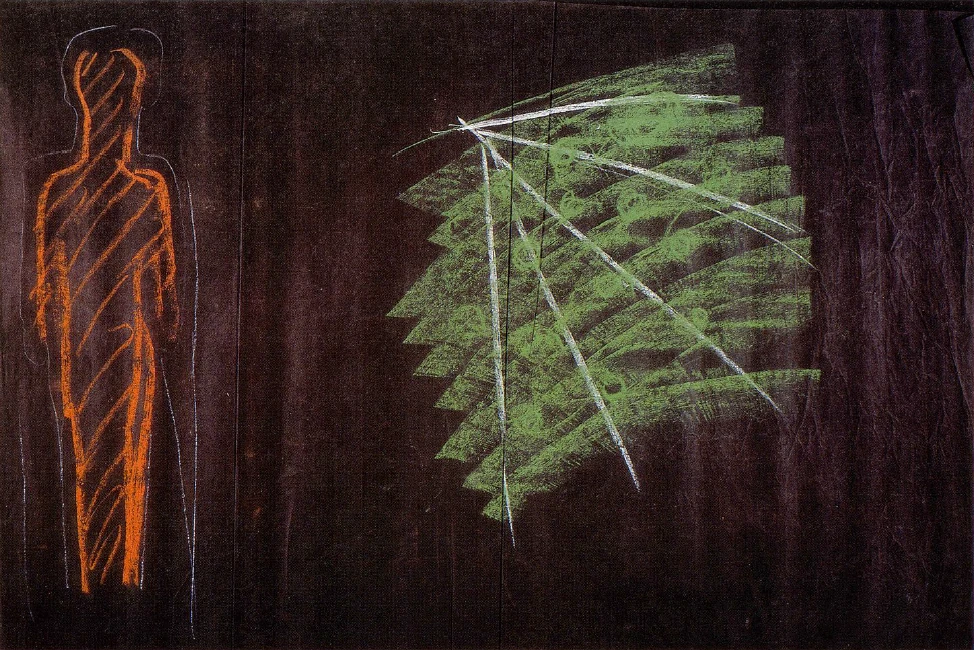
[ 11 ] We must consider this in a much higher sense. We know, after all, from the now extensive body of published anthroposophical literature that the human being consists of a spiritual-soul aspect—I will sketch it out here in outline form (see drawing, blue)—and a physical aspect (red). We know that certain theoretical materialists of the 19th century said: “Oh, come on, the spiritual-soul aspect—that’s something we shouldn’t even talk about; it’s something that doesn’t appear anywhere in human knowledge.” What lives in the so-called human soul as thinking, feeling, and willing is, after all, merely the result of the physical nervous system, of the physical brain. As you know, we must distinguish this theoretical materialism from practical materialism, which is something entirely different and which, especially today, still prevails quite blatantly. Theoretical materialism reached its peak in the 19th century. Anyone who is now accustomed to thinking only in the ways we do today will say: Well, materialism—which claims that human thoughts, feelings, and impulses of will are merely the product of the nervous system and the brain—is false. It must be refuted. And once it has been refuted, one has proven that human beings do not consist merely of their physical body with its nervous system and brain, but that they possess a spiritual and soul aspect. — But spiritual science, as understood here, cannot stop at such a refutation, for it is not merely a matter of logical reasoning but a matter of reality. Everything that lives here in the physical world is a reflection of the spiritual and soul world, but not merely in the sense that one has a picture painted on a wall; rather, it is a reflection that includes all its activities and all its expressions of life. This is how it is with regard to the human being: The human being descends from the spiritual-soul world into the physical world through conception or birth; what he brings with him from the spiritual-soul world—this interplay of forces—works upon that physical body which is received through the stream of heredity. This body, with its entire configuration, is formed by the spiritual-soul aspect that descends (see drawing on page 35). But it is not only formed in terms of its outer form; it is also formed in terms of its inner activities. So that if you think only of what is present in your outer sensory reality, you can do so quite well with the brain alone. For this brain, with all its faculties, is also a reflection of the spiritual-soul aspect. And anyone who limits themselves to processing only what the external sensory world provides, or what current sciences provide, is thinking merely with the brain; such a person is merely thinking matter. There is nothing more to say about it: they are merely thinking matter. Today is the time to move beyond being merely thinking matter by entertaining thoughts that are not derived from the sensory world—such as anthroposophically oriented thoughts. Those people who today insist on limiting themselves solely to the sensory world find these anthroposophical thoughts crazy, unreal, and fantastical, because the moment they are supposed to think these thoughts, they must exert a strong effort; they must break free. They want to think these thoughts with their brains. But with that, one can think only of external physical thoughts—the external physical realm. With these thoughts, one can quite well conceive of atoms and molecules in the manner of the nonsense mentioned yesterday; but what is written in a book such as *Outline of Esoteric Science* cannot be conceived through this brain. So for them, it is a fantasy. One must make an effort to tap into the spiritual-soul aspect. Then one can actually think these thoughts; then one no longer finds them fantastical or absurd at all; then one can think them, and then one finds them in complete harmony with life.
[ 12 ] But over the course of the last few centuries, since the mid-15th century, humanity has increasingly come to I would say, to sink into itself, to let the spiritual-soul aspect fall asleep, and to allow itself to sink into the materiality of the physical, thinking only with the physical brain—letting this physical brain run automatically according to what the professor, as he sits up there at the lectern, lets run just as automatically in his own brain. Up there, the brain automaton—down here, the brain automaton follows the automaton. And entire groups of people are shifting to a purely material functioning of the brain—which is, after all, physical thinking—sinking into physicality, failing to muster the inner impulse to grasp what has been gained from the supersensible world. This has become increasingly the case with the people of the so-called civilized world since the middle of the 15th century. And by the middle of the 19th century, it was precisely that segment of humanity—referred to as the “intellectuals” within this civilized part of Europe and America—that had become physical thinkers.
[ 13 ] Now, if Büchner or Moleschott or the portly Vogt came along and gave it a little thought, yet failed to realize that there was something underlying their own thinking that needed a jolt, then they looked at the people of their time and interpreted them quite correctly by saying: Individualism, spiritualism—wrong; the brains are thinking!—After all, it was only the brains that were thinking; materialism was right, after all. That is precisely the secret: that the theoretical materialists of the 19th century did not say anything wrong, but rather that they said things that were entirely correct. It would even have been an insult if colleague X had said of colleague Y that he had a mind and a soul, for, in truth, X could only say of him that there was a brain thinking automatically. So materialism in the mid-19th century was, in essence, correct, for it refers to a certain stage in the development of humanity, characterized by the fact that people had indeed become material, that their thinking, feeling, and willing arise from matter. There were even mystics who delved into their inner selves; but as we know, these very mystics observed only the inner seething of materiality beneath the skin, until it becomes a flame and shines into consciousness.
[ 14 ] Spiritual science would be doing itself a disservice if it were now to adopt a purely logical standpoint. It must not say: “Materialism is wrong; let us refute it.” — Such refutation is the longing of our abstract-minded age. Spiritual science must take action based on its insights. So, first of all: refuting materialism for people who have become materialistic is not the answer; second, nothing is accomplished by merely refuting materialism—rather, the task today is to bring to people that which prompts them to pull themselves together and emerge once more from materiality, to cherish and nurture thoughts that are the result of reflection on the supersensible. Materialism is not to be refuted, but overcome! People must once again become spiritual and soulful; they must once again awaken their spiritual and soulful nature. The task must be to overcome true materialism, not to refute it in some false way. The fact that materialism has become the norm in recent cultural development—that is precisely the problem, not that it is a false worldview. And the point is not to refute a false worldview, but to provide people—in terms of their soulful actions—with the means to overcome humanity’s materialization and to extricate themselves from the material. The insight referred to here must be action, not mere logic. That is what is at stake.
[ 15 ] But what people find so difficult to grasp today is the difference between mere talk—whether in the form of affirmations or negations, which remains entirely within the realm of abstract concepts—and action that springs directly from the spiritual. One need only realize how different it is to merely refute materialism logically—because one believes it to be false—from overcoming the actual materialism that has gripped humanity like a disease, so that healing through spirituality may take place. One must grasp this difference, for what matters today is that spiritual deeds be performed and that these spiritual deeds also be carried into social life. This is a very profound distinction between taking pleasure in a theoretical worldview and actively standing within knowledge as action.
[ 16 ] Attention must be focused on these matters so that one may recognize the difference between anthroposophically oriented spiritual science and other similar endeavors today. For this anthroposophically oriented spiritual science must certainly be understood as something that is connected—truly connected—to the real forces of rise and decline in social life.
[ 17 ] If we look toward Eastern Europe today, we see something spreading over the Russian spirit—a spirit that people in the West and Central Europe today can scarcely grasp—something that Central and Western Europeans can understand well, even if they abhor it: what is spreading there is Leninism and Trotskyism. There are many people who believe that this Leninism and Trotskyism have something to do with what will one day emerge in the East. They have absolutely nothing to do with what is to emerge in the East, but only with what is being destroyed there—what is being further ruined by Leninism and Trotskyism. These are merely destructive forces, and what is to emerge in the East must develop in opposition to these destructive forces. One might say: In the East, there is something serving as a foundation (see diagram, green), which is given less attention today. Over the past few years, Bolshevism, Leninism, and Trotskyism have spread over it as destructive forces (white). But what I have indicated here in green is striving to come to the surface. Leninism and Trotskyism are merely the continuation of the old tsarism, and Lenin is—as I have already emphasized here—the tsar, merely in a different guise, essentially the very same. Tsarism dies in Leninism, but it dies as tsarism in Leninism. Yet for centuries now, something has also been emerging in the East in opposition to tsarism—something that now merely misunderstands its own existence when it somehow aligns with Leninism and Trotskyism—and this is happening far into Asia. People will only come to see what upheavals they are facing; this is merely a lull between the last catastrophe and the next. The slumbering souls will one day be rudely awakened from their sleep during this lull; they will rub their eyes and pull off their pointed caps when the catastrophe resumes. But what is nevertheless emerging there is the village community. And only those who understand the nature of individual village communities can grasp what is emerging in the East as a social constitution. The village community is the only real thing in the East. Everything else is an institution that is falling apart.
[ 18 ] In the West, people will have to understand how this aggregate of the village community can be organized. And the only way to organize the fabric of opinion in the West—which is disintegrating into individual human personalities—is through the threefold structure of the social organism. The threefold structure of the social organism must incorporate the individual members of the Eastern village communities and must save the disintegrating old organisms of the West—which are becoming individualized and, as aggregates, are breaking down into their constituent parts—from ruin.
[ 19 ] For the foreseeable future, the so-called civilized world has only one alternative: on the one hand, Bolshevism; on the other, the threefold social order. And anyone who fails to recognize that these are the only two options for the foreseeable future simply does not understand the course of events on a grand scale today. But a true understanding of these matters can only be gained by attempting to apply the inner education acquired through spiritual science to the observation and management of public social conditions.
[ 20 ] It is always terribly sad today to see people squander their intellectual capacity on all sorts of outdated programs, and to see so little willingness on their part to understand that something truly new is necessary in order to overcome the last remnants of the old—the most extreme reaction, the most extreme conservatism, namely Bolshevism. The programs devised by today’s moderate and Western statesmen will certainly not overcome Bolshevism, for they contain none of what must live in every impulse of the future; they contain none of the new spirit. Yet this new spirit is what is needed. And if this new spirit is not present in major cultural-political undertakings, then such undertakings are only capable of allowing humanity to slide into further catastrophes. If this new spirit is not present in party opinions, humanity will continue to slide deeper into catastrophes.
[ 21 ] This is precisely what we should now be rethinking and considering in all possible ways. We are asked time and again: “Yes, the threefold social order is all well and good, but what will this or that look like once the threefold social order is introduced?” — The spice merchant, for example, wonders how he’ll sell his spices once the threefold social order is in place, and so on. — Here in this very hall, the question was raised some time ago about what would become of owning a sewing machine in the threefold social organism. If one does not have the ability to address these questions on a grand scale and tell oneself: once they are integrated into social life on a grand scale, then the individual details will naturally fall into place; then the individual details will naturally take shape—if one is not able to address this grand question on a grand scale, then one will never be able to rise to the level required by the current, such a difficult time of trial for humanity. But this requires that we view our old, cherished ideas today through the lens of spiritual metamorphosis. It is likely that even here, if one were to look through the notebooks of Central European schoolchildren at the end of the school year to see what essays they had written, one would find the following sentence as an essay topic in a large number of them: “Everyone must choose a hero, following whom they work their way up to Olympus.” Boarding school girls, high school students, and middle school students write beautiful essays on this topic. In life, however, people chase after abstract party platforms. Even something like this line of poetry—which certainly has its place in the context of the poem—must be read here in a spiritual metamorphosis. We must find the perspective in the spiritual world that leads to the spiritual essences under which we group ourselves.
[ 22 ] What used to be called a conservative program or a liberal program, what is today called a social democratic program or an agrarian program—all of that is wishy-washy; it’s all abstract rhetoric, just like all the programs of women’s associations, all the vegetarian programs, and so on. What matters is that one understands the course of the world as it is pulsed through by spiritual forces, and that one is able, for example, to answer the question of what reigns in the supersensible realm over that group of people who have united under some women’s association-style program, and so on. Today, with a certain seriousness, everything must be elevated to a view of the spiritual, of the supersensible world; for only by bringing the supersensible and the sensible worlds together in a unified vision is it possible to find that which can truly move us forward in our present time of grave distress and severe trials.