

Spiritual Scientific Insight into the
Fundamental Impulses of Social Organization
GA 199
8 August 1920, Dornach
Translated by Steiner Online Library
Third Lecture
[ 1 ] Today I would like to delve deeper into some of the topics we have been discussing recently by picking up on an older theme that many of you are already familiar with. Years ago, I once spoke about the characteristics of the human sensory world as a whole. As you know, when we speak of the senses, we customarily list the sense of sight, the sense of hearing, the sense of smell, the sense of taste, and the sense of touch. Recently, however, some scientists have also been led to speak of other senses—ones that are, so to speak, more inwardly oriented—such as a sense of balance and so on. But this entire conception of the human senses lacks, on the one hand, a sense of coherence, and, on the other hand, above all, a self-contained unity. In fact, when one considers the commonly listed senses, one is actually dealing only with a part of the human sensory system. One has only fully exhausted the human sensory system when one takes twelve senses into account. Today, let us first bring these twelve senses to mind—I would say, merely by listing them and providing a brief description.
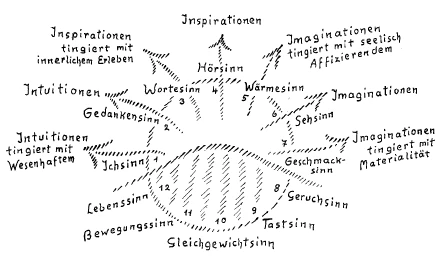
[ 2 ] One can begin the enumeration and characterization of the senses anywhere. So let us begin, for example, by considering the sense of sight. First, let us look at its characteristics from a purely external perspective, as anyone can observe for themselves (see Figure $. 48). The sense of sight conveys to us the surface of external physicality, which presents itself to us as colorful, light, dark, and so on. We could describe this surface in a multitude of ways and would then have what the sense of sight conveys. If we now penetrate somewhat into the interior of external physicality through sensory perception—if, through our sensory organization, we perceive that which does not lie on the surface but rather extends further into the interior of the body—this must occur through the sense of warmth. Drawn even closer to us, bound to us, and inclined toward us from the surface of physicality, we perceive qualities through the sense of taste. It lies, so to speak, on the other side of the sense of sight. When you consider colors, light and dark, and when you consider taste, you will say to yourself: what confronts you on the surface of physicality is something conveyed through the sense of sight. That which confronts you in interaction with your own organism—that which, in a sense, detaches itself from the surface in the sensation and moves toward you—is conveyed by the sense of taste.
[ 3 ] Now let us imagine that you go even deeper into the inner nature of physicality than is possible through the sense of warmth—that you consider, so to speak, not only that which penetrates physicality from the outside but also permeates it from within, like warmth, but rather what the inner quality of bodies is in terms of their essence. For example: You strike a metal plate; you then perceive something of the substantiality of this metal plate—that is, of the inner essence of the metallic. Whereas, when you perceive heat, through the sense of warmth you perceive only that which, so to speak, permeates bodies as general warmth—but is nevertheless present within—you thus perceive through the sense of hearing that which is already connected to the inner essence of bodies. Now, if you turn to the other side, you experience something that the body exerts on you as an effect, which is much more internal than what is perceived through the sense of taste. Smell is, in material terms, much more internal than taste. Tasting occurs, so to speak, when objects merely touch us and our secretions then combine superficially with our inner being; smelling, on the other hand, is already a significant change within us, and the nasal mucosa is something that is organized much more internally—in a material sense, of course—than the taste buds.
[ 4 ] If you then penetrate even further into the innermost part of the outer physical realm—where the outer physical realm is already becoming more spiritual—you penetrate, through the sense of hearing, into the essence of the metallic realm; you, so to speak, grasp the soul of the metallic realm, but you penetrate even deeper—namely into the outer realm—when you perceive not only through the sense of hearing, but through the sense of the word, through the sense of language. It is a complete misunderstanding to believe that the sense of hearing alone exhausts what the sense of the word encompasses: one might hear, but one does not yet need to perceive the content of the words in such a way as to understand it. There is also a difference, in terms of organic structure, between the mere hearing of sound and the perception of words. Hearing a sound is mediated by the ear, whereas the perception of words is mediated by other organs, which are just as physical in nature as those that mediate the sense of hearing. And we also penetrate more deeply into the essence of an external object when we understand it through the sense of language than when we merely hear its inner essence as sound.
[ 5 ] Even more inwardly situated, already completely separated from things—much more so than is the case with the sense of smell—is that mediation which we might call mediation through the sense of touch. When you touch objects, you are actually perceiving only yourself. You touch an object; the object exerts a strong pressure on you in a certain way because it is hard, or exerts only a slight pressure because it is soft. But you do not perceive anything about the object itself; rather, you perceive only what is brought about within yourself: the change within yourself. A hard object pushes your organs far back. You perceive this pushing back—as a change within your own organism—when you perceive through the sense of touch. You see, as we move inward with the inner workings of the senses, we step outside of ourselves. We step out of ourselves only slightly with the sense of taste; we step out of ourselves more when we engage with the surface of bodies, through the sense of sight. We already penetrate the body through the sense of warmth; we penetrate the being even more deeply through the sense of hearing; and we are fully immersed in the innermost being through the sense of speech. In contrast, we penetrate into our own inner being—there is already some of this present in the sense of taste, more so in the sense of smell, and even more so in the sense of touch. But then, when we penetrate even further into our inner being, a sense arises within us that is actually rarely mentioned—at least not very often—a sense through which we distinguish whether we are standing or lying down, and through which we also perceive how we maintain our balance when standing on our two legs. This feeling of being in balance is conveyed by the sense of balance. Here, then, we are already penetrating quite deeply into our inner being; we perceive the relationship of our inner being to the external world, within which we feel ourselves to be in balance. But we perceive this entirely within our inner being.
[ 6 ] If we delve even deeper into the external world—deeper still than we can through the sense of words—we do so through the sense of thought. And in order to perceive the thoughts of another being, we simply need a different sense organ than the mere sense of language. In contrast, when we delve even deeper into our inner self, we have a sense that tells us internally whether we are at rest or in motion. We do not perceive whether we are at rest or in motion merely by the fact that external objects pass us by; we can perceive internally—through the lengthening and shortening of our muscles and the configuration of our body, insofar as these change when we move—to what extent we are in motion, and so on. This occurs through the sense of motion.
[ 7 ] When we encounter other people, we perceive not only their thoughts but also their sense of self. And the sense of self is not yet perceived if one merely perceives their thoughts. Precisely for the same reason that we distinguish the sense of hearing from the sense of sight, we must—when we examine the finer structures of the human organism—also distinguish a special “sense of the self,” a sense for self-perception. By perceptually entering into another person’s self, we step out of ourselves the most.
[ 8 ] When do we turn inward the most? Well, when, in our general sense of life, we perceive that which we always experience in our waking state as our consciousness—that we are, that we feel ourselves inwardly, that we are ourselves. This is conveyed through the meaning of life.
[ 9 ] I have thus listed for you the twelve senses that make up the complete system of sensory organs. You can now readily see from this that a certain number of our senses are, so to speak, more outwardly directed, more focused on penetrating the external world. If we regard the whole (see diagram) as the scope of our sensory world, we can say: the sense of self, the sense of thought, the sense of speech, the sense of hearing, the sense of warmth, the sense of sight, and the sense of taste—these are the senses that are more directed outward. In contrast, where we perceive ourselves more in relation to things, where we perceive the effects of things within us, there we have the other senses: the sense of life, the sense of movement, the sense of balance, the sense of touch, and the sense of smell. They constitute the realm of the human inner life; they are senses that open inward and, through the perception of the inner world, convey our relationship to the cosmos (see drawing, hatched). Thus, when we consider the complete system of the senses, we can say: We have seven senses that are directed more outward. The seventh sense is already questionable: the sense of taste stands on the border between what concerns external objects and the effects those external objects have on us. The other five senses are those that reveal to us purely internal processes taking place within us, yet which are effects of the external world upon us. What I would now like to add today to this classification of the senses—which most of you will be familiar with—is the following.
[ 10 ] You know that when a person ascends from ordinary sensory perception to higher knowledge, they can do so by stepping out of their physical body with their spiritual and soul aspects. Then the higher forms of cognition emerge: imagination, inspiration, and intuition. I would like to say: Imagination, inspiration, and intuition are indeed described in my *Outline of Esoteric Science* and in my treatise *How Does One Attain Knowledge of the Higher Worlds?*. But you can easily imagine that, precisely when we have this structure of the senses before us, we can arrive at a special characterization of what perception of the higher worlds is. We step out of ourselves. What boundary do we cross in doing so? When we remain within ourselves, when we are confined within ourselves, then the senses are our boundaries; when we step out of ourselves, then we reach outward through the senses. It is quite—I would say—self-evident that when our spiritual-soul nature leaves the physical body, it penetrates outward through the senses. We thus come outward through the external senses: the sense of taste, the sense of sight, the sense of warmth, the sense of hearing, the sense of speech, the sense of thought, and the sense of the “I.” We will see later where we end up when we penetrate inward through the other boundary, where the senses open inward. So we penetrate outward through the senses by, so to speak, leaving the boundaries of our physical body with our spiritual-soul nature. For example, we pass through the sense of sight outward: that is, we penetrate outward with our spiritual-soul nature by leaving our visual organs behind. As we move through the world, seeing with the soul’s eye but leaving the physical eyes behind—that is, when we leave our physical body precisely through the eye—we enter that region where imagination reigns (see drawing on page 48).
[ 11 ] And if we are truly able, through initiation, to penetrate into the spiritual world precisely through the eye, then we receive pure imaginations—imaginations that, I would say, are images, just as the rainbow is an image—pure pictorial imaginations, weaving and living within the soul-spiritual realm. When we penetrate outward through the organ of taste, the images still appear tinged with the last remnants of material existence. So we can say: When we penetrate outward through the organ of taste, the imaginations are tinged—literally dabbed with materiality. We do not receive pure, ethereal images as with the rainbow, but rather something that is tinged, something that, in a sense, contains within the image a kind of last remnant of the material: we encounter ghosts—real ghosts—when we leave the physical body through the sense of taste. If one leaves the physical body through the sense of warmth, the images are also tinged. The images, which are otherwise pure—I would say, like a rainbow—then appear in such a way that they affect us psychologically in a certain manner. That is what constitutes their tinge. Through the sense of taste, the image, as it were, condenses into something ghostly. But when we go outward through the sense of warmth, we do indeed receive imaginations as well—but imaginations that have a psychological effect, that evoke sympathy or antipathy, that feel psychologically warm or cold. So the images do not appear in the same serene manner as the others; rather, they appear warm or cold—but psychologically warm or cold.
[ 12 ] When we leave our body through our ear, through the sense of hearing, we enter the spiritual-soul world and experience inspiration. So here before (in the drawing) we experience imaginations tinged with soul-affecting elements; when we leave our body through the sense of hearing, we enter the realm of inspiration. Whereas these senses usually tend outward, what passes from the sense of warmth to the sense of hearing when we leave the body now penetrates more deeply into our soul-spiritual inner being. For inspirations belong more to the soul-spiritual inner being than imaginations do; we are more deeply moved—not merely emotionally—but we feel permeated by inspirations, just as we feel physically permeated by the air we have inhaled; so, too, do we feel spiritually permeated by the inspirations into whose realm we enter when we leave our body through the sense of hearing.
[ 13 ] When we leave our body through the sense of the word, through the sense of language, then our inspirations take on a new character. This is something that is particularly important: to become acquainted with that organ, which is just as real within the physical organism as the sense of hearing is, by first developing a sense of what the sense of language is. When, through this organ, one leaves the physical body and enters the spiritual-soul realm, inspiration becomes imbued with inner experience—with the feeling of oneness with the foreign being.
[ 14 ] When we leave our body through the sense of thought, we enter the realm of intuitions. And when we leave our body through the sense of the “I,” these intuitions are tinged with the essence of the spiritual external world.
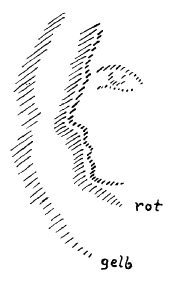
[ 15 ] Thus, as soon as we leave the body with our spiritual-soul aspect, we penetrate ever more deeply into the essence of the spiritual outer world, and we can always point out how, in fact, what surrounds us is the spiritual world. But human beings are, in a sense, pushed out of the spiritual world. They only perceive what lies beyond the senses when they leave the body through their spiritual and soul nature. Yet it is reflected through the senses: intuitions appear to us through the “I” sense and the sense of thought, but only as reflections of them; inspirations through the sense of speech and the sense of hearing, but again only as reflections of them; imaginations through the sense of warmth and the sense of sight, and to a small extent through the sense of taste, but toned down, absorbed, and transformed into the sensory realm. Schematically, one could illustrate this as follows: At the boundary lies the perception of the sensory world (see diagram, red); when one ventures beyond it with the spiritual-soul aspect, one enters the spiritual world (see diagram, yellow) through imagination, inspiration, and intuition. And that which is to be imagined, inspired, or intuited is out there. But as it penetrates into us, it becomes our sensory world. You see: atoms are not out there, as the materialists imagine, but out there is the world of the imaginative, the inspired, and the intuitive. And as this world acts upon us, impressions of it arise in our external sensory perceptions. From this you can see that—when we, through our skin, which encloses the sense organs, penetrate outward, so to speak, but in the various directions in which the senses act—we then enter the objective spiritual-soul world. There, through the senses, which we have recognized as opening outward, we penetrate into the external world.
[ 16 ] So you see that when a person penetrates the external world through their senses—when they cross the threshold into the external world, which, as you can see, is very close—they enter the objective spiritual-soul world. This is what we strive to achieve through spiritual science: to penetrate this objective spiritual-soul world. We reach a higher realm by penetrating, through our external senses, that which lies within the sensory world but is veiled from us.
[ 17 ] What happens, then, when we penetrate into our inner being through the inner senses—the sense of life, the sense of movement, the sense of balance, the sense of touch, and the sense of smell—when we penetrate into ourselves through these inner senses, just as we penetrate outward through the outer senses? Then the situation looks entirely different. Let’s list these inner senses once more: the sense of smell, the sense of touch, the sense of balance, the sense of movement, and the sense of life. What is actually happening within us is not perceived there. In everyday life, we do not actually perceive what is happening within the realm of these senses; it remains subconscious. What we perceive through these senses in everyday life has already been projected up into the soul.
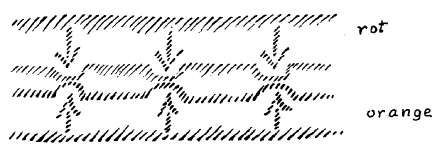
[ 18 ] You see, if this is the outer spiritual world of imagination, inspiration, and intuition (see drawing on p. 54, in red), it radiates, as it were, onto our senses, and through the senses it is presented before us—the sensory world is thus created. So the outer spiritual world is brought in one step further. But what surrounds these senses, and what stirs down there in the physical realm (orange), is not perceived directly. Just as one does not directly perceive the objective outer spiritual world, but only as it is brought into our senses, so too one does not directly perceive what is stirring within our body, but only its emergence into the soul. One perceives, so to speak, the soul effects of these inner senses. You do not perceive the processes that are the life processes themselves, but rather you perceive—from the sense of life (see drawing on page 48)—the feeling associated with what you do not perceive when you sleep, what you perceive as inner comfort when awake, as that sense of well-being that is only disturbed when something hurts you inside. There is the sense of life, which otherwise radiates as a sense of well-being, such that it is disturbed, just as an external sense is disturbed when, for example, one’s hearing is impaired. But on the whole, in a healthy person, the sense of life manifests itself as a sense of well-being. That pervasive sense of well-being—heightened after a hearty meal, somewhat subdued when hungry—this general inner feeling is the effect of the sense of life radiating into the soul.
[ 19 ] The sense of movement (see illustration on page 48)—that which takes place within us as we perceive, through the shortening and lengthening of our muscles, whether we are walking or standing, jumping or dancing; in other words, through which we perceive whether and how we are in motion—this, when it radiates into the soul, gives rise to that human sense of freedom that allows us to experience ourselves as souls: the sensation of one’s own free soul. That you perceive yourself as a free soul is the radiance of the sense of movement; it is the streaming into your soul of the shortening and lengthening of your muscles, just as inner comfort or discomfort is the streaming into your soul of the results and experiences of the sense of life.
[ 20 ] When the sense of balance shines into the soul, we are already detaching ourselves very strongly from that soul. Just think for a moment how little we are inclined—unless we have actually fainted, in which case we are unaware of it—to truly and directly sense that we are placed in the world in a state of balance. How, then, do we perceive the experiences of the sense of balance when they radiate into the soul? This is entirely a matter of the soul: we experience it as inner peace—that inner peace which ensures that when I walk from there to here, I do not leave behind the one who is there within my body, but take him with me; he remains calmly the same. And even if I were to fly through the air, I would calmly remain the same. This is what makes us appear independent of time. I do not leave myself behind today either; rather, I am the same person tomorrow. This independence from physicality is the sense of balance radiating into the soul. It is the feeling of being spirit.
[ 21 ] We are even less aware of the inner processes of the sense of touch. After all, we project these entirely outward. We use our sense of touch to determine whether objects are hard or soft, rough or smooth, silky or coarse; we project the experiences of the sense of touch entirely into external space. In reality, what we experience through the sense of touch is an inner experience, but what takes place internally remains entirely in the unconscious. Only a shadow of this is present in the qualities of the sense of touch that we attribute to objects. But it is the organ of the sense of touch that enables us to feel objects as silky or woolly, hard or soft, rough or smooth. This also radiates inward, into the soul; yet human beings do not perceive the connection between their inner experience and what the external sense of touch perceives, because the two are very distinct—what radiates inward and what is experienced outwardly. But what radiates inward is nothing other than being imbued with the sense of God. If a person had no sense of touch, they would not have this sense of God. What is felt through the sense of touch as roughness and smoothness, hardness and softness, is what radiates outward; what is reflected back in the soul’s experience is the permeation with the general substance of the world, the permeation with Being as such. We establish the existence of the external world precisely through the sense of touch. When we see something, we do not yet believe that it actually exists in space; we are convinced that it exists in space only when the sense of touch can perceive it. That which permeates all things, which also penetrates us, which holds and sustains you all—this all-pervading divine substance enters consciousness and, when reflected inward, is the experience of the sense of touch.
[ 22 ] The sense of smell: you are familiar with how it radiates outward. But when the sense of smell radiates its experiences inward, people no longer even notice how these inner experiences coincide with their outer experiences. When a person smells something, that is the outward projection of their sense of smell; they project the images outward. But this effect is also projected inward. People simply pay less attention to it than to the outward effect. Some people enjoy smelling pleasant scents; in doing so, they observe the outward projection of the sense of smell. But there are also people who surrender to what, as the inward effect of the sense of smell, so intensely seizes their inner being—an effect that not only permeates them like the sense of God, but also takes such a deep hold within them that they experience it as a mystical oneness with God.
[ 23 ] 5. Sense of smell = mystical oneness with God
4. Sense of touch = being imbued with a sense of God
3. Sense of balance = inner peace, feeling oneself as spirit
2. Sense of movement = perception of one’s own free soul
1. Sense of life = comfort
[ 24 ] You see, if one is to see things as they really are in the world, one must free oneself from certain sentimental prejudices. For some people will have quite strange feelings when they want to be mystics and then discover what this mystical experience actually is in relation to the sensory world: it is an olfactory experience radiating into the innermost depths of the soul.
[ 25 ] There is no need to be alarmed by such things, for even our sensations are formed only in the outer, conventional world of appearances—in Maya. And why, if one does not immediately regard the sense of smell as something of the highest order, should one maintain this Maya-based view of the sense of smell? Why shouldn’t one be able to view the sense of smell in its higher aspect, where it becomes the creator of a person’s inner experiences? Yes, mystics are sometimes terrible materialists; they condemn matter, they want to rise above matter because matter is something so base, and they rise above matter by inwardly and complacently surrendering themselves to the effects of the sense of smell.
[ 26 ] Those who possess a finer receptivity and sensitivity to such things will, especially when it comes to outspoken mystics of a sympathetic nature—such as Mechthild of Magdeburg, Saint Teresa, or John of the Cross—be able to “smell” things through the particular nature of their experiences as they describe their inner experiences—and such figures describe them very vividly. Mysticism, even in the works of Meister Eckhart or Johannes Tauler, is just as well—indeed, more appropriately—perceived through smell as it is through the sensual absorption of spiritual sensation. If, for example, one considers the descriptions of the mystical experiences of Saint Teresa or Mechthild of Magdeburg, one senses a sweetish scent within oneself when one understands these things in an occult sense. If one considers the mysticism of Tauler or Meister Eckhart, one experiences a scent somewhat like that of the rue plant—a tart but not unpleasant scent.
[ 27 ] In short, what is peculiar and striking about this is that when one moves outward through the senses, one enters a higher world—an objectively spiritual world. When one descends through mysticism, through being imbued with the sense of God, through the inner peace of feeling oneself as spirit, through feeling oneself spiritually free, through inner contentment—then one enters into physicality, into materiality, as I have already indicated to you in these reflections. In terms of inner experience, to put it in a “maya”-like way, one always enters into regions lower than those one already experiences in ordinary life. When one elevates oneself externally above the senses, one enters into higher realms. From this you can surely see how important it is not to harbor any illusions about these things—above all, not to succumb to the illusion that one is entering into a special form of spirituality when, through mystical identification with the Divine, one descends into one’s inner self. No, there one merely descends inward into the radiations of one’s own nose. And those mystics who are most beloved give us, through their descriptions, what they feel within themselves through the radiations of the nose continuing inward.
[ 28 ] As you can see: when one speaks of the world beyond the threshold—that is, when one speaks from the spiritual world about the affairs of this world—one must use entirely different words than people imagine from their perspective in this physical world. That shouldn’t really surprise you, for you certainly shouldn’t expect the spiritual world beyond the threshold to be a mere duplicate of this physical world here. You can experience such duplicates only when you read the descriptions of the higher world in Islamic esotericism, or when you read Mr. Leadbeater’s descriptions of Devachan. There you have, only slightly altered but essentially, duplicates of this world. People find this very comforting. Especially among those who lead a certain kind of social life here in the physical world—dressed in fine clothes and with their desires otherwise sufficiently satisfied—it is easy to find that after their death they also enter that Devachan salon, where one can then spend time in a manner similar to the salons here, just as Mr. Leadbeater describes it to them. The one who must describe the truths of the spiritual worlds is not in this comfortable position. He must tell you that being imbued with the sense of God leads to the projection of the sense of smell inward, and that the mystic actually reveals nothing to the true occultist other than what he smells within himself. There is no room for sentimentality in a genuine contemplation of the world from the spiritual perspective. I have often mentioned this: If one truly penetrates the spiritual world, then the gravity of the matter begins to such an extent that all things must take on different words than they have here, and that the words themselves take on entirely opposite meanings. To penetrate the spiritual world does not merely mean describing ghosts of this world; rather, one must be prepared to experience much that is the opposite of the physical world here—and above all, the opposite of what is pleasant.
[ 29 ] I wanted to present this point of view to you today in order to give you a more general sense of what our time truly needs. When one listens to what is being said today from the West—in the East, and the further east one goes, the situation is different—when a thought is expressed in a Western form, one often finds oneself saying: “You can’t express yourself that way in French,” or “You can’t express yourself that way in English.” The farther one goes west, the more one encounters this judgment. But what does this judgment mean other than clinging to the physical, which is already a state of rigidity in the physical in relation to the real world? What do words matter? What matters, rather, is that we communicate about things beyond words. But then we must also be able to detach words from things, and we must not only be able to detach words, but we must even be able to detach the subjective sensations acquired in the sensory world. If one regards the sense of smell as a lower sense, that is a judgment derived from the sensory world. And if one regards its inner correlate—mysticism—as something higher, that, too, is a judgment derived from the sensory world. Viewed from beyond the threshold, the organization of the sense of smell is something extraordinarily significant, and mysticism is not something so magnificent when viewed from beyond the threshold. For mysticism is entirely a product of the material, physical world; it is, in fact, the way in which people—who actually remain materialistic—seek to penetrate the spiritual world by regarding what is here all the more as matter. That is too lowly, too materialistic for them. If, however, they were to penetrate into what lies out there, they would enter precisely into the spiritual world, into the hierarchies. Instead, however, they penetrate into their inner selves: there they stumble into the very heart of matter within their own skin! To them, however, this appears to be the higher spirit. But the point is not that we mystically penetrate down into our bodies through our spiritual-soul phenomena; rather, the point is that we penetrate through our material phenomena—through the phenomena of the sensory world—into the spiritual world, into the world of the hierarchies, into the world of spiritual beings. Not until the world is ready to hear such ideas expressed, not until the world is ready to accept that it is spoken of in a completely different way than in the last four centuries, not until the world is ready to accept that we also form our social judgments from such completely transformed concepts—only then will we arrive at impulses that in turn lead to an ascent. But if we wish to remain within all that we have appropriated, and if we wish to orient our social actions accordingly, then we will sail ever deeper into decline; then we will descend into the decline of the West.
[ 30 ] What is the basis for something like Oswald Spengler’s judgment? It is based on the fact that he is a very brilliant man, but one who can think of nothing other than the ordinary concepts of the Western world that we have today. He analyzes these concepts. He concludes—and this is entirely correct within the framework of these concepts—that by the beginning of the third millennium, barbarism will have replaced our civilization. If you mention anthroposophy to him, he turns red in the face because he can’t stand it. If he understood what anthroposophy can bring into humanity, how it can enliven people, then he would see that only through it can decline be averted, that only through it can we achieve an ascent.