

Spiritual Scientific Insight into the
Fundamental Impulses of Social Organization
GA 199
22 August 1920, Dornach
Translated by Steiner Online Library
Eighth Lecture
[ 1 ] I would like to summarize once again what I explained yesterday regarding the differentiation of the spiritual dispositions of peoples—and of human beings in general—across the Earth. I indicated how different dispositions and different types of soul constitutions exist among people in the most diverse regions of the Earth, so that, in fact, every region of the Earth can, through its people, contribute something specific to what all of humanity accomplishes with regard to the entire Earth civilization. We had to point out yesterday how the Eastern peoples, the peoples of Asia, and those associated with them are particularly predisposed to develop the element that contributes to the spiritual aspect of social organization. The Eastern peoples are particularly predisposed to everything that constitutes spiritual development in humanity—that is, knowledge of the supersensible and forms of the supersensible. This is connected to the fact that these Eastern peoples are particularly predisposed to form conceptions and ideas about how the human being has descended into this earthly existence from the spiritual worlds he has lived through between his last death and this birth. The doctrine of pre-existence—the teaching that is certain that a human being has undergone a spiritual existence before entering the physical body here—is something that lies particularly within these Eastern dispositions. Hence, too, the predisposition to gain insight into repeated earthly lives. One may hold the view that life continues after death, continuing forever, without returning to Earth. But logically, one cannot hold the view that life here on Earth is a continuation of a spiritual life without having to consider that it then follows naturally that this life must repeat itself. Thus, the Eastern person was particularly predisposed to recognize that he had lived in spiritual worlds prior to this earthly life, and that he had, so to speak, received the impulses and motivations for this earthly life precisely from the divine-spiritual world.
[ 2 ] This is connected to the entire way in which the Oriental has arrived at his knowledge and his entire state of mind. I have already hinted at this to some of you; there are now a different group of friends here, and I would like to elaborate once more on something that I have already discussed with some of you.
[ 3 ] We know that the human being is a threefold being, that he can be divided into the nervous-sensory human being, the rhythmic human being—which encompasses those activities involved in breathing, blood circulation, and so on—and that the third aspect of the human being is the metabolic human being, everything connected with metabolism. Now, these three aspects of human organization are not expressed in roughly the same way throughout the entire world, but rather in different ways.
[ 4 ] The Oriental person is today in a state—I would say, of decadence; today all of this is suppressed; today it lies dormant within the Oriental person. But we need not get to know the Oriental person according to his current state of mind; rather, we must get to know him primarily according to the state of mind he possessed in a very distant past —the Oriental person is today in this state precisely because that state of mind has receded, and Europeans and Americans will notice this in the not-too-distant future, to their great horror, as they embrace Bolshevism with the same fervor, with the same religious devotion, as they once embraced the doctrine of the sacred Brahman. Which of the three aspects of human nature has found its most distinctive expression in the Eastern person? It is the metabolic human. The ancient Easterners, in particular, lived entirely within their metabolism. This will not seem shocking to anyone who does not conceive of matter as lumps of substance, but who knows that spirit lives in all matter. And what was precisely the lofty spirit, the admirable spirit of the Orientals, was that which arose from the metabolism of Oriental nature and shone into consciousness. What takes place in human metabolism is, after all, intimately connected with the nature of the external sensory world. We derive from the external sensory world that which then becomes matter within us. We know that behind this external sensory world lies spirit. In truth, we eat spirit, and the spirit we eat only becomes matter within us. But what we take in—as was the case with the people of the East—also yielded spirit after it had been taken in. Thus, the one who understands these things looks upon the admirable poetic achievements of the Vedas, the grandeur of the Bhagavad Gita, the profound philosophy of the Vedas and Vedanta, and the Indian philosophy of yoga, and will not admire them any less for knowing that they arose from an inner process as a product of metabolism, just as the blossoms of a tree arise from its metabolism. And just as we look at the tree and see in its blossoms that which the earth sends forth toward the air and the light, so do we see in what the ancient Indian people produced in the Vedas, in Vedanta, and in the philosophy of yoga, a blossom of earthly existence itself. In a sense, on the one hand, it is what we see in the blossoms of trees—a product of the earth, offered to the air and light—but a product of the earth, that is, of what grows in the fields as wheat and grain, and on the trees as fruit, consumed and digested by humans, cooked by humans. In the unique ancient Indian tradition, instead of plant blossoms and fruits, it becomes the magnificent manifestations of the Vedas, the Vedanta, and the philosophy of yoga; one views these ancient Indian people as if they were trees, as witnesses to what the earth, through its metabolism, can bring forth from within itself by flowing into human beings—in the case of the tree through the roots and the flow of sap, in the case of human beings through food—and one learns to recognize the divine in that which the spiritualist despises, because matter seems so lowly to him.
[ 5 ] And so the ancient Indian had an ideal. His ideal was to rise, through his own experience, out of the metabolic process to the higher level of human nature—the rhythmic system. That is why he practiced his yoga exercises. He performed special breathing exercises. He practiced these with full awareness. That which metabolism brings forth from within him as the spiritual flowering of Earth’s evolution comes unconsciously. What he does consciously is to bring his rhythmic system—the respiratory and circulatory systems—into a regulated, systematized movement. And what does he do when he elevates himself—when that very act is his elevation—what is he doing there? Within this rhythmic system, what is happening? We inhale the external air; we release into the external air that which arises from human metabolism: carbon. Within us, a metabolic exchange takes place between what is the result of our metabolism and what is contained in the air we breathe in. Today’s materialistic-physical worldview sees nitrogen in the air—without knowing what that is—and oxygen—without knowing what that is—mixed together; it sees something purely material. The ancient Indian perceived the air—that is, the process taking place within the human being as the products of metabolism combine with what is inhaled and processed. In the blood circulation, the ancient Indian—by fulfilling his ideal, the philosophy of yoga—perceived through this metabolic process the mysteries of the air, that is, what is spiritual in the air. Through the philosophy of yoga, he came to know what is spiritually present in the air. What does one come to know there? There one comes to know precisely that which has entered into us as we have become breathing beings. There one learns to recognize that which has entered into us when we descended from the spiritual worlds into this physical body. There one cultivates this knowledge of pre-existence, of prenatal life. Therefore, in a certain sense, it is the secret—first and foremost for those who practice such yogic philosophy—to penetrate the mystery of prenatal life.
[ 6 ] Thus we see that the ancient Indian lives within his metabolism, even though he produces such beautiful, magnificent, and powerful works, and artificially elevates himself to a rhythmic system. All of this has fallen into decadence. All of this lies dormant in Asia today. In Asian souls, it makes itself felt only vaguely in abstract forms when enlightened spirits such as Rabindranath Tagore speak of and revel in the Asian ideal.
[ 7 ] And if we move from this Asia to Central Europe, we find that the Central European—where he is truly such—I characterized him yesterday by referring you to Fichte’s statement: “The external sensory world is merely the sensed material of my duty; it has no existence in and of itself; it is there so that I may have something with which to fulfill my duty.”—The person who lived and lives in the central regions of the earth, emerging from this foundation, lives—just as the Indian lives within his metabolism—within the rhythmic system. That in which one lives remains unconscious. The Indian still strove upward toward the rhythmic system as an ideal, and it became conscious to him. The Central European lives within this rhythmic system; it does not become conscious to him, and through living within this rhythmic system, he shapes everything that constitutes the legal, democratic, and state elements in social organization. He shapes it one-sidedly, but he shapes it in the sense I indicated yesterday, for he is particularly predisposed to shape what occurs in the interplay between human beings, in the interplay between the human being and his environment. But he, in turn, has an ideal. He has the ideal of now rising to the next stage, to that of the nervous-sensory human being. Just as the Indian regarded the philosophy of yoga—the artful breathing that leads to knowledge in a special way—as his ideal, so too does the Central European regard the ascent to concepts that arise from the nerve-sensory human being—to concepts that are ideal, to concepts that are attained through an elevation, just as the philosophy of yoga is attained by the Indian through an elevation.
[ 8 ] Therefore, it is also necessary to realize that if one wants to truly understand people who created from such depths—such as Fichte, Hegel, Schelling, and Goethe—one must understand them in the same way that the Indian understood his yoga initiates. But this particular disposition of the soul dampens true spirituality. One still attains a clear awareness—as Hegel did, for example—that ideas are realities. Hegel, Fichte, and Goethe all possessed this clear awareness that ideas are realities. One also comes to say something like Fichte did: “The external sensory world is not an existence in itself, but merely the sensed material of my duty.” — But one does not reach that fulfillment of the ideas that the Easterners had. One comes to say, as Hegel did: “History begins; history lives.” That is the living movement of ideas. — But one limits oneself solely to this external reality. One views this external reality in a spiritual, ideal sense. Yet, especially if one is Hegel, one cannot speak of either immortality or non-birth. Hegel’s philosophy begins with logic—that is, with what human beings ultimately think—extends to a certain philosophy of nature, includes a theory of the soul that deals only with the earthly soul, encompasses a theory of the state, and finally, as the highest point to which it soars, presents the threefold division of art, religion, and science. But it does not go beyond this; it does not enter into the spiritual worlds. In the most spiritual way, a person like Hegel or Fichte has described what exists in the external world; but everything that looks beyond the external world is muted. And so we see that it is precisely that which has no counterpart in the spiritual world—legal life, political life, that which belongs solely to this world—that constitutes the greatness of these systems of ideas that arise. One regards the external world as spiritual. But one does not go beyond this external world. But one trains the spirit; one instills a certain discipline in the spirit. And if one then places value on a certain inner development, what happens is that, precisely by training oneself in what can be achieved in this realm of the world through the education of the spirit by the world of ideas, one is, as it were, driven inwardly upward into the spiritual world. That is, after all, the remarkable thing.
[ 9 ] I must confess to you that whenever I read the writings of the Scholastics, I always find myself thinking: “This person can think; this person knows how to live in thought.” — In a somewhat different way, one more attuned to the earthly realm, I find myself thinking the same thing about Hegel: He knows how to live in thought—or with Fichte or Schelling. Even in the decadent form in which Scholasticism manifests itself in Neo-Scholasticism, I must say that I still find more of a developed intellectual life in Scholasticism than, for example, in modern science or in modern popular books or newspaper literature. There, all thought has already evaporated and vanished. It is true that the better minds of Scholasticism—in the present day, for example—conceive of concepts more precisely than our university professors of philosophy. But that is precisely what is so peculiar: when these thoughts take hold of you—for example, when you read a scholastic book, a truly scholastic-Catholic book, and let it sink in, using it, so to speak, as a form of self-education—the soul is propelled beyond itself. It acts like a meditation. It has the effect of leading one to something else, bringing about enlightenment. And there is a very curious fact here.
[ 10 ] Just imagine such modern Dominicans, Jesuits, and other members of religious orders who immerse themselves in what remains of Scholasticism today; if they were to allow the Scholastic modes of thought that are shaping them to take full effect, they would all, through this education, come to an understanding of spiritual science with relative ease. If those who study neo-scholasticism were left to their own spiritual development, it would not take long at all before these very Catholic religious would very soon become adherents of spiritual science. Therefore—what is necessary to prevent them from becoming so? It is forbidden to them. They are given the dogma that cuts off the whole matter, that prevents what would bring about development from emerging from the soul. Even today, one could still give as a book for meditation—for example—that scholastic book I once presented here, written by a contemporary Jesuit, to anyone who wishes to develop toward spiritual science; but as I have told you, it bears the imprimatur of that archbishop; it has been curtailed in a way that would prevent what might arise within a person if that person were allowed to engage with it entirely freely.
[ 11 ] One must see through these things, for then one will realize how important it is for certain circles to ensure that the consequences of what might arise if things were allowed to take their natural course in people’s souls do not come to pass. This Central European aspiration consists precisely in rising from the naturally rhythmic human being to the nervous-sensory human being—to the one who, in the realm of the ideal, possesses that which he has attained through his own efforts. These people possess a special predisposition to comprehend the life of the earth as a spiritual reality. Hegel, after all, did just that in the most comprehensive sense.
[ 12 ] Let us now turn to Western man. I said yesterday that Western man—particularly in his most enlightened thinkers, such as Bentham, John Stuart Mill, Spencer, Buckle, even Bacon of Verulam and others, Thomas Reid, and so on, and in political economy, Adam Smith—has a special predisposition to develop the kind of thinking that can then be applied to the economic sphere of the social organism. If, for example, one takes Spencer’s philosophy, one says to oneself: this is a mode of thinking that originates entirely from the nervous-sensory human being, is entirely a product of the senses and the nerves, and would be best suited to creating economic organizations and associations. It is simply misplaced that Spencer applied this way of thinking to philosophy. If Spencer were to use this same way of thinking to set up factories and create social organizations, then it would be in the right place. That he uses this way of thinking to construct a philosophy—that is misplaced.
[ 13 ] This stems from the fact that Westerners no longer live within the rhythmic system, but have ascended to a higher level; they naturally live within the human nervous-sensory system. By nature, the Eastern person lives within the metabolic system; the person of the Middle lives by nature within the rhythmic system; the Western person lives by nature within the nervous-sensory system (see diagram). Metabolism in the Eastern person: He turns upward and strives toward the rhythmic system. The Central European lives within the rhythmic system; he strives toward becoming a nervous-sensory human being. The Westerner already lives within the nervous-sensory system. Toward what does he strive? He is not there yet, but he is compelled to strive upward; he is compelled to strive beyond himself. In the caricature, this first becomes apparent in what I described to you yesterday: the denial of the material, the self-suggestion of the human nature of Mrs. Eddy, the founder of Christian Science. But this is, for the time being, a caricature—and yet, as a caricature, a harbinger of what Western man must now strive toward. Something superhuman must be striven for, though I certainly do not mean to claim that everyone who, instead of striving upward from the nervous-sensory human being, strives downward into powerlessness and so on, thereby becomes a superhuman.
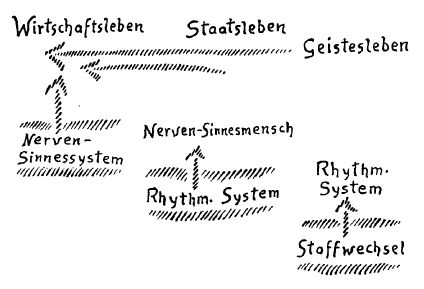
[ 14 ] But I concluded yesterday by saying: Human abilities are distributed in this way across the various regions of the Earth, and it is essential that genuine cooperation take place. Today, we are in a situation where, in terms of civilization, we are already entirely dependent on the nervous-sensory nature of the West. I used a paradox, but this paradox very clearly expresses reality. What is thought in Vienna, what is thought in Berlin, are not the thoughts that emerged from the national character and culminated in Fichte or Hegel. Those spirits have been overwhelmed. What appears today in Central Europe—in Vienna or Berlin—in books and newspapers are not Fichte’s thought forms; it is a lie when people quote Fichte today. The truth is rather this: what is now reaching the public in Berlin or Vienna is more closely related to what is being thought in Chicago or New York than to what was thought by Fichte or Hegel.
[ 15 ] But it had to happen that these three branches—of which this one in particular was initially predisposed to spiritual life—would then transmit spiritual life as a tradition of that original, elemental aspect of spiritual life, as it existed in the East, where the human being lives within it—just as he stands here in physical life—alive within spiritual life itself. Of this, only a faint echo remained in Central Europe; of this, only the tradition remains in Western Europe. This Western Europe is characterized by its own predisposition toward the life after death, toward that life which is longed for after death. I told you yesterday that in America—albeit within individual sects—an awareness is already taking shape that a person must not merely be passive here with regard to the life of the soul in general, in order to carry something through death and continue living in the spiritual world, but that they must acquire here, through their work and their actions, what they wish to carry through the gate of death. The awareness that a person will dissolve if they do not provide for their immortality here, if they do not develop an ideal sense here—even if this ideal sense manifests itself in a caricatured way—this awareness is already taking hold in certain sects in the West.
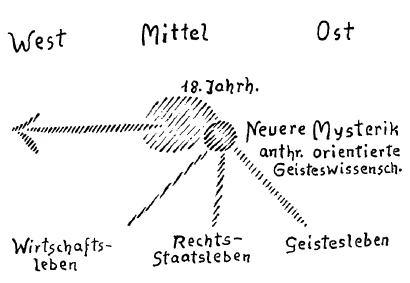
[ 16 ] But what constituted public life was pursued in such a way that one lived within the rhythmic human being and carried it up into one’s thoughts. This became particularly evident in the average person. It then radiated westward. Here we have a peculiar phenomenon that can only be understood by looking at things from within. As strange as it may seem to some, something was taking place in Central Europe. Naturally, the urge toward human coexistence—toward a social, human coexistence in freedom—remained within the rhythmic system. At first, this remained deeply embedded in the unconscious (see diagram). But what lives among people is precisely that which they do not hold in their consciousness. So let us say that in the 18th century, something specific existed in Central Europe, initially unconsciously, without being able to rise into consciousness; but it radiated toward the West. As it radiated toward the West, as it was received there, and as it did not develop naturally from within, it became a passion, it became a feeling, and it became the French Revolution.
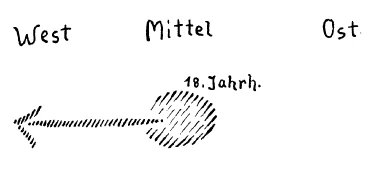
[ 17 ] Schiller came to his senses—(the diagram is pointed out)—because of the French Revolution—; there is even a symbol of the fact that Schiller reflected on what was actually happening there. As you know, Schiller had the honor of being made a French citizen—so Schiller, he reflected; but for him, it initially lived on in the rhythmic system. Well, through his own observation, he brought it to the fore and wrote his letters concerning the aesthetic education of human beings.
[ 18 ] In them you find what could be said at the time about human coexistence, about human coexistence in a truly free state. Hume, I would say, merely systematized—somewhat pedantically—this element of the state that Schiller had brought to the fore in his “Aesthetic Letters.” What Schiller drew from the depths of folk culture in these letters on aesthetic education is precisely something of extraordinary significance. Because it is so profound, it was not understood when the nervous, sensory-oriented human being became dominant everywhere.
[ 19 ] I have often told the story of a lonely man who lived in Vienna; his name was Heinrich Deinhardt. He wrote letter after letter about this aesthetic education of human beings—very witty letters. The man had the misfortune of breaking his leg one day on the street when he fell. The leg was set, but he could not recover; he died from the broken leg because he was malnourished. In other words, the man who, in the second half of the 19th century, interpreted Schiller’s *Aesthetic Letters* with the utmost diligence died of starvation. And these letters by Deinhardt on Schiller’s aesthetic education of humanity have been completely forgotten!
[ 20 ] These “Aesthetic Letters” by Schiller would, in turn, serve as good preparation for elevating the soul to a spiritual contemplation of the world. Schiller himself was not yet capable of this. But it always has an effect when another person takes in—thereby educating their own soul—something that comes from a person who has not yet ascended into the spiritual world; it enables them to glimpse into the spiritual world. However, in Europe, instead of this, people have revered Ralph Waldo Trine, Marden, and similar superficialities as a special remedy for the soul, and have forgotten the other things that would truly lead up into the spiritual world.
[ 21 ] These things must also be grasped and understood within the broader context of life and the nature of the world. One must be clear about just how varied human abilities are across the globe. And it must be said: while care has been taken thus far to ensure that Schiller’s tumultuous early works—*The Robbers*, *Fiesko*, or *Intrigue and Love*—become well-known, and while people at best rise to the sentimentalism of *Maria Stuart* or to the—admittedly—highly externalized dramatic scenes of *The Maid of Orleans* or *The Bride of Messina*, we should begin today to explore Schiller’s *Aesthetic Letters*, in which he himself—with all his *The Robbers*, with the entirety of *Maria Stuart*, and with *Wallenstein* — in significance for humanity; one should begin not merely to study these “Aesthetic Letters,” but to let them take effect upon oneself. For today we must not merely regurgitate the school-philistine drivel that has been spouted for more than a century by academic philistines about our classics—Goethe, Schiller, and so on—but above all, we must reevaluate these works and discover for ourselves what was truly great about these classics. We keep parroting what has been said about *Wallenstein* and *Maria Stuart* and so on by school philistines for more than a century. Today we have the task of grasping that greatness for ourselves in a fundamental way, for only in this way can humanity move forward. Thus, here too lies the necessity for a transformation, a renewal. Even what people read and hear in our schools about “Maria Stuart,” “Wallenstein,” “The Robbers,” and so on—that, too, must be reshaped. In these grave times, we need a complete renewal, for the times are grave.
[ 22 ] And when we look toward the West, we see that the West, with all that it can bring forth as the expression of humanity through the nervous-sensory system, calls for an ascent into that which lies beyond human knowledge in a spiritual world. And I told you yesterday: These three elements must work together so that spiritual life, political life, and economic life can assert themselves within the threefold social organism. Let us not simply say: *Ex oriente lux!* — Let us turn to the East, study the *Bhagavad Gita*, study the philosophy of yoga, study the Vedas; let us regurgitate this stuff just as we have become accustomed to regurgitating other things in Europe; let us now begin to regurgitate Orientalism, now that the other things have become boring to us. No, that will not move us forward, for what was once right for the Earth will not be so again for the present and the future; it is a thing of the past. We can admire it as something that was once right for the Earth; but we cannot, as a Theosophical Society might do, simply adopt it again in a passive manner. Nor can we simply adopt what has been handed down to us in the old way from Europe’s past; we cannot say: “What lies in the folk traditions of the East and the Middle, we can simply revive”—but we must ask: If we want to achieve a genuine union of these three elements, which are indeed inherent in human nature, how can we do so? — Only if we become aware of how the nervous-sensory life—which, after all, has already become part of us all—must transcend itself. That is to say, we must ascend to something else that can come neither from this (as illustrated in the drawing on page 142), nor from this, nor from this, but solely through the new initiation, through the new spiritual science—which is truly attained by ascending from the most modern thinking, which has been trained in the natural sciences and in the nervous-sensory realm, by ascending to the science of the new initiation and drawing from this new initiation the way in which what was once the East, what later became the Middle Realm, and what is now the Western Realm can interact. We need a new science of initiation that can bring about precisely this unity—a living unity. In modern times, we cannot attain a spiritual life unless we strive toward this new science of initiation. We cannot attain a political life, nor can we attain a civic life, if we continue to operate in the old way, if we do not turn to those branches of science that emerge from the new initiation and ask: How should the politics of the future be shaped? — Nor will we attain an economic life unless we understand that which is not to be applied to a philosophy, as Spencer did, or to a system of government, as Adam Smith did, but which is to be applied solely to the organization of economic life—unless we apply it to the organization of economic life. But we must then know how to integrate this into the other two systems. For this, however, we need the science of initiation. We cannot make progress unless we can say to ourselves: Through understanding what was once the Eastern disposition, we arrive at the essence of spiritual life. By truly understanding the disposition of the average human being, we come to truly understand what legal or political life is. By understanding the Western, we come to understand what economic life is. But the three fall apart if we cannot unite them in a higher unity. And we will only be able to unite them in a higher unity if we view all three from the perspective that arises for us through the newer mysticism, which is referred to here as anthroposophically oriented spiritual science.
[ 23 ] These things must be seen through, for whoever sees through them knows that all the striving that is currently in full swing is leading toward ruin. People fail to take the most important factors into account. Just look at even the most radical socialists. They may subjectively mean well for humanity, but they rely solely on forces of decline. They take a false view of life. We can only make a correct assessment of life if, based on the science of the spirit, we do not simply postulate something arbitrarily—saying, “It must be this way or that way if humanity is to be happy,” and so on—but rather if we can ask ourselves: What emerges when spiritual life, legal or political life, and economic life come into the right relationship with one another? What kind of social organism results from this? — Then this social organism will also embody spiritualization; that is to say, within this social organism—in addition to an economic life that is possible, not the one we dream of or fantasize about, but the one that can potentially emerge as the best possible—and if there is a political system which in turn is the best possible form, that spiritual life will be present which unites life before birth with life after death, and which will see in the human being living here in this physical world the being oriented toward justice, whose prenatal life is illuminated in the spiritual life—a life that, in economic life, cannot achieve an ideal but only the best possible outcome, yet which can transform the forces active in economic life through the science of initiation in the will, so that they shed light on life after death. Because this is so, anthroposophically oriented spiritual science is not just any theory among others, nor is it something that presents itself as a party or sectarian program alongside other party or sectarian programs; rather, it is something drawn from the knowledge that can be gained by grasping the development of the Earth and the development of humanity in their interplay and in their entirety.
[ 24 ] And one must admit today that any other relationship to the world or worldly reforms can lead nowhere, that what can advance humanity must be drawn from the science of the new initiation.
[ 25 ] This must be expressed again and again today in the most diverse ways. It has been built into this structure; it is expressed in every detail of this structure. If you look at even the smallest part of it here, it will be able to tell you what is meant here, what is expressed here in various ways through words. This is what gives the whole endeavor here a certain unified character, but at the same time expresses a will that is intimately connected with the ascending—not the descending—forces of evolving humanity, and which one would therefore hope would be understood. This is what we would like to work toward, what we would like to work toward more and more, what we would like to work toward now through the fall courses that are being held, in which it is to be shown how what comes from anthroposophically oriented spiritual science can truly have a fruitful effect on the individual branches of science. And then perhaps the time will come when people will understand what is actually intended here, when there will be so much understanding in the world that we will eventually be able to open this building at some point in the future—a future that is still shrouded in mist today. For as long as this building cannot be opened, there will still be evidence of an insufficient understanding of what is intended here.
[ 26 ] I'll talk more about that next Friday at eight o'clock.
[ 27 ] Tomorrow at 8:00 a.m., our friend Count Polzer will give a lecture here on European politics of the last century in the context of Peter the Great’s will—a thought-provoking topic that will hopefully spark a discussion. Then, on Friday, I will continue discussing the questions we have begun to explore as they apply to the individual, focusing particularly on the specific religious questions; I will continue on Saturday at eight o’clock. On Sunday at half past six, there will be the next eurythmy performance, followed by a lecture.