

Spiritual Scientific Insight into the
Fundamental Impulses of Social Organization
GA 199
21 August 1920, Dornach
Translated by Steiner Online Library
Seventh Lecture
[ 1 ] A true understanding of the various impulses at work within humanity—and of what must be recognized if one wishes to take a stand in any particular direction within humanity—is possible only if one attempts to delve deeply into the differences that exist between the spiritual constitution of one member of humanity and that of another. Certainly, for true progress within all of humanity, it is necessary for people to understand one another—that is, for there to be a sense of commonality among them. But this commonality can only develop when one’s gaze is directed toward the differences that exist in the dispositions of the soul and in the development of the soul among the various members of humanity. In an age of abstract thinking, of mere intellectualism—such as the one in which we now live—people are all too eager to look only at abstract unities. As a result, one fails entirely to grasp the true, concrete unity. It is precisely by grasping these differences that one must arrive at unity. And I have pointed out, from a wide variety of perspectives, the mutual relationships that arise between the Western and Eastern halves of the world’s population as a result of these differences. Today I would like to draw attention once again, from yet another perspective, to such distinctions within humanity. If one considers today what usually catches one’s eye when looking at general education, what does one actually find? If one directs one’s gaze toward what, so to speak, most people in the civilized world regard as their thought forms, one essentially finds something that is fundamentally Western in character and has its origin in the particular disposition of the West. What I mean is this: If you pick up a newspaper today published in America, England, France, Germany, Austria, or Russia, you will certainly sense that there are certain differences in the way of thinking and so on, but you will also notice something in common. This commonality, however, does not stem from the fact that—if I were to divide the world into the Western region, the Central region, and the Eastern region (see diagram)—what appears, say, in the newspapers and also in ordinary popular and scholarly works of literature would everywhere arise from what lies deep within the national character. For example, you do not read in a St. Petersburg newspaper what arises from the folk culture of Russia; nor do you read today in a Viennese or Berlin newspaper what arises from the folk culture of Central Europe; rather, what defines the basic configuration and character has, in essence, arisen from the West and has flowed into these individual regions. Thus, the fundamental nuance of what actually arose from the folk traditions of the West is, in essence, widespread throughout the civilized world.
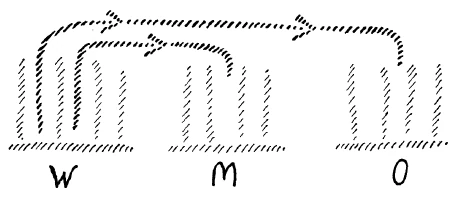
[ 2 ] One might doubt this if one looks at things superficially; but if one delves a little deeper, one can no longer doubt the things being discussed here. Take, for example, what today constitutes the mindset, underlying sentiment, and mode of thought—let’s say—of a Viennese or Berlin newspaper, or of a Viennese or Berlin work of fiction or even a scholarly book. Compare that with a London book—leaving aside the language for now—and you will find that such a comparison reveals more similarities between the Viennese, Berlin, and London or Parisian books—or even New York and Chicago books—than between the ideas and forms of thought that emerge today in Viennese or Berlin fiction and scholarly literature, and what, for example, Fichte possesses as his distinctive nuance, which he infuses throughout his thoughts as a vitalizing element. I’ll give you a specific example where you can see this.
[ 3 ] There is a statement by Fichte that is so characteristic of Johann Gottlieb Fichte—the great philosopher of the turn of the 18th to the 19th century—that no one understands it today. This statement reads: “The external world is the sensed material of duty.” For this statement means nothing less than this: When one looks out into the world of mountains, into the world of clouds, forests, rivers, animals, plants, and minerals—all of this is something that, in and of itself, has no meaning whatsoever, no reality at all; all of this is a mere appearance. It exists solely so that human beings, in the course of their development, can fulfill their duty; for I cannot fulfill my duty if I find myself in a world where I am not surrounded by anything I can interact with. There must be wood, there must be a hammer: these things have no significance in and of themselves, no materiality; rather, they are merely the sensually perceived material of my duty. And what exists out there is there so that duty can come to light at all. A person shaped this a century ago, drawing from the innermost feelings of his soul, from the innermost nuances of his state of mind, and then from the folk tradition. It has not become popular. When people today speak of Johann Gottlieb Fichte, write books about him, or discuss him in newspaper articles, they do so in a way that perceives only the outward form of the words. No one understands anything about Fichte. You can safely regard everything that is currently reported about Fichte in popular literature and academia as having absolutely nothing to do with Johann Gottlieb Fichte; but it has a great deal to do with what has arisen from Western folk culture and what has spilled over into what is also known as the rest of the civilized world.
[ 4 ] These more subtle connections are not readily apparent. Consequently, one does not even think to characterize, in an intensive and exhaustive manner, what constitutes the essence that arises from the various folk cultures. For today, everything is, after all, overwhelmed by what arises from the West and flows into the rest. In Central Europe and in the East, people believe they are thinking in terms of their own folk culture. That is not the case at first glance. They do not think in terms of their own folk culture at all; they think in terms of what they have adopted from the West.
[ 5 ] Much of what I am about to say touches on what is, in fact, the enigma of our time. This enigma of our time can only be solved when one becomes aware of the specific qualities that emerge from these individual regions. First, there is the East—this East, which, after all, does not present its true image today. If hypocrisy were not, in the first place, the fundamental characteristic of all public life in our time, the world would not be so unaware today that what is called Bolshevism is spreading with breakneck speed across the entire East, into Asia—and that it has already gone very far. People long to remain oblivious to what is actually happening and are very glad when they are not told what is actually taking place there. That is why it is, of course, very easy to withhold from them what is actually happening. Thus we will witness the East—indeed, all of Asia—being overwhelmed by what is the most extreme, most radical product of the West: Bolshevism, that is, by an element that is thoroughly alien to it.
[ 6 ] If one wishes to look into what the world of the East brings forth from the depths of its folk culture, then one can become aware—because the East has completely fallen into decadence with regard to the primordial element and is, in fact, no longer conscious of itself; because the East is currently allowing itself to be overwhelmed by what I have characterized as the most extreme, radical offshoot of the West —that one can find the true fundamental nuance of Eastern sensibility only by going back to earlier times and learning from them. Certainly, everything that was once contained within the humanity of the East is still there, but today it is all overwhelmed. What once lived in the East, what once made souls tremble there, lives on in its outermost reaches—where it is no longer understood, where it has become a superstitious cult, where it has become the hypocritical mutterings of the popes in the final, specifically Orthodox Russian cult, misunderstood even by those who believed they understood this Orthodox Russian cult. It was a continuum stretching from ancient Indian culture all the way to these formulas of the Russian cult, now merely hypocritically blurted out to the masses. For this entire disposition, which found its full expression there, which gave this East its spiritual character—a character it still possesses today, though suppressed—is the disposition to develop a spiritual state of mind that directs human beings toward the pre-birth realm, toward that which lies in our lives before birth or, rather, before conception. Originally, what permeated this East as a worldview and religiosity was such that it was connected to the fact that this East had a concept that has been completely lost to the West. The West, as I have already mentioned here, has the concept of immortality, but not that of “unbornness,” of being unborn. We speak of immortality, but we do not speak of “unbornness.” That is to say, in our thoughts we extend life beyond death, but we do not extend it back into the pre-birth period. But the East, due to the special disposition of its soul—which still incorporated imagination and inspiration into its thoughts and concepts— was predisposed, through this particular, substantive immersion in the world of imagination, to focus less on life after death than on pre-birth life, and to regard this life here in the sensory world as something that is rightfully his, having received his tasks before birth—tasks he must carry out here in accordance with the mission he has received. He was predisposed to regard this life as the duty to fulfill what had been given to him by the gods before he descended into this earthly, physical body. It is a self-evident requirement that such a worldview incorporate repeated earthly lives and the lives between death and birth, for one may well speak of a single life after death, but not of a single life before birth. That would be an impossible doctrine. For anyone who speaks of pre-existence at all is not speaking of just one earthly life, as you can see for yourself upon careful reflection. It was a gaze upward into the supersensible world, brought about by the very nature of these Eastern souls, but it was a gaze such that, fundamentally, they had in mind this life between death and a new birth, before we entered into earthly life here. Everything else that was thought about in political, social, historical, and economic terms was merely a consequence of what lay within the soul with regard to this alignment with life before birth or, rather, before conception.
[ 7 ] But this way of life, this state of mind, is particularly suited to directing the human soul’s gaze upward toward the spiritual realm, to filling the human being with the supersensible world. For here, the human being regards himself entirely as a creature of the supersensible world, as something that merely continues the supersensible life here through the sensory life. Everything that later fell into decadence—from the structures of empires to the social structures of the ancient Orient, right down to the constitution itself—became what it did because this particular state of mind lay at its foundation. And today this state of mind is, I would say, overwhelmed, because it has grown weak, has become paralyzed, because it has been proclaimed—I would say—as if from rickety limbs of the soul, as, for example, by Rabindranath Tagore, as something poured out into vague, nebulous formulas. Today, in practice, we are inundated by what is playing itself out as the most extreme radical wing of the West in Bolshevism, and the West will have to experience that what it itself does not want is being pushed off toward the East, and that in a not-too-distant time, what it has itself pushed off there will come back to meet it from the East. And that will then be a remarkable moment of self-realization.
[ 8 ] But what has this strange development in the East led to? It has led to the people of the East now directing all the sacred inner zeal they once used to nourish their impulse toward the supersensible world—to comprehend the spiritual in its purity—toward embracing the most materialistic view of external life with religious fervor. And Bolshevism, as it spreads toward Asia—even though it is the most extreme consequence of the most materialistic worldview and social outlook—will increasingly transform itself to the point where it is embraced there with the same religious fervor with which the supersensible world was once embraced. And in the East, people will speak of economic life in the very same terms in which they once spoke of the sacred Brahman. For what constitutes the fundamental disposition of the soul does not change; it remains; for it is not the content that matters here. One can grasp the most materialistic things with the same religious fervor with which one previously grasped the most intellectual and spiritual things.
[ 9 ] Let us turn our gaze away from there and toward the West. The West has brought forth the stage of human soul development that has emerged relatively most recently. This must be of particular interest to us, for it has brought forth the worldview that has risen like a mist in the West and is spreading across the entire civilized world. It is the worldview that found its most significant expression already in Bacon of Verulam, in Hobbes, and in such minds as, among more recent figures, the economist Adam Smith, the philosopher John Stuart Mill, the historian Buckle, and so on. It is a way of thinking in which there is nothing left of imagination or inspiration in concepts or thoughts, in which human beings are entirely dependent on directing their mental life outward, toward the sensory world, and on taking in the impressions of the sensory world according to the chains of thought that arise precisely from the sensory world. Philosophically, this has found its most striking expression in David Hume, as well as in others, such as Locke, and so on. It is something very peculiar, but it must be said. When one looks to the West, one must observe how thinkers such as John Stuart Mill speak of the chain of human thought. The term “association of ideas” is actually a purely Western construct; yet in Central Europe, for example, it has become so commonplace over the past half-century that people speak of these associations of ideas as if they were something distinct in their own right. For example, when teaching psychology in the sense of John Stuart Mill, one says: Thoughts in the human soul connect, first of all, in such a way that one thought encompasses another, or that one thought follows on from another, or that one thought permeates another. That is to say, one looks at the world of thoughts and sees the individual thoughts as individual little balls that connect with one another, that associate with one another (see diagram). If one were to be consistent, one would have to eliminate everything related to the “I” and everything astral, and would have to present, inwardly, a mere mechanism of thoughts—and indeed, many people do speak of this inner mechanism of thoughts. The human being is, so to speak, spiritually eviscerated. When one reads John Stuart Mill and his deductive and inductive logic, one feels as if one has been transported, spiritually speaking, into a dissection room where various animals are hanging, being gutted, their insides removed. With Mill, one feels as if the human being’s spiritual-soul nature has been removed. He first takes out the inner core and leaves only the outer shell. Indeed, thoughts then appear merely as associative, atomistic entities that coalesce when we form a judgment. “The tree is green”: there is one thought, “green,” and another, “the tree”; they merge together. The innermost essence is no longer alive—it has been gutted—leaving only the mechanism of thought and so on.

[ 10 ] This conception does not originate from the external sensory world, but is imposed upon it. I therefore pointed out in my book *The Riddles of Philosophy* that a mind such as John Stuart Mill’s is in no way connected to the inner world, but simply surrenders to it and behaves merely as a spectator in whom the external world is reflected. The point is that this way of thinking gives rise to precisely what I have often characterized: the tragedy of materialism is that it can no longer recognize matter. How, then, can materialism penetrate matter if it first strips away—in thought—what matter actually represents—for we have seen that when one delves into the human being, one is in fact delving into the true materiality of the earth? This has now reached an extreme consequence in this regard.
[ 11 ] This extreme consequence can already be observed today, except that people never see things in context; instead, they always focus only on details. Consider where this must lead if the entire real, inner, dynamic “I”—that is, the very thing that can shed light on the sensory world through the spirit—is torn out of the human being—think about where this must ultimately lead. Added to this is the fact that the human being then feels that he actually has nothing left of the world’s true content. He looks out into the sensory world. They do not know that what we said yesterday—that there are spiritual beings behind the outer sensory world—is true. If they give in to illusions, yes, then they assume there are atoms and molecules out there. They dream of atoms and molecules. If they do not give in to any illusions regarding the external world, they can say nothing other than: This entire external world contains no truth. It is, in fact, nothing. — But inwardly, he has found nothing. He is empty. He must convince himself that there is something within him. He does not possess the spirit, so he convinces himself of the spirit. He creates the illusion of the spirit. And he is unable to maintain this illusion unless he categorically rejects the reality of matter. That is to say, he immerses himself completely in a worldview that does not recognize the spirit but instead suggests it to himself—merely suggesting to himself the belief in the spirit and denying matter. You find its extreme manifestation in the West; you find the antithesis of what I have just characterized for you in the East in Mrs. Eddy’s Christian Science. It had to arise as the ultimate consequence of such views as those of Locke, David Hume, or John Stuart Mill. It is a view that is also the ultimate consequence of what has emerged in recent times in the unfortunate division of the entire life of the human soul into knowledge and faith.
[ 12 ] Once one begins to separate knowledge on the one hand from faith on the other—that faith which no longer seeks to be knowledge—this ultimately leads to the point where one no longer possesses the Spirit at all. Faith eventually ceases to have any substance. Then one must conjure up that substance for oneself. One does not seek to arrive at pure spirit through a spiritual science; rather, one seeks spirit itself and arrives at Mrs. Eddy’s Christian Science—that spirit which, as a final consequence, has found expression in Mrs. Eddy’s Christian Science. And Western politics as a whole has been breathing this spirit for quite some time. It does not thrive on realities; it thrives on self-generated suggestions. Of course, as is well known, one can also use Christian Science to heal—provided one does not have to treat the root cause—and stories of the most miraculous cures are told. Similarly, one can accomplish all sorts of uplifting things through the West’s politics of suggestion.
[ 13 ] But this Western perspective does have qualities—significant qualities, in fact. These are qualities we recognize best when we contrast them with the qualities of the East. If we look back to those times when the qualities of the East were particularly prominent, these were the qualities that were first able to perceive prenatal life—to perceive it with the eye of the soul—and which are therefore especially suited to constituting what, in a social organism, can be the spiritual world, the spiritual element. Essentially, everything we have developed in Central Europe and in the West is, in a certain sense, a legacy of the East. I have, in fact, mentioned this before on another occasion. The East was particularly predisposed to cultivating spiritual life. The West, on the other hand, is particularly predisposed to developing forms of thought; I have just described them in a somewhat unfavorable light. But they can also be portrayed in a favorable light, namely when one considers what stems from Bacon of Verulam, Buckle, Mill, Thomas Reid, Locke, Hume, Adam Smith, Spencer, or similar minds—Bentham, for example—and when one takes all of that and admits to oneself, on the one hand: Yes, this is certainly not suited to penetrating, through imagination or inspiration, into a spiritual world that encompasses prenatal life. But on the other hand, one must say—especially when one studies how deeply this way of thinking has penetrated our Western scholarship, how it lives on in our Western scholarship—one must say that all of this proves particularly well-suited to economic thinking. And if the economic aspect of the social organism is to be developed, then one will have to look to the West for guidance: to “Thomas Reid, John Stuart Mill, Buckle, Adam Smith, and so on.” Their only mistake is that they applied their thinking to science, to knowledge, and to intellectual life. If one trains oneself in this way of thinking and reflects on how to form associations and how best to manage economic affairs, then this way of thinking is appropriate. Mill should not have written a treatise on logic; rather, he should have used the intellectual capacity he possessed—which was sufficient to write such a treatise—to describe in detail the structure of a certain commercial association. And it must be said that if one wants to produce something today like my book *The Key Points of the Social Question*, one must have learned to understand the Eastern approach to the spiritual realm and the Western approach to economic thinking—even if the latter is still very much on the wrong path. For both things belong together; both are mutually necessary.
[ 14 ] In the realm of worldview, however, this leads to such aberrations as Mrs. Eddy’s Christian Science. But one must not view things in terms of what they cannot be; one must view things in terms of what they can be. For it is through the cooperation of all people across the globe that the unity of humanity must arise—not through some abstract theoretical construct that one simply imposes and then regards as unity.
[ 15 ] And one might now ask: Where, exactly, within human society does this particular way of thinking—characteristic of Mill, Buckle, and Adam Smith—actually come from? Oriental thought, especially when one looks back to the earlier days of Orientalism, essentially arose from an interaction with the world; it is the kind of thinking, the kind of feeling, that appears to one as if—I might say—the roots of a tree were growing out of the earth itself and sprouting leaves. Thus, for example, the ancient Indian seems to us to be connected to the entire earth, and his thoughts appear to have grown out of earthly existence in a spiritual way, just as the leaves and blossoms of a tree seem to have grown out of that tree through all the forces of the earth.
[ 16 ] It is precisely this fusion with the external world that characterizes the Eastern person—this absorption of that spirituality I have spoken to you about, which lies beyond the sensory world. In the West, everything is drawn from the instincts of the personality, from the depths of the personality. I would say it is the human metabolism, not the external world. For the Eastern person, the world acts upon the senses and upon the spirit, causing within him to shine forth that which he calls his sacred Brahma. In the West, it is that which rises from the body’s metabolism and leads to associations of the imagination—which, however, is particularly suited to characterizing economic life—and which is intended for the next earthly life. For what we carry within us besides the head is, as we have explained, that which will only truly find expression in the next earthly life. We have this head from our previous earthly life; we carry our limbs and our metabolism into the next earthly life. This is metamorphosis from one earthly life to the next. That is why people in the West think with what only matures in the next earthly life. It is therefore precisely this Western way of thinking that is predisposed to contemplate life after death, rather than speaking of eternity or immortality—not using the term “unborn,” but only the term “immortality.” It is the West that presents life after death as that which human beings should seek above all else. But even now, within the West’s entirely materialistic culture, something—I would say radical, yet noble precisely in the radical sense—is taking shape in this regard. Anyone who can glimpse even a little into the depths of what is about to unfold there will make a remarkable discovery. Although there is indeed a most heartfelt striving for life after death, for some form of immortality—that is, for a self-centered life after ‘death’—this striving is such that something special will develop from it; while a large part of humanity still lives under an illusion on this point, something quite remarkable is, strangely enough, developing in the West. A large portion of European humanity, because it reflects, as it were, certain aspects of this afterlife that the West has developed, has also particularly developed this focus on life after death. But what this European would most like to say is: Yes, my religion promises me a life after death, but here in this vain, this unsatisfying earthly life, in this purely material life, I need do nothing to make my soul immortal. Christ died so that I might be immortal. I need not strive for this immortality. I am already immortal; Christ makes me immortal. Or something to that effect.
[ 17 ] Something else is taking shape in the West, particularly in America. There, we see something emerging from the most diverse—and at times the most baroque and trivial—religious worldviews; though it takes on entirely materialistic forms, it is connected to what will be the life of the future, precisely in relation to this worldview of immortality. The belief is gaining ground, particularly in certain American sects, that one cannot live at all after death unless one has made an effort here in this earthly life, unless one has done something by which one earns this life after death. The afterlife is not merely seen as a judgment of good and evil—transposed into eternity according to the pattern of earthly truth—but rather, those who do not make an effort here so that they may carry their soul’s development through death will dissolve and scatter into the cosmos. What one wishes to carry through death must be developed here. And the one who does not ensure here that his soul becomes immortal also dies this second death—to use this Pauline term—in the soul. This is something that is indeed developing in the West as a worldview, not the slow, passive drifting through life and waiting to see what will happen after death. This is what is coming to the fore in certain sects in America. It may go largely unnoticed today, but numerous sentiments strive to view this life here—morally and in other respects as well—and to organize one’s way of life in such a way that, through what one does here, one carries something through the gate of death.
[ 18 ] This is how the special focus on life before birth once developed in the East. As a result, people came to view this life here as a continuation of that prenatal, supersensible spiritual life, and it derived its meaning from that—not from itself. And something is developing in the West today for the future—not a way of living here passively and indifferently, waiting until one dies because life after death is guaranteed—but rather, something through which one knows: one carries nothing through the gate of death unless one ensures here that one carries something through that gate by taking in what comes from what one already possesses.
[ 19 ] Thus, Western thought is focused, on the one hand, on the economic structuring of the social organism, and on the other hand, on developing a one-sided post-mortem doctrine. This is why spiritualism was able to develop particularly strongly there and, from there, spread throughout the rest of the world—even though it was actually invented solely to provide people who can no longer arrive at a belief in immortality through any kind of inner development with a kind of illusion that they are truly immortal. For in reality, people usually become Spiritists for the sole reason that they wish to be given, through some means, the illusion of certainty that they are immortal after death.
[ 20 ] Between these two worlds lies something akin to what Fichte put into words: “The external world is the sensually perceived material of my duty.” — As I said earlier, people today do not really understand this way of thinking. And what is written about Fichte today is really just like a blind person talking about color. Especially in recent years, an enormous amount has been said and preached about Fichte’s statement. But it has all been such that one is tempted to say: Fichte, the quintessentially Central European spirit, has in fact been Americanized by the German newspapers, by German fiction writers and authors. What we encounter there are, in fact, Americanized versions of Fichte. There is that nuance of human inner life which the middle link of the social organism must particularly develop—the one that arises from the relationship between human beings. It would indeed be good if some of you would once—though it is not easy—delve into a text by Fichte where he actually speaks as if nature did not exist at all; for example, duty and everything else are deduced only after first proving that there are also external human beings in whom the sensed material of duty can come into being. Everything lives within that—I would say as raw material—from which the legal and state organisms must be composed within the threefold social organism.
[ 21 ] And what, fundamentally, is the root cause of the catastrophic events of recent years? It stems from the fact that such things have simply not been truly understood or felt. In Berlin, American politics is being pursued. That works very well for America, but it simply doesn’t work for Berlin. That is why this Berlin policy has come to nothing. For consider this: if American politics were constantly being pursued in Berlin or Vienna, one could essentially have called Berlin “New York” and Vienna “Chicago”—apart from the language—and there wouldn’t have been much of a difference. When something is done there—in the center—that is actually foreign through and through, that belongs in the West and is right at home there, then that which is the primordial element of national character steps in and proves it false, without people even realizing it. And that is essentially how it has been in recent decades. That is the fundamental phenomenon of what has taken place—the fundamental phenomenon that consists, for example, in trampling Fichteanism underfoot and, out of instinct, reading Ralph Waldo Trine. In fact, all the aristocratic political figures have engaged with Ralph Waldo Trine and drawn their particular inner inspiration from him, or from something else. When things got particularly heated, it even became Woodrow Wilson. And the person who now wants to become president of the German Republic again is still at the point where his mind automatically reels off Woodrow Wilson’s Fourteen Points. So we have witnessed how, recently in the Grand Duchy of Baden, yet another formerly prominent German figure has been bellowing “Americanism” to the world. It is the best, most vivid example of how things actually stand. Isn’t it true that these connections—these fundamental, phenomenal connections—must truly be grasped if one wants to understand what is actually happening today? If one merely picks up the newspaper, reads Prince Max of Baden’s speeches, and extracts them out of context, then that is absolutely worthless today; it has no value at all—it is merely a kaleidoscope of words. Only those who can place such things within the broader context of the world truly understand it. And until people realize that it is necessary to gain an understanding of the world today if they want to have a say in it, things cannot get any better. The most characteristic sign of the present age is the belief that when a society adopts a hollow slogan as its general program—general unity among all races, nations, colors, and so on—something has thereby been accomplished. That accomplishes nothing; it merely throws sand in humanity’s eyes. Something is only accomplished when one looks at the distinctions, when one recognizes what is in the world. People used to be able to live by their instincts. That has now been taken from them. They must learn to live consciously. But one can only live consciously if one looks into what is really happening.
[ 22 ] The East was great in regard to pre-existence and the associated repeated earthly lives. The West was great in its disposition toward the afterlife. Here in the middle (see diagram on page 126) is where true—though today still misunderstood—historical science emerged. Take Hegel, for example. In Hegel’s thought, there is neither pre-existence nor post-existence. There is neither a pre-birth state nor a post-death state, but there is a spiritual grasp of history. Hegel begins with logic, then moves on to the philosophy of nature, develops his theory of the soul, develops his theory of the state, and concludes with the triad: art, religion, and science. This is the content of the world. There is no mention of pre-existence or an immortal soul, but only of the spirit that lives here in this world.
[ 23 ] Pre-existence — post-existence — here is the immediate life in the human present, the permeation of history. Read through what Hegel has just written on the philosophy of history. In libraries, it is usually the case that when you open the book, one page is still stuck to another; you must first separate them. Not many editions of Hegel’s books, in particular, have been published. In the 1880s, Eduard von Hartmann wrote that in all of Germany—where there are twenty universities with philosophy departments—there were only two people among the university lecturers who had actually read Hegel! This claim went unchallenged because it was true; nevertheless, all the students, of course, swore by what their professors—who had not read Hegel—had told them about Hegel. But if you familiarize yourself with his work, you will see that a conception of history has indeed emerged there—the experience of what takes place between human beings. There, too, lies the material from which the state or legal component of the threefold social organism must be carved. The constitution of the spiritual organism is to be learned from the East; the constitution of the economic is to be learned from the West.
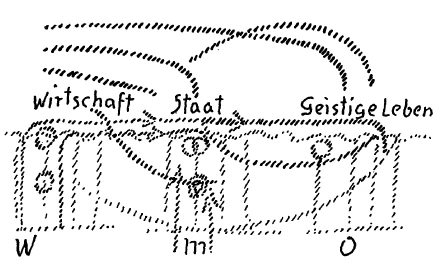
[ 24 ] One must thus look into the differentiation of humanity across the Earth, and one can understand the matter from one perspective or the other. If one proceeds directly toward the goal and studies social life, one arrives at the threefold social order as I developed it in *The Key Points of the Social Question*. If one studies human life across the globe in this way, one comes to say to oneself: There is a group with a special predisposition for the economy, there is a group with a special predisposition for the state, and there is a group with a special predisposition for spiritual life. — Here, a threefold structure can be created by taking the actual economy from the West, the state from the center, and spiritual life—renewed, of course, as I have always said—from the East. Here is the state, here is economic life, here is spiritual life (see diagram); the other two must be taken from here. This is how humanity must work together, because the origins of these three members of the social organism are found in different parts of the world, and must therefore be kept properly separate everywhere. And if people want to mix together in the old way—into a unitary state—that which is meant to be threefold, the result will be nothing other than a unity in the West, where economic life floods everything and everything else is merely subsumed into economic life. When theorists then take this up and study it—that is, when Karl Marx moves from Germany to London—he concludes: Everything must be economic life. — And when Marx’s madness reaches its peak, the three components are reduced to a single component, but one with only an economic character. If one limits oneself to what merely purports to be a state or legal construct, one imitates the economic life of the West, creating a sham version of economic life that persists for decades—which then, of course, collapses when catastrophe strikes, as indeed has happened!
[ 25 ] The East, which initially weakened spiritual life, is simply adopting economic life from the West and thereby introducing something entirely foreign into itself. It is precisely when one studies these things that one will see that blessings can come upon the earth only when what develops naturally in various places is brought together everywhere through human activity within the threefold social organism.