

Spiritual Scientific Insight into the
Fundamental Impulses of Social Organization
GA 199
20 August 1920, Dornach
Translated by Steiner Online Library
Sixth Lecture
[ 1 ] Today I would like to summarize once again some of what has been discussed here recently. We have spoken of the external sensory world in relation to the inner human world, and I have emphasized two points in particular. I have pointed out that the external sensory world must be understood as a world of appearances, and that one of the prejudices of our time is a failure to interpret this view of the world of appearances correctly. Certainly, here and there a certain recognition emerges that the external sensory world is a phenomenal world—that is, a world of appearances, not of any kind of reality, not even material reality. But people then search behind this world of external appearances for material realities, for example, for atoms, molecules, and the like. This search for atoms, molecules—in short, for any world of material reality lying behind the world of appearances—is exactly the same as if someone were to search, for example, within a rainbow—which is obviously nothing more than an appearance, a phenomenon—for all sorts of molecular entities, for molecular materialities that must lie behind it. This search for material reality in relation to the external world is, as spiritual science shows us from a wide variety of perspectives, something completely unfounded. We must be clear about this: We are surrounded by a world of appearances in what constitutes the sensory world, and we must not regard the sense of touch in relation to the sensory world any differently than we regard the other senses. Just as we see the rainbow with our eyes and do not seek a material reality behind it, but rather accept it as an appearance, so must we accept the entire external world as it is, in the sense that I described decades ago in my introduction to the *Theory of Colors* volume of Goethe’s *Scientific Writings*. And the question then arises before us: What, then, lies behind this world of appearances? There are no material atoms behind it; there are spiritual beings behind it; there is spirituality behind it. Recognizing this means a great deal; for it means, after all, that we admit: We are not in a material world, but we are in a world of spiritual realities!
[ 2 ] So when we, as human beings, turn our attention outward—where that (see diagram) is, so to speak, the boundary of our body—we encounter the sensory world, and beyond it the world of spiritual realities and spiritual beings (on the right).
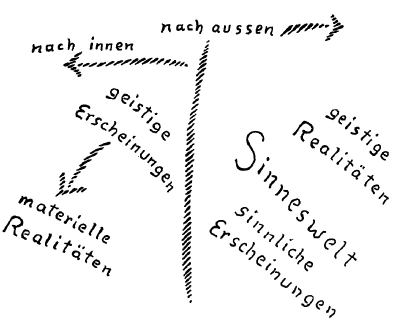
[ 3 ] If we now enter into the inner world of the human being—that is, if we turn inward—then, when we move inward from our senses, we first encounter what constitutes the content of our world of imagination, the content of our inner world. If we call the sensory world the world of sensory phenomena, of sensory appearances, then when we turn inward from our senses, we encounter the world of mental appearances (left). For, of course, as they exist within us, our thoughts and ideas are not realities, but rather mental appearances. And now it all depends on the fact that, as we descend even deeper from this world of the soul into our inner being, we do not believe that we are arriving at what mystical dreamers presuppose—a special, higher world—but rather that we are entering the world of our organism; we are entering the world of material realities.
[ 4 ] And that is why it is important not to believe that one can find something spiritual by brooding over oneself; rather, one should seek the constitution of the human material organism. One should not seek all manner of mystical realities within oneself—as I have emphasized from various perspectives—but rather one should look behind what pushes its way up into the soul, that is, what becomes a spiritual phenomenon—precisely as one delves deeper and deeper within oneself— the interplay of the liver, heart, lungs, and so on, as well as other organs that mystics in particular do not like to have mentioned. There we come to know the truly material aspect of our earthly existence. And many a person—as I have often emphasized—who believes they are delving deep into their inner being to encounter mystical realities actually encounters only what their liver, gallbladder, and other similar organs are producing. Just as tallow forms a flame, so too does what the liver, lungs, heart, and stomach produce take shape as what shines up into consciousness as mystical phenomena.
[ 5 ] That is precisely the point: true spiritual science leads people beyond any kind of illusion. It is the illusion of the materialists that behind the sensory world they can find not spiritual realities, but physical, material realities. It is the illusion of the mystics that when they descend into their own being, they can find not the world of material organization, but some kind of particularly divine sparks and the like.
[ 6 ] It is important for genuine spiritual science that we do not seek the material in the external world, and that we do not seek the spiritual in the inner world as it is initially perceived through inner contemplation.
[ 7 ] What I have just said has significant implications for our entire worldview. Just consider that we must demonstrate that, from the moment a person falls asleep until they wake up, their astral body and their “I” are outside the physical body and the etheric body. Where, then, is the human being? — We must ask ourselves this question: Where, then, is the human being? — If we assume that the world described by physicists lies out there, then it makes no sense at all to speak of the astral body or the “I” existing outside the physical body. But if we know that beyond the sensory world lies the world of spiritual realities, from which the sensory world springs forth, then we can imagine that the astral body and the “I” are drawn into the spiritual world that lies behind the sensory world. They are truly in that part of the spiritual world that underlies the sensory world; so that one can say: While sleeping, the human being enters that spiritual world which underlies the sensory world. Upon waking, however, he enters—with his “I” and his astral body—into what is first and foremost etheric being, and what is the world of material organization.
[ 8 ] One can only gain a clear understanding of what one is capable of absorbing from the anthroposophical worldview if one is able to form clear ideas about such matters. For then, above all, one will not succumb to the delusion that one can somehow seek the divine or the spiritual that underlies our humanity behind the sensory environment. There is only the spiritual that brings this sensory world forth from within itself. We ourselves, as human beings, are rooted in the spiritual world. But in which spiritual world? In the spiritual world that we leave behind when we incarnate in our physical bodies. We come from that spiritual world which we experience between death and a new birth; we enter this physical existence through birth or conception. But the world in which we find ourselves between death and a new birth—the one we leave behind—is a different spiritual world from this one; it is a spiritual world and, as such, related to this one. Yet that spiritual world gives rise to our sensory world. The spiritual world of which we speak—I have discussed it in the lecture series “The Inner Being of the Human Being and Life Between Death and a New Birth” —that world we experience between death and a new birth, which springs forth from us, which brings us into being—we do not grasp it when we seek it behind the sensory world, nor do we grasp it when we seek it within ourselves. There we find only the material aspect of our own physical constitution. We can grasp it only if we step out of the realm of space altogether. It is not in space. As I have often emphasized, we can speak of it only if we take time as our sole basis—if we conceive of it as a temporal phenomenon. Therefore, all the descriptions we have of this world between death and a new birth can, of course, be nothing but imagination, nothing but images. And we must not confuse these images, in which we are necessarily compelled to express ourselves, with the realities in which we live between death and a new birth. It is so necessary that, on the basis of the anthroposophical worldview, one does not merely speak of all sorts of fantastical things designated by the old terms—whereby one actually designates nothing new with those old terms—but rather it is necessary to enrich one’s world of concepts and ideas if one wishes to send one’s thoughts and ideas into that world which we experience between death and a new birth. So that we may acquire a concept that is extraordinarily important, one that can also be the occasion for deep reflection—albeit an uncomfortable one. This is the concept: When we have lived through the life between death and a new birth, we incarnate here in space. We emerge from something that is not spatial and enter into space. Space has meaning only for what we experience here between birth and death. And again, when we pass through the gate of death, we do not merely emerge from our body with our soul; we emerge from space—that is important.
[ 9 ] This concept, which was so familiar to people as late as the 4th, 5th, 6th centuries A.D.—and was indeed still familiar to someone who lived as late as the 9th century, such as Scotus Erigena—this idea that the spiritual essence underlying human beings, which they experience throughout their lives, as was believed at the time, only after death—as we must now say: at all between death and a new birth—this idea has been completely lost in modern times. Modern times are proud, even arrogant, of their thinking, but in reality they can only conceive of the spatial. In every thought, they live only in such a way that they think of space as well. But in order to think the spiritual, one must strive to overcome space itself in one’s thinking. Otherwise, we will never enter into the true spiritual realm and, above all, will never even come close to a truly accurate natural science, let alone a spiritual science. Precisely in light of our times, it is of infinite importance to familiarize ourselves with these finer distinctions of spiritual scientific knowledge. For what we acquire through such concepts is not merely some worldview or some content of thought. This acquisition of a content of thought is, after all, the very least that can come to us through anthroposophically oriented spiritual science. For it makes no difference whether someone ultimately believes that the world consists of molecules and atoms, or whether they believe that the human being consists of the physical body, then of something more subtle, the etheric body, then of something even more subtle, even more nebulous, the astral body, and what is even more subtle—who knows what comes next: the mental body, and whatever else may follow—ever more subtle, more subtle, more subtle—while even the etheric body is no longer adequately described when one speaks merely of “subtlety”! Ultimately, it makes no difference whether one is a materialist and conceives of the world as atoms, or whether one holds this crudely materialistic view, which is precisely the common ground of the so-called teachings of the Theosophical Society—or whatever one wishes to call it. What really matters is something entirely different: it is that we are able to transform our entire state of mind, that we must make an effort to think differently about the spiritual realm than we are accustomed to thinking about the external sensory world. It is not by thinking of something other than the sensory world as spiritual that we enter into spiritual science, but rather by thinking about the spiritual in a different way than we think about the sensory world. We think about the sensory world in spatial terms. We can think of the spiritual realm, at most, in terms of time within certain limits, because we must conceive of ourselves within this spiritual world. And we are, in a certain sense, also spiritually conditioned by time, in that we are transferred at a specific point in time from the life between death and birth into the life between birth and death.
[ 10 ] This transformation of the state of mind—that is what I have often pointed out, and what humanity today so desperately needs. For how did we end up in the calamities of the present? We have fallen into the calamities of the present because, with so-called modern progress, humanity has completely forgotten how to incorporate the spiritual into its conceptions at all. The so-called “Theosophical Society’s” theosophical teaching is, in fact, precisely the attempt to characterize the spiritual using materialistic thought forms—that is, to drive materialism right into the spiritual realm. Simply calling something “spiritual” does not constitute a spiritual understanding; rather, it arises only from transforming the thinking appropriate to the sensory realm.
[ 11 ] If people are to live together, then their relationships are not merely spatial; they are not the kind of relationships that can be conceived of using the way of thinking that has become commonplace today through the natural sciences. That is why we can no longer develop social concepts within today’s worldview, because the way of thinking to which humanity has become accustomed through the natural sciences simply does not lead to a characterization of human coexistence. Hence those aberrations that we experience today as all manner of social worldviews, and which stem solely from the fact that it is impossible to truly think about the social realm based on the concepts by which we today judge something to be right or wrong. Only when we are willing to delve into the spiritual sciences will it once again be possible to think about the social realm as it must be thought of—not if decline is to continue, but if an ascent is to take place. The education that spiritual science provides us is far more important than the content of spiritual science itself. Otherwise, we will eventually come to demand more and more that spiritual matters be presented, as they say, in a “popular” way—that is, in a crude, literal manner. We end up finding such things—which simply must be stated in a certain way so that we do not fantasize but speak of realities, as was necessary, for example, both in our anthroposophical presentations and in my book *The Key Points of the Social Question*—we end up finding them unvivid. Indeed, “vivid” is a term by which humanity today understands something quite peculiar. There are people today who speculate on this human longing to have everything presented in a crudely vivid way. And they speculate on this across the entire globe, not just in individual territories.
[ 12 ] For example, I found an interesting passage in a book published very recently, *Les forces morales aux États-Unis*, written by a French woman. The sections are: the church, the school, and women. This book contains an interesting little anecdote that illustrates how certain quarters attempt to bring to life the relationship between human beings and the spiritual world. The author recounts: One evening, I was strolling down Broadway with a friend. I came upon a church. A glance revealed that the square was filled exclusively with men. Outraged by the sight, we refrained from venturing inside. A priest in a cassock noticed us, came over, and invited us to come further inside. Since we hesitated, he asked us about our denomination. “We’re not Catholic,” I said. He urged us earnestly to enter his church and, raising his index finger, invited us: “Come here,” he said with conviction, “listen to me.” For example, if you want to go to Chicago, how do you do it? To get there, you can go on foot, by car, by ship, or by train. Logically, you’ll choose the fastest and most comfortable means of transportation. In this case, that’s the train. Of course, if you want to enter the Garden of God, you’ll likewise choose the religion that will lead you there the fastest and most safely. That is the Catholic religion, which is the express train to Paradise. The person sharing this story adds only that she was so perplexed that it didn’t even occur to her to tell him that he had forgotten to include the airplane in his vivid comparison—which he could have cited as an even faster way to reach Paradise.
[ 13 ] As you can see, someone who is eager to address people’s prejudices chooses vivid imagery here. It is a vivid image for the Catholic religion that it is “the express train to heaven.” This is, in fact, the trend of the times: vivid imagery—that is, seeking out images that place no demands on people’s thinking. But this is precisely where we must already recognize the gravity of life today, which consists in the fact that we must break free from that vividness that turns into banality and triviality and thereby drags people down into materialism regarding precisely those things that ought to be grasped spiritually. We must also seek within such symptoms what is most essential for our time. And it must be said again and again: We must not overlook such symptoms; we must not walk through our world today with blindfolds on, for it is an organism that demands to be understood through its very symptoms, because within these symptoms lies what must be discerned if we are to rise from our general decline to a state of ascent.
[ 14 ] However, it is necessary to view certain things in the proper light on this point. What has actually been drawn from spiritual scientific sources in *The Key Points of the Social Question* did not arise from any theory, but from life in all its breadth—only that this life is viewed from a spiritual perspective. And humanity cannot move forward today unless it adjusts to such a way of viewing life.
[ 15 ] I would like to bring together two aspects of life that have once again shown me in recent days just how necessary it is to guide humanity today toward this vibrant grasp of reality—but at the same time, toward a spiritual grasp of reality. For you see, yesterday I read an article by a journalist who, as I’ve been told, is named René Marchand and was for a long time a journalist for *Le Figaro*, *Le Petit Parisien*, and so on, who then fought in the war on the Russian front, who was a staunch opponent of the Bolsheviks, who then became involved with the general of the counterrevolution and was a supporter of his, and who then, in a single moment, converted to the idea of the councils, to Bolshevism. From an opponent of Bolshevism—it says here—he has become a champion, an unreserved supporter of both their leaders and the idea of the councils. It is interesting how a person like this—who, after all, belongs to the intellectuals, since he is a journalist; who lives with a deeper understanding of life, with a deeper feeling for life; who lives within what is old and traditional, within what the slumbering souls of today mostly inhabit—how such a person suddenly comes to the realization: This certainly leads to ruin! — And so the only destination that appears to him is nothing other than Bolshevism. That is to say, he now sees that everything that is not Bolshevism leads to ruin. I have already shown you how Spengler described this. Marchand sees only Bolshevism, and at first he believed that Bolshevism was merely a Russian affair. But then he discovered something entirely different; he realized that Bolshevism is an international affair that must spread throughout the entire world, and: It has now become clear to me that peace can only be restored—and that the principles which, up to this day, have been merely proclaimed by bourgeois governments to deceive the masses—can only become a reality once this new imperialism—that of the Entente—has itself collapsed, and once the peoples of all countries freely take control of their own destinies into their own hands, and so on. — And then he explains how he has now come to the conclusion that only when the world is thoroughly Bolshevized will justice, harmony, peace, and the rule of law prevail, and that only through this can reconstruction take place. This man has come to realize that everything else leads to ruin. And he says, quite accurately in essence: If what exists apart from Bolshevism is to be maintained, it must be the dictatorship of old capitalism, of the bourgeoisie, or of whatever belongs to it. It must be the dictatorship of Lloyd George, Clemenceau, Scheidemann, and so on. If one does not want that—if one does not want to head toward ruin—then there is no alternative but the dictatorship, the dictatorship of Bolshevism. And in that, he sees the only salvation.
[ 16 ] You see, this man is, in a certain sense, honest—much more honest than all the others who see Bolshevism approaching and believe that the old regime could stand up to it. At least he recognizes that all of this old order is ripe for destruction. But a question must inevitably arise, especially when one stands on the ground of the humanities, when one experiences something like this; for a person like this Ren& Marchand is an exception. The question must inevitably arise: Where does this man get his knowledge of all this? — He derives his knowledge from the same sources as most people today; he gets it from newspapers and books. He does not know life. For the people living today know life, for the most part, only from newspapers and books. The ruling classes, in particular, know life only from newspapers. How much have we experienced in this regard through newspapers and books! We have seen that, as recently as decades ago, people formed their worldviews based on French comedies; that they were more familiar with the literature featured in a comedy than with what actually happens in life; that they overlooked the realities of life and, in fact, learned only from what they saw on stage. We later witnessed how people formed their worldviews based on Ibsen, Dostoevsky, or Tolstoy—how they did not know life, nor could they judge books by life itself, but essentially absorbed only the derived life as it appeared on paper. And so they develop their mottos, they found their associations for all manner of reforms, without knowing real life—which they know only from Ibsen or Dostoevsky, or know it in a way that must often have been repulsive during the time when, for example, Hauptmann’s *The Weavers* was being performed in all the major cities of Europe. The weavers’ way of life was presented on stage. Those people who had no idea what goes on in life—whose caricature appeared before them here on stage—now, because it was, after all, the “social era,” observed the weavers’ misery from the stage and also discussed all sorts of social issues, since this was the only way they knew about such matters. Basically, these are all people who do not know life, who know it only as it is derived from newspapers, from books—from what books are today. I’m not speaking against books—one must be familiar with them—but one must read them in such a way that one looks through them at life and is able to see it. The point, however, is that we live today in an age of abstractions: abstract party demands, abstract organizational demands, and so on. And so I find it interesting that, on the one hand, we are confronted by a man as true to life as this René Marchand, who is at the same time an oracle to many, for he is a journalist who is thus never in a position to ask himself: “Yes, can one arrive at a viable way of life starting from this Bolshevism?” — For he doesn’t really know life at all; he merely replaces what he has come to know—and what he deems ripe for collapse—with a new abstract formula, with new theories. And so I had to compare these ramblings of an intellectual with a letter I received this morning, in which someone writes to me—someone who has been immersed in real life, who has experienced precisely what one can experience today to assess the social situation, and for whom the book *The Key Points of the Social Question* had become a kind of salvation—a practitioner who worked in a weaving mill and knows the practical side of things through and through. Only then will one have even the slightest inkling of what is meant by *The Core Points of the Social Question* as a book grounded in reality—yet one that has been drawn from the spiritual world, just as everything intended to serve life today must be drawn from the spiritual world; only then will one know what is meant by it when judging it from the perspective of practical life, when one knows that everywhere—in every line, in every word—it is not theory but is drawn from practical life; when one understands that it is a book for those who want to actively engage with life, not for those who want to speculate about life and spout socialist rhetoric.
[ 17 ] These are the very things that cause such pain today: that those who have no idea of reality call a book about reality “utopian,” and that those who have no idea of the reality of life—and who themselves suffer from “literaryitis”—also perceive such a book, drawn from life itself, as merely a “literary” book. And today, it is the “how” that matters, not the “what.” What matters is that we acquire forms of thought that are suitable as instruments for grasping spiritual life, for in reality, spiritual life is everywhere. There are spiritual realities in our surroundings—whether within or beyond the sensory world—and it is from these spiritual realities that social reconstruction must be built, not from the drivel found in Leninism and Trotskyism, which is nothing more than the squeezed-dry remnants of age-old, petty-bourgeois Western views that lack any power whatsoever to generate any social idea of their own. One must ask where the people are today who wish to perceive life in this way with sufficient intensity. One will not perceive it unless one perceives it from the perspective of the spirit. One will not understand life between birth and death unless one is willing to understand life between death and a new birth. For one either becomes a crass materialist if one refuses to turn to spiritual life, or one becomes an intellectual who lives in theories that enable him to grasp life only after hearing it dramatized by Ibsen, or by Dostoevsky, or by someone like that. But what matters is that we know how to understand everything we encounter in literature as a kind of windowpane through which we gaze upon life. We will only do so if we perceive, behind the sensory world, the spiritual world—the world of spiritual entities— and when we finally bid farewell to those fantasies about atoms and molecules, from which modern physics seeks to construct a world for us—and from which it would follow that the entire present world, in essence, consists truly and really only of atoms and molecules—thereby casting out everything spiritual and, with it, every moral and religious ideal. I will speak further on this tomorrow.