

Spiritual Scientific Insight into the
Fundamental Impulses of Social Organization
GA 199
15 August 1920, Dornach
Translated by Steiner Online Library
Fifth Lecture
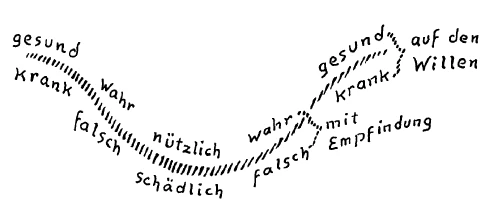
[ 1 ] Today I would like to elaborate on some points that have already been raised here repeatedly, which at the same time can serve, in a certain sense, as a preparation for what will be discussed here tomorrow regarding the formation of social judgment. I would first like to draw your attention to how, within the educational practices of the present day, we assume that we should discuss questions of worldview and form our views in such a way that our primary concern is to decide, in a logical sense: What is true, and what is false? Yet this is precisely what must change in the present. Johann Gottlieb Fichte, after all, spoke these beautiful words: “One’s philosophy is a reflection of the kind of person one is.”—Well, depending on one’s disposition, one forms a more materialistic or spiritualistic worldview, a realistic, idealistic, liberal, conservative, or socialist worldview—or even a philistine or progressive view on the issue of women’s rights. I could go on listing these things for a long time. One forms views, and one then defends these views by imagining that one’s own position is correct, while the other, who holds the opposite view, is wrong. Right and wrong are concepts that are of particular interest to us today when forming a judgment.
[ 2 ] However, it is already apparent—as we will explain in detail shortly—that a transition from this “true and false” to something entirely different is beginning. But first, let us make it clear that this “true and false” was not always as it is today. Even in the earlier times of Christianity, or even in the times of Egyptian and Chaldean civilizations—not to mention the times that preceded these cultural epochs—something entirely different applied when one sought to form a judgment. One did not form a judgment by first looking at its logical consistency, but rather had the feeling: If someone judges in a certain way, they judge soundly; if they judge in another way, they judge unsoundly. — Just as one says, when seeing someone with chubby cheeks, a rosy complexion, and a bit of vitality, that they are healthy, and just as one says, when finding someone quite gaunt, sallow, pale, with dark circles under their eyes, that they are sickly—so too did people say that if someone judged in one way or another, they were judging in a healthy or sickly manner. Thus, the way someone judged was seen as a reflection of their entire human constitution, just as much as a chubby, gaunt, or sallow appearance. People were judged more in terms of what they are in themselves, and less in terms of how they relate to an environment about which they form ideas of right or wrong.
[ 3 ] I have already emphasized here before—for some of you who were present at that time—that, in a certain sense, we must return to this way of looking at things. In a certain sense, the course of human development is such that certain instinctive, atavistic truths originated in the ancient mysteries, which were then intellectualized and abstracted. And we still live today within this intellectualism, within this abstraction. But the newer science of initiation, which must assert itself, must, in a certain sense, return from full consciousness to earlier perceptions. And so in the future—albeit in a future that is more or less distant for humanity at large—there will be no dispute over whether a judgment is right or wrong when one earnestly strives to contribute to the rise of human civilization. One will regard someone who, for example, seeks atoms and molecules in the external world instead of seeing spiritual beings behind the veil of the sensory as having a pathological mindset; one will find that he suffers from a certain kind of illness of the soul that can be described as mental deficiency. One will regard as feeble-minded the view that the external world is not a “phenomenon” in Goethe’s sense, but that something like real atoms or molecules is hidden behind it. One will call this feeble-minded, not wrong, because one will find that it arises from an inadequate organization of the whole human being. And if someone describes what rises from their constitution—from the boiling and bubbling of the liver, stomach, and so on—what comes from the blood—if someone describes this as a sublime mysticism—it can indeed be described that way, but the point is how one relates to it—if someone relates to it in such a way that they see in it something other than the flame that burns up from the organism, then one will not say that this is wrong, but rather that it is childish. “Childish,” as I have told you, is a word that means something different on the other side of the threshold than it does on this side. From this side, the matter will appear as follows: one says that a human being must mature in the course of their life between birth and death; they must become settled and level-headed; they cannot remain playful in their judgment like a child. — But when one looks at the sensory world from beyond the threshold, from the supersensible world, and sees the growing child, then one sees how the human being has descended from the spiritual world, has taken possession of the physical body, and how what has descended there works in a formative way upon the physical-material aspects of the physical world. And one then sees in a completely different way how the spiritual-soul aspect is far more perfect than what we are able to develop in life between birth and death as our intellect, as our spirituality.
[ 4 ] I have previously suggested that the wisdom which, from the spiritual world, works on the formative shaping of the human brain and the rest of the human organism can be attained inwardly by the human being between birth and death. And philosophers, such as Max Dessoir, have stumbled over such matters because, when they speak of the soul, they simply have no idea what the spiritual-soul aspect actually is. “Childlike”—speaking from beyond the threshold—simply means that the spiritual-soul aspect of the childlike mind is at work on the physical head. And what we here on this side of the threshold call a person’s genius is nothing other than the preservation of a measure of this childlike quality throughout one’s entire life. Only when one retains too much of this childlike quality and cannot perceive how it bursts forth—as the inner spark, as the inner God, and so on—from the seething organism, then one lacks genius; then one simply has too much childishness. This is something that must be objectively understood in this way. We must simply be clear that things beyond the threshold must be named differently than on this side, that the words take on a different meaning. When we speak of childishness on this side of the threshold, we actually mean something derogatory; when we speak of it on the other side of the threshold, we mean that which remains in human beings—in the true sense as genius and, in a pathological sense, as false mysticism. Thus, such false mysticism will be called pathological, and it will also be called childish. We will move on to terms that go from the merely abstract-logical back to the real. When we speak of right and wrong, we mean something that lives in a person only as a thought—a mere lack of correspondence between the inner and the outer. But when one speaks of pathological judgment, one means that something is not right within a person; this is the case, for example, when a person regards the phenomenal world as a real material world, or when they regard mysticism as a direct divine manifestation within themselves, rather than as a flare-up of organic processes. Thus, one must understand knowledge as an act. This is the essential point toward which we must strive through spiritual science: to mean, once again, the factual and the real—not merely the logical—when we speak of what comes from the human being.
[ 5 ] As I said, even in the early days of Greek civilization, people would not have understood such talk of right and wrong as we mean it today in the sense of logic. Back then, people still spoke of sound and unsound judgment. Then the successors of Platonism gradually developed a logical approach, which reached its peak in Roman culture and was carried forward into later times. And under certain conditions, this concept of true and false took on a particular form in Scholasticism, which was like an echo—albeit in a different field—of the Roman way of judging. In our time, we are still far from developing, in a spiritual sense, an understanding of sound and unhealthy judgment; rather, we are working toward something else. We have worked our way toward something that is now completely detached from the human being with regard to judgment. When I say, “A person judges in a healthy or unhealthy way,” I am referring to their constitution; when I say, “A person judges true or false,” I am at least saying something about their state of soul and mind. I am thereby expressing that they are a fool or a wise person—these are, after all, still qualities of theirs. But people have strayed from this in recent times. A particular worldview has already taken hold even among individual people. And among those who will not find themselves in spiritual scientific views, this worldview will become popular and will spread more and more. It is what is coming out of America but is already making its mark in the West—initially, however, among philosophers, who are always the first to take up such matters. It is so-called pragmatism. It no longer speaks of true and false in the sense of traditional logic; rather, it asserts that what is true is that which enables a person to throw themselves into life. If someone asserts something that does not enable them to throw themselves into life, then they are asserting something harmful. But if someone asserts something that helps them get by well in life, then they are asserting something useful. In these circles, which are based on pragmatism, truth and falsehood are already regarded more or less as wishy-washy concepts—something to which people cling as an illusion. A school of philosophy has already embraced this view; as mentioned, it is even more widespread in America than in Europe, though it is already appearing in Europe as well in a wide variety of forms. It holds that truth and falsehood are merely illusions, and that what is called true is actually only what a person asserts because it is useful to them in life. False is what people assert because it is harmful to their lives. In Germany, where people are always the most thorough in such matters, this view has taken on a very distinctive form through the so-called “Philosophy of As If.” This “Philosophy of As If,” which originates from a certain Vaihinger and has already gained some traction—I believe there is now even an “As If Science” or something similar—states: One certainly cannot claim that atoms exist, that molecules exist. But one can say: We view the world in a way that is useful to us, and it is useful to us when we view the world “as if” there were molecules and atoms; we view the course of the world “as if” moral ideals were being realized. That is useful to us. We view the world “as if” it were governed by a God. This “as if” philosophy, the philosophy of the “as if,” is very characteristic of our time. It is the German interpretation of American pragmatism, which has, however, found followers; for example, one of its followers is Wilhelm Jerusalem, who has already said: “True and false originally mean nothing other than useful or harmful in the biological sense.” If one must say of someone that he asserts something false, yet in doing so becomes a wealthy man and is able to make his way in life, then these logicians say: That is true. — But that is an illusion to us. In reality, it is not true, but rather something that is useful to him, and that is then reinterpreted; it is then called “true.” And whatever is harmful to him is then incorrect, untrue.
[ 6 ] Another passage in *Jerusalem* states: “The evaluation that a completed interpretation undergoes based on the usefulness or harmfulness of the measures taken on the basis of that interpretation—this evaluation, and nothing else, is the origin of the concepts of true and false.” — Yes, I can’t read it to you any other way—it’s philosophical style!
[ 7 ] It’s almost like legalese. So you see, here the concepts of “true” and “false” are reduced to the concepts of “useful” and “harmful.” That’s the absolute rock bottom. We start with the concepts of “healthy” and “sick,” then encounter the concepts of “true” and “false.” These are still tied to human beings: if someone judges correctly, they are smart; if they judge incorrectly, they are stupid. So at least this still points to human characteristics. Now we come to the point where we find the “true” only in what is “useful,” and the “false” only in what is “harmful.” That is the truth of our time! Philosophers articulate this, but other people today, deep down, already judge almost exactly the same way; they just don’t realize it, but fundamentally, they judge in the same way. And especially when social judgments are made, they are made exclusively from this perspective.
[ 8 ] Development must once again move upward. We must first be able to have a feeling, an inner experience of what is true, which itself gives us a sense of what is wholesome. We must, so to speak, feel happy with what is true and unhappy with what is false. This is the demand of the times, which we must strive to meet in a healthy way. We must return to true and false, but with feeling.
[ 9 ] This is what must take hold of humanity as an inner education in civilization: that people should not treat truth and falsehood with indifference, as they do now, but that each person must be able to take an inner interest in truth and in falsehood. One feels this, when looking today at the necessities of the times, with such terrible pain that people have gradually become so indifferent to one assertion or another. Things were different even a century ago. One need only imagine what would have happened a century ago if someone had said to an assembly: “Childish,” viewed from the other side, means the very same thing that, viewed from this side, might under certain circumstances be called genius! — How a Wilhelm von Humboldt or a Fichte or people of that caliber would have leaped to their feet had such a thing been said back then, when people were still fully engaged with these matters with their whole being. Today, blood does not boil or seethe when one assertion or another is made. Souls have fallen asleep. This is what fills the one who sees through the demands of the age with sorrow—that he must witness these sleeping souls. And indeed, as the ultimate flowering of this drowsiness of our time, we have been given that theosophical movement, where people seek to feel inner pleasure in listening, where they want things to be said in such a way that they are gently soothed and become ever more at peace, and where a harmonious mood washes over the listeners, so that everything can gently drift off to sleep little by little. And it is precisely then—when everything can gradually and gently drift off to sleep—that one feels the eternal mystical!
[ 10 ] That is precisely what must change; that is what we need—for our hearts to lean one way or the other, depending on which assertion is made. Then we will no longer examine whether something is right or wrong with mere logical neutrality, but we will ourselves feel healthy or sick, depending on whether we perceive something as true or false. And then we will ascend further. But spiritual science must cultivate this already now as something that must take root within us. We will have to return, in full consciousness, to the judgment: healthy or sick—and this must act upon the will. We must, as it were, be filled inwardly with will regarding what we previously perceived only as true or false. The will must be stirred. We must will what is right; we must not merely refrain from wanting, but must destroy that which is wrong—that is, sick. It is this transformation of the human being that must be sought. We must not merely strive for yet another more or less correct view—one that can then be discussed—but rather we must strive for what makes people inwardly healthy; that is to say, through knowledge we must not merely strive for something about which one can say: ‘That is logically correct’—but rather, through knowledge, we must strive for something that is action, that is reality, through which something happens.
[ 11 ] You see, true, genuine spiritual science is all about life itself—not about what might be going on today in the mind of a professor who sits in his chair and pontificates with complete indifference to what is true and what is false, while his neutrality might put one in such a mood that one feels like climbing the walls. Certainly, some will say: Yes, but the point is precisely to develop inner serenity, inner peace. — One must not misunderstand such things. Inner serenity and inner peace mean balance, and the point is that we can indeed, let’s say, swing to one side in the exercise of sound judgment, but we also have the ability to develop the counterforces so that, despite this swing, we remain in balance—that is, we always remain in control of ourselves. Conscious balance is different from a lethargic balance. So you see, what we call evolution in the spiritual-scientific sense must penetrate to the very core of the naming of truth.
[ 12 ] We cannot speak of the characteristics of a human being between death and a new birth unless we accustom ourselves to using words in a completely different sense than is customary in our everyday language today. Therefore, of course, those who wish to hear only what they already possess will find the language of spiritual science incomprehensible, because they must not only get used to the fact that words are combined in a different way, but also that something different is poured into the very essence of the words than has been poured in until now. When we look in this way at human development, only then do we gain an understanding of how different human beings were in ancient times, how different they will again become in the distant future, and how we must evaluate what exists in our present stage of civilization. Our time is so permeated by catastrophe that it is important to make the effort to gain a true understanding of humanity. In a sense, we are currently living in a time of the most crucial European decisions, and people have scarcely any inkling of what is actually taking place within this complex organism that constitutes public life. The days we are living through now are almost even more important for the future course of European civilization than the days of the recent past. We will have to come to terms with the reality that any desire to cling to the old is destructive, and that only a thorough drawing from the sources reopened by spiritual science can lead to the goal.
[ 13 ] It is remarkable how what offers a certain glimpse beyond the threshold, into the spiritual worlds, now casts its shadow into this age of such raw materialism. Two or three years ago, people would laugh at you if you spoke of the forces originating from certain secret societies in the West and other parts of the world that influence public affairs. I have given a whole series of lectures here on these matters, and some of you will have become familiar with the content of these lectures in one way or another. But one was more or less laughed at if one spoke of public affairs being permeated by forces whose origin can be traced by shining a light into certain secret societies that possess traditions of ancient initiatory wisdom and apply them in the wrong direction. Today, in a relatively short time, things have changed. The sober English press, which truly does not lend itself to wild speculations, has now been publishing articles for weeks about the existence of secret societies; and even if these articles are based on premises that are nothing more than a fabricated Jesuit plot, one must at least say: Even if people are sensing the wind blowing from a completely wrong direction, one can already see a trend toward such things today. And what has been discussed for weeks—what, I might say, has been discussed with philological precision—indicates just how thoroughly the world has changed in this regard over the past few years. But people easily overlook the fact that even—as I said—in the sober English newspapers today, compilations like this are being published, showing that as early as 1897 something emerged that resembled a description of future events. Today, this is presented by setting it out in columns on the left-hand page, while the Bolsheviks’ programs and what is happening now are shown on the right-hand page. What was already known in 1897 is happening today, and it can be demonstrated philologically that what is happening today corresponds to what happened earlier. Of course, people—without having any knowledge of the deeper connections—point these things out in a journalistic manner. Of course, very few people today sense what such matters are really about: that people who stand deep in the background of these events—yet who nevertheless hold the reins of these events firmly in their hands—wish to remain unknown and therefore shift the blame onto others. The whole thing—what is printed there—is a ruse, but it is a well-calculated ruse when one looks back at its origins, for it is designed to shift the blame onto others so that humanity does not think of those who truly hold the strings. As I said, it is already the case today that one must feel a sense of responsibility to look closely at what is actually taking place.
[ 14 ] I said the following about 1914: The history of that war catastrophe that began in 1914 must not be written the way earlier events were written—simply based on archival records. If one truly wants to understand what began in 1914, then one must turn to occult thinking; one must realize that the most important figures throughout the entire civilized world who were involved in bringing about the catastrophe were clouded, their consciousness obscured. But those moments when people’s consciousness is clouded are the gateways through which the Ahrimanic forces enter the world to guide and direct it. When someone holds an important position and, at a crucial moment, their consciousness becomes clouded, then they no longer rule—Ahriman rules through them. Spiritual forces, such as those I am referring to now—in this case, of an Ahrimanic nature—rule the world. Only by tracing these connections from the perspective of spiritual science can one understand the events of recent years; and it will become less and less possible to understand what is happening throughout the civilized world unless one seeks to understand it on the basis of spiritual science; one could spend a long time debating whether this or that person said this or that three, four, or more years ago, or is saying it today. What is far more important today is to acquire an understanding of human nature, so that one knows how sound or unsound this or that person was or is in that situation, for it depends on this whether good or evil forces are at work in the course of events. It is true that the path to judging in this way is not exactly strewn with roses; for when people are to judge in this manner the interplay of supersensible or subsensible forces in this sensory world, they are easily led to become fanciful or mystically exalted.
[ 15 ] For anyone who is to seriously pursue spiritual science, what is necessary is not merely the usual degree of sobriety, but a higher degree of sobriety; no enthusiasm whatsoever, no losing oneself—a firm standing on solid ground in reality—that is what is necessary. We must train ourselves to face reality if we are to judge as we ought to be judging today.
[ 16 ] It is a great danger when someone claims that what they say is not the result of what they want or do not want, but of higher powers. After all, there is usually nothing behind this but the purest selfishness. And the mystics who present themselves to the world as bearers of this or that spirituality are, for the most part, the greatest egoists. That is why the first thing necessary on the path to a certain higher understanding is to become sober-minded, to be able to look beyond everything connected with egoism. Enthusiasm is, as a rule, merely another form of egoism. And in particular, it will be necessary for humanity to develop a certain sense of humor on the path to spirituality. The world today is far removed from this kind of humor. And it is extraordinarily difficult to cope with the world’s judgment when it comes to such matters, because everything that organically grows and weaves in the depths of human nature has a say in the matter.
[ 17 ] This may, for the time being, serve to indicate what needed to be indicated in order to highlight, on the one hand, the importance of the path toward reaching a spiritual judgment, and, on the other hand, the difficulty and danger of that path. One must keep these two things in mind. One must not allow oneself to be deterred by the dangers; nor, however, must one become complacent regarding the efforts required to truly arrive at a spiritual judgment. One must always keep these things in mind if one wishes to understand people in the present. And without understanding people in the present, one cannot arrive at any social judgment. One must understand people today in such a way that one truly views them in their entirety—as soul, body, and spirit—so that one is able to look not only at their life between birth and death, but also at the life between death and a new birth. And fundamentally, the judgment “useful” or “harmful” has no meaning for the life between death and a new birth, but the judgment “healthy” and “sick” has great significance precisely for this time between death and a new birth. There, souls are healthy under the aftereffects of earthly life, or they are sick under the aftereffects of earthly life. To regard “useful” or “harmful”—in the sense we are explaining here—as true or false means, at the same time, limiting one’s entire view of the world to the physical world alone. And the fact that there is a pragmatism and a philosophy of “as if” in the present is the surest sign that people have no sense of all that lies beyond the threshold from the physical world to the spiritual world.
[ 18 ] However, sound social judgment can only arise on the basis of this science of initiation. For you see, if we take one area of the threefold social organism—if we take the most material and prosaic aspect, as some say—economic life. We know that this economic life will develop in a healthy way only if it develops under the principle of association. What does that mean? It means that in the future, people will not form economic judgment at all from the individual self. It will, of course, originate epistemologically from the individual self, but it will not be formed from the individual self. To form an economic judgment solely from one’s individuality will seem to the people of the future—if they develop properly—like Jean Paul’s famous sleeper, who wakes up in the middle of the night in a dark room, sees nothing, hears nothing, and wonders what time it is, trying to figure it out through thought alone. One must be in harmony with one’s surroundings if one wants to form a judgment in the middle of the night about what time it is. And in the future, if one wants to form an economic judgment—say, a judgment about prices or about how many workers should be employed in a particular industry—one will need to have associations around oneself: associations that produce within that industry, and associations that consume within that industry. And from the convergence of what emanates from these associations, one will form a judgment. To try to do this today, as is currently desired—based on individuality—would be precisely like the sleeper who wants to figure out what time it is on his own. We have just seen exactly how far one can get with such a judgment, which is not grounded in associative experience.
[ 19 ] I have, in fact, already cited another example to some of you. In the 19th century, we had informed discussions about the usefulness of the gold standard, and you can find, from people in all the parliaments of Europe and in all sorts of practical fields across Europe—from the mid-19th century and continuing into the last third of the century—the most elegant and ingenious arguments in favor of replacing bimetallism with the gold standard. What did people hope to gain from it? They said that the gold standard would bring about free trade. And what actually happened? Protective tariffs everywhere—the exact opposite of what the clever economists and the clever parliamentarians had said! I don’t mean this humorously when I say “the clever people.” They were all mistaken, but I do not call them stupid or foolish for that reason; they were truly intelligent. But they lacked experience—economic experience—because such experience cannot be conjured out of thin air or developed through mere reflection; it can only be gained by drawing connections between various factors within an associative context. And just as one reads the time from a clock, so too does one derive from these associations the foundations for an economic judgment that can lead to action.
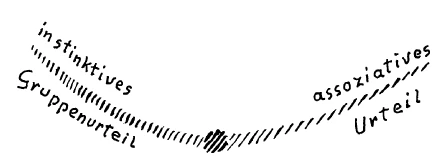
[ 20 ] What does all this mean? You will recall that I have often said how, at a certain starting point in the development of humanity, there existed a kind of group judgment, a group soul. At that time, people—acting on instinct—judged and felt the same way as a whole group. Languages would never have developed if people had not judged in such groups. There was even, as I have explained in several lectures, a group memory. So we started with groups, with instinctive group judgment. We then reach a certain lowest point, and we rise again through associations—but now consciously—by uniting people into groups in economic life, forming associations that are sustained and supported by their economic judgment. We rise again to associative judgment. The difference is that these groups will be formed consciously; what previously occurred atavistically and instinctively will now take place with full consciousness. Here you have yet another of the justifications that can be derived from spiritual science for the necessity of such social development as is outlined in *The Key Points of the Social Question*. These things are such that they follow with absolute mathematical certainty when one delves into the sources of true knowledge. These things are not carelessly thrown into the world, but are drawn from the very foundations of human life. And this is precisely what our time needs: that a social world be built upon an understanding of human nature. Without this, we cannot move forward; without this, all talk of left- and right-wing politics, of all dogmatic dictates that people must believe in a God, of everything from the most philistine to the most liberal views on the women’s question, from the most reactionary wing to the Bolshevik wing—without this, all of that remains mere idle chatter that will not establish any reality but will only lead to destruction. Only through spiritual experience will reality be grasped. But then one must be able to engage with a genuine understanding of human nature; then one must see how something that is demanded with full consciousness as an associative link in economic life yields, in its ascent, precisely that which was lost in its descent—namely, atavistic, instinctive judgment. We are dealing with a genuine, authentic, and completely transparent science—a science as transparent as the Pythagorean theorem, even if today’s scientists themselves do not acknowledge this transparency. But there must be a sufficiently large number of people who perceive this inner crystal clarity of the judgment that alone can lead from decline to ascent, springing from the sources of spiritual science.
[ 21 ] I also wanted to mention this as a kind of preparation for tomorrow, when we plan to discuss—through lectures and open discussion—the formation of social judgment and the necessity of such a formation in today’s social conditions.