

Spiritual Scientific Insight into the
Fundamental Impulses of Social Organization
GA 199
28 August 1920, Dornach
Translated by Steiner Online Library
Tenth Lecture
[ 1 ] I have often had to mention here how essential the science of initiation is to the forces that are to bring about the reconstruction of a declining civilization, and how necessary it is to recognize what arises from that view of the world which is possible from beyond the threshold to the supersensible world. One might say that humanity’s spiritual development originated in a form of knowledge—and the corresponding perception, feeling, and will—that was drawn from beyond this threshold. Everything that is revealed when one goes back to the primordial wisdom of humanity becomes understandable if one can trace this primordial wisdom back to the revelations that came from the knowledge of the mysteries—that is, if one can assume that, in the early stages of its earthly development, humanity had access to sources of knowledge, sources of sensation, sources of will that are not accessible through the purely human forces known to humanity today. Then development has progressed to the point where human beings have become increasingly dependent on what can come from within the human being itself, and this is, in essence, the content of those forces of human civilizational development that have been at work in recent centuries.
[ 2 ] These forces, which have thus far come from within humanity itself, have indeed brought about a state of civilization that would inevitably lead to decline if it were left to its own devices. Even today, people in the broadest circles still do not believe this. They automatically continue to speak and act in the old way and reject what is being drawn in a new way from the same spiritual sources—but now directly through human powers—from which the ancient wisdom of the mysteries was once drawn. We must address in very concrete terms what can be revealed to present-day humanity—as it were, as a foundation for everything we need in the coming period in terms of knowledge of nature, as well as the knowledge that underpins human ethics, moral teaching, and social will. We must address certain matters here that have, in fact, been discussed here in recent weeks from a wide variety of perspectives—matters that I would like to touch upon again today from a particular point of view. |
[ 3 ] When we stand awake in the world, we are, after all, first and foremost surrounded by the external sensory world—by everything that essentially constitutes the impressions exerted on our eyes, ears, organs of warmth, and our senses in general. The external sensory world spreads out around us. The inner life of most people consists, in essence, of nothing other than a kind of further processing of these external impressions. From beyond the threshold, however, the external world appears in a different sense than it does from this side of the threshold. You know, after all, where humanity has arrived in recent centuries, during which it has essentially limited itself to observing the world from this side of the threshold. Humanity has come to—if I may put it schematically—look at itself, so to speak. We call what one sees there the threefold human being: the head human, the rhythmic human, and the limb-metabolic human. Here we wish to schematically indicate that tapestry that spreads out around us (see drawing on page 165), which essentially constitutes the content of the sensory world. From this side of the threshold, people now speculate about what lies behind this sensory tapestry. They speak of molecules, atoms, and substances performing all manner of dances behind it. They give these dances all sorts of names, but they are convinced that when a person looks out through their eyes, listens out through their ears—in short, perceives through their senses—there lies some kind of material world behind it.
[ 4 ] From beyond the threshold, nothing of such a material world out there is revealed; rather, it becomes immediately apparent—as soon as a person enters even slightly into the region that lies beyond the threshold—that behind this tapestry of the senses lies a specific realm of the spiritual world; that is to say, we are essentially dealing with the spiritual world that lies behind this sensory world.
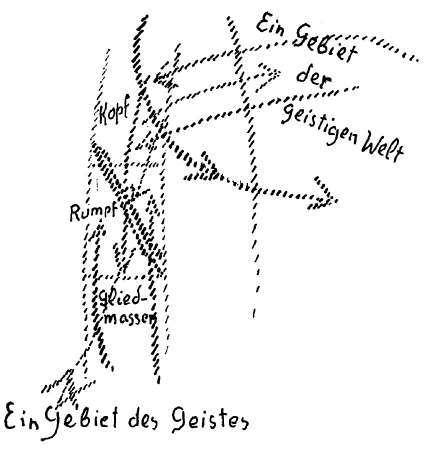
[ 5 ] If we take into account that the human being consists of the “I,” the astral body, the etheric body, and the physical body, then we must say: When a human being is awake—that is, when their “I” and astral body are immersed within their physical organism—they have no part in the world that lies here as the spiritual realm behind the veil of the senses. But when a human being sleeps—that is, when they have withdrawn their “I” and astral body from their physical organism—then they are present with their “I” and astral body within this realm of the spiritual world. Thus, from the moment a person falls asleep until they wake up, they are part of this realm, which lies, so to speak, behind nature as a spiritual natural world. One could also say that it is the world to which a person belongs from the moment they fall asleep until they wake up—a certain realm of the spiritual world that is assigned to them precisely for this state of sleep.
[ 6 ] After all, a person can only look within to a certain extent. A person can reflect inwardly to a certain extent; when speaking of their inner life—of thoughts, feelings, and impulses of the will—they do so. They usually speak in a highly vague manner about these thoughts, feelings, and impulses of the will. From this inner world, which remains quite vague to them, they draw forth those thoughts that form memories; but they do not see beyond this inner world of theirs. And we can say: just as there is, so to speak, a boundary here—like a partition—between ourselves and a certain realm of the external world, so we can draw a boundary that the inward gaze cannot penetrate (see illustration on page 165). If, however, a person were to delve into this region, which lies, so to speak, beyond the mirror that reflects his memories back to him, he would not discover what many deluded mystics believe—namely, one need only brood within oneself to recognize the highest spiritual reality; rather, one would discover precisely the mysteries of one’s own organization—the mysteries of this marvelous structure that manifests itself in the human organism. If a person were to truly see through this, they would not perceive the imaginings of Mechthild of Magdeburg or Meister Eckhart or Saint Teresa, but rather they would behold the human organism—which would appear quite prosaic to certain deluded mystics, though it certainly does not appear prosaic to those who have a true sense of the true mystery of the universe. For it must be said: far more wondrous than the imaginings of Saint Teresa, Mechthild of Magdeburg, or Johannes Tauler—far more wondrous than these reminiscences, forged from the reflections that live on as memories, imbued with those sensory impulses that radiate from the liver, stomach, spleen, and so on—far more wondrous than all of this, indeed far more wondrous than everything that has been depicted, for example, in the archetypes of human development found in myths, legends, and the like—is that which builds itself up within the prosaic organs of the human interior. As strange as it may sound, the truth must be recognized on this point. But what is taking shape there is, first and foremost, the truly earthly-material, that which actually constitutes earthly matter. We do not find earthly matter in the external world. Earthly matter lies within the human skin. But then again, these organs, this entire inner structure of the human being, are nothing other than—I would say—something that is squeezed out from another spiritual realm. It is a realm of the spirit that, so to speak, sweats out of itself what constitutes the organs in the human organism. Behind this organology—which is first discovered when a person looks into their inner self, when they see through the tapestry of memories that otherwise shines out at them, even if sometimes mystically embellished—when they look through this tapestry of memories, just as they can see through the tapestry of the external senses from beyond the threshold—behind this organology, they then see the other realm of the spirit, to which they now belong from the moment they fall asleep until they wake up—a realm they do not pay attention to as a spiritual realm, but which is precisely the spiritual realm that gives them the forces that manifest in their limbs.
[ 7 ] When we reflect on our senses, we find that forces dwell within them. These forces are essentially those that lie behind the veil of the senses, penetrating us through our sensory openings (see illustration), unnoticed when a person perceives the world only from this side of the threshold.
[ 8 ] But forces from the realm of the spirit—which I have indicated here below (see drawing on page 165, arrow)—also live within our organs. And the forces we have in our arms and legs are actually the forces that come from the other realm of the spirit. So that when a human being is viewed from beyond the threshold, they appear as the confluence of two spiritual realms. And what first meets our gaze when we observe a human being here in the earthly world is, in essence, at first only an apparent unity. This apparent unity is not, in fact, the human being at all. The human being is the confluence of the spiritually active forces from the two realms I have indicated to you. And the forces that are at work, for example, in our eyes and in our ears are, at first glance, of a completely different origin than the forces that come into play when we place one leg in front of the other or when we move our arms. One cannot hold such a conception without becoming aware of how the human being is, so to speak, embedded in the entire cosmos; how, through his senses, he belongs to a certain spiritual realm of the cosmos; and how, through his limbs, he belongs to another spiritual realm of the cosmos. Only what lies, so to speak, in the middle—the rhythmic human being, the respiratory system, the cardiac system, and all that belongs to them—is actually of earthly origin; it is, so to speak, woven from a kind of middle world. Thus, the human being is, in and of itself, a threefold being. And without grasping this threefold nature, we cannot understand the human being. I say that this is how the human being appears when we view him from beyond the threshold. There he stands before us as a link in the entire cosmos. Through spiritual science, one becomes aware of how the human being lives within the entire cosmos, is formed out of this cosmos, and one will then no longer be far from the truth—the truth to be recognized—that human beings have not only to fulfill the tasks they carry out here on Earth, but that they have tasks to fulfill within the entire cosmic evolution, that they constitute, so to speak, an essential factor in the entire spiritual cosmic evolution.
[ 9 ] So one can say: spiritual science opens our eyes to what a human being is as a part of the cosmos. Just think how—I would say—Lilliputian in comparison what people today think about human beings appears. Today, after all, people are willing to accept as knowledge only what comes from this side of the threshold. They consider only what is revealed to them between waking and falling asleep, and what is revealed to them between birth and death. And they also wish to construct everything that human beings can possibly accomplish here on Earth as a task out of the concepts and ideas that arise from this Lilliputian view of humanity. This does not move us forward. It is precisely because of this—because our intellectuals, in particular, refuse to construct the world’s tasks from anything other than what they gather from all that lies between waking and sleeping and between birth and death—that we are sliding further and further into decline. But what human beings accomplish is something far more profound, and this can only be understood when everything that can be mustered from the ordinary observation of life is illuminated and enriched by what can be known from the view of the world from beyond the threshold. And the development of world civilization simply cannot improve unless we take in what can be gained from beyond the threshold for human knowing, feeling, and willing.
[ 10 ] One might say that it is particularly painful today to see how all this fragmented knowledge—this knowledge that has been curtailed on all sides, which humanity has accumulated over the last three to four centuries—is now being turned into life programs. One actually finds oneself in a strange situation when faced with these life programs. Today there are religious communities that, at least according to the letter of the text, follow what they have inherited from earlier times—times when the ancient mystery knowledge was still alive. It is no longer understood within these religious communities. It is merely passed down according to the letter of the text; it has been squeezed dry, becoming like a squeezed lemon. In essence, it is no longer really there. It can, of course, be penetrated in a certain sense by one person or another, especially if one or the other ventures into areas that their church usually forbids them to explore. Then they can gain a great deal precisely from the traditional, old denominational knowledge. If, for example, a Catholic today—regardless of what is prescribed for him—reflects on the Trinity or the Incarnation, he may arrive at something very significant. And in many respects, it would be wiser to reflect on the Trinity or on the Creed than to support those movements that are emerging today and forging a new creed, a new body of knowledge, out of today’s truncated and incomplete understanding. For far more truncated than what has traditionally been preserved from the past—though it is, of course, distorted by the denominations—is what humanity has piled up over the last few centuries and what it uses today to launch movements in the world that purport to introduce improvements. It is indeed lamentable to see today how all manner of socialist or women’s movements—or the like—which have been cobbled together from the truncated knowledge of the past centuries, believe they can change the world, while they merely talk past what actually matters.
[ 11 ] This is due—and this must be said—to a certain, almost invincible arrogance on the part of humanity today, that arrogance which refuses to learn anything at all. When anyone has grown up within a movement or a political party, they usually feel that the party has not yet attained precisely what they themselves already possess from their current vantage point in life, and so they pass that on. That is precisely the tragedy of the present day: that so much truncated material is presented as reformist. Truly fruitful work can be accomplished today only if what can be explored beyond the threshold of the sensory world flows into everything that people seek to present as earth-shattering. For you see, out there is a certain realm of the spirit, beyond the carpet of the sensory world. What, then, is the purpose of this realm of the spirit? This realm of the spirit—just think of it as the very same world in which, when we are awake, we are not present with our consciousness, yet in reality we are fully immersed in it with our entire organism; for as we stand, as we walk, we are indeed within this world—we simply do not see it. We are constantly moving through this world; we are in it, we act within it, and when we pursue a political agenda like that of the Bolsheviks, what the Bolsheviks fail to see rebounds upon humanity, because the Bolsheviks want to construct a world solely out of what they see. But they are not in the world they see; they are in the world that lies beyond the veil of the sensory world. When women’s movements emerge today and make all sorts of demands, they do so based on what they see; but they demand it for the world they do not see. Therefore, what actually exists in the world in which we do live—but which is absent from the demands being made—always rebounds upon us, because people resist taking in anything from the spiritual world.
[ 12 ] And this world, this realm, naturally has its significance within the greater cosmos. Why is it there, after all? You see, when we consider the world in which we live—between death and a new birth—it is a different world from the one that lies here, beyond the veil of the senses. This world, which we enter between death and a new birth, is a different realm of the spiritual. It is the realm of the spiritual in which, essentially, those beings dwell whom we refer to when we speak of the hierarchies of the Angeloi, Archangeloi, and so on. But this world of the beings of the nine hierarchies—this world can exist only if, through the physical human being—and only through him can it do so—it enters into a certain interaction, a reciprocal exchange, with the world that I have described here as the realm of the spiritual world beyond the realm of the senses.
[ 13 ] If you live in a house and want to interact with the outside world without going outside, then you must look out the window. If the gods of the nine hierarchies want to interact with this world, they must do so through human beings. They cannot do so directly; they must do so through human beings. This is a realm that the gods can observe only through human beings. Human beings must enter this physical world from the realm they experience between death and a new birth in order to mediate, on behalf of the gods, communication with this world that is developing here (see illustration on page 165). And this world that is developing here beyond the veil of the senses—what is its purpose? The world that also exists there would, if this world were not there, scatter in all directions. It is the world that would scatter in all directions (see the following drawing, arrows). It is the world in which only forces of repulsion exist. And this world here, which lies beyond the tapestry of the senses—it holds this world together (circle). So that we can say: When a person looks toward the world beyond the tapestry of the senses, they are looking toward the world that is the realm of centripetally acting entities. They hold the world together. In the other world, there is a tendency to constantly grow larger, to constantly expand; this world (circle) holds it together.
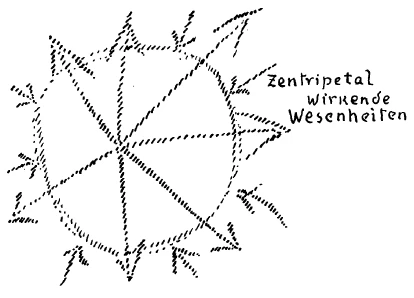
[ 14 ] But even the gods come into contact with this centripetal world only through human beings. This is the meaning of humanity’s entry into the cosmos: that the world of the gods can enter into a relationship—a perceptible relationship—and into communion with this centripetal world.
[ 15 ] This centripetal world, when viewed from beyond the threshold, is cold, icy. It is a world that, when perceived, essentially feels like something that freezes, like something that calcifies, yet it is full of wisdom. In a sense, it is entirely woven from wise thoughts, yet it is cold, rigid, and evokes a chill. And this cold, rigid world of power holds the other world together. Human beings are not organized in such a way that they can sense this world directly. Those who enter the realm beyond the threshold feel this chill, this cold constriction. And this is a sign that one is truly entering—with one’s ego and one’s astral body—the world into which human beings enter every night, but without consciousness, and thus do not perceive it. It is a sign that one is entering consciously when one enters a world that makes one shiver, that permeates one with radiant, boundlessly intense wisdom, yet still makes one shiver. Without this shivering, without this feeling of becoming frozen, one cannot initially sense oneself with the “I” and the astral body beyond the threshold.
[ 16 ] This is the experience that can be had there. It is something that, fundamentally speaking, can only be attained through experience. It must be approached in the spirit of the discussions you will find in my book *How Does One Attain Knowledge of the Higher Worlds?* and in my *Outline of Esoteric Science*—all of which are sufficient to enable these experiences, provided they are pursued consistently—one must simply enter the realm beyond the threshold. It is a real realm, just as real as the realm of the sensory world.
[ 17 ] But once you know this, once you realize that this realm exists—you cannot understand the world unless you realize that this realm exists—then something else will also become clear to you, namely: why human beings move about in this realm. Isn’t that right? After all, a person cannot go about with this constant shivering, with this constant feeling of cold. That is why, for their ordinary consciousness, a boundary is established in the first place. A person would truly have restless nights if they were to consciously experience the time between falling asleep and waking up. But why does a person—after all, they also walk around in this very same world when they are awake—why do they walk around in it? They bring into this world—into this world of centripetal world forces—that which lives within them. And when we take a close look with the eye of the soul at the forces that live within the human being—we will speak of this in greater detail tomorrow—we can name them love, warmth, the warmth of the soul; and human beings carry this warmth of the soul into this cold realm. They are the warmers of this realm. This is something that, first and foremost, belongs to their cosmic task. Human beings are the warmers of this region. In that—if I may put it this way—when the gods created human beings, they created—now let me put it in trivial terms—the opening precisely for this region, which must hold together the world that would otherwise scatter in all directions.
[ 18 ] This is just one example—we will hear others tomorrow, ones that lead us into the social realm, so that we may understand what mission human social life on Earth has for the entire cosmos— but this is just one such example of how, from beyond the threshold, the human being reveals himself with a task that is not limited to what is usually regarded as his earthly mission, but rather how the human being has a cosmic task, how he exists for something that lies, so to speak, within the great world plan of the divine spirits. And just as one must recognize that human existence as such is meant to bring about something in the universe, so too must one be able to recognize, with regard to everything—even the smallest human activities—that humanity is truly a part of this entire cosmos, that everything it does has significance beyond what it can initially perceive with its consciousness, that it has meaning in the context of the entire cosmos; that by expanding ordinary, petty human sensations, one can transform these sensations into a cosmic sense of the world. This is what is important in spiritual science. And this is what humanity needs now.
[ 19 ] Especially in the last three to four centuries, all of civilized humanity has, so to speak, fallen out of its heavenly realm; it has concerned itself only with what arises from birth and death and between waking and sleeping. Today, life as a whole consists solely of this. But this life is doomed to death; this life is one that is gradually withering away. And no matter how many socialist theories and their transformations into so-called actions you introduce into this life, they only hasten its decline. No matter how many women’s movements you introduce into this life—and if you do not allow these women’s movements to be inspired by a new spiritual science—you will be able to achieve less and less of what one actually instinctively desires through such women’s movements and the like.
[ 20 ] One must always grasp that which needs to be fertilized today at the right end. Oswald Spengler, who wrote the book on the Decline of the West and who, based on scientific premises, correctly calculated that the decline of the West must inevitably occur at the beginning of the next millennium—though, of course, only if one takes into account what was available to Oswald Spengler— Oswald Spengler is, in a sense, right: this decline will indeed take place unless a new impetus comes from the spiritual sciences. He does not admit this, which is why he is right from his own standpoint in writing only about the decline of the West. From this sense of decline, Spengler—this theorist of decline—can utter many meaningful words. For example, he once spoke quite aptly about those philistine philosophies or philistine mysticisms—or whatever one wishes to call them—that have emerged recently, such as vegetarianism and the discussions about food as they are usually conducted, particularly as they appear in those philistine journals that are typically found in vegetarian restaurants. It is a philistine philosophy; it is the most philistine thing imaginable. But why is that so? Is it so in the absolute sense? Yes, what is being said there is, of course, philistine in the absolute sense; but over the last three to four centuries, people have failed to see the spirit behind these things. People today do not speak of the spirit. Vegetarianism, anti-alcoholism, and other “noble” causes—they’re all discussed from the purest materialistic standpoint. The spiritual essence behind them goes completely unnoticed. And so the point is that these very things have, in fact, triumphed. The bourgeois nature of this stems from the fact that people who want to start becoming spiritual today are, at heart, often the worst materialists, because they adopt the concepts of other materialists and then somehow build a spiritual system based on them.
[ 21 ] In this regard, even theoretical constructs are extraordinarily interesting. For example, as most of you will know, there is a certain Leadbeater who is active in the Theosophical Society. This Leadbeater has written all sorts of books; a large number of people were particularly delighted when he wrote something like *Occult Chemistry*; I have even met scholars who were extraordinarily delighted by this *Occult Chemistry*. What actually happened there? This Mr. Leadbeater became acquainted with contemporary materialistic chemistry, with its molecules and atoms. This modern materialistic chemistry, with its molecules and atoms, describes oxygen, hydrogen, nitrogen, iron oxide, sodium acetate, and so on—it builds everything on these molecules and atoms. Leadbeater, on the other hand, constructs the spiritual worlds, the spirits, the angels, and so on, out of such atoms. He creates a form of spiritualism out of materialism. I have seen people walking around in sheer rapture when, among the various things—there were, after all, sometimes such “fat droplets” floating about on the surface of the Theosophical Society, weren’t there?—when one such “fat droplet” had once floated by: the so-called “permanent atom.” This permanent atom: a strange thing! A person dies, is reborn; what is it that passes over? Of course, people could not conceive that the human organism is constituted by forces. It would be downright impossible for them to imagine how the physical body reorganizes itself into the next life, how the head is carried over from the previous life, for they imagine the head and the limbs to be merely something of coarse material that is, of course, simply lowered into the grave. They cannot imagine that there are forces within them and that these forces are actually what is meant when one speaks in this way. Something must surely pass over into the next earthly life. There is one atom among all these millions, billions of atoms; it passes through the spiritual world, and then the atoms of the next organism group themselves once again around this one atom, the permanent atom. It was a source of sheer delight for theosophists to see how this fat droplet, the permanent atom, floated on the watery broth of the Theosophical Society—on the spiritual watery broth.
[ 22 ] These things are really only meant to be said to illustrate how, in the present, everything—even that which seeks to strive toward the spiritual—is corroded by the materialistic ideas of the last three to four centuries, and how one must break free from these ideas in order to achieve any kind of reconstruction. However, as I said yesterday, this is indeed the case today: there are forces that are determined to prevent the emergence of anything that might in any way serve humanity’s renewal.
[ 23 ] You might ask: Does humanity really want its own downfall? — Surely one cannot assume that people want the downfall of the entire civilization. Yet observation shows that they do want it, because they continue to live in the old way without even thinking about it. I will explain to you why they want this. I need only point out a single phenomenon to you, and that phenomenon will serve as an explanation. Have you not seen insects flying around a room when there is a burning light, and these insects rushing into the burning light? Study this phenomenon, and you will gain a clear picture of the state of mind of humanity today. One need only take the phenomena of nature for what they are—as symptoms of the interplay of forces in the universe. Well, we will speak further about these things tomorrow and try to find a direct path to a certain social vision.