

Spiritual Scientific Insight into the
Fundamental Impulses of Social Organization
GA 199
28 August 1920, Dornach
Translate the original German text into any language:
Versions Available:
Spiritual Scientific Insight into the Fundamental Impulses of Social Organization, tr. SOL
Zehnter Vortrag
Tenth Lecture
[ 1 ] Ich habe hier öfter erwähnen müssen, wie notwendig zu den Kräften, die einen Neuaufbau der niedergehenden Zivilisation bewirken sollen, die Wissenschaft der Initiation ist, wie notwendig es ist, dasjenige zu erkennen, was sich ergibt aus jener Betrachtung der Welt, die möglich ist von jenseits der Schwelle zur übersinnlichen Welt aus. Man kann sagen, die geistige Entwickelung der Menschheit ist ausgegangen von einem Erkennen und demgemäßen Empfinden, Fühlen und Wollen, das hergenommen war von jenseits dieser Schwelle. Alles, was sich offenbart, wenn man zurückgeht zu den Urweistümern der Menschheit, wird ja verständlich, wenn man diese Urweisheit zurückführen kann zu den Offenbarungen, die aus dem Mysterienwissen gekommen sind, wenn man also annehmen kann, daß zunächst der Menschheit in ihrer Erdenentwickelung zugänglich waren Wissensquellen, Empfindungsquellen, Willensquellen, die durch die heute der Menschheit bekannten rein menschlichen Kräfte eben nicht zugänglich sind. Dann ist die Entwickelung so fortgeschritten, daß die Menschen immer mehr und mehr angewiesen worden sind auf das, was aus dem Menschen selber kommen kann, und das ist ja im wesentlichen der Inhalt jener Kräfte menschlicher Zivilisationsentwickelung, die in den letzten Jahrhunderten tätig waren.
[ 1 ] I have often had to mention here how essential the science of initiation is to the forces that are to bring about the reconstruction of a declining civilization, and how necessary it is to recognize what arises from that view of the world which is possible from beyond the threshold to the supersensible world. One might say that humanity’s spiritual development originated in a form of knowledge—and the corresponding perception, feeling, and will—that was drawn from beyond this threshold. Everything that is revealed when one goes back to the primordial wisdom of humanity becomes understandable if one can trace this primordial wisdom back to the revelations that came from the knowledge of the mysteries—that is, if one can assume that, in the early stages of its earthly development, humanity had access to sources of knowledge, sources of sensation, sources of will that are not accessible through the purely human forces known to humanity today. Then development has progressed to the point where human beings have become increasingly dependent on what can come from within the human being itself, and this is, in essence, the content of those forces of human civilizational development that have been at work in recent centuries.
[ 2 ] Diese aus dem Menschen selbst bisher gekommenen Kräfte, sie haben ja einen Stand der Zivilisation hervorgerufen, der unbedingt, wenn er auf sich selbst angewiesen bliebe, in den Niedergang hineinführen würde. Das glauben ja die Menschen der weitesten Kreise heute noch nicht. Sie reden und tun automatisch weiter im alten Stil und weisen zurück, was in einer neuen Art aus denselben geistigen Quellen, aber jetzt unmittelbar durch die Kräfte des Menschen, geholt wird, aus welchen einstmals die alte Mysterienweisheit geholt worden ist. Man muß ganz im Konkreten eingehen auf dasjenige, was sich da für die Menschheit der Gegenwart enthüllen kann gewissermaßen als eine Grundlage für alles das, was wir brauchen für die nächste Zeit an Naturwissen, brauchen an Wissen, welches hält die menschliche Ethik, die menschliche Sittenlehre, aber auch das soziale Wollen. Man muß da schon eingehen auf gewisse Dinge, die ja in den letzten Wochen hier von den verschiedensten Gesichtspunkten besprochen worden sind, die ich von einem gewissen Gesichtspunkte aus auch heute wiederum andeuten will. |
[ 2 ] These forces, which have thus far come from within humanity itself, have indeed brought about a state of civilization that would inevitably lead to decline if it were left to its own devices. Even today, people in the broadest circles still do not believe this. They automatically continue to speak and act in the old way and reject what is being drawn in a new way from the same spiritual sources—but now directly through human powers—from which the ancient wisdom of the mysteries was once drawn. We must address in very concrete terms what can be revealed to present-day humanity—as it were, as a foundation for everything we need in the coming period in terms of knowledge of nature, as well as the knowledge that underpins human ethics, moral teaching, and social will. We must address certain matters here that have, in fact, been discussed here in recent weeks from a wide variety of perspectives—matters that I would like to touch upon again today from a particular point of view. |
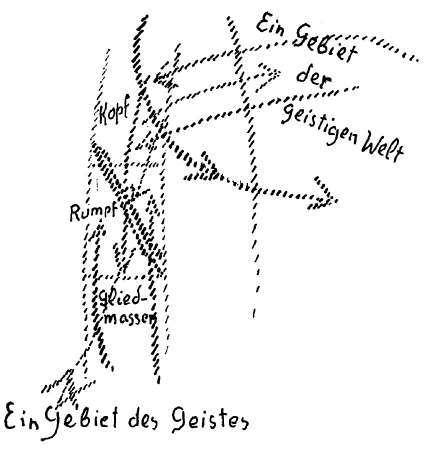
[ 3 ] Wenn wir wachend in der Welt stehen, sind wir ja zunächst umgeben von der äußeren Sinneswelt, von alldem, was im Grunde genommen die Eindrücke ausmacht, die auf unser Auge, Ohr, auf unsere Wärmeorgane, auf unsere Sinne überhaupt ausgeübt werden. Da breitet sich die äußere Sinneswelt um uns aus. Das Innenleben der meisten Menschen besteht ja im wesentlichen in nichts anderem als in einer Art weiterer Verarbeitung desjenigen, was die äußeren Eindrücke sind. Von jenseits der Schwelle nimmt sich nun das, was da äußere Welt ist, eben in einem andern Sinne aus als von diesseits der Schwelle. Sie wissen ja, wozu die Menschheit gekommen ist in den letzten Jahrhunderten, in denen sie sich im wesentlichen darauf beschränkt hat, die Welt von diesseits der Schwelle zu betrachten. Die Menschheit ist dazu gekommen, wenn ich schematisieren will, gewissermaßen sich selbst anzusehen. Wir nennen das, was man da selbst ansieht, den dreigliedrigen Menschen, den Kopfmenschen, den rhythmischen Menschen und den Gliedmaßen-Stofwechselmenschen. Hier wollen wir schematisch andeuten jenen Teppich, der sich um uns herum ausbreitet (siehe Zeichnung Seite 165), der im wesentlichen den Inhalt der Sinneswelt ausmacht. Von diesseits der Schwelle spekulieren nun die Menschen, was hinter diesem Sinnesteppich ist. Sie reden davon, daß hinter diesem Sinnesteppich Moleküle, Atome und Stoffe allerlei Tänze aufführen. Sie geben diesen Tänzen die verschiedensten Namen, aber sie sind eben davon überzeugt, daß, wenn der Mensch hinaussieht aus seinen Augen, hinaushört aus seinen Ohren, kurz, hinauswahrnimmt aus seinen Sinnen, daß dahinter irgendeine Stoffwelt liegt.
[ 3 ] When we stand awake in the world, we are, after all, first and foremost surrounded by the external sensory world—by everything that essentially constitutes the impressions exerted on our eyes, ears, organs of warmth, and our senses in general. The external sensory world spreads out around us. The inner life of most people consists, in essence, of nothing other than a kind of further processing of these external impressions. From beyond the threshold, however, the external world appears in a different sense than it does from this side of the threshold. You know, after all, where humanity has arrived in recent centuries, during which it has essentially limited itself to observing the world from this side of the threshold. Humanity has come to—if I may put it schematically—look at itself, so to speak. We call what one sees there the threefold human being: the head human, the rhythmic human, and the limb-metabolic human. Here we wish to schematically indicate that tapestry that spreads out around us (see drawing on page 165), which essentially constitutes the content of the sensory world. From this side of the threshold, people now speculate about what lies behind this sensory tapestry. They speak of molecules, atoms, and substances performing all manner of dances behind it. They give these dances all sorts of names, but they are convinced that when a person looks out through their eyes, listens out through their ears—in short, perceives through their senses—there lies some kind of material world behind it.
[ 4 ] Von jenseits der Schwelle enthüllt sich nichts von einer solchen Stoffwelt da draußen, sondern es zeigt sich sogleich, wenn der Mensch nur etwas hineinkommt in die Region, die jenseits der Schwelle liegt, daß hinter diesem Sinnesteppich ein bestimmtes Gebiet der geistigen Welt liegt, das heißt, wir haben es zu tun im wesentlichen mit Geistwelt, die hinter dieser sinnlichen Welt liegt.
[ 4 ] From beyond the threshold, nothing of such a material world out there is revealed; rather, it becomes immediately apparent—as soon as a person enters even slightly into the region that lies beyond the threshold—that behind this tapestry of the senses lies a specific realm of the spiritual world; that is to say, we are essentially dealing with the spiritual world that lies behind this sensory world.
[ 5 ] Wenn wir darauf Rücksicht nehmen, daß der Mensch aus dem Ich, dem astralischen Leibe, dem Ätherleibe, dem physischen Leibe besteht, dann müssen wir sagen: Wenn der Mensch wach ist, also mit seinem Ich und seinem Astralleib untergetaucht ist in seinen Organismus, dann hat er keinen Anteil an der Welt, die hier als Geistesgebiet hinter dem Sinnesteppich liegt. Wenn der Mensch aber schläft, also sein Ich und seinen astralischen Leib herausgezogen hat aus seinem physischen Organismus, dann ist er mit seinem Ich und seinem astralischen Leib in diesem Gebiete der geistigen Welt darinnen. Der Mensch hat also vom Einschlafen bis zum Aufwachen Anteil an diesem Gebiet, das gewissermaßen hinter der Natur als eine geistige Naturwelt liegt. Man könnte auch sagen, es ist die Welt, der der Mensch angehört vom Einschlafen bis zum Aufwachen, ein gewisses Gebiet des geistigen Weltreiches, das ihm für diesen seinen Zustand des Schlafens eben zugewiesen ist.
[ 5 ] If we take into account that the human being consists of the “I,” the astral body, the etheric body, and the physical body, then we must say: When a human being is awake—that is, when their “I” and astral body are immersed within their physical organism—they have no part in the world that lies here as the spiritual realm behind the veil of the senses. But when a human being sleeps—that is, when they have withdrawn their “I” and astral body from their physical organism—then they are present with their “I” and astral body within this realm of the spiritual world. Thus, from the moment a person falls asleep until they wake up, they are part of this realm, which lies, so to speak, behind nature as a spiritual natural world. One could also say that it is the world to which a person belongs from the moment they fall asleep until they wake up—a certain realm of the spiritual world that is assigned to them precisely for this state of sleep.
[ 6 ] In sich hinein sieht ja der Mensch auch nur bis zu einem gewissen Grade. Der Mensch kann in sich hinein bis zu einem gewissen Grade brüten, redet dann, wenn er von seinem Seelischen redet, von Gedanken, von Gefühlen, von Willensimpulsen. Er redet zumeist in einer höchst unbestimmten Art von diesen Gedanken, Gefühlen und Willensimpulsen. Er holt aus diesem Inneren, das ihm ein ziemlich Unbestimmtes bleibt, jene Gedanken hervor, die Erinnerungen bilden; aber er sieht nicht hinter dieses sein Inneres. Und wir können sagen: gerade so, wie hier gewissermaßen wie eine Scheidewand zwischen uns selbst und einem gewissen Gebiete der äußeren Welt eine Grenze liegt, so können wir eine Grenze ziehen, durch die der nach innen gerichtete Blick nicht dringt (siehe Zeichnung Seite 165). Würde allerdings der Mensch hinunterdringen in diese Region, die gewissermaßen jenseits des Spiegels liegt, der ihm seine Erinnerungen zurückwirft, so würde der Mensch nicht dasjenige entdecken, was viele illusionsbehaftete Mystiker glauben, die da glauben, man brauche nur in sich hineinzubrüten, dann werde man das höchste Geistige erkennen, sondern der Mensch würde da gerade die Geheimnisse seiner Organisation entdecken, die Geheimnisse dieses wunderbaren Aufbaues, der sich in dem menschlichen Organismus ausspricht. Der Mensch würde da, wenn er wirklich durchsehen würde, eben nicht etwa die Imagination einer Mechthild von Magdeburg oder eines Meister Eckhart oder einer heiligen Therese, sondern er würde die menschliche Organisation erblicken, was gewissen illusionsbehafteten Mystikern als etwas recht Prosaisches erscheinen würde, was allerdings nicht demjenigen als etwas Prosaisches erscheint, der für das eigentlich Geheimnisvolle des Weltenalls den richtigen Sinn hat. Denn es darf schon gesagt werden: viel wunderbarer als die Imaginationen der heiligen Therese oder der Mechthild von Magdeburg oder des Johannes Tauler, viel wunderbarer als diese Reminiszenzen, geschmiedet aus den Spiegelungen, die als Erinnerungen leben, durchdrungen von jenen Empfindungsimpulsen, die heraufstrahlen aus Leber, Magen, Milz und so weiter, viel wunderbarer als dieses alles, ja auch viel wunderbarer als alles das, was etwa dargestellt worden ist in den Urbildern der menschlichen Entwickelung in Mythen und Legenden und dergleichen, ist dasjenige, was sich da aufbaut in den prosaischen Organen des menschlichen Inneren. So sonderbar das klingt, die Wahrheit muß in diesem Punkte eben durchschaut werden. Aber was sich da aufbaut, das ist zunächst das wahrhaft IrdischMaterielle, dasjenige, was eigentlich die irdische Materie ausmacht. In der Außenwelt finden wir nicht die irdische Materie. Die irdische Materie ist innerhalb der menschlichen Haut. Aber wiederum, diese Organe, dieser ganze innere Aufbau des Menschen, er ist nichts anderes als, ich möchte sagen, etwas, was herausgepreßt wird aus einem andern Geistgebiete. Ein Gebiet des Geistes ist es, das gewissermaßen aus sich herausschwitzt, was da an Organen im menschlichen Organismus ist. Hinter dieser Organologie, die zunächst entdeckt wird, wenn der Mensch in sein Inneres hineinschaut, wenn er durchschaut den Teppich der Erinnerungen, der sonst ihm entgegenstrahlt, wenn auch manchmal mystisch verbrämt, wenn er hindurchblickt durch diesen Erinnerungsteppich, so wie er durchblicken kann von jenseits der Schwelle durch den Teppich der äußeren Sinne, hinter dieser Organologie sieht er dann das andere Gebiet des Geistes, dem er nun angehört vom Einschlafen bis zum Aufwachen, das er als geistiges Gebiet eben nicht beachtet, das aber dasjenige geistige Gebiet ist, welches ihm die Kräfte gibt, die in seinen Gliedmaßen sich äußern.
[ 6 ] After all, a person can only look within to a certain extent. A person can reflect inwardly to a certain extent; when speaking of their inner life—of thoughts, feelings, and impulses of the will—they do so. They usually speak in a highly vague manner about these thoughts, feelings, and impulses of the will. From this inner world, which remains quite vague to them, they draw forth those thoughts that form memories; but they do not see beyond this inner world of theirs. And we can say: just as there is, so to speak, a boundary here—like a partition—between ourselves and a certain realm of the external world, so we can draw a boundary that the inward gaze cannot penetrate (see illustration on page 165). If, however, a person were to delve into this region, which lies, so to speak, beyond the mirror that reflects his memories back to him, he would not discover what many deluded mystics believe—namely, one need only brood within oneself to recognize the highest spiritual reality; rather, one would discover precisely the mysteries of one’s own organization—the mysteries of this marvelous structure that manifests itself in the human organism. If a person were to truly see through this, they would not perceive the imaginings of Mechthild of Magdeburg or Meister Eckhart or Saint Teresa, but rather they would behold the human organism—which would appear quite prosaic to certain deluded mystics, though it certainly does not appear prosaic to those who have a true sense of the true mystery of the universe. For it must be said: far more wondrous than the imaginings of Saint Teresa, Mechthild of Magdeburg, or Johannes Tauler—far more wondrous than these reminiscences, forged from the reflections that live on as memories, imbued with those sensory impulses that radiate from the liver, stomach, spleen, and so on—far more wondrous than all of this, indeed far more wondrous than everything that has been depicted, for example, in the archetypes of human development found in myths, legends, and the like—is that which builds itself up within the prosaic organs of the human interior. As strange as it may sound, the truth must be recognized on this point. But what is taking shape there is, first and foremost, the truly earthly-material, that which actually constitutes earthly matter. We do not find earthly matter in the external world. Earthly matter lies within the human skin. But then again, these organs, this entire inner structure of the human being, are nothing other than—I would say—something that is squeezed out from another spiritual realm. It is a realm of the spirit that, so to speak, sweats out of itself what constitutes the organs in the human organism. Behind this organology—which is first discovered when a person looks into their inner self, when they see through the tapestry of memories that otherwise shines out at them, even if sometimes mystically embellished—when they look through this tapestry of memories, just as they can see through the tapestry of the external senses from beyond the threshold—behind this organology, they then see the other realm of the spirit, to which they now belong from the moment they fall asleep until they wake up—a realm they do not pay attention to as a spiritual realm, but which is precisely the spiritual realm that gives them the forces that manifest in their limbs.
[ 7 ] Wenn wir über unsere Sinne nachdenken, so leben in unseren Sinnen Kräfte. Diese Kräfte sind im wesentlichen diejenigen, die eigentlich hinter dem Sinnesteppich liegen, die durch unsere Sinnesöffnungen in uns eindringen (siehe Zeichnung), ohne daß es gewußt wird, wenn der Mensch die Welt nur von diesseits der Schwelle beachtet.
[ 7 ] When we reflect on our senses, we find that forces dwell within them. These forces are essentially those that lie behind the veil of the senses, penetrating us through our sensory openings (see illustration), unnoticed when a person perceives the world only from this side of the threshold.
[ 8 ] Aber auch in unseren Organen leben Kräfte aus dem Gebiet des Geistes, das ich hier unten (siehe Zeichnung Seite 165, Pfeil) angedeutet habe. Und diejenigen Kräfte, die wir in unseren Armen, in unseren Beinen haben, das sind eigentlich die Kräfte, die aus dem andern Gebiete des Geistes kommen. So daß der Mensch in dem Augenblicke, wo er betrachtet wird von jenseits der Schwelle, als der Zusammenfluß von zwei Geistgebieten erscheint. Und was uns zunächst entgegentritt, wenn wir den Menschen hier in der irdischen Welt betrachten, das ist im Grunde genommen zunächst nur eine scheinbare Einheit. Diese scheinbare Einheit ist eigentlich der Mensch gar nicht. Der Mensch ist der Zusammenfluß der geistig wirkenden Kräfte aus den beiden Ihnen angedeuteten Gebieten. Und die Kräfte, die zum Beispiel in unseren Augen, in unseren Ohren leben, sie sind ganz anderer Herkunft zunächst als die Kräfte, die sich entwickeln, wenn wir unsere Beine voreinandersetzen, oder wenn wir unsere Arme bewegen. Man kann eine solche Vorstellung nicht hegen, ohne daß man gewahr wird, wie der Mensch gewissermaßen eingebettet ist in den ganzen Kosmos, wie er angehört durch seine Sinne einem gewissen Geistgebiet des Kosmos, wie er angehört durch seine Gliedmaßen einem andern Geistgebiet des Kosmos. Nur das, was etwa in der Mitte liegt, der rhythmische Mensch, das Lungensystem, das Herzsystem und all das, was dazu gehört, das ist eigentlich irdischen Ursprungs, das ist eigentlich gewissermaßen gewoben aus einer Art mittleren Welt heraus. So ist der Mensch an sich ein dreigliedriges Wesen. Und ohne diese Dreigliedrigkeit zu durchschauen, können wir den Menschen nicht verstehen. Ich sage, so nimmt sich der Mensch aus, wenn wir ihn von jenseits der Schwelle betrachten. Da stellt er sich hinein für uns als ein Glied in den ganzen Kosmos. Man wird gewahr durch Geisteswissenschaft, wie der Mensch darinnen lebt in dem ganzen Kosmos, herausgebildet ist aus diesem Kosmos, und man wird dann nicht mehr entfernt sein von der Wahrheit, von der zu erkennenden Wahrheit, daß der Mensch nicht nur dasjenige als seine Aufgabe zu erfüllen hat, was er hier vollbringt auf der Erde, sondern daß er Aufgaben zu erfüllen hat in der ganzen kosmischen Entwickelung, daß er gewissermaßen einen wesentlichen Rechnungsfaktor bildet in der ganzen geistigen kosmischen Entwickelung.
[ 8 ] But forces from the realm of the spirit—which I have indicated here below (see drawing on page 165, arrow)—also live within our organs. And the forces we have in our arms and legs are actually the forces that come from the other realm of the spirit. So that when a human being is viewed from beyond the threshold, they appear as the confluence of two spiritual realms. And what first meets our gaze when we observe a human being here in the earthly world is, in essence, at first only an apparent unity. This apparent unity is not, in fact, the human being at all. The human being is the confluence of the spiritually active forces from the two realms I have indicated to you. And the forces that are at work, for example, in our eyes and in our ears are, at first glance, of a completely different origin than the forces that come into play when we place one leg in front of the other or when we move our arms. One cannot hold such a conception without becoming aware of how the human being is, so to speak, embedded in the entire cosmos; how, through his senses, he belongs to a certain spiritual realm of the cosmos; and how, through his limbs, he belongs to another spiritual realm of the cosmos. Only what lies, so to speak, in the middle—the rhythmic human being, the respiratory system, the cardiac system, and all that belongs to them—is actually of earthly origin; it is, so to speak, woven from a kind of middle world. Thus, the human being is, in and of itself, a threefold being. And without grasping this threefold nature, we cannot understand the human being. I say that this is how the human being appears when we view him from beyond the threshold. There he stands before us as a link in the entire cosmos. Through spiritual science, one becomes aware of how the human being lives within the entire cosmos, is formed out of this cosmos, and one will then no longer be far from the truth—the truth to be recognized—that human beings have not only to fulfill the tasks they carry out here on Earth, but that they have tasks to fulfill within the entire cosmic evolution, that they constitute, so to speak, an essential factor in the entire spiritual cosmic evolution.
[ 9 ] So daß man sagen kann: die Geisteswissenschaft eröffnet unseren Blick für das, was der Mensch als ein Glied des Kosmos ist. Denken Sie nur, wie, ich möchte sagen, liliputanerhaft sich dagegen ausnimmt, was der Mensch heute über den Menschen denkt. Heute ist es ja so, daß der Mensch nur das als sein Wissen aufnehmen will, was von diesseits der Schwelle her kommt. Er betrachtet nur das, was sich ihm offenbart zwischen Aufwachen und Einschlafen, und was sich ihm offenbart zwischen der Geburt und dem Tode. Und er möchte auch alles, was der Mensch überhaupt hier auf der Erde als Aufgabe erfüllen kann, aus den Begriffen und Ideen heraus konstruieren, die sich aus dieser liliputanerhaften Betrachtung des Menschen ergeben. Dadurch kommen wir nicht vorwärts. Gerade dadurch kommen wir immer mehr und mehr in den Niedergang hinein, daß sich insbesondere unsere Intellektuellen nicht darauf einlassen, aus etwas anderem heraus die Aufgaben der Welt zu konstruieren als aus dem, was sie da zusammenlesen von alledem, was zwischen Aufwachen und Einschlafen und zwischen Geburt und Tod liegt. Aber dasjenige, was der Mensch vollbringt, ist etwas wesentlich Weiteres, und das kann nur durchschaut werden, wenn alles, was man so aufbringen kann aus der gewöhnlichen Lebensbetrachtung, durchleuchtet und befruchtet wird von dem, was gewußt werden kann aus dem Anblicke der Welt von jenseits der Schwelle her. Und es kann einfach nicht besser werden mit der Zivilisationsentwickelung der Welt, wenn nicht aufgenommen wird, was von jenseits der Schwelle für das menschliche Erkennen, Fühlen und Wollen erobert werden kann.
[ 9 ] So one can say: spiritual science opens our eyes to what a human being is as a part of the cosmos. Just think how—I would say—Lilliputian in comparison what people today think about human beings appears. Today, after all, people are willing to accept as knowledge only what comes from this side of the threshold. They consider only what is revealed to them between waking and falling asleep, and what is revealed to them between birth and death. And they also wish to construct everything that human beings can possibly accomplish here on Earth as a task out of the concepts and ideas that arise from this Lilliputian view of humanity. This does not move us forward. It is precisely because of this—because our intellectuals, in particular, refuse to construct the world’s tasks from anything other than what they gather from all that lies between waking and sleeping and between birth and death—that we are sliding further and further into decline. But what human beings accomplish is something far more profound, and this can only be understood when everything that can be mustered from the ordinary observation of life is illuminated and enriched by what can be known from the view of the world from beyond the threshold. And the development of world civilization simply cannot improve unless we take in what can be gained from beyond the threshold for human knowing, feeling, and willing.
[ 10 ] Man möchte sagen, man empfindet es heute ganz besonders schmerzlich, daß aus all dem Wissenstorso, aus diesem allseitig beschnittenen Wissen, das in den letzten drei bis vier Jahrhunderten von der Menschheit aufgestapelt worden ist, heute Lebensprogramme gemacht werden. Man ist gegenüber diesen Lebensprogrammen eigentlich in einer sonderbaren Lage. Es gibt heute Religionsgenossenschaften, sie leiten dem Wortlaute nach wenigstens dasjenige, was sie haben, von früheren Zeiten her, von Zeiten, in denen noch lebendig war das alte Mysterienwissen. Es wird nicht mehr verstanden innerhalb der Religionsgenossenschaften. Es wird nur dem Wortlaute nach tradiert, es ist ausgepreßt, eine ausgepreßte Zitrone geworden. Es ist eigentlich im Grunde genommen nicht mehr da. Es kann ja in einem gewissen Sinne von dem einen oder von dem andern durchdrungen werden, namentlich wenn der eine oder der andere zu dem vordringt, wozu ihm vorzudringen gewöhnlich seine Kirche verbietet. Dann kann er gerade aus dem traditionellen alten konfessionellen Wissen vieles gewinnen. Wenn zum Beispiel heute, unabhängig von dem, was ihm vorgeschrieben ist, der Katholik nachdenkt über die Trinität, über die Inkarnation, da kann er zu etwas sehr Bedeutsamem kommen. Und gescheiter wäre es in vieler Beziehung, über die Trinität nachzudenken oder auch über das Credo nachzudenken, als diejenigen Bewegungen zu protegieren, die heute auftreten und aus dem heutigen Rumpf- und Torsowissen heraus ein neues Credo, ein neues Wissen schmieden. Denn viel kurzgeschürzter als das, was traditionell vom Alten geblieben ist, was aber eben von den Konfessionen verunstalter wird, viel kurzgeschürzter ist das, was die Menschheit in den letzten Jahrhunderten aufgestapelt hat und was sie heute dazu verwendet, um scheinbar Verbesserungen einführende Bewegungen in der Welt zu lancieren. Es ist ja jammervoll, wenn man heute sieht, wie allerlei sozialistische oder Frauenbewegungen oder dergleichen, die aus dem Torsowissen der letzten Jahrhunderte heraus gezimmert sind, glauben, daß sie die Welt bewegen können, während sie nur vorbeireden an dem, worauf es eigentlich ankommt.
[ 10 ] One might say that it is particularly painful today to see how all this fragmented knowledge—this knowledge that has been curtailed on all sides, which humanity has accumulated over the last three to four centuries—is now being turned into life programs. One actually finds oneself in a strange situation when faced with these life programs. Today there are religious communities that, at least according to the letter of the text, follow what they have inherited from earlier times—times when the ancient mystery knowledge was still alive. It is no longer understood within these religious communities. It is merely passed down according to the letter of the text; it has been squeezed dry, becoming like a squeezed lemon. In essence, it is no longer really there. It can, of course, be penetrated in a certain sense by one person or another, especially if one or the other ventures into areas that their church usually forbids them to explore. Then they can gain a great deal precisely from the traditional, old denominational knowledge. If, for example, a Catholic today—regardless of what is prescribed for him—reflects on the Trinity or the Incarnation, he may arrive at something very significant. And in many respects, it would be wiser to reflect on the Trinity or on the Creed than to support those movements that are emerging today and forging a new creed, a new body of knowledge, out of today’s truncated and incomplete understanding. For far more truncated than what has traditionally been preserved from the past—though it is, of course, distorted by the denominations—is what humanity has piled up over the last few centuries and what it uses today to launch movements in the world that purport to introduce improvements. It is indeed lamentable to see today how all manner of socialist or women’s movements—or the like—which have been cobbled together from the truncated knowledge of the past centuries, believe they can change the world, while they merely talk past what actually matters.
[ 11 ] Es beruht das — das muß schon gesagt werden — auf einem gewissen schier unbesieglichen Hochmut der heutigen Menschheit, auf jenem Hochmut, der durchaus nichts lernen will. Wenn irgend jemand hineingewachsen ist in eine Bewegung, in irgendeine Partei, dann fühlt er gewöhnlich, daß die Partei just das noch nicht erlangt hat, was er nun gerade auf dem Standpunkte des Lebens, auf dem er steht, von selber hat, und nun tradiert er das. Das ist gerade der Jammer der Gegenwart, daß so viel kurzgeschürztes Zeug als reformatorisch auftritt. Wirklich Fruchtbares kann heute nur geleistet werden, wenn hineinfließt in all das, was man so als weltbewegend auftreten lassen will, dasjenige, was jenseits der Schwelle der sinnlichen Welt erforscht werden kann. Denn sehen Sie, da draußen ist ein gewisses Gebiet des Geistes, jenseits des Teppichs der Sinneswelt. Wozu ist denn dieses Gebiet des Geistes da? Dieses Gebiet des Geistes, denken Sie doch nur, daß es dieselbe Welt ist, in der wir, wenn wir wachen, nicht mit unserem Bewußtsein sind, aber in Wirklichkeit sind wir ja mit unserem ganzen Organismus drinnen; denn indem wir stehen, indem wir gehen, sind wir ja in dieser Welt drinnen, wir sehen sie nur nicht. Wir gehen ja fortwährend durch diese Welt, wir sind ja in ihr, wir handeln in ihr, und wenn wir in ihr eine Politik machen wie die bolschewistische, dann schlägt das, was die Bolschewisten nicht sehen, zurück auf die Menschheit, weil die Bolschewisten nur eine Welt zimmern wollen aus dem, was sie sehen. Aber sie sind nicht in der Welt, die sie sehen; sie sind in der Welt, die jenseits des Teppichs der Sinneswelt ist. Wenn heute Frauenbewegungen auftreten und allerlei verlangen, so verlangen sie es aus dem heraus, was sie sehen; aber sie verlangen es für die Welt, die sie nicht sehen. Daher schlägt immer dasjenige zurück aus der Welt, in der wir ja sind, was in Wirklichkeit da ist, was aber in den Forderungen, die aufgestellt werden, nicht da ist, weil die Leute sich stemmen dagegen, irgend etwas aufzunehmen aus der geistigen Welt.
[ 11 ] This is due—and this must be said—to a certain, almost invincible arrogance on the part of humanity today, that arrogance which refuses to learn anything at all. When anyone has grown up within a movement or a political party, they usually feel that the party has not yet attained precisely what they themselves already possess from their current vantage point in life, and so they pass that on. That is precisely the tragedy of the present day: that so much truncated material is presented as reformist. Truly fruitful work can be accomplished today only if what can be explored beyond the threshold of the sensory world flows into everything that people seek to present as earth-shattering. For you see, out there is a certain realm of the spirit, beyond the carpet of the sensory world. What, then, is the purpose of this realm of the spirit? This realm of the spirit—just think of it as the very same world in which, when we are awake, we are not present with our consciousness, yet in reality we are fully immersed in it with our entire organism; for as we stand, as we walk, we are indeed within this world—we simply do not see it. We are constantly moving through this world; we are in it, we act within it, and when we pursue a political agenda like that of the Bolsheviks, what the Bolsheviks fail to see rebounds upon humanity, because the Bolsheviks want to construct a world solely out of what they see. But they are not in the world they see; they are in the world that lies beyond the veil of the sensory world. When women’s movements emerge today and make all sorts of demands, they do so based on what they see; but they demand it for the world they do not see. Therefore, what actually exists in the world in which we do live—but which is absent from the demands being made—always rebounds upon us, because people resist taking in anything from the spiritual world.
[ 12 ] Und diese Welt, dieses Gebiet hat natürlich seine Bedeutung im großen Kosmos. Wozu ist es denn da? Sehen Sie, wenn wir die Welt betrachten, in der wir leben zwischen dem Tode und einer neuen Geburt, so ist das eine andere Welt als diejenige, die hier hinter dem Sinnesteppich ist. Diese Welt, die wir betreten zwischen dem Tode und einer neuen Geburt, ist ein anderes Gebiet des Geistigen. Es ist dasjenige Gebiet des Geistigen, in dem im wesentlichen leben diejenigen Wesen, die wir anführen, wenn wir reden von den Hierarchien der Angeloi, Archangeloi und so weiter. Aber diese Welt jener Wesen der neun Hierarchien, diese Welt kann nur bestehen, wenn sie durch den physischen Menschen — und nur durch ihn kann sie es — in einen gewissen Verkehr, in einen Wechselverkehr tritt mit der Welt, die ich hier als das Gebiet der geistigen Welt jenseits des Sinnengebietes bezeichnet habe.
[ 12 ] And this world, this realm, naturally has its significance within the greater cosmos. Why is it there, after all? You see, when we consider the world in which we live—between death and a new birth—it is a different world from the one that lies here, beyond the veil of the senses. This world, which we enter between death and a new birth, is a different realm of the spiritual. It is the realm of the spiritual in which, essentially, those beings dwell whom we refer to when we speak of the hierarchies of the Angeloi, Archangeloi, and so on. But this world of the beings of the nine hierarchies—this world can exist only if, through the physical human being—and only through him can it do so—it enters into a certain interaction, a reciprocal exchange, with the world that I have described here as the realm of the spiritual world beyond the realm of the senses.
[ 13 ] Wenn Sie in einem Hause leben und Sie wollen in einen Verkehr treten mit der äußeren Welt, ohne hinauszugehen, dann müssen Sie zum Fenster hinausschauen. Wenn die Götter der neun Hierarchien in einen Verkehr treten wollen mit dieser Welt, dann müssen sie das durch den Menschen hindurch tun. Sie können das nicht direkt, sie müssen es durch den Menschen hindurch tun. Das ist ein Weltgebiet, das von den Göttern nur durch den Menschen hindurch betrachtet werden kann. Der Mensch muß aus der Welt, die er durchlebt zwischen dem Tod und einer neuen Geburt, in diese physische Welt einziehen, um für die Götter zu vermitteln den Verkehr mit dieser Welt, die sich hier entwickelt (siehe Zeichnung Seite 165). Und diese Welt, die sich hier entwickelt jenseits des Sinnenteppichs, wozu ist die denn da? Die Welt, die außerdem noch da ist, die würde, wenn diese Welt nicht da wäre, sie würde nach allen Seiten zerstieben. Es ist die Welt, die sich nach allen Seiten zerstreuen würde (siehe folgende Zeichnung, Pfeile). Es ist die Welt, in der nur Abstoßungskräfte existieren. Und diese Welt hier, die jenseits des Sinnenteppichs liegt, die hält zusammen (Kreis) diese Welt. So daß wir sagen können: Indem der Mensch hinblickt auf die Welt jenseits des Sinnenteppichs, blickt er hin auf diejenige Welt, welche die Welt der zentripetal wirkenden Wesenheiten ist. Sie halten die Welt zusammen. Es ist die Tendenz vorhanden in der andern Welt, sich immer zu vergrößern, immer auszubreiten; diese Welt (Kreis) hält zusammen.
[ 13 ] If you live in a house and want to interact with the outside world without going outside, then you must look out the window. If the gods of the nine hierarchies want to interact with this world, they must do so through human beings. They cannot do so directly; they must do so through human beings. This is a realm that the gods can observe only through human beings. Human beings must enter this physical world from the realm they experience between death and a new birth in order to mediate, on behalf of the gods, communication with this world that is developing here (see illustration on page 165). And this world that is developing here beyond the veil of the senses—what is its purpose? The world that also exists there would, if this world were not there, scatter in all directions. It is the world that would scatter in all directions (see the following drawing, arrows). It is the world in which only forces of repulsion exist. And this world here, which lies beyond the tapestry of the senses—it holds this world together (circle). So that we can say: When a person looks toward the world beyond the tapestry of the senses, they are looking toward the world that is the realm of centripetally acting entities. They hold the world together. In the other world, there is a tendency to constantly grow larger, to constantly expand; this world (circle) holds it together.
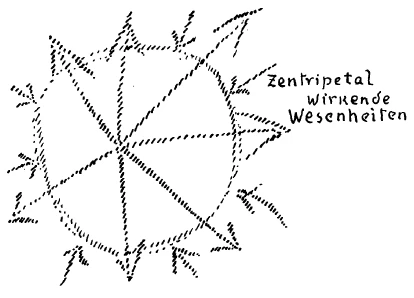
[ 14 ] Aber mit dieser zentripetal wirkenden Welt kommen auch die Götter nur in Berührung durch den Menschen. Das ist der Sinn, daß der Mensch in den Kosmos eingetreten ist, daß die Welt der Götter in Beziehung kommen kann, in eine wahrnehmbare Beziehung, in einen Verkehr kommen kann mit dieser zentripetalen Welt.
[ 14 ] But even the gods come into contact with this centripetal world only through human beings. This is the meaning of humanity’s entry into the cosmos: that the world of the gods can enter into a relationship—a perceptible relationship—and into communion with this centripetal world.
[ 15 ] Diese zentripetale Welt, wenn sie gesehen wird von jenseits der Schwelle aus, ist kalt, eisig. Sie ist eine Welt, welche im Grunde genommen berührt so, wenn man sie empfindet, wie etwas Erstarrendes, wie etwas Verkalkendes, aber sie ist voller Weisheit. Sie ist gewissermaßen ganz gewoben aus weisheitsvollen Gedanken, aber kalt, starr, Frösteln hervorrufend. Und die kalte, starre Kraftwelt hält die andere Welt zusammen. Der Mensch ist nicht so organisiert, daß er diese Welt unmittelbar fühlt. Derjenige, der das Gebiet jenseits der Schwelle betritt, der empfindet dieses Frösteln, dieses kalte Zusammenziehen. Und es ist das ein Zeichen, daß man wirklich mit seinen Ich und mit seinem astralischen Leib in die Welt kommt, in die der Mensch jede Nacht eintritt, aber ohne das Bewußtsein, also sie nicht empfindet. Es ist das Zeichen, daß man bewußt eintritt, wenn man eintritt in eine Welt, die einen frieren macht, die einen lichtvoll durchdringt mit unbegrenzt intensiver Weisheit, die einen aber frieren macht. Ohne dieses Frieren, ohne dieses Sich-in-Erstarrung-Fühlen kann man zunächst nicht mit dem Ich und mit dem astralischen Leib sich jenseits der Schwelle fühlen.
[ 15 ] This centripetal world, when viewed from beyond the threshold, is cold, icy. It is a world that, when perceived, essentially feels like something that freezes, like something that calcifies, yet it is full of wisdom. In a sense, it is entirely woven from wise thoughts, yet it is cold, rigid, and evokes a chill. And this cold, rigid world of power holds the other world together. Human beings are not organized in such a way that they can sense this world directly. Those who enter the realm beyond the threshold feel this chill, this cold constriction. And this is a sign that one is truly entering—with one’s ego and one’s astral body—the world into which human beings enter every night, but without consciousness, and thus do not perceive it. It is a sign that one is entering consciously when one enters a world that makes one shiver, that permeates one with radiant, boundlessly intense wisdom, yet still makes one shiver. Without this shivering, without this feeling of becoming frozen, one cannot initially sense oneself with the “I” and the astral body beyond the threshold.
[ 16 ] Das ist die Erfahrung, die da gemacht werden kann. Es ist etwas, was im Grunde genommen nur als Erfahrung erobert werden kann. Es muß eben im Sinne derjenigen Auseinandersetzungen, die Sie finden in meinem Buche «Wie erlangt man Erkenntnisse der höheren Welten?» und in meiner «Geheimwissenschaft im Umriß», die alle hinreichen, um diese Erfahrungen zu machen, wenn sie nur konsequent verfolgt werden, es muß eben das Gebiet jenseits der Schwelle betreten werden. Es ist ein wirkliches Gebiet, geradeso wirklich wie das Gebiet der Sinneswelt.
[ 16 ] This is the experience that can be had there. It is something that, fundamentally speaking, can only be attained through experience. It must be approached in the spirit of the discussions you will find in my book *How Does One Attain Knowledge of the Higher Worlds?* and in my *Outline of Esoteric Science*—all of which are sufficient to enable these experiences, provided they are pursued consistently—one must simply enter the realm beyond the threshold. It is a real realm, just as real as the realm of the sensory world.
[ 17 ] Aber wenn man das kennt, wenn man begreift, daß es dieses Gebiet gibt — man kann die Welt nicht verstehen, wenn man nicht begreift, daß es dieses Gebiet gibt —, dann wird einem auch etwas anderes klar sein, nämlich: warum der Mensch herumgeht in diesem Gebiet. Nicht wahr, der Mensch kann ja nicht herumgehen mit diesem fortwährenden Frösteln, mit diesem fortwährenden Frieren. Daher ist ja ihm zunächst für sein gewöhnliches Bewußtsein die Grenze errichtet. Der Mensch würde wahrlich schlechte Nächte erleben, wenn er bewußt erleben würde die Zeit zwischen dem Einschlafen und dem Aufwachen. Aber warum geht denn der Mensch — er geht ja auch, wenn er wach ist, in dieser selben Welt herum —, warum geht er dadrinnen herum? Er bringt in diese Welt, in diese Welt der zentripetalen Weltenkräfte, dasjenige hinein, was in seinem Inneren lebt. Und wenn wir das, was im menschlichen Inneren an Kräften lebt — wir werden davon morgen noch genauer sprechen —, wenn wir das genau ins Seelenauge fassen, so ist es so, daß wir es mit dem Namen Liebe benennen können, Wärme, Seelenwärme, und der Mensch trägt die Seelenwärme in dieses kalte Gebiet hinein. Er ist der Erwärmer dieses Gebietes. Das ist etwas, was zunächst zu seiner kosmischen Aufgabe gehört. Der Mensch ist der Erwärmer dieses Gebietes. Indem, wenn ich mich so ausdrücken darf, die Götter die Menschen geschaffen haben, haben sie geschaffen — nun lassen Sie mich trivial die Sache ausdrücken — die Öffnung gerade für dieses Gebiet, welches ihnen zusammenhalten muß die sonst auseinanderstiebende Welt.
[ 17 ] But once you know this, once you realize that this realm exists—you cannot understand the world unless you realize that this realm exists—then something else will also become clear to you, namely: why human beings move about in this realm. Isn’t that right? After all, a person cannot go about with this constant shivering, with this constant feeling of cold. That is why, for their ordinary consciousness, a boundary is established in the first place. A person would truly have restless nights if they were to consciously experience the time between falling asleep and waking up. But why does a person—after all, they also walk around in this very same world when they are awake—why do they walk around in it? They bring into this world—into this world of centripetal world forces—that which lives within them. And when we take a close look with the eye of the soul at the forces that live within the human being—we will speak of this in greater detail tomorrow—we can name them love, warmth, the warmth of the soul; and human beings carry this warmth of the soul into this cold realm. They are the warmers of this realm. This is something that, first and foremost, belongs to their cosmic task. Human beings are the warmers of this region. In that—if I may put it this way—when the gods created human beings, they created—now let me put it in trivial terms—the opening precisely for this region, which must hold together the world that would otherwise scatter in all directions.
[ 18 ] Das ist nur ein Beispiel — wir werden morgen andere hören, und zwar andere, welche dann ins soziale Gebiet hinüberführen, so daß wir einsehen, welche Mission das soziale Leben der Menschen auf Erden für den ganzen Kosmos hat — , aber dies ist nur ein solches Beispiel, wie von jenseits der Schwelle aus der Mensch sich zeigt mit einer Aufgabe, die sich nicht erschöpft in dem, worin man gewöhnlich sonst seine innerweltliche Aufgabe sieht, sondern wie der Mensch eine kosmische Aufgabe hat, wie er zu etwas da ist, was sozusagen im großen Weltenplane der göttlichen Geister liegt. Und wie man für das Dasein des Menschen als solchen einsehen muß, daß dieses Dasein eben dazu da ist, daß etwas im Weltenall geschieht, so muß man für alles, für die kleinsten Verrichtungen der Menschheit einsehen können, daß der Mensch wahrlich ein Glied dieses ganzen Kosmos ist, daß alles, was er tut, etwas bedeutet über das hinaus, was er zunächst mit seinem Bewußtsein wahrnehmen kann, etwas bedeutet im Zusammenhange mit dem ganzen Kosmos, daß man durch das Erweitern der gewöhnlichen kleinmenschlichen Empfindungen diese Empfindungen in kosmisches Weltempfinden umwandeln kann. Das ist das Wichtige in der Geisteswissenschaft. Und das ist das, was die Menschheit jetzt braucht.
[ 18 ] This is just one example—we will hear others tomorrow, ones that lead us into the social realm, so that we may understand what mission human social life on Earth has for the entire cosmos— but this is just one such example of how, from beyond the threshold, the human being reveals himself with a task that is not limited to what is usually regarded as his earthly mission, but rather how the human being has a cosmic task, how he exists for something that lies, so to speak, within the great world plan of the divine spirits. And just as one must recognize that human existence as such is meant to bring about something in the universe, so too must one be able to recognize, with regard to everything—even the smallest human activities—that humanity is truly a part of this entire cosmos, that everything it does has significance beyond what it can initially perceive with its consciousness, that it has meaning in the context of the entire cosmos; that by expanding ordinary, petty human sensations, one can transform these sensations into a cosmic sense of the world. This is what is important in spiritual science. And this is what humanity needs now.
[ 19 ] Gerade in den letzten drei bis vier Jahrhunderten ist die ganze zivilisierte Menschheit gewissermaßen herausgefallen aus ihrem himmlischen Gebiete, Sie hat sich nurmehr beschäftigt mit dem, was sich ergibt durch Geburt und Tod und zwischen Aufwachen und Einschlafen. Das ganze Leben setzt sich heute nur aus diesem zusammen. Aber dieses Leben ist dem Tode geweiht, dieses Leben, das ist ein allmählich absterbendes Leben. Und setzen Sie noch so viele sozialistische Theorien und ihre Umwandlungen in sogenannte Taten in dieses Leben hinein, die befördern nur den Niedergang. Setzen Sie noch so viele Frauenbewegungen in dieses Leben hinein und lassen Sie diese Frauenbewegungen nicht befruchtet sein von einer neuen Geisteswissenschaft, immer weniger und weniger wird dasjenige erreicht werden können, was man eigentlich instinktiv will mit solchen Frauenbewegungen und dergleichen.
[ 19 ] Especially in the last three to four centuries, all of civilized humanity has, so to speak, fallen out of its heavenly realm; it has concerned itself only with what arises from birth and death and between waking and sleeping. Today, life as a whole consists solely of this. But this life is doomed to death; this life is one that is gradually withering away. And no matter how many socialist theories and their transformations into so-called actions you introduce into this life, they only hasten its decline. No matter how many women’s movements you introduce into this life—and if you do not allow these women’s movements to be inspired by a new spiritual science—you will be able to achieve less and less of what one actually instinctively desires through such women’s movements and the like.
[ 20 ] Man muß ja dasjenige, was heute befruchtet werden muß, immer an dem rechten Ende fassen. Oswald Spengler, der das Buch über den Untergang des Abendlandes geschrieben hat und wirklich aus wissenschaftlichen Voraussetzungen heraus richtig ausgerechnet hat, daß im Beginn des nächsten Jahrtausends der Untergang dieses Abendlandes unbedingt erfolgen muß — allerdings, wenn man nur das in Rechnung stellen kann, was Oswald Spengler zur Verfügung steht —, Oswald Spengler hat ja gewissermaßen recht: dieser Untergang wird wirklich erfolgen, wenn nicht von Geisteswissenschaft her ein Einschlag kommt. Den gibt er ja nicht zu, daher hat er recht von seinem Standpunkte aus, indem er nur über den Niedergang des Abendlandes schreibt. Aus dieser Niedergangsempfindung kann dieser Spengler, dieser Niedergangstheoretiker, manches bedeutungsvolle Wort sprechen. So zum Beispiel sagt er einmal recht treffende Worte über jene Spießerphilosophien oder Spießermystiken oder dergleichen, wie man es nennen will, die in der letzten Zeit aufgetreten sind, wie der Vegetarismus, die Reden über das Essen, so wie sie gewöhnlich geführt werden, namentlich wie sie in jenen Spießerjournalen geführt werden, die gewöhnlich in vegetarischen Restaurants aufliegen. Es ist eine Spießerphilosophie, es ist das Philiströseste, was sich denken läßt. Aber warum ist denn das so? Ist es im absoluten Sinne so? Ja, was da geredet wird, ist natürlich schon im absoluten Sinne spießig; aber man sah in den letzten drei bis vier Jahrhunderten nicht, was als Geist hinter diesen Dingen steckt. Die Leute reden ja heute nicht von dem Geist. Vegetarismus, Antialkoholismus und andere schöne Dinge, sie werden ja alle von dem pursten materialistischen Standpunkte aus erörtert. Was Geistiges dahintersteckt, wird ja nicht gesehen. Und so handelt es sich darum, daß gerade diese Dinge eigentlich gesiegt haben. Das Spießerige kommt ja davon her, daß die Leute, die heute anfangen möchten, spirituell zu werden, eigentlich im Grunde oftmals die schlimmsten Materialisten sind, weil sie die Begriffe der andern Materialisten aufnehmen und von denen aus dann irgendwie ein spirituelles System aufbauen.
[ 20 ] One must always grasp that which needs to be fertilized today at the right end. Oswald Spengler, who wrote the book on the Decline of the West and who, based on scientific premises, correctly calculated that the decline of the West must inevitably occur at the beginning of the next millennium—though, of course, only if one takes into account what was available to Oswald Spengler— Oswald Spengler is, in a sense, right: this decline will indeed take place unless a new impetus comes from the spiritual sciences. He does not admit this, which is why he is right from his own standpoint in writing only about the decline of the West. From this sense of decline, Spengler—this theorist of decline—can utter many meaningful words. For example, he once spoke quite aptly about those philistine philosophies or philistine mysticisms—or whatever one wishes to call them—that have emerged recently, such as vegetarianism and the discussions about food as they are usually conducted, particularly as they appear in those philistine journals that are typically found in vegetarian restaurants. It is a philistine philosophy; it is the most philistine thing imaginable. But why is that so? Is it so in the absolute sense? Yes, what is being said there is, of course, philistine in the absolute sense; but over the last three to four centuries, people have failed to see the spirit behind these things. People today do not speak of the spirit. Vegetarianism, anti-alcoholism, and other “noble” causes—they’re all discussed from the purest materialistic standpoint. The spiritual essence behind them goes completely unnoticed. And so the point is that these very things have, in fact, triumphed. The bourgeois nature of this stems from the fact that people who want to start becoming spiritual today are, at heart, often the worst materialists, because they adopt the concepts of other materialists and then somehow build a spiritual system based on them.
[ 21 ] In dieser Beziehung sind ja selbst theoretische Konstruktionen außerordentlich interessant. Da gibt es zum Beispiel, wie ja die meisten von Ihnen wissen werden, in der Theosophischen Gesellschaft wirksam einen gewissen Leadbeater. Dieser Leadbeater hat allerlei Bücher geschrieben; besonders entzückt war eine große Anzahl von Leuten, als er so etwas wie eine okkulte Chemie geschrieben hat; sogar Gelehrte habe ich getroffen, die außerordentlich entzückt waren über diese okkulte Chemie. Was ist da eigentlich geschehen? Jener Mr. Leadbeater hat kennengelernt die materialistische Chemie der Gegenwart mit ihren Molekülen und Atomen. Diese materialistische Chemie der Gegenwart mit ihren Molekülen und Atomen beschreibt den Sauerstoff, Wasserstoff, Stickstoff, das Eisenoxyd, das essigsaure Natron und so weiter, baut sie auf auf diesen Molekülen und Atomen. Leadbeater baut die geistigen Welten, baut die Geister, baut die Engel und so weiter aus solchen Atomen auf. Er macht einen Spiritualismus aus dem Materialismus heraus. Ich habe Leute gesehen, die geradezu entzückt herumgelaufen sind, als unter den mancherlei Dingen — es schwammen ja manchmal, nicht wahr, auf der Suppe der Theosophischen Gesellschaft solche Fettaugen herum —, als ein solches Fettauge einmal herumgeschwommen war das sogenannte «permanente Atom». Dieses permanente Atom: ein merkwürdiges Ding! Der Mensch stirbt, kommt wiederum zur Welt; was ist es, was da herübergeht? Die Leute konnten sich natürlich nicht denken, daß der menschliche Organismus von Kräften konstituiert wird. Das wäre ihnen geradezu eine Unmöglichkeit, zu denken, wie der Gliedmaßenmensch sich hinüberorganisiert in das nächste Leben, wie das Haupt hinüberorganisiert ist aus dem vorhergehenden Leben, denn sie stellen sich beim Haupte und bei den Gliedmaßen nur etwas Grobmaterielles vor, das eben natürlich ins Grab versenkt wird. Daß da Kräfte drinnen sind und daß diese Kräfte eigentlich gemeint sind, wenn man so spricht, das können sie sich nicht vorstellen. Es muß doch etwas hinüber ins nächste Erdenleben. Da ist ein Atom von diesen ganzen Millionen, Milliarden von Atomen, eines; das geht durch die geistige Welt durch, dann gruppieren sich die Atome des nächsten Organismus wiederum um dieses eine Atom, das permanente Atom. Es war geradezu das Entzücken von theosophischen Leuten, wie dieses Fettauge, das permanente Atom, geschwommen hat auf der Wassersuppe der Theosophischen Gesellschaft — auf der geistigen Wassersuppe.
[ 21 ] In this regard, even theoretical constructs are extraordinarily interesting. For example, as most of you will know, there is a certain Leadbeater who is active in the Theosophical Society. This Leadbeater has written all sorts of books; a large number of people were particularly delighted when he wrote something like *Occult Chemistry*; I have even met scholars who were extraordinarily delighted by this *Occult Chemistry*. What actually happened there? This Mr. Leadbeater became acquainted with contemporary materialistic chemistry, with its molecules and atoms. This modern materialistic chemistry, with its molecules and atoms, describes oxygen, hydrogen, nitrogen, iron oxide, sodium acetate, and so on—it builds everything on these molecules and atoms. Leadbeater, on the other hand, constructs the spiritual worlds, the spirits, the angels, and so on, out of such atoms. He creates a form of spiritualism out of materialism. I have seen people walking around in sheer rapture when, among the various things—there were, after all, sometimes such “fat droplets” floating about on the surface of the Theosophical Society, weren’t there?—when one such “fat droplet” had once floated by: the so-called “permanent atom.” This permanent atom: a strange thing! A person dies, is reborn; what is it that passes over? Of course, people could not conceive that the human organism is constituted by forces. It would be downright impossible for them to imagine how the physical body reorganizes itself into the next life, how the head is carried over from the previous life, for they imagine the head and the limbs to be merely something of coarse material that is, of course, simply lowered into the grave. They cannot imagine that there are forces within them and that these forces are actually what is meant when one speaks in this way. Something must surely pass over into the next earthly life. There is one atom among all these millions, billions of atoms; it passes through the spiritual world, and then the atoms of the next organism group themselves once again around this one atom, the permanent atom. It was a source of sheer delight for theosophists to see how this fat droplet, the permanent atom, floated on the watery broth of the Theosophical Society—on the spiritual watery broth.
[ 22 ] Diese Dinge sollen ja wahrhaftig nur gesagt werden, um anzudeuten, wie in der Gegenwart alles, auch das, was nach dem Geistigen streben will, angefressen ist von den materialistischen Vorstellungen der letzten drei bis vier Jahrhunderte, und wie man aus diesen Vorstellungen heraus muß, um zu irgendeinem Aufbau zu kommen. Allerdings, es ist in der Gegenwart schon so, wie ich gestern sagte: es gibt Kräfte, die durchaus dasjenige nicht heraufkommen lassen wollen, was der Menschheit irgendwie zu einem Neuaufbau dienen kann.
[ 22 ] These things are really only meant to be said to illustrate how, in the present, everything—even that which seeks to strive toward the spiritual—is corroded by the materialistic ideas of the last three to four centuries, and how one must break free from these ideas in order to achieve any kind of reconstruction. However, as I said yesterday, this is indeed the case today: there are forces that are determined to prevent the emergence of anything that might in any way serve humanity’s renewal.
[ 23 ] Sie können fragen: Will denn die Menschheit ihren Untergang? — Man kann doch nicht annehmen, daß die Menschen den Untergang der ganzen Zivilisation wollen. Die Beobachtung zeigt es, sie wollen ihn, denn sie leben automatisch im alten Stile fort. Ich will Ihnen erklären, warum sie das wollen. Ich brauche Sie nur auf eine einzige Erscheinung hinzuweisen, dann wird Ihnen diese Erscheinung eine Erklärung sein können. Haben Sie noch nicht Insekten im Zimmer herumfliegen sehen, wenn ein brennendes Licht da ist und diese Insekten sich in das brennende Licht hineinstürzen? Studieren Sie einmal dieses Phänomen, dann werden Sie die Stimmung der Gegenwartsmenschheit im Bilde haben. Man muß nur die Erscheinungen der Natur nehmen als das, was sie sind, als Symptome für Kräftewirkungen im Weltenall. Nun, wir werden ja morgen von diesen Dingen weiter sprechen und die Brücke gerade zu einem gewissen sozialen Vorstellen hin zu finden versuchen.
[ 23 ] You might ask: Does humanity really want its own downfall? — Surely one cannot assume that people want the downfall of the entire civilization. Yet observation shows that they do want it, because they continue to live in the old way without even thinking about it. I will explain to you why they want this. I need only point out a single phenomenon to you, and that phenomenon will serve as an explanation. Have you not seen insects flying around a room when there is a burning light, and these insects rushing into the burning light? Study this phenomenon, and you will gain a clear picture of the state of mind of humanity today. One need only take the phenomena of nature for what they are—as symptoms of the interplay of forces in the universe. Well, we will speak further about these things tomorrow and try to find a direct path to a certain social vision.