

Spiritual Scientific Insight into the
Fundamental Impulses of Social Organization
GA 199
29 August 1920, Dornach
Translated by Steiner Online Library
Eleventh Lecture
[ 1 ] Through yesterday’s reflections, I attempted to evoke an idea of humanity’s place in the cosmos. When humanity is viewed from the perspective beyond the threshold that lies between the sensory and supersensory worlds, the nature of humanity reveals itself as being embedded within the entire cosmos as a constituent part. And yesterday I first attempted to show how, in a sense, humanity is situated externally within the cosmos by pointing out that behind the veil that spreads out around us—and which contains all sensory impressions—there is a spiritual world. I emphasized that this spiritual world is a chilling, cold world. It is the world in which, as you know, we are unconscious between falling asleep and waking up—a world in which we actually dwell, though we do not perceive its true nature at that time; rather, we mediate the spiritual world’s interaction with it by bringing warming love into this very world. We have thus described one spiritual realm. But that spiritual realm which is our actual environment is a different spiritual realm—as I already pointed out yesterday—it is the one that lies beneath that mirror which reflects memories back to us. That spiritual realm from which arises the structure of our limb system in particular, along with everything that belongs to this limb system—it is this spiritual realm that the ordinary mystic strives toward. But he does not find it, because it can only be discovered when a person penetrates the mysteries of his physical and etheric organism in order to then discover precisely what forms, shapes, and permeates these physical and etheric organisms with movement. This realm has a fundamentally different character than the spiritual realm that can be described in relation to the external world. This realm does not first need to be warmed by human beings. This realm is, so to speak, a realm that creates the sensation of warmth within itself. It is the realm that is endowed with forces opposite to those of the previous one. I said that the previous realm is endowed with the forces that hold the spiritual cosmos together—the centripetal forces; this other realm, from which the forces that move our limbs originate, is permeated by the opposing forces—the centrifugal forces—those forces that are constantly at work, so to speak, spreading the spiritual cosmos out into the vastness. These are the centrifugal forces. But you must not imagine these forces as physical forces, but rather as spiritual entities. We are, so to speak, looking into the constitution of the universe. We connect what constitutes the universe with what is within ourselves. We trace the forces that live in our eyes, in our ears—in short, in our sensory apparatus—and we recognize them as the forces that hold the world together. We find within ourselves the forces through which we move our arms, our legs, and through which many other things occur in our limb system; and we must regard them as the very forces that, if left to their own devices, would scatter the universe into the vastness of space. As human beings, we are placed within this interplay of forces. Within this interplay of forces lies the world of the most diverse beings—those beings with whom the nine hierarchies, of which we have spoken from time to time, are connected precisely through the human being. The human being is the mediator between the worlds of the gods. One might say: The gods meet through the human being.
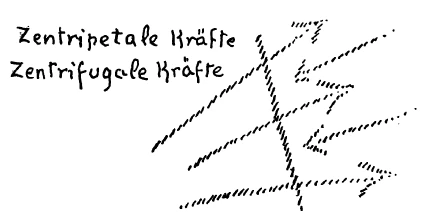
[ 2 ] One looks out into the universe and, in a certain sense, sees human beings as mediators between the worlds of the gods. One hopes that such an awareness will permeate human souls; for it is only through this awareness that the egoistic elements of the old religions can be overcome. These elements of the old religions are, after all, largely based on selfishness. When people are preached to from within the existing denominations, it is done to appeal to their selfish instincts regarding immortality and the like. Speaking from within the traditional denominations, one addresses these selfish instincts. One need only have a sense of how these selfish instincts are exploited. Spiritual science will present humanity in such a way that people gain an awareness of the role they play in the entire cosmos, and how, through them, a world of centripetal forces and a world of centrifugal forces are interconnected—forces that, in essence, meet only within the human being itself (see diagram).
[ 3 ] If what I have just said does not remain a dry theory, but instead permeates the entire world of human feelings and sensations, then a person feels themselves to be at the very heart of the universe and says to themselves: I am here for the sake of the universe’s evolution; the current of cosmic events flows through me. This feeling of being firmly rooted in the universe is precisely what must permeate our consciousness of the present and the immediate future. Just think for a moment how this feeling is contrasted with another feeling that has been brought to the surface of human development by the culture of the last three to four centuries. Have these last three to four centuries, of their own accord, fostered anything of such a human consciousness? No, for there has been no scientific reflection whatsoever on what the human being is and means within the universe. The focus was placed on the animal kingdom. People learned to recognize how one animal form develops from another, and then they said: Well, the human being is the highest of the animal forms. They pieced the human being, as it were, together as the highest animal from the lower animals. They came to know the human being in terms of his animal nature. There was no discussion at all of the essence of the human being. This is the transformation that must now take place in the soul life of humanity: that the human being once again becomes aware of how he forms a point of passage for divine forces, how he is, so to speak, the place where hierarchies meet so that they can work together in the universe. And human beings must know: If they think lowly of themselves, act in a lowly manner, and suppress their sense of humanity, then they will not be mediators between the higher and lower worlds. Human beings must learn to feel themselves as beings who belong to the cosmos. Divine beings who serve the centrifugal driving forces and divine beings who serve the centripetal forces meet within the human being.
[ 4 ] And where do they find their balance? The centripetal forces act primarily through the human head, while the centrifugal forces act primarily through the human limbs. The balanced human being, the rhythmic human being, is the being who is meant to bring about balance, harmony, and unity between the centripetal and centrifugal forces of the world. Consider what this means. It means that when a person develops a certain state of mind within themselves, when a person develops a certain inner disposition—which, as we have seen in various contexts, can naturally come to them only through spiritual science—then they imbue their entire inner experience with a certain character, and this inner experience unfolds in a certain way. And this extends into the organic realm, right down to the rhythms of the heart and breathing. In other words: the way a person breathes, the way a person’s heart beats—this has significance not only within the human being, but also within the entire cosmos. And when the human heartbeat is perceived, this signifies the interplay of various divine or spiritual worlds. The ancient truth that the human being is a temple for the divine is once again emerging from the newer insights of initiatory science.
[ 5 ] And so what emerges from these insights of the science of initiation will necessarily have a different character than what the old traditional denominations can offer people. The latter rely on human selfishness. What does that which can emerge as a worldview through spiritual science rely on? It relies on human responsibility toward the world. It appeals primarily to a sense of responsibility. It elevates the human being by showing him how he stands as an essential link within the entire universe.
[ 6 ] This attainment of a certain sense of humanity—that is what is so urgently needed. For what is the reason that people today have fallen into this chaos, in which our social order throughout the entire civilized world has, in part, already collapsed and, in part, is threatening to collapse? What is the reason for this? It is because human beings have forgotten their place within the cosmos, because they want nothing to do with their place within the cosmos. Whoever feels this way within the cosmos will understand that the development of the world must not be described solely on the basis of what lies outside of human beings, but that the forces that gave our Earth its origin, that will bring about its end, and that will transform it into other metamorphoses of the world’s structure lie primarily within human beings themselves. It is within human beings that we must primarily seek what we should know, what we should feel, and from which we should shape our will.
[ 7 ] What are these forces that act primarily in the human head and are, after all, related to the centripetal, compressing forces of the cosmos? What are these forces? They are the oldest forces in our universe. Do you recall my descriptions in *An Outline of Esoteric Science*, where I described the ancient Saturn evolution, and how I had to point out that human sensory life emerged from this Saturn evolution? What remains from this Saturn evolution lies behind the tapestry of our senses as the cold, shivering world that has developed out of the state of warmth of the beginning—a world into which we must now bring warmth. What lies behind the tapestry of our senses is, in a sense, the oldest of the worlds. We enter it unconsciously during the time between falling asleep and waking up. But in reality, we are constantly moving about within it. It provides us with everything connected to our senses. The centripetal forces act—as it were, forming the senses from the outside—into our senses, into our eyes, into our ears, and from there into our physical intellect, into what we think. And as we walk through the world thinking, we are actually walking through the world with that human possession which is formed for us from this environment—that is, with the oldest forces that have now already reached the point of decay. We must never forget that these are the forces that have, in fact, already reached the point of decay.
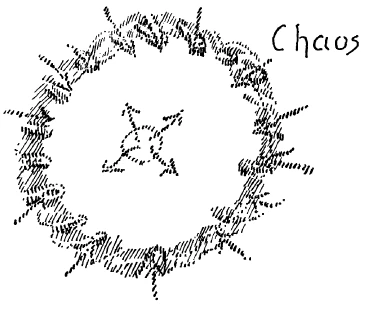
[ 8 ] One might say that the situation is as follows: If one depicts the universe schematically—spreading apart, striving into the vastness, yet held together centripetally at this boundary—these are the oldest forces of the universe (see drawing). They are crumbling in a certain way. And from these crumbling forces, from these forces already passing into death, from these forces that have become chaos, arises that which is our mind, that which is our human intellect.
[ 9 ] It was the destiny of modern humanity that, over the last three to four centuries, this intellect had to be developed in a special way. But this intellect, in a sense, rises out of the dying chaos that remains from the old Saturn evolution. Up to the present time, people have sought to bring about reform—even in social life—by drawing on these forces. But these are precisely the forces that function normally only when they are destructive. We could not think if we did not have these forces. We could not develop our intellect if we did not have these forces. We destroy the social order when we try to enforce it with what follows from our intellect.
[ 10 ] Everything that requires thought to be active depends on appealing to this intellect—the intellect that rises from chaos. But we must not use what rises from chaos for social reforms. In Eastern Europe, the situation is such that the outermost extensions of European intellectualism are now manifesting themselves in the form of social reform. What has arisen there in Eastern Europe is spreading across Asia, across Europe, and over to the West—unless a counterforce—not another intellectualist one, but, as we shall soon see, a different kind of counterforce—is brought into play soon enough. We need these forces for our spiritual life, for our free spiritual life. We need them because that which is to be borne by the human intellect can arise only from chaos. But these forces are of no use if they unite with the forces that act upon society. That intelligence which is useful and fruitful in the more intimate spiritual life is harmful in this context. That which gives rise to inventions, that which shapes inspired works of poetry, must arise from chaos, from the mature materiality of the human organism; it must never believe that there can be social impulses with regard to external life. It is important that humanity now begin to see clearly into these matters. It will not see clearly into them if it continues to refuse to take spiritual science into account. But everything that makes the true spiritual life great must rise from this chaos. This spiritual life must rise from the chaotic depths of the human individual.
[ 11 ] The question of education is thus intertwined with the general question of culture. For whatever is to be brought to humanity in this way must, after all, arise from the chaos that the human being brings with him when he descends from higher worlds through birth. He brings with him a disintegrating brain organism. And from this chaotic brain organism arises that which can constitute spiritual life. At the opposite end of the human organization, the forces that can underlie social ideas must develop.
[ 12 ] Here, however, I am touching on something that is still completely incomprehensible to present-day humanity with its terrible prejudices. Present-day humanity believes that it thinks solely with its head. That is nonsense. We do not think, feel, and will merely with our heads, but with our whole being. Arms and legs are just as much organs of the soul as the head. One of the worst prejudices is that the life of the soul has been organically assigned one-sidedly to the nervous system. Only intellectual life is assigned to the nervous system. Thus, it is precisely from the centrifugal forces—from the fresh organic forces that do not represent chaos but rather live within the organization of the human limbs and all that pertains to them—that what can generate social impulses must develop, preferably social impulses of external life, especially those of the third member of the social organism: economic life. Here, human beings are dealing with the most recent formations. In the organization of the head, which underlies the spiritual organization, we are dealing with the oldest formations. Here, in all that underlies the economic organization, we are dealing with the most recent formations—those formations that are the bearers of the human will, which in people today, in the normal state of consciousness, lie entirely in the unconscious, but which must be brought up from the unconscious through initiatory science, through the science of the mysteries. And how can they be brought up? I need not describe to you how true free spiritual life is to come about. Free spiritual life begins with the education of the child, drawing out of the child’s individuality that which is sent down by the gods from the spiritual worlds when children enter physical existence through birth. There we work out of the chaos, out of the dark, misty depths, to bring human genius and human predispositions from the spirit through the chaos of matter into physical existence.
[ 13 ] The situation is different when we must appeal to that part of the human being which is the youngest link in his organization—a part that is completely unconscious in normal consciousness, and from which the science of initiation must draw everything up from these unconscious depths. How does this happen? Well, social thinking is different from thinking that arises from the spiritual realm. In the spiritual realm, everything is based on the development of individuality. In social thinking, it is the case that one can, for example, calculate statistically how many people—say, out of a thousand twenty-year-olds—will reach the age of sixty. One can easily obtain figures for this by taking a sample of thousands of twenty-year-olds from a certain region; of these thousands of twenty-year-olds, after ten years there will be a certain number of thirty-year-olds, after another ten years a certain number of forty-year-olds, after yet another ten years a certain number of fifty-year-olds, and then a certain number of sixty-year-olds. A certain method of calculation—probability theory—is based on what can be deduced in this way from the numerical trends in the development of human groups. And social institutions can rely on these calculations. Insurance companies, after all, are based on these calculations. If, as a twenty-year-old, I take out life insurance, I have to pay a premium based on the figure that results from calculating how many out of a thousand twenty-year-olds, for example, will still be sixty years old—that is, how much will need to be paid out in their sixtieth year. And by approaching the matter from a social perspective—by considering it in terms of groups—the system works; otherwise, all insurance companies would have to go out of business. They are based on such groupings of facts in human development. Does this calculation have any value for the individual? And from this calculation, can a twenty-year-old determine how long their probable life expectancy is? No one will say to themselves: “So I’ll only live this long”—that probable life expectancy, on the basis of which one insures one’s life, is different from the one one calculates as a single human being, as an individual. This lies in entirely different realms of thought and judgment. One must think about human beings in a completely different way when one wants to insure them—that is, when one wants to establish a social institution—than when one, as a human being, as an individual, thinks about one’s own life,
[ 14 ] And if one wants to address social institutions at all—namely those of an economic nature—what must one do? One must compile statistics in the very manner of these insurance statistics; one must compile the data that emerges. From this, one never gains the wisdom that arises from within the human being, from chaos, but rather one obtains something that can be expressed in numerical terms. Just look around at everything people have come to do, especially those in Western science. You’ll find statistics everywhere, and from these statistics, conclusions are drawn about how much duty to pay on this or that item, how much of this or that is needed, and so on. This is a calculation very similar to that used in insurance. When one looks at one aspect—that which is creative in spiritual life—one arrives at a completely different judgment than when one looks at that which is socially established within human groups. But what takes shape socially within human groups—what can be calculated in this way—is precisely connected to these centrifugal forces; it is connected to the most recent organizational forces within human beings, which have not yet reached the level of consciousness, and whose content must therefore be inferred from statistics.
[ 15 ] Those people who possess a very special kind of enthusiasm—a cynical enthusiasm, such as Nietzsche had—for everything that springs from the innermost depths of the human being, from the chaos within, and works its way out of that chaos, find that, in fact, only that which emerges from this innermost chaos has any value, and they despise everything that is group-oriented. Nietzsche deeply despised everything in the world that was group-oriented. That is why, especially in his early period, Nietzsche viewed the entire development of humanity in such a way that, for him and his worldview, only a select few individuals had any value. Nietzsche viewed world history as nothing more than the path by which the others—the insignificant ones—form a detour leading to the few outstanding individuals. This was the foundation of Nietzsche’s initial worldview. He wanted to focus his attention solely on the few geniuses that human development has produced. As for the rest, Nietzsche said, let the devil or statistics take it. To him, that was more or less the same thing. But today, these statistics are—and must be—the foundation for everything related to economic organization and economic decision-making, which have to do with the centrifugal forces, with the most recent forces shaping human society.
[ 16 ] But nothing truly beneficial can actually come from these statistics. Trotsky and Lenin derived their most fundamental truths from such statistics, and statistics play a major role in the purely economic thinking of the West. But all these statistics actually have no direct value. I would like to point out to you that no matter how ingeniously you try to compile statistics, you will hardly gain much insight from them, and it must be said that what has been done with statistics—even as a social science—is a rather terrible thing. Not much comes of it, and not much has come of it. Basically, some people group the numbers one way, others group them another way, and that leads to a wide variety of recommendations in the social sciences.
[ 17 ] Where does this come from? It stems from the fact that the forces to which this refers—the centrifugal forces—are, in fact, the most recent forces in human beings, those forces that have not yet risen to any level of consciousness at all. Humanity is still wandering about like a child in this realm. So we would have to say: If one were to base social science and social impulses on what currently exists in humanity’s normal consciousness, nothing at all would come of it. Until we admit to ourselves that contemporary science and consciousness are powerless when it comes to forming a social judgment—as this science and this ordinary consciousness currently stand—until we admit that to ourselves, there can be no clear insight into what is necessary. — For what is necessary? To know that the individual cannot do anything with numbers at all, that only associations with numbers can achieve anything—groups of people who make use of these experiences, complementing one another. But such associations will nevertheless accomplish nothing of significance if they lack guiding forces, and what must these guiding forces be? Those that arise from imaginative cognition, those that emerge from the science of initiation. People must come forward who are, in a certain sense, initiated, and they must steer the experiences of these associations—particularly in economic life—onto the right course.
[ 18 ] Where will the guiding forces of the humanities be needed first if we are to properly understand the needs of humanity in the present and in the near future? They will be needed precisely in the realm of economic life. There, associations must be formed; there, the experiences that these associations compile in their statistics must derive their guiding forces from those effects that can be gained solely and exclusively from inner experience in the higher worlds. Spiritual life—which is the life of geniuses—must be extracted from the chaos of natural organization in education. The guiding forces underlying economic life must be drawn from the science of initiation, and these guiding forces of initiation must organize what is gathered by the individual associations from this or that professional circle, from this or that industrial or agricultural circle, and so on. Economic life, in particular, makes the influence of spiritual life most necessary, and it is precisely in economic life that one will not make any progress without it; for in economic life, everything will remain instinctive unless it is brought to consciousness through developing in the way I have described. Therefore, one must say: First, bring a broom and sweep out of economic life everything that negates the spirit! The salvation of future humanity depends on this. Everything that does not will the spirit must be removed from economic life—precisely from economic life! That is where it is most necessary; otherwise, economic chaos will ensue, and with it, the collapse of civilization as a whole. And this, I would say, is evident enough.
[ 19 ] It is strange to consider how people thought during this catastrophic moment in world history. People had seen the global catastrophe looming since 1914. What did they think? They thought: Well, if only peace comes next year, then we’ll be all right again. — And when peace did not come: “Well, if only it comes next year!” —and so on. Then peace did come, but it was only the starting point for even greater conflicts. Now people continue to sleep. They do not see how, month by month, the forces of decline are accumulating and growing stronger. They do not want to see it. Why don’t they want to see it? Because they don’t want the Spirit, because they don’t want the very thing that alone can truly help the world. It’s no use believing today that one can make compromises with this or that element that stands out from the old. That won’t work. The world needs to be rebuilt; the world needs new forces to spring from new sources. What must be established as the science of initiation—and from which the impulses I have described are to arise—is precisely what seeks to enter the world anew, and what must be embraced; for, above all, that which is to lead to an ascent must have this, without which it is bound to decay and cannot move forward. The point is that a strong awareness of these things must take root, particularly in those people who, in a sense, bear the greatest responsibility in the coming period—I have spoken of these facts here before—namely, the Anglo-American population. The populations of Central and Eastern Europe are lying prostrate. The Anglo-American population, by virtue of standing as the one whose power is expanding, whose influence is spreading above all else, bears the absolute responsibility to turn toward the spiritual life.
[ 20 ] And one might say that this is why it was of such great importance that the representative of our spiritual movement stood on neutral ground during those catastrophic years. Here in Dornach there was neutral ground where people from all nations who wished to come could gather, and where no obstacle was placed in anyone’s path that stemmed from the very foundations of spiritual science itself. I would say that what now stands here has been brought forth from Central Europe. It is truly not the worst forces of this Central Europe that have brought about—even in material terms—what now stands here, and what stands there in such a way that it asks: Does the world show it understanding? — Central Europe cannot be asked in this way: “Does the world offer it understanding?” — for it lies at the very foundation, and this runs counter to its spiritual and economic devaluation. That it possessed values within itself may be evident from the fact that it was able to erect this building here. Now it stands as a question: Will the world offer it understanding? And it is already a question for the world, a question directed out into the world: Will this structure one day remain unfinished—as it may indeed seem more likely today—will it one day remain unfinished, will it be built only to the extent that Central Europe has built it and to the extent that neutral territories have added to it? Or will the Anglo-American world show understanding toward this question concerning the future of humanity? One should regard this question as deeply significant. For either one will say “yes” to the Spirit—in which case one will also find the means and ways to complete what would otherwise have to remain unfinished—or one will say “no” to the Spirit, in which case an unfinished structure will stand here as a sign that one did not wish to understand the forces of ascent. But then, too, one will have effectively answered “no” to the question of whether one is serious about the progress of humanity.