

Spiritual Scientific Insight into the
Fundamental Impulses of Social Organization
GA 199
3 September 1920, Dornach
Translated by Steiner Online Library
Twelfth Lecture
[ 1 ] In the humanities, the aim is to gradually come to know what is to be understood from a wide variety of perspectives. One might say that the world expects precisely from the humanities an easily accessible path to conviction. However, this cannot be achieved so easily. For when it comes to the facts of spiritual science, the point is that conviction is actually acquired in a process of development. It begins at a certain stage that is still weak, and one then comes to know the same things from ever-new perspectives, and through this, this conviction grows stronger and stronger. That is the first point I would like to take as my starting point today. The other point builds upon various topics I have brought up for discussion here over the past few weeks, building upon what has been said about the differentiation of humanity across the civilized world. Let me briefly touch on some of the more essential facts that are of some importance for our reflections over these three days.
[ 2 ] I have pointed out in what sense the Orient is the source of humanity’s true spiritual life. I then pointed out that in central regions—Greece, Central Europe, and the Roman Empire—which, it must be said, spans vast periods of time—the predisposition exists above all to develop legal and political concepts, and that the West is particularly inclined to contribute economic concepts to the overall civilization of humanity. When we look toward the East—as has already been mentioned—we find that its civilizational life today is essentially in a state of decadence, and in order to truly understand what the East actually represents for the overall civilization of humanity, we must go back to earlier periods. Among the historically accessible documents that bear witness to what the East is, the Vedas and the Vedanta philosophy from the East shine out most clearly to us, along with many other things that in turn bear witness to what existed in the East in even earlier times. And these things point to how a spiritual life was born from an original, entirely spiritual disposition of the people of the Orient. Then came for the Orient the times of the obscuring of this spiritual life. But anyone who knows how to view what is happening in the East today—even if it is now only a caricature of the old—in the right way will still see, even in these decadent things, the aftereffects of the old spiritual life.
[ 3 ] Somewhat later, what we might call true legal or political thought developed across the central regions of the world—in ancient Greece, in ancient Rome, and later in those areas that spread throughout Europe beginning in the Middle Ages. The Orient originally had no true state-oriented thinking; above all, it lacked what we call legal thinking. This is not contradicted by the fact that there are codices such as those of Hammurabi and the like. For anyone who examines the content of these law codes will recognize from their overall tone and attitude that they represent something different from the way of thinking we in the West describe as “legal.” And in the West, it is only in recent times that a true economic way of thinking has developed. Even science, as it is practiced there, takes on—as I have already explained—forms that actually belong to economic life.
[ 4 ] As far as Eastern spiritual life is concerned, it is indeed interesting to observe how everything the West has possessed up to now is, in essence, also a legacy of Eastern spiritual life—albeit in transformed forms. I have previously drawn attention here to the extent to which Eastern spiritual life has been transformed within Europe. The fact remains that those faculties which prevailed in the East gave rise to a conception of the immortal human soul—but in such a way that this immortality was essentially linked to a state of non-birth. The pre-existent life—the life of the soul prior to this earthly existence, between birth and death—was, above all, what lay before the soul, before the concept of the soul, in the Eastern mind. The other aspect arose, so to speak, as a consequence. And from this arose those great interconnections that Westerners, even to this day, can only intuit—what might be called karmic interconnections—which then left a faint reflection in the Greek concept of fate, but only a faint one. And what, in fact, has actually been passed on to the West—even of those concepts through which one has sought to understand the Mystery of Golgotha—what has been passed on into this Western tradition? Something that is very strongly colored by legalistic thinking. It is something radically different when, on the one hand, one considers the path of the soul in the sense of the Eastern worldview—how it descends from the spiritual world into the physical world and ascends again into the spiritual world—and how one there grasps the connections of destiny from a broad perspective, and the legal judgment of the soul—the very concept through which these Eastern ideas have permeated the West. One need only recall Michelangelo’s magnificent fresco in the Vatican, in the Sistine Chapel, and recall how the Judge of the World, like a universal jurist, passes judgment on the good and the evil. This is an Eastern worldview translated into Western legal thought; it is by no means an original Eastern worldview. This legal thinking lies entirely outside the Eastern perspective. And the more advanced the view of the spiritual realm is—particularly in Central Europe—the more the spiritual has flowed into Roman law.
[ 5 ] Thus, in temperate regions, we are primarily dealing with what is predisposed toward the legal and political. However, civilization is not merely differentiated across the globe in this way, but also in another way. When one considers the achievements of the Orient, when one takes into account the particular nuance of the spiritual life of the Orient—precisely where this spiritual life is at its greatest—one finds that this Oriental spiritual life, despite producing primarily the spiritual—from which, as I said, all of humanity has drawn sustenance—is, in the most eminent sense, instinctive, atavistically instinctive. It springs from subconscious imaginings, which are, admittedly, already overshadowed by a certain ray of consciousness. But there is much that is unconscious, much that is instinctive within it.
[ 6 ] Thus, what humanity has produced so far in terms of spiritual life has, in fact, been produced in such a way that it points upward toward the highest realms of which the human soul can partake; but these realms were reached in a kind of instinctive soaring. It is not enough to trace, through concepts or images, what the East has developed; rather, one must take into account the particular nature of the spiritual and soul life through which the Easterners arrived at these ideas, especially during their heyday. One can, however, only gain a sense of this particular nature of the soul—which I have already characterized here by linking it to metabolic life—if one can feel the entire original spiritual current of works such as the Vedas and the like. One must certainly not lose sight of the fact that the East has now reached a state of decadence, and one should, for example, in no way confuse that mystical, nebulous quality—which, despite his greatness, characterizes Rabindranath Tagore—with what is truly the essence of Eastern spiritual life; for Rabindranath Tagore certainly possesses what has been passed down from the ancient Eastern spiritual life to the present day, but he interweaves it with all manner of modern Western European affectations and is, above all, a coquettish spirit.
[ 7 ] These things must truly be grasped by spiritual science, step by step, in such a way that one does not merely take preconceived concepts, but actually takes into account the particular nuance of the soul that comes into play here. In other words, an instinctive spiritual life in the East, interwoven through and through with the perception of what develops as a legal-political spiritual life in the central regions. This leads us to the development of the semi-instinctive—half-conscious, half-instinctive. It is highly interesting how, let us say, a purely legal mode of thinking emerges from the souls of Fichte, Goethe, Schelling, and Hegel. It is purely legal, yet it is half instinctive and half intensely conscious. This is precisely what is so fascinating about Hegel, for example—this half-instinctive and half-fully conscious quality. And something entirely conscious first emerges in the West, in the Western soul, where consciousness develops out of the instincts themselves—it is still instinctive in the Western soul, but the conscious emerges instinctively—in Western economic thought. Thus, for the first time, humanity is called upon to use consciousness to gain insight into public and social affairs as well.
[ 8 ] And this is where something highly peculiar comes to light. One might even recommend that people for whom this is in any way important should now try to understand the entire framework of civilized humanity’s thinking, and familiarize themselves with the attempts by English thinkers—such as Spencer, Bentham, and especially Huxley, and so on—to arrive at a social way of thinking. These thinkers are all rooted in the same intellectual atmosphere as Darwin, and they all actually think the way Darwin did; it’s just that they—Huxley, for example—strive to develop a social way of thinking out of their scientific thinking. One does, in fact, have a strange feeling when one delves so deeply, say, into Huxley’s attempts to arrive at a social way of thinking—say, about the state or the legal coexistence of human beings. One has a peculiar feeling. Let us suppose the following: Someone wanted to get a sense of what I mean here, and for that purpose, let’s say, they were to pick up something like Hegel’s book on natural law or political science, or Fichte’s philosophy of law, or something else—even by the less significant minds of Central Europe—and then read, for example, Huxley’s attempts to move from scientific thinking toward political thinking. They would experience something like the following. One would say to oneself: Yes, now I’m reading Fichte, now Hegel—all of this consists of well-developed concepts, concepts that are truly sharply defined and vividly articulated. And now I’m reading Huxley or Spencer: that’s primitive; it’s as if one were just beginning to think about these things. — When faced with such things, one cannot simply get by saying that one was perfect and the other imperfect. One cannot get by with such things at all when confronted with realities.
[ 9 ] I’d like to draw a parallel for you from a completely different field. It can happen that one gives a lecture on something from the field of spiritual science—let’s say, on the Earth’s previous incarnation, or on the lunar incarnation. One mentions all sorts of things. Someone who is clairvoyant in a completely atavistic way reads this or listens to it. This might be a person who appears illogical on the surface, who in ordinary practical life cannot string together five words in a logical way, who is clumsy in every respect, so that one cannot use them for this or that—or for anything else, for that matter—in ordinary life. Now such a person hears what is being said about the configuration of a particular lunar phase, and this person—who in outward life is foolish and clumsy, to the point of barely being able to count to five properly, but who is atavistically clairvoyant—can now take in what they have heard, expand upon it, develop further insights, and . But the things this person then adds may be permeated by an extraordinarily astute logic—a logic that is admirable—even though in their outward life they are clumsy and illogical, unable to string five words together logically. That is certainly possible; for when someone is atavistically clairvoyant, their images—and they can find these images themselves—are not logically pieced together by their ego, but rather by all manner of spiritual beings residing within them. It is their logic that one then comes to know, not one’s own logic.
[ 10 ] One cannot simply say that one is superior and the other inferior; rather, one must take into account the specific nature of the matter in each case. And so it is here as well. The legal or other views of Fichte, Hegel, or lesser minds are only half instinctive, only half fully conscious. But what appears in the West as primitive economic thinking is, in fact, entirely conscious; things like those conceived—albeit in a primitive way—by Huxley, Spencer, or the like are impertinently conscious; yet they are, after all, primitive. What used to emerge instinctively or semi-instinctively now comes to light in a conscious manner, though quite charmingly so in the beginning. Let me illustrate this with a concrete example.
[ 11 ] Huxley says to himself: Consider nature—he views it, of course, in the Darwinian sense—and there is a struggle for existence. Every creature fights ruthlessly for its own survival, and the whole of nature fights in such a way that the strongest survive by exterminating the weaker ones. — This has become second nature to Huxley. But surely this cannot be carried over into human society. Freedom, as one should seek it in human social life, does not exist in nature, for there can be no freedom, Huxley argues, in a realm where every creature must either ruthlessly assert itself or die. Equality cannot exist where the fittest must always eliminate the others. Now Huxley turns his gaze away from this natural realm to the social realm, and now he is compelled to say: Yes, but in the social realm, goodness must prevail, freedom must prevail; therefore, something must come into play that cannot yet be found in nature.
[ 12 ] It is, once again, the great divide that I have already characterized from a wide variety of perspectives. Huxley once beautifully refers to human beings as “the splendid rebel”—the brilliant rebel who, precisely in order to establish a human realm, rebels against everything that reigns in nature. So something emerges here that does not yet exist in nature. But here Huxley is, in fact, thinking in scientific terms once again. He is compelled to find natural forces within human beings that constitute social life—forces that rebel against nature itself. He wants to find something concrete within human beings that forms the basis of human social community; for the other natural forces of the natural realms cannot establish this social community, since there is a struggle for existence there, and none of the elements that might hold people together in a social context. And yet, for Huxley, there is, after all, nothing other than this natural context. So this “splendid rebel” must himself possess natural forces that, as forces of nature, actually rebel against the general forces of nature. And here Huxley finds two natural forces that are at the same time the fundamental forces of social life. One of these natural forces is, in fact, established in a perverse way, for it cannot yet truly establish social life, but only family egoism. It is what Huxley calls “family attraction”—that is, what operates within blood kinship. The other, however, which he cites and which could now form a kind of foundation—a natural foundation for social life—is what he calls the “human instinct for mimicry,” the human capacity for imitation.
[ 13 ] Now we have something that occurs in human beings in the sense that Huxley describes: the power of imitation. That is to say, one person imitates another, and therefore not everyone simply goes their own way; rather, society as a whole—social life, so to speak—follows similar paths because people imitate one another. This is as far as Huxley goes. It is interesting, because, as you know, we have identified that, as we trace human development, the element of imitation is present from the first to the seventh year, the element of authority from the seventh to the fourteenth year, and the element of independent judgment from the fourteenth to the twenty-first year. Naturally, all of these play a role in shaping social life. But Huxley stops at the first stage; he is only just working his way out of the primitive. He has nothing other than what actually operates in human beings only up to the age of seven. In essence, this amounts to nothing less than this: if the social community, as Huxley conceives it, were to truly exist, it would have to consist entirely of children, and people would have to remain children forever. So Western society has actually only managed to conceive of social life to the extent that it applies to children. It has not yet gone further—this social science that is consciously pursued. That is extraordinarily interesting.
[ 14 ] Here you can see the primitive aspect in a particular element. This Western thinker works from a scientific and economic perspective and consciously attains something that, in the middle section, has been attained in a semi-conscious or semi-instinctive manner at a higher level. One can follow these things in great detail, and they become interesting when one does so. All the things that spiritual science brings to light can always be traced through the details. It would only require a sufficiently large number of people to develop the necessary diligence to truly follow the details of spiritual science.
[ 15 ] I would like to say: Doesn’t this make it obvious—as if we’d stumbled right into it—that there must be something else at work here that contributes to the social shaping of existence? — After all, one cannot now found societies in which only those forces prevail that are forces of imitation; in such societies, one could really only have children, and people would have to remain children forever if the social order were to arise solely through one person constantly imitating another. In order to truly arrive at something that in turn sheds light on what is being attempted in a primitive way here—and that can bring together the East, the Center, and the West—one must start from the science of initiation. This means that we must now connect the train of thought we have just attempted to link to the present discussion with what the science of initiation has to offer humanity, so that humanity may develop a social life truly shaped by the spirit.
[ 16 ] People don’t really notice how the human environment is permeated by very precisely differentiated forces. Isn’t it true that today’s scientific mindset leads us to say: “Air is all around us, because we breathe it in and breathe it out.” — But what is actually, at the very core, almost even clearer than the fact that “air is all around us” in relation to our lives—that is what people fail to notice. Take the following very simple example—something no one says today, but which everyone could actually say. All around us humans, the animal kingdom spreads out. This animal kingdom comprises beings in the most diverse forms. Let us visualize in our minds the entire diverse animal kingdom spreading out around us. Yes, when there is a table standing there, everyone assumes that there are forces at work that have given this table its form. If the animal kingdom spreads out all around us, then naturally everyone must also assume that there are forces in the environment—just as the air is there—that give the creatures of the animal kingdom their forms. We all live in the same realm. The dog, the horse, the ox, the donkey—they do not, after all, move about in a world other than the one in which we, too, move about. And the forces that give the donkey its donkey-like form also act upon us humans; indeed, they do act upon us humans, and yet—forgive me for putting it so bluntly—we do not take on the form of a donkey. There are elephants in our surroundings as well, and we do not take on the form of an elephant. But all the forces that shape these forms are all around us. Why, then, do we not take on the form of a donkey or an elephant? Because we have other forces that counteract this. We would indeed take on the form of a donkey or an elephant if we did not have other forces to counteract it. For it is indeed true: when we, as human beings, stand before a donkey, our etheric body constantly tends to become a donkey as well. It constantly strives to take on the form of a donkey. And it is only because we have a physical body with its fixed form that we prevent our etheric body from taking on the form of a donkey. And again, when we stand before an elephant, our etheric body wants to take on the form of an elephant, and it is only because our physical body has its fixed form that the etheric body is prevented from becoming an elephant—and it wants to become a stag beetle or a dung beetle, and everything else as well. All these forms are latent within our etheric bodies, and we can understand them only by, so to speak, tracing them inwardly. And our physical body merely prevents us from becoming all of these things. So we can say: We actually carry the entire animal kingdom within us in our etheric body. We are human only in our physical body. We carry the entire animal kingdom within us in our etheric body.
[ 17 ] And once again, we are surrounded by the same field of force that shapes plant forms. Just as our etheric body is predisposed to take on all animal forms, so is our astral body predisposed to replicate all plant forms. Here it becomes easier to draw comparisons, for the etheric body is animated by the tendency, when it sees a donkey, to become a donkey itself; the astral body merely wants to become the thistle that the donkey eats. But this astral body is thoroughly imbued with the tendency to submit itself to those forces that find their outward expression in plant forms. So we can say that the astral body reacts to the complex of forces that constitutes the plant world.
[ 18 ] The mineral kingdom: here, too, there is a complex of forces that forms the various forms of the mineral kingdom. This acts within our “I.” In the “I,” you can see it quite clearly, for you are thinking only of the mineral kingdom. It is said ad nauseam that one can comprehend only the inanimate with the intellect. So what is within the “I” understands the inanimate, so that our “I” lives within this complex of forces that forms the mineral kingdom. The physical body, as such, does not actually live in any of the kingdoms; it has a kingdom of its own, as you well know. In my *Outline of Esoteric Science*, the mineral, plant, and animal kingdoms are listed separately, and this means that the physical human body has a kingdom of its own. But the animal kingdom is actually assigned to the etheric body; from this point of view, the plant kingdom is assigned to the astral body, and the mineral kingdom to the “I.” However, you know something else from my various books. You know that work is done on these various bodies throughout life. I have, after all, explained how work is done on the “I,” on the astral body, on the etheric body—and even on the physical body. I explained this there initially, I would say, from a humanistic perspective. Let us now examine it from a different point of view.
[ 19 ] Consider, for a moment, the mineral concepts that human beings take in. After all, they experience the external world in such a way that they perceive it in mineral concepts and forms. Only more enlightened minds, such as Goethe, work their way up to the forms of images, to the morphology of plants, to metamorphosis. There, the forms transform. But the ordinary view, which still prevails today, lives only in the fixed mineral forms. But when the “I” elaborates these forms, when it works its way up through them, what happens then? Yes, then spiritual life—conscious spiritual life—becomes one sphere of the threefold social organism. Spiritual life is what the “I” forms by working on itself internally. All spiritual life is, after all, the inner, formative work of the “I.” What the “I” draws from the mineral kingdom and in turn transforms into art, religion, science, and so on—that is the spiritual world; that is the transformed mineral kingdom, the spiritual realm.
[ 20 ] What results from the fact that the astral body—which, after all, lies in the depths of the subconscious in most people—actually always has a tendency to take on all kinds of plant forms? If you transform what lives within the astral body—if it radiates up into consciousness in a semi-instinctive, semi-conscious form—what emerges? What emerges is the legal or territorial domain.
[ 21 ] And when you grasp what is now reversed within outer life—that which the human being experiences in the etheric body as part of the animal realm—when you grasp what exists there from human to human, then you arrive at the third sphere of the threefold social organism. If we were to stop at the etheric body as it is given to us from birth, we would have only the tendency within that etheric body to be now a donkey, now an ox, now a cow, now a butterfly—this or that—and we would be reenacting the entire animal world. Now, we do not merely imitate the animal world; rather, we transform the etheric body into that of a human being. We do this in social life by living together. When we stand before a donkey, the etheric body wants to become a donkey; when we stand before a human being, we certainly cannot say—without causing deep offense—that we would also like to become a donkey. Isn’t that right? When we stand before a human being, that’s not possible—at least not in normal life; there we must become something else. I would like to say that this is where we see the transformation, and this is where the forces at work in economic life come into play. These are the forces at work when human beings face one another in brotherhood. In this kind of brotherly encounter, the forces that shape the etheric body are at work, so that through the shaping of the etheric body, the third realm—the economic realm—comes into being.
Animal Kingdom: Etheric Body—Economic Sphere
Plant Kingdom: Astral Body—Legal or State Sphere
Mineral Kingdom: I—Spiritual Sphere
[ 22 ] And just as human beings are connected to the animal kingdom through their etheric body on the one hand, so on the other hand—in their external environment—they are connected to the economic sphere of the social organism. We can say: There is the human being inwardly—that is, spiritually, viewed from within; looking first from the physical body toward the etheric body, if we were to go inward into the human being, we would find the animal kingdom. If we go outward, into the environment, we find economic life.
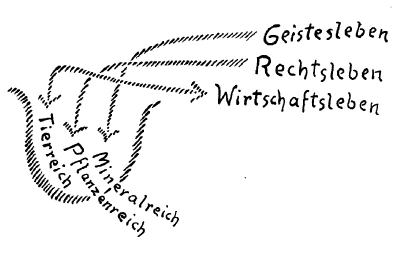
[ 23 ] When we look within the human being and explore what he is through his astral body, we find the plant kingdom. Outwardly, in social life, the plant kingdom corresponds to the legal sphere. When we look within the human being, we find the mineral kingdom corresponding to the “I.” Out in the environment, corresponding to the mineral kingdom, is spiritual life. Thus, the human being is connected in his constitution to the three kingdoms of nature. By working on his entire being, he becomes a social being.
[ 24 ] You see, it is impossible to gain an understanding of the social realm unless one is able to ascend to the etheric body, the astral body, and the I, for one cannot grasp the connection between the human being and the social realm without making this ascent. If one starts from the natural sciences alone, one remains stuck at the “human instinct for mimicry,” at the capacity for imitation; one cannot go further; one reduces the whole world in one’s thoughts to childish play, because the child still possesses the greatest natural forces within itself. If one wishes to ascend further, one needs precisely the insight provided by the science of initiation: that the human being is connected to the etheric body through the animal realm, to the astral body through the plant realm, and to the I through the mineral realm, and that through what he gains from observing the mineral realm, he attains spiritual life; that by transforming the deep instincts he carries—which are related to the plant kingdom—he attains legal and political life; that this deep instinct corresponds to legal and political life. That is why political life, at first, if it is not permeated by spiritual jurisprudence, has so much of an instinctive character. Then we have the economic sphere, which is essentially a transformation of those inner experiences that are lived in the etheric body.
[ 25 ] Now, these experiences are not brought to light from within, for example through the science of initiation, because Huxley does not, through the science of initiation, come to fathom the connection between human beings and economic life; rather, he observes the external world—he observes what exists externally in the economic sphere. The entire context—the economic sphere, the etheric body, and the animal kingdom—is unclear to him. He observes what is external. However, he cannot get any further than what is most primitive, most elementary: the power of imitation.
[ 26 ] We can see from this that if people were to continue deriving social thought from the natural sciences, they would get bogged down in absurdities, and something truly terrible would inevitably result. A social life would emerge across the entire Earth that would bring about the most primitive conditions, leading humanity back to a childish way of living together. Little by little, the lie would become self-evident, for the simple reason that people could not do otherwise, even if they wanted to. They would be thirty, forty, fifty years old—some even older—but if they were to use their consciousness to grasp only what follows from the natural sciences, they would have to behave like children. They would be able to develop only their instincts for imitation. Indeed, one often has the feeling today that only these instincts for imitation are being developed. There we see how, once again, a new radical reform movement is emerging. Yet it actually embodies nothing more than the imitative instincts of some university philistine. And so much of what appears very illustrious today—when viewed through the lens of the usual deceptive language—would look quite different in the light of the imitative worldview. But today we actually understand only as much of the world as can be seen in the light of the perspective of imitation, unless we wish to move beyond ordinary, official science toward the science of initiation—the science that draws upon the inner impulses of existence.
[ 27 ] Thus I have tried to show you how that which is lacking in the present—that which reveals where the present must come to a standstill because it cannot penetrate reality—must be enriched and illuminated by the science of initiation.